
小学英语新外研版(一起)六年级上册M3错误知识点
M3 错误知识点
7. 收集玩具汽车是我的爱好。 8. Collecting toy cars is my hobby.(动词作主语, 用ing形式;toy 不能落掉;cars 用复数) (可数名词前面要么有冠词,要么用复数; 不可以孤零零一个单数) 9. I like riding bike.\I want eat apple. 10.背课文+3/人次。
精课件
小学英语新外研版(一起) 六年级上册
市实小 清风制作
M3 错误知识点
1. It’s a picture of the sun. 它是一张太阳的 照片(翻译要准确、全面) 2. I 的大小写 3. 这台电脑来自美国。 4. This computer is from the US(注意单复数, 落掉is, the不能落掉) 5. 你有一些娃娃吗?不,我没有。 6. Have you got any dolls. No I haven’t.(any,不 能用some. any后面用复数形式)
外研版小学六年级英语易错知识点
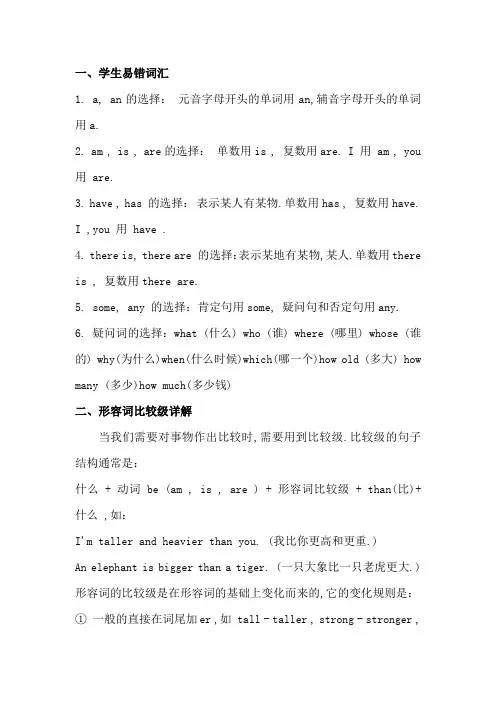
一、学生易错词汇1. a, an的选择:元音字母开头的单词用an,辅音字母开头的单词用a.2. am , is , are的选择:单数用is , 复数用are. I 用 am , you 用 are.3. have , has 的选择:表示某人有某物.单数用has , 复数用have.I ,you 用 have .4. there is, there are 的选择:表示某地有某物,某人.单数用there is , 复数用there are.5. some, any 的选择:肯定句用some, 疑问句和否定句用any.6. 疑问词的选择:what (什么) who (谁) where (哪里) whose (谁的) why(为什么)when(什么时候)which(哪一个)how old (多大) how many (多少)how much(多少钱)二、形容词比较级详解当我们需要对事物作出比较时,需要用到比较级.比较级的句子结构通常是:什么 + 动词be (am , is , are ) + 形容词比较级 + than(比)+ 什么 ,如:I'm taller and heavier than you. (我比你更高和更重.)An elephant is bigger than a tiger. (一只大象比一只老虎更大.) 形容词的比较级是在形容词的基础上变化而来的,它的变化规则是:①一般的直接在词尾加er ,如 tall - taller , strong - stronger ,②以e结尾的,直接加r ,如 fine – finer ,③以辅音字母加y结尾的,先改y为i再加er,如funny - funnier④双写最后的字母再加er,如big –bigger, thin –thinner ,hot – hotter☆注意☆比较的两者应该是互相对应的可比较的东西.典型错误:My hair is longer than you.(我的头发比你更长.)比较的两者是我的头发,你(整个人),那么比较的对象就没有可比性. 应该改为:My hair is longer than yours. 或My hair is longer than your hair.比较级专项练习:1.从方框中选出合适的单词完成句子 heavy tall long big(1) How is the Yellow River(2) How is Mr Green He's 175cm.(3) How are your feet I wear size 18.(4)How is the fish It's 2kg.2.根据句意写出所缺的单词(1) I'm 12 years old. You're 14. I'm than you.(2) A rabbit's tail is than a monkey's tail.(3) An elephant is than a pig.(4) A lake is than a sea.(5) A basketball is than a football.3.根据中文完成句子.(1) 我比我的弟弟大三岁. I'm than my brother.(2) 这棵树要比那棵树高. This tree than that one.(3) 你比他矮四厘米. You are than he.(4) 谁比你重 than you三、动词过去式详解动词的过去式的构成规则有:A,规则动词①一般直接在动词的后面加ed:如 worked , learned , cleaned , visited②以e结尾的动词直接加d:如 lived , danced , used③以辅音字母加y结尾的动词要改y为i再加ed(此类动词较少)如study – studied carry – carried worry –worried (注意play,stay不是辅音字母加y,所以不属于此类)④双写最后一个字母(此类动词较少)如 stoppedB,不规则动词(此类词并无规则,须熟记)小学阶段要记住以下动词的原形和过去式:sing – sang , eat – ate , see – saw , have – had , do – did , go - went , take - took , buy - bought , get - got , read - read ,fly - flew , am/is - was ,are - were , say - said , leave - left , swim - swam , tell - told , draw - drew , come - came , lose - lost , find - found , drink - drank , hurt - hurt , feel - felt四、动词现在分词详解动词的ing形式的构成规则:①一般的直接在后面加上ing , 如doing , going , working ,singing , eating②以e 结尾的动词,要先去e再加ing ,如having , writing③双写最后一个字母的(此类动词极少)有:running , swimming , sitting , getting五、人称和数六、句型专项归类肯定句:是指用肯定的语气来陈述的句子,如:I'm a student. She is a doctor. He works in a hospital.There are four fans in our classroom. He will eat lunch at 12:00. I watched TV yesterday evening.2,否定句:含有否定词或表示否定意义词的句子,如:I'm not a student. She is not (isn't) a doctor.He does not (doesn't) work in a hospital. There are not (aren't) four fans in our classroom.He will not (won't) eat lunch at 12:00. I did not (didn't) watch TV yesterday evening.☆注意☆小结:否定句主要是在肯定句的基础上加上了否定词 "not".有动词be的句子则"not"加在be后面,可缩写成"isn't, aren't",但am not 一般都分开写.没有动词be的句子则要先在主要动词的前面加上一个助动词(do, does, did),然后在它后面加上"not",你也能够把它们缩写在一起如"don't , doesn't , didn't ).这三个助动词要根据人称和时态来选择,其中"does"只用于一般现在时主语是第三人称单数的情况,而"did"只用于一般过去时,不论主语是什么人称和数,都用"did" .一般疑问句:是指询问事实的句子,此类句子必须用"yes",或"no"来回答.如:Are you a student Yes, I am / No, I'm not.Is she a doctor Yes, she is. / No, she isn't.Does he work in a hospital Yes, he does. / No, he doesn't. Are there four fans in our classroom Yes, there are. / No, there aren't.Are you going to buy a comic book tonight Yes, I am. / No, I am not. (Yes, we are. / No, we aren't.)Will he eat lunch at 12:00 Yes, I will. / No, I will not(won't). Are they swimming Yes, they are. / No, they aren't.Did you watch TV yesterday evening Yes, I did. / No, I didn't. ☆注意☆小结:一般疑问句是在肯定句的基础上,②动词be调到首位,其他照写,末尾标点符号变成问号即可.②没有动词be的句子则要在句首加上一个助动词(do, does, did)再把紧跟在后面的动词变回原形,末尾标点符号变成问号即可.这三个助动词也要根据人称和时态来选择,其中"does"只用于一般现在时主语是第三人称单数的情况,而"did"只用于一般过去时,不论主语是什么人称和数,都用"did" .一般疑问句有个重要的原则就是问和答要一致,即问句里的第一个单词(助动词)和简略答句里的这个词是一致的.特殊疑问句:以特殊疑问词(what , where , who , which , when , whose , why , how等)开头引导的句子.此类句子应该问什么就答什么,不能用"yes ,no"来回答.如:What is this It's a computer.What does he do He's a doctor.Where are you going I'm going to Beijing.Who played football with you yesterday afternoon Mike. Which season do you like best Summer.When do you usually get up I usually get up at 6:30. Whose skirt is this It's Amy's.Why do you like spring best Because I can plant trees.How are you I'm fine. / I'm happy.How did you go to Xinjiang I went to Xinjiang by train.☆其中how又能够和其他一些形容词连用组成特殊疑问词组用来提问,如: how many(多少(数量)), how much(多少(钱)), how tall(多高), how long(多长), how big(多大), how heavy(多重)例句:How many pencils do you have I have three pencils. How many girls can you see I can see four girls.How many desks are there in your classroom There are 51.☆小结:how many 用来提问可数名词的数量,主要有以上三种句式搭配,How many + 名词复数 + do you have 你有多少……How many + 名词复数 + can you see 你能看见多少……How many + 名词复数 + are there…有多少……七:完全,缩略形式:I'm=I am he's=he is she's=she is they're=they are you're=you are there's=there is they're=they are can't=can not don't=do not doesn't=does not isn't=is not aren't=are not let's=let us won't=will not I'll=I will wasn't=was not八、与字母相关的题型( 注:五个元音字母是 Aa Ee Ii Oo Uu )(1)将所给字母的大小写写在四线格上Hh Rr Xx Gg Mm Uu Zz Ff Qq Ii(2)写出下列字母的左邻右舍.1.( ) Hh ( )2.( ) Bb ( )3.( ) Ll ( )4.( ) Rr ( )5.( ) Qq ( )6.( ) Ww ( )(3)用小写字母抄写下列单词.1.ROOM( )2.UNDER( )3.PLEASE( )4.PICTURE( )5.WHERE( )6.TWINS( )7.EXCUSE( )8.HOW( )9.CAKE( ) 10.SMALL( )(4)将全是元音字母的那一组圈起来1. a c e2. i e o3. v u k4. e u I5. J B I6. E T V7. EI O 8. A U E(5)写出与所给单词发音相同的字母(大小写).1.bee ( )2.sea ( )3.tea ( )4.are ( )5.why ( )6.you ( )。
小学英语新外研版(一起)六年级上册M3M4基础知识梳理
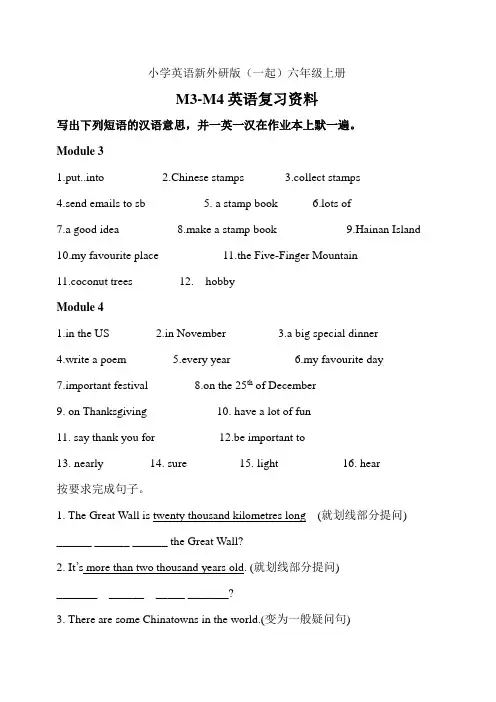
小学英语新外研版(一起)六年级上册M3-M4英语复习资料写出下列短语的汉语意思,并一英一汉在作业本上默一遍。
Module 31.put..into2.Chinese stamps3.collect stamps4.send emails to sb5. a stamp book6.lots of7.a good idea 8.make a stamp book 9.Hainan Island10.my favourite place 11.the Five-Finger Mountain11.coconut trees 12. hobbyModule 41.in the US2.in November3.a big special dinner4.write a poem5.every year6.my favourite day7.important festival 8.on the 25th of December9. on Thanksgiving 10. have a lot of fun11. say thank you for 12.be important to13. nearly 14. sure 15. light 16. hear按要求完成句子。
1. The Great Wall is twenty thousand kilometres long (就划线部分提问) ______ ______ ______ the Great Wall?2. It’s more than two thousand years old. (就划线部分提问)_______ ______ _____ _______?3. There are some Chinatowns in the world.(变为一般疑问句)_______ ______ _______ Chinatowns in the world?4. We ate in a Chinese restaurant. (变为一般疑问句)_____ you _____ in a Chinese restaurant?5. We saw a lion dance in the street. (就划线部分提问)______ ______ you ________ in the street?6. James went to a library yesterday. (就划线部分提问)_______ ______ James _____ yesterday?7. I’m putting my new books into my bag. (就划线部分提问) ______ ______ ______ ________ ?8. There are some apples on the table. (一般疑问句)_____ _______ ______ _______ on the table?9. I have got some stamps from England. (就划线部分提问) _____ _______ you _______ ?10 Have you got any kites? (做否定回答)______, ______ ______11. Can you tell me about Christmas? (做肯定回答)______, _____ _______。
小学英语新外研版(一起)六年级上册M3M4基础知识梳理

小学英语新外研版(一起)六年级上册M3-M4英语复习资料写出下列短语的汉语意思,并一英一汉在作业本上默一遍。
Module 31.put..into2.Chinese stamps3.collect stamps4.send emails to sb5. a stamp book6.lots of7.a good idea 8.make a stamp book 9.Hainan Island10.my favourite place 11.the Five-Finger Mountain11.coconut trees 12. hobbyModule 41.in the US2.in November3.a big special dinner4.write a poem5.every year6.my favourite day7.important festival 8.on the 25th of December9. on Thanksgiving 10. have a lot of fun11. say thank you for 12.be important to13. nearly 14. sure 15. light 16. hear按要求完成句子。
1. The Great Wall is twenty thousand kilometres long (就划线部分提问) ______ ______ ______ the Great Wall?2. It’s more than two thousand years old. (就划线部分提问)_______ ______ _____ _______?3. There are some Chinatowns in the world.(变为一般疑问句)_______ ______ _______ Chinatowns in the world?4. We ate in a Chinese restaurant. (变为一般疑问句)_____ you _____ in a Chinese restaurant?5. We saw a lion dance in the street. (就划线部分提问)______ ______ you ________ in the street?6. James went to a library yesterday. (就划线部分提问)_______ ______ James _____ yesterday?7. I’m putting my new books into my bag. (就划线部分提问) ______ ______ ______ ________ ?8. There are some apples on the table. (一般疑问句)_____ _______ ______ _______ on the table?9. I have got some stamps from England. (就划线部分提问) _____ _______ you _______ ?10 Have you got any kites? (做否定回答)______, ______ ______11. Can you tell me about Christmas? (做肯定回答)______, _____ _______。
外研版小学六年级英语易错知识点
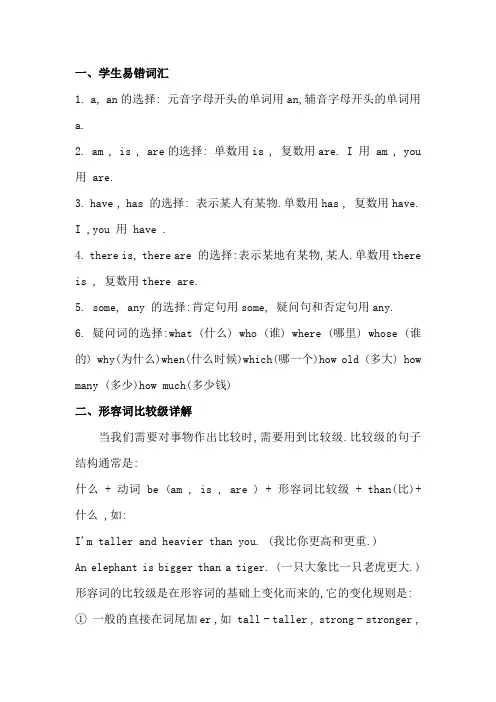
一、学生易错词汇1. a, an的选择: 元音字母开头的单词用an,辅音字母开头的单词用a.2. am , is , are的选择: 单数用is , 复数用are. I 用 am , you 用 are.3. have , has 的选择: 表示某人有某物.单数用has , 复数用have.I ,you 用 have .4. there is, there are 的选择:表示某地有某物,某人.单数用there is , 复数用there are.5. some, any 的选择:肯定句用some, 疑问句和否定句用any.6. 疑问词的选择:what (什么) who (谁) where (哪里) whose (谁的) why(为什么)when(什么时候)which(哪一个)how old (多大) how many (多少)how much(多少钱)二、形容词比较级详解当我们需要对事物作出比较时,需要用到比较级.比较级的句子结构通常是:什么 + 动词be (am , is , are ) + 形容词比较级 + than(比)+ 什么 ,如:I'm taller and heavier than you. (我比你更高和更重.)An elephant is bigger than a tiger. (一只大象比一只老虎更大.) 形容词的比较级是在形容词的基础上变化而来的,它的变化规则是: ①一般的直接在词尾加er ,如 tall - taller , strong - stronger ,②以e结尾的,直接加r ,如 fine – finer ,③以辅音字母加y结尾的,先改y为i再加er,如funny - funnier④双写最后的字母再加er,如big –bigger, thin –thinner ,hot – hotter☆注意☆比较的两者应该是互相对应的可比较的东西.典型错误:My hair is longer than you.(我的头发比你更长.)比较的两者是我的头发,你(整个人),那么比较的对象就没有可比性. 应该改为:My hair is longer than yours. 或My hair is longer than your hair.比较级专项练习:1.从方框中选出合适的单词完成句子 heavy tall long big(1) How is the Yellow River(2) How is Mr Green He's 175cm.(3) How are your feet I wear size 18.(4)How is the fish It's 2kg.2.根据句意写出所缺的单词(1) I'm 12 years old. You're 14. I'm than you.(2) A rabbit's tail is than a monkey's tail.(3) An elephant is than a pig.(4) A lake is than a sea.(5) A basketball is than a football.3.根据中文完成句子.(1) 我比我的弟弟大三岁. I'm than my brother.(2) 这棵树要比那棵树高. This tree than that one.(3) 你比他矮四厘米. You are than he.(4) 谁比你重 than you三、动词过去式详解动词的过去式的构成规则有:A,规则动词①一般直接在动词的后面加ed:如 worked , learned , cleaned , visited②以e结尾的动词直接加d:如 lived , danced , used③以辅音字母加y结尾的动词要改y为i再加ed(此类动词较少)如study – studied carry – carried worry –worried (注意play,stay不是辅音字母加y,所以不属于此类)④双写最后一个字母(此类动词较少)如 stoppedB,不规则动词(此类词并无规则,须熟记)小学阶段要记住以下动词的原形和过去式:sing – sang , eat – ate , see – saw , have – had , do – did , go - went , take - took , buy - bought , get - got , read - read ,fly - flew , am/is - was ,are - were , say - said , leave - left , swim - swam , tell - told , draw - drew , come - came , lose - lost , find - found , drink - drank , hurt - hurt , feel - felt四、动词现在分词详解动词的ing形式的构成规则:①一般的直接在后面加上ing , 如doing , going , working ,singing , eating②以e 结尾的动词,要先去e再加ing ,如having , writing③双写最后一个字母的(此类动词极少)有:running , swimming , sitting , getting五、人称和数六、句型专项归类肯定句:是指用肯定的语气来陈述的句子,如:I'm a student. She is a doctor. He works in a hospital.There are four fans in our classroom. He will eat lunch at 12:00. I watched TV yesterday evening.2,否定句:含有否定词或表示否定意义词的句子,如:I'm not a student. She is not (isn't) a doctor.He does not (doesn't) work in a hospital. There are not (aren't) four fans in our classroom.He will not (won't) eat lunch at 12:00. I did not (didn't) watch TV yesterday evening.☆注意☆小结:否定句主要是在肯定句的基础上加上了否定词 "not".有动词be的句子则"not"加在be后面,可缩写成"isn't, aren't",但am not 一般都分开写.没有动词be的句子则要先在主要动词的前面加上一个助动词(do, does, did),然后在它后面加上"not",你也可以把它们缩写在一起如"don't , doesn't , didn't ).这三个助动词要根据人称和时态来选择,其中"does"只用于一般现在时主语是第三人称单数的情况,而"did"只用于一般过去时,不论主语是什么人称和数,都用"did" .一般疑问句:是指询问事实的句子,此类句子必须用"yes",或"no"来回答.如:Are you a student Yes, I am / No, I'm not.Is she a doctor Yes, she is. / No, she isn't.Does he work in a hospital Yes, he does. / No, he doesn't. Are there four fans in our classroom Yes, there are. / No, there aren't.Are you going to buy a comic book tonight Yes, I am. / No, I am not. (Yes, we are. / No, we aren't.)Will he eat lunch at 12:00 Yes, I will. / No, I will not(won't). Are they swimming Yes, they are. / No, they aren't.Did you watch TV yesterday evening Yes, I did. / No, I didn't. ☆注意☆小结:一般疑问句是在肯定句的基础上,②动词be调到首位,其他照写,末尾标点符号变成问号即可.②没有动词be的句子则要在句首加上一个助动词(do, does, did)再把紧跟在后面的动词变回原形,末尾标点符号变成问号即可.这三个助动词也要根据人称和时态来选择,其中"does"只用于一般现在时主语是第三人称单数的情况,而"did"只用于一般过去时,不论主语是什么人称和数,都用"did" .一般疑问句有个重要的原则就是问和答要一致,即问句里的第一个单词(助动词)和简略答句里的这个词是一致的.特殊疑问句:以特殊疑问词(what , where , who , which , when , whose , why , how等)开头引导的句子.此类句子应该问什么就答什么,不能用"yes ,no"来回答.如:What is this It's a computer.What does he do He's a doctor.Where are you going I'm going to Beijing.Who played football with you yesterday afternoon Mike. Which season do you like best Summer.When do you usually get up I usually get up at 6:30.Whose skirt is this It's Amy's.Why do you like spring best Because I can plant trees.How are you I'm fine. / I'm happy.How did you go to Xinjiang I went to Xinjiang by train.☆其中how又可以和其他一些形容词连用组成特殊疑问词组用来提问,如: how many(多少(数量)), how much(多少(钱)), how tall(多高), how long(多长), how big(多大), how heavy(多重)例句:How many pencils do you have I have three pencils. How many girls can you see I can see four girls.How many desks are there in your classroom There are 51.☆小结:how many 用来提问可数名词的数量,主要有以上三种句式搭配,How many + 名词复数 + do you have 你有多少……How many + 名词复数 + can you see 你能看见多少……How many + 名词复数 + are there…有多少……七:完全,缩略形式: I'm=I am he's=he is she's=she is they're=they are you're=you are there's=there is they're=they are can't=can not don't=do not doesn't=does not isn't=is not aren't=are not let's=let us won't=will not I'll=I will wasn't=was not八、与字母相关的题型( 注:五个元音字母是 Aa Ee Ii Oo Uu )(1)将所给字母的大小写写在四线格上Hh Rr Xx Gg Mm Uu Zz Ff Qq Ii(2)写出下列字母的左邻右舍.1.( ) Hh ( )2.( ) Bb ( )3.( ) Ll ( )4.( ) Rr ( )5.( ) Qq ( )6.( ) Ww ( )(3)用小写字母抄写下列单词.1.ROOM( )2.UNDER( )3.PLEASE( )4.PICTURE( )5.WHERE( )6.TWINS( )7.EXCUSE( )8.HOW( )9.CAKE( ) 10.SMALL( )(4)将全是元音字母的那一组圈起来1. a c e2. i e o3. v u k4. e u I5. J B I6. E T V7. EI O 8. A U E(5)写出与所给单词发音相同的字母(大小写).1.bee ( )2.sea ( )3.tea ( )4.are ( )5.why ( )6.you ( )。
外研社六年级上知识点总结
外研社六年级上知识点总结外研社六年级上册是一本重要的教材,它包含了许多知识点,帮助学生学习英语。
在这篇文章中,我将对外研社六年级上册的知识点进行总结和归纳,让我们一起来回顾一下吧!Unit 1: Hello!这个单元主要介绍了自我介绍和问候的用语,学生们学会了用英语进行基本的问候和自我介绍。
通过练习,他们能够流利地使用这些句子。
Unit 2: Numbers在这个单元,学生们学习了基本数字的发音和用法。
他们通过各种练习,巩固了对数字的理解和记忆。
Unit 3: Colors这个单元主要教授了常见颜色的词汇,并引导学生们掌握描述物品颜色的表达方式。
学生们通过游戏和练习,巩固了对颜色的学习。
Unit 4: Family学生们在这个单元学习了家庭成员的称谓,并能够正确地使用这些称谓进行交流。
通过角色扮演和讨论,学生们提高了家庭成员的英语口语能力。
Unit 5: School Life这个单元主要介绍了学校生活的常见场景和对应的英语表达。
学生们通过模拟对话和小组活动,学会了描述校园生活和表达自己的想法。
Unit 6: Animals在这个单元中,学生们学习了各种动物的名称,并能够使用正确的表达方式来描述这些动物。
通过游戏和练习,学生们丰富了他们的动物词汇。
Unit 7: Food and Drinks这个单元教授了常见食物和饮料的名称,并引导学生们学习如何用英语进行点餐和询问饮食偏好。
学生们通过模拟场景和口头表达,提高了他们的用餐用语。
Unit 8: Hobbies在这个单元中,学生们学习了各种爱好的名称,并了解了不同爱好的表达方式。
通过小组讨论和个人介绍,学生们展示了他们的爱好并且加强了英语口语交流的能力。
Unit 9: Time这个单元主要介绍了时间的表达方式,学生们学会了询问时间和回答时间的句子结构。
通过练习,学生们提高了他们的时间概念和英语口语能力。
Unit 10: My Day学生们在这个单元学习了描述日常活动的词汇,并能够运用所学知识来描述自己的一天。
(完整word版)外研版英语六年级上册语法知识点总结
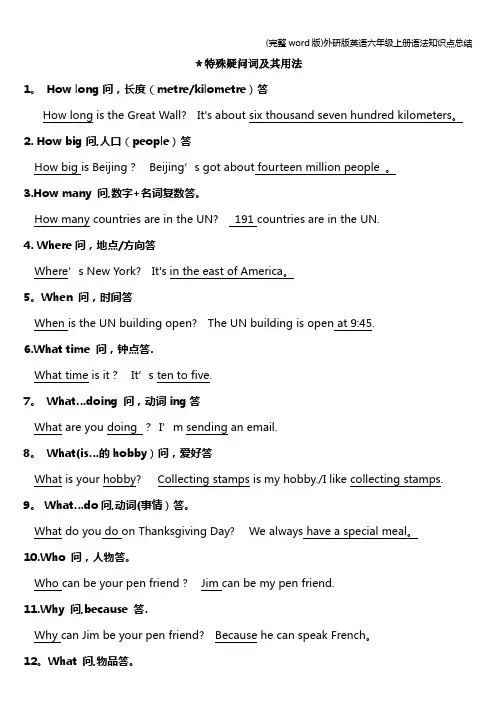
*特殊疑问词及其用法1。
How long 问,长度(metre/kilometre)答How long is the Great Wall? It's about six thousand seven hundred kilometers。
2. How big 问,人口(people)答How big is Beijing?Beijing’s got about fourteen million people 。
3.How many 问,数字+名词复数答。
How many countries are in the UN? 191 countries are in the UN.4. Where问,地点/方向答Where’s New York? It's in the east of America。
5。
When 问,时间答When is the UN building open? The UN building is open at 9:45.6.What time 问,钟点答.What time is it?It’s ten to five.7。
What…doing 问,动词ing答What are you doing ?I’m sending an email.8。
What(is…的hobby)问,爱好答What is your hobby? Collecting stamps is my hobby./I like collecting stamps. 9。
What…do问,动词(事情)答。
What do you do on Thanksgiving Day? We always have a special meal。
10.Who 问,人物答。
Who can be your pen friend?Jim can be my pen friend.11.Why 问,because 答.Why can Jim be your pen friend? Because he can speak French。
外研版小学英语六年级上册语法知识点总结
一、特殊疑问词及其用法二、同义句转换三、Be动词用法四、There be句型表示有……五、频率副词六、some和any的用法七、连词and和but的用法八、have got /has got的用法九、Can的用法十、询问动物是否喜欢什么句型:十一、询问别人是否经常干某事句型:Do you often…? 你经常干什么吗?十二、询问别人是否想要干某事句型:Do you want to +动词原形? 你想干什么吗?十三、选择疑问句十四、感叹句十五、强调句十六、祈使句十七、一般现在时态十八、动词各种形式的用法十九、时间的计时法二十、地点方位的表达二十一、人称代词和物主代词二十二、课文中图画所含的单词和短语二十三、模块单词短语一、特殊疑问词及其用法1. How long 问,长度(metre/kilometre)答How long is the Great Wall? It’s about six thousand seven hundred kilometers.2. How big 问,人口(people)答How big is Beijing? Beijing’s got about fourteen million people .3.How many 问,数字+名词复数答。
How many countries are in the UN? 191 countries are in the UN.4. Where问,地点/方向答Where’s New York? It’s in the east of America.5.When 问,时间答When is the UN building open? The UN building is open at 9:45.6.What time 问,钟点答。
What time is it? It’s ten to five.7. What…doing 问,动词ing答What are you doing ? I’m sending an email.8. What(is…的hobby)问,爱好答What is your hobby? Collecting stamps is my hobby./I like collecting stamps.9. What…do问,动词(事情)答。
外研版英语(一起)六年级上册 Module 3 模块知识点复习
圈出正确的单词。
1. Wh__(do / doing) ? 2. I’m ___________(watch / watching) TV . 3. ___________(Have / Has) your mother got a dog ? 4. No , she ____________(haven’t / hasn’t) . 5. Simon _____________(collect / collects) stamps . 6. Daming doesn’t ______________(collect / collects)
Dragon Stamp Football Stamp
This is the first stamp of China. It’s called “Dragon Stamp”. It has got a dragon. It’s beautiful.
And it’s very, very famous (著名的).
Collecting Show !
Hello, My name is Sally. My hobby is collecting boxes. I’ve got lots of boxes from China. Look, These boxes are pink , they’re very beautiful. And I’ve got some boxes from Korea. They are big. And this box is from Shanghai. My daughter gave it to me. I like it very much.
× 4.My favourite cap is from LSuimcyo. n( )
外研版小学六年级上册英语语法知识汇总
语法知识(六上)Module 1Tell me more about...告诉我更多关于...的信息如:Tell me more about the Great Wall.告诉我更多关于长城的信息。
These +可数名词复数+are great !如:These postcards are great ! 这些明信片太棒了!It’s a picture of...它是一张...的图片It’s a picture of the Great Wall. 它是一张长城的图片。
询问长度的句型-----How long...? 多长如:How long is it ? 它有多长。
答语:It’s...long.如:It’s more than twenty thousand kilometres long.它超过两万千米长。
How big 多大How big is Beijing ?北京有多大?答语:Beijing has got about twenty million people.北京大约有两千万人口。
询问某地位置的句型----Where is...?如:Where’s New York ?纽约在哪里?7.描述某地的位置north 北east东It’s in the south 南west 西Module 2描述某处有某人/某物的句型----There is /are...有如:There’s a Chinatown in New York.在纽约有一个唐人街。
There is + 可数名词单数/不可数名词There are + 可数名词复数There be 结构的就近原则(2)There are many desks and chairs in the classroom.(3)There is a pen and many pencils in my bag.频度副词never sometimes often always从不有时经常总是强调句You do miss China !你确实想念中国。
外研版小学英语六年级上册Module3知识讲解
Say a chant:
Running, running, I like running, Jumping, jumping, I like jumping, Reading, reading, I like reading. Playing, playing, I like playing.
2
oy
玩具
toy cars
2、 I’ve got lots of stamps.
_____ I’ve got lots of _k_i_te_s__.
_____ I’ve got lots of _t_o_y_c_a_r_s.
have got 和 has got 的用法区别:
have got 用于除第三人称单数外: I we you they 即两个人以上(复 数)
1、I’ve got lots of stamps.
“I have got …”表达“我有…”,当主语是第 三人称单数时候要用“has got”,例如主语是 “she或者he”的时候。
2、These are some stamps
from Canada.
“ These are (some)+可数名词复数 +from+地点”表达“这些是来自某地 的事物”.
• They are famous people.
These stamps are • This stamp is from Canada. from China.
famous
著名的
Your favorite stamps
A: Have you got any stamps? B:Yes, I have. They have got famous people on them. A:They are from Canada. B:Yes.