
高中英语 新人教版必修一 Unit4 Listening&Speaking
News report 3&4
5. When did people see the tornado in Memphis? At 9:25am
6. Which building were damaged in Seoul? A library and a supermarket
7. What caused the landslide in Seoul? The heavy rain
time
6.Which buildings were damaged in Seoul?
place
7.What caused the landslide in Seoul?
reason
News report1
Good morning. It's 17th April. A strong earthquake hit Ecuador yesterday. The ___7_.8___ magnitude earthquake damaged many buildings and early reports said that about ___2_3_0___ people were killed and more than ___1_,5_0_0__ were injured. Volunteers and rescue workers are helping the survivors.
3. Where are the floods?
place
4.What are the rescue workers and soldiers doing in the flood-hit area?
activity
5. When did people see the tornado in Memphis?
2. What kind of the natural disaster can you think of?
Earthquake
Match and speak
Do you know any other natural disaster?
earthquake
tornado
tsunami
wildfire
Listening skill
Listen for details:
time number place activity people reason
Circle and speak
Circle the key word(s) in the questions below and write the kind of information they refer to. Then listen again and answer the questions.
rescue
Competition
If your school intends to select a news reporter, the ss are required to prepare a news report on one of these three natural disasters.
Discuss and speak
basic information
Good morning. It's 17tthimAperil. A ster
yesterday. The 7.8 magnitude earthquake damaged many
buildings and early reports said thatdaabmouatg2e30 people were killed
and more than 1,500 were injured. Volunteers anpdeorepslceue workers
are helpinagcthiveitsiuersvivors. number
flood
landslide
Listen and tick
Listen to the news reports and tick the disasters that you hear. ● earthquake ● tornado ● wildfire ●drought ● landslide ● tsunami ● flood ● volcanic eruption
Question 1. What was the magnitude of the earthquake in Ecuador? 2. How many people were killed or injured in Ecuador?
Type of information number number
News report2
Place: More news about the floods in c__e__n__t_r_a__l _C__h__in__a___.
Activities: The government is _h__e__l_p__in__g__ more than 12,000 people. Rescue workers and soldiers are _w__o__r_k__i_n__g_ _d__a_y__ a__n__d_ n__i_g__h__t to make sure people are safe. They are also _b_r__in__g__i_n__g_ food and water to those whose home were lost in the disasters.
Look and speak
1. What can you see from this photo?
(1)A troop of soldiers are rescuing an
Unit 4 NaturinajulreDd piserasosnt.ers Listening an(rudi2n)sS.Tpheehaokusiens agre damaged and in
2019新人教高中英语必修一Unit4Listening and Speaking公开课课件

flood
tornado landslide
___H__o_m_e_s_a_n_d__la_n_d___ have been R__e_sc_u_e__w_o_r_k_e_rs_and__s_o_l_d_ie_r_s__
destroyed. No one has been killed. are working day and night to
vt. _____保_护__;__掩_蔽_______ vi. ___躲__避__(风__雨__或_危__险__)__
First Listening
What is the main idea of the conversation? Four news reports about natural disasters: earthquake, flood, tornado, and landslide.
At 9:25 p.m. A library and a market. By heavy rain that has fallen in the last week.
Third Listening
Listen again and find out the following information.
7.What caused the landslide in Seoul?
Type of information number
number place activities time place reason
Answer 7.8
About 230 were killed and more than 1,500 were injured. Central China. They are working day and night to make sure that people are safe.
高一英语必修一Unit 4Listening听力材料

高一英语必修一Unit 4ListeningP31Listening text:A reporter is asking a man to describe his experience in the San Francisco earthquake of 1906.R=reporter M=manR: What was the first thing you remember?M: Oh, my goodness. It was about 5 o’clock in the morning. I remember, I woke up when I was thrown out of the bed. When I tried to walk, the floor shook so that I fell. I felt terrified and rushed downstairs.R: What did you see outside?M: Oh, I saw things I never want to see again. It1.______as if the end of the world came. People were crying, shouting and 2. ______ everywhere. bricks were falling down from some buildings while big ones were3.________… Lots of people were getting4. _______under bricks. There were great fires around us. It was terrible!R: Did you realize what was happening?M: No. I asked a man 5.________ next to me what happened. Before he could answer, some bricks fell on him and he was killed.R: That sounds6._________. Did you know where to find a safer place? M: Oh, no. Luckily I met a man who knew the way to a boat.R: So…you got away easily?M: No, we didn’t. It was difficult because the streets had deep7._______ .As we were carefully picking our way, some frightened cows rushed up Market Street and8. ______ into one of them. I’ll never forget the noise they made. Some of them had broken their legs and others were 9.______ upon each other to get out. Horrible!R: How did you feel once you’d left the city?M: Umm. I felt safer because we were being cared for. The soldiers saved us. They brought us water and food. Thanks to them many of us are still alive!Listening textP62WorkbookPart1Listening text:Why do earthquakes happen? Scientists believe that the surface of the earth is covered by a number of moving plates. Sometimes two plates move __________and push __________each other. Sometimes they stop for years but at other times they jump and an earthquake is felt. Because of the movements of these plates, California, China and Japan have a lot of earthquakes. You can see the result in San Francisco where the Pacific plate______ the North American plate. When the 1906 earthquake happened, the Pacific plate jump 5 to 6 metres to the north.Part2Listening text:China is a country 1.________ many earthquakes happen. The Pacific plate is pushing China from the east and the Indian plate is pushing China from the southwest. The power of this movement created the Himalayas and Mount Qomolongma. It now causes earthquake in China. We cannot stop earthquakes but we can do things to make sure they do not2. _______whole cities. First it is not a good idea to build houses along the line where two plates meet. Second, if you think there may be an earthquake, make sure to build houses on rock 3.______ _______sand. Third, you must make the houses as strong as possible. Weak buildings will fall down in an earthquake, but strong ones may5._____ ______.。
人教版高中英语必修一Unit4--Listeningppt课件

earthquake happened. T 2. Many huge buildings were shaking –
brickspeople were buried under the ruins.
3 Discuss this question in small groups:
Why do some earthquakes kill more people than others? ✓Some earthquakes are stronger. ✓Some houses are not built strongly enough to withstand earthquakes. ✓More people die if they do not know what to do when there is an earthquake.
2. Preview Writing on page 31, Speaking task and Writing task on page 67.
3 Listen to Part 1 again. Write down the three things to do to keep safe if there is an earthquake.
1st thing I must do :
I must drop to the floor and cover my head and neck with my arms.
If you are in the living room, you should make sure that the bookcases are fastened to the wall and the TV set is tied to a table so that they can’t move.
新人教选择性必修1Unit4Listening to how bodies talk词汇句型课件

“things are great”.However, in such places as Latin America,Sardinia,
Greece, and southern Italy, the gesture has the opposite⑦ meaning. In
are extended③ above the thumb and index finger. However, this hand
gesture is considered insulting④ in France and Latin America.
The “victory” hand gesture is made by bending the third and fourth
gesture. Allied leaders and hippies(嬉皮士) used this gesture at
different times. The Allied leaders used it to show the symbol⑥ of
victory during World War II. Hippies used it during the Vietnam War
various.不同的;各种各样的
variety.变化;多样性;种类
avariety of = varieties of 种种的;各种各样的
各个国家的风俗习惯不同。
The students’ work varies considerably in quality.
学生作业的质量相当得参差不齐。
英语人教版高中必修一(新课标)教案Unit 4 Listening and Talking 教案
Unit 4 Natural DisastersPeriod 4Listening and Talking教材分析该板块的活动主题是“为灾害作准备”(Prepare for a disaster)。
活动主题与单元引言中的Raising awareness, reducing mortality相呼应。
听力文本以对话形式呈现,地震救援专家Mrs Fors带着搜救犬Lucky进入学生课堂,与学生互动,在回答学生问题的同时,讲解了减少灾害损失的准备工作,以及地震发生时能够帮助自救的基本安全准则等内容。
该板块要求学生了解、思考、讨论地震防灾知识及其应对措施,最后能够有条理地叙述应该如何为应对灾难作准备,探讨应急包的准备以及灾难发生时如何逃生等相关内容。
教学目标1. 能正确理解使用下列词汇:power, pipe, emergency, calm, aid, kit。
2. 能够运用指令性语言,介绍应对各种自然灾害的准备工作和措施。
教学重难点【教学重点】引导学生通过指令性语言清晰地表达从地震等自然灾害中逃生的措施和建议。
【教学难点】理解并正确运用指令性语言。
教学过程Step 1 Warming-up1. What happened in Wenchuan on May 12, 2008?2. Listen to a news report about it and fill in the blanks.3. Earthquake is a common natural disaster. What should people do in case of earthquake? Let’s find out.设计意图:看关于汶川地震的图片,听一段相关的地震报道,激活学生的背景知识,引导学生思考如何应对地震。
Step 2 Pre-listening1. Look at the table in Activity 1. Predict the main idea of the conversation.2. Teacher help students to understand the meanings of the new words in the table (tap, pipe, whistle).设计意图:预测将要听到的内容,扫清词汇障碍。
Unit 4 Listening and Speaking 年高中英语人教版(2019)必修第一册
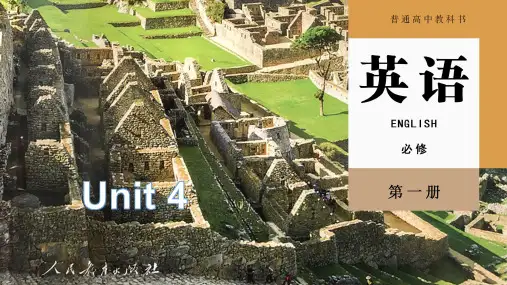
Watch the video Natural Disasters and look at the photos. Do you know what these disasters are? Write down their names.
tornado n.龙卷风 tsunami n.海啸 earthquake
The potential (潜在的) influence of a natural disaster depends on the size and location of the event. If the disaster takes place in a heavily populated area, it immediately causes more damage to both life and property.
1,500 _w_e_r_e_i_n_j_u_r_ed_.
mudslide / mudflow
glacier calving 冰裂
Listen to the news reports and tick the disasters that you hear.
√ earthquake √ landslide
tsunami
√ tornado
wildfire
drought √ flood
volcanic eruption
Think about what you are listening for before you listen: numbers, dates, times, addresses, activities, people or places, reasons, etc.
flood /flʌd/
英语人教版高中必修一(新课标)教案Unit 4 Listening and Speaking 教案
Unit 4 Natural DisastersPeriod 1Listening and Speaking教材分析本单元以自然灾害为话题,探讨在“人与自然”的主题之下,当人类面临自然灾害的威胁时,应该树立防灾意识,提高在灾害中逃生和生存的能力。
主题图的内容是汶川地震时解放军战士在废墟中运送伤者的感人画面,体现了在发生重大自然灾害时军民同心,合力救助受灾人员的大无畏的人道主义精神。
而开篇页的引言“Live to Tell: Raising Awareness, Reducing Mortality.”中文可以译为:“用生命呼吁:增强减灾意识,减少人员伤亡。
”这句话是2016年联合国世界减灾日的活动主题,目的是呼吁全球各地的人们重视自然灾害,树立防灾意识。
听力板块的活动主题是“播报自然灾害”(Report natural disasters)。
学生通过观看视频并听新闻播报,最终完成模拟播报自然灾害新闻的活动。
教学目标1. 能正确理解使用下列词汇:disaster, drought, slide, flood, rescue, damage, destroy, death, affect, shelter。
2. 能根据听力问题,预判听力内容并能提炼出关键信息,例如:数字、时间、日期、事由等。
3. 了解新闻播报应包含的基本要素和语言特征。
4.能够简要模仿新闻播报,报道突发的自然灾害。
5. 复习清辅音和浊辅音p/b、t/d、k/g、f/v、th、s/z、sh/g、ch/dg、tr/dr、ts/ds的发音规律,并利用这些规律准确辨音,有效记忆单词。
教学重难点【教学重点】1. 引导学生运用听力策略,主动思考、预判听力要点;2. 引导学生运用新闻套语,模仿听力文本,完成自然灾害的新闻播报。
【教学难点】掌握听前预判听力要点的策略和技能。
教学过程Task 1Step 1 Warming-up1.Look at the opening page and discuss the following questions.(1) What problems/natural disasters do you see in the picture?(2) What do you think the soldiers are doing?(3) Can the person in the picture survive?(4) Can we stop natural disasters from happening?2. Read the quote and discuss the following questions.How do you understand the quote? Do you agree with it?设计意图:通过询问学生对引言的看法,启发学生思考,培养学生的思辨能力。
人教版必修第一册 Unit 4 Natural Disasters Listening 教学设计
感知与注意
描述与阐释
分析与判断
内化与运用
想象与创造
Homework:
1.听录音,朗读听力原文。
2.口头汇报:学生根据自己的水平,任意从下面三项任务中选择一项完成。
教师展示哨子和应急包的图片,介绍生词和短语whistle和first aid kit。
学生学习新生词和短语whistle和first aid kit
2.学生2人一组讨论第53页第三部分应急用品中每一项的重要性,然后全班分享。
Having an emergency kit prepared is very important. These emergency supplies should be included in your emergency kit. Discuss with a partner why these emergency supplies are necessary.
教学目标
教学目标:在本课学习结束时,学生能够:
1.获取听力材料中关于人们在地震不同阶段具体应该做什么的信息;
2.应用表达安全须知的句型介绍自然灾害前、中、后分别应该做什么;
3.根据获取和总结内容,介绍急救包里必需的物品并说明原因。
教学重难点
1.介绍自然灾害前、中、后人们分别应该做什么;
2.介绍应急包里必须的物品并说明原因。
What questions may the students ask?
2.学生第一遍听录音,检验预测内容,总结学生都问了哪些问题和Mrs Fors在谈话中都介绍了什么方面的内容。
高中英语人教版选择性必修一Unit4 Listening to How Bodies Talk课件
Choose the right answer:
1.Can you guess the meaning of interaction in Para. 1?
D A. making friends
B. business
C. helping each other D. communication
Para. 1 We use both words and body language to express our thoughts and opinions in our interactions with other people.
Para 5 Some gestures have t_h_e_s_a_m_e_m__ea_n_i_ngeverywhere
Para 6 Body language has many __d_if_fe_r_e_n_t _uses.
Listening to how bodies talk? 1 express thoughts
Choose the right answer:
while-reading
2.Which of the following is True according Para.2-4?
C
A. In many Middle Eastern countries, women are permitted to make eye contact with men. B. The gesture for “OK” has the same meaning in different cultures. C. You should avoid making the gesture OK in Brazil and Germany. D. In Japan and Russia, people may kiss their friends on the cheek when they meet.
人教版(2019)高中英语选择性必修第一册Unit4 Listening and Speaking
3. consolidate the skill of making inference to express your opionion
Review the text
think about these questions: 2. What emotion does different body language convey?
If so, what body language do they use?
What meaning does their body language convey?
Activity 2: Prediction
What will be talked about in the interview?
(WB P84)
Review the text
think about these questions: 2. What emotion does different body language convey?
Review the text
think about these questions: 2. What emotion does different body language convey?
Review the text
think about these questions: 2. What emotion does different body language convey?
Activity 1: thinking
Does animals convey feeling like humans?