
英语人教版八年级上册Unit7 Section B 2a- 2e 课程教学设计
T: Read the passage again. This time you should read the passage and fill in the blanks in thisparagraphwith words in the article.
Pre-reading: Meet robots.走进机器人
1.Play games;Ask Ss to listen and guess: T: What kind of robot is it?
Get some Ss think and answer the questions.
2.Present some new words on the big screen.e.g.
Ⅴ. Group work(5`)
Post-reading: Imagine robots.畅想机器人
Ask some Ss what their life will be in the future. And talk about the robots in the future.
T: What will robots look like in 100 years?
Work in groups. Tell your partnerwhatyou know about robots.What dothey look like and whatcanthey do? Ask some Ssdescribethe robots they know.
Ⅱ. Lead in (5`)
S:I think robots will look likecapsin100years.They willhelp me fly in the sky.
.Education
Nothing is impossible if you put your heart in it!
(世上无难事,只怕有心人。)
2)通过阅读策略的指导,借助一定阅读量的累积,培养学生在阅读的过程中获取和处理信息的能力。
3)用will表达一般将来时态的用法。结合机器人这一话题表达自己的想法。
Brainstorm
创设词汇教学情景,为阅读扫清障碍。
阅读策略1:看图片和题目,预测文章主旨。
2:注意寻找与文段重复的单词。
3:注意根据关键词找细节。
Robots before:
Read Paragraph 1 and answer questions below:
1)In what kind of movies can we sometimes see robots?Movies about the future.
2)What are the robots like?Human servants.
shape, human, servant, factory…
3. Explain some main words to the Ss . Give some examples on the big screen.
shape, fall, fall down, look for, possible,impossibleeven, dangerous, already
Ⅲ. Reading(25`)
While-reading: Know more about robots探索机器人
1.Predicting(预测).Do you think you will have your own robot?
What is the article about?(choose)
整合2c和2d的内容,避免学生混淆。
检验学生阅读理解的程度,并实现对语言的创造性运用
渗透情感教育
借助分层作业,让不同水平的学生在不同层次上得到发展。
【重点难点】
阅读短文,获得相关信息,提高学生们的综合阅读能力。
【情感目标】
通过引导学生展望未来,及对未来生活的设计,来达到前景教育的目的,同时也通过对前景的设想,让学生在潜移默化中反省自己的现状,使之对目前的学习、生活习惯作适当的调整,并不断的改善自己的现状,使学生的理想观和价值观更为科学,更具发展价值。
Keys:make, walk, dance, talk, difficult, think, wake,up, know
Ⅳ.Discussion(5`)
Read last paragraph again,and answer question1.
1.Do you think robots are useful in India? Why?
Unit 7 Will people have robots?
Section B Reading
教学设计
姓名:李娜
单位:格尔木市第三中学
课题
Unit7Will people have robots?
内容
Section B 2a-2e
课时
1
设计说明
【学习目标】
1)能掌握以下单词:human, servant, dangerous, already, factory, simple, over and over again, believe, hundreds of, inside, disagree, shape, fall, fall down, look for, possible,impossible
(写一篇关于“我梦想中的机器人”的小作文。)
【板书设计】
Unit7Will people have robots?
Section B Reading
【教学反思】
A.Science fiction(科幻) movie .B.Scientist James White C. Robots in the future.
2.Skimming(略读).Match the main ideas and give short explanation.
Paragraph1 A. Will robots think like humans in the future?
Robots today:
Listen to Paragraph 2 and fill in the blanks below:
Today there are robots working in factories. Some robots can help to build_______ and do _______jobs over and over again. They will never get ________. Answers:cars ,simple, bored
Let some Ss talk about question 2 and 3 answers.
2.If we have robots, will they be useful in Sichuan? Why?
3.If we have robots, will they be useful in Malaysia? Why?
Paragraph2 B. What will robots be like in the future?
Paragraph3 C. What can robots do today?
Paragraph4 D. What are robots like in movies?
3.Careful reading(细读)
Robots in scientist
Other scientists think it will be _________ to make robots _______like a human. For example, James White thinks robots will never be able to ______ ______and ______ where they are.
some scientists VS other scientists
Some scientists think that in the future they will_______ robots more like humans. For example, some robots in Japan can ________and________. They think robots will even be able to ________like humans in 25 to 50 years.
Homework
A类:Complete your dream card and send it to future you.
(完成卡片,并寄给未来的你。)
Name: Dream robots:
Look like:
Be able to:
B类:Write a short passage about“My Байду номын сангаасream Robots”.
【教学方法】
游戏教学法,情景教学法,任务型教学法,小组合作教学发
【教学准备】
多媒体电子白板
【教学过程】
【教学过程】
Ⅰ. Warming- up (5`)
1.Daily greeting.
2.创设情景,观看视频,展开话题:What do robots look like? What can robots do?
Unit7SectionB(2a-2e)教案人教版英语八年级上册
Unit7 SectionB(2a2e)教学目标1.熟练掌握重点单词、短语、句型2.能够运用所给信息,如标题、图片等预测文章大意。
3.能够运用本课的核心句型,想象和预测未来社会发展。
教学难点重点:读写能力的提高;will 句型的掌握。
难点:根据框架复述文章以及表述自己及组员对于机器人和未来生活的想象与看法。
教学过程一、Lead inWhat do they look like?have many different shapes=be in different shapesThey can do the same things as us/we can.help with the housework and do some simple jobsReadingGet the main idea:It tells us what the _______look like,and what they ___ __ now and_____ ___in the future.Prereading:Predict(预测) what we can learn from the title and the picture.Do you think you will have your own robot?Reading strategy: Look at the title and the picture, and predict what you will read about.先看标题和图片,预测你要读到的内容2aTell your partner what you know about robots. Will you have a robot? and What do they look like?Do it like this.I will/won't have a robot.It may look like...Predicting (预测)What can we learn from the title and the picture?A. It’s about a science fiction(科幻)movie.B. It’s about the robot scientist James White.C. It’s about the robots in the future.Task1 Look through the notice to find the general idea.Match each paragraph with the question it discusses.Scanning: Robots todayRead Para. 1carefully and fill in the blanks.Some robots look like___________They can___________________ and_________They arelike______________Scanning: Robots todayRead Para. 2 carefully and answer the questions.1. Where are the robots already working?In factories.2. Will the robots get bored?No, they won’t.Para 3 :Robots in the futureSome scientists think that in the future they will make robots more look like ________ .For example, some robots in Japan can _______and________. They think robots will even be able to ________like humans in 25 to 50 years.Other scientists think it will be _______ to make robots really _____ like a human. For example, James White thinks robots will never be able to _____ _____and ______ where they are.Para 4 : Robots in the futureRead and Mark True or False.1.Some scientists believe that there will be robots in the future.2.These new robots will have many different shapes.3. If buildings fall down with people inside, these snake robots can help look for people under the buildings.puters and rockets also seemed impossible years ago. 课堂练习同学们做exercisesthank you。
人教版初中英语八年级上册Unit-7阅读课教案
初中英语八年级上册Unit 7Will people have robots一、本课分析本课是一节阅读课。
文本话题是机器人。
通过设置读前预热、读中理解、读后检测和拓展等活动,让学生了解机器人的由来、发展过程、对人类生活产生的重大影响等,并把所读信息转化成对话信息,关注语言的使用。
引导学生关注生活,展望未来和相信未来,崇尚科学,探索和创造未来,从而对学生进行适当的情感态度教育。
帮助学生树立远大的理想。
(二)教学目标的确立1.能学会重点词汇以及目标语言。
2.在阅读中尝试概括段落大意,加强对篇章的整体理解。
3.在阅读过程中尝试找出文章的主线。
三、教学过程Step I. Warming-up and lead inAsk: What do the robots look like ?What can they do?Step II Fast readingLook at the questions.Read the article and match each paragraph with the question it discuss.2. Careful reading1. Listen to the text and pay attention to the pronunciation, they c an underline the topic sentences of each paragraph and the detail inf ormation that they interest.2. What can robots do in movies?They help with housework and do jobs like working in dirty or dangerous places.3. Have students read the text aloud then compete the sentences below (1). Robots can build _cars___ in factories.(2).They can do __simple__ jobs many times and never get bored.(3).Some can __walk___ and _dance____.(4).Some can help __look for ___ people under _the buildings_____. 4.Write T or FScientists in Japan can make robots walk and dance.Some scientists believe it will be difficult for robots to look like a humanJames White thinks robots can talk like humans in the future.Step III. After-reading(1)About whether robots can think , do scientists have the same ideas?(2)What are the different ideas?(3) Which idea are you on? Say why.StepⅣ.Homework1. Recite the new words and expressions in the article.2. Write a short paragraph.For example: I want to have a robot in the future. It will look lik e a ______. It will be able to_____, and it will also be able to help me _______________________________________________... .I think I will like it very much.3. Ask S to finish 2d-2e.四、教学反思本节课的设计从激发学生的兴趣开始,由易到难,逐步完成各个环节,尤其注意文本信息的思考、评价和转换,使学生找到了学习兴趣。
人教版英语八年级上册Unit7 单元教材分析
Unit7 单元教材分析本单元以Talk about future为话题,共设计了三个部分的内容:Section A:该部分一共有四个模块,第一模块以“People will do...”为重点句型,预测未来,熟悉一般将来时的基本用法包括:Read and Check (la)、Listen and circle (1b)、Pair work (1c);第二模块以fewer/less/more和一般将来时的猜测用法的进一步运用为学习重点,练习运用语法句型there will be结构。
包括:Listen and circle (2a)、Listen and check (2b)、Pair work (2c)。
Role-play the conversation (2d)则整合了“sb. will do".”和there will be 结构;第三模块首先通过语法聚焦对本单元的语法重点般将来时进行讲解,然后进行各种练习,包括Fill in the blanks(3a).Complete the prediction (3b)以及小组合作,训练团队精神和活用英语的能力的Group work(3c)。
Section B:该部分一共有四个模块,第一模块以new words为重点,学习新单词。
包括la,1b; 第二模块以听力训练为重点,分别从两个层面,从宏观到细节,以一般过去式和一般现在时的对比为重点,让学生进一步了解、掌握一般将来时的结构与用法,包括:Listen and Number (1c)、Fill in the blanks (1d)、Pair work(le);第二模块以未来的机器人为主题,主要练习阅读和写作,首先通过让学生描述自己眼中未来的机器人(2a),引起对将要阅读文章的兴趣,而且挖掘出他们对机器人已有的认识。
接着让学生阅读文章,概括大意(2b),完成句子(2c)与短文填空(2d), 完成了对文章的基本掌握。
人教版英语八年级上册Unit7SectionB(2a~2e)教学设计
2.口语表达方面,学生在描述过去的事情时,可能存在词汇量不足、句子结构单一等问题。
3.部分学生对英语学习缺乏兴趣和自信,课堂参与度不高,影响学习效果。
针对以上学情,教师在教学过程中应注重以下几点:
1.强化一般过去时态的语法点讲解,通过举例、练习等方式,帮助学生熟练掌握动词过去式的变化规律。
2.注重拓展学生的词汇量,引导学生积累并运用本课所学的重点词汇和短语,提高口语表达能力。
3.创设生动、有趣的课堂情境,激发学生的学习兴趣,增强课堂互动,提高学生的参与度。
4.关注学生的个体差异,给予每个学生足够的关注和鼓励,提高他们的自信心,促进全体学生的全面发展。
三、教学重难点和教学设想
(一)教学重难点
3.教师通过情境创设,让学生练习一般疑问句和特殊疑问句,如:What did you do yesterday? Did you go anywhere last weekend?等,提高学生的口语表达能力。
4.教师针对学生的回答进行点评,纠正错误,巩固新知识。
(三)学生小组讨论
1.教师将学生分成小组,每组选择一个话题,如:last weekend's activities, a memorable day等,要求学生用一般过去时态描述相关内容。
2.作业难度要适度,既要让学生感到挑战,又要确保他们能够通过努力完成,以提高学生的学习自信心。
3.鼓励学生在完成作业的过程中,积极思考、主动探究,培养良好的学习习惯。
4.家长辅助作业的设置,旨在增进家长与孩子之间的互动,让家长了解孩子的学习情况,同时培养学生的口语表达能力。
5.教师应关注学生的作业完成情况,及时给予反馈和指导,帮助学生不断提高英语水平。
初中英语_初二英语上册教学设计学情分析教材分析课后反思

教学设计_Unit 7 Will people have robots? Section B (2a-2e)_英语_初中_【教学内容】Unit 7 Will people have robots? Section B (2a-2e)【课型】新授课【教学目标】(一)知识与能力1. New words:human servants human snake shape building over and over again2. Target languages: how to talk about the future and make predictions. (Will + verb)(1)Students can obtain information by reading(2)Students can improve their reading skills (scanning for the main idea, careful reading for detailed information and further understanding)(二)情感态度与价值观1. Develop students’ imagination to make predictions about our future.2. Encourage students to get ready for a better future.(三)过程与方法1.Tasked-based language teaching method2. Students-focused teaching method3. Competitive method【教学重难点】(一)教学重点1. How to lead students to improve their reading skills smoothly.2. How to get students to use “ will” to make predictions about robots.(二)教学难点1. How to stimulate students’ imagination.2. How to get students to use “will” to make predictions about robots.3. How to make students to understand the reading text deeply.【设计思路】Step 1 Warm-upRound 1 Guessing gameShow some pictures of different robots and ask students to describe the appearances and their capabilities. Ask students to guess what the robots can do.Students’ activities:Describe the robots’ appearances and their capabilities.Guess what the robots can do.【设计目的】用竞赛的形式更能吸引学生的兴趣,同时又达到为阅读做好铺垫。
八年级英语上册 Unit 7 Will people have robots Section B 2a-2e教学案(无答案)(新版)人教新目标版
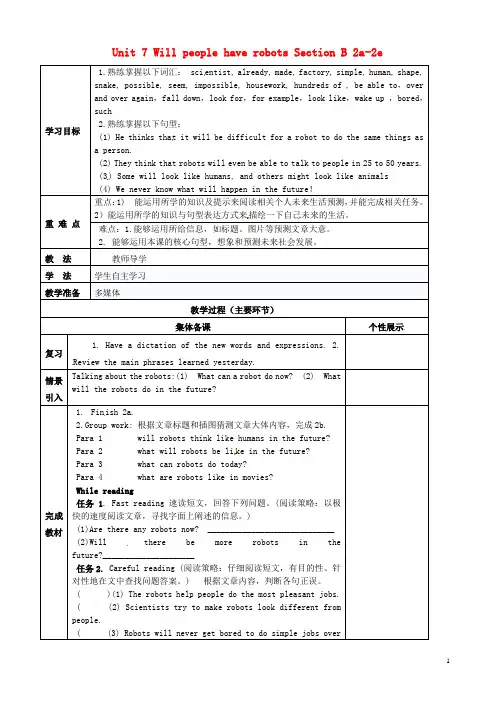
(4) We never know what will happen in the future!
重难点
重点:1)能运用所学的知识及提示来阅读相关个人未来生活预测,并能完成相关任务。2)能运用所学的知识与句型表达方式来 描绘一下自己未来的生活。
( (3) Robots will never get bored to do simple jobs over and over again.
( (4) Humans will have more work to do it the future.
( (5) Space rockets seemed possible a hundred ye ars ago.
Unit 7 Will people have robots Section B2a-2e
学习目标
1.熟练掌握以下词汇:sci entist, already, made, factory, simple, human, shape, snake, possible, seem, impossible, housework, hundreds of , be able to,over and over again,fall down,look for,for example,look like,wake up,bored,such
While reading
任务1. Fast reading速读短文,回答下列问题。(阅读策略:以极快的速度阅读文章,寻找字面上阐述的信息。)
(1)Are there any robots now? _____________________________
Unit+7+Section+B+2a-2e+课件2023-2024学年人教版八年级英语上册+
Read the article carefully, then complete the table.
robots
Today’s robots
In movies
In real life
They’re like human servants.
They help with the hdoiursteywork and do ________ or dangerous jobs.
➢ To read and understand the passage: Do You Think You Will Have Your Own Robot?
➢ To talk about the robots.
Learning objects (学习目标)
By the end of the class, you will be able to… ✓ Master the key words & phrases: astronaut,
Talk about your future life.
➢ What will you do 10 years from now? jobs
➢ Where will you live 10 years from now? places to live
➢ How will you go to work 10 years from now?
these robots will be able to do? Write your ideas and discuss them with your partner.
I think some future robots might look like __b_u_tt_e_r_fl_ie_s__. They will _b_e_a_b_l_e_t_o_s_in_g__a_n_d_d_a_n_c_e_. _W_h_e_n__I_a_m__s_a_d_, _th_e_y_c_a_n__tr_y__th_e_i_r_b_e_st_t_o_m__a_k_e_m__e_ _h_ap__p_y._A__n_d_w_h_e_n__I_w_a_n_t_t_o_g_o__s_h_op__p_in_g_,_t_h_ey__c_a_n__ _ta_k_e_m__e_t_o_t_h_e_m__a_ll_. _In__m_y__li_f_e,_t_h_e_y_w_i_l_l _gi_v_e_m__e_a__ _lo_t_o_f_h_e_lp_._________________________________
人教版八年级英语上册Unit7SectionB(2a2c)说课稿
为了促进学生的参与和合作,我计划设计以下师生互动和生生互动环节:
1.师生互动:通过提问、回答和示范,引导学生积极参与课堂讨论,及时给予反馈和鼓励,建立积极的师生关系。
2.生生互动:设计小组讨论、角色扮演和小组竞赛等活动,让学生在小组内或小组间进行交流合作,共享学习成果。
3.课堂展示:鼓励学生上台展示小组讨论或角色扮演的结果,提高他们的自信心和表达能力。
1.通过展示不同场景的图片,引导学生学习如何用"Would you mind..."结构提出礼貌请求,并让学生进行实际操作,加深理解。
2.分组讨论:让学生分小组讨论如何回答"Would you mind..."的提问,并请小组代表进行展示,培养学生的合作能力和表达能力。
3.播放教学视频,让学生模仿视频中的人物进行对话练习,提高学生的听说能力。
(四)总结反馈
在总结反馈阶段,我将采取以下方式引导学生自我评价,并提供有效的反馈和建议:
1.让学生自我评价:在学习本节课的过程中,学生对自己的表现进行评价,总结自己的优点和不足。
2.同伴互评:学生相互评价,提出建议和改进措施,促进同学之间的相互学习和共同进步。
3.教师评价:针对学生的表现,给予积极的反馈和鼓励,针对不足之处提供具体的改进建议。
3.使用不同颜色和图形,增强板书的视觉效果,提高学生的学习兴趣。
(二)教学反思
在教学过程中,我预见到以下可能出现的问题或挑战:
1.部分学生对"Would you mind..."结构的掌握不够熟练;
2.学生在真实情境中运用所学知识时可能存在紧张和不自信;
3.课堂时间有限,可能无法充分照顾到每个学生的学习需求。
3.自我反思,总结课堂中的亮点和不足,不断调整教学策略。
Unit7WillpeoplehaverobotsSectionB2a-2d课件人教版八年级英语上册
Some can help to build cars and do simple jobs over and over again.
3.what jobs will few people do?
The boring jobs.
4.What can some robots do in Japan?
What will robots be like in the future?
Read the passage carefully to finish the questions. 1.What are robots usually like?
They are usually like human servants.
They can walk and dance.
5.What can snake robots do in India?
They can help look for people under the buildings.
6.Does the writer know what will happen in the future ?
What can rห้องสมุดไป่ตู้bots do today?
3.What is the main idea of the paragraph 3?
Will robots think like humans in the future?
4.What is the main idea of the paragraph 4?
summary
What have you learned in this lesson?
人教版英语八年级上册Unit7sectionB优秀教学案例
2.问题导向:设计一些一般过去时态的疑问句,让学生分组讨论并尝试回答,引导学生通过思考和讨论来理解和运用所学的知识。这种问题导向的教学方法培养了学生的思考能力和解决问题的能力。
2.提高学生的英语语法知识,加深对一般过去时态的理解,使其能够在适当的语境中熟练运用。
3.培养学生运用英语进行交际的能力,使其能够在日常对话中正确运用一般过去时态,表达过去发生的事情。
4.提升学生的阅读理解能力,通过阅读关于过去经历的短文,培养学生理解并运用一般过去时态的能力。
(二)过程与方法
1.通过展示过去照片和设计角色扮演的活动,引导学生主动参与课堂,激发学生对一般过去时态的兴趣和好奇心。
2.引导学生提出问题:在教学过程中,我会鼓励学生提出问题,激发他们的思考能力,培养他们解决问题的能力。
3.提供解答资源:为学生提供相关的解答资源,帮助他们找到答案,同时鼓励他们自主查找资料,培养他们的自主学习能力。
(三)小组合作
1.分组讨论:我将学生分成小组,让他们在小组内进行讨论,鼓励他们相互交流和合作,共同完成任务。
2.利用小组合作和互动交流的方式,培养学生与他人合作的能力,提高学生的口语表达和交际能力。
3.通过阅读和写作任务,培养学生的自主学习能力,提升学生的阅读理解能力和写作能力。
4.运用任务型教学法,模拟真实语境,让学生在实际情境中运用一般过去时态,提高学生的实际应用能力。
(三)情感态度与价值观
1.培养学生对英语学习的兴趣和积极性,使其能够主动参与课堂活动,享受学习英语的过程。