
译林版九年级英语上册Unit2 welcome to the unit
violet n. 紫罗兰色
A One day, Millie looked out of
her window after a rain shower and saw a rainbow. Write the names of the colours in the blanks.
you know.
但是你知道粉色没什么不好。 there’s something/nothing wrong with ... 意 为“某物有/没有问题”。 e.g. There’s something wrong with my bike.
我的自行车出了点问题。
2. And I’m not sure if blue looks good on you. 而且我不确定你穿蓝色是否好看。 something looks good on somebody 意为 “某物穿在某人身上好看”; somebody looks good in something 意为 “某人穿某物好看”。
What colour are the oranges? They are orange.
What colour do you like best? Why?
black
blue
red
green
purple
White yellow
Listen and answer.
1. What colour does Eddie like better? He likes blue better.
Which is Shirley’s favourite colour? Green.
Work in pairs and talk with your partner about colours. Use the conversation as a model.
1. But there’s nothing wrong with pink,
1. Recite the dialogue between Eddie and Hobo.
2. Remember the words and sentences in the lesson.
e.g. Red looks good on Kitty. 红色穿在基蒂身上好看。
Kitty looks good in red. 基蒂穿红色好看。
Translation. 1. 蓝色是男孩子们喜欢的颜色。
Blue is boys’ favourite colour. 2. 你的手表没有问题。
There’s nothing wrong with your
2. Why doesn’t Eddie like pink? He thinks it is the girl’s colour.
Have you ever seen a rainbow? How many colours are there in a rainbow? What colour do you like best?
Welcome to the unit
Studying aims
1.Learn some words about colours 2. Make dialogues about colours
Talk about the following pictures.
What colour is the car? It is blue.
A: Which is your favourite colour? B: I like ... best. What about you? A: I like ... best.
B Amy’s cousin Shirley is talking
with Amy about the rainbow. Listen to their conversation and answer the question.
blue green indigo orange red violet yellow
1 __r_e_d_____ 2 __o_r_a_n_g_e__ 3 __y_e_l_lo_w___
4 __g_r_e_e_n___ 5 __b__lu_e____ 6 __i_n_d_ig_o___ 7 __v_i_o_l_et___
What colour is the grass? It is green.
What colour are these apples? They are red.
What colour is the T-shirt? It is yellow.
What colour is the motorcycle? It is black.
watch. 3.你穿这条紫色的连衣裙很好看。
You look good in this violet dress.
4. 我不确定明天是否会下雨。 I am not sure if it will rain tomorrow.
5. 这件黄色的外套穿在你身上很好看。 This yellow coat looks good on you.
牛津译林版英语九上Unit 2《Colours》(Welcome to the unit)说课稿

牛津译林版英语九上Unit 2《Colours》(Welcome to the unit)说课稿一. 教材分析《牛津译林版英语九上Unit 2 Colours》是一篇关于颜色的文章,通过介绍各种颜色以及它们所代表的意义,引导学生学习并运用相关词汇和句型。
文章内容丰富,贴近生活,有利于激发学生的学习兴趣,提高他们的英语水平。
本节课的主要目标是让学生掌握颜色词汇的用法,能够用英语介绍自己的喜好和心情。
二. 学情分析九年级的学生已经具备一定的英语基础,对于日常生活中常见的颜色词汇有所了解。
但他们在运用英语进行表达时,还存在一定的困难。
因此,在教学过程中,教师需要关注学生的个体差异,充分调动他们的学习积极性,引导他们更好地掌握本节课的内容。
三. 说教学目标1.知识目标:让学生掌握表示颜色的词汇,如red, yellow, blue等,以及相应的短语,如in favour of, feel like等。
2.能力目标:培养学生用英语进行简单交流的能力,能够用所学词汇和句型介绍自己的喜好和心情。
3.情感目标:激发学生学习英语的兴趣,培养他们的合作意识和跨文化交际能力。
四. 说教学重难点1.重点:颜色词汇的用法,以及用英语介绍自己的喜好和心情。
2.难点:正确运用短语in favour of和feel like,以及如何根据实际情况灵活运用所学知识。
五. 说教学方法与手段本节课采用任务型教学法,通过各种活动让学生在实践中学习英语。
同时,运用多媒体手段,如图片、视频等,丰富教学内容,激发学生的学习兴趣。
六. 说教学过程1.导入:展示一幅色彩斑斓的画,引导学生谈论颜色,自然引入本节课的主题。
2.新课呈现:通过展示不同颜色的物品,教授颜色词汇,让学生跟读并模仿。
3.句型练习:利用颜色词汇,引导学生用英语描述自己的喜好,如“Ilike green because it makes me feel relaxed.”4.小组活动:学生分成小组,用英语讨论喜欢的颜色及其原因,促进合作学习。
江苏省永丰初级中学英语牛津译林版九年级上册(新)Unit 2 Colours 教案
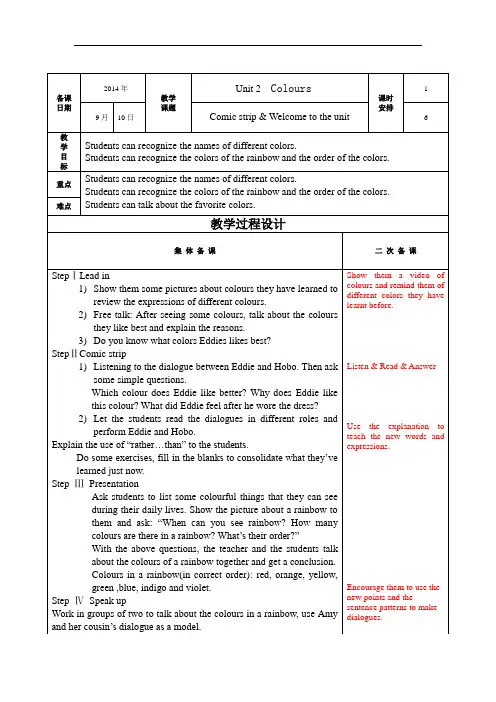
备课日期2014年教学课题Unit 2 Colours课时安排1 9月10日Comic strip & Welcome to the unit 6教学目标Students can recognize the names of different colors.Students can recognize the colors of the rainbow and the order of the colors.重点Students can recognize the names of different colors.Students can recognize the colors of the rainbow and the order of the colors. Students can talk about the favorite colors.难点教学过程设计集体备课二次备课StepⅠLead in1)Show them some pictures about colours they have learned toreview the expressions of different colours.2)Free talk: After seeing some colours, talk about the coloursthey like best and explain the reasons.3)Do you know what colors Eddies likes best?StepⅡComic strip1)Listening to the dialogue between Eddie and Hobo. Then asksome simple questions.Which colour does Eddie like better? Why does Eddie likethis colour? What did Eddie feel after he wore the dress?2)Let the students read the dialogues in different roles andperform Eddie and Hobo.Explain the use of “rather…than” to the students.Do some exercises, fill in the blanks to consolidate what they’ve learned just now.Step ⅢPresentationAsk students to list some colourful things that they can seeduring their daily lives. Show the picture about a rainbow tothem and ask: “When can you see rainbow? How manycolours are there in a rainbow? What’s their order?”With the above questions, the teacher and the students talkabout the colours of a rainbow together and get a conclusion.Colours in a rainbow(in correct order): red, orange, yellow,green ,blue, indigo and violet.Step ⅣSpeak upWork in groups of two to talk about the colours in a rainbow, use Amy and her cousin’s dialogue as a model.Show them a video of colours and remind them of different colors they have learnt before.Listen & Read & Answer Use the explanation to teach the new words and expressions.Encourage them to use the new points and the sentence patterns to make dialogues.Step5. ExercisesI. 根据中文完成下列句子:1.How many colours are there in a (彩虹)?2.She wears a (紫色的) blouse today.3.I’d (宁愿) wear blue than pink.4.Thank you for (邀请) us. I really enjoy myself very much.5.In spring, we can hear birds (歌唱)Finish more exercises to master the new language points.教学反思It is relatively easy for them to talk about the colors. We can help them to remember and master the key words and phrases by helping them to use them.备课日期2014年教学课题Unit 2 Colours课时安排2 9月10日Reading 1 6教学目标Students can understand what colors represent through different reading skills. Students can recognize and understand vocabulary about emotions.重点Students can understand what colors represent through different reading skills. Students can recognize and understand vocabulary about emotions.难点教学过程设计集体备课二次备课Step 1: RevisionRevise different kinds of colours by asking students:What’s your favourite colour?Step 2: Presentation.Tell students that different colours can give people different feelings. Let students enjoy a series of pictures, including different kinds of colours and let students discuss:What’s your feeling after looking at the pictures?Then teachers make a conclusion:Blue & white can make people calm and peaceful. Blue can also represent sadness and white is the colour of purity. Work in pairs.Encourage students to say as much as possible.Teach the new words in theYellow and orange make you feel warm, happy and contented. Orange represents joy while yellow is the colour of wisdom.Green makes you feel energetic. It represents new life and growth.Red represents power. It is also the colour of heat and strong feelings.Step3 While-readingA.Read the whole passage quickly and silently, then answer the questions(1) Do different colours represent different moods? ______________(2) How many kinds of colours are mentioned in the article? _______B. Listen to the tape of Part 2, do T/F questions(1) Blue is a calm colour. It creates the feeling of harmony. ( )(2)White will make you feel calm and peaceful. ( )(3) Blue can represent sadness. ( )(4) Many women like to be in white on their wedding day . ( )C. Read Part 3 loudly, answer the following questions(1) How will you feel when you see warm colours?(2) What does orange represent?(3) What can yellow remind you of ?(4) Why do some of you prefer yellow stationery ?D. Read Part 4 clearly, try to find some key wordsgive you _________energetic _____ the colour of _______and ________represent ______ _______and ______ Step Five Read Part 5 loudly , complete the following passageRed is a kind of _______ colour, It represents ________, ________ and strong ________.It can make it _______for you to _______ actions or make a ________.E. Further-readingRead the passage again and fill in the formColours Moodsblue harmony, ______________________, peace, _________joy, ____________yellow warmth, _______________Energeticcoloursenergy,________, _________ and _______Strongcolours____________, powerFinish the exercises of Part B4 on P25.Step 4 We’ve known a lot about colours, but Millie doesn’t. Let’s help her to choose the best colour for her friends. Finish Part C1 on P 29 . Step 5 Talk about the following questionsWhat’s your favourite colour ?context and with the help of the explanation.Check the students’ whole understanding of the text by different reading skills.Give them time limits.Listen to the flash and read loudly.Work in groups of four. Ask them to try to retell the passageEither in the form of passage or dialogues.What does it represent ?Why do you like it best ?How does this colour make you feel ?What are your characteristics ?Do your favourite colour match your characteristics ? Homework:Read and try to recite the reading. Try to say as much as they can.教学反思Help students to use the different reading strategies to get general and detail information. We had better give them the time limits in specific task.备课日期2014年教学课题Unit 2 Colours课时安排3 9月10日Reading 2 6教学目标Students can master the usage of some words and phrases. Students can describe your moods with the proper colours.重点To recognize and understand vocabulary about emotions To match colors to characteristics难点教学过程设计集体备课二次备课Step 1: Reading comprehension.Ask students to read the passage again carefully and then try to retell the passage with the key phrases.Step 21. Encourage students to think about their own characteristics. Remind them that they can also use words that are not on board. Ask them to write their characteristics.2. Ask students to compare what they have written. They should decide whether their characteristics represents.3. When students have finished , ask 5 or 6 of the more able students to stand up and read what they have written to the rest of the class. Praise them for any parts they have done well. Try not to focus only on their mistakes. Work in groups.Encourage students to retell with their own ideas.Talk about their own personalities and the colors.Language pointsActivity One Words1. Do you know anything interesting about colours?句中anything 是_____常用于疑问句,肯定句中用____, 否定句中用______.形容词修饰不定代词,位于其______。
译林版九年级上册英语第二单元 9A Unit 2 词组句型汇总

9A Unit 2 词组句型Comic & Welcome to the unit(P20)1.女孩穿的颜色a girl’s colour2.试穿try on3.粉红色没什么不好there’s nothing wrong with pink4.某物在某人身上看起来不错(两种表达) sth look good on sb / sb look good in sth(P21)5.你知道彩虹中有多少种颜色吗? Do you know how many colours there are in a rainbow? Reading(P22)1.颜色的力量the power of colours2.影响我们的心情influence our moods3.这篇文章解释了颜色能做什么以及它们代表什么样的性格特征。
This article explains what colours can do and what characteristics they represent.4.冷色calm colours5.给我们的大脑和身体带来平静bring peace to our mind and body6.感到伤心feel blue7.纯洁的颜色the colour of purity8.在结婚那天穿白色wear white on the wedding day9.暖色warm colours(P23)10.营造一种温暖而舒适的感觉create a warm and comfortable feeling11.使某人振作起来cheer sb. up12.使某人想起某事remind sb. of sth13.智慧的颜色the colour of wisdom14.希望成功hope for success15.有活力的颜色energetic colours16.自然的颜色the colour of nature17.嫉妒的,眼红的green with envy18.强烈的颜色strong colours19.身体和大脑需要力量require strength in either body or mind20.对某人有一些帮助be of some help to sb.21.使采取行动更加容易make it easier to take action22.做某事有困难have difficulty (in) doing sth23.做决定make a decision(P24)24.在婚礼上at the wedding25.陷入麻烦get into trouble26.结婚get married27.互相打架fight with each other28.对…确信be / feel sure about sthGrammar(P26)1.…和…有关系there a relationship between …and…2.浅色light colours3.深色dark colours4.使房间看上去似乎更大了make rooms seem larger5.个人品味personal taste(P27)6.Sandy不知道白色衣服是否适合她。
高中英语 Unit 2 Section I Welcome to the unit 【新教材】牛津译林版必修一同步学案

Section I Welcome to the unit
I don’t know what “home” is, but unhappiness and worries melt away once here. - Bing Xin
“家”是什么,我不知道;但烦闷-忧愁,都在此中融化消灭=冰心
Often ,she worries, from day to day-
Very soon her baby will be full-grown.
Excitedly, it will jump away,
Spread its wings and fly alone
Yet, she knows, she must let it fly
In this unit, you are going to:
Read a magazine article about relationship between teenagers and their parents.
Write a letter of advice on parent-child tensions;
Morning and night, Mother Bird is there
Until her baby’s old enough to leave the nest.
Mother Bird, with all her love and care,
Longs to provide her baby with the best.
Read a short story of a mother’s love for her children
牛津译林版九年级英语上册Unit2colour教案

Unit2coloursratherchoosepurplethanred. Askthestudentstomakethesamesentences. Step5ListeningandAnsweringOneday,HoboplayedatrickonEddie.Whathapp ened?Let’slookatthepictureswhilelisteningtothetape.1.WhywouldEddieratherwearbluethanpink?2.DoesEddielookniceonblue?Whynot?3.HobosaystoEddie,“Bluelooksgoodonyou .”Doeshereallythinkso? ThejokehereisthatEddieismaleandchoosesblue thinksthisisamasculinecolor.However,theblu othingturnsouttobeadress.Hoboisdeliberatel misleadEddiebynotshowingortellinghimthatit Step7ReadingandActing Readthedialogueafterthetape,thenreadita ndactitout.Step8ConsolidationExercise1.Howmanycolo ursarethereina__________(彩虹)?Step8ConsolidationExercises改写句子1.There’snothingwrongwithyoureyes.(改为同义句)There___________________wrongwithyou reyes.2.Theyhavealreadyseenthatfilm.(改为否定句)They_________seenthatfilm_________. 3Bluelooksgoodonher.(改为同义句)She_____________good_____________blu e.找出错误并在横线上改正1.Weallthinkpinkisagirlcolor._____________2.Doyoukno whowmanycolorsarethereinarai nbow? _____________3.Therewillhaveabasketballmatchtomorrow . ______________4.Aftertherain,Millielooksoutofthewindo wandseearainbow. ______________Step9Homework1.Revisetoday’sphrases.2.Readandrecitethedialogue.TeachTeachingnotes课题Reading2 总第课时备课时间上课时间课时Period3 教具ArecorderandteachingpicturesTeach ingai ms Torevisevocabularyandexpressionstodescribecolou ratthesametime,learnmorenewwordsandphrases.Teach ingfo cus 1.Torevisevocabularyandexpressionstodescribecol our2.TopracticethemainlanguagepointsofthecontextDiffi cultp oints Tolearnsomeusefulexpressionsandusethemindiffere ntcontextTeachingmethodFreetalk,Presentation,Practice,Consolidation.Teachingprocedures Thesecondpreparinglessons Step1Revision1.Haveadictation.2.Askthefollowingquestions:(1)Howmanykindsofcolorsdoyouknow?(2)Whatdoblueandwhitebelongto?(3)Whyiswearingblueclothesorsleepinginabluer forthemindandbody?(4)Whatcanbluerepresent?(5)Whenshouldyouwearwhite?(6)Whatdoorangeandyellowbelongto?(7)Whatdoesorangerepresent?Whatcanitbringyou(8)Whendopeopleliketouseyellow?(9)Whatdoesgreenbelongto?Whatdoesitrepresent(10)Whatdoesredbelongto?Whatdoesitrepresent?(11)Whencanredhelpyou?Forstrongerclasses,askthestudentstointrodu cewhatdifferentcolorsrepresentandhowtheyaffectus.Step2ReadingandPracticingReadthepassage,andthenaskthestudentstodescribethedifferentkindsofcolorsonebyone.Then askthetopstudentstoretellthewholepassage.T heweakerstudentscanretellthepassageaccordi ngtothetable.Step3Presentation Millieisthinkingaboutherfriends.Sheistryin gtofigureoutwhichcolorsmatchtheircharacter isticsbest.Helpherdecidewhichthebestcolors areforherfriends.FinishtheexerciseinpartC1 onpage29.(Explainwhytheychoosesuchanswers.)1.yellow(‘goodmarks’——wisdom)2.blue(‘helppeoplecalmdown’)3.white(‘worryalot,getstressed’)4.red(‘astrongpersonality,leader’——power)5.green(‘feeltired’——makeyoufeelenergetic Step4PracticeThereisaquestionnaire.Fillintheblankswithy ourowninformationtoseeifyourfavoritecolormatchesyourcharacteristics.Step5ExtensionActivity Askthestudentstowriteaboutoneoftheirfriend9AUnit2coloursons Step1Lead-in Givethemsomesentencestoseeiftheyunderstand.1.Askhimifhecancome.2.Wedon’tknowwhetheritwillrain.3.Theywonderifthematchwillbeheldtomorrow.4.Heisnotsureifhecandothejobwell.5.Shecan’tdecidewhetherthedresslooksniceonher. Makesurethattheyknowthemeaningofifandwhether.Step2Presentation1Askthemtoreadthroughpage27andtellthestu dentsthatweuseiforwhethertointroduceanob jectclausewhichexpressesayes/noquestion s.ReadthesentencesanddoPartB1. Payattentiontothewordorderanditshouldbet hesameasthatinastatement.Checktheanswers.Step3Practice1.Domoreexercisestopractice.(1).Theywonder WillMissLibeinchargeoftheirclass? (2).Doyouremember Hasheenteredthecontest?.(3).Iaskhim Doyouoftencomeheretoreadnewspaper? (4).IwanttoknowIsheaLeaguemember?Checktheanswers. Finishtheexercisesonpage28andthencheckth eanswers.Step4homework2.Domoreexercises.1.FinishUnit2period5onAssessmentBook.2.ReadandrecitetheshortpassageinPartB2.Teachingnotes课题Integratedskills总第课时上课时年月日第周星期间课时Period6 教具Arecorder●Tounderstandhowacolourtherapistdoes●TogetinformationfromaprintedadvertisementTogetfurtherinformationfromaTVinterview.MainpointsandDifficultpoints:●ToconsolidatetheinformationgainedfromreadingandlisteninganddeterminethefactsTeachingmethod:Task-basedapproach,ScenepedagogyandTeachingwithhumorTeachingProcedures:Personaldesign Step1aninterviewQuestion1:Howdoyoufeelatthebeginningofthenewterm?Idiscoverthatdifferentstudentshavedifferentmoodsduringtheterm.Thistermisveryspecial.Youmustworkharderforyouridealhighschool,collegeandbrightfuture.I7Extensionactivity IfoundanadvertisementontheInternet. Wanted:Part-timemodels.Females(aged14-25 tisements.Mustbeatleast1.6mtall.Shouldbe veagoodsmile.CallSuperModelAgencyon55568 Whatinformationcanyouget?Thendividest udentsinto4groups.Eachgroupmustmakeup anadvertisementandthenreadittotheothe rgroupsandletthemgetsomeinformation.8Consolidation改写句子1.ThetrousersaresotightthatIcan’twea rthem.(改为同义句)Thetrousersare_________tight_________ wear.2.Shecanmakeyourelaxed.(改为同义句)She________________________makeyourel axed.3.Idon’tknowwhatIcanwear.(改为同义句)Idon’tknow_________________wear.4.Hehasknownmesince last year.(对划线部分提问)_________________hasheknownyou?9Homework1. Revisethewordsandthephrases.2.Domoreconsolidationexercises.(1)她使用的油有不同的颜色。
Unit 2 Welcome to the unit课件-高中英语牛津译林版(2020)必修第二册

Foods like noodles, rice,fruit and vegetables give your body plenty of carbohydratesto keep up your energy.
After exercise,you need to eat foods rich in protein such as fish, eggs and milk products.
How can a weak body develop a sound mind?
---Cai Yuanpei
有健全之身体, 始有健全之精神;
若身体柔弱, 则思想精神何由发达?
---蔡元培 (南开学校,19170523)
sound n. 声音 v. 听起来
adj. 合理的;健康的;酣睡的
2 Q: What do soccer players and magicians have in common? A: Both do hat-tricks!
2 What do we know from
?
C
A physical activity can prevent heart and lungs working too hard.
B exercise is only good for physical health in the long term.
A Figuring out your expectations. B Having a physical examination
C Developing your physical health D Stretching your muscles A
4 Why does the author compare your body to a car? A
牛津译林版九年级英语上册Unit2课件
_G_r_e_e_n__ is an energetic colour. It represents new life and __g_r_o_w__th____ because it is the colour of__n_a_t_u_r_e____. It is also the colour of ___e_n_v_y_____. Red is a _s_t_r_on__g______ colour. It represents __p_o_w_e_r_____, ___h_e_a_t_____ and strong feelings.
White. Because white is the colour of purity.
1.How do you feel when you see orange? Warm, happy and comfortable.
2. How can orange help and what does it represent? It can cheer you up. It represents joy.
Guess a riddle
It’s colourful. It looks like a bridge. It is high in the sky. We can’t see it on a sunny day. Sometimes we can see it after a rain shower.
Blue. He thinks pink is a girl’s colour. Blue is better than pink.
2. Why does Hobe laugh?
Eddie looks funny in the blue dress.
江苏译林英语9上Unit 1-4课文翻译
9上Unit 1-4课文翻译姓名:_______________ 9AU1 Comic strip—埃迪,这是一篇有趣的关于性格的文章。
—哦?让我看看。
—它说有些人很慷慨。
他们感觉与其他人分享东西很好。
—对,我同意。
—我很慷慨。
—是的,你是。
—霍波,你把我的早餐吃光了 ! —但这会让你感觉很好啊!9AU1 Welcome to the Unit1.Suzy很有条理。
她把所有的东西都整理得井井有条。
2. Daniel很聪明,但他很谦虚且从不炫耀。
3. 吴老师足够耐心,为我们重复语法规则。
4. Samuel很有创造力。
他经常想到新主意。
5. Billy对一切都很好奇。
他喜欢问问题。
6. Simon很有活力。
他总是成小时地踢球。
米莉:我很有耐心,不轻易生气。
我认为我会是一名好老师或者一名好医生。
你呢,保罗?保罗:我有时候很粗心。
我父母和我都认为我不能做一名好会计,你喜欢什么工作,桑迪?桑迪:我的美木老师说我经常有令人兴奋的主意。
我喜欢创造性的工作。
你呢,戴维?戴维:我很活跃,我喜欢与人交谈。
对于我来说,整天工作而不说话很可怕。
9AU1 Reading吴维,艺术家:“吴维是一位天生的艺术家,”他最好的朋友说。
“他很安静,话不多,但是他的作品却极具说服力!”吴维——年轻的艺术家,他富有创造力的作品给全国留下了很深的印象。
他给阳光镇广场做的雕塑赢得了艺术协会的高度赞扬。
他说:“我想与人们分享最好的艺术,因此我总是搜索一些更好的或不同的东西。
这本身就是非常有趣的事。
”苏宁,经理:五年前,苏宁放弃了她的会计工作,并开始在一家大公司的销售部门工作。
“我活跃并且精力充沛,我喜欢和人们在一起工作。
然而,在我的上一份工作中,我只能日复一日地跟数字打交道。
那使我不开心。
”现在苏宁是这家公司的总经理。
她说:“人生就像一场赛跑。
你要么领先要么落后。
我随时准备好迎接新的挑战。
”刘浩,工程师:刘浩是阳光镇到天津这段高速公路的首席工程师。
Unit2colours整套教案牛津译林版英语九年级上册
Wele to the unit 主备人:赵凤英Teaching objectives:1. Knowledge objectivesPharases: try on, look good on sb. in the skyStructures: There’s nothing wrong with pink.I’m sure if blue looks good on you.2. Ability objectivesTo review different colours.To talk about students’ favourite colours.3. Value objectivesTo let students be interested in different colours and the meaning of different colours. Teaching focuses and difficulties1. Words: indigo, violet, rainbow2. To talk about students’ favourite colours.Teaching procedures::Step 1 Warming upPresent some pictures of colours and get the students to say their names.Step 2 ic strip1. Ask the students to talk about their favourite colours.2. Listen and answer the questions.1) Which colour does Eddie like better?2) Why doesn’t Eddie like pink?3. Act the dialogue out.Step 3 Wele to the unit1. Ask the students to talk about the questions below:1) Have you ever seen a rainbow?2) How many colours are there in a rainbow?3) What colour do you like best?2. Present a picture of a rainbow and teach the new words.rainbow indigo violetStep 4 Finish Part A on page 21.Step 5 Dialogue practiceA: Which is your favourite colour?B: I like ... best. What about you?A: I like ... best.Step 6 Finish Part B on page 21.Step 7 Language pointsStep 8 ExercisesTranslation.1. 蓝色是男孩子们喜欢的颜色。
译林版九年级上册英语全册教案(全英)
九年级上册英语全册教案Unit 1 Know yourselfWelcome to the unit教学目标By the end of the lesson:Students can talk about personalities.Students can master some useful expressions.Students can use some adjectives to describe one’s personalities.教学重点1. To let students know the background of different places in the world and talk about them.2. The usage of adjectives.教学难点How to talk about personalities effectively.How to grasp some adjectives and useful phrases.教学过程Step 1 Lead inTeacher says, ‘Hello, everybody! We haven’t seen each other for a long time. Were you happy in winter holidays? Did you have a good time? Where did you go? What did you do? What did you eat? What food is your favourite? Have you visit your best friends?’ Introduce your best friend with different adj.Eg: creative adj. 有创造力的;创造性的curious adj.好奇的energetic adj.精力充沛的modest adj.谦虚的organized(=organised) adj. 有条理的;有效率的Ask students to practice reading the words I introduced just now.Step 2 BrainstormAsk ss to write adjectives to describe personalities as many as possible in groups. Ask some volunteers to try to read and explain them in English. Match these adjectives with their meaningsOrganized -----keep…in good orders modest-----the opposite of show off Patient -------- without getting angry creative ----think of new ideas Curious ------- eager to know or learn energetic -----full of energyAsk ss to choose one adjective to describe themselvesStep 3 Presentation1. Teacher asks, do you still remember Hobo and Eddie? How are they this term? What are they talking about now? Let’s listen to the tape. (Play the tape for the Ss to listen to the dialogue between Hobo and Eddie.)2. Ask some questions about it:What makes generous people feel good?Is Eddie really generous?Why did Hobo eat up all the breakfast?Step 4 ExplanationExplain the important phrases and sentences in the dialogue.Step 5 Practice1. Work in pairs and drill the dialogue.2. Ask some Ss to act the dialogue out.Step 6 PresentationA. Some words are often used to describe people's personalities.Help Millie complete the following sentences with the words in the box.B. Millie and her classmates are talking about their own personalities and the kind of job they like or dislike. Work in groups and talk about yourselves.Use the conversation below as a model.C. Explain and Practice using the following phrases and sentences.keeps all her things in good order.shows offrepeat grammar rules for us.comes up withNeither my parents nor I think I can make a good accountant.It's terrible for me to work without speaking all day long.Step 7 Homework1. Recite the important sentences.2. Preview Reading.Unit 1 Know yourselfReading(Ⅰ)Teaching objectivesBy the end of the lesson, students should be able to:1. guess the meanings of the new words from the context;2. talk about jobs and personalities;3. identify the main idea of each paragraph in the passage by skimming;4. describe the four people’s jobs and personalities by detailed reading;5.improve their reading abilities.Important pointsHow to talk about jobs and personalities with some new expressions.Teaching contents1. New words and phrases:born, impress, sculpture, praise, sales department, general,race, either or, lead, take the lead, fall behind, challenge,chief, high-speed, connect, connect to/with, miss, as goodas, attention, pay attention to, standard, pioneer, surgeon,carelessness, extra, devote, respect, suitable, partner2. New structures:Life is like a race. You either take the lead or fall behind.A miss is as good as a mile.As a doctor, you can’t be too careful.III. Focus of the lesson and predicted area of difficulty1. To read the passage in different ways;2. To describe four people’s jobs and personalities by detailed reading.IV.Teaching proceduresStep 1 Warming-upFree talkT: Today, we’ll meet some outstanding people. They like their jobs very much. Now show me your ideas, what kind of person are they?Step 2 Pre-reading1. Watch a videoT: Who is this man? Let’s watch a video first.T: You know him very well. He is the pioneer of Alibaba. He is devoting most of his time to it.He says, “If not now, when? If not me, who?” Any time he is ready to take onnew challenges. He always works to high standards. Now he is one of the richest in China. So people often say he is a born businessman.2. PredictionT: Look at these pictures from Sunshine Town. They are also outstanding in their fields. Would you please guess what their jobs are?Step 3 While-reading1. SkimmingT: Now please look through the text quickly and check if you have made the rightprediction, also try to find what they think of their jobs.T: Yes, Wu Wei is an artist, Su Ning is a manager, Liu Tao is an engineer, and Fang Yuan is a doctor. What do they think of their jobs?T: Yeah, they are happy with their jobs. How can you get the information quickly? T: Great! Pay attention to the title and the pictures while reading.2. ScanningPassage 1:(1) Read and answerT: Now let’s read Passage 1 more carefully and answer two questions:●What does Wu Wei’s best friend think of him?●What has won Wu Wei high praise from the art community?T: Yes, his best friend said, “He is a born artist. He’s quiet and doesn’t like to talk much, but his work shouts.” And his sculptures for Sunshine Town Square have won high praise from the art community.(2) Read and guessT: Good job! Let’s do some guessing work. What does “his work shouts” mean here?T: Yes, that is to say his work is wonderful. Then what about “praise”? What does it mean?T: Excellent! How can we guess the meaning of new words?T: I agree. Circle some key words before and after the new word or the sentence.It’s possible to find its meaning.(3) Read and thinkT: Wu Wei said, “I want to share the best art with people, so I’m always searching for something better or different. This in itself is great fun.” What can you infer from it?T: I love all your ideas. He is so creative and of course he is happy with his job. Passage 2:Read and finishT: Find out some information about Su Ning’s past and present.five years ago•was an __________•only worked with ______•made me _______(accountant, numbers, unhappy) now•is a general manager•is active and _________•love working with ________•is ready to take on ________ any time (energetic, people, challenges)Passage 3:Read and practicePassage 4:An interview between groupsT: Read through Passage 4 and do an interview with Fang Yuan in pairs. Try to ask more questions and give detailed answers. The team which gets the most stars will be the winner.3.Further reading(1) ThinkingT: What do the sentences mean? Choose the right Chinese meaning, and try to find out some supporting sentences.●Life is like a race. You either take the lead or fall behind.● A miss is as good as a mile.●As a doctor, you can’t be too careful.(2) Listen and circleT: Now I’ve collected many words about their personalities. Please circle them in your books and try to match the words with the four persons.T: OK, Wu Wei is quiet and creative. Su Ning is active and energetic. Liu Tao is serious, organized and modest. Fang Yuan is kind, patient and careful. Different people have different personalities, and they also have different jobs. Are the jobs suitable for them? Why? You may use the sentences in the text to support your ideas.Step 4 Post-reading1.Listen and adviseT: The four persons here are all happy with their present jobs, and the jobs are suitable for them. Now let’s listen to a short conversation from Cindy, Stone and Tiantian.Write down their future jobs.T: Stone would like to be an engineer, Cindy hopes to be an artist, and Tiantian prefers to be a manager. Would you please give them some advice so that their personalities can match the job requirements.2.Share and reportT: It’s your turn to talk about yourselves. Think about what job you want to do in the future and if your personality matches the job requirements. You can share your ideas in groups, and then speak in front of the class.T: I hope you all can have a bright future. In your daily life, you should form good personalities to get ready for the future job. I believe finally you can be the one that you want to be.Homework1. Search more articles about people who are outstanding in their fields and try to make notes.2. Finish your own article about jobs and personalities and read it to your friend.Unit 1 Know yourselfReading (Ⅰ)Teaching objectivesBy the end of the lesson, students should be able to:1. describe people’s jobs and personalities by using what they learn in this period;2. talk about what the four people do and their personalities;3. have a better sense of working hard and being outstanding;4. understand vocabulary about characteristics and other important words.Important points1.To recognize and understand the important phrases;2. To use the new words and phrases to describe people’s personalities and jobs.Teaching contents1. New words and phrases: born, impress, sculpture, praise, sales department, general,race, either or, lead, take the lead, fall behind, challenge,chief, high-speed, connect, connect to/with, miss, as goodas, attention, pay attention to, standard, pioneer, surgeon,carelessness, extra, devote, respect, suitable, partner2. New structures: Life is like a race. You either take the lead or fall behind.As a doctor, you can’t be too careful.Carelessness will be a disaster not only to ourselves but also to patients.Teaching proceduresStep 1 Lead-inT: Guess who he is. He is the great Greek philosopher—Socrates and he once said, “Know yourself, and then you can understand life.”Step 2 ReviewingT: Knowing yourself is very important. Do the four outstanding people know themselves very well? Now you’ll be divided into four groups: Su Ning Group, Wu Wei Group, Liu Hao Group and Fang Yuan Group. Su Ning and Wu Wei Groups will discuss who is suitable for the general manager of a big company. Liu Hao and Fang Yuan Groups will discuss whether you are suitable for your jobs. Give your reasons. Step 3 DiscussionT: What’s your favourite saying? Why?Step 4 Language pointsPresent and practice the important words and expressions mentioned in the discussion.1. Life is like a race. You either take the lead or fall behind.T: Look at the picture of Liu Xiang.Liu Xiang is taking the lead in the race.The other top players are falling behind in the race.T: You know the story of the hare and tortoise. Can you say something about it? S: The hare is taking the lead. The tortoise is falling behind.T: In this race, either the hare or tortoise will win.2.either ... or ...T: If you’re planning a day out, what will you choose to do? Use “either … or …”to make a conversation3. It’s necessaryto pay attention to every detail.T: When you go on an outing, what should you pay attention to?S: …T: pay attention to sth. 注意某事pay attention to doing sth. 注意做某事Try to complete the sentences:Pay attention to protecting the environment.Successful businessmen always pay attention to details.4. I’m ready to take on new challenges any time.Present new structures “take on new challenges”, “connect … to …” by talking about Ma Yun.T: Ma Yun and Bill Gates are both successful businessmen. Ma Yun likes taking on new challenges. He owns Alibaba, Taobao, China Yahoo, etc. He has connect ed the Internet to people’s life.It’s your turn to talk about Bill Gates.5. He has impress ed the whole country with his work.T: Ma Yun and Bill Gates has impressed us with their creative ideas. Have youheard about a disabled young girl called Liao Zhi, whose legs were hurt during an earthquake? What about Nick Vujicic, a famous speaker with no arms andlegs?(1) Liao Zhi, the young disabled dancer, has impressed the country with herwonderful spirit and dancing skills.(2)Nick Vujicic has no arms or legs, but he has impressed the whole world with his speeches.Practice (Open task):Watch a video about Nick Vujicic and Practice:Nick ________________ me with ___________________.6. Carelessness will be a disaster not only to ourselves but also to patientsT: Nick Vujicic can not only choose how to live but also face problems bravely.Now look at these two pictures. Use “not only … but also” to make one sentence. T: So Not only my husband but also my daughter likes him very much. Some tips for you.Careless is a humorous film. Not only children but also adults like it.7.carelessnessT: Learn to use “care”, “careful”, “careless”, “carelessly” and “carelessness”. After that, try to make a summary about them.●Take _______. The bus is coming.●Be ________ with fire. It can be dangerous.●The less __________, the fewer mistakes.●Pay attention to your safety. Don’t drive ___________.●_________________ will lead to accidents.8. As a doctor, you can’t be too careful.T: As a driver, don’t drive carelessly. Carelessness will lead to accidents. Thatmeans you can’t be too careful when driving.T: Would you please talk about your ideas? As a student/teacher/…, you can’t be too _________. In a word, one can’t be too modest.Step 5 Other words and phrasesT: Read the four passages again. Underline all the new words and phrases and see if you understand them.Step 6 Practice1. Use some of the new phrases to complete the sentences2. DescriptionChoose at least four phrases to talk about your hero.(1) a born …(2) win high praise from(3) either … or …/not only … but also …(4) take the lead/fall behind(5) be ready to/ be willing to …(6) take on new challenges(7) connect … to …(8) pay attention to …(9) work to high standardsStep 7 Myfavourite sayingT: The American educator, Samuel Bubler once said, “Every man’s work, whether it be literature or music or pictures or architecture or anything else, is always a portrait of himself.” So love what we do.HomeworkWrite about your hero’s personality and job, and share it in your groups.Unit 1 Know yourselfGrammarTeaching goalsKnowledge and skills:To master the usage of conjunctions like and but or and so.Process and method:Listening,speaking,reading.Emotion and attitude:Use conjunctions to join ideas together.Important and difficult points1. Use conjunctions to join ideas together.2. Use conjunctions to join ideas together.Teaching proceduresA Using and, but, or and soStep 1 Lead inFree talkT: Today, we’ll learn Grammar of Unit 1. We’ve met four outstanding persons. Do you remember them? (Show the pictures of the characters we’ve learned.)S: They are Wu Wei, Su Ning, Liu Tao and Fang Yuan.T: Among them, I admire Wu Wei the most because I wanted to be an artist when I was young.Step 2 Presentation1. BrainstormingT: How much do you know about Wu Wei?workshobby personalitysayingWu WeiS: He is quiet and doesn’t like to talk much.S: He impressed the whole country with his creative work.S: I want to share the best art with people, so I’m always searching for something better or different.T: Do you know something about his hobby? Let’s listen together.(Wu Wei: I like doing something quiet like fishing and watching TV. I don’t like singing or dancing)S: He likes fishing and watching TV. He doesn’t like singing or dancing.Step 3 Practice1. Show the picture of Wu WeiT: Wu Wei likes reading and watching TV. Guess what TV programmes he likes watching.S: …(Play the theme songs of two TV programmes.)T: He likes watching “the V oice of China” and “Dad, where are we going?” like you and me. Let’s talk about “the V oice of China” first.2. Show some pictures of the programmesAsk the students to describe the pictures, and join the sentences together with and, but, or or so.(1) We can watch the programmes on TV. We can watch the programmes on the Internet.We can watch the programmes on TV or on the Internet.(2) The rules of the programmes are special. Many people are interested in it.The rules of the programmes are special so many people are interested in it.(3) The coaches sit with their backs to the singers. They listen carefully.The coaches sit with their backs to the singers, but they listen carefully.(4) The girl sang very well. Four coaches all turned their chairs.The girl sang very well, so four coaches all turned their chairs.(5) She didn’t choose Yang Kun. She didn’t choose Qi Qin. She chose Na Ying.She didn’t choose Yang Kun or Qi Qin.She thought twice, and she chose Na Ying finally. (think twice: 三思,再三考虑)Step 4 Production1. DiscussionT: We often use and, but, or and so to join ideas together. Let’s have a discussion: When we join ideas together, how should we use these conjunctions?and join different ideasbut introduce another possibility/join two or more ideas (in negative sentences)so join similar ideasor express the results of something2. Finish the exercises on Page 123. Game timeT: You are so great. Now, let’s play a game to see which group will be the winner.Here are the rules: You are divided into 4 groups. Try to make sentences with and, but, or and so. If the first student in Group1 makes a sentence correctly, thenhe’ll have the chance to ask the first one in Group 2 to make a sentence with any word of the four … If you can’t make a sentence in 5 seconds, your group will lose the game.B Using both … and …, not only … but (also) …, either … or … and neither … nor …Step 1 Lead inFree talkT: Just now, we talked about “the V oice of China”. You’ve done a good job. What other programme does Wu Wei like?S: It’s “Dad, where are we going?”T: This programme is popular this year. I also like watching it.Step 2 Presentation1. Talk about “Dad, where are we going?”(1) The show is popular in China. The show is popular in other countries.The show is popular not only in China but also in other countries.The show is popular not only in China but in other countries.T: Who take part in the show?(2) Dads take part in the show. Their kids take part in the show.Not only Dads but also their kids take part in the show.Both dads and their kids take part in the show.(3) Feynman is five years old. Joe is five years old too.Not only Feynman but also Joe is five years old.Both Feynman and Joe are five years old.(4) Joe isn’t happy. Grace isn’t happy.Neither Joe nor Grace is happy.(5) The boy is so lovely. We call him Yang Yangyang. In fact, his name is Yang Wenchang.We can call him either Yang Yangyang or Yang Wenchang.(6) The two boys are wrestling. Either Joe or Feynman does better in wrestling. 2. DiscussionPlease read all these sentences by yourselves. Then discuss two questions: How should we use these conjunctions? How should we use the verb form?We use _________ to emphasize that something is true not just of one person, thing or situation but of another too.We use __________ to add another fact to something you have mentioned.We use __________ to mean one or the other, this or that, he or she, etc.We use __________ to mean not this one and the other, not this and not that, not he and not she etc.Step 3 Practice1. Finish B1 on Page 142. Finish B2 on Page 143. A competitionAmy made an interview in her class. Look at the form carefully, and try to get the information. Then, let’s have a competition in groups. Try to make as manysentences as possible with conjunctions we have learned. One of your group members should write them down. If your group gets the most sentences, you are the winner. For example: Nancy is both creative and curious.Step 4 ProductionT: All of you have done a good job! Let’s enjoy a poem together to relax.T: We all know that this poem is about my dream. Now it’s your turn to write about your dream or your school life. You can use this poem as a model.T: When we write, we can use conjunctions if necessary. Keep trying, and I think you can write something beautiful one day!V. Homework1. Interview two of your classmates about their personalities and future jobs;2. Write a short report about the interview. Try to use conjunctions.教学反思Unit 1 Know yourselfIntegrated skillsTeaching goalsKnowledge and skills:To get specific information from a listening material.Process and method:To talk about personalities.Emotion and attitude:To talk about animal signs.Important and difficult points1.To listen to the tape and get information about the radio programme.2. To learn about Chinese animal signs and personalities.Teaching proceduresStep1 Lead in1. Show the animal signs and English names.Rat horse ox sheep tiger monkey rabbit rooster dragon dog snake pig2. What do you think of monkeys? They are clever.3. New words lunar calendar animal sign represent appear fixed order cycle powerful lively practical loyalStep 2Listening1. Read A1, try to finish A2 with as much information as possible.2. Listen to the tape without writing.3. New words divide divide ...into... Shape4. Finish A35. Read A3.Speak up:We can read about them for fun.Step3 Presentation1. Is it true that people born under the same animal sign or star sign may have similar personalities? It may be true,but we shouldn’t believe in them. Let’s listen to a conversation between Millie and her neighbour Joe. Then answer these questions:1) What is Joe’s animal sign?2) What are people born in the year of the Tiger like?3) Whose animal sign is the sheep?4) What is Julie like?5) What does Millie think of the relationship between signs and personalities?2. Revise born brave in some ways that’s not the caseGentle believe inStep 4 Activities1. Practice in pairs.It is said that... It says that...I’m not sure... I agree/ disagreeI (don’t) think... That’s not the case.What about?2. Show their conversation.Step 5 Homework.Recite speak up.Blackboard Designappear in a fixed order every 12 yearsin all decide your personalitythe year of the Rabbit divide ... intoIt is you who shape your life and your future.People born under the same animal sign课堂检测动词填空1.You are the most suitable _______________(take) this job.2.—Where’s your brother?—He _________(do) an operation.3.What a creative artist! He ______________(impress) the whole country with the sculpture.4.We can’t afford ____________(fall) behind our classmate.5.You can go and play tennis only when your report ____________(finish).6.When I went to visit him yesterday, he ____________(read) a magazine about personalities.Homework1. Read A3 on page 16 and try to remember more information;2. Practice talking about animals and personalities with your partner;3. Write down your own ideas about what decides your personality.Teaching reflectionUnit 1 Know yourselfStudy skillsTeaching objectsKnowledge and skills:To get specific information of skimming.Process and method:How to skim.Emotion and attitude:To talk about skimming.Important and difficult points1. Learn to skim an article.2. Learn to skim an article.Teaching contentStep 1 Lead in1. Free talkT: Boys and girls, can you tell me what you often do when you are free?S: …T: We have a lot of things to do in our spare time. Do you want to know about my hobby? You can find it by finishing the saying: ______ are the stepping stones of human progress.S:Books.T: Yes. Books are the stepping stones of human progress. I spend much time reading books every day because I think reading brings us everything. Do you like reading books?S: Yes, of course.T: I’d like to tell you a piece of good news. Our school will set up a reading club. If you want to join the club, please answer three questions about the reading skills.Let’s do it together.Step 2 Presentation1. Understand the meaning of the skimming(1) T: Now, the first question is “What is skimming?” If you don’t know the answer,it doesn’t matter. I’ll help you.(2) Show the picture of “skim stones”, and talk about it.T: Look at the picture. What’s the young man doing?T: He is playing a game called “skim stones”. People try to throw a little stone onto the surface of the water, and make it float on the surface as far as possible before it sinks. And here “skim” means “漂过” or “略过”.(3) Make a choiceT: So, what does skimming mean while reading? Of the two idioms, which is more similar to “skimming”, “字斟句酌” or “浮光掠影”?T: I agree with you. “浮光掠影” is closer to skimming. What does “浮光掠影”mean in Chinese?T: So, when skimming, do we read fast or slowly? Do we expect to get the main idea or specific information?S: …T: Skimming means reading the text quickly to get the main idea. You can understand the word in this way: “s” stands for the speed of the reading;“m”means the main idea. I hope it will help you understand “skim” better.2. Learn how to skim when readingT: Since you have understood the meaning of “skimming”, let’s come to the second question: How to skim when reading? That is to say, how can we read fast and get the main idea at the same time?(1) Show the reading process of four people. Ask students to tell if they are skimming.(2) Discussion: In Which part of the text can we find the main idea quickly?(3) Draw the conclusion: When skimming, read the title, the main headings, the firstand last paragraphs, and the first sentence of each paragraph.3. Find the main idea of the article by skimmingT: You’ve done a good job. The last task is to find the main idea of an article by skimming in one minute. I’ll give you three questions to help you:(1) What is the article about?(2) Is it true that some aspects of your personality are formed by nature?(3) What can change your personality?T: As you have answered three questions correctly, you have the chance to be the member the reading club.Step 3 Practice1. A competitionT: Now, let’s have a competition. We will vote for the best readers in our class. Who can find the main ideas of the following articles in the shortest time will be the best readers in our class.2. T: We all know that reading is a good habit to all of us. Let’s share a saying aboutreading: Reading ten thousand books is like travelling ten thousand miles. In Chinese, we say “读万卷书,行万里路”. Actually, we have different ways of reading. Sometimes, skimming is useful. Sometimes, we need to get the specific information. Join the reading club, and more reading activities are waiting for you!课堂检测一、根据句意和所给汉英释义写出单词1. He ________________(分成)a cake into pieces and gave them out to his children.2. Jack enjoyed reading all kinds of books. These books ______________(塑造)his ideals about the world.3. Nora’s birthday is not in this year’s ______________(日历). Do you know why?4. It was nearly half an hour before the bus __________________(start to be seen) at the street corner.5. Linda is a _____________________(full of energy,very active)girl. We all like her.6. Our classes begin and finish at ______________(not changing) times.Homework1. Skim one or two articles to get main idea;2. Search the Internet to know more about reading skills.教学反思Unit 1 Know yourselfTask。