
go_for_it七年级上册unit4_where's_my_schoolbag_教案
Unit 4 Where’s my schoolbag ?一.教学内容本单元的主要内容是谈论物品所在的位置。
通过这一话题,训练学生的听、说、读、写四项基本技能,让学生通过询问物品的位置,学习一些有关家居物品和学习用品的单词,以及方位介词in, on, under, behind 等的用法;学习并掌握Where问句的问答,一般疑问句提问并用方位介词来回答;学习名词单复数及人称代词they 的用法,同时培养学生养成干净、整洁、合理摆放物品的好习惯。
二.教学目标1.知识目标:A. 掌握有关物品的新单词:table, bed, dresser, bookcase, sofa, chair,drawer, plant, bag, alarm clock, CD, video, video cassette, hat, etc;B. 熟练运用in, on, under, behind, in front of, near等介词;C. 熟练运用Where问句和一般疑问句及其回答;D. 掌握名词单复数及人称代词they的用法。
2.能力目标:A.学会用英语准确描述物品所在的位置;B. 学会用英语询问自己的或他人物品的具体位置;C. 能够合理地描述和设计房间。
3.情感目标:A. 培养学生整齐地摆放自己物品的生活习惯;B.通过小组对话、讨论、调查和设计等一系列的课堂活动,培养学生的合作精神。
4.学习策略:A. 交际策略: 学会与他人合作交流,并能把语言材料用到真实的生活中去;B.资源策略:学会利用一切可利用的学习资源,如词典,音像资料,网络等来获取更多的学习信息;C.认知能力:积极思考,及时反馈;D.调控策略:在反思,顿悟和自醒中不断调整自己的学习策略。
三.教学重点、难点1.重点:A. 方位介词: in, on, under, behind, in front of, near 等的用法;B.Where 的特殊疑问句和一般疑问句:Is the… in/on/under the …?的肯定、否定回答;C.新单词:bed, dresser, table, bookcase, backpack……2.难点:A. 能够准确运用方位介词描述物品所在的位置;B.能够运用Where问句找到物品的位置。
四.教学方法采用任务型语言教学,实施情景教学法、交际法、情感激励法等教学方法。
五.课时安排第一课时:Section A 1a, 1b, 1c第二课时:Section A 2a, 2b, 2c, 3a, 3b, 3c, 4第三课时:Section B 1a, 1b, 1c, 2a, 2b第四课时:Section B 3a, 3b, 3c, 4, Self-checkPeriod One课前准备教师:制作多媒体课件,准备部分学习用品的实物。
Step One Warming up●Play an English song before class.●Revise some school things by asking questions.e.g.: What’s this? Is this a …?How do you spell it? etc.●Learn the new words in, on, under, behind …by helping the teacher find the lostthings.e.g.: T: Where’s my English book?S1: It’s here. / I think it’s …T: Oh, it’s on the desk.…T: Where’re my color pencils?S2: …Teach the new word “where” and the use of “they”.●Consolidate the prepositions by looking at the screen and answer the questions:Where’s … ? Where’re…?设计意图:通过设置让学生帮助老师找东西这样一个真实的场景来导入新课,能够立刻调动学生的参与性,激发学生思维,启动学习的发生。
Step Two Game: Hide and look for thingsStudents hide and look for the school things in pairs. One student hide one schoolthing and ask: Where’s…? Where’re…? The other student guess and answer: It’sin your desk. They are in your pencil case. etc. Ask some pairs to share theirperformance.设计意图:通过学生之间相互猜测的游戏,能使他们刚被激发的兴奋点持续下去。
Step Three New words learning●Show the students a picture of a room, tell them this is a bedroom, let the students listthe things in it first. Then show them the whole picture, teach the new words, ask where the things are, let the students answer, using the prepositions.●Repeat with a sitting room and a study, teach the new words and practice in the sameway.设计意图:由于课前引导学生通过自主学习初步接触本课要学的新单词,所以在新单词的教学过程中,一些有能力的学生可以将自己已有的认识水平与实际运用结合起来,使他们能体会到通过自主学习带来成功的满足感。
通过这样的方法呈现新单词,效果远比教师单纯地用图片来传授新单词要大。
任务运用:ListingStep Four Make up dialogues●Section A, 1a: Match the words with the things in the picture. Students do itindividually first, then check the answers.●Section A, 1c: Make up dialogues in pairs, using the things in the picture.Step Five Listen and sayListen and imitate the dialogues in Section A, 1b.Step Six Summary: A memory testShow a picture of a room, give the students one minute to look at it, then ask themwhat kind of things they saw and where the things are. Have a competition amonggroups. See which group can remember all the things and places.设计意图:通过这种活动调动学生的视觉、感觉和记忆力来参与语言活动,并且使本课的主要语言知识得到重现,加深印象;同时,小组之间的竞赛体现了协作和团队精神。
任务运用:ListingHomework:●Copy the new words and try to remember them.●Make a survey: Interview one of your friends or teachers. Fill in the form below.任务运用:Making a surveyPeriod Two课前准备教师: 准备表格、一些学习用品和多媒体课件。
Step One Warming upChatting. Chat with the students about the things around the room by showing them pictures. Ask the students to spell the new words.设计意图:根据学生的年龄特征,他们非常喜欢这种情景猜测活动。
这可以调动他们各方面的情绪来参与语言活动,激活他们已有的知识水平。
任务运用:ListingStep Two Listen and imitate●Section A, 2a. Revise what the things are. Play the tape for students and let themnumber them.●Section A, 2b. Play the tape again, students number the things [1-6] in the picture.Imitate the dialogues.Step Three A guessing game● A guessing game. Show the students a picture of a room with a few things in it.Have them guess the places of the other things.e.g.: T: There is a bookcase in it. Is the bookcase near the bed?Ss: Yes, it is. / No, it isn’t.Write the general question and the answers on the blackboard.Step Four PairworkSection A, 2c. Look at the picture in 2b again. Students use general questions to ask and answer about the things in it.Step Five Game: Find the difference●Section A, 4. Student A looks at Picture 1 ( Textbook P21.4), Student B looks atPicture 2 ( Textbook P19, 1a). Ask and answer in pairs and fill in the form.e.g.: S A: Where is the backpack? Is it under the table?S B: No, it isn’t. It’s on the table.●Ask some students to report their answer like this: In Picture 1, the pencil case is …In Picture 2, the pencil case is…; In Picture 1, the books are …In Picture 2, thebooks are …设计意图:设置任务,通过对比的方式让学生理解方位介词。
义务教育教科书《英语(Go for it!)》七年级上册单词表
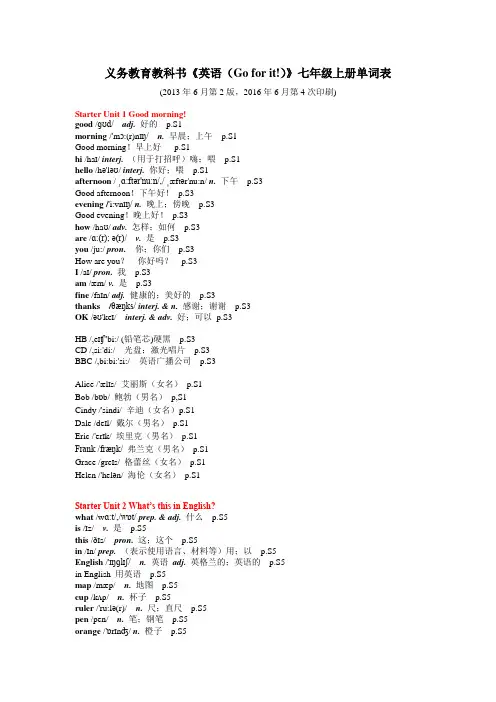
义务教育教科书《英语(Go for it!)》七年级上册单词表(2013年6月第2版,2016年6月第4次印刷)Starter Unit 1 Good morning!good /ɡʊd/ adj.好的p.S1morning /'mɔ:(r)nɪŋ/ n.早晨;上午p.S1Good morning!早上好p.S1hi /haɪ/ interj.(用于打招呼)嗨;喂p.S1hello /hə'ləʊ/ interj.你好;喂p.S1afternoon / ˌɑ:ftər'nu:n/,/ˌæftər'nu:n/n.下午p.S3Good afternoon!下午好!p.S3evening /'i:vnɪŋ/ n.晚上;傍晚p.S3Good evening!晚上好!p.S3how /haʊ/ adv.怎样;如何p.S3are /ɑ:(r); ə(r)/ v.是p.S3you /ju:/ pron. 你;你们p.S3How are you?你好吗?p.S3I /aɪ/ pron.我p.S3am /æm/ v.是p.S3fine /faɪn/ adj.健康的;美好的p.S3thanks /θæŋks/ interj. & n.感谢;谢谢p.S3OK /əʊ'keɪ/ interj. & adv. 好;可以p.S3HB /,eɪʧ''bi:/ (铅笔芯)硬黑p.S3CD /,si:'di:/ 光盘;激光唱片p.S3BBC /,bi:bi:'si:/ 英语广播公司p.S3Alice /'ælɪs/ 艾丽斯(女名)p.S1Bob /bɒb/ 鲍勃(男名)p,S1Cindy /'sindi/ 辛迪(女名)p.S1Dale /deɪl/ 戴尔(男名)p.S1Eric /'erɪk/ 埃里克(男名)p.S1Frank /fræŋk/ 弗兰克(男名)p.S1Grace /greɪs/ 格蕾丝(女名)p.S1Helen /'helən/ 海伦(女名)p.S1Starter Unit 2 What’s this in English?what /wɑ:t/,/wɒt/ prep. & adj.什么p.S5is /ɪz/ v.是p.S5this /ðɪs/ pron.这;这个p.S5in /ɪn/ prep.(表示使用语言、材料等)用;以p.S5English /'ɪŋɡlɪʃ/ n.英语adj.英格兰的;英语的p.S5in English 用英语p.S5map /mæp/ n.地图p.S5cup /kʌp/ n. 杯子p.S5ruler /'ru:lə(r)/ n. 尺;直尺p.S5pen /pen/ n.笔;钢笔p.S5orange /'ɒrɪnʤ/ n.橙子p.S5jacket /'ʤækɪt/ n.夹克衫;短上衣p.S5key /ki:/ n.钥匙p.S5quilt /kwɪlt/ n. 被子;床罩p.S5it /ɪt/ pron.它p.S5a /eɪ;ə/ (an /æn; /ən/) art.(用于单数可数名词前,表示未曾提到的)一(人、事、物)p.S5 that /ðæt/ pron. 那;那个p.S7spell /spel/ v. 用字母拼;拼写p.S7please /pli:z/ interj.(用于客气地请求或吩咐)请p.S7NBA /,en bi:'eɪ/ (美国)全球篮球协会p.S6P /pi:/ 停车场;停车位p.S6kg /,keɪ'ʤi:/ 千克;公斤p.S6Starter Unit 3 What color is it?color /'kʌlə(r)/ n. ( = colour) 颜色p.S9red /red/ adj. & n.红色(的)p.S9yellow /'jeləʊ/ adj. & n.黄色(的)p.S9green /ɡri:n/ adj. & n.绿色(的)p.S9blue /blu:/ adj. & n.蓝色(的)p.S9black /blæk/ adj. & n.黑色(的)p.S9white /waɪt/ adj. & n.白色(的)p.S9purple /'pɜ:pl/ adj. & n. 紫色(的)p.S9brown /braʊn/ adj. & n. 棕色(的);褐色(的)p.S9the /ði; ðə/ art.指已提到或易领会到的人或事物p.S11now /naʊ/ adv.现在;目前p.S12see /si:/ v. 理解;明白p.S12can /kæn; kən/ modeal v.能;会p.S12say /seɪ/ v.说;讲p.S12my /maɪ/ pron.我的p.S12S /es/ (尤指服装的尺码)小号的p.S10M /em/ (尤指服装的尺码) 中号的p.S10L /el/ (尤指服装的尺码) 大号的p.S10UFO /,ju: ef'əʊ/ 不明飞行物p.S10CCTV /,si: si: ti: 'vi:/ 中国中央电视台p.S10Unit 1 My name’s Gina.name /neɪm/ n.名字;名称p.1nice /naɪs/ adj.令人愉快的;宜人的p.1to /tu:/ 常用于原形动词之前,表示该动词为不定式p.1meet /mi:t/ v.遇见;相逢p.1too /tu:/ adv. 也;又;太p.1your /jɔ:(r)/ pron.你的;你们的p.1Ms. /mɪz/ (用于女子的姓氏或姓名前,不指明婚否)女士p.1his /hɪz/ pron.他的p.2and /ænd/ conj.和;又;而p.2her /hɜ:(r)/ pron.她的p.2yes /jes/ interj.是的;可以p.2she /ʃi:/ pron.她p.2he /hi:/ pron.他p.2no /nəʊ/ adv. & adj.不;没有;不是p.2not /nɒt/ adv.不;没有p.2zero /'zi:rəʊ/,/'zɪərəʊ/ num.零p.4one /wʌn/ num. 一p.4two /tu:/ num. 二p.4three/θri:/ num. 三p.4four /fɔ:(r)/ num.四p.4five /faɪv/ num. 五p.4six /sɪks/ num. 六p.4seven /'sevən/ num. 七p.4eight /eɪt/ num. 八p.4nine /naɪn/ num. 九p.4telephone /'telɪfəʊn/ n.电话;电话机p.4number /'nʌmbə(r)/ n.号码;数字p.4phone /fəʊn/ n.电话;电话机p.4telephone/ phone number 电话号码p.4first /fɜ:(r)st/ adj.第一p.5first name名字p.5last /læst/;/lɑ:st/ adj.最后的;末尾的p.5last name 姓p.5friend /frend/ n.朋友p.5China /'ʧaɪnə/ 中国p.5middle /'mɪdl/ adj.中间的n.中间p.6school /sku:l/ n.学校p.6middle school 中学;初中Gina / ˈdʒinə/ 吉娜(女名)p.1Jenny /'dʒenɪ/ 珍妮(女名)p.1Brown /braʊn/ 布朗(姓)p.1Alan / 'ælən/ 艾伦(男名)p.1Tom /tɒm/ 汤姆(男名)p.2Mike /maɪk/迈克(男名)p.2Jack /dʒæk/ 杰克(男名)p.2Mary /ˈmɛərɪ/ 玛丽(女名)p.2Miller /'mɪlə/ 米勒(姓)p.2Linda /'lɪndə/ 琳达(女名)p.2Jane /dʒeɪn/ 简(女名)p.2Green /griːn/ 格林(姓)p.5Smith /smɪθ/ 史密斯(姓)p.5Unit 2 This is my sister.sister /'sɪstə(r)/ n.姐;妹p.7mother /'mʌðə(r)/ n. 母亲;妈妈p.7father /'fɑ:ðə(r)/ n. 父亲;爸爸p.7parent /'perənt/ n. 父(母)亲p.7brother /brʌðə(r)/ n. 兄;弟p.7grandmother /'ɡræn,mʌðə(r)/ n.(外)祖母;奶奶;外婆;姥姥p.7 grandfather /'ɡrænd,fɑ:ðə(r)/ n. (外)祖父;爷爷;外公;姥爷p.7 grandparent /'ɡræn,perənt/ n. 祖父(母);外祖父(母)p.7 family /'fæməlɪ/ n.家;家庭p.7those /ðəʊz/ pron.那些p.7who /hu:/ pron.谁;什么人p.7oh /əʊ/ interj.哦;啊p.7these /ði:z/ pron.这些p.7they /ðeɪ/ pron.他(她、它)们p.8well /wel/ interj.嗯;好吧p.8have /hæv/ v.经受;经历p.8day /deɪ/ n.一天;一日;白天p.8Have a good day! (表示祝愿)过得愉快!P.8bye /baɪ/ interj.再见(=goodbye)p.8son /sʌn/ n.儿子p.10cousin /'kʌzən/ n. 堂兄(弟、姊、妹);表兄(弟、姊、妹)p.10 grandpa /'ɡrænpɑ:/ n. (外)祖父;爷爷;外公;姥爷p.10 mom /mʌm/ n. (=mum) 妈妈p.10aunt /ɑ:nt/ n. 姑母;姨母;伯母;婶母;舅母p.10grandma /'ɡrænmɑ:/ n. (外)祖母;奶奶;外婆;姥姥p.10dad /dæd/ n. 爸爸p.10uncle /'ʌnkl/ n. 舅父;叔父;伯父;姑父;姨父p.10daughter /'dɔ:tə(r)/ n. 女儿p.10here /hɪr/ adv.(用以介绍某人或某物)这就是;在这里p.11 photo /'fəʊtəʊ/ n. 照片p.11of /əv/ prep.属于(某人或某物); 关于(某人或某物)p.11 next /nekst/ adj. & n. 下一个(的);接下来(的)p.11picture /'pɪkʧə(r)/ n.照片;图画p.11girl /ɡɜ:(r)l/ n.女孩p.11dog /dɒɡ/ n. 狗p.11Sally /'sælɪ/萨利(女名)p.8Kate /keɪt/ 凯特(女名)p.8Paul /pɔ:l/ 保罗(男名)p.8Unit 3 Is this your pencil?pencil /'pensəl/ n.铅笔p.13book /bʊk/ n. 书p.13eraser /ɪ'reɪsər/ n. 橡皮p.13box /bɒks/ n. 箱;盒p.13pencil box 铅笔盒;文具盒p.13schoolbag /'sku:lbæɡ/ n. 书包p.13dictionary /'dɪkʃənərɪ/ n. 词典;字典p.13his /hɪz/ pron.他的p.13mine /maɪn/ pron. 我的p.13hers /hɜ:(r)z/ pron. 她的p.13excuse /ɪk'skju:z/ v. 原谅;宽恕p.14me /mi:/ pron.(I的宾格)我p.14excuse me 劳驾;请原谅thank /θæŋk/ v. 感谢;谢谢p.14teacher /'ti:ʧə(r)/ n.老师;教师p.14about /ə'baʊt/ prep.关于adv. 大约p.14What about...?(询问消息或提出建议)...怎么样?...好吗?p.14 yours /jɔ:(r)z/ pron. 你的;你们的p.14for /fɔ:(r)/ prep.为了;给;对p.14thank you for 为...而感谢p.14help /help/ v. & n. 帮助;援助p.14welcome /'welkəm/ adj. 受欢迎的p.14You're welcome. 别客气。
go for it 初中英语初一七年级上册各单元语法句型演练单元习题句型填空
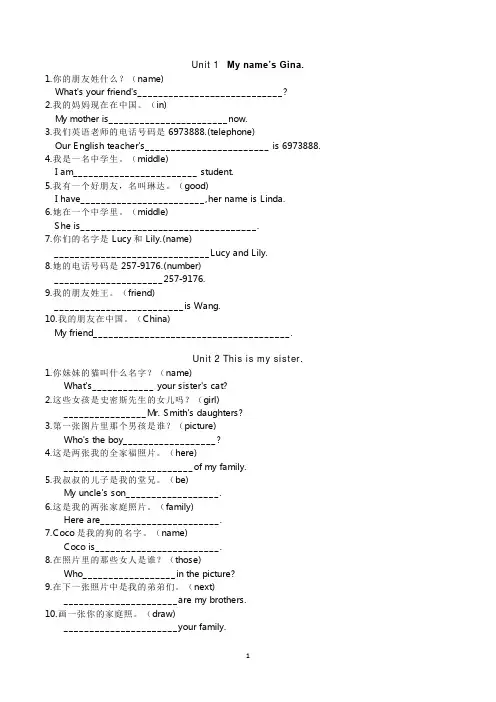
Unit 1 My name’s Gina.1.你的朋友姓什么?(name)What's your friend's____________________________?2.我的妈妈现在在中国。
(in)My mother is_______________________now.3.我们英语老师的电话号码是6973888.(telephone)Our English teacher's________________________ is 6973888.4.我是一名中学生。
(middle)I am________________________ student.5.我有一个好朋友,名叫琳达。
(good)I have________________________,her name is Linda.6.她在一个中学里。
(middle)She is__________________________________.7.你们的名字是Lucy和Lily.(name)______________________________Lucy and Lily.8.她的电话号码是257-9176.(number)_____________________257-9176.9.我的朋友姓王。
(friend)_________________________is Wang.10.我的朋友在中国。
(China)My friend______________________________________.Unit 2 This is my sister.1.你妹妹的猫叫什么名字?(name)What's____________ your sister's cat?2.这些女孩是史密斯先生的女儿吗?(girl)________________Mr. Smith's daughters?3.第一张图片里那个男孩是谁?(picture)Who's the boy__________________?4.这是两张我的全家福照片。
义务教育教科书《英语(Goforit!)》七年级上册单词表.doc
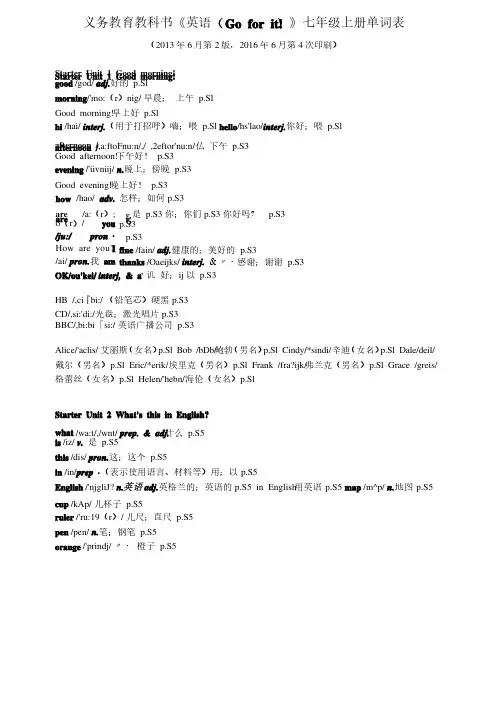
义务教育教科书《英语(Go for it!)》七年级上册单词表(2013年6月第2版,2016年6月第4次印刷)Starter Unit 1 Good morning! good /god/ adj.好的p.Slmorning /'mo:(r )nig/ 早晨;上午p.SlGood morning!早上好p.Slhi /hai/ interj.(用于打招呼)嗨;喂p.Sl hello /hs'lao/interj.你好;喂p.Slafternoon / ,a:ftoFnu:n/,/ ,a:ftoFnu:n/,/ ,2eftor'nu:n/ 仏下午p.S3 Good afternoon!下午好!p.S3evening /'iivniij/ n.晚上;傍晚p.S3Good evening!晚上好! p.S3怎样;如何p.S3v,是p.S3 你;你们p.S3 你好吗?p.S3 p.S3p.S3fine /fain/ adj.健康的;美好的p.S3thanks /Oaeijks/ interj. & 〃・感谢;谢谢p.S3 OK/ou'kei/ interj, & a 〃讥〃讥好;ij 以p.S3HB /,ci 『bi:/ (铅笔芯)硬黑p.S3CD/,si:'di:/光盘;激光唱片p.S3BBC/,bi:bi 「si:/ 英语广播公司p.S3Alice/'aclis/ 艾丽斯(女名)p.Sl Bob /bDb/ 鲍勃(男名)p,Sl Cindy/*sindi/ 辛迪辛迪(女名)p.Sl Dale/deil/ 戴尔(男名)p.Sl Eric/*erik/ 埃里克(男名)埃里克(男名)p.Sl Frank /fra?ijk/弗兰克(男名)p.Sl Grace /greis/ 格蕾丝(女名)p.Sl Helen/'hebn/ 海伦(女名)海伦(女名)p.SlStarter Unit 2 What's this in English?what /wa:t/,/wnt/ prep. & adj.什么p.S5 is /iz/ v.是p.S5this /dis/ pron.这;这个p.S5in /in/prep ・(表示使用语言、材料等)用;以p.S5English /'njgliJ? n.英语adj.英格兰的;英语的p.S5 in English用英语p.S5 map /m^p/ n.地图p.S5 cup /kAp/ 儿杯子p.S5ruler /'ru:19(r )/ 儿尺;直尺p.S5pen /pen/ n.笔;钢笔p.S5orange /'prindj/ 〃・橙子p.S5how /hao/ adv. are/a:(r ); o (r )/ you /ju:/ pron ・How are you? I /ai/ pron.我amjacket /f d32ckit/ n.夹克衫;短上衣 p.S5 key /ki:/ n.钥匙 p.S5 quilt /kwilt/ n.被子;床罩 p.S5 it /it/ pron.它 p.S5 a /ei;a/ (an /sen; /sn/)art.(用于单数可数名词前,表示未曾提到的)一(人、事、物)p.S5 that /dsct/ pron.那;那个 p.S7 spell /spel/ v.用字母拼;拼写p.S7 please /pli:z/ interj.(用于客气地请求或吩咐)请 p.S7NBA /,en bi:Q/(美国)全球篮球协会p.S6 P/pi :/停车场;停车位p.S6 kg/Jkei'ctji:/ 千克;公斤 p.S6 Starter Unit 3 What color is it? color /'kAb(r)/ n. ( = colour)颜色 p.S9 red /red/ adj. & n.红色(的) p.S9 now /nao/ adv.现在;目前 p.S12 see /si:/ v.理解;明白 p.S12 can /k^n; kon/ m odeal v.modeal v. 能; 会 p.S12 say /sci/ v.说;讲 p.S12 my /mai/ pron. 我的 p.S12 S/es/ (尤指服装的尺码)(尤指服装的尺码)小号的 M /em/ (尤指服装的尺码) 中号的 L/cl/(尤指服装的尺码) 大号的 UFO /Ju: ef90/ 不明飞行物 p.SlO CCTV/,si: si: ti: M:/ 中国中央电视台 p.SlO Unit 1 My name's Gina. name /ncim/ n. 名字;名称 p 」nice /nais/ adj.令人愉快的;宜人的 p.l to /tu:/常用于原形动词之前,表示该动词为不定式p 」meet /mi:t/ v.遇见;相逢 p 」too /tu:/adv.也;又;太 p.l your/jo:(r)/pron.你的;你们的 p.lMs. /miz/ (用于女子的姓氏或姓名前,不指明婚否)女士 p.lhis /hiz/ pron.他的 p.2 and /send/ conj.和;又;而 p.2 her /h3:(r)/ pron.她的 p.2 yes /jes/ interj.是的;可以 p.2 she l^v.l pron.她 p.2 he /hi:/ pron.他 p.2 yellow /Jeloo/ adj. & n. green /gri:n/ adj. & n. blue /blu:/ adj. & n. black /blgck/ adj. & n. white /wait/ adj. & n. purple /'p3:pl/ adj. & n. brown /braon/ adj. & n. 黄色(的) p.S9 绿色(的) p.S9 蓝色(的) p.S9 黑色(的) p.S9 白色(的) p.S9 紫色(的) p.S9 棕色(的); 褐色(的) the /di; ds/ a rt.art.指C 提到或易领会到的人或事物p.S9 p.Sll p.SlO p.SlO p.SlO no /nao/ adv. & adj.不;没有;不是p.2not /nnt/ adv.不;没有p.2 zero /'zi:roo/,/'zior9o/ num.'冬p.4one /wAn/ num・一p.4 two /tu:/ num.二p.4three /0ri:/ num・三p.4 four /fo:(r)/ num.四p.4 five /faiv/ num.五p.4 six /siks/ num,六p.4 seven /'sevsn/ num.七p.4 eight /cit/ num.八p.4 nine /nain/ num・九p.4 telephone /'telifoun/ n.电话;电话机p.4 number /'nAmbs(r)/ n.号码;数字p.4 phone /fson/ n.电话;电话机p.4 telephone/ phone number 电话号码电话号码p.4 first /f3:(r)st/ adj.第一p.5 first name 名字p.5last/lxst/;/la:st/adj.最后的;末尾的p.5 last name 姓p.5friend /frend/ n,朋友p.5 China /'『ama/ 中国p.5 middle /'midi/ adj.中间的n.中间p.6 school /sku:l/ n.学校p.6 middle school 中学;初中Gina/ ^ins/ 吉娜(女名)吉娜(女名)p.lJenny/'djeni/ 珍妮(女名)p.lBrown /braun/ 布朗布朗(姓)p」Alan /空bn/艾伦(男名)p.l Tom /tnm/ 汤姆(男名)p.2 Mike /maik/边克(男名)p.2 Jack /d3^k/ 杰克(男名)p.2 Mary /'niEori/ 玛丽(女名)p.2Miller /'mils/ 米勒(姓)米勒(姓)p.2Linda /'lindo/ 琳达(女名)琳达(女名)p.2Jane /d3ein/ 简(女名)简(女名)p.2Green /gri:n/ 格林(姓)格林(姓)p.5Smith /smiO/ 史密斯(姓)史密斯(姓)p.5Unit 2 This is my sistersister/,sisto(r)/ n.姐;妹p.7 mother /*mAd9(r)/ n.母亲;妈妈p.7 father /'fa:d9(r)/ n.父亲;爸爸p.7 parent /'peront/ n.父(母)亲p.7 brother /brAdo(r)/ n.兄;弟p.7 grandmother^grsen^iAdafr)/n.(外)祖母;奶奶;外婆;姥姥p.7 grandfather/'graendja^^r)/n.(外)祖父;爷爷;外公;姥爷p.7 grandparent/'grasn,pcr0nt/ n.祖父(母);外祖父(母)p.7 family /'fsemoli/ n,家;家庭p.7those /dauz/ pron.那些p.7who /hu:/pron.谁;什么人p.7oh /su/interj.哦;啊p.7these /di:z/ pro/z.这些p.7they /dei/pron.他(她、它)们p.8well /wcl/ interj.嗯;好吧p.8have /haev/ v.经受;经历p.8day/dei/n・一天;一口;白天p.8Have a good day!(表示祝愿)过得愉快!P.8bye /bai/ interj.再见(=goodbyc) p.8son /sAn/n・儿子p」0cousin /'kAzon/ n,堂兄(弟、姊、妹);表兄(弟、姊、妹)p.10 grandpa/'greenpa:/n.(外)祖父;爷爷;外公;姥爷p」0 mom /mAm/ n. (=mum)妈妈p」0aunt/a:nt/n.姑母;姨母;伯母;婶母;舅母p.10grandma ^graenmu:/ n,(外)祖母;奶奶;外婆;姥姥p.10 dad /dsed/ n.爸爸p.10uncle /'Ankl/n,舅父;叔父;伯父;姑父;姨父p.10daughter /’do:to(r)/ n.女儿p」0here/hir/ adv.(用以介绍某人或某物)这就是;在这里p.ll photo/'foutsu/n.照片p.llof/sv/ prep.属于(某人或某物);关于(某人或某物)p.ll next/nckst/adj.&兀.下一个(的);接下来(的)p」l picture/'pikjb(r)/n.照片;图画p.llgirl /g3:(r)l/ n.女孩p.lldog/dng/n.狗p.llSally/鈕li/萨利(女名)p.8Kate /keit/ 凯特(女名)凯特(女名)p.8Paul /po:l/ 保罗(男名)保罗(男名)p.8Unit 3 Is this your pencil? pencil/'penssl/ n.铅笔p」3 book /bok/ n,书p」3 eraser /I'reisor/ n・橡皮p.13 box /boks/ n.箱;盒p」3 pencil box铅笔盒;文具盒p.13 schoolbag /'sku:Ib至g/ n,书包p.13 dictionary /'dikjbnsri/ n.词典;字典p.13 his /hiz/ pron,他的p」3 mine /main/ pron・我tl勺p.13 hers /h3:(r)z/ pron.她的p」3 excuse /ik'skjuiz/ v,原谅;宽恕p」4 me /mi:/pron,(I 的宾格的宾格)我p.14 excuse me劳驾;请原谅thank /Oa^ijk/ v.感谢;谢谢p」4 teacher/'tig(r)/几老师;教师p.14 about/9fbaot/prep・关于adv.大约p.14What about...?(询问消息或提出建议)…怎么样?...好吗?p.14 y oursyours /jo:(r)z/pron.你的;你们的p」4 for/fo:(r)/prep・为了;给;对p」4thank you for 为…而感谢 p.14 help /help/ v, & 〃•帮助;援助 p.14 welcome /'welksm/ adj.受欢迎的 p 」4 You're welcome.别客气。
人教版go-for-it-英语七年级上重点短语及句型
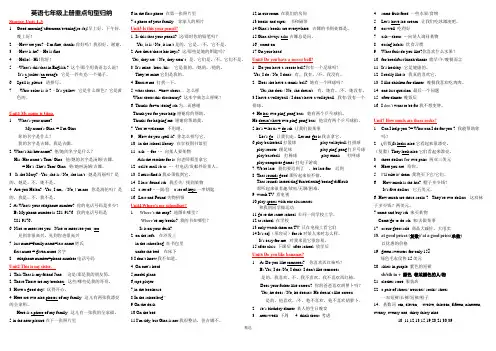
英语七年级上册重点句型归纳Starter Unit 1-31.Good morning/afternoon/evening(to sb)!早上好,下午好,晚上好!2.–How are you? –I’m fine, thanks.你好吗?我很好,谢谢。
3.–How is he? – He is fine.4.–Hello! –Hi !你好!5.–What’s this/that in English ? 这个/那个用英语怎么说?It’s a jacket./an orange. 它是一件夹克/一个橘子。
6.Spell it, please. 请拼写。
7.--What color is it ? – It’s yellow. 它是什么颜色?它是黄色的。
Unit1 My name is Gina.1.-What’s your name?-My name's Gina. = I’m Gina.你的名字是什么?我的名字是吉娜。
我是吉娜。
2.-What’s his/her name? 他/她的名字是什么?- His /Her name’s Tom/ Gina. 他/她的名字是汤姆/吉娜。
= He’s /She’s Tom/ Gina. 他/她叫汤姆/吉娜。
3.- Is she Mary? –Yes, she is./ No, she isn’t. 她是玛丽吗?是的,她是。
不,她不是。
4.-Are you Helen? –Yes, I am。
/ No, I’m not. 你是海伦吗?是的,我是。
不,我不是。
5. A: What's your telephone number? 你的电话号码是多少?B: My phone number is 281-9176. 我的电话号码是281-9176。
6.-Nice to meet/see you. -Nice to meet/see you, too.见到你很高兴。
新目标版(Go for it)2019-2020学年初中英语七年级上册Unit4 Where's my schoolbag?Section B课时练D卷
新目标版(Go for it)2019-2020学年初中英语七年级上册Unit4 Where's myschoolbag?Section B课时练D卷一、单选题 (共15题;共30分)1. (2分)一 Your paintings are as good as our teacher's.— ___________.A . Thank you for saying soB . I don't think soC . Certainly2. (2分)Miss Li is teaching ___________ the classroom and I am sitting ________ my friend.A . in front of; in the front ofB . behind; in the front ofC . in the front of; behind3. (2分)March 8th is _______ Day. I'll make a gift for my mother.A . WomanB . WomenC . Women'sD . Womens’4. (2分)I don't really r like the write, I have to say his books are very exciting.A . althoughB . unlessC . untilD . as if5. (2分)If you _______ the book, you _______ buy it right now, I think.A . needn't; needn'tB . don't need; don't needC . don't need; needn'tD . don't need; needn't to6. (2分)This cake is really big. _______ share it.A . May be we canB . We may be canC . Maybe we canD . Maybe can we7. (2分)—______?—My computer doesn't work.A . What should I doB . What's wrongC . What's the matterD . both B and C8. (2分)We usually have a party _______ the evening _______ December 31.A . in; onB . in; ofC . on; ofD . on; on9. (2分)Can you communicate your best friend?A . forB . atC . ofD . with10. (2分)It is __________.A . penB . my a penC . a my penD . my pen11. (2分)They on the farm too.A . areB . isC . am12. (2分)The boy often goes skating ________ weekends.A . inB . toC . onD . for13. (2分)Gina's birthday is the first of June.A . inB . onC . atD . for14. (2分)_____ teacher and _____ writer is going to give us a lecture next week.A . The; theB . The; /C . A; aD . A; /15. (2分)Here ________________________________ my sisters and this________________________________ my cousin.A . are; isB . are; areC . is; areD . is; is二、完型填空 (共1题;共10分)16. (10分)A young man was about to finish school. For a long time he had 1to get a beautiful sports car. He knew his father could well 2it, so he told him that a sports car was all he wanted. Then on the morning of his graduation(毕业),he was called to his father’s room. His father told him how 3he was to have such a fine son, and told him how much he loved him. He handed his son a beautiful gift box.4, the young man opened the box and found a lovely Bible(圣经)with his name on it. Angrily, he raised his 5 to his father and said, “With all your money you give me a Bible? ” He then rushed out of the house, leaving the Bible.Many years passed and the young man was very 6in business, and had a beautiful home and a wonderful family. 7that his father was very old, he thought perhaps he should go to see him. He had not seen him 8that graduation day. Before he could go, he received a phone telling him that his father had died. He had to go home immediately and take care of the things that his father left him. When he began to search through his father’s important papers, he saw the still new Bible, 9as he had left it years ago. Heopened the Bible and began to turn the pages. As he was reading, a car key with a tag(标牌)dropped from the back of the Bible. On the tag was the 10of his graduation, and the words “PAID IN FULL”. Sadness and regret(悔恨)filled his heart.(1)A . expectedB . believedC . enjoyedD . felt(2)A . affordB . spendC . costD . pay(3)A . excitedB . proudC . angryD . anxious(4)A . InterestedB . TiredC . SurprisedD . Relaxed(5)A . handB . headC . voiceD . sound(6)A . carefulB . helpfulC . wonderfulD . successful(7)A . WantingB . SuggestingC . NoticingD . Realizing(8)A . onB . sinceC . afterD . from(9)A . justB . onlyC . alwaysD . already(10)A . placeB . dateC . testD . name三、按要求完成句子 (共5题;共48分)17. (3分)We want two cups of tea(对划线部分提问) ________ ________ ________ do you want?18. (3分)Martin plays basketball after school. (改为一般疑问句并补全否定答语)——________ Martin ________basketball after school?——No, he ________.19. (18分)句型转换。
秋人教版七年级英语上册《Unit-4-Where's-my-schoolbag》单元练习
Unit 4 Where's my schoolbag?单元练习一、单项选择(共15小题;共15分)1. There is a window the wall.A. onB. inC. underD. at2. The English book is the desk the room.A. on; underB. under; onC. under; inD. on; in3. A young man glasses came the office. He had an old bag his arm.A. without; in; inB. with; into; underC. in; out of; underD. with; in; on4. most museums you can't make any noise.A. InB. OnC. AtD. Under5. --- your phone number?--- It's 6678954.A. Where'sB. What'sC. How'sD. What6. Where the twins?A. isB. areC. amD. be7. Betty speaks best English in our class she often helps us with it.A. andB. butC. orD. for8. Nancy is a good student. She studies hard she also likes to help others.A. andB. soC. butD. or9. The students are from England and maths teacher is from China.A. theyB. themC. theirD. theirs10. An old friend of my sister's always helps my brother and with English.A. I; ourB. me; ourselvesC. I; myD. me; our11. Tommy's pingpong bat is the ground.A. onB. inC. underD. /12. --- Where are the keys?--- They are the drawer.A. atB. underC. inD. on13. Look! A bird is flying the river.A. inB. underC. aboveD. on14. I have a black cat. It's the room.A. onB. underC. inD. after15. Where he from?A. areB. isC. doesD. has二、单词拼写(单句首字母填空)(共5小题;共5分)16. --- What do you think of his room?--- It's really t !17. I t your map is in your room.18. I have a pencil, b I don't have a pen.19. You should not a eat noodles for supper. You should try other food.20. Where is Mary? Oh, she's listening to music on the r (收音机).三、单词拼写(根据中文提示拼写单词)(共5小题;共5分)21. Mr. Wang's house has been (整洁的) since the robot came.22. At the moment Mr. Fox (想) "I'm right."23. We shouldn't throw rubbish e (到处) to protect environment.24. He is (总是) in the library.25. My (收音机) is on the bed.四、完形填空(共10小题;共15分)Jim has a small room. There 26 a desk, two chairs and a bed in it. There's a basketball 27 the door. He has a clock. 28 on the desk. A bag and some books 29 on it, too. A chair is near the desk. His shoes are 30 the bed. We can't see them. 31 a picture and a photo in his room. The picture is 32 the wall. You can 33 some trees and flowers in the picture. The 34 is on the wall, too. It's a photo of Jim's family. You can see his parents, his sister and 35 the photo. What a nice room it is!26. A. are B. is C. has D. have27. A. at B. on C. in D. behind28. A. Its B. It C. It's D. They're29. A. is B. are C. am D. has30. A. in B. under C. on D. at31. A. has B. have C. are D. is32. A. in B. on C. under D. at33. A. look B. see C. watch D. hear34. A. kite B. tree C. flower D. photo35. A. on B. near C. in D. under五、阅读理解(共20小题;共40分)AMy name is Max. I am twelve years old. I have many friends. Most of them are as old as I.My best friend is Bill. He lives near me. We go to the same school and we are in the same class. Bill helps me with my maths homework. I help him with his English homework.Bill is taller than me. He is quite fat. He doesn't like sports, so he doesn't get much exercise. We both have black eyes, but Bill's hair is longer. I like sports and I play football or go swimming every day. Every Sunday morning Bill and I play computer games. Sometimes I win. Sometimes he wins.36. The main(主要的) idea of the text is .A. Max has many friendsB. Max and Bill go to the same schoolC. Max and Bill are best friendsD. Max and Bill like the slime things37. Most of Max's friends are .A. twelve years oldB. older than MaxC. younger than MaxD. thirteen years old38. Max and Bill live .A. near each otherB. in different townsC. in the same houseD. in the school39. Max helps Bill with .A. his maths homeworkB. his English homeworkC. his sports lessonsD. his computer lessons40. Max and Bill both like .A. swimmingB. playing footballC. playing computer gamesD. sportsBWe have a flat(公寓) in London. There are six families in that building, Lucy and her son Tom, Tom is a student in 14 middle school. He is thirteen years old. His mother is a policewoman, Flat 102 is Sally's family. Her parents, Nick and Helen are teachers. Her grandpa, Peter lives with them. Sam and Mary are in flat 201. They are very old. They have a son, Ned. Ned works in China now. Rose lives in Flat 202. She is a doctor. Flat 302 is Joy's home. She is 71 years old. Joy has a daughter, Jane. Jane works in Hong Kong. Jean, Jane's daughter, lives with her grandma. Everyone here is nice. They are all happy.41. Where is our flat?A. It's in ChinaB. It's in EnglandC. It's in CanadaD. It's in America42. Where does Lucy work?A. She works in a libraryB. She works in a schoolC. She works in a police officeD. She works in a restaurant43. How may sons do Sam and Mary have?A. They have oneB. They have two sonsC. They have four sonsD. They have four sons44. Who is Jane?A. She is Joy's mother, Jean's daughterB. She is Joy and Jean's motherC. She is Joy's daughter, Jean's motherD. She is Jean's grandmother, Joy's mother45. What's our flat's number?A. It's 201B. It's 302C. It's 301D. It's 102CThere is a new park near Andy's home. It's fine today. Andy and his family are in the park now. On their left, there is a cafe(咖啡厅). On their right, there is a big lake. There are many flowers and trees around the lake.There's a small hill behind the lake. Near the lake, there are two signs. One says, "Don't swim in the lake!" The other says, "No fishing!" But you can go boating on the lake. There is a beautiful garden in the middle of the park.There are beautiful flowers and green grass in it. There are some small shops between the lake and the garden. The park is so nice. Andy and his family like it very much.46. The park near Andy's home isA. new and beautifulB. old and beautifulC. clean and newD. old and clean47. Is there a cafe (咖啡厅) in the park?A. Yes, there isn'tB. No, there isn'tC. Yes, there isD. No,48. Andy and his family can on the lake.A. swimB. fishC. boatD. like49. The shops in the park are notA. smallB. bigC. goodD. pretty50. Do Andy and his family like the park?A. Yes, they don'tB. No, they doC. Yes, very muchD. No, theyDThis is a picture of Michael's room. It is nice and bright. The walls are blue and the window is big. You can see a photo of him on the wall. The desk is near the window. There is a computer on the desk. You can see small green plants on the window. A nice clock is on it, too. Can you tell me the time? Yes, it is eight now. A new basketball is under his bed. His T-shirt and his bag are on the bed. Look! What's that on the floor? Oh, it's Mimi. It is playing with a ball. Mimi looks like a black ball. Do you know what it is?51. It is a picture of Michael's .A. classroomB. roomC. familyD. desk52. You can see blue and a big in the picture.A. beds; clockB. walls; doorC. walls; windowD. doors; bed53. The plants are .A. bigB. niceC. blueD. green54. Michael's T-shirt is .A. near the windowB. under his bedC. on the floorD. on the bed55. You can guess Mimi is a black .A. hatB. birdC. catD. dog六、阅读与表达(判断式)(共5小题;共10分)Pat: Great! Our clothes are OK. Where is my dad's new shirt?Julie: What color is it?Pat: It's white.Julie: Here is a light(淡色的) blue shirt. Is it your dad's?Pat: No, it's not his... Oh, it's his.Julie: Oh, no! All our clothes are light blue.Pat: Here is the problem(问题). It's the new blue trousers. Whose(谁的) trousers are they? Julie: Uh, they're mine. Sorry.根据短文内容,判断正误,正确的为“T”,错误的为“F”。
七年级英语上册《Unit 4 Where's my schoolbag》教学设计 (新版)人教新目标
Unit 4 Where’s my schoolbag?Learning ObjectivesIn this unit, students will learn to talk about where things are.一、Topics(话题):Things around the house二、Functions (功能)Talk about where things are三、Structures (结构)Where questionsPrepositions: on, in, underConjunction and四、Target Language (目标语言)Where is his pencil?It is in his schoolbag.Where’s your ruler?It’s under the chair.Where are my books?They’re on the sofa.五、Vocabulary (词汇)Rooms of the house, furniture, table, bed, sofa, chair, desk, radio, clock, tape, tape player, model plane, on, under, where, their, e on六、Skills (技能)Listening and reading for specific information七、Recycling (复习巩固)Personal itemsQuestion forms with to beSchoolbag, key, ruler, map, hat, CD, bag, book, pencil box, pencil, pen, puter game, dictionary, notebook, inI’m..., and my sister...八、教材分析本单元围绕着Where’s my schoolbag?的话题,共设计了三个部分的内容。
Unit 4 Where's my schoolbag 教材重要知识点梳理人教版英语七年级上册
Unit 4 Where’s my schoolbag?I. Section A该句型意为“某人/某物在哪里?”,用于询问地点,其中where 为疑问副词,意为“在哪里;到哪里”,用来引导特殊疑问句,be 动词在人称和数方面和主语保持一致。
-Where is your schoolbag?你的书包呢?-It’s on the desk.它在桌子上。
-Where are your books?你的书本呢?-They’re in the schoolbag.它们在书包里。
3.bed的用法作为可数名词,意为“床”。
常用于:(1)go to bed,意为“上床睡觉”。
Tom,let’s go to bed.汤姆,让我们去睡觉吧。
(2)make the bed,意为“整理床铺”。
Look! The little boy is making the bed.看!小男孩儿正在整理床铺。
4.sofa的用法作为名词,意为“沙发”,是一个音译词,常用于on the sofa,意为“在沙发上”。
Jack’s family are watching TV on the sofa.杰克一家人正坐在沙发上看电视。
拓展:和sofa一样常见的音译词还有jeep【吉普车】,cartoon【卡通】,coffee【咖啡】等。
e的用法作为不及物动词,意为“来;来到”,其反义词为go,意为“去”. 常用于:(1)come on 意为“快点儿;加油;行啦等”Come on!The bus is coming.【come on 表示催促】快点儿!公交车来了。
Come on,Jim.You can do it.【come on 用于鼓励他人】加油,吉姆!你可以做到的。
Come on!Don’t cry,I can help you.【come on 表示安慰、请求等】好啦!不要哭,我来帮助你。
(2)come to sp. 意为“来到某地”Come to my house tonight if you are free.如果你有空的话,今晚来我家吧。
【初中英语】人教版七年级上册Unit 4 Where's my schoolbag-(练习题)
人教版七年级上册Unit 4 Where's myschoolbag?(855)1.我的房间H i, bo ys a n d g ir ls.Do yo u wan t to k no w a bou t me? O K.Le t me tell yo u s o me th in g ab ou t mys e lf.M y 1na me is S a ll y.M y la s t na me is B r o wn.I 2 f rom th e U K. 3 now I li ve in Ca n ad a(加拿大)with my p a r e n ts.I h a ve a n e w r oo m.I o f te n c le an(打扫)it, s o it is ve r y 4 .T h e win d o w is ve r y b ig.T he 5 o f th e cu r ta in(窗帘)is b lu e.T he r e is a b e d, a d e sk, a ch a ir a n d ab o okc a se 6 my r o o m.W h a t's o n myde s k? Oh, it's a7 .S o me E n g lish b oo ks a r e on it, too.8 is my ta p e p la ye r? It is in my b o o k ca s e.Myf a th e r b o u gh t(买) the ta p e p la ye r f o r 9 .Is my s c h o o lb ag on my ch a ir? No, it is o n my b e d.So me bo ok s, a p en c il bo x a nd a d ictio n a r y a r e in it.I lik e my 10ve r y mu c h.D o yo u lik e it?(1)A.f ir s tB.f a milyC.l a s tD.fu ll(2)A.b eB.a mC.isD.a r e(3)A.S oB.A ndC.O rD.B u t(4)A.g o odB.tid yC.we lc o meD.n e w(5)A.n a meB.ca r dC.co lo rD.n u mb e r(6)A.o nB.inC.un de rD.fo r(7)A.so f aB.c lo c kC.ch a irD.tab le(8)A.W he r eB.W h a tC.H o wD.W ho(9)A.itB.IC.meD.h e r(10)A.sc ho o lB.ro o mC.lib ra r yD.c la s s r oo m2.汤姆的卧室T h is is a ph o to o f my b e d r oo m(卧室).It's n ot b ig,b u t it's ve r y ti d y.You c a n s ee a bed n e x t to th e wa ll(墙).T h e p h o to o n th e wa ll is min e.T h e re is a qu ilt a nd a b a se b a ll c ap o n my b e d.Th e r e is a c lo c k o n th e tab le.It's my g o o d f r ie nd.E ve r y mo r n in g it c a n “s in g” on time to wa ke me up.W ha t's u n de r the c h a ir?It's my f a vo r ite f oo tb a ll.Do yo u wa n t to p la y f o o tba ll with me? M y p en s ar e in the p en c il b ox o n th e d e sk.On th e d es k,yo u c a n a lso se e s o me b o ok s.Wh e r e's my s c h oo lb ag?O h,it's o n th e fl oo r.D o you k n o w my n a me I'm To m B ro wn.(1)W he r e is th e c lo ck()A.On the ta b le.B.O n th e c ha ir.C.O n th e wa ll.D.On the be d.(2)W ha t's u n d e r th e ch a ir?()A.A sc ho o lba g.B.A p e nc il b ox.C.A b a s eb a ll ca p.D.A fo o tba ll.(3)W ha t ca n yo u s ee on th e b ed?()A.A q u ilt an d a bo ok.B.A q u ilt an d a ba s e ba ll c a p.C.A fo o tba ll a nd a s cho o lb ag.D.A p e nc il bo x a n d s ome b o o k s.(4)W ha t do e s th e u nd er lin e d wo r d(画线的单词)“f lo o r”me a n(意思是)i n C h i n e s e?()A.沙发B.床C.地板D.书架(5)We c an kn o w.()A.To m's b e d r o o m is big a nd tid yB.the c lo c k c an r ea lly s in gC.the r e isn't a p h o to on th e wa llD.To m lik e s p la yin g fo o tb a ll3.词汇积累:ne x t to 靠近;紧邻s in g v.唱;唱歌on time准时;按时wa ke u p 叫醒(某人);醒来从“词汇积累”中选择合适的单词或短语并用其适当的形式填空。