
PEP六年级上册 Unit5 B Let's Talk
aunt
scientist
at a
by
university subway
sister
coach in a gym on foot
brother worker
at a factory
by bus 10
-_H__o_w_ does she go to work? -By bike.
-__W__h_a_t _ does she do? -A postwoman.
8
• 1 Where does Mike’s uncle work? He works at sea.
• 2 How does he go to work? He goes to work by bike.
• 3 Where does your father/mother work? He/She works at a_____.
(cinema/hospital/shop) • 4 How does your father/ mother work?
He/She goes to work by/on_____.
(taxi/bus/bike/car/foot)
9
A: What does your ……(称呼) do?
Group work
11
-_W__h_e_n__ does she go to work? -At 8:30 a.m.
-__W__h_e_r_e__does she work? -In the bookstore.
12
My Friend Zhang Peng
Zhang Peng is my good
_f_r_ie_n_d_ .He is _1_3__. He is a s_t_u_d_e_n_t. He g__o_e_s to school by bike every day. He _li_k_e_s_ math andEnglishat school. Hel_ik_e_s_ singing and going hiking, too. Sometimes he teaches
16
me to sing and dance. What is he
going to be? He says he wants to be
a pilot .
13
a cleaner an actor a businessman
a singer a writer a host
14
-- What does she/he do?
How does he go to work?
He goes to work by ….
4
What does she do?
How does she go to work?
She goes to work by ….
5
What does he do?
How does he go to work?
He goes to work by ….
6
Task 1 Let’s try!
Xiao Yu and Mike are on their way home. They are talking about Xiao Yu's uncle. What's Xiao Yu's uncle like?
7
Task 2
B: She/He is ……(职业).
A: Where does she/he work?
B : She/He works ……(地方).
A: How does she/he go to work?
B: She/He goes to work ……(e
How
uncle fisherman at sea by boat
a factory worker.
a coach.
-- She’s /He’s
a police officer.
a postman.
a pilot.
-- Where does she/he go to work?
-- She/He works in/on/at ….
-- How does she/he go to work?
Unit 5 What does she do? Part B Let’s talk
1
What does he/she do? Where does he/she work?
nurse
postman police officer
in a hospital at a post office at the police(警署)
-- She/He goes to work by ….
15
连词成句
1. works hospital in My sister a (.)
My sister works in a hospital. 2. does your How uncle to work go (?)
How does your uncle go to work?
factory worker teacher businessman
in a factory
at a school in a company2
What does she do?
How does she go to work?
She goes to work by ….
3
What does he do?
Unit5 What does he do B let's talk(教案)人教PEP版英语六年级上
Unit 5 What Does He Do? B Let’s Talk教学目标本课程主要教授职业名称及相关动词的规范运用,让学生通过真实场景中的对话来学习相关内容,掌握英语表达能力以及职业观念。
教学重点•掌握单词:doctor, engineer, teacher, actor, musician, artist, athlete, student。
•掌握以下动词:help, teach, play, draw, sing, dance, run, study。
•能够正确运用所学单词和动词,通过模拟对话表达职业及其相关行为。
教学难点正确运用所学内容和单词构建完整句子,达到英语交流的标准并实现职业概念的灵活运用。
教学准备教师:课堂教具、音频资源。
学生:课本、笔记本。
教学内容及流程Step 1 - Lead-in1.教师通过展示职业头像图片进行职业名称的教学。
2.发现职业的行为特征,引导学生探究职业名称及其相关内容。
Step 2 - Presentation1.教师播放音频,让学生通过对话来学习不同职业名称及其相关行为各是什么。
2.教师在黑板上记录下母语学生所学习的单词,加深记忆。
Step 3 - Practice1.教师通过身份运动的方式带领学生熟悉相关动词。
2.教师分为两组进行角色扮演,以完整的对话形式为主题进行讨论。
3.在讨论中,教师通过适时提醒、纠正表达错误,帮助学生加深对英语表达的认识和理解。
Step 4 - Extension1.学生将对话写在笔记本上,并对其中出现的所学单词进行标注。
2.学生利用所学内容,完成有关职业的短文写作、图片画作等扩展训练。
教学结束本次课程的教学完成后,学生将具备掌握职业名称并能够正确运用所学单词以及动词的表达能力,实现了对于职业概念的灵活运用。
同时学生也将认识到自己所喜爱的职业方向,并加深对职业的理解和认识。
【精选】人教pep版六年级上册英语第五单元Unit5《What does he do》课文翻译
【精选】人教pep版六年级上册英语第五单元Unit5《What does he do》课文翻译A. Let's talk说一说Is your father here today?今天你的父亲在这儿吗?No.He's in Australia.不。
他在澳大利亚。
What does he do?他是做什么的?He's a businessman.他是一名商人。
He often goes to other countries.他经常去其他的国家。
And what does your mother do?那你母亲是做什么的?She's a head teacher.她是一位校长。
That's nice.那太好了。
Yeah. She'll be here today!是的。
她今天将在这儿!Do you want to be a head teacher,too?你也想成为校长吗?No,I want to be a businessman. 不,我想成为一名商人。
A. Let's learn学一学Is your father a postman?你的父亲是一名邮递员吗? No,he isn't.不,他不是。
What does he do?他是干什么的?He's a businessman.他是一名商人。
factory 工厂工人worker postman邮递员businessman 商人;企业家police officer警察B. Let's talk说一说My uncle is a fisherman.我的叔叔是一个渔民。
Where does he work?他在哪儿工作?He works at sea.他在海上工作。
He sees lots of fish every day!他每天看见许多鱼!I see.How does he go to work? By boat?我明白了。
pep六年级英语上册unit5 B let talk 第六课时-优件
Haha!you’re nuts!哈哈你疯了
Story time
1.Zoom: Wow!What a great job!哇!真是个好工作! Zip:Yes.What other unusual jobs can you think of? 是的。你能想到其他不寻常的工作?
2.Zoom:How about a lion tamer? 驯狮员如何? Zip:Oh,no.Too dangerous!哦,不,太危险了。
What about a bee farmer?I love honey.一只蜜蜂的农夫怎么样?我爱 蜂蜜
Hmm,Maybe a bee farmer will get stung.That’s not for me.嗯,也许一只蜜蜂会蜇农民。但这不是我
Maybe you can be a
computer game tester. You
6.Zip:I want to be a nut cracker.Yum!I like eating nuts.我 想成为一个胡桃夹。我喜欢吃坚果 Zoom:Haha!you’re nuts!哈哈你疯了
•不习惯读书进修的人,常会自满于现状,觉得再没有什么事情需要学习,于是他们不进则退。经验丰富的人读书用两只眼睛,一只眼睛看到纸面上的话,另 一眼睛看到纸的背面。2022年3月31日星期四2022/3/312022/3/312022/3/31 •书籍是屹立在时间的汪洋大海中的灯塔。2022年3月2022/3/312022/3/312022/3/313/31/2022 •正确的略读可使人用很少的时间接触大量的文献,并挑选出有意义的部分。2022/3/312022/3/31March 31, 2022 •书籍是屹立在时间的汪洋大海中的灯塔。
小学英语六年级上册Unit 5 Part A Let's talk教学设计
课堂练习
Summary andHomework
Summary
词汇:country, head teacher
句型:询问对方父母的职业:
-What does your father/mother do?
回答:He/She is a ______.
Do you want to be a _____?
10.Listen and imitate:音频跟读,模仿语音语调,进一步理解课文。
11.Practice:1. Read loudly by yourself.自己大声朗读。2. Read with your group members.分角色朗读
12.Show time:配Leabharlann 擂台,播放动画,学生给动画进行配音。
3.能完成talk about部分根据卡片信息进行正确问答,进行小组调查活动等巩固单词和句型。
重点
能够熟读talk部分对话并能进行情景表演并能通过游戏和小组活动巩固句型。
难点
能熟练运用所学单词和句型What does your father/mother do?询问对方父母的职业并能用He/She is a+职业名词的形式正确回答等。
19.Practice:用所给词的正确形式填空。
20.Practice:按要求完成句子
游戏巩固单词
话题导入
Free talk
听力练习
课文导入
音视频帮助学生理解课文
自主阅读,
培养能力
课文精读,语言点学习和运用
跟读模仿
小组合作
更好的掌握新授内容
创设情景,正确运用所学句型
对话练习,巩固单词和句型
通过游戏巩固句型
人教PEP版六年级英语上册《Unit5-B-Let’s-talk名师教案》

三、目标预设
1. 能够理解对话大意,能够用he/she do?
He’s/she’s...
二、呈现新课(Presentation)
1.听前预测。教师出示人物图片,介绍对话背景:Xiao Yu and Mike are on their way home. They are talking about Xiao Yu’s uncle.教师提问:What’s Xiao Yu’s uncle like Can you guess 在学生听前预测时,引导学生使用Is he…句型进行猜测。
四、小结(Summary)
Look at the words and sentences, the students summarize the contents of this class.
五、作业设计
1.Listen to the talk and readitsmoothly and correctly.
2.播放录音,回答第一个问题:What does Xiao Yu’s uncle look like?
3.教师追问:What does he do How does he go to work Does he often take Xiao Yu to school 并板书What does he do 和 How does he go to work 教师第二遍放录音,学生回答问题,并验证答案。
五、评价设计
1.借助动画、录音和图片,用听音跟读、Pair work、角色扮演等活动检测目标1的达成情况。
人教PEP六年级英语上册Unit5_B_Let’s_talk优秀课件
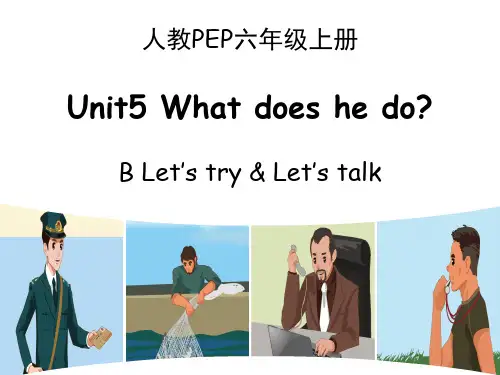
Unit5 What does he do?
B Let’s try & Let’s talk
>>Warm-up
Review
postman
police officer
factory worker
businessman
(一人站起来表演某职业的动作,其他人大声说出该职业名称。)
>>Warm-up
点击小喇叭或文本框都可以播放音频
>>Practice
Listen and imitate
Mike: No. He works on a boat. He goes to wor(k) by bike. Xiao Yu: He has a very healthy life. Mike: Yes. He works very hard an(d) stays healthy. Xiao Yu: We shoul(d) study hard an(d) stay healthy, too.
>>Practice
Listen and imitate
Mike: My uncle is a fisherman. Xiao Yu: Where does he work? Mike: He works a(t) sea. He sees lots o(f) fish every day! Xiao Yu: I see. How does he go to work? By boat?
science museum
cinema
school
post office
>>Practice
Do a survey
How does he / she go to work?
人教PEP版六年级英语上册《Unit5_B_Let’s_talk名师说课稿》
人教PEP版六年级英语上册《Unit5_B_Let’s_talk名师说课稿》一. 教材分析《人教PEP版六年级英语上册》Unit 5 B Let’s talk部分的名师说课稿如下:本节课主要讲述了关于动物的话题。
通过本节课的学习,学生能够掌握有关动物的词汇,如panda, tiger, penguin, elephant等,以及句型“What animal do you like? I like pandas.”,并能够运用所学知识进行简单的交流。
教材内容丰富,插图生动有趣,有利于激发学生的学习兴趣。
二. 学情分析六年级的学生已经具备了一定的英语基础,能够听懂并运用简单的英语进行交流。
但是,部分学生对动物的词汇和句型还不够熟悉,需要老师在教学中给予重点辅导。
此外,学生们的学习兴趣和学习积极性较高,有利于开展本节课的教学。
三. 说教学目标1.知识目标:学生能够掌握有关动物的词汇,如panda, tiger, penguin,elephant等,以及句型“What animal do you like? I like pandas.”。
2.能力目标:学生能够运用所学知识进行简单的交流,如询问和介绍自己喜欢的动物。
3.情感目标:通过本节课的学习,学生能够培养对动物的喜爱之情,提高保护动物的意识。
四. 说教学重难点1.重点:掌握有关动物的词汇和句型“What animal do you like? I likepandas.”。
2.难点:能够运用所学知识进行简单的交流,如询问和介绍自己喜欢的动物。
五. 说教学方法与手段1.教学方法:采用情景教学法、交际法、任务型教学法等。
2.教学手段:利用多媒体课件、图片、卡片等辅助教学。
六. 说教学过程1.导入:教师通过展示各种动物的图片,引导学生谈论自己喜欢的动物,为新课的学习营造轻松愉快的氛围。
2.呈现:教师展示本节课的主要词汇和句型,如panda, tiger, penguin, elephant等,以及句型“What animal do you like? I like pandas.”。
PEP小学英语六年级上册Unit5 PartA Let's talk 教学设计
PEP小学英语六年级上册Unit5 PartA Let's talk 教学设计教学目标:1. 通过听、说、读、写和综合运用语言进行交际和表达,学生能够熟练地正确使用本单元所学的生词和短语。
2. 能够听懂、理解、复述与本单元有关的对话及短文。
3. 能够在掌握本单元的基础上,培养学生阅读和听取信息的能力。
4. 增强学生的模仿、跟读、朗读、独立说英语的能力。
5. 让学生能够运用所学知识和技能,自主创造语言交际情境。
重点难点:1. 重点掌握课文中涉及的生词和短语。
2. 学习并掌握本单元中的四会单词。
3. 熟练掌握本单元的语音、语调、语音语调组合。
4. 超出单词表中单词和短语的情境对话。
教学准备:1. 多媒体设备2. 学生课本、作业本3. 小白板教学过程:Step 1. 总结回顾1. 通过生字、短语、句型的练习,巩固学生在第四单元培养的词汇量;2. 小组、全班共读教材中的对话,并尝试表演;3. 教师拓展课文中的话题,引导学生进行口语表达。
Step 2. 引入新课通过活动道具引入本单元的主题和内容。
T: Hello, everyone. Look at this picture.(点互动课件) What can you see in the picture?(随机提问学生)S1: I can see a bike.S2: I can see a house.……T: Yes, you are right. Now, I have a bike here, Can you see it?(教师指向课件中的图片)Ss: Yes, I can .T: Do you like riding a bike?(教师示范动作)S: Yes, I do.T: What do you need to ride a bike?(教师画出课件中的骑车人和大树,引导学生回答骑车的必备装备)Ss: We need a bike and a helmet.T: Very good. Today we will learn Unit 5 Let’s talk Part A. It’s about riding a bike. Is it interesting?Step 3. 学习新知1. 教师用情景地图复述短文(配合图片讲解)。
PEP六年级英语上册 Unit5 B Let's talk
How does she go to work? she goes to work by s_u_b_w.ay
What does she do? She is a _fa_c_to_r_y_woker
Where does she work? she works in the factory.
How does she go to work? He goes to work by _c_a_r__.
He/she works in the …… 2、How does your father/ your mother go to work?
Let’s ask!
He/she goes to worur father
doctor
Fu Xing Hospital
by car
A: Where does she _w_o_r_k? B: She works in the _sc_h_oo_l.
A: _H_o_w_ does she go to work?
B: She goes to work _on___fo_o_t.
B: what does __h_e_ do?
A: _H__e_is a _fi_sh_e_r_man
What does he do? He is a _s_in__g_e_r
PEP小学英语六年级上册Unit5 PartB Let's talk 教学设计
PEP小学英语六年级上册Unit5 PartB Let's talk 教学设计教学设计课题:PEP小学英语六年级上册Unit5 PartB Let's talk教学目标知识与技能:能准确地使用What time...? 和It’s+时间进行日常交际;情感态度:通过本节课学习,学生能够更好地理解并体验文化差异,提高跨文化交际能力。
教学重点How to use What time...? 和It’s+时间进行日常交际。
教学难点学习如何表达时间、在不同地点,不同时间问候朋友的区别。
教学准备PPT、卡片、黑板、白板、课件等。
教学过程Step 1 导入1. Greeting & Warm-up互相问候,检查学生的日常用语表达,可强调小组内部的问候方式的差异,利用黑板或PPT列出一些不同语境下的问候表达(例如早上、傍晚、晚上等),让学生显出文化差异。
2. Presentation出示图片或现场布置场景,让学生模拟场景互相问候(如:在商店/学校门口/公园中等等),根据不同场景再向学生简单介绍不同时间的表达,例如:What time is it? It’s five o'clock. / It’s ten in the morning. / It’s half past two. / It's a quarter to eleven.等等。
Step 2 预习任务1. Group work让学生分组完成一些预习石,要求他们准备关于自己所在城市的时间及与任意一个国家的时差。
2. Discussion让学生在小组内互相分享自己所掌握的时间信息,并总结出今天需要了解的表达。
Step 3 学生活动1. Examples and Activities出示多个英文表达时间的例子,并让学生跟随发音练习。
然后以小组表演为形式,让每个小组中的学生依次使用英语对组内的成员问候,根据时间进行不同回答。