
pep四年级英语上册第四单元
教学内容大课题Unit 4 My home学时共6学时本节内容A Let's talk Let's play C Good to know第1学时目的要求教学目标:1.能听懂会说Is it on your desk? Is it in your pencil-box? Is it in your desk? Is it under your book? Yes, it is. No, it isn’t 并能应用2.了解西方国家的房屋结构以及各部分名称教具准备:1.图片study, bathroom, bedroom, living room, kitchen2.教材相配套的教学挂图[Unit 4 Let’s talk]3.教材相配套的教学录音带内容分析教学重点:句型:Is it in/on/under/…? Yes, it is. No, it isn’t.词汇:isn’t教学难点:发音:it is 连读,isn’t方法教具学具程序教师指导学生活动教学过程(一)热身/复习(Warm-up/Revision)1.做游戏:教师把图片study, bathroom, bedroom, living room, kitchen放在讲台桌上,让一个学生到前面来看教师指定好的图片,然后向全班同学做出在该房间可发生的动作,让其他同学来猜一猜他看到的是哪张图片。
2.做A部分Let’s do 的游戏。
一个同学说指令,让其他同学根据指令做可能发生的动作。
3.Sing a song“My bedroom”.(二)呈现新课(Presentation)1.教师对一个学生说:I have a new eraser. Do you have it? Where is it? 让学生回答以上问题。
教师继续对其他学生说:Ihave…. Do you have it? Where is it? 让学生回答:It’sin/on/under…2.教师分别指着书、本、铅笔、尺子、橡皮等实物凭借记忆再次询问以上学生:Is it on your desk? Is it in your pencil-box? Is it in your desk? Is it under your book? 在学生回答出Yes 和No的基础上,引导他们用Yes, it is. No, it isn’t 来回答。
3.做猜一猜的游戏。
教师告诉学生有一些东西(物体或动物)分别放在家中的各个房间里。
让学生猜一猜他们到底在哪个房间中。
把学生分为两大组,一组学生必须使用句型Is itin/on/under…?来猜,另一组学生看着图用Yes, it is. No, it isn’t 来回答。
教师所给的单词是:desk, bed, cat, chair, TV, sofa, book, bag.4.教师通过叙述故事,导入课文对话。
教师:一天,Sarah来到Chen Jie的家中,在Chen Jie的卧室里,看到她家的猫把她的新橡皮给叼跑了。
你知道,猫把橡皮叼到哪里去了吗?可让学生先用句型Is it in…?来猜一猜。
5.让学生观看教学课件。
[使用Unit 4 Let’s talk/A]看完课件后,让学生回答:Where is the cat?6.听录音,跟读课文对话。
7.让学生做对话表演。
(三)趣味操练(Practice)1.做Let’s play部分的游戏。
让一个人蒙上眼睛,其他的人来藏一件物品。
然后,让蒙上眼睛的同学猜Where’s…., 蒙上眼睛的同学用Is itin/on/under/…?来猜。
其他同学用Yes, it is. No, it isn’t 来判断。
如果猜对了,换人继续游戏。
如果猜错了,要被罚演节目。
2.猜袋中物教师从书包中拿出一件东西放入一只不透明的袋子里,由每组的第一名学生轮流猜,可以问:“Is it a banana(an apple, orange)?”猜对了为优胜。
(四)扩展性活动(Add-activities)看图猜词以每一纵行为一组进行竞赛,教师先出示一些单词的图片,然后收起来,再从中抽出一张放在身后,由每组的第一名学生轮流猜,可以问:“Is it a plane (bus, bike)?”回答:Yes it is.或No,It isn’t.等。
哪个组猜对了就给记10分,然后接着往下猜,第一排的学生猜过后第二排接着猜,最后得分最多的组为优胜。
做游戏时,还可以找一位学生来主持,由他让学生们猜。
板书设计Unit 4 My homeIs it in/on/under…?Yes, it is.No, it isn’t.教学反思教学内容大课题Unit 4 My home学时共学时本节内容A Read and write C Let’s play第2学时目的要求教学内容:A Let's talk Let's play C Good to know教学目标1.能听懂会说Is it on your desk? Is it in your pencil-box? Is it in your desk? Is it under your book? Yes, it is. No, it isn’t 并能应用2.了解西方国家的房屋结构以及各部分名称教具准备:1.图片study, bathroom, bedroom, living room, kitchen2.教材相配套的教学挂图[Unit 4 Let’s talk]3.教材相配套的教学录音带内容分析教学重点:句型:Is it in/on/under/…? Yes, it is. No, it isn’t.词汇:isn’t教学难点:发音:it is 连读,isn’t方法教具学具程序教师指导学生活动教学过程(一)热身/复习(Warm-up/Revision)1.做游戏:教师把图片study, bathroom, bedroom, living room, kitchen放在讲台桌上,让一个学生到前面来看教师指定好的图片,然后向全班同学做出在该房间可发生的动作,让其他同学来猜一猜他看到的是哪张图片。
2.做A部分Let’s do 的游戏。
一个同学说指令,让其他同学根据指令做可能发生的动作。
3.Sing a song“My bedroom”.(二)呈现新课(Presentation)1.教师对一个学生说:I have a new eraser. Do you have it? Where is it? 让学生回答以上问题。
教师继续对其他学生说:I have…. Do you have it? Where is it? 让学生回答:It’sin/on/under…2.教师分别指着书、本、铅笔、尺子、橡皮等实物凭借记忆再次询问以上学生:Is it on your desk? Is it in your pencil-box? Is it in your desk? Is it under your book? 在学生回答出Yes 和No的基础上,引导他们用Yes, it is. No, it isn’t 来回答。
3.做猜一猜的游戏。
教师告诉学生有一些东西(物体或动物)分别放在家中的各个房间里。
让学生猜一猜他们到底在哪个房间中。
把学生分为两大组,一组学生必须使用句型Is itin/on/under…?来猜,另一组学生看着图用Yes, it is. No, it isn’t 来回答。
教师所给的单词是:desk, bed, cat, chair, TV, sofa, book, bag.4.教师通过叙述故事,导入课文对话。
教师:一天,Sarah来到Chen Jie的家中,在Chen Jie的卧室里,看到她家的猫把她的新橡皮给叼跑了。
你知道,猫把橡皮叼到哪里去了吗?可让学生先用句型Is it in…?来猜一猜。
5.让学生观看教学课件。
[使用Unit 4 Let’s talk/A]看完课件后,让学生回答:Where is the cat?6.听录音,跟读课文对话。
7.让学生做对话表演。
(三)趣味操练(Practice)1.做Let’s play部分的游戏。
让一个人蒙上眼睛,其他的人来藏一件物品。
然后,让蒙上眼睛的同学猜Where’s…., 蒙上眼睛的同学用Is itin/on/under/…?来猜。
其他同学用Yes, it is. No, it isn’t 来判断。
如果猜对了,换人继续游戏。
如果猜错了,要被罚演节目。
2.猜袋中物教师从书包中拿出一件东西放入一只不透明的袋子里,由每组的第一名学生轮流猜,可以问:“Is it a banana(an apple, orange)?”猜对了为优胜。
(四)扩展性活动(Add-activities)看图猜词以每一纵行为一组进行竞赛,教师先出示一些单词的图片,然后收起来,再从中抽出一张放在身后,由每组的第一名学生轮流猜,可以问:“Is it a plane (bus, bike)?”回答:Yes it is.或No,It isn’t.等。
哪个组猜对了就给记10分,然后接着往下猜,第一排的学生猜过后第二排接着猜,最后得分最多的组为优胜。
做游戏时,还可以找一位学生来主持,由他让学生们猜。
作业布置:1.从以下作业中自选一个:(1)听录音,仿读对话;(2)听录音,仿读并表演对话;(3)听录音,仿读对话,表演对话。
并根据对话内容适当替换其中的单词创编一个新对话。
2.小组内课下继续玩Let’s play部分的猜物游戏。
板书设计Unit 4 My homeIs it in/on/under…?Yes, it is. No, it isn’t.教学反思教学内容大课题Unit 4 My home学时共学时本节内容A Read and write C Let’s play第3学时目的要求教学目标1. 能听说读写单词home, room, school, classroom2. 能用英语介绍居室或学校教具准备:1.图片study, bathroom, bedroom, living room, kitchen 2.教材相配套的教学录音带3.单词卡片内容分析教学重点:单词home, room, school, classroom的拼写。
教学难点:home与house的区别方法教具学具程序教师指导学生活动教学过程(一)热身/复习(Warm-up/Revision)1.复习Let’s talk/A部分的对话。
2.做Let’s play的游戏。
(二)呈现新课(Presentation)1.出示图片home, 让学生说出单词,并让学生用home说一句话。
PEP人教版小学英语四年级上册unit4 my home说课稿

Unit4 My home PartA Let's Learn说课稿大家上午好,我是试讲人周雨欣,今天我要说课的内容是PEP教材四年级上册第四单元的课题My Home的第一课时,包括A部分Let' s Learn、Let's do.下面我将从教材、学情、教学目标、教法学法、教学准备、教学过程、板书设计这七个方面进行分析:一、说教材:第四单元主要话题之一是room.所以首先应让学生掌握各个房间的名称,这是十分重要的,也是必要的,是接下来的话题学习的基础。
A部分的Let' s Learn主要是让学生学习和掌握五个四会单词study、living room、bedroom、bathroom、kitchen. 再通过Let's do等TPR活动进行巩固练习。
二、说学情:本课的教学对象是学过一年英语的四年级学生,此阶段学生天真活发,好奇心强,有较强的模仿能力和求知欲望,而且具有一定的逻辑思维能力,体现出对英语一定的兴趣。
但在单词的学习过程中,还容易出现发音不到位或发音不准确的语法错误。
三、说教学目标:根据对教材的理解和学情分析,我预设了如下教学目标:(1)知识目标:能听、说、认、读study、living room、bedroom、bathroom、kitchen 五个单词;能听懂Let’s do 部分的指示语,并按照指令做出相应的动作。
(2)能力目标:能用简单的句子描述自己的家,如:“This is my home. ....(3)情感目标:初步培养学生对家的热爱。
教学重点:听说认读单词study、living room、bedroom、bathroom、kitchen.能用简单的句子描述自己的家如: "This is my home. ......教学难点:正确掌握单词bedroom、kitchen、bathroom的发音。
四、说教法、学法、:英语中有一句谚语: "Education must be fun”小学阶段的英语教学,应该从儿童的各种兴趣入手,以各种活动动为手段,注重学生听、说、唱、玩几方面能力的综合训练,运用多种感官学英语,实施“兴趣教育”。
PEP人教版小学四年级上册英语Unit4教案

PEP人教版小学四年级上册英语Unit4教案Unit 4单元分析一、教学内容1、本单元要求会听,说,认读的单词和词组:study bathroom bedroom living room kitchen phone bed sofa shelf fridge tableit’s=it is aren’t=are not they’re=they are2、本单元要求会听,说的单词和词组:hey they open the door on the table near the phone in the door3、帮助学生在掌握单词的基础上造出句子,编出对话,学以致用。
4、培养学生用英语交流的能力,为学生的进一步学习奠定基础。
二、教学要求1、能听懂、会说,会用每一课会话。
2、掌握本单元出现的生词,词组和字母。
3、会唱本单元的歌曲。
三、教学重点和难点1、对于较长的单词如bathroom ,bedroom ,living room, kitchen的掌握以及对于第一次出现的介词短语如open the door on the table near the phone in the door的掌握。
2、对于礼貌用语“Thank you , Excuse me, After you”的掌握与应用。
3、描述卧室中所有物件,并能据此编出对话。
四、教学时间本单元共6课时,每周3课时,2周完成。
Lesson 191.Teaching aimsTo act quickly after listening to the T.Master the sentences: This is my home. Y ou can see a bedroom...New words: study bathroom bedroom living room kitchenPractice: This is my home. Y ou can see a bedroom, a living room…2. Teaching aidsA tape-recorder A pictureSeveral word cards3. Important pointsThe pronunciation of the new words4.Teaching steps1)GreetingsDo some oral work and sing a song.2)New contentsAt first, the teacher shows Amy’s house using the computer. “What ca n you see in the picture?”“I can see a study.”“I can see a bedroom.”…….5.Homework WorkTo say the sentences smoothlyListen to the tape and recite the new words.1.Teaching notesLesson 201.Teaching content1)Learn the dialogue and act it out.2) Let them master the sentences1.Teaching aimsMaster the phrases: in the living room, in the study, in your desk, in your hand…Use the dialogue smoothly.3. Important pointsThe pronunciation of the new words4.Teaching aidsA tape-recorder A pictureSeveral word cards5.Teaching steps1.GreetingSing an English song. Ask the students to introduce their homes.2.RevisionLearn the drills and practice the drills.T: What’s this? Ss: An eraser.T: yes, what does it like? S: It looks like a fish.T: Where is my eraser? Is she in the…?Ss: Y es, she is.(No, she isn’t.)Show them several pictures.T: Oh, how beautiful! Where is it?S: This is my bedroom.(This is myLiving-room. This is my bathroom.)T: Is this your ..? S: Y es, it is.(No, is n’t.)Game.-Where is my pen? -Is it in the …?- No, isn’t. - Is it in the …?-Y es, it is.Tell them the difference between “Is it…?” and “Is she…?”Listen to the tape and imitate. Practice in groups and act it out.6.HomeworkTo say the sentences smoothlyRecite the dialogue and listen to tape.2.Teaching notesLesson 211.Teaching AimsLet them master the words :home room school classroom(listening speaking reading and writing)And the sentencesWelcome to my ……home ……This is my ……room ……When they see the pictures, they can recognize and say their English names..2.Teaching Aidsa tape recorder cards pictures3.Important points4-skill words:home room school classroom4.Teaching steps1).Greeting and organizationSing an English song and do oral work.2). RevisionA:Act the dialogue of lesson 21B: Review these words:Home room school classroom3).PresentationRead the words and spell them.Ask a student come to the front to read all the words, and the others after him or her. 4).PracticeListen to the tape, imitate and practice the sentences.Read and spell the words.5. HomeworkSpell the words , then write them:Home room school classroom1.Teaching notesLesson 221.Teaching AimsLet the students master the words and phrase :phone bed shelf fridge table sofaLet the students listen and read these drill:Sit on … Make …Watch TV. Answer… Open… Set…2.Teaching Aidsa tape recorder cards pictures3.Important pointsLearn to say the words: phone shelf fridge table sofaWhen they see the subject, they can recognize and say their English names..4.Teaching steps1).Greeting and organizationSing a song and do a oral work.2). RevisionReview these words:Home room school classroom3).PresentationThe teacher shows the phone of the room and points at something one by one, and the students say it in English. In this way, learn to say the new words:phone shelf fridge table bed sofaAsk a student come to the front to read all the words, and the others read after him.4).Play a game:Passing the eight words between eight groups, and then checking which group did quickly and right.5).PracticeListen to the tape, imitate and practice the words:phone…Read and spell the words.6).Let’s doSit on the sofa. Make the bed. Watch TV. Answer the phone. Open the fridge. Set the table. 5.Homework1. Listen and read the new words and drill.2. Recite “Let’s do”.2.Teaching NotesLesson 231.Teaching content1) DrillsA: Are they on the …? A: Are they near…?B: Y es, they are. (No, they aren’t.)2)Learn the dialogue and act it out .3).Let’s chant.2. Teaching aimsLet them master the short sentences:Open the door on the table near the phoneLearn the new drills.Use the dialogue smoothly.3.important points1).The pronunciation of the new words2). A: Are they on the …? B: Y es, they are.(No, the arearen’t)4.Teaching aidsA tape-recorder A pictureSeveral word cards5.Teaching steps1).Greeting and organizationSing an English song and do oral work. Ask the students to introduce their home.2).At first, the teacher talk to the students.T: Where are the key(book…)?S: It’s on the table(in the desk, near the phone…)T: Where are the keys(books…)?S: They are on the table(in the desk, near the phone…)T: Are they on the table? S: Y es, they are.(No, they aren’t.)Then learn to say the drills. And practise the drill with the Ss. From “the T ask s, theS answers” to “the S asks, the S answers.”3) Then practise these drills smoothly.Play a game.S1:Where are the keys? S2:Are they in he …?S3: No, they aren’t. S2: Are they in the …?S3: Yes, they are.Tell them the different of “Is it…?” or“Are they…?”Listen to the recorder and imitate.Work in groups and act it out.6. HomeworkRecite the dialogue.To say the sentences smoothly3.Teaching notesLesson 241 .Teaching Aims1)Let the students master the four-skill words :Window desk door chair bed2)Let the students read these sentences:What can you see in my room? I can see…When they see the objects, they can recognize and read them and do the action about them.2 .Teaching Aidsa tape recorder.3.Difficult words and emphasis:4-skill letters and words:Window desk door chair bed4.Teaching steps1)OrganizationChant together and do a oral work.2). RevisionSpell the word: Window desk door chair bedPhrase: w_nd_w d_ _r d_sk ch___b_d3).PresentationWhen the teacher point at the subject, the students say the word and spell it. Then write these words.Read the drills smoothly:What can you see in my room?I can see…Read and choose: Listen to the T and choose A,B,C or4).Listen to the tape, imitate and read..5).GameThe teacher asks a student come to the front of the class, and tell him/her a word, then asks other students guess the word.5.HomeworkSpell and write the four-skill words :。
(PEP)人教版四年级上册英语Unit Four My home单元整体分析

Unit Four My home单元整体分析本单元是义务教育灵通版(pep)小学英语教科书四年级上册第四单元。
单元主题为My home(我的家)。
主情景图展示了几个学生以及Zoom和Zip的家居生活,从而揭示本单元的主题:描述家里的居室及物品设施。
A部分共三页,分三课时。
第一课时为情景对话和练习部分。
Let’s talk部分Amy向Sarah介绍自己的小猫,然后两个人在家里的房间找来找去,终于找到了它。
以此介绍了询问物品或人物位置的句子:Is she in the ...? 以及表示房间名称的词汇:living room, study, kitchen。
之后的Let’s play是个猜东西位置的游戏。
以此来练习重点句式。
第二课时为词汇学习课时,Let’s learn中介绍了房间名称词汇:bedroom, study, living room, kitchen, bathroom以及询问物品或人物位置的句子:Where is ...? Is she in the ...?之后的Let’s do通过指令活动来练习房间名称以及在这个房间里能做的活动。
第三课时为语音与字母学习课时,通过读一读,听一听,唱一唱;听一听、圈一圈;听一听,圈一圈,写一写三个活动,让学生学习元音字母u在开音节中的发音/ju:/。
B部分共四页,分两课时。
第一课时仍然呈现情景对话和练习。
Let’s talk中John和妈妈到处找门钥匙,最后发现它在门上。
以此来引出询问物品和人物位置的句子Where are...? Are they ...? 以及词汇:table, phone。
之后的Ask, answer and write活动来练习重点句式与单词。
第二课时以John和Mike的对话来学习新的词汇:sofa, phone, table, fridge之后通过一个活动Let’s play来练习句子。
进一步熟悉新授词汇。
之后的读写练习、听音判断、看一看并判断的练习以及歌曲都用来巩固练习本课的重点词汇及句型,与C部分合为一个课时。
四年级上册英语优质教案-Unit 4 My home PB Let’s talk 人教PEP版
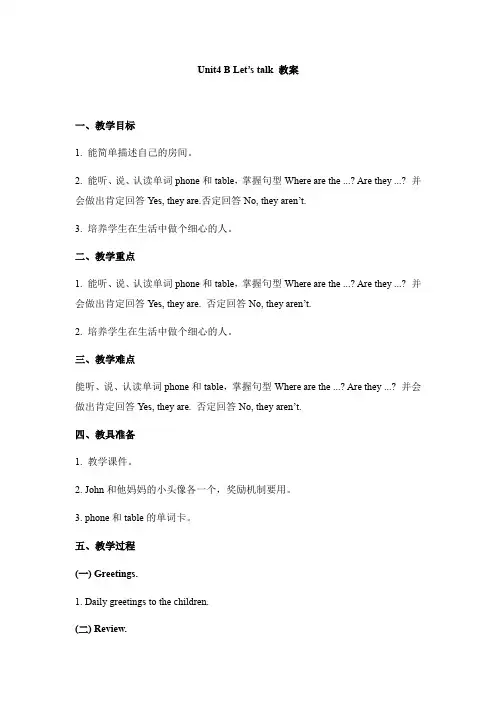
Unit4 B Let’s talk 教案一、教学目标1. 能简单描述自己的房间。
2. 能听、说、认读单词phone和table,掌握句型Where are the ...? Are they ...? 并会做出肯定回答Yes, they are.否定回答No, they aren’t.3. 培养学生在生活中做个细心的人。
二、教学重点1. 能听、说、认读单词phone和table,掌握句型Where are the ...? Are they ...? 并会做出肯定回答Yes, they are. 否定回答No, they aren’t.2. 培养学生在生活中做个细心的人。
三、教学难点能听、说、认读单词phone和table,掌握句型Where are the ...? Are they ...? 并会做出肯定回答Yes, they are. 否定回答No, they aren’t.四、教具准备1. 教学课件。
2. John和他妈妈的小头像各一个,奖励机制要用。
3. phone和table的单词卡。
五、教学过程(一) Greetings.1. Daily greetings to the children.(二) Review.1. Warm-up.“Let’s sing”复习与本课有关的旧知,复习已学单词。
2. Lead in.T: This is John’s home. It’s so beautiful. What’s in his home?Ss: There is/are ...复习已学单词,教授新单词phone和table。
(三) Presentation.1. 以猫偷鱼的故事贯穿整堂课,T: Listen, who is coming? Ss: It’s a cat. T: Where is the cat? Is it on the sofa? 让学生做出回答,复习以be动词开头的单数名词一般疑问句以及它的肯定和否定回答方式。
Pep小学英语四年级上册第四单元Unit4(Let’s learn, Let’s play)学情分析

Pep小学英语四年级上册第四单元Unit4(Let’s learn, Let’s play)学情分析一、学习情况久,难于长时间地注意同一件事物,容易为一些新奇刺激的事物所吸引。
所以他们对课件里的动画和能动发声的教具感兴趣。
另一方面,他们感知事物的特点比较笼统,不精确,往往只注意到一些孤立的现象,看不出事物之间的联系和特点,对时间和空间的概念也比较模糊。
比方做作业时,因为孩子的感知觉发展不够充分,经常看错题、有学生会bd不分,单词抄着抄着就错了,而且在教师指出时,他们仍然意识不到错误出在哪里,这些现象在孩子身上或多或少都会有。
在记忆方面,这个年龄段的孩子的有意识记逐渐占据主导地位,即使是抽象材料也能花功夫努力记住,并能自觉检查记忆的效果。
他们记忆发展的另一特点是从机械识记向意义识记发展。
随着知识的增长,理解水平的提升,中年级学生意义识记逐渐占据主导地位。
所以他们不但仅能记忆押韵的,朗朗上口的英语儿歌,也能够通过图片很快背诵A部分的课文。
本年级四个班,每个班有60名学生。
学生总体反映出纯朴、可爱。
但是绝大部分学生很喜欢上英语课,但学生主动学习的积极性高,作业很认真完成。
但是英语处于非主非副的尴尬地位:说它是主课,不过又没有主课的课时以及特权待遇,说它是副课,不过又要统考。
学生对语、数学科有一种重视感,但是对英语则不然。
就造成了学习不够主动,不愿吃苦的现状。
总体现状如下:1、本年级学生在逐步培养学习习惯和行为习惯,对于英语的掌握水准一般。
2、本年级学生平时上课能够积极主动的发言,学生思想比较单纯,但个别同学在课堂上纪律不是很好,因为插班生的加入是班级的英语掌握水平参差不齐,使教学计划要妥善安排。
3、本年级学生绝大部分上课时能够专心听讲,但个别的学生行为习惯应再增强,鼓励他们在课堂上认真听讲,积极主动的回答老师提出的问题,善于提问。
二、学习策略首先,还是增强学习习惯培养,协助学生建立良好的学习行为和学习方法。
四年级上册英语单元测试unit 4My home 人教(PEP)(含答案)
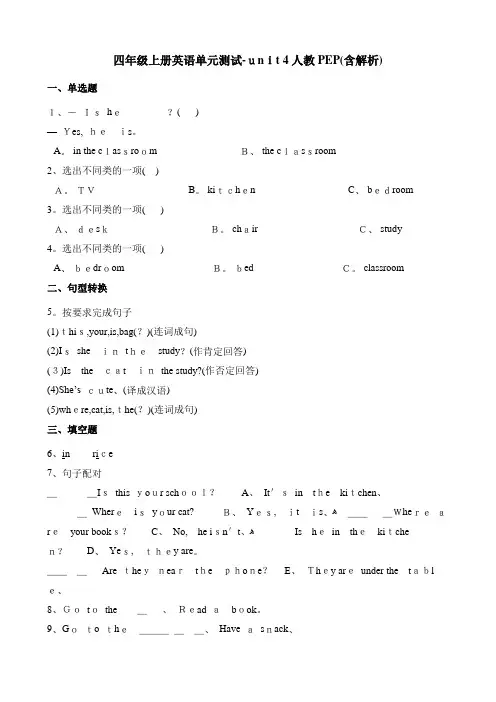
四年级上册英语单元测试-unit 4人教PEP(含解析)一、单选题1、-Ishe________?( )—Yes, heis。
A。
in the classroom B、 the classroom2、选出不同类的一项( )A。
TV B。
kitchen C、 bedroom3。
选出不同类的一项( )A、deskB。
chair C、 study4。
选出不同类的一项( )A、bedroom B。
bed C。
classroom二、句型转换5。
按要求完成句子(1)this,your,is,bag(?)(连词成句)(2)Issheinthestudy?(作肯定回答)(3)Is thecatinthe study?(作否定回答)(4)She’s cute、(译成汉语)(5)where,cat,is,the(?)(连词成句)三、填空题6、in rice ________7、句子配对________Isthis your school? A、It'sin the kitchen、________Whereisyour cat? B、Yes,itis、ﻫ________Whereareyour books?C、No,he isn't、ﻫ________Is hein thekitchen? D、Yes,they are。
________Are theynearthephone?E、They areunder the tabl e、8、Gotothe________、Read abook。
9、Goto the________、Have asnack、10、Goto the________。
Have a nap、11、Go to the________、Take a shower、四、连词成句12。
连词成句(1)in thesheis living room (?)(2)arethe wherekeys(?)(3)on table are theythe(?)(4)theyaren'tin the kitchen(、)(5)has he glasses blue and are his shoes(、)五、阅读理解13、阅读理解ﻫHello, I'm Lily。
PEP小学英语四年级上册第四单元B部分课件演示文稿
phone
第七页,总共十七页。
shelf
第八页,总共十七页。
fridge
第九页,总共十七页。
sofa
第十页,总共十七页。Fra bibliotektable
第十一页,总共十七页。
第十二页,总共十七页。
第十三页,总共十七页。
第十四页,总共十七页。
第十五页,总共十七页。
第十六页,总共十七页。
第十七页,总共十七页。
PEP小学英语四年级上册第四单 元B部分课件演示文稿
第一页,总共十七页。
优选PEP小学英语四年级上册第 四单元B部分课件ppt
第二页,总共十七页。
第三页,总共十七页。
Where is …?
Is it on / in / under …
第四页,总共十七页。
第五页,总共十七页。
bed
第六页,总共十七页。
“PEP”2024年小学四年级上册第十四次英语第四单元测验试卷
“PEP”2024年小学四年级上册英语第四单元测验试卷考试时间:80分钟(总分:120)B卷考试人:_________题号一二三总分得分一、选择题(共计20题,共40分)1、选择题:What is 3 x 5?A. 15B. 16C. 17D. 182、What shape is a coin?A. SquareB. RectangleC. CircleD. Triangle3、What do you call a young goat?A. LambB. CalfC. KidD. Foal4、选择题:What do you call a building where you see movies?A. TheaterB. MuseumC. LibraryD. Gallery5、What do we call the science of studying weather?A. GeologyB. MeteorologyC. BiologyD. Oceanography6、选择题:What is the name of the famous landmark in Italy?A. Eiffel TowerB. Leaning Tower of PisaC. ColosseumD. Statue of Liberty7、What do we call the time it takes for the Earth to spin once?A. DayB. MonthC. YearD. Hour8、选择题:Which instrument has keys and is played by pressing them?A. GuitarB. DrumsC. PianoD. Violin9、What is the fastest land animal?A. CheetahB. LionC. HorseD. Antelope10、What do we call the place where we go to learn about art?A. MuseumB. SchoolC. GalleryD. Studio11、What is the capital of Italy?A. VeniceB. FlorenceC. RomeD. Milan12、选择题:What is the capital of Greece?A. AthensB. RomeC. IstanbulD. Cairo13、How many months have 28 days?A. 1B. 2C. 12D. 014、What is the capital city of Jamaica?A. KingstonB. Montego BayC. NegrilD. Ocho Rios15、What is the name of the famous ancient city in Egypt?A. CairoB. AlexandriaC. ThebesD. All of the above16、选择题:What do you call the hard outer covering of an egg?A. ShellB. YolkC. AlbumenD. Membrane17、How many players are on a soccer team?A. 10B. 11C. 12D. 1318、What is the opposite of ‘yes’?A. MaybeB. NoC. AffirmativeD. Certainly19、What is the shape of a basketball?A. SquareB. TriangleC. OvalD. Sphere20、What is the largest continent?A. AfricaB. AsiaC. North AmericaD. South America二、听力题(共计20题,共40分)1、听力题:The chemical symbol for tellurium is _____.2、听力题:The sun is _______ (bright) in the sky.3、听力题:The capital of Russia is __________.4、听力题:The flowers are very ______. (pretty)5、听力题:The __________ is important for understanding natural disasters.6、听力题:We go ________ every summer.7、听力题:A ____ is often kept as a pet and enjoys being around people.8、听力题:A reaction that gives off heat is called an ______ reaction.9、听力题:The festival is very _______ (exciting).10、听力题:Acids taste ______.11、听力题:The girl sings very ________.12、听力题:The chemical symbol for sodium is ______.13、听力题:I want to ________ a new bike.Atoms are made up of protons, neutrons, and ______.15、听力题:A solution can be diluted by adding more ______.16、听力题:The antelope is quick and agile, able to outrun many ____.17、听力题:An alkali metal is found in group _____ of the periodic table.18、听力题:The sun sets in the _____ (west/east).19、听力题:The _____ (feather) is light.20、听力题:Emma is a ______. She loves to dance.三、填空题(共计20题,共10分)1、填空题:The __________ (历史的回忆) enriches our understanding.2、填空题:My dog loves to _______ (跟随) me everywhere.3、填空题:The __________ (历史的影响) is far-reaching.4、填空题:The _____ (生态系统) relies on many plants and animals.5、填空题:The ________ (农业技术推广) enhances practices.6、lake) is a large body of freshwater surrounded by land. 填空题:The ____7、填空题:A _____ (植物信息平台) can enhance knowledge sharing.My brother and I like to . (我和我哥哥喜欢。
PEP人教版小学英语四年级上册Unit4单元教案
Unit 4 My home第一课时教学内容:A Let's learn Let's do C Let's sing教学目标:1.能听懂,会说句子This is my home y home并能简单描述自己的房间2.听、说、认读单词:study, bathroom, living room, bedroom, kitchen。
3.能听懂一些简单的指示语,并能按指令做出相应的动作4.会唱歌曲My Bedroom教学重点:听、说、认读单词:study, bathroom, living room, bedroom, kitchen。
学习表示指令的词组。
教学难点:单词study, bathroom, bedroom的发音。
教具准备:1. 教材相配套的教学挂图[Unit 4 Let’s learn/A]2. 教材相配套的教学录音带3. 教师自制的单词卡4. 教师使用的study, bathroom, bedroom, living room, kitchen 图片。
5. 教师使用的课文挂图P46页Let’s learn部分。
教学过程: 一、热身、复习(Warm-up / Revision) A. Learn these sentences Where is the doll? It is in the box. Where is the doll? It is on the box. Where is the doll? It is under the box. Where is the box? It is on the table. B. Ask and answer Where is the farmer? He is in the van. Where is the monkey? It is under the taxi. Where is the elephant? It is in the car. Where is the boy? He is on the train. Where is the nurse? She is on the bus. Where is the girl? She is in the truck. Where is the bird? It is on the bridge. 二、呈现新课(Presentation) 1. 教师出示study的图片,手指着书房里的书问学生:What are they? 学生回答:They are books. 教师接着自问自答:Where are the books? They are in the study. 教读单词study, 并板书,让学生认读。
PEP小学英语四年级上册 Unit 4 Read and write教学设计
教学设计小学英语(PEP)四年级上册 Unit 4 Read and write板书设计:人教版(PEP )四年级上册Unit4英语学案课 题:Unit 4 My home Read and WriteG1 G2 G3一、教学目标:Ⅰ.知识与技能:1. Students will be able to read the four-skill words in this unit.2. Students will be able to describe the positions with “in” “on” “under” “near”.3. Students will be able to distinguish the differences between “is” and “are” and use them correctly in the real situations.4. Students will be able to read the passage about the living room and catch the main idea;5. Students will be able to get information from the passge and finish the exercise ( Tick the things in the living room and matching ).6. Students will be able to describe the rooms with the main sentence structure.The ______ is in/on/near/under the _______.The ______ are in/on/near/under the _______.7. Students will be able to complete the sentences and finish an imitative writing.II. 情感、态度与价值观:通过本节课的学习,培养学生热爱学习英语,共同体验英语阅读与写作带来的无限乐趣;培养学生间小组合作,互相学习,互相帮助的学习品质;采用适时适度的个人评价与小组评价相组合的方式,激发学生的学习兴趣。