
人教版七年级英语下册unit2知识点
Unit 2 What time do you go to school ?短语·集萃1.get up起床2.either,or,或者,或者,;要么,要么,3.get dressed 穿上衣服4.lots of 大量5.take a shower洗澡6.go to bed上床睡觉7.radio station广播台8.do homework做家庭作业9.go to school去上学10.eat dinner吃晚饭11.bursh teeth刷牙齿12.take a walk散步13.be late for因,,迟到14.clean my room打扫我的房间15.need to do sth需要做某事16.have time to do sth有时间做某事17. from,to,从,到,18.on weekends 在周末=on the weekend句式·记忆1.What time do you usually get up? I usually get up at six thirty.2.What time does Rick eat breakfast? He eats breakfast at seven o’clock.3.When does Scott go to work? He always goes to work at eleven o’clock. He is never late.4.That’s a funny time for breakfast.考点·分析1. get相关词组辨析:get up 起床;get on 上(车、船等);get off下(车、船等);2. interested与interestinginterested 感兴趣;对,感兴趣通常修饰“人”,通常用于be/get/feel/become interested in结构中interesting令人感兴趣的;有趣的通常修饰“物”3. o’clock的用法:指“,点钟”,用在整点之后。
Eg:six o’clock4. fun与funny区别:①funny表示“有趣的,滑稽的”,它指的是一种滑稽而可笑的“有趣”,侧重点是让人绝对好玩或发笑。
②fun主要指“有趣,好玩”,不想funny那样强调“滑稽”。
It is more fun to go with someone than to go alone. 携伴同去比自己独自去好玩。
It’s funny to see a man walk with his hands and head.看见一个人倒立走路很滑稽。
5.时间的表达:钟点的正读法:先读小时,再读分钟;如需区分上下午,可在时间后加 a.m或p.m4:30p.m. 读作four thirty p.m.钟点的倒读法:前半小时的读法:分钟数+past+分钟数;30分钟用half;15分钟用 a quarter。
8:14读作fourteen past eight后半小时读法:分钟数+to+未来的点钟数8:46读作fourteen to nine6. half a(an)+名词单数:半个,,one and a half+名词复数形式:一个半,,half past,,几点半,,7. quarter:一刻钟;四分之一。
一刻钟,即十五分钟8. go to bed 和go to sleep区别:①go to bed 强调“上床睡觉”的动作及过程,无“睡着”的意思。
②go to sleep 强调“入睡;睡着”这一动作,强调人已经“睡着”。
9. quickly,fast和soon的区别:①quickly 迅速的强调动作发生或完成得快,也可指人的思维敏捷。
②fast 迅速的强调运动速度之快,既可做形容词,也可作副词。
可与quickly互换。
③soon 不久以后侧重两件事情的先后发生,中间的间隔的时间很短。
Eg:1)The next morning, the teacher asked the boy, “How did you find the answer so quickly?”第二天早上,老师问这个男孩:“你怎么能够这样快找到了答案的呢?”2)You are always saying I am growing so fast. 你老是说,我长得很快。
3)Soon they were in the middle of the river. 很快他们就到了河中间。
10.sometimes和sometime区别:Sometimes:有时;不时频度副词Sometime:在某个时候时间副词句子·讲解1. -What time do you usually get up, Rick?-I usually get up at five o’clock.瑞克,你通常几点起床?我通常在五点起床。
点拨:这是询问什么时间做某事的常用句型,它是由特殊疑问词what+time+助动词do/does+主语+谓语动词原形+其他?构成。
它经常用来询问具体的时间短语what time的意思是:“几点、什么时间”,它和when是同义词,都是对“时间”进行提问,但what time 所问的时间范围比较小,一般用来提问比较精确的时间,回答的时候一般用具体到几点。
而when所问的时间范围比较大,回答的时候可以用几点钟,也可以是上午或者下午,甚至是哪一天、哪一年。
2. -What time is it now?-It’s about six-fourteen.现在几点了?大约六点十四分。
点拨:这是询问时间的常用句型,它的意思是:现在几点了?询问时间还可以用:What is the time now? ;what's time now?;Do you know the time now?3. I usually get up at five o’clock.我通常五点起床。
点拨:介词at意为“在,,”,既可以用来表示时间,有可以用来表示方位。
4. What a funny time to have breakfast!吃早饭的时间是多么有趣呀!点拨:这是一个感叹句,是由what+冠词+形容词+名词+主语+谓语+其他!构成的感叹句。
what在本句子的意思是“多么的”,经常用在感叹句中。
特殊疑问词how也引导感叹句,但是它的句型是:How+形容词+主语+谓语+其他!how的后面只能用形容词或者副词,不能用名词。
5. To get to work, he takes the No. 17 bus to a hotel.为了上班,他乘坐第17路公共汽车到旅馆。
点拨1:句子中的to get to work是动词不定式短语,在本句子中作目的状语,动词不定式作目的状语经常放在句子的后面,如果放在句子的前面用逗号隔开。
点拨2:第几路公共汽车的表达方式。
No. 17 bus点拨3:1)work不及物动词,意为工作,第三人称单数是works ;worker是名词,意为工人,复数是workers 。
2)work 名词,意为工作,是不可数名词,但表示一份工作可以用 a job 。
3)work 名词,意为“著作,作品”,是可数名词,复数为works 。
6. Can you think what his job is? 你能猜测到他是做什么工作的吗?点拨:本句子是含有宾语从句的复合句,宾语从句通常用陈述语序。
7. I usually do my homework at around six-thirty in the evening.我通常在晚上六点半左右做家庭作业。
点拨1:do one’s homework的意思是做作业。
短语中的one’s可以用名词所有格或者物主代词。
点拨2:around 在此处作副词,相当于about,意思是“大约”。
8. School starts at nine o’clock.学校九点开始上课。
点拨:动词start的意思是“开始”,动词begin也是开始的意思。
动词start的后面可以用动名词作宾语。
也可以用动词不定式作宾语。
注意:start可以是不及物动词,后面可以不跟宾语。
9. Thanks for your letter.谢谢你的来信。
点拨:动词短语Thanks for的意思是为,而感谢你,它相当于Thank you for,介词for的后面可以用名词作宾语,也可以用动名词形式作宾语。
10. Please tell me about your morning.请写信告诉我你早晨的情况。
点拨:about为介词,后常接名词,表示涉及的内容,即有关的人或物,意思是“关于”。
语法·点拨时刻表达法和感叹句的用法(一)时刻表达法:1. 如何询问时间英语询问时间可以用What time is it?也可以用What’s the time now?还可以用Do you know the time?等句型。
回答的时候用It’s+数字。
如果是整点可以用o’clock也可以省略。
2. 如何表达时间1)如果时间在整点可以用整点数+o’clock这种形式表达,有时候可以不用o’clock。
例如:It’s six o’clock now.2)如果是几点几分,分钟不超过半个小时(包括半小时),可以直接用数字表示。
例如:6:11;也可以用介词past表示,past的前面是分钟,past的后面是钟点数,表示几点过了几分的意思。
例如:6:11 eleven past six 。
如果是15分钟可以用 a quarter。
例如:7:15 a quarter past six ;如果是30分钟可以用half。
例如:6:30 half past six 。
3)如果是几点几分,分钟超过半小时,可以用介词to,to的前面是分钟(是差几分到下一点的分钟数字),to 的后面是下一个点的数字。
例如:6:58 two to seven 。
(二)感叹句的用法:感叹句是表示说话人的说话的时候的惊讶、喜悦、气愤等情绪。
1. 由what引导的感叹句What的意思是“多么”,what修饰名词,名词的前面可以用形容词修饰,如果是可数名词的单数形式,还要有冠词a/an。
如果是不可数名词直接是what+形容词+名词。
2. 由how引导的感叹句How也可以引导感叹句,how的后面用形容词、副词或者动词。
它的句型是:How +形容词、副词+主语+谓语!unit2 基础练习I.用适当的介词填空。
1. Mike goes to school seven o’clock the morning.2. Mr. and Mrs. Jackson don’t go to work Sundays.3. Jim’s birthday is April 18th.II.单项选择。
人教版七年级英语下册Unit 2知识点汇总

人教版七年级英语下册Unit 2知识点汇总一、词汇拓展up(反义词) downbrush(单三)brushestooth(复数)teethalways (反义词) neverearly(反义词)latework(同义词)jobnight(反义词)dayhalf(复数)halvesrun(现在分词)runningclean(现在分词)cleaningeither…or… (反义词)neither …nor…life(复数)livestaste(单三)tastes二、重点短语get up 起床;站起get dressed 穿上衣服have/take a shower 洗淋浴on weekends(在)周末do (one’s) homework 做作业take a walk 散步;走一走lots of=many+可数(复数)大量,许多either… or... 要么…要么…;或者………或者…brush teeth 刷牙have(eat) breakfast /dinner吃早餐/晚餐go to school 去学校at night 在晚上from…to… 从……到……in the morning/ afternoon /evening 在上午/下午/晚上go to work 去上班That's a funny time for… 那是做……有意思的时间。
be late for………迟到on school days 在上学期间a quarter past /to+钟点数……过/差一刻钟go to bed 上床睡觉half past +钟点数……点半go home回家eat quickly 吃得快play sports 做运动have much time for …有许多时间做……for half an hour 半小时get home 到家eat a good breakfast 早餐吃得好,好好吃一顿早餐eat … for lunch午餐吃……after lunch /dinner 午餐/晚餐后be (not) good for 对……健康有(没)益taste good 尝起来好吃have a very healthy life 有健康的生活need to do … 需要做……from Monday to Friday从周一到周五radio station 广播电台make breakfast for sb. 替某人做早饭get to school 到校三、经典句型1.---What time do you usually get up,Rick?里克,你通常几点起床?---I usually get up at six thirty.我通常六点半起床2.---When does Scott go to work?斯科特什么时候去上班?---He always goes to work at eleven o'clock.他总是在十一点去上班。
初中英语人教版七年级下Unit 2 What time do you go to school知识点

七年级英语下册Unit2知识点Section A1.Get up 起床2.Go to school 去上学3.Get dressed 穿衣服Dress (名词) 连衣裙 (动词) 穿衣服Put on, wear, dress区别:Put on强调穿衣服的动作Eg: It’s cold outside, please put on your sweater.“外面天气冷,请穿上你的毛衣。
”wear强调穿衣服的状态Eg: The girl wears a sweater today.“这个女孩今天穿了一件毛衣。
”Dress 后面接人,表示给某人穿衣服Eg: The boy is too young to dress himself.“这个小那还太小了不能自己穿衣服。
”4.Brush teeth 刷牙(1)Brush (名词) 刷子Eg: Please pass the brush to me.“请把刷子递给我。
”Brush(动词) 刷Eg: The floor is easy to brush clean.“这个地板很容易刷干净。
”(2)Teeth 是tooth(牙齿)的复数形式5.Eat breakfast/lunch/dinner “吃早/午/晚饭”= have breakfast/lunch/dinner注意:在表示吃早午晚饭时不可加冠词,但当有形容词修饰早午晚饭时可加冠词Have a good breakfast“吃一顿好的早饭”句型:have ... for breakfast/lunch/dinner“早/午/晚饭吃...”Eg: We have bread and milk for breakfast.“我们早饭吃面包和牛奶。
”6.Take a shower= have a shower 洗淋浴7.At six thirty 在六点半在具体某一时刻前通常用介词 at时间表达法:1)采用数词表达时间Eg: six thirty 六点半;eight fifteen 八点十五分2)采用介词past,to表达时间一般说来半个小时以内,常常用介词past,表示“几点过几分”Eg: a quarter past three 三点一刻;half past eight 六点半;ten past two 两点十分半小时过后多用介词to,表示“差几分到几点”Eg: a quarter to three 两点四十五;twenty to four 三点四十3)a. m. 和p. m.A.m. 表示“午前;上午”(午夜12:00后至中午12:00前);p.m. 表示“午后;下午”(中午12:00后至午夜12:00前)。
Unit2知识点讲解人教版英语七年级下册
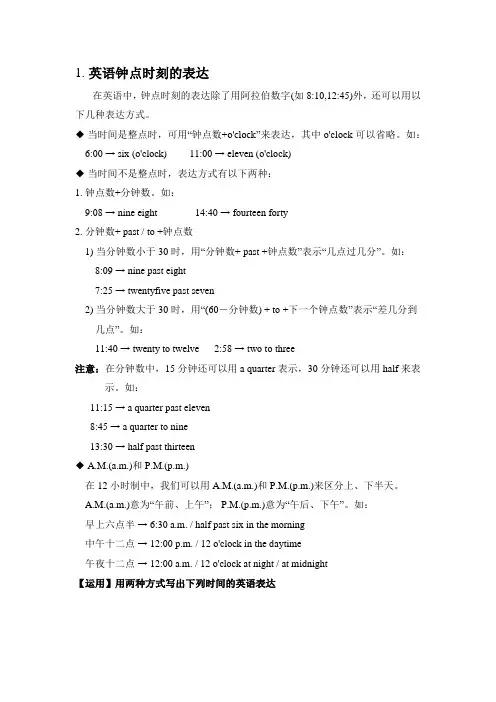
1.英语钟点时刻的表达在英语中,钟点时刻的表达除了用阿拉伯数字(如8:10,12:45)外,还可以用以下几种表达方式。
◆当时间是整点时,可用“钟点数+o'clock”来表达,其中o'clock可以省略。
如:6:00 → six (o'clock) 11:00 → eleven (o'clock)◆当时间不是整点时,表达方式有以下两种:1. 钟点数+分钟数。
如:9:08 → nine eight 14:40 → fourteen forty2. 分钟数+ past / to +钟点数1) 当分钟数小于30时,用“分钟数+ past +钟点数”表示“几点过几分”。
如:8:09 → nine past eight7:25 → twentyfive past seven2) 当分钟数大于30时,用“(60-分钟数) + to +下一个钟点数”表示“差几分到几点”。
如:11:40 → twenty to twelve 2:58 → two to three注意:在分钟数中,15分钟还可以用a quarter表示,30分钟还可以用half来表示。
如:11:15 → a quarter past eleven8:45 → a quarter to nine13:30 → half past thirteen◆ A.M.(a.m.)和P.M.(p.m.)在12小时制中,我们可以用A.M.(a.m.)和P.M.(p.m.)来区分上、下半天。
A.M.(a.m.)意为“午前、上午”; P.M.(p.m.)意为“午后、下午”。
如:早上六点半→ 6:30 a.m. / half past six in the morning中午十二点→ 12:00 p.m. / 12 o'clock in the daytime午夜十二点→ 12:00 a.m. / 12 o'clock at night / at midnight【运用】用两种方式写出下列时间的英语表达1. 2. 3.___________________ 或___________________ ___________________或______________________________________或___________________参考答案1. four thirty; half past four2. eleven five; five past eleven3. nine fifteen; a quarter past nine2. what time & when 引导的特殊疑问句what time和when均可对时间状语进行提问,用来询问什么时间。
七年级英语下册Unit2Whattimedoyougotoschool短语语法知识点汇总人教版

Unit 2 What time do you go to school 一、基础归纳【教材内容解析】Section A1.get dressed (P. 7)get dressed意为“穿上衣服”,dress用作动词,表示“给(某人)穿衣服”,接宾语时,只能接表示人的名词或者代词。
He can’t dress himself.I usually dress my daughter before I go to work.【拓展】辨析wear, put on和dress2.take a shower (P. 7)take a shower意为“洗淋浴”,相当于have a shower,shower用作名词,表示“淋浴”。
I often take a shower in the evening.I take a cold shower when I feel tired.3.What time do you usually get up, Rick? (P. 7)(1)what time用来询问具体的时间点,表示“什么时候”。
What time do you go to school?(2)usually是频度副词,意为“通常、一般”,在句中作状语,一般位于实义动词之前,连系动词be、助动词或者情态动词之后。
I usually have lunch at school.He usually goes to school by bike.4.I never get up so early. (P. 8)early此处用作副词,表示“很早地”,反义词为late,意为“晚地”。
Please come to school early tomorrow.【拓展】early还可以用作形容词,表示“早的、提前的”,反义词是late,意为“晚的”。
He gets up early to catch the early bus.5.Scott has an interesting job. (P. 8)job用作可数名词,表示“工作”,强调具体的职业或者工作,work表示“工作”时,用作不可数名词,指人们日常生活和工作中从事的体力或者脑力劳动,及各类工作。
人教版七年级英语下册Unit2知识点归纳

Unit2 What time do you go to school?知识点归纳一、重点短语1. what time 几点2. go to school 去上学3. get up 起床4. take a shower 洗淋浴5. brush teeth 刷牙6. get to 到达7. do homework 做家庭作业8. go to work 去上班9. go home 回家10. eat breakfast 吃早饭11. get dressed 穿上衣服12. get home 到家13. either…or… 要么…要么…14. go to bed 上床睡觉15. in the morning/afternoon/evening 在上午/下午/晚上16. take a walk 散步17. lots of=a lot of 许多,大量18. radio station 广播电台19. at night 在晚上20. be late for=arrive late for 迟到二、用法归纳1. at + 具体时间点在几点(几分)2. eat breakfast/lunch/dinner 吃早饭/午饭/晚饭3. thirty/half past +基数词…点半4. fifteen/a quarter to +基数词差一刻到…点5. take a/an+名词从事…活动6. from…to… 从…到…7. need to do sth 需要做某事三、重点句子1. —What time do you usually get up? 你通常几点钟起床?—I usually get up at six thirty. 我通常6:30起床。
2. That’s a funny time for breakfast. 那是个有趣的早餐时间。
3. —When do students usually eat dinner? 学生们通常什么时候吃完饭?—They usually eat dinner at a quarter to seven in the evening. 他们通常在晚上6:45吃晚饭。
七年级英语人教版下册Unit2重点知识点归纳
人教版七年级英语单元重点知识点归纳Unit2 What time do you go to school?一、重点词组与句子Section A1.what time几点,什么时候2.go to school去上学3.get up起床4.take/have a shower淋浴,洗澡5.put on穿上,增加6.go to work去上班7.get to到达8. an interesting job 一份有趣的工作9.be late for迟到10.have/eat breakfast 吃早餐11.on weekends 在周末12.get dressed = dress oneself穿上衣服13.brush teeth 刷牙14.at a radio station 在广播电台句子:1.What time is it? 几点了?2.What time do you usually get up?你通常几点起床?3.I usually get up at five o’clock. 通常5点钟起床。
4.-What time does he eat breakfast?他什么时候吃早饭?5.-He eats breakfast at seven o’clock. 他七点钟吃早饭。
Section B1.listen to听2.get back 归还,取回3.get home 到家4.get to 到达5.get for 为某人拿(取)买6.half past six 六点半7..get from 从某人/某物那得到……8.go to bed early早睡9.do (one’s) homework做作业10.go home回家11.take a walk 散步12. either…or…要么……要么……13.lots of 许多,大量14.eat dinner吃晚饭15. eat quickly吃的快16 play sports/games 做运动/游戏17. taste good尝起来不错18.healthy activities 健康的活动19. unhealthy habits 不健康的习惯句子:1.When do students usually eat dinner?学生们通常什么时候吃晚餐?2.I don’t have much time for breakfast.我没有许多时间吃早餐。
人教版七年级下册英语Unit-2单元知识点复习
人教版七年级下册英语Unit-2单元知识点复习Unit 2 What time do you go to school?1. What time / when...? (U8 已讲)几点/什么时候。
2. get up : 起床1) get up early /late 早起/ 起得晚2)---你通常几点起床?-What time do you usually getup ?---我通常在6:30起床- I usually get up at sixthirty.3. dress 1)dress sb给...穿衣eg:我小时候我妈妈给我穿衣服。
My mother dressed me when I was young.2) dress oneself 给自己穿衣服eg: 这个女孩会自己穿衣服。
The girl can dress herself.3)be dressed in 穿着;戴着=weareg:她穿着一件漂亮的裙子。
She is dressed in a beautiful skirt.4)get dressed 穿上衣服4. brush 1) v 刷brush teeth 刷牙eg: 我一天刷两次牙。
I brush my teeth twice a day.2)n 刷子two brushes 两个刷子5. shower ①n/v 淋浴②淋浴器、间1)take/have a shower洗淋浴2)take a cold shower洗个冷水澡6. never 从不;绝不1)我从没起床这么早。
I never get up so early.2)我上班/上学从迟到。
I'm never late for work/ school.7. early adj/adv 早的1) catch the early bus赶早班车2) The early bird catch而是the worm.早起的鸟儿有虫吃。
人教版七年级下册英语 Unit 2 基础知识单词、短语、句子默写版
Unit 2 What time do you go toschool?A部分重点单词★根据汉语提示默写出下列单词1.向上adv.2.穿衣服v.连衣裙n.3.刷;刷净v. 刷子n.4.牙齿n.5.淋浴n. & v. 淋浴器(间)n.6.通常地;一般地adv.7.四十num.8.哇;呀interj.9.从不; 绝不adv.10.早(的) adv. & adj.11.五十num. 12.工作;职业n.13.工作n. & v.14.电(视)台;车站n.15.(表示整点)点钟adv.16.晚上;夜晚n.17.奇怪的; 滑稽好笑的adj.18.锻炼; 练习n. & v.19.最好的adj. 最(好地) adv.20.组; 群n.★写出下列单词变形1.funny⎼______________(名词)2.never⎼______________(对应词)3.up⎼______________(反义词)4.four⎼______________(四十)5.usually⎼______________(形容词)6.tooth⎼______________(复数)7.dress⎼______________(复数)⎼______________(单三)8.brush⎼______________(单三)⎼______________(复数)重点短词★根据汉语提示默写出下列短语1.吃早餐2.在六点四十3.什么时间4.刷牙5.穿上衣服6.去上学7.起床;站起8.洗淋浴9.(在)周末10.广播节目11.然后12.广播电台重点句子★根据汉语提示默写出下列句子1.—里克,你通常几点起床?—我通常6:30起床。
2.—斯科特什么时候去上班?—他总是11:00去上班。
3.—你通常什么时候洗淋浴?—我通常六点四十洗淋浴。
4.斯科特有一份有趣的工作。
5.你的朋友们什么时候锻炼?6.我上班从来不迟到。
7.他什么时候去上班?8.那个时间吃早饭真有意思!B部分重点单词★根据汉语提示默写出下列单词1.一半;半数n. & pron.2.―刻钟;四分之一n.3.跑;奔v.4.打扫;弄干净v. 干净的adj. 5.或者conj. 也adv. 6.大量;许多pron.7.品尝v. 味道;滋味n.8.晚于prep. 过去的adj.9.家庭作业n.10.行走;步行n. & v.11.很快地adv.12.生活;生命n.13.有时adv.★写出下列单词变形1.half⎼______________(复数)2.quickly(副词)⎼______________(形容词)3.life⎼______________(复数)4.one⎼______________(序数词)5.quarter⎼______________(复数)6.healthy⎼______________(反义词)⎼______________(名词)7.run⎼______________(现在分词)8.late⎼______________(反义词)重点短词★根据汉语提示默写出下列短语1.回家2.做作业3.吃晚饭4.上床睡觉5.做运动6.一个健康的生活7.散步;走一走8.从学校回到家9.去鲍勃家10.打扫某人的房间11.半个小时12.到家13.大量;许多14.对…有好处15.尝起来味道好16.在下午三点一刻17.要么…要么…; 或者…或者…18.在晚上差一刻七点19.在早晨六点半重点句子★根据汉语提示默写出下列句子1.在晚上, 我要么么玩电脑游戏。
人教版七年级下册英语unit2 知识点+经典练习题
人教版七年级下册英语unit2 知识点+经典练习题Unit 2:What time do you go to school?重点词汇1.go to school去上学;go to the hotel去旅馆;go to the bus station去公交车站;go to work去上班;go to bed去睡觉;go home回家;go there去那儿2.get to school到校;get to the hotel到达旅馆;get to XiaMen 到达厦门;get to the bus station到达车站;get up起床;get home到家;get there到那儿;get dressed打扮,穿衣;be dressed in穿着---衣服;3. what time/when几点;(have\eat吃)breakfast\lunch\dinner吃早餐/午餐/晚餐;brush teeth刷牙;have\take a shower淋浴;take a bus\taxi.乘公交车\出租车;take a walk散步;do homework做作业;clean my room打扫房间;write a letter 写信;taste good/bad/terrible尝起来味道(好/不好);have a good job有一份好工作;have an interesting job有一份有趣的工作;4.Lots of=a lot of=many或much,(许多,大量);be good for 对---有好处;be bad for对---有害处;5.from---to---从---到---;from 7am to 6pm从早上七点到傍晚六点;From your home to the library从你家到学校;From Monday to Friday从周一到周五;6.Please请:listen to me听我讲;listen to the teacher听老师讲;listen to him\her听他\她讲;listen to music听音乐;listen to the tape.听磁带7.be late for class上课迟到;be late for school上学迟到;be late for work上班迟到;8.both(两者)都;all(三者以上)都,全都;either两者之一;Both---and---即---又---;两者都;either---or---或者---或者;要么---要么---9.at about 7am在早上大约七点;at half半past过six=at six thirty在六点半;At eleven fifteen=at a quarter 一刻past 过eleven在十一点一刻;At eleven forty-five=at a quarter to差twelve;十一点四十五/十二点差一刻At a quarter to two两点差一刻。
人教版七年级英语下 Unit2 知识点语法归纳总结
Unit 2 What time do you go to school ?1.短语归纳①what time 几点(具体时间)①when具体时间或不具体时间①go to school 去上学①get up 起床①take a shower 洗淋浴①brush teeth 刷牙①get to 到达①do homework 做家庭作业①go to work 去上班①go home 回家(home是副词,前不加to)①eat breakfast=have breakfast 吃早饭①get dressed 穿上衣服①get home 到家①either…or…要么…要么…①go to bed 上床睡觉①take a walk 散步①in the morning/ afternoon/ evening在上午/下午/晚上①lots of=a lot of 许多,大量(加可数名词复数或者不可数名词)①radio station 广播电台①at night 在晚上21 be late for=arrive late for 迟到2.典句必背①--What time do you usually get up?--I usually get up at six thirty.①--That’s a funny time for breakfast.①--When do students usually eat dinner?--They usually eat dinner at a quarter to sevenin the evening. ①--I either watch TV or play computer games.①--At twelve, she eats lots of fruit and vegetables for lunch.①--She knows it’s not good for her, but it tastes good.宾语从句①--Here are your clothes. 倒装句3.用法集萃(1)What time do you usually get up , Rick?①频度副词:表示动作频率的副词辨析:always, usually, often, sometimes, seldom, never频度频度副词含义举例always一直;总是The sun always rises in the east and sets in the west.太阳总是东升西落usually通常I usually ask my father for help. 我通常会向我爸爸求助often经常It often rains here in April. 这儿四月份常下雨sometimes有时;不时I sometimes wait for him at the school gate.我有时在学校大门口等他seldom/hardly/hardly/ever很少;几乎不I don’t like swimming, so I seldom go swimming.我不喜欢游泳,所以我很少去游泳频率由高到低never从不;从来没有I never tell lies. 我从不说谎①常见的get 短语get up 起床;站起get back 回来get on 上车get out 出去get off 下车get to 到达get dressed 穿上衣服get married 结婚get together 相聚;聚会get ready (for) (为...)做好准备(2)辨析 get dressed 与 be dressed in①get dressed 表示“穿”的动作①be dressed in 表示“穿”的状态①拓展:dress, put on, wear, be indress其后可跟表示人的名词或代词,意为“给...穿衣服”She can dress herself.她会自己穿衣服put on意为“穿上;戴上”,强调“穿、戴”的动作You’d better put on your coat.你最好穿上你的外套wear意为“穿着;戴着”,强调“穿、戴”的状态She is wearing a beautiful evening dress.她穿着一件漂亮的晚礼服be in其后可跟衣服或颜色类的词汇,也表示“穿、戴”的状态The girl in red is my sister.那个穿红色衣服的是我的妹妹(3)辨析:at, in,on→I usually get up at six thirty.at at和时间点搭配,还可以和noon,night等搭配at nine o’clock/at nightin in和年、月、季节搭配,还可以和morning,evening等搭配in July/in summer/in the morning on on和星期、日期搭配,还可以表示在具体某一天的上午、下午或晚上on Sunday/on June 1st(4)exercise的用法→ After that, I usually exercise at about ten twenty.那之后我通常在10点20分左右锻炼身体①作动词,意为“锻炼”,可作及物动词,也可作不及物动词例:How often do you exercise? 你多久锻炼一次?He exercises his body every day. 他每天锻炼身体。