
最全面人教版八年级下册英语第一单元知识点归纳总结
Unit 1 What's the matter?
一、词汇与短语
◆ 重点单词
A部分
1.matter n. 问题;事情 2.sore adj. 疼痛的;酸痛的
3.stomachache n. 胃痛;腹痛 4.foot n. 脚;足
5.neck n. 颈;脖子 6.stomach n. 胃;腹部
7.throat n. 咽喉;喉咙 8.hurt v. (使)疼痛;受伤
9.fever n. 发烧 10.passenger n. 乘客;旅客
11.lie v. 躺;平躺 12.break n. 间歇;休息
13.rest v. & n. 放松;休息 14.onto prep. 向;朝
15.X-ray n. X射线;X光 16.trouble n. 问题;苦恼
17.toothache n. 牙痛 18.hit n. (用手或器具)击;打
19.headache n. 头痛 20.herself pron. (she的反身代词)她自己
21.off adv. & prep. 离开(某处);不工作;从……去掉
B部分
1.bandage n. 绷带 v. 用绷带包扎 2.press v. 压;挤;按
3.sick adj. 生病的;有病的 4.knee n. 膝;膝盖
5.breathe v. 呼吸 6.knife n. 刀
7.sunburned adj. 晒伤的 8.blood n. 血
9.ourselves pron. (we反身代词)我们自己 10.mean v. 意思是;打算
11.climber n. 登山者;攀登者 12.importance n. 重要性;重要
13.risk n.&v. 危险;风险;冒险 14.decision n. 决定;抉择
15.accident n.(交通)事故;意外遭遇 16.control v.&n. 限制;约束;管理
17.situation n. 情况;状况 18.spirit n. 勇气;意志
19.kilo( = kilogram) n. 千克;公斤 20.death n. 死;死亡
21.rock n. 岩石 22.nurse n. 护士
◆ 重点短语
A部分
1.have a cold 感冒 2.lie down 躺下
3.have a stomachache 胃痛 4.take one's temperature 量体温
5.have a fever 发烧 6.to one's surprise 使……惊讶的是
7.get off 下车 8.right away 立即;马上 9.take breaks (take a break) 休息 10.talk too much 说得太多
11.drink enough water 喝足够的水 12.have a very sore throat 嗓子非常疼
13.get an X-ray 拍X光片 14.see a dentist 看牙医
15.drink some hot tea with honey
喝一些加蜂蜜的热茶 16.put some medicine on sth.
在……上面敷一些药
17.feel very hot 感到很热 18.sound like 听起来像
19.all weekend 整个周末 20.in the same way 以同样的方式
21.go to a doctor 看医生 22.go along 沿着……走
23.on the side of the road 在马路边 24.shout for help 大声呼救
25.without thinking twice 没有多想 26.have a heart problem 有心脏病
27.thanks to 多亏了;由于 28.in time 及时
29.save a life 挽救生命 30.get into trouble 陷入麻烦
31.hurt oneself 受伤 32.fall down落下;摔倒
B部分
1.be used to 习惯于……;适应于…… 2.in a difficult situation 在困境中
3.take risks (take a risk) 冒险 4.keep on doing sth. 继续(或坚持)做某事
5.run out (of) 用尽;耗尽 6.make a decision 作出决定
7.cut off 切除 8.get hit on the head 撞到头部
9.get out of 离开;从……岀来 10.be interested in 对……感兴趣
11.give up 放弃 12.mean doing sth. 意味着做某事
13.put a bandage on sth. 用绷带包扎… 14.lose one's life 失去生命
15.feel sick 感到恶心 16.mountain climbing 登山运动
17.have problems breathing 呼吸困难 18.be in control of 掌管;管理
◆ 重点句子
A部分
1.What's the matter with you?=What's the trouble with you?=What's wrong with you?
你怎么了?
2.What should she do? 她该怎么办呢?
3.Did you fall down? 你跌倒了吗?
4. Should I take my temperature? 我应该量一下体温吗?
5.I think I sat in the same way for too long without moving.
我想我以同样的姿势一动不动地坐得太久了。
6.You need to take breaks away from the computer. 你需要远离电脑休息。
7.The driver saw an old man lying on the side of the road. 司机看见一位老人正躺在路边。
8.The bus driver, 24-year-old Wang Ping, stopped the bus without thinking twice.
二十四岁的公交车司机王平,没有多想就停下了车。
9.But to his surprise, they all agreed to go with him.
但是使他吃惊的是,他们都同意和他一起去。
10.Thanks to Mr. Wang and the passengers, the man was saved by the doctors in time.
多亏了王先生和乘客们,医生及时挽救了那个人的生命。
11.It's sad that many people don't want to help others because they don't want any
trouble. 这太令人伤心了,许多人不想帮助别人是因为他们不想惹麻烦。
B部分
1.He has problems breathing. 他呼吸困难。
2.As a mountain climber, he is used to taking risks. 作为一位登山者,他习惯于冒险。
3.With his left arm, he bandaged himself so that he would not lose too much blood.
他用左臂把自己包扎好,以便不会失血过多。
4.His love for mountain climbing is so great that he kept on climbing mountains even
after this experience. 他是如此酷爱爬山,以至于即使在这次经历之后,他(仍然)继续爬山。
5.There were many times when Aron almost lost his life because of accidents.
阿伦有很多次都差点儿因为事故丧命。
6.This means being in a difficult situation that you cannot seem to get out of.
书名的意思是一个人身陷似乎无法解脱的困境之中。
7.Aron did not give up after the accident and keeps on climbing mountains today.
阿伦在事故之后没有放弃,现在仍继续登山。
8.Aron loves mountain climbing and doesn't mind taking risks.
阿伦热爱登山,不介意冒险。
◆ 重点单词变形
A部分
1.foot—feet(复数) 2.stomach—stomachs(复数)
3.hurt—hurt(过去式) 4.hit—hit(过去式)
5.lie(躺)—lay(过去式)—lying(现在分词) 6.she —herself(反身代词)
B部分
1.sick—ill(同义词) 2.breathe(动词)—breath(名词)
3.we(主格)—ourselves(反身代词) 4.climb(动词)—climber(名词)攀登者
5.kilogram—kilo(缩写形式) 6.knife—knives(复数) 7.cut—cut(过去式)—cutting(现在分词) 8.decide(动词)—decision(名词)
9.importance(名词)—important(形容词)
10.mean—meaning(名词)—meant(过去式)
11.run—ran(过去式)—running(现在分词)
12.die(动词)—death(名词)—dying(现在分词)
二、语法知识点
A部分知识点
1.What's the matter?
What's the matter (with sb.)? “(某人)怎么了?”常用来询问某人患了何种疾病或遇到了何种麻烦。常与What's the trouble with sb.?/What's wrong with sb.?互换。此句型中matter,trouble是名词,故前要加冠词the。
eg:— What's the matter with Mike? 迈克怎么了?
— He has a fever. 他发烧了。
★ 询问某人患了何种疾病或遇到了何种麻烦时,常用以下几种结构来表达:
❶ What's the matter (with sb.)? (某人)怎么了?
❷ What's the trouble (with sb.)? (某人)出什么事了?
Unit1-Unit10单元知识点人教版英语八年级下册
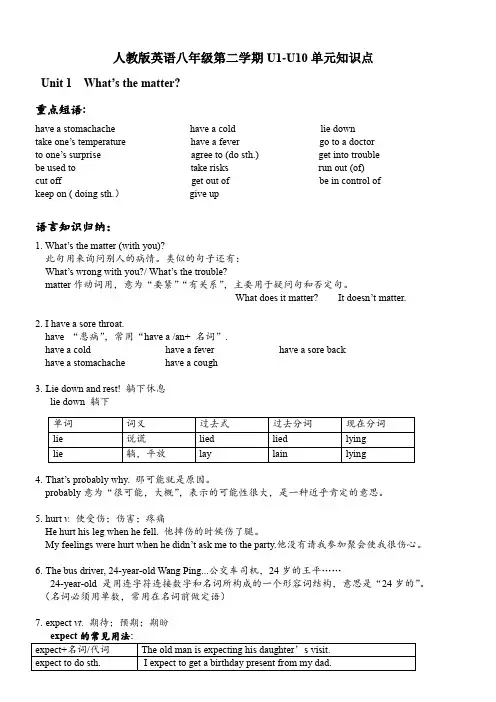
人教版英语八年级第二学期U1-U10单元知识点
Unit 1 What’s the matter?
重点短语:
have a stomachache have a cold lie down
take one’s temperature have a fever go to a doctor
to one’s surprise agree to (do sth.) get into trouble
be used to take risks run out (of)
cut off get out of be in control of
keep on ( doing sth.) give up
语言知识归纳:
1. What’s the matter (with you)?
此句用来询问别人的病情。类似的句子还有:
What’s wrong with you?/ What’s the trouble?
matter作动词用,意为“要紧”“有关系”,主要用于疑问句和否定句。
What does it matter? It doesn’t matter.
2. I have a sore throat.
have “患病”,常用“have a /an+ 名词”.
have a cold have a fever have a sore back
新人教版八年级英语下册第一单元知识点
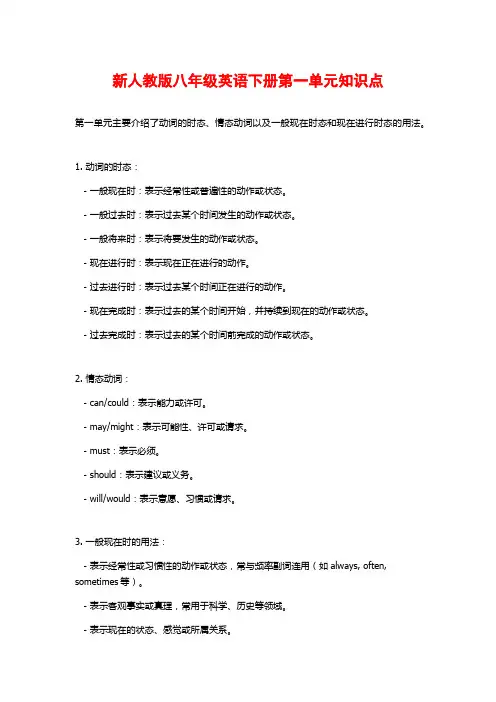
新人教版八年级英语下册第一单元知识点
第一单元主要介绍了动词的时态、情态动词以及一般现在时态和现在进行时态的用法。
1. 动词的时态:
- 一般现在时:表示经常性或普遍性的动作或状态。
- 一般过去时:表示过去某个时间发生的动作或状态。
- 一般将来时:表示将要发生的动作或状态。
- 现在进行时:表示现在正在进行的动作。
- 过去进行时:表示过去某个时间正在进行的动作。
- 现在完成时:表示过去的某个时间开始,并持续到现在的动作或状态。
- 过去完成时:表示过去的某个时间前完成的动作或状态。
2. 情态动词:
- can/could:表示能力或许可。
- may/might:表示可能性、许可或请求。
- must:表示必须。
- should:表示建议或义务。
- will/would:表示意愿、习惯或请求。
3. 一般现在时的用法:
- 表示经常性或习惯性的动作或状态,常与频率副词连用(如always, often,
sometimes等)。
- 表示客观事实或真理,常用于科学、历史等领域。
- 表示现在的状态、感觉或所属关系。
4. 现在进行时的用法:
- 表示现阶段正在进行的动作或临时状态。
- 表示计划或安排的未来动作。
- 与always或often连用,表示经常性的不满或抱怨。
以上是第一单元的知识点,希望对你有帮助。
人教版八年级英语下册第一单元知识点汇总

人教版八年级英语下册第一单元知识点汇总
Unit 1: Where did you go on vacation?
第一单元:你去过哪里度假?
I. Vocabulary(词汇)
1. vacation (n.) - a period of time when you are not working or studying,
especially one spent traveling or doing enjoyable things.(假期)
2. destination (n.) - a place to which someone is going or where
something is being sent or taken.(目的地)
3. explore (v.) - to travel to a new place in order to learn about it or to
search and discover new things.(探索)
4. souvenir (n.) - something that you buy or keep to remind you of a
special place or trip(纪念品)
5. sightseeing (n.) - the activity of visiting interesting places, especially
as tourists(观光)
6. fascinating (adj.) - extremely interesting or attractive(迷人的)
7. relaxing (adj.) - helping you to rest and become less anxious or tense(放松的)
II. Grammar(语法)
1. Simple Past Tense(一般过去时)
期末Units1-10单元知识点总结 人教版八年级英语下册

Unit 1 What’s the matter?
一、词形变化
1. stomach 名词 胃;腹部——stomachache 名词 胃痛
2. lie 躺 lie—lay—lain lying; 说谎 lie—lied—lied
3. hurt 动词 (使)疼痛;受伤 hurt—hurt—hurt
4. hit 动词 击;打 hit—hit—hit
5. 反身代词(oneself):myself 我自己—ourselves 我们自己
himself 他自己—herself 她自己—themselves 他们自己
yourself 你自己—yourselves 你们自己
enjoy oneself 玩得开心 hurt oneself 伤害自己 by oneself 独自
6. climb 动词 登;爬——climber 名词 登山者
7. knife 名词 小刀——复数:knives
8. mean 动词 意思是;打算 mean—meant—meant
9. important 形容词 重要的—importance 名词 重要性
10. decide 动词 决定——decision 名词
11. die 动词 死——death 名词 死亡——dead形容词 死亡的
die—died—died dying
二、短语归纳 1. lie down 躺下 to one’s (my/his/her...) surprise 令某人惊讶的是
2. take one’s (my/your/his/her..) temperature 量体温
3. take a break = take breaks 休息 take a risk = take risks冒险
4. run out 物做主语:The money ran out. 钱用光了。
人教版八年级英语下册全册知识点考点整理
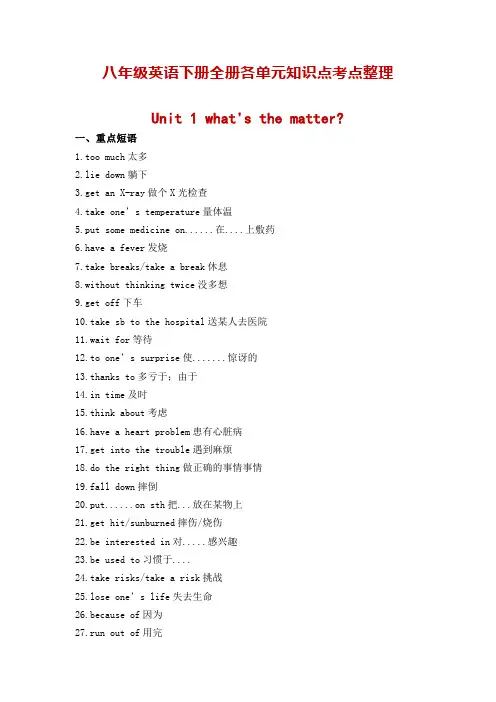
八年级英语下册全册各单元知识点考点整理
Unit 1 what's the matter?
一、重点短语
1.too much太多
2.lie down躺下
3.get an X-ray做个X光检查
4.take one’s temperature量体温
5.put some medicine on......在....上敷药
6.have a fever发烧
7.take breaks/take a break休息
8.without thinking twice没多想
9.get off下车
10.take sb to the hospital送某人去医院
11.wait for等待
12.to one’s surprise使.......惊讶的
13.thanks to多亏于;由于
14.in time及时
15.think about考虑
16.have a heart problem患有心脏病
17.get into the trouble遇到麻烦
18.do the right thing做正确的事情事情
19.fall down摔倒
20.put......on sth把...放在某物上
21.get hit/sunburned摔伤/烧伤
22.be interested in对.....感兴趣
23.be used to习惯于....
24.take risks/take a risk挑战
25.lose one’s life失去生命
26.because of因为
27.run out of用完 28.cut off切除
29.get out of从...出来
30.make a decision/decisions做决定
31.be in control of掌管;管理
32.give up放弃
主要句型
1.It’s+形容词+for sb.+to do sth.做某事对某人来说是…的。
人教版英语八年级下册第一单元知识点
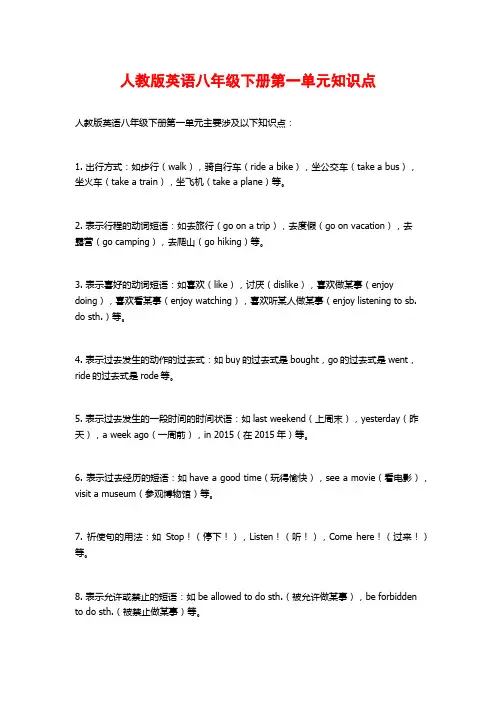
人教版英语八年级下册第一单元知识点
人教版英语八年级下册第一单元主要涉及以下知识点:
1. 出行方式:如步行(walk),骑自行车(ride a bike),坐公交车(take a bus),坐火车(take a train),坐飞机(take a plane)等。
2. 表示行程的动词短语:如去旅行(go on a trip),去度假(go on vacation),去露营(go camping),去爬山(go hiking)等。
3. 表示喜好的动词短语:如喜欢(like),讨厌(dislike),喜欢做某事(enjoy
doing),喜欢看某事(enjoy watching),喜欢听某人做某事(enjoy listening to sb.
do sth.)等。
4. 表示过去发生的动作的过去式:如buy的过去式是bought,go的过去式是went,ride的过去式是rode等。
5. 表示过去发生的一段时间的时间状语:如last weekend(上周末),yesterday(昨天),a week ago(一周前),in 2015(在2015年)等。
6. 表示过去经历的短语:如have a good time(玩得愉快),see a movie(看电影),visit a museum(参观博物馆)等。
7. 祈使句的用法:如Stop!(停下!),Listen!(听!),Come here!(过来!)等。
8. 表示允许或禁止的短语:如be allowed to do sth.(被允许做某事),be forbidden
to do sth.(被禁止做某事)等。
9. 推测或猜测的短语:如maybe(或许),probably(可能),I think(我认为),I
guess(我猜)等。
以上是人教版英语八年级下册第一单元的主要知识点,希望对你有帮助。
人教版八年级英语下册第一单元知识点归纳总结doc1500字
人教版八年级英语下册第一单元知识点归纳总结doc1500字
人教版八年级英语下册第一单元知识点归纳总结
一、单词
1. invention - 发明
2. engineer - 工程师
3. chemistry - 化学
4. physics - 物理
5. medicine - 医学
6. biology - 生物学
7. scientist - 科学家
8. research - 研究
9. struggle - 斗争
10. successful - 成功的
11. heart - 心脏
12. robot - 机器人
13. design - 设计
14. operate - 操作
15. intelligent - 聪明的
二、短语
1. come up with - 提出,想出 2. be made up of - 由...组成
3. be well received - 受到好评
4. have difficulty (in) - 遇到困难
5. succeed in - 在...方面成功
6. take the place of - 取代
7. go through - 经历
8. in time - 及时,准时
9. make a difference - 有所不同
三、语法
1. 现在完成进行时
现在完成进行时表示过去开始,一直延续到现在的动作或状态。表示未完成的动作,通常带有表示一段时间的状语,如:for, since等。
例如:
- Mary has been studying in this school for two years.
- It has been raining since this morning.
2. 过去完成时
过去完成时表示在过去某一时间或动作之前已经完成的动作。
例如:
- I had finished my homework before my father came back.
人教版英语八年级下册第一单元知识点 2
人教版英语八年级下册第一单元知识点
Unit1What’sthematter
【单词】
matter /'mt/n.问题;事情
What’s the matter(with sb.)怎么啦出什么事情了询问有什么病或遇到什么麻烦、问题
sore/s:/adj.疼痛的,酸痛的;恼怒的 --have a sore back 后背痛 --sore throat咽喉痛
n. 溃疡,痛处;恨事 pressure sore褥疮, sore spot 伤疤,痛处;伤心事,旧疮疤
stomachache['stmkek] n.胃痛;腹痛
stomach/'stmk/n.胃;腹部
foot/ft/n.脚;足 pl. feet
-- on foot步行;在进行中 -- at the foot of在…(山)脚下;在…的下部
neck/nek/n.颈;脖子
--necklace项链 -- necktie领带 --neck and neck(with sb.) (与…)并驾齐驱,不分上下
throat/θrt/n.咽喉;喉咙
fever/'fi:v/n.发烧 haveafever发烧
lie/la/--vi.躺, 平躺;位于,存在 liedown躺下
--vi.说谎,
作为不及物动词的变化: -- lying,pt-- lied,pp—lied
--vt. 下蛋;放置 ., The hen stopped laying eggs. She laid the baby down gently on the bed.
作为及物动词是的变化: -- laying,pt-- lay,pp—lain
restv.&n.放松;休息
coughn.&v.咳嗽
射线;X光
toothache /'tu:θek/n.牙痛
temperature温度,体温 takeone'stemperature量体温
人教版英语八年级下册第一单元Unit 1知识点
Leeya英语课堂
1Unit1What’sthematter知识点SectionA
1.What’sthematter?怎么啦?出什么事情了?
【解析】mattern.问题;事情What’sthematterwithyou?=What’sthetroublewithyou?=What’swrongwithyou?
【注】:matter和trouble为名词,其前可加the或形容词性y物主代词,wrong是adj.不能加the【用法】用于询问某人有什么病或某人遇到什么麻烦、问题其后跟询问对象时,与介词with连用。即:What’sthematterwithsb.?=What’syourtrouble?=What’sup?=Whathappenedtosb.?
【拓展】matter的用法(1)Itdoesn’tmatter没关系(用来回答别人道歉时的用语)
()—I’msorrytobreakyourpen.—_______A.That’srightB.Itdoesn’tmatterC.Thankyou
答案:B(2)asamatteroffact=infact事实上,实际上
2.Ihaveacold我感冒了Ihaveastomachache我患胃痛Ihaveasoreback.我背痛。
【解析】haveacold受凉;感冒havea/an+疾病名词“患……病”(cold/fever/cough)
haveasorethroat患喉咙痛haveasoreback患背痛haveafever发烧haveacold=catchacold患感冒haveastomachache患胃痛haveatoothache患牙痛haveaheadache患头痛haveabackache患背痛①Mike’ssister_________________(nothave)astomachache.
答案:doesn'thave
3.handn.手handinhand手拉手V.交给;传递handin上交handon依次传递handout分发4.Shetalkedtoomuchyesterdayanddidn’tdrinkenoughwater.她昨天说话太多了并且没有喝足够的水。
人教版八年级下册英语第一单元unit1知识点
人教版八年级下册英语第一单元unit1知识点(总5页)
-本页仅作为预览文档封面,使用时请删除本页- Unit 1 Will people have robots
★语法知识归纳
一、概念:表示将来某个时间要发生的动作或存在的状态,也表示将来经常或反复发生的动作,常与表示将来的时间状语连用,如tomorrow, next week, next year等。
I will go back to my hometown next week.
We will come to see you every Sunday.
二、构成
1.肯定式:主语+will/shall/be going to +动词原形+其他
will:
shall:
be going to:
○They’ll have a test next week.
○Shall we have a rest?
○I’m going to write a letter to my friend.
2.否定式:在will/shall/be后面加not
will+not= shall+not= is+not= are+not=
将上面三个肯定句变为否定句
○
○
○
3.一般疑问句:将will/shall/be提到主语之前。
将○、○句变为一般疑问句
○
○
★重点句子讲解
you think there will be robots in people’s homes?
(1)本句是一个_________句,think后面接_________从句,从句的语序必须是_________语序。引导词_______________________.
(2)there will be是there be 句型的一般将来式,否定形式为___________________.一般疑问句形式是 _____________________. be going to 形式为______________________________.