
初中英语人教版七年级下册《Unit4 Don’t eat in class》课件PPT
=the other people
M:What about the others? Are they with you?
B:Well, right now Tony is eating a delicious ice cream. Wang
Hui is taking lots of photos.
新知讲解
基础词汇
Words and expressions
postcard call lie sun line take
take photos wait
wait for walk
n. 明信片 v. 打电话 v. 躺 n. 太阳 n. 行, 排 v. 拿, 花费(时间)
拍照 v. 等待
等待 v. 步行
基础词汇
Words and expressions
trip few a few sale on sale enjoy anyway back go back
n. 旅行 adj. 很少的
几个 n. 卖;出售
正在出售 n. 享受…乐趣 v. 无论如何 adv. 向后
回去
PART 02
新知讲解
新知讲解 1. Look at the pictures and talk about them.
新知讲解
3. Listen and read.
B:Hi, Mum!
M:Hello, Betty! Where are you now?
B:I’m standing on the Great Wall of China and talking to you.
M:Really? That’s great. B:We’re on a school trip.
People
Betty
Tony Wang Hui Lingling Daming
Things he/she is doing
She’s standing on the Great Wall and talking to her mum. He’s eating a delicious ice cream. He’s taking lots of photos. He’s buying a few presents and postcards. He’s having lunch and lying in the sun.
a lot “非常”, 动词后; a lot of “许多”, 名词前
观ห้องสมุดไป่ตู้思考
读句子,找规律: I’m standing on the Great Wall of China and talking to you. Wang Hui is taking lots of photos. Lingling is buying a few presents and postcards. Daming is having lunch and lying in the sun. We’re enjoying the school trip a lot.
buy postcards call lie in the sun shop stand in line take photos wait for the bus walk on the Great Wall
4 2
1
3
2. Listen and number the pictures.
任务阅读 Now listen, read and complete the table.
— Betty is talking to her mother. — Tony is __e_a_t_in_g_a__d_el_ic_io_u_s_i_c_e_c_re_a_m___. — Wang Hui is___ta_k_i_ng__lo_t_s_o_f _p_h_o_to_e_s__. — Lingling is___bu_y_i_n_g_a_f_e_w_p_r_e_se_n_t_s_a_n_d_p_o_s_tc_a_rd_s_________. — Daming is__h_a_v_i_ng__lu_n_c_h_a_n_d_l_y_in_g_i_n_th_e__su_n____________.
B:Lingling is buying a few presents and postcards. They’re
on sale at the shop. Daming is having lunch and lying in
the sun.
M:I’d like a postcard too, but please take some photoes of
Unit4 Don’t eat in class.
Section A 1a-1c
人教版初中英语七年级下册课件
复习巩固
目
新知讲 解
录
教学重点
拓展练习
PART 01
复习巩固
课前热身
Would you like to have a school
trip to...?
Mount Tai
snow mountain
新知讲解 4 Underline the correct words.
The children are on a school (1) trip / holiday to the Great Wall. They’re walking on it, taking photos and buying (2) a few / a lot of presents, ice creams and postcards on (3) sale / line at the shop. They (4) are enjoying/aren’t enjoying the trip a lot.
the Great Wall and send them to me by email.
B:OK. We’re enjoying the school trip a lot. Anyway, it’s time
to go back to school now. Bye, Mum!
M:Bye, Betty!
1.谓语动词的形式有什么共同点?
be(am,is,are)+v-ing(现在分词) 2.中文句意的共同点是什么? 某人正在做某事。
初识进行
请找出本课中所 有的现在分词形
式并朗读。
能力创新
仿例造句
新知讲解
课文动画
5 Say what people are doing in the conversation.
人教版英语七年级下册_unit4Don’t_eat_in_class!
reach +地点 (到达某地方 )
2 class 班 ,课 在课堂上 上课
in class
have classes
be late for class
上课迟到
• on time 准时 in time 及时 • 他每天准时到校。 • He gets to school on time everyday • 她及时赶到了医院。 • She gets to the hospital in time.
Are they good students?
What rules are these students breaking?
What are they doing now ?
She is eating an apple .
Dave and Tom
Selina
They’re fighting .
Nick
√
Activity
can
can
can’t
can’t
√ √ √ √ eat in the dinning hall 5. ___
6. ___ eat outside 7. ___ wear a hat
can can can can can can
can’t can’t can’t can’t can’t can’t
bravely. 他们正在勇敢地同敌人战斗。
Grammar
1. 祈使句是表示请求、命令、叮嘱、号召、
劝告等的句子; 通常省略主语you; 句中谓语
动词用动词原形; 句尾一般用降调; 祈使句的
开头是动词原形。
祈使句有肯定和否定两种: e.g. Look out! 小心! Wait here for me! 在这等我!
人教版七级下英语Unit 4 Dont eat in class单元知识复习总结
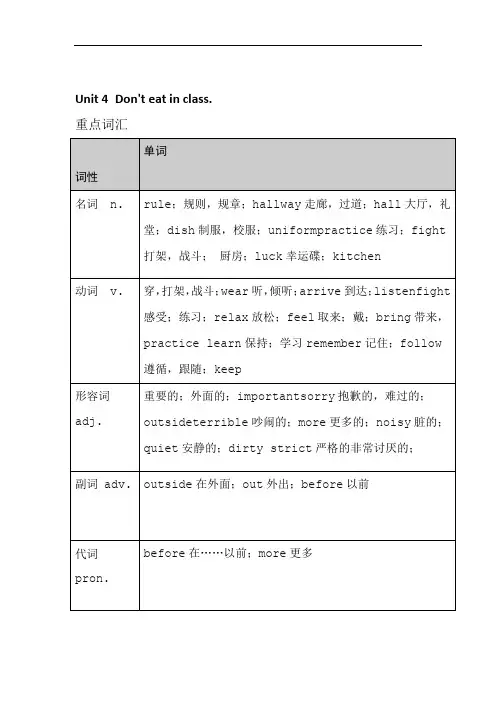
Unit 4Don't eat in class. 重点词汇重点短语Section A1.in class在课堂上2.arrive late for class=be late for class上课迟到3.on time准时4.in the hallways在走廊里5.in the dining hall在餐厅里6.listen to听7.at school在学校8.be late迟到9.music player音乐播放器10.bring...to school 把……带到学校来不得不做have to do.11.12.wear a school uniform穿校服13.be quiet安静Section B14.go out外出15.on school nights在上学期间的晚上16.practice the guitar练吉他17.do the dishes清洗餐具18.make breakfast做早饭19.make one's bed整理床铺20.leave sth.in...把……丢在……里21.read a book看书22.think about考虑23.make rules制订规则24.follow the rules遵守规则25.Good luck!祝好运!26.keep sth.+adj.使……保持……状态重点句型1.Don't eat in class.在课堂上不准吃东西。
2.Don't arrive late for class.You must be on time.不准上课迟到,务必守时。
3.Don't run in the hallways.不准在走廊内乱跑。
4.Don't eat in the classroom.You must in the dining hall.不准在教室里吃东西,务必在餐厅里吃东西。
5.Don't listen to music in class.不准在课堂上听音乐。
人教版英语七年级下册-Unit-4-Don't-eat-in-class-语法解析
2021/2/4
1
6
疑问句: must 提前,回答时注意一二人称的互换。肯定用 must, 否定用needn’t. e.g. --Must I go home now?
-- Yes, you must. -- No, you needn’t.
B: And I must clean my room every Saturday. =?
A: Wow, you do have a lot of rules!
2021Dr. Know, There are too many rules! At 6:00 a.m. my mom says, “Get up now and make your bed!”
too many rules “太多的规定”, 其中too many 用来 修饰可数名词复数rules。 e.g. He has too many friends to meet.
修饰不可数名词时, 要用too much e.g. We have too much work to do.
much too 太……much 用来增强语气。后接形容 词或副词。
What can I do. Dr. Know? Molly Brown, New York
表“看”的单词?
either 也。用于否定句和疑问句中。肯定句中用too 表也。
watch,see,look r,read
2021/2/4
1
13
Dear Molly, I know how you feel. People always tell us, “ Don’t do this!” or “You can’t do that!” But think about it, Molly. There are a lot of things you can do. You can play basketball on weekends. You can watch TV after you read a book. Parents and schools are sometimes strict,
人教版英语七年级下册Unit4Don’teatinclass.知识点及课后作业
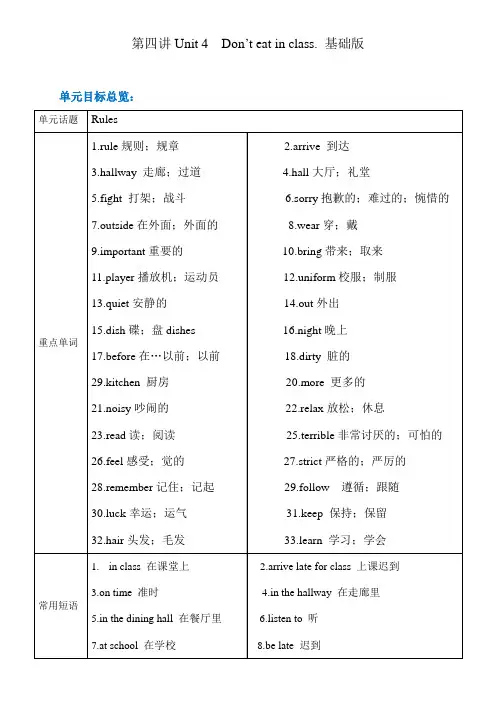
第四讲Unit 4 Don’t eat in class. 基础版单元目标总览:【知识点详解】1、Don’t arrive late for class.上课不要迟到。
1)arrive 意为“到达”。
arrive at+小地点,arrive in +大地点。
◆I will arrive in Beijing next week. 我下周到北京。
◆I arrived at the small village on a cold morning. 在一个寒冷的早晨我到达了那个小村庄。
2)arrive 后面跟地点副词here, there, home时,不需要跟介词。
◆arrive home 到家arrive here 到这儿2、You must be on time.你必须准时。
(1)on time&in timeon time 意为“按时,准时”,指按照规定的时间或者指定的时间做某事;而in time指“及时”,指不迟到或在规定的时间之前或者接近所规定的时间做某事。
◆We must arrive there on time. 我们必须按时到达那里。
At last, the police arrived there in time. 最后警察及时赶到了那里。
(2)must情态动词,意为“必须”,不能单独做谓语,必须和动词原形以其构成谓语;其后接动词原形;其否定形式mustn’t意为“禁止,千万不要”◆I must do my homework before dinner.晚饭前我必须做完作业。
3、Don’t listen to music in class.不要再课堂上听音乐。
(1)listen 是不及物动词,意为“听,倾听”,强调听的动作,后面接宾语时要加上介词to。
◆We should listen to the teacher carefully. 我们应该认真听老师讲课。
◆Listen! Someone is singing in the garden. 听! 有人在花园里唱歌。
人教版七年级英语下册Unit4 要点详解3

Don’t eat in class. 要点详解1. Don’t run in the hallways. 不要在走廊内乱跑。
此句是祈使句的否定式,表示命令别人不要做某事。
祈使句表示请求、命令、建议、劝告或征求对方意见等,其否定形式是在前面加上don’t构成,肯定形式是以动词原形开头。
在句首或句尾加上please,使语气变得委婉,如果在句尾加please,要用逗号隔开。
e.g. Sit down, please. 请坐。
Please don’t sit down. 请别坐下。
Don’t swim in the river. 别在河里游泳。
2. Which rules are these students breaking? 这些学生在违反哪些规章制度?此句中break为动词,意思为“违背,违反,不依从,不服从,不遵守”,后常接法律、规则、诺言等做宾语。
e.g. He always breaks the rules of school. 他总是违反校规。
He broke his words. 他失言了。
Don’t break the law! 别犯法!3. What else do you have to do? 你还有别的不得不做的事吗?else做副词,表示“另外,其他”,放在something,someone,somebody等复合代词或者what,who, where,when等疑问代词或副词之后,e.g. Would you like anything else? 你还要点别的东西吗?Where else do you want to go? 你还想去别的什么地方吗?4. John, you have to wear sports shoes for gym class. 约翰,体育课你得穿运动鞋。
have to do “不得不做某事”侧重于客观上的“必须,不得不”解,和其他情态动词的区别在于它具有人称的变化。
人教版英语七年级下册Unit4听力原文及翻译
人教版英语七年级下册Unit4听力原文及翻译Unit 4 Don’t eat in class.Section A, 1bMs. Clark: Hey, Peter. You know the rules. Don’t run in the hallways.彼特,你知道规定,不可以在走廊跑。
Peter: Sorry, Ms. Clark.抱歉,克拉克女士。
Mr. Smith: Amy, don’t eat in the classroom. You must eat in the dining hall.艾米,不可以在教室吃东西。
你必须在食堂吃。
Amy: Oh, sorry, Mr. Smith.抱歉,史密斯先生。
Mr. Smith: Hey, Mike, don’t listen to music in class. Mike!麦克,不可以在课堂听音乐。
Boy: He can’t hear you, Mr. Smith.史密斯先生,他听不到你说话。
Section A, 2a, 2bCindy: What are the school rules, Alan?艾伦,学校的规定有哪些?Alan: Well, we can’t listen to music in the classroom or hallways. But we can listen to it outside or in the music room.我们不能在教室或走廊听音乐,但是可以在此之外或音乐室。
Cindy: Uh-huh.好的。
Alan: And we can’t eat in the classroom, but we can eat in the dining hall.然后我们不能在教室吃东西,但是可以在食堂吃。
Cindy: Oh. And can we wear a hat in class?那么我们能在课堂上戴帽子吗?Alan: No, we can’t. What else? Oh, you can’t fight with your classmates. That makes the teachers really unhappy.不能。
人教版新目标英语七年级下册:Unit 4 《Don't eat in class》
Unit4 Don’t eat in class!附参考答案一.单项选择.1.____ late. It’s your first day to work.A. Don’t to beB. Don’t beC. Don’tD. No 2.-______sing! -All right.A. LetB. Let’sC. We let3.When will the train ______?A. arriveB. arrive atC. reachD. arrive in4.I ______ but I _______ nothing.A. listened ; heardB. listened; hearC. heard; heardD. heard; listened5.The girl ______ the red dress is Jill Green.A. withB. wearC. put onD. in6.-Do you have an eraser?-______. I have _______ eraser.A. No; notB. Not; noC. No; noD. Not; not7. Mary usually _____ her dog at weekend.A. walkB. takesC. go withD. walks8. Don’t ______ bed by 9 o’clock.A. goB. inC. be inD. go in9. We can’t go out _______ school nights.A. atB. inC. onD. by10. He can’t meet his friends tonight because he _______ do homework.A. has toB. needC. have toD. don’t have to11. It’s very warm. You ______ to wear the coat.A. mustB. d on’t have toC. have toD. mustn’t12. Don’t go into the classroom _______ the teacher.A. withB. togetherC. withoutD. with not13. He can’t _______, but he often _______ to the beach and play.A. swimming, goB. swim, goesC. swims, goesD.swim, go14. Does she always wear _______?A. uniformB. sneakerC. a uniformD. a sneaker15. There are ________ rules in our class.A. many tooB. too muchC. much tooD. too many16. Tom never ________ fun at home.A. have muchB. has anyC. have anyD. has many二.句型转换。
人教版英语七年级下册教案unit4 don't eat in class
3. Careful reading
1) Read Dr. Know's letter and answer the question:
What does she think of the school and home rules?
句型:①Don't eat in class.
②You must be on time.
③Eat in the dining hall.
课后反思
Unit 4 Don't eat in class
课题
Unit4
课型
新
教学目标
1.重点单词:outside,wear,important,bring,uniform,quiet
A.don't B.can't C.aren't D.are
(C)3.You ________ go in a hurry(匆忙).There's enough time left.
A.have to B.hadn't
C.don'thave to D.haven't to
作业布置
请同学们做前面课时训练部分。
2) Ss read Dr Know's letter and find the answer to the question.
3) Let one student read out his/her answer.
(She thinks parents and schools are sometimes strict, but they make rules to help us. We have to follow them. )
初中英语 七年级下册 Unit4 Don't eat in class
(2)意为“一定;准是”,表示肯定推 测,用于肯定句中。 这本书一定是玛丽的。
The book must be Mary’s.
2.情态动词 have to 的用法 (1) have to 意为“必须;不得不”,后接动词 原形,表示客观需要做的事情。 现在我不得不离开。 I have to leave now.
不要吵闹。 Don’t be noisy.
肯定句:
让我帮你吧。
Let+宾语+动词原形+其他. Let me help you.
Let 型 否定句:
①Don’t let+宾语+动词原 形+其他. ②Let+宾语+not+动词原 形+其他.
别让他走。
Don’t let him go./
Let him not go.
2.祈使句的句式
肯定句:
请坐。
动词原形(+宾语)+其他. Sit down, please.
Do
型 否定句:
不要在这儿跑。
Don’t +动词原形(+宾语)
+其他.
Don’t run here.
肯定句: Be +表语+其他. Be 型 否定句: Don’t + be +表语+其他.
请安静。 Be quiet, please.
Summary
语法 1. 祈使句的三种类型用法
Don’t run in the hallway. 2. 情态动词can, must, have to的用法
Can we wear a hat in class? We must be on time for class. We have to be quiet in the library.