
听力教程第二版第三册答案UNIT7施心远
UNIT 7Section one Tactics for ListeningPart 1 Spot DictationMeet Your ChiropractorThe doctor of chiropractic (D.C.) is a (1) well-recognized member of the health team who (2) considers the human body as a total functioning (3) unit and gives special attention to the spine, (4) muscles, nerves, circulatory and skeletal (5) systems. The chiropractor seeks to (6) relieve pain.The procedures utilized are primarily focused on the (7) spine. The chiropractor is concerned about the spine's relationship to the (8) nerve system, which controls important body functions. The chiropractor knows that a malfunctioning* spinal joint can not only cause (9) back pain or headaches, it can also (10) interfere with the nerves leading from the spine, thereby (11) affecting other portions of the body.Millions of Americans are chiropractic patients for a wide variety of (12) health disorders. They depend on their chiropractor as their (13) family doctor to help them maintain their health through proper (14) diagnosis, treatment, and referral when (15) necessary.A minimum of six years of college study including internships (16) goes into the making of a chiropractic physician. Many doctors of chiropractic choose to (17) limit their practices to certain specialties, such as (18) sports injuries, nutrition, orthopedics or radiology.As a (19) licensed and regulated member of the healing arts, the doctor of chiropractic must pass a state (20) licensing board examination in order to practice.Part 2 listening for GistLike the "Iron Age" volunteers, Paul has also chosen to cut himself off from many aspects of modem life, not, however, as an experiment but because he feels it is a more satisfactory way to live. He is talking about his small cottage in the Welsh mountains:"And that brings me to say what is primitive about it, namely, it is anything that has to be done, and there are obviously certain basic needs of life, is 'DIY' as they say: Do it yourself. There is no labor to be had nowadays in such a remote part. Er, there are no neighbors for most of the year and so you are on your own entirely. The place itself is extremely primitive. Er, I mentioned the water. I mentioned that we now have got electricity. Er, thebuilding itself - it's important to keep it clean and it's stupid to try. We try to keep it tidy, and reasonably clean. It is very difficult to keep it warm, warm enough particularly in winter and that we do by an old kitchen range with coal and wood." ExerciseDirections: Listen to the passage and find its topic sentence. The topic sentence is "The place itself is extremely primitive."Section Two Listening ComprehensionPart1 DialogueA Healthy LifeDr Martin Answay writes a column in a popular women's magazine on health problems. He is also an expert on heart disease.Q: Is there a secret to good health? I mean, is there some way we can achieve it which is not generally known?A: It certainly isn't a secret. However, there is a great deal of ignorance, even among supposedly educated people, about how to be reasonably healthy.Q: Well, what advice do you give, then?A: Vh ... to begin with, take diet. I believe that one of the greatest dangers to health in Britain and other countries ...particularly developed countries ... is the kind of food wetend to prefer.Q: Such as?A: Such as that great national institution, the British breakfast, for example, ham and eggs. Or the kind of lunch so many people in this country have: sausage and chips! Or all the convenience foods like hamburgers. Or even things we regard as "healthy", such as full-fat milk. Or Cheddar cheese.The list is endless.Q: What's wrong with those things?A: The excessive consumption of such things leads to the overproduction of cholesterol, which in turn results in heart attack ...Q: Excuse me, but what exactly is cholesterol?A: It's a ... wax-like substance ... yellowish ... and it's produced naturally in our livers. We all need some cholesterol forsurvival.Q: Well, if we need it, in what way is it bad for us?A: Too much of it is bad for us. It builds up in our arteries, causing them to get narrower, so that our blood supply has difficulty in getting through ... and this, of course, can eventually end in a heart attack or stroke. The point I'mtrying to make here is that, even though we all need some cholesterol in order to insulate our nerves, and to produce cell membranes and hormones, the things many of us eat and even consider healthy lead to the overproduction of cholesterol. And this is very dangerous.Q: How can we avoid this overproduction of cholesterol?A: By cutting down our consumption of animal fats: things like red meat, cheese, eggs, and so on. And by increasing ourconsumption of fresh fruit and vegetables, and also by eating more potatoes, rice, pasta and bread.Q: Pasta? Potatoes? But ... aren't such things fattening?A: Nonsense. It isn't pasta, potatoes or bread that makes us fat.It's what we put on such things! Cheese, Butter, Meat!Q: So anything we like, anything that's delicious, is bad for us.Isn't that what you're saying?A: Rubbish! I'm simply saying we eat too much of these things.And there are many ways of preparing delicious food without using such large quantities of animal fats.Q: Last of all, what about exercise? You recently warned against certain forms of exercise, which you said could bedangerous.A: What I said was that if people aren't used to getting regularand vigorous exercise, they should begin slowly, and not try to do too much at the beginning! I also said that certain games, such as squash, can be dangerous, particularly if you aren't used to playing them. A number of injuries are due to sudden, twisting movements that games like squash involve. Q: What kinds of exercise do you recommend, then?A: Gentle jogging, swimming, cycling, brisk walking ... exercise that is rhythmic and gentle, and above all, sustained. That is, done for at least fifteen minutes uninterruptedly at least three times a week. We all need such exercise, and the fact is that far too few of us get enough of it, particularly if we live in large cities and regularly use cars.ExerciseDirections: Listen to the dialogue and complete the following grids.A. CholesterolB. ExercisePart 2 PassageAging of America1)T he impending collision between the boomers and the nation's retirement system is naturally catching the eye of policymakers and the boomers themselves.2)R etirement income security in the United States has traditionally been based on the so-called three-legged stool: Social Security, private pensions, and other personal saving.3)R etirement planning takes time, and these issues need to be addressed sooner rather than later.4)O ne found that in 1991 the median household headed by a65-69-year-old had financial assets of only $14,000, but expanding the measure to include Social Security, pensions, housing, and other wealth boosts median wealth to about $270,000.5)O nly one or two generations of Americans have hadlengthy retirements, and the crucial retirement issueskeep changing rapidly, making long-term predictionseven harder.The Baby Boom* generation - the roughly 76million people born between 1946 and 1964has been reshaping American society for five decades. From jamming the nation's schools in the 1950s and 1960s, to crowding labor markets and housing markets in the 1970s and 1980s, to affecting consumption patterns almost continuously, boomers have altered economic patterns and institutions at each stage of their lives. Now that the leading edge of the generation has turned 50, the impending collision between the boomers and the nation's retirement system is naturally catching the eye of policymakers and the boomers themselves.Retirement income security in the United States has traditionally been based on the so-called three-legged stool: Social Security, private pensions, and other personal saving. Since World War II the system has served the elderly well: The poverty rate among elderly households fell from 35 percent in 1959 to 11 percent in 1995 .Are the baby boomers making adequate preparations for retirement? In part, the answer depends on what is meant by "adequate". One definition is to have enough resources to maintain pre-retirement living standards inretirement. A rule of thumb* often used by financial planners is that retirees should be able to meet this goalby replacing 60-80 percent of pre-retirement income. Retired households can maintain their pre-retirement standard of living with less income because they havemore leisure time, fewer household members, and lower expenses. Taxes are lower because retirees escape payroll taxes and the income tax is progressive. And mortgages have, for the most part, been paid off. On theother hand, older households may face higher and more uncertain medical expenses, even though they are covered by Medicare.From a public policy perspective, assuring that retirees maintain 100 percent of pre-retirement living standards may be overly ambitious. But should policymakers aim to ensure that they maintain 90 percent of their living standards? Or that they stay out of poverty? Or use some other criterion? Retirement planning takes time, and these issues need to be addressed sooner rather than later.A second big question is how to measure how well baby boomers are preparing for retirement. Studies that focus only onpersonal saving put aside for retirement yield bleak conclusions. One found that in 1991 the median household headed by a65-69-year-old had financial asset of only $14,000. But expanding the measure to include Social Security, pensions, housing, and other wealth boosts median wealth to about $270,000.A third issue - crucial but as yet little explored - is which baby boomers are not provided adequately for retirement and how big the gap is between what theyhave and what they shouldhave. Some boomers are doing extremely well, others quite poorly. Summary averages for an entire generation may not be useful as descriptions of the problem or as suggestions for policy.The uncertain prospects for the baby boomers in retirement are particularly troubling because, as a society, we as yet understand little about the dynamics of retirement. Only one or two generations of Americans have had lengthy retirements, and the crucial retirement issues - health care, asset markets, Social Security, life span - keep changing rapidly, making long-term predictions even harder.Exercise A Pre-listening QuestionAs China's aging population is increasing rapidly, there should be a well-funded pension system put in place. However, the country's pension system only covers a fraction of the work force. It predicts that China will have an elderly population of about 400 million by 2040, which will be a large burden on the economy if an effective pension system is not established.The Chinese government, aware that the old pension system in the planned economy could not keep pace with the market economy, started to reform a purely "pay-as-you-go" pension system in 1997 and introduced one that combines a basic pension with personal savings accounts. The accounts are jointly paid into by employers and employees, as saving to support employees' retirements. The state is considering expanding a reformed pension insurance system nationwide.China is also accelerating the reform of China's pension system.It has been trying to find appropriate ways to invest pension funds in the capital market rather than simply putting them in banks or buying treasury bonds.It has also been trying to find appropriate ways to invest pension funds in the capital market overseas.To ensure the maintenance and appreciation of the pensionpool, more investment tools should be allowed, with sound governance and parallel reform in the financial sector to ensure returns.Exercise B Sentence DictationDirections: Listen to some sentences and write them down. You will hear each sentence three times.Exercise C Detailed ListeningDirections: Listen to the passage and choose the best answer to complete each of the following sentences.l.D 2.D 3. B 4.B 5.C 6.C 7.A 8.CExercise D After-listening DiscussionDirections: Listen to the passage again and discuss the following questions.1)T he boomers have altered economic patterns from jamming the nation's schools in the 1950s and 1960s, to crowding labor markets and housing markets in the 1970s and 1980s, to affecting consumption patterns almost continuously.2)(Open)。
全新版大学英语(第二版)听说教程3听力练习答案
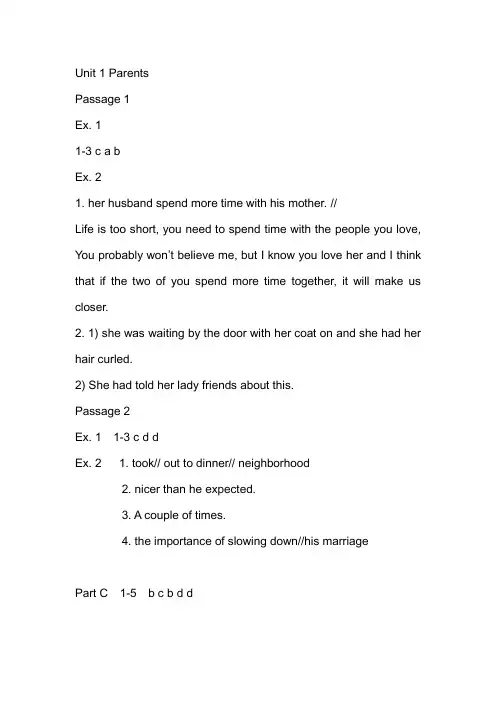
Unit 1 ParentsPassage 1Ex. 11-3 c a bEx. 21. her husband spend more time with his mother. //Life is too short, you need to spend time with the people you love, You probably won’t believe me, but I know you love her and I think that if the two of you spend more time together, it will make us closer.2. 1) she was waiting by the door with her coat on and she had her hair curled.2) She had told her lady friends about this.Passage 2Ex. 1 1-3 c d dEx. 2 1. took// out to dinner// neighborhood2. nicer than he expected.3. A couple of times.4. the importance of slowing down//his marriagePart C 1-5 b c b d dUnit 2 CoincidencePassage 1Ex 1 1-4 b a d cEx 2 1984 // son // medical school // tuition // afford it // realize // newspaper ads // extra business // advertisement //succeeded // agent // changed // phone call // put aside // doing // immediately familiar // his father-in-law’s // visited // father-in-law // alive //coincidencePassage 21. The house was decorated exactly the same as Mr. Stewartremembered it2. Mr. Stewart happened to be in the house when a postman cameto deliver a letter to his father-in-law who had died 15 years ago.3. The old postman had called in sick that day, and the postmanwho came in his place was not familiar with the neighborhood.Other wise the letter would have been returned to its sender.Ex. 21. He was intrigued.2. A bank statement.3. His father-in-law had put an amount of money in the bank for hisgrandchildren’s education.4. A little over $ 15,0005. He could use the money to cover the tuition of his first year at amedical college.6. He is a doctor in Illinois.Part C1) collections 2) shot 3)presence 4)justice5)Theater 6) occur 7) victim8) officers had only managed to identify the first victim minutes before the second accident9) They married on the same day, had worn identical wedding dresses and carried the same flowers.10) How can we explain the above similarities?Unit 3 CourageEx 1 1-2 c c Ex 2 1-8 T F F F F T T FPassage 21-2 d bEx. 21. Because she was afraid Krimali might not be able to catch thebaby.2. Because she thought the bed sheets could somehow protect thebaby form being hurt if she failed to catch her.3. Because they were afraid of the swaying ceiling.4. To make it easier and safer for the baby’s mother to get down.5. About two dozen.Part C1-4 a b d dUnit 4 MarriageConversation 1Ex. 1 1-3 b c aEx. 21. understand each other’s expectations // could be avoided //livehappily2. Cleaning up // cleaned up and put away before going to bed3. Sleeping //11 p.m. // 6:30 a.m. // on weekendsConversation 2Ex. 1 1-3 c c aEx. 21. get lost// five minutes // driving // stop // directions2. breaking rules // break a rule // apologize and do something nicefor the other person to make it up3. reviewing the contents of the agreement // review thisagreement once a year // make necessary changesPart C 1-3 a d bUnit 5 YouthPassage 1Ex. 1 1-2 d cEx. 2 Testing //river // if there were antibiotics // resistant // 350 water samples // the samples // Low levels // three // Water Prize // 5000 / Sweden’sPassage 2Ex. 11. reaching //everybody //exposing //lies2. advertising campaign // youth // against tobacco companies3. the message // teenagers // their advertisementsEx. 2 1-5 c a d c bPart C1-4 a c d cUnit 6 StressConversation 11-3 d c aEx. 2 police officer // 30 // patrol // undercover // detective //supervising investigations // being a police officer // assignment // patrol // the fear of the unknownConversation 2Ex 1 1-5 T F T F TEx. 21. an exercise program // a psychological program // counselingfor officers // several discussion groups //2. baseball // get some sort of exercise // his personalrelationships // relationship with his wifePart C 1-5 d d d b cUnit 7 The Business WorldConversation 1Ex. 11. In Mr. Andrew Song’s office2. Boss and secretary3. To see Mr. Andrew Song on businessEx. 2 1-5 d b a b cConversation 2Ex. 1 1-2 b cEx 2. to discuss the causes of the decline in profits // 10 :00a.m. // Chief Sales Executive1. Sales are down but not by too much2. The budget for sales hasn’t increased even with inflation3. The products are oldPart C1-4 d b d bUnit 8 The EnvironmentPassage 1Ex. 1 1-3 c a dEx. 2 15 million // at the beaches // and in local waters // serious pollution // $ 70 // burning // cancer-causing chemicals// the number of plastic bags used // the public’s overall awareness of environmental problems // the public’s overall awareness of environmental problems //1500 // customers //10 // marketsPassage 2Ex. 1 1-3 d c bEx. 21. Western Europe 、、waterway2. seriously polluted// Fish // dangerous to swim in it3. A fire broke out // tons of pesticides to leak into the Rhine4. The countries //realized // clean it up // keep it clean5. Every six // 24 hoursPart C 1-4 c b d dUnit 9 The Single CurrencyPassage 1 1-3 b b dEx. 21. midnight // 31 // 2001 // the new notes / new currency2. 300 million // 15 billion // 52 billion // 646 billion // 568 billion3. greater Europe // stronger // wealthier4. championed // peace and securityPassage 21-3 d c cEx. 21. When economic conditions are right2. The polls show that many Britons oppose the euro and see it asharming Britain’s sovereignty3. Because as very small retail outlets they don’t have the facilitiesfor changing currencies4. More than 6.55 billion eurosPart C1)symbols 2)ancient 3) grief 4) rebirth5)stable 6) reputation 7) abolishing8)such a conservative people did not express greater sorrow for the loss of their familiar francs9) The name franc was first used in 1360, to celebrate and help to pay for the release of the King of France10) On February 17th, 2002, the French franc disappeared completely from the financial scene.Unit 10 The CinemaPassage 1 Ex. 1 1-2 c dEx. 2 popcorn // successful // 20 million // soft drinks // ice cream // three // four // box office // half the moeny // 69 percent // 89 percent // a little over 90p // 4 // 3.95 Passage 2Ex. 1 1-3 b c dEx. 21. falling2. swimming3. driving4. setting fire5. fights6. flying // exploding helicopter // back of a speeding trian。
大学英语听力教程答案
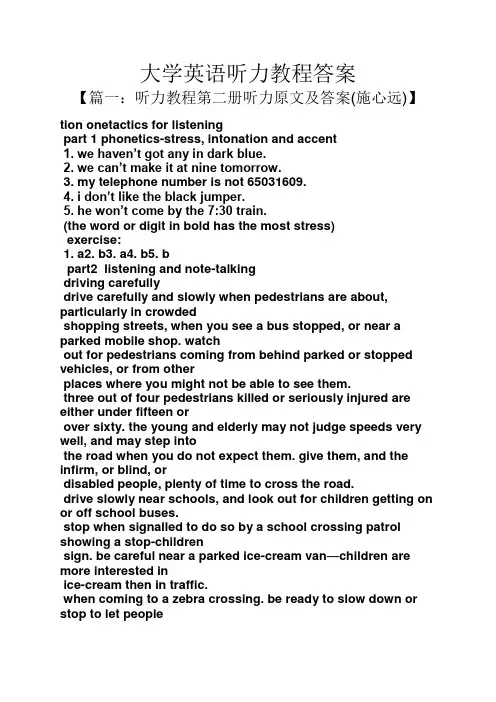
大学英语听力教程答案【篇一:听力教程第二册听力原文及答案(施心远)】tion onetactics for listeningpart 1 phonetics-stress, intonation and accent1. we haven’t got any in dark blue.2. we can’t make it at nine tomorrow.3. my telephone number is not 65031609.4. i don’t like the black jumper.5. he won’t come by the 7:30 train.(the word or digit in bold has the most stress)exercise:1. a2. b3. a4. b5. bpart2 listening and note-talkingdriving carefullydrive carefully and slowly when pedestrians are about, particularly in crowdedshopping streets, when you see a bus stopped, or near a parked mobile shop. watchout for pedestrians coming from behind parked or stopped vehicles, or from otherplaces where you might not be able to see them.three out of four pedestrians killed or seriously injured are either under fifteen orover sixty. the young and elderly may not judge speeds very well, and may step intothe road when you do not expect them. give them, and the infirm, or blind, ordisabled people, plenty of time to cross the road.drive slowly near schools, and look out for children getting on or off school buses.stop when signalled to do so by a school crossing patrol showing a stop-childrensign. be careful near a parked ice-cream van—children are more interested inice-cream then in traffic.when coming to a zebra crossing. be ready to slow down or stop to let peoplecross. you must give way once they have stepped onto a crossing. signal to otherdrivers that you mean to slow down or stop. give yourself more time to slow down orstop on wet or icy roads. never overtake just before a zebra crossing.exercise a:1. 2. 3. —4. when coming to a be ready to or stop to let people 5.exercise b:driving carefullyi. look out for pedestriansa. b. c. ii. look out for the young, the old and the disableda. pedestrians killed or seriously injured are either underb.c. give them, and the infirm, or or people, plenty of to iii. look out for childrena. b. iv. coming to a zebra crossinga. b. c.section twolistening comprehensionpart 1 dialogues mum: hello.tessa: hi, mum. it’s me. how are you?mum: oh, i’m fine, tessa. i except you’re phoning to find out how the arrangementsfor your party are going?tessa: yes. that’s right. you know, it’s really good of you and dad to make all thearrangements while i’m away. i really don’t know what i’d do without you!mum: oh, there is not that much to do really. in fact, your father and i are quiteenjoying ittessa: good. so how are thing going?mum: well, let’s see. i’ve already hired the hall, so that’s ok. tessa: have you found anyone to do the disco yet?mum: no, not yet, dear.tessa: well, do you think you could do that soon, mum? it might not be easy. whatabout the equipment?mum: well, we’re having the sound system and records delivered by a localcompany next week.tessa: good. that should be all right. what about the bar? mum: that’s all under control. we’re having the drinks delivered next week.tessa: great! have you organised the food? are you cooking it? mum: what, for 70 people? you must be joking! no, i think i’ll have it done by thecaterers* in the village.t essa: you’ll do that soon, won’t you? they’ll need a bit of notice.mum: mmm. of course. now, i had the invitations printed last week. thestationer’s did them, but i haven’t had time to send them yet…tessa: oh, mum, but the party’s in ten days! sen d them soon, will you, or we’llhave no guests!mum: yes, i’m sorry, dear. look, i’ll phone everyone too. i’ve been so busy with allthe arrangements…a: excuse me, do you mind answering a few questions?b: no.a: um firstly, do you ever eat fast food.b: yes, yes, i do.a: what kind of fast food do you normally eat?b: oh, er you know, burgers, sandwiches, well sometimes like a pizza or, you know,kebabs*.a: oh, right. and how often do you eat fast food? every day, more than once aweek or less than once a week?b: er, well monday to friday when i’m working er, yeah every day, um butnot…not usually at the weekends.a: and what time of day do you eat fast food?b: well, at work as i said, you know at lunchtime, um you know, i sort of go outand get a burger or sandwich. sometimes, you know, if, if i’m going out and i’veno time to cook in the evenings then i’ll, i’ll send out for a pizza.a: oh, right. do you only eat it as a main meal or do you snack between meals?b: no, only as a main meal, you know lunch or, or in the evening.a: and what do you think of fast food? which statements do you think are true?um, either“it’s convenient”b: oh, definitely. i mean, that’s sort of the main reason that i eat it.a: right. how about “it tastes good”?b: yeah. um, i mean, not as good as food like in a, in a good restaurant, but it’s notbad.a: “it’s good for you”?b: no. sort of eating quickly and standing up. it’s sort of bad for you. the fooditself isn’t very good for you, you know there’s not enough greens, um you know, vegetables or salad.a: mm. how about “it’s an expensive way of eating”? what do you think of that? b: oh, yes it is, er but you’re paying for the convenience, you know the speed of it.er, well, i certainly think that it’s cheaper than you know cooking your own food.a: er, and what about lastly “it creates litter.” do you think that’s true?b: yes, yes, it does. only i, i always put mine in a you know in a litter bin, but erunfortunately a lot of people don’t, um but in the packaging there is a lot of paper involved and plastic and sometimes polystyrene*.exercise b:it is convenient and fast, thought it doesn’t taste as good as food in good a restaurant. however it is bad to one’s health because there are not enough vegetables. it is also quite an expensive way of eating, but you’re paying for the convenience. and it creates litter because in the packaging there is a lot of paper, plastic and sometimes polystyrene involved.part 2 passagesit’s 3:15 in the afternoon and half the office just stepped out* for a coffee break. your eyelids are starting to close and 7-11 isjust around the corner. a soda or a bag of chips would be just the thing to perk you up*. so you, too, go out for an afternoon snack.sometimes we eat simply because everyone else is doing it. other times we eatwhen we feel tired, bored or depressed. snacking for the wrong reasons can lead to overeating and unhealthy diet.of course, there are times when our bodies really need extra energy. here are four tips to keep your snacking on the right track.le, but it’s only a temporary cure. once the fries are gone, the problem is still there. if you’re feeling lonely, don’t reach into the refrigerator. call a friend. if you’re feeling stressed, take a 10-minute walk.2. find a healthy pick-me-up*. if you’re truly hungry, a healthy snack can give you the boost of energy you need. if you like fresh foods, bring a small bag of tomatoes or apples slices to work whit you. to tame your sweet tooth, try a handful of dried fruit. a serving of nuts can be a perfect pick-me-up. they have the right combination of nutrients to give you the energy you need. but wait until you’re hungry to find something to eat. plan ahead and bring something healthy whit you.3. eat just one serving. don’t open up a whole box of cr ackers and start munching away. instead, pull out just one serving and put away the box.4. think of snacks as mini-meals. eating small, healthy snack can keep you from stuffing yourself at the next meal. instead of eating three big meals each day, split them into four or five mini-meals. you may actually eat less food overall.use these tips to help you plan snacks ahead of time. the next time you have a snack attack, tame your hunger the healthy way.exercise a:a soda or a bag of chips; a piece of cake; a sandwich; a small bag of tomatoes; a small bag of apple slices; a serving of nuts;a glass of low-fat-milk; a serving of crackers, etc.exercise b:1. a2. d3. b4. c5. d6. b7. c8. aexercise c:1. a soda or a bag of chips would be just the thing to perk you up.2. using food to change your feeling can be a dangerous habit.3. if you’re feeling lonely, don’t reach into the refrigerator. calla friend.4. a serving of nuts can be a perfect pick- me-up.5. eating small, healthy snacks can keep you from stuffing yourself at the next meal. breakfast fills your “empty tank”to get you going after a long night without food. and it can help you do better in school. easy-to-prepare breakfasts include cold cereal with fruit and low-fat milk, whole-wheat toast with peanut butter, yogurt *with fruit, whole-grain waffles or even last night’s pizza!it’s easy to fit physical activities into your daily routine. walk, bike or jog to see【篇二:全新版大学英语听说教程3答案】txt>全新版大学英语听说教程2009-03-07 20:19阅读527评论0字号:大中小全新版大学英语听说教程答案第三册part btext 1exercise 1: 1. c 2. a3.bexercise 2:1.she suggested that her husband spend more time with his mother. she said to her husband, life is too short, but you need to spend time with the people you love. you probably wont believe me, but i know you love her and i think that if the two of you spend more time together , it will make us closer.2.1) ...she was waiting by the door with her coat on and she had her hair curled.2) she had told her lady friends about this.text 2exercise 1: 1. c 2. d 3. dexercise 2: 1. f2. t3. f4. t5. fpart c1. b2. c3. b4. d5. dpart dmy first jobmy parents ran a small restaurant. it was open twenty-four hours a day, seven days a week. my first job was shining shoes for customers when i was six years old. my duties increased as i grew older. by age ten i was clearing tables and washing plates. my father made it clear that i had to meet certain standards. i had to be on time, hard-working and polite to the customers. i was never paid for any work i did. one day i made the mistake of telling dad i thought he should give me ten pounds a week. he said, ok, then how about you paying me for the three meals a day when you eat here and for the times you bring your friends here for free drinks? he figured i owed him about 40 pounds a week. this taughtme quite a lot.unit 2part btext 1exercise 1: 1. b 2. a 3. d 4. cexercise 2:1984 / son / medical school / tuition / afford it / realize / newspaper ads / extra business / advertisement / succeeded / agent / changed / phone call / put aside / doing / immediately / familiar / father-in-laws / visited / his father-in-law alive / coincidence.text 2exercise 1: 1. t 2. f 3. f 4. f5. fexercise 2:1.he was intrigued.2.a bank statement.3.his father-in-law had put an amount of money in the bank fo r his grandchildrens education.4.a little over $15,000.5.he could use the money to cover the tuition of his first year at a medical college.6.he is a doctor in illinois.part c1. f2. t3. f4. f5. t6. t7. f8. tpart dunexplained parallelsone of the best-known collections of parallels is between the careers of abraham lincoln and john f. kennedy. both were shot on a friday, in the presence of their wives; both were succeeded by a southerner named johnson; both their killers were themselves killed before they could be brought to justice. lincoln had a secretary called kennedy; kennedy a secretary called lincoln. lincoln was killed in the ford theater; kennedy met his death while riding in a lincoln convertible made by the ford motor company -- and soon.similar coincidences often occur between twins. a news story from finland reported of two 70-year-old twin brothers dying two hours apart in separate accidents, with both being hit by trucks while crossing the same road on bicycles. according to the police, the second victim could not have known about his brothers death, as officers had only managed to identify the first victim minutes beforethe second accident.connections are also found between identical twins who have been separated at birth. dorothy lowe and bridget harrison were separated in 1945, and did not meet until 1979, when they were flown over from britain for an investigation by a psychologist at the university of minnesota. (8处答案为met,34)they found that when they met they were both wearing seven rings on their hands, two bracelets on one wrist, a watch and a bracelet on the other. they married on the same day, had worn identical wedding dresses and carried the same flowers. dorothy had named her son richard andrew and her daughter catherine louise; bridget had named her son andrew richard and her daughter karen louise.(10处答案similar自己看下这个不一定, children) in fact, she had wanted to call her catherine. both had a cat called tiger. they also had a string of similarmannerisms when they were nervous.how can we explain the above similarities?unit 3part btext 1exercise 1: 1. b 2. c3.aexercise 2:1.because she wanted to understand each others expectations so that potential problems could be avoided and they could live happily together.2.cleaning up. everything must be cleaned up and put away be fore going to bed.3.sleeping. time for bed: 11pm; time to get up: 6:30am except on weekends.【篇三:全新版大学英语听说教程2答案】art a1. 172. 19633. 1.984. 2165. 19846. 19867. 30418. third9. 198710. 1988 11. four 12. ten 13. 1998 14. six 15. 1990s 16. 45 17. sixth18. 1998 19. 1999 20. five 21. 1999 22. 2001part bexercise 11. d2. bexercise 21. because she wants to enjoy good health. she also wants to stay in shape and look good2. both peter and laura like cycling and swimming. laura also plays tennis regularlypart c.1. d2. c3. d4. c5. bunit twopart a.1. yes2. no3. yes4. no5. yes6. no7. no8. nopart bexercise 1.1. for a while2. plans, this saturday3. have dinner, weekend4. italian, too much food5. chinese, japaneseexercise 21. it uses natural flavors, not much oil or cream or heavy sauces1. they will have dinner on saturday at either a chinese or a japaneserestaurantpart c1. b2. c3. dunit threepart a1. a. fine and pleasant b. 18℃(64℉) c. cloudy with heavy showers moving in from the west2. a. it started around 8 p.m and lasted for about three hoursb. it caused foru deaths and serious damage including a widespread power failurepart bexercise 11. b2. a3. dexercise 21. they went to the department picnic but their fun was spoiled by the hot weather1. because he thinks itll only be a short shower that cools things off a little part c1. a2.b3. c4. d5. bunit fourpart a.1. however; a2. because; d3. firtly; then, finally; c4. in short; bpart b.exercise 12 4 5 10 12 13 16 17exercise 21. b2. d3. c4. apart c1. eouraged2. talent3. composed4. conquest5. steady6. enthusiastic7. investing8. her real breakthrough in america came when she was selected by disney to sing the theme song of beauty and the beast9. in 1996 she performed at the opening ceremony of the 1996 atlanta olymic games10. she sings the depth and the power of love in a great many of her hits such as “love can move mountains”, “because you loved me”, “the power of love”unit 5part a1. c2. dexercise 11. d2. d3. c4. dexercise 21. she has suffered from insomnia for several months and lately has had alot of indigestion1. he gave the patient some medicine for insomnia and indigestion. he alsoadvised the patient to have a proper diet and begin a regular exercise programpart c1. d2. b3. b4. a5. dunit 6part a1. they are probably business partners1. one is showing the other the buidling where her company has offices1. 2nd 8th 9th 1stintroduction history business marketspart bexercise 11. they are discussing which candidate is more suitable for a vacant positionin the company1. leader of a group1. being dynamic1. because he has no experience in leadership1. because he has always been a follower, not a leaderexercise 2loyal, twenty no experience peterpersonnel management experience joan peter and cliveexperienced, solid reliable caustious, dynamic peter and clive part c1. c2. c3. a4. d5. cunit 7part aa medium-sized white t-shirt, a slogan on the front, a shop assistant in gettingwhat he wantsexercise 11. b2. c3. dexercise 21. interesting, handsome, successful, sporty, fashionable, fun 1. great, terrible1. the high status group, taste and style, image1. brightens, good, face another day, energy1. high fashion, practical, the image, the realitypart c1. significant 2 relatively 3. concentrate 4. iberal 5. editor 6. ready-to-wear 7. expand8. vera wang herself is a very good skater and she had olympic dreams too9. however, her love for the sport never ceased10. i dont know if designing costumes for nancy has been good in terms of actual sales, but it has been tremendous for name recognitionunit 8part a1. learn to like yourself1. self-esteem grows out of achieving realistic goals1. take occasional days of rest1. exercise1. get enoug sleep to feel rested1. build close relationshipspart bexercise 11. b2. d3. d4. b5. c6.dexercise 2millions, dream of swimming, one million, receive, $25000 to $40000, twenty, taxes, differentpursue their own interests, home, travel, their childrens college education mosta small number stay on their jobs security opportunities happiness part c1. c2. b3. d4. dunit 9part a1. b2. c3. dexercise 11. c2. b3. aexercise 21. his belief that one day he would become a movie star1. parking cars for one of hollywoods big restaurant1. no, his pay was only basic. but he got generous tips from guests drivinginto the restaurant1. larry parked the car of a famous film director and was able to introducehimself to the man1. a. many big film companies are interested in meb. many big companies are pressing me to pay their billspart c1. b2. d3. b4.aunit 10part a1. 1. earthquake2. three days ago3. turkey4. 100005. 340002. 1. explosion 2. early this morning3. 1084. 385. 11part bexercise 11. three months ago2. in the middle of a jungle3. a terrible storm4. all on board the plane except the narrator5. one (the narrator) exercise 21. it rolled and shook in the wind1. no. it arrived nine days later because it was raining heavily and the。
《英语听力教程3》第二版_Unit7_答案[1]
![《英语听力教程3》第二版_Unit7_答案[1]](https://360docs-1393072327.cos.ap-beijing.myqcloud.com/0940d64f852458fb770b5690.webp)
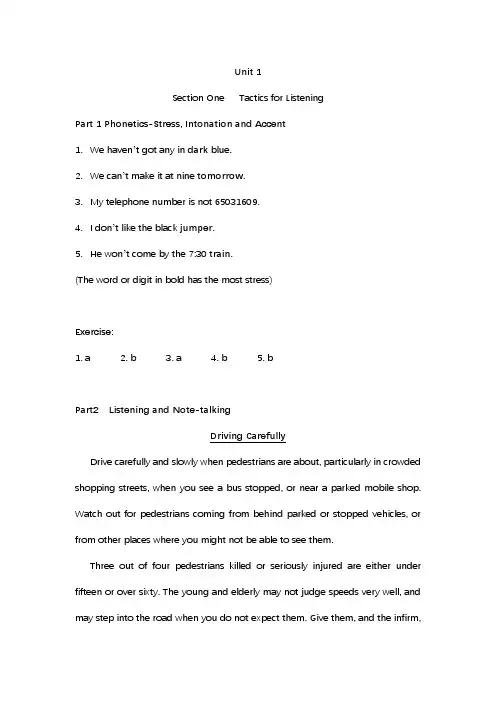
The topic I'd like to deal with this morning is what makes a good language learner. This is an eternal problem, and one to which there's no real solution. I would however like you to think about the situation of learners outside the classroom because in many ways it would be true to say that there are more people in the world who speak a foreign language or a second language who didn't learn it in a classroom than there are who did and I think this awareness of the success of out-of-classroom learning provides us with a key to how in-classroom learning can be successful.
Part I Getting ready
B.
1. People are delighted if you can speak their language, and they don't care how well you speak it. They are not upset when you make mistakes. I think in order to learn, you mustn't be afraid of making mistakes. 2. I'm a very shy person and it's not easy for me to talk to strangers. But you have to force yourself to talk to people. That's what I did and it really helped me. 3. I think the best language learners are people with a sense of humor. Try to laugh at your own mistakes and don't take yourself too seriously. You'll find that other people will be sympathetic when you make mistakes. 4. I took two courses in business studies. I read, studied, listened to lectures and took notes in English. It was a very good experience for me because I didn't have time to think about the language. I recommend forgetting about the grammar and thinking about the meaning instead. 5. In my experience, learning a foreign language always involves a lot of time, a lot of boring work and lots of problems! In short, if you want to learn another language you have to work hard. 6. Try to read as much as you can. I think that's the best way to improve your English and to learn more new words. I always try to read something in English every day.
听力教程第二册第二版听力原文与答案(施心远)Unit
Done To be done Relevant information
The place The hall has been hired.
The disco To find someone to do it.
The equipment The sound system and records will be delivered by a local company next week.
Three out of four pedestrians killed or seriously injured are either under fifteen or over sixty. The young and elderly may not judge speeds very well, and may step into the road when you do not expect them. Give them, and the infirm, orblind, or disabled people, plenty of time to cross the road.
B: Er, well Monday to Friday when I’m working er, yeah every day, um but not…not usually at the weekends.
. Coming to a zebra crossing
A.Slow down or stopto let people cross.
B.Signal toother drivers that you mean to slow down or stop.
C.Neverovertakejust before a zebra crossing.
新视野大学英语视听说教程第三册(第二版)的答案

新视野大学英语视听说教程第三册(第二版)答案Unit 1 testPart I Keys: 1.A 2.B 3.D 4.B 5。
DPart II (1)for (2)with (3)opportunity (4)tuition (5)explore (6)encounter (7)adventure (8)As with any country, it is not advisable to carry large amounts of cash around with you (9)Traveler's checks are one of the safest and easiest ways to transport money, because you may have them replaced if they get lost or stolen (10)It is wise to bring about $100 with you in U。
S。
cash, so you will be able to manage upon your arrival in the StatesPart III 1.C 2.A 3。
B 4.D 5。
APart IV 1.C 2.A 3。
A 4。
D 5.C 6.B 7.A 8。
C 9。
B 10。
CUnit 2 testPart I Keys: 1。
C 2.C 3.B 4。
C 5.DPart II (1)chemicals (2)atmosphere (3)particles (4)trapped (5)lasts (6)human-based (7)progressed (8)Even in Ancient Rome people complained about smoke put into the atmosphere (9)Air pollution can have serious consequences for the health of human beings (10)Cities with large numbers of automobiles or those that use great quantities of coal often suffer most severely from air pollution problemsPart III 1.A 2.C 3。
全新版大学英语综合教程第二版第三册课后习题答案-第七单元

Unit 7 Making a LivingText A Life of a SalesmanPart II Text AContent Questions1.A surgeon’s scar cuts across his lower back. The fingers on his right hand are so twisted that he can’t tie his shoes. His mother’s challenges and the voices of those who believed him stupid, incapable of living independently keep him going on.2.He is a door-to-door salesman. His weapons are: dark slacks, blue shirt and matching jacket, brown tie, tan raincoat, hat and a briefcase.3.He is afraid that someone will steal his briefcase. He was different in that cerebral palsy affected his speech, hands and walk.4.First a school for the disabled and then Lincoln High School, where he was placed in a class for slow kids.5.She was certain that he could rise above his limitations.6.He applied for a salesman’s job.7.With his mother setting up a meeting with a Watkins representative, as well as by his own persistence.8.He lacked confidence. It took him quite a while to have the courage to ring the first doorbell. 9.He keeps coming back until the customer buys. He tells himself not to worry if hid day has not turned out to be profitable.10.Because he was laid up for five months after band surgery and couldn’t work.11.Like a home of the past era. He leads a solitary life.12.No, he doesn’t. Because he lives a life of dignity.Vocabulary:1) disabled 2) impatient 3) solitary 4) crushed5) feel like 6) lashed 7) echoing 8) paused9) betrayed 10) laundry 11) section 12) tilted2.1) cared for 2) hang on3) was laid up with 4) are gaining on5) kicked up 6) went off7) drop ... off 8)straighten out3.1) … sometimes didn't register with her.2)… in disorder, drawers pulled out, shoes and boots scattered.3)… was transferred from Father's account to my account.4)… a pledge to contribute 1000,000dollars to the Children in Needed charity campaign.5)… the most profitable business in that province.4. 1) gaining on; off balance; was laid up in; scar on2) a cripple\ crippled ; surgery , limitations, in literature.3) commission ; on the phone ; his territory ; never registers withII. Usage1.I never did go over these books, although I probably should have.2.I know this is a personal question. You don't have to answer me if you don't want to.3.I think this topic should have attracted far more attention from philosophers than it has.4."I think you're right." — "I'm sure I am."5."He thought that the condition was hereditary in his case." —"Well, it might be."6."Sugar?" ---- "No. Maybe next time."7.The house is only a building. It is a place to live, nothing more.8.DIANE: You didn't! Tell me you didn't! FATHER: Oh, yes.Anything for my children.III. Word Family1.1) bored 2) boredom3) bored 4) boringly5) boring2. 1) encouraged 2) encouragingly3) encouraging 4) encouragement3. 1) frozen 2) freeze3) freezing 4) freezer5) freezeComprehensive ExercisesI Cloze1. Text-related1) off … feet 2) signature 3) commission 4) on the phone5) laid up 6) surgery 7) territory 8) disorder9) applying for 10) dignity2. Theme-related1)didn’t 2) read 3) come 4) money5) because 6) earning 7) doing 8) own 9) obviously 10) valueII. TranslationI. I grew terribly scared when I heard sound of footsteps echoing round the hallway atmidnight yesterday.2. The name-brand sports shoes are guaranteed for 12months.3. Snowstorms threw communications and transportation into disorder.4.I’ve been suffering a lot of stress from work lately, I feel like taking a vacation atthe seaside.5. Living in an apartment is all right, but it has its limitations--- for example, you don’thave your own gardens.6. Tom was born a cripple, with one of his lower limbs useless. Early in his childhood, he learned that unless he so exerted himself as to rise above his limitations, he could not earn a living, and unless he succeeded in making a living on his own, he could not win/gain the respect of others. That was the price he had to pay for his dignity as a human being.Tom applied for numerous jobs, only to be turned down, before he finally got one as a delivery boy for a Pizza Hut. He then worked as a sales representative for a sportswear company in a territory no one else would want. Today he owns a fairly profitable retail shop in his hometown, and hires several people to work for him.Part III TextBComprehension Check1. c 3. a 5. d2. d 4. d 6. bTranslation1.当时我俩并未意识到这一点,但那就是我们之间开始拉开距离的日子,是开始在家庭内部重新界定劳动者的意义的日子。
施心远主编《听力教程》3-(第2版)Unit(00002)
施心远主编《听力教程》3-(第2版)Unit-2答案UNIT 2Section One Tactics for listeningPart 1 Sport DictationMy MotherMy mother was an efficient (1) taskmaster who cooked, cleaned and shopped for nine people (2) on a daily basis. She was a disciplinarian* who would (3) make us seven kids walk up and down the stairs a hundred times if we clumped like (4)field hands to-dinner. She also enlisted us to help her in the day's (5) chores.My mother believed that each of her children had a special (6) knack that made him or her invaluable on certain (7)missions.My brother Mike, for example, was believed to have especially (8) keen eyesight. He was hoisted up as a human (9) telescope whenever she needed to see something (10) far away. John was the climber when a kite (11) got caught. My own job was navigator for our (12) gigantic old Chrysler.But my mother's (13) ability to get work done well was only (14) one side. She also had an (15) imagination that carried her in different directions. That (16) allowed her to transcend her everyday life. She did not (17) believe in magic as portrayed on a stage, but (18) valued instead the sound of a metal bucket being (19)filled by a hose, or the persistence of a dandelion at the (20)edge of a woodpile.Part 2 Listening for GistFor hundreds of years man has been fascinated by the idea of flying. One of the first men to produce designs for aircraft was Leonardo da Vinci, an Italian artist who lived in the fifteenth century. However, it was not until the eighteenth century that people began to fly, or perhaps it would be better to say float, across the countryside in balloons. The first hot-air balloon was made in April 1783 by the Montgolfier brothers in France.In the following years many flights were made by balloon. Some of the flights were for pleasure and others were for delivering mail and for military purposes, such as observation and even bombing. However, in the late nineteenth century, airship s superseded balloons as a form of transport.Airships came after balloons. The first powered and manned flight was made by a Frenchman, Giffard, in September 1852. His airship, powered by steam, traveled twenty-seven kilometers from Paris to Trappes at a speed of eight kilometers per hour. However the days of the airship were numbered as the aero- plane became increasingly safe and popular.ExerciseDirections: Listen to the passage and write down the gist and the key words that help you decide.1.This passage is about the early history of flying.2.The key words are designs, an Italian artist, fifteenth century, eighteenthcentury, fly, float, balloons, hot-air balloon, April 1783, airships, September 1852, aeroplane.Section Two Listening ComprehensionPart 1 DialogueBuying a CarA: Good morning, can I help you?B: Yes, I'm interested in buying a car.A: Have you anything in mind?B: Not really.A: What price are you thinking of?B: Not more than £13,500.A: Let's see now ... Over there between the Lancia and the Volvo is a Mini. It costs £12,830 and is cheap to run: It does 38 miles per gallon. Or there's the Citroen, behind the Mini. It costs £12,070 and is even cheaper to run than the Mini: It does 45 miles per gallon. It's not very fast though. It only does 69 miles per hour.B: No, I think the Mini and the Citroen are too small. I've got three children.Isn't there anything bigger at that price?A: Well, there's the Toyota over there, to the left of the Peugeot. It's very comfortable and costs £13,040. It's cheap to run too, and it also has a built-in radio. Or there's the Renault at the back of the showroom, behind the Peugeot. It costs a little more, £13,240, but it is cheaper to run. It does 40 miles per gallon and the Toyota only does 36 miles per gallon.B: What about that Volkswagen over there, in front of the Toyota?A: That costs a little more than £13,500 but it's a very reliable car. It's more expensive to run than the others: It does 34 miles per gallon, but it's faster.Its top speed is 90 miles per hour. The Toyota's is 80 miles per hour and the Renault's is 82 miles per hour.B: How much does it cost?A: £13,630 and that includes a 5-year guarantee.B: And the Fiat next to the Volkswagen?A: Again that's more than £13,500, but it's cheaper than the Volkswagen. It costs £13,550.B: Hmm well, I'll have to think about it and study these pamphlets. How much is that Peugeot incidentally, behind the Lancia?A: Oh, that's expensive. It costs £15,190.B: Yes, that is a bit too much. Thank you very much for your help. Goodbye.Part 2 PassageThe Wrights ’ StoryOn the morning of December 17, 1903, between 10:30 a.m. and noon, four flights were made, two by Orville Wright and two by Wilbur Wright. The starts were all made from a point on the level sand about 200 feet west of our camp, which is located a quarter of a mile north of the Kill Devil sand hill, in Dare County, North Carolina.The wind at the time of the flights had a velocity* of 27 miles an hour at 10 a.m., and 24 miles an hour at noon, as recorded by the anemometer* at the Kitty Hawk Weather Bureau Station.The flights were directly against the wind. Each time the machine started from the level ground by its own power alone with no assistance from gravity or any other source whatever.After a run of about 40 feet along a monorail* track, which held the machine 8 inches (20 centimeters) from the ground, it rose from the track and under the direction of the operator climbed upward on an inclined course till a height of 8 or 10 feet from the ground was reached, after which the course was kept as near horizontal as the wind gusts and the limited skill of the operator would permit.Into the teeth of a December gale (逆风) the "Flyer" made its way forward with a speed of 10 miles an hour over the ground and 30 to 35 miles an hour through the air.It had previously been decided that for reasons of personal safety these first trials should be made as close to the ground as possible. The height chosen was sufficient for maneuvering* in so gusty a wind and with no previous acquaintance with the conduct of the machine and its controlling mechanisms. Consequently the first flight was short.The succeeding flights rapidly increased in length ,and at the fourth trial a flight of 59 seconds was made, in which time the machine flew a little more than half a mile through the air and a distance of 852 feet over the ground.The landing was due to a slight error of judgment on the part of the aviator. After passing over a little hummock* of sand, in attempting to bring the machine down to the desired height, the operator turned the rudder* too far, and the machine turned downward more quickly than had been expected. The reverse movement of the rudder was a fraction of a second (转瞬间,顷刻) too late to prevent the machine from touching the ground and thus ending the flight. T £13,040 36m/g80m/hC £12,070 45m/g69m/hF£13,550VW £13,630 34m/g 90m/h M £12,830 38m/g V £15,850As winter was already well set in, we should have postponed the trials to a more favorable season, but we were determined to know whether the machine possessed sufficient power to fly, sufficient strength to withstand the shocks of landings and sufficient capacity of control to make flight safe in boisterous* winds, as well as in calm air.Exercise A Pre-listening QuestionOrville Wright (1871-1948), American aeronautical engineer, famous for his role in the first controlled, powered flight in a heavier-than-air machine and for his participation in the design of the aircraft's control system. Wright worked closely with his brother, Wilbur Wright (1867-1912), American aeronautical engineer, in designing and flying the Wright airplane.During the years 1900, 1901, 1902, and 1903, the two brothers developed the first effective airplane. At Kitty Hawk, North Carolina, on December 17, 1903, Orville Wright made the first successful flight of a piloted, heavier-than-air, self-propelled craft, called the Flyer. The third Flyer, which the Wrights constructed in 1905, was the world's first fully practical airplane. It could bank, turn, circle, make figure eights, and remain in the air for as long as the fuel lasted, up to half an hour on occasion.Exercise B Sentence DictationDirections: Listen to some sentences and write them down. You will hear each sentence three times.1.On the morning of December 17, 1903, between 10:30 a.m. and noon, fourflights were made, two by Orville Wright and two by Wilbur Wright.2.Under the direction of the operator it climbed upward on an inclined coursetill a height of 8 or 10 feet from the ground was reached.3.Into the teeth of a December gale the "Flyer" made its way forward with aspeed of 10 miles an hour over the ground and 30 to 35 miles an hour through the air.4.The height chosen was sufficient for maneuvering in so gusty a wind and withno previous acquaintance with the conduct of the machine and its controlling mechanisms.5 .In attempting to bring the machine down to the desired height, the operator turned the rudder too far, and the machine turned downward more quickly than had been expected.Exercise C Detailed ListeningDirections: Listen to the passage and answer the following questions.1.Four flights were made on the morning of December 17, 1903, two by OrvilleWright and two by Wilbur Wright.2.The wind at the time of the flights had a velocity of 27 miles an hour at 10a.m., and 24 miles an hour at noon, as recorded by the anemometer at theKitty Hawk Weather Bureau Station.3.Each time the machine started from the level ground by its own power alonewith no assistance from gravity or any other source whatever.4.The machine ran about 40 feet along a monorail track before it rose from thetrack.5.These first trials should be made as close to the ground as possible for reasonsof personal safety.6.The machine flew a little more than half a mile through the air in 59 secondsat the fourth trial.7.The early landing was due to a slight error of judgment on the part of theaviator.8.As winter was already well set in, it was not a favorable season for the trials. Exercise D After-listening DiscussionDirections: Listen to the passage again and discuss the following questions.1.Because they wanted to know whether the machine possessed sufficient powerto fly, sufficient strength to withstand the shocks of landings and sufficient capacity of control to make flight safe in boisterous winds as well as in calm air.2.(Open)Section Three NewsNews Item 1World Basketball ChampionshipThe semifinal round of the World Basketball Championship tournament is later today (Saturday) in the mid-western (US) state of Indiana.Argentina is the only undefeated team at the tournament. The South Americans have outscored their opponents by an average of 19 points per game. On Wednesday, Argentina shocked the host United States (87-80) to snap a 58-game international winning streak* by professional squads of the National Basketball Association players.Argentina also defeated Brazil (78-67) to reach the semifinal round where the team will face Germany. Primarily using European experienced players, Argentina defeated Germany earlier in the second round, 86-77.Defending champion Yugoslavia, which ousted the United States (81-78) in the quarterfinals, plays upstart* New Zealand. But Yugoslav head coach Svetislav Pesic says he is not surprised.The losers of each game will play for the third place on Sunday before the championship game.Exercise ADirections: Listen to the news item and complete the summary.This news item is about the semifinal round of the World Basketball Championship tournament.Exercise BDirections: Listen to the news again and complete the following sentences.1.In the second round Argentina defeated Germany 86-77.2.Argentina also defeated Brazil to reach the seminal round.3.Before the semifinal round Argentina is the only undefeated team at thetournament.4.Defending champion Yugoslavia, which ousted the United States in thequarterfinals, plays against New Zealand.5.The four teams that will play in the semifinals are Argentina, Germany,Yugoslavia and New Zealand.6.The losers of each game will play for the third place before thechampionship game.News Item 2European FootballEnglish football club Liverpool crashed out of the Champions League, despite fighting back from a 3-0 deficit to tie FC Basel 3-3 in Switzerland. Liverpool needed a win Tuesday to qualify / for the second phase. Instead, the English club will play for the UEFA Cup. Basel became the first Swiss side ever to reach the last 16 of the Champions League, qualifying second in Group B· behind Valencia of Spain, which beat Spartak Moscow 3-0.English champion Arsenal played to a scoreless home draw against Dutch-side PSV Eindhoven to top Group A and move into the second phase, where the team will be seeded. They'll be joined by German team Borussia Dortmund*, which advanced despite a 1-0 loss to Auxerre in France.AS Roma played to a 1-1 draw against AEK Athens in Italy, to capture second place in Group C. Group winner Real Madrid of Spain will also advance, after drawing 1-1 with Racing Genk* in Belgium.In Group D, Inter Milan of Italy got a pair of goals from Hernan Crespo to beat Ajax Amsterdam 2-1 in the Netherlands. Both teams qualified at the expense of French side Lyon, which was held to a 1-1 draw by Rosenborg in Norway.Exercise ADirections: Listen to the news item and complete the summary.This news item is about European football matches.Exercise BDirections: Listen to the news again and decide whether the following statements are true (T) or false (F).1.T2.F3.F4.T5.T6.F7.TNews Item 3Kemper Open Golf PreviewThe annual Kemper Open* golf tournament gets underway Thursdaynear Washington at the Tournament Players Club at Avenel.Twenty-eight-year-old American Rich Beem is back to defend his title. Before his victory here, he had missed the halfway cuts in five straight tournaments. He hopes he can again find his form during the next four days, as he is currently 132nd on the money list.The player who is number-one on golf's money list and in the world rankings, American Tiger Woods, decided to skip this event after winningthe rain-delayed Memorial Open in (Dublin) Ohio on Monday.Compatriot* Jeff Sluman says even Tiger has to take periodic breaks.He's unbelievable. He's got an opportunity, as I said even a couple years ago, if he stays healthy and does the right things, he can maybe be the best golfer of all time, and he's showing right now what he can do. The kid is just a fabulous,fabulous player, but he can't play every week."Eight of the past 10 Kemper Open winners are in this year's field of 156 golfers, who are vying for three million dollars in prize money. The first-place check has been increased from 450 thousand to 540 thousand dollars.Exercise ADirections: Listen to the news item and complete the summary.This news item is about an annual Kemper Open golf tournament on Thursday. Exercise BDirections: Listen to the news again and answer the following questions."1.The Kemper Open golf tournament will be held on Thursday.2.Rich Beem comes back to defend his title.3.He is currently ranked 132nd on the money list.4.Tiger Woods is number-one on golf's money list and in the world rankings.5.He has to take a break after a match on Monday.6.There are 156 golfers taking part in this event.7.The total prize money is three million dollars.8.The prize for the first place is 540 thousand dollarsSection Four Supplementary ExercisePart 1 Feature ReportUS Men’s National Collegiate Basketball Tournament The widely followed US men's national collegiate basketball tournament concludes tonight (9 p.m. EST) in Atlanta with a championship match-up* between Maryland and Indiana.Maryland is in the championship game for the first time in the school history. To get here, the Maryland Terrapins had to beat three teams with great basketball traditions: Kentucky, Connecticut and Kansas.Now they face another, Indiana. While Maryland was one of the four top seeds in this 65-team tournament, the Indiana Hoosiers* were a fifth seed, and virtually no one expected them to reach the title game*. But they knocked off defending champion Duke in the third round, and in the semifinals they upset Oklahoma.Maryland coach Gary Williams knows it will take a solid effort to win. "Any team that's gotten to where Indiana has gotten, you don't look at their record. You look at how they're playing now, how they play. Any time a team plays team defense like they do, they have a chance to beat anybody. That's what concerns me the most, their ability to play together as a unit, because a lot of times you can play with anybody when you play that close together like they do."Indiana has 27 wins and 11 defeats this season. The last time a team won the national championship with as many as 11 losses was Kansas in 1988. Maryland has a school record of 31 wins against only 4 losses. It has three seniors in the starting line-up* who reached the semifinals last year, and they are determined that this time they will take home the school's first men's national basketball championship.Exercise ADirections: Listen to the news report and complete the summary.This news report is about two teams that will compete for the championship of US men's national collegiate basketball tournament.Exercises BDirections: Listen to the news again and complete the following sentences.1.M aryland moves in the championship game for the first time in the schoolhistory.2.The Maryland Terrapins had to beat three teams with great basketballtraditions before it reached the title game.3.Among the 65 teams, the Indiana team was a fifth seed.4.Indiana has 27 wins and 11 defeats this season.st year the Maryland Terrapins reached the semifinals.6. In 1988, the team who won the national championship with as many as 11 losses was Kansas.Part 2 PassageWho on Earth Invented the Airplane?1. He would keep his dirigible tied to a gas lamp post in front of his Parisapartment and during the day he'd fly to go shopping or to visitfriends.2. Since his was the first public flight in the world, he was hailed as theinventor of the airplane all over Europe.3. But to bring up the Wright brothers with a Brazilian is bound to elicitan avalanche of arguments as to why their flight didn't count.4. His flight did meet the criteria: He took off unassisted, publicly flewa predetermined length and then landed safely.5. By the time the Brazilian got around to(开始考虑做) his maidenflight the Wright brothers had already flown numerous times,including one flight in which they flew 39 kilometers.Ask anyone in Brazil who invented the airplane, and they will say Alberto Santos-Dumont, a bon vivant as well-known for his aerial prowess as he was for his dandyish* dress and place in the high-society life of Belle Epoque Paris.As Paul Hoffman recounts in his biography Wings of Madness, the eccentric* Brazilian was the only person in his day to own a flying machine."He would keep his dirigible* tied to a gas lamp post in front of his Paris apartment at the Champs Elysees, and every night he would fly to Maxim's for dinner. During the day he'd fly to go shopping or to visit friends," Hoffman said.It was on November 12, 1906, when Santos-Dumont flew a kite-like contraption* with boxy wings called the 14-Bis some 220 meters on the outskirts of Paris. Since his was the first public flight in the world, he was hailed as the inventor of the airplane all over Europe.It was only later that Orville and Wilbur Wright proved they had beaten Santos-Dumont at Kitty Hawk, North Carolina, three years earlier.But to bring up the Wright brothers with a Brazilian is bound to elicit* an avalanche of arguments as to why their flight didn't count."It's one of the biggest frauds* in history," scoffs Wagner Diogo, a taxi driver in Rio de Janeiro."No one saw it, and they used a catapult* to launch the airplane."The debate centers on the definition of flight.Henrique Lins de Barros, a Brazilian physicist and Santos-Dumont expert, argues that the Wright brothers' flight did not fulfill the conditions that had been set up at the time to distinguish a true flight from a prolonged hop.Santos-Dumont's flight did meet the criteria: He took off unassisted, publicly flew a predetermined length and then landed safely."If we understand what the criteria were at the end of the 19th century,the Wright brothers simply did not fill any of the prerequisites," said Lins de Barros.Brazilians claim that the Wrights launched their Flyer in 1903 with a catapult or at an incline, disqualifying it from being a true airplane.Even Santos-Dumont experts like Lins de Barros concede* this is wrong. He says that the steady winds at Kitty Hawk were crucial for the Flyer's takeoff, disqualifying the flight because it probably could not lift off on its own.Peter Jakab, chairman of the aeronautics division at the US National Air and Space Museum in / Washington, says such claims are preposterous*.By the time Santos-Dumont got around to his maiden flight the Wright brothers had already flown numerous times, including one flight in which they flew 39 kilometers.Even in France the Wrights are considered to have flown beforeSantos-Dumont, says Claude Carlier, director of the French Center for the History of Aeronautics and Space.By rounding the Eiffel Tower in a motorized dirigible in .1901,Santos-Dumont helped prove that air travel could be controlled.Exercise A Pre-listening QuestionAlberto Santos-Dumont was a wealthy Brazilian aviation pioneer who came to Paris, France, at the age of 18 to live and study. He attempted his first balloon ascent in 1897 and had his first successful ascent in 1898. He began to construct dirigible airships powered with gasoline-powered engines in 1898 and built and flew fourteen of the small dirigibles. In 1901, he flew his hydrogen-filled airship from St. Cloud, around the Eiffel Tower, and back to St. Cloud. It was the first such flight and won him the Deutsch Prize and a prize from the Brazilian government. In 1902, he attempted to cross the Mediterranean in an airship but crashed into the sea. In 1909, he produced his "Demoiselle" or "Grasshopper" monoplane, the precursor to the modern light plane.Exercise B Sentence DictationDirections: Listen to some sentences and write them down. You will hear each sentence three times.Exercise C Detailed ListeningDirections: Listen to the passage and decide whether the following statements are true (T) or false (F). Discuss with your classmates why you think the statement is true or false.-T- 1. The Brazilians believe that it was Alberto Santos-Dumont who invented the airplane.(Ask anyone in Brazil who invented the airplane, and they will say Alberto Santos-Dumont ... )-T- 2. In Paul Hoffman's day Alberto Santos-Dumont was the only person to own a flying machine.(As Paul Hoffman recounts in his biography Wings of Madness, the eccentric Brazilian was the only person in his day to own a flying machine.)-T- 3. According to Hoffman, Alberto Santos-Dumont used his dirigible as a means of transportation.(He would keep his dirigible tied to a gas lamp post in front of his Paris apartment at the Champs Elysees, and he would fly to Maxim's for dinner every night and he'd fly to go shopping or to visit friends during the day.)-F 4. On November 12, 1906, Santos-Dumont flew a kite-like device with boxy wings some 200 meters on the outskirts of Paris.(It was on November 12, 1906, when Santos-Dumont flew a kite-like contraption with boxy wings called the 14-Bis some 220 meters on the outskirts of Paris.)-T- 5. Some Brazilians claim that the Wrights launched their Flyer in 1903 with assistance by a device.(Brazilians claim that the Wrights launched their Flyer in 1903 with a catapult or at an incline, disqualifying it from being a true airplane.)-T- 6. Some experts believe steady wind might have helped the Flyer's takeoff. (Even Santos-Dumont experts like Lins de Barros ... , Lins de Barros says that the steady winds at Kitty Hawk were crucial for the Flyer's takeoff, disqualifying the flight because it probably could not lift off on its own.)-F7. Officials from the US National Air Force say such claims are groundless.(Peter Jakab, chairman of the aeronautics division at the US National Air and Space Museum in Washington, says such claims are preposterous.)-T-8. The Wrights had already made several successful flights before Santos-Dumont got around to his maiden flight.(By the time Santos-Dumont got around to his maiden flight the Wright brothers had already flown numerous times, including one flight in which they flew 39 kilometers.)Exercise D After-listening DiscussionDirections: Listen to the passage again and discuss the following questions.1.By rounding the Eiffel Tower in a motorized dirigible in 1901, Santos-Dumonthelped prove that air travel could be controlled.2.(Open)。
全新版大学英语听说教程第二版听说教程第三册听力原文及答案
全新版大学英语第二版听说教程第三册听力原文及答案Unit 1Text 1Dating with My Mother (Part One)After 22 years of marriage, I have discovered the secret to keep love alive in my relationship with my wife, Peggy. I started dating with another woman.It was Peggy's idea. One day she said to me, 'Life is too short, you need to spend time with the people you love. You probably won't believe me, but I know you love her and I think that if the two of you spend more time together, it will make us closer.' The 'other' woman my wife was encouraging me to date is my mother, a 72-year-old widow who has lived alone since my father died 20 years ago. Right after his death, I moved 2,500 miles away to California and started my own life and career. When I moved back near my hometown six years ago, I promised myself that I would spend more time with mom. But with the demands of my job and three kids, I never got around to seeing her much beyond family get-togethers and holidays.Mom was surprised and suspicious when I called and suggested the two of us go out to dinner and a movie.'What's wrong?' she asked.'I thought it would be nice to spend some time with you,' I said. 'Just the two of us.''I would like that a lot,' she said.When I pulled into her driveway, she was waiting by the door with her coat on. Her hair was curled, and she was smiling. 'I told my lady friends I was going out with my son, and they were all impressed. They can't wait to hear about our evening,' Mother said.Exercise 1: 1. c 2. a 3.bQuestions:1. What would make the speaker closer to his wife, Peggy?2. What do you know about the speaker's mother?3. Which of the following adjectives best describes Peggy?Exercise 2:1. She suggested that her husband spend more time with his mother. She said to her husband, "Life is too short, but you need to spend time with the people you love. You probably won't believe me, but I know you love her and I think that if the two of you spend more time together , it will make us closer."2. 1) ...she was waiting by the door with her coat on and she had her hair curled.2) She had told her lady friends about this.Text 2Dating with My Mother (Part Two)We didn't go anywhere fancy, just a neighborhood place where we could talk. Since her eyes now see only large shapes and shadows, I had to read the menu for both of us.'I used to be the reader when you were little,' she said.'Then it is time for you to relax and let me return the favor,' I said.We had a nice talk over dinner, just catching up on each other's lives. We talked for so long that we missed the movie.'I'll go out with you again,' my mother said as I dropped her off, 'but only if you let me buy dinner next time.'I agreed.'How was your date?' my wife asked when I got home that evening.'Nice...nicer than I thought it would be,' I said.Mom and I get out for dinner a couple of times a month. Sometimes we take in a movie, but mostly we talk. I tell her about my trails at work and brag about the kids and Peggy. Mom fills me in on family gossip and tells me about her past. Now I know what it was like for her to work in a factory during the Second World War. I know how she met my father there, and know how they went through the difficult times. I can't get enough of these stories. They are important to me, a part of my history. We also talk about the future. Because of health problems, my mother worries about the days ahead.Spending time with my mom has taught me the importance of slowing down. Peggy was right. Dating another woman has helped my marriage.Exercise 1: 1. c 2. d 3. dQuestions:1. What does the story mainly tell us?2. Which of the following is true?3. What can you learn from the story?Ex. 2 1. took// out to dinner// neighborhood2. nicer than he expected.3. A couple of times.4. the importance of slowing down//his marriageUnit 2Text1What a Coincidence! (Part One)Andrew had always wanted to be a doctor. But the tuition for a medical school in 1984 was 15,000 dollars a year, which was more than his family could afford. To help him realize his dream, his father, Mr. Stewart, a real estate agent, began searching the house-for-sale ads in newspapers in order to find extra business. One advertisement that he noted down was for the sale of a house in a nearby town. Mr. Stewart called the owner, trying to persuade him to let him be his agent. Somehow he succeeded and the owner promised that he would come to him if he failed to get a good deal with his present agent. Then they made an appointment to meet and discuss the thing.As good things are never easy to acquire, the time for the appointment had to be changed almost ten times. On the day when they were supposed to meet at 3 o'clock in the afternoon, Mr. Stewart received another call from the owner. His heart sank as he feared there would be another change of time. And so it was. The owner told him that he couldn't make it at three but if he would come right then, they could talk it over. Mr. Stewart was overjoyed. Leaving everything aside, he immediately set out todrive to the house.As he approached the area, he had a strange feeling of having been there before. The streets, the trees, the neighborhood, all looked familiar to him. And when he finally reached the house, something clicked in his mind. It used to be the house of his father-in-law! The old man had died fifteen years ago but when he was alive, he had often visited him with his wife and children. He remembered that, like his son Andrew, his father-in-law had also wanted to study medicine and, failing to do so, had always hoped that one of his two daughters or his grandchildren could someday become a doctor.Exercise 1:1. b 2. a 3. d 4. cQuestions:1. Who are the two main characters in the story you have just heard?2. How did Mr. Stewart get to know the owner of the house?3. What problem did Mr. Stewart have?4. What is the coincidence in the story you have just heard?Exercise 2:1984 / son / medical school / tuition / afford it / realize / newspaper ads / extra business / advertisement / succeeded / agent / changed / phone call / put aside / doing / immediately / familiar / father-in-law's / visited / his father-in-law alive / coincidence Text2What a Coincidence! (Part Two)When he entered the house, Mr. Stewart was even more amazed to find that the house was decorated exactly as he had remembered it. He told the owner about this and the latter became intrigued too. However, they were in for even greater surprises. It so happened that in the middle of their discussion, a postman came to deliver a letter. And the letter was addressed to Mr. Stewart's father-in-law! Were it not for Mr. Stewart's presence there and then, the letter would be returned as no person of that name lived in the house any longer. As the postman demanded a signature on the receipt slip, Mr. Stewart signed for his long-deceased father-in-law. Mystified, the owner urged Mr. Stewart to open the letter and see what it contained. The letter was from a bank. When he opened it, two words immediately met his eye -- 'For education'. It was a bank statement of an amount his father-in-law had put in years ago for his grandchildren's education needs. With the interest it had earned over the years, the standing value of the amount came to a little over $15,000, just enough money to cover the tuition of Andrew's first year at a medical college!Another thing that is worth mentioning is about the postman. The original postman, who had worked in this neighborhood, called in sick that day. So the postman, who was new to the area, came to deliver mail in his place. Had it been the old postman, the letter would undoubtedly be returned to the sender as he knew full well that no person bearing that name lived in that house any longer.The miracle was a blessing for Andrew. With the money given to him by his grandfather he was able to study medicine. Now he is a doctor in Illinois.Exercise1:1.The house was decorated exactly the same as Mr. Stewart remembered it2.Mr. Stewart happened to be in the house when a postman came to deliver a letterto his father-in-law who had died 15 years ago.3.The old postman had called in sick that day, and the postman who came in hisplace was not familiar with the neighborhood. Other wise the letter would have been returned to its sender.Exercise 2:1. He was intrigued.2. A bank statement.3. his father-in-law had put an amount of money in the bank for his grandchildren's education.4. A little over $15,000.5. He could use the money to cover the tuition of his first year at a medical college.6. He is a doctor in Illinois.Unit 3Text 1Krimali (Part One)On the morning of the devastating earthquake that struck India in 2001, Krimali, a girl of 17, had just left home to go to an interview for a position of a sales clerk. She was pleased with her green and yellow flowered dress, but felt something wasn't quite right about her hair. She returned home, removing her shoes and leaving them at the door.Moments later, the earthquake struck. Ceilings and walls in the building shook in the deafening noise. Then everything began crashing down.Krimali and her immediate family escaped serious injury but were unable to make their way out. The ceiling of an entire room towered above the only possible escape route. Completely detached on three sides, the huge slab clung to an outside wall on its fourth side. To an observer, it could drop at any moment.People were screaming and didn't know what to do. Krimali decided to act. Carefully she climbed barefoot up and down the debris until she reached a point just beneath the swaying ceiling. About four meters below were uneven pieces of concrete, broken glass and smashed furniture, all mixed with sharp spikes of iron. She knew if she could manage to get down to the ground level, she could make her way to safety. She paused to figure out the best way down. As there wasn't any good place to jump, she just jumped. Luckily, she landed in a crouch, her feet missing any sharp edges. Emboldened by her good fortune, Krimali knew it was up to her to persuade others to follow.Exercise 1: Ex 1 1-2 c c Ex 2 1-8 T F F F F T T FText 2Krimali ( Part Two)Krimali planned to rescue her family first, but just then she heard a woman from two storeys above screaming for someone to save her two-month-old baby."Throw the baby to me," Krimali shouted. "I can catch her!"The woman refused. Krimali told the woman to wrap the baby in bed sheets and then toss her down. Crying uncontrollably, the mother wrapped the little girl but stillwould not part with her baby. As the mother tried to decide what to do, Krimali intently watched the concrete ceiling hanging above her. Finally the mother tossed the baby. Krimali made a clean catch. A bright smile lit up the woman's face. "I'll be back!" Krimali called out, hugging the child to her as she hurriedly picked her way out to where survivors had gathered.She gave up the baby, then asked if any of the men there would come back with her to help others trapped in the building. No one came forward, for they were all afraid of that swaying ceiling. But for Krimali, a small girl of 154 centimeters in height and weighing about 50 kilos, her fears had been lifted by what she had accomplished.On her way back into the ruins, she saw part of a large door. It was extremely heavy but she managed to drag it to the spot just below the hanging ceiling. By placing it on the ruins, she created something like a sliding board. With Krimali coaching her, the baby's mother partly jumped and partly rolled down the board to the ground level. Krimali led her through the debris to her baby.In the hours that followed Krimali made countless rescue missions into the building, each time in the shadow of the huge ceiling. Thanks to her courage, about two dozen men, women and children were saved.Exercise 1:Questions :1-2 d bExercise 2:1. Because she was afraid Krimali might not be able to catch her.2. Because she thought the bed sheets could somehow protect the baby from being hurt if she failed to catch her.3. Because they were afraid of the swaying ceiling.4. To make it easier and safer for people to get down.5. About two dozen were saved.Unit 4Text 1A Marriage Agreement (Part One)(Tom and Linda have signed a marriage agreement. Both agree not to break the rules outlined in the agreement. John, a reporter, is talking to them about the agreement.) John: Tom, Linda, first I'd like to ask you why you decided to write this unusual agreement.Tom: We found that many problems are caused when a person has different expectations from his or her spouse. We wanted to talk about everything openly and honestly before we started living together.Linda: Also we both know how important it is to respect each other's pet peeves. Like, I can get very annoyed if others leave stuff -- clothing, papers, everything! -- lying around on the floor. It really bugged me, so we put that in the agreement.John: This is mentioned in Article 1: Cleaning Up, isn't it? It says, "Nothing will be left on the floor overnight. Everything must be cleaned up and put away before going to bed."Tom: Then I'll know clearly what Linda's expectations are.John: I see. What about Article 2: Sleeping? It says, "We will go to bed at 11 p.m. and get up at 6:30 a.m. except on weekends." I'm sure some people hearing this will think that this agreement isn't very romantic.Tom: Well, we disagree. We think it's very romantic. This agreement shows that we sat down and talked, and really tried to understand the other person. A lot of problems occur in a marriage when people don't talk about what they want.Linda: That's right. When we disagreed about something, we worked out a solution that was good for both of us. I would much rather have Tom really listen to me and understand my needs than give me a bunch of flowers or a box of candy.Exercise 1: 1. b 2. c 3.aQuestions:1. Which statement best summarizes the marriage agreement between Tom and Linda?2. According to Tom, what will give rise to problems in a marriage?3. What can be inferred about Linda from the conversation?Exercise 2:1. Because she wanted to understand each other's expectations so that potential problems could be avoided and they could live happily together.2. Cleaning up. Everything must be cleaned up and put away before going to bed.3. Sleeping. Time for bed: 11pm; time to get up: 6:30am except on weekends.Text 2A Marriage Agreement (Part Two)John: Linda, do you spend a lot of time checking to see if the other person is following the rules? Arguing?Linda: No, not at all.Tom: A lot of couples argue because they don't understand each other's expectations. I think we spend less time arguing than most couples because we both know what the other person expects.John: What happens if one of you breaks a rule?Tom: Well, that's in Article 13 of our agreement.John: Is it? Oh yes, Article 13: Breaking Rules. "If you break a rule, you must apologize and do something nice for the other person to make it up."Linda: Yeah, like last time Tom broke the rule of driving.John: What's the rule?Linda: The rule is we must ask for directions if we are driving and get lost for more than five minutes.John: What happened?Tom: We were driving to a friend's wedding, and we got lost. Linda wanted to stop at a gas station to ask for directions, but I thought I could figure it out.Linda: Then we drove forty miles in the wrong direction and ended up being late for the wedding.Tom: So I took her out to dinner. I knew what I should do to apologize.John: That's very important, I think, knowing how to apologize. By the way, do youplan to update your agreement at all? What if things change in your life and a rule doesn't work anymore?Linda: We've thought about that too. Article 14 states that we must review this agreement once a year and make necessary changes.John: Well, it was really nice talking to you both. Thank you very much for your time. Tom & Linda: Thank you.Ex. 1 1-3 c c aEx. 21.get lost// five minutes // driving // stop // directions2.breaking rules // break a rule // apologize and do something nice for the otherperson to make it up3.reviewing the contents of the agreement // review this agreement once a year //make necessary changesPart BText 1AshleyAshley was reading a magazine when she came across an article about antibiotics and other drugs discovered in European rivers and tap water. If such drugs were present there, she reasoned, they might also be found near her home in West Virginia.Ashley feared that antibiotics in the waters could lead to resistant bacteria, or supergerms, which can kill untold numbers of people.The girl, then 16, began testing her area's river -- the Ohio. With a simple device she herself had designed, she collected 350 water samples from the Ohio and its tributaries over ten weeks. Reading scientific journals, she taught herself to analyze the samples. It was the most scientifically sound project for someone her age.Her experiment, one of the first of its kind in the United States, showed that low levels of three antibiotics are indeed present in local waters. Ashley's study won the International Stockholm Junior Water Prize, a virtual Nobel Prize for teenagers. She received a $5,000 scholarship and an audience with Sweden's Crown Princess Victoria.Her interest in science was sparked by walks in the woods with her mother. But it was the day-to-day stuff -- how water comes to the tap, how rain sticks to glass, that most fascinated her. "Science is not a dead thing," she says. "It's happening all around us."By the sixth grade, she was winning at science fairs. She has won $70,000 in prize money, which she has put aside for college. She plans to attend Harvard University. "I want to make my own discoveries, and not just read about what others have done," she said. Her teachers predict that she will one day win a Nobel Prize. Exercise 1: 1. D 2. DQuestions:1.What is the story mainly about?2.Which of the following best describes the way the speaker tells the story?Ex. 2 Testing //river // if there were antibiotics // resistant // 350 water samples // the samples // Low levels // three // Water Prize // 5000 / Sweden’sText 2Young People Say No to SmokingOn February 16, 2001, the teens from a youth group called REBEL launched their advertising campaign at the Liberty Science Center in New Jersey. By now just about everybody has heard the "Not for Sale" commercial on television and the radio against tobacco companies. What many people don't know is that teenagers from West New York and across New Jersey worked on various aspects of the campaign, and even appeared in some of the advertisements. The campaign organizer thought it would be better than using actors if actual REBEL members were in the commercials.REBEL, which stands for Reaching Everybody by Exposing Lies, is a statewide youth initiative against tobacco companies. The movement, which began in November last year, carries the message that teens no longer want to be targeted by tobacco companies in their advertisements. Knowing that peer pressure on teens to smoke or do drugs is one of the biggest problems that teens face, the group is working hard to ensure that their message reaches all teenagers at New Jersey schools.When the group was first formed, there were only five members, all eighth grade students. But by this summer the group had grown to close to 90 members. At a recent recruiting party, a pizza and pool party, at the West New York swimming pool, more than 50 new members were attracted to the group."We don't think that too many people would be interested," said Jackie, one of its founding members. "But everyone knows our message. They know who we are now."Exercise 1:1. Reaching Everybody by Exposing Lies2. They launched an advertising campaign to call on youth to fight against tobacco companies by starting the "Not fro Sale" commercial on television and radio.3. They intend to spread the message that teenagers no longer want to be targeted by tobacco companies in their advertisements.Exercise 2: 1. c 2.a 3.c 4.c 5.bQuestions:1. When did REBEL launch their advertising campaign?2. How many members did REBEL have by the summer of 2001?3. Who are the members of REBEL?4. What did REBEL do for their campaign against tobacco companies?5. What did REBEL do recently?Unit 6Text 1Being a Police Officer Is a Stressful JobInterviewer: Welcome to our program, Sam.Sam: Thank you.Interviewer: Sam, how long have you been a police officer?Sam: I've been a police officer for thirty years.Interviewer: Thirty years. And you've had different types of assignments on the police force, I guess.Sam: Yeah, I've done everything from patrol to undercover work to detective work, and now I'm supervising investigations.Interviewer: Sam, I think most people would say that being a police officer is a very stressful job. Would you agree?Sam: Yes, it's definitely a stressful job. But it depends on your assignment. Interviewer: So, what's probably the most stressful assignment you can have? Sam: I'd say patrol is the most stressful assignment.Interviewer: That's interesting! In what way?Sam: Well, I guess the biggest part of the stress is the fear factor -- the fear of the unknown.Interviewer: What do you mean, Sam?Sam: Well, in patrol work, you don't know from moment to moment who you are talking to or what their reaction is going to be to justify your presence. Let's say, for example, a patrol officer stops someone for a traffic violation. It seems as though that would be a very low-stress situation.Interviewer: Yes, it is a very low-stress situation.Sam: But the truth is, there are more police officers injured during a routine stop. Interviewer: Really?Sam: Really! That's why all police officers are taught from the very beginning to be aware of their surroundings. People back over policemen, people shoot policemen, people jump out at policemen -- different kinds of things. So that's probably the most stressful time.Interviewer: I see. Let's take a break and then we'll move on to our next topic. Sam: All right.Exercise 1: 1. d 2. c 3.aQuestions:1. What's the relationship between the two speakers?2. What does Sam mainly talk about?3. What do you know about Sam?Exercise 2:Sam has been a police officer for 30 years. He has done everything from patrol to undercover work. He has also done detective work and now he is supervising investigations.Sam thinks being a police officer is a very stressful job, but it depends on the assignment one has. In his opinion the biggest pert of the stress is the fear of the unknown and patrol is the most stressful assignment.Text 2Stress ReducersInterviewer: Sam, you've talked about the police officers' stressful time. Now let's move on to the next topic. So far as I know, there's a connection between stress and illness. Do you think that there's a higher percentage of illness among police officers than in the general population? I mean, do they get more colds or anything? Is this really true?Sam: Yes, it is, and the stress level not only manifests itself in daily health --whether or not you've feeling well on any given day. It also manifests itself in things like ulcers, heart disease -- police officers tend to have a higher rate of heart disease and ulcers than people in other professions.Interviewer: Really? That's documented?Sam: Yes, it's documented. And also the divorce rate among police officers is much higher.Interviewer: Is there something that the police department does to help you deal with this stress?Sam: Yes, there are several programs that most police departments have in place. One is an exercise program where some part of your day is spent on some type of physical exercise. They've found that's a great stress reducer. Besides, there's also a psychological program with counseling for officers to help them reduce their stress. And there are several discussion groups as well. They've found that sometimes just sitting around and talking about the stress with other officers helps to reduce it. So, those things are available.Interviewer: And what do you do, personally, to help you deal with the stress of your job, Sam?Sam: Well, during the baseball season, I'm the biggest baseball fanatic, and I will either be reading about baseball, or listening to baseball, or watching baseball. Another thing I try to do is to get some sort of exercise every day. And then I work hard at keeping up my personal relationships, especially my relationship with my wife. Fortunately I get along very well with my wife. When I come back home, I can talk about my day with her, and then just forget about it.Exercise 1: 1. T 2. F 3. T 4. F 5. TStatements:1. The dialogue is mainly about how police officers can deal with stress.2. According to Sam, most police officers enjoy good health.3. According to Sam, the divorce rate among police officers is higher than among people in other jobs.4. Counseling is the most effective program to help police officers relieve stress.5. Sam knows how to reduce his stress.Exercise 2:1. ... One is an exercise program, another is a psychological program with counseling for officers. And there are several discussion groups as well for officers to sit down and talk about their stress with other officers.2. 2)...He tries to get some sort of exercise every day.3)...his personal relationships, especially his relationships with his wife.Unit 7 The Business WorldKenneth: Hello, my name is Kenneth Johnson. I have an appointment with Mr. Andrew Song.Laura: Oh hello, Mr. Johnson, I'm Laura Lee. We've spoken on the phone a couple of times. Nice to meet you.Kenneth: It's nice to be here.Laura: Oh — let me take your coat.Kenneth: Thanks.Laura: Let me get you a drink, Mr. Johnson.Kenneth: Yes, I'd like a cup of tea, if possible, thanks.Laura: Sure. With milk or lemon?Kenneth: With lemon, please — and sugar. Two spoons.Laura: Right.Laura: Did you have a good trip?Kenneth: Absolutely, no problems.Laura: That's good. You flew, didn't you?Kenneth: Yes, that's right, and then I took a taxi down here from the airport.Laura: Oh, that's good. Kunming can be a little wet at this time of year ... you'll have to come back in summer.Kenneth: Oh, I'd like that. I always like coming to China. Miss Lee, I wonder if I could send a fax from here. It's rather urgent.Laura: Yes, of course. Shall I show you to the machine or shall I take it?Kenneth: Oh, it would be better if you could take it — here's the number.Laura: Fine. Would you like a newspaper to read — or The Economist?Kenneth: No, it's okay — I can prepare some work while I'm waiting.Laura: Right, I'll get this off for you.Kenneth: Thanks. Oh —one other thing. I need to send some flowers to my wife. Today is the fifth anniversary of our marriage. I think some flowers from your beautiful city would be rather appropriate, don't you?Laura: Oh, sure! Right, I'll get you a number of a florist. I expect you'll want to send a special message with the flowers.Kenneth: Yes, I'll think of one.Laura: Oh, here's Mr. Song. Andrew, this is Mr. Johnson. He's just arrived. Andrew: Hello, Mr. Johnson. Pleased to meet you and welcome here.Kenneth: Thanks.Andrew: Now shall we go inside and let me explain the program to you? Kenneth: Sure.Andrew: I think we've sent you an outline for the day — if you agree, we could start with a video which explains some of our services and then we could have a look at a few reports on campaigns.Kenneth: That'll be good.Conversation 1Ex. 11.In Mr. Andrew Song’s office2.Boss and secretary3.To see Mr. Andrew Song on businessEx. 2 1-5 d b a b cConversation 2 At a Business MeetingChairman: Okay, I think we should start now. It's ten o'clock.V oices: Okay / Right / Yeah.Chairman: Well, we're here today to look at some of the reasons for the decline in。
听力教程第二版第三册标准答案UNIT7施心远
UNIT 7Section one Tactics for ListeningPart 1 Spot DictationMeet Your ChiropractorThe doctor of chiropractic (D.C.) is a (1) well-recognizedmember of the health team who (2) considersthe human body as a total functioning (3) unitand gives special attention to the spine, (4) muscles, nerves, circulatory and skeletal (5) systems. The chiropractor seeks to (6) relievepain.The procedures utilized are primarily focused on the (7) spine. The chiropractor is concerned about the spine's relationship to the (8) nerve system, which controls important body functions. The chiropractor knows that a malfunctioning* spinal joint can not only cause (9) back painor headaches, it can also (10) interfere withthe nerves leading from the spine, thereby (11) affecting other portions of the body.Millions of Americans are chiropractic patients for a wide variety of (12)health disorders. They depend on their chiropractor as their (13) family doctorto help them maintain their health through proper (14) diagnosis, treatment, and referral when (15) necessary.A minimum of six years of college study including internships (16) goes intothe making of a chiropractic physician. Many doctors of chiropractic choose to (17) limit their practicesto certain specialties, such as (18) sports injuries, nutrition, orthopedics or radiology.As a (19) licensed and regulatedmember of the healing arts, the doctor of chiropractic must pass a state (20) licensingboard examination in order to practice.Part 2 listening for GistLike the "Iron Age" volunteers, Paul has also chosen to cut himself off from many aspects of modem life, not, however, as an experiment but because he feels it is a more satisfactory way to live. He is talking about his small cottage in the Welsh mountains:"And that brings me to say what is primitive about it, namely, it is anything that has to be done, and there are obviously certain basic needs of life, is 'DIY' as they say: Do it yourself. There is no labor to be had nowadays in such a remote part. Er, there are no neighbors for most of the year and so you are on your own entirely. The place itself is extremely primitive. Er, I mentioned the water. I mentioned that we now have got electricity. Er, the building itself - it's important to keep it clean and it's stupid totry. We try to keep it tidy, and reasonably clean. It is very difficult to keep it warm, warm enough particularly in winter and that we do by an old kitchen range with coal and wood." ExerciseDirections: Listen to the passage and find its topic sentence. The topic sentence is "The place itself is extremely primitive."Section Two Listening ComprehensionPart1 DialogueA Healthy LifeDr Martin Answay writes a column in a popular women's magazine on health problems. He isalso an expert on heart disease.Q: Is there a secret to good health? I mean, is there some way we can achieve it which is notgenerally known?A: It certainly isn't a secret. However, there is a great deal of ignorance, even among supposedly educated people, about how to be reasonably healthy.Q: Well, what advice do you give, then?A: Vh ... to begin with, take diet. I believe that one of the greatest dangers to health in Britain and other countries ...particularly developed countries ... is the kind of food wetend to prefer.Q: Such as?A: Such as that great national institution, the British breakfast, for example, ham and eggs. Or the kind of lunch so many people in this country have: sausage and chips! Or all the convenience foods like hamburgers. Or even things we regard as "healthy", such as full-fat milk. Or Cheddar cheese.The list is endless.Q: What's wrong with those things?A: The excessive consumption of such things leads to the overproduction of cholesterol, which in turn results in heart attack ...Q: Excuse me, but what exactly is cholesterol?A: It's a ... wax-like substance ... yellowish ... and it's produced naturally in our livers. We all need some cholesterol forsurvival.Q: Well, if we need it, in what way is it bad for us?A: Too much of it is bad for us. It builds up in our arteries, causing them to get narrower, so that our blood supply has difficulty in getting through ... and this, of course, can eventually end in a heart attack or stroke. The point I'm trying to make here is that, even though we all need some cholesterol in order to insulate our nerves, and to produce cellmembranes and hormones, the things many of us eat and even consider healthy lead to the overproduction of cholesterol. And this is very dangerous.Q: How can we avoid this overproduction of cholesterol?A: By cutting down our consumption of animal fats: things like red meat, cheese, eggs, and so on. And by increasing ourconsumption of fresh fruit and vegetables, and also by eating more potatoes, rice, pastaand bread.Q: Pasta? Potatoes? But ... aren't such things fattening?A: Nonsense. It isn't pasta, potatoes or bread that makes us fat.It's what we put on such things! Cheese, Butter, Meat!Q: So anything we like, anything that's delicious, is bad for us.Isn't that what you're saying?A: Rubbish! I'm simply saying we eat too much of these things.And there are many ways of preparing delicious food without using such large quantities of animal fats.Q: Last of all, what about exercise? You recently warned against certain forms of exercise, which you said could bedangerous.A: What I said was that if people aren't used to getting regular and vigorous exercise, they should begin slowly, and not try to do too much at the beginning! I also said that certaingames, such as squash, can be dangerous, particularly if you aren't used to playing them. A number of injuries are due to sudden, twisting movements that games like squash involve. Q: What kinds of exercise do you recommend, then?A: Gentle jogging, swimming, cycling, brisk walking ... exercise that is rhythmic and gentle, andabove all, sustained. That is, done for at least fifteen minutes uninterruptedly at least three times a week. We all need such exercise, and the fact is that far too few of us get enough of it, particularly if we live in large cities and regularly use cars.ExerciseDirections: Listen to the dialogue and complete the following grids.A. CholesterolB. ExercisePart 2 PassageAging of America1)T he impending collision between the boomers and the nation's retirement system is naturally catching the eye of policymakers and the boomers themselves.2)R etirement income security in the United States has traditionally been based on the so-called three-legged stool: Social Security, private pensions, and other personal saving.3)R etirement planning takes time, and these issues need to be addressed sooner rather than later.4)O ne found that in 1991 the median household headed by a65-69-year-old had financial assets of only $14,000, but expanding the measure to include Social Security, pensions, housing, and other wealth boosts median wealth to about $270,000.5)O nly one or two generations of Americans have hadlengthy retirements, and the crucial retirement issueskeep changing rapidly, making long-term predictionseven harder.The Baby Boom* generation - the roughly 76 million people born between 1946 and 1964has been reshaping American society for five decades. From jamming the nation's schools in the 1950s and 1960s, to crowding labor markets and housing markets in the1970s and 1980s, to affecting consumption patterns almost continuously, boomers have altered economic patterns and institutions at each stage of their lives. Now that the leading edge of the generation has turned 50, the impending collision between the boomers and the nation's retirement system is naturally catching the eye of policymakers and the boomers themselves.Retirement income security in the United States has traditionally been based on the so-called three-legged stool: Social Security, private pensions, and other personal saving. Since World War II the system has served the elderly well: The poverty rate among elderly households fell from 35 percent in 1959 to 11 percent in 1995 .Are the baby boomers making adequate preparations for retirement? In part, the answer depends on what is meant by "adequate". One definition is to have enough resources to maintain pre-retirement living standards in retirement. A rule of thumb* often used by financial planners is that retirees should be able to meet this goal by replacing 60-80 percent of pre-retirement income. Retired households can maintain their pre-retirementstandard of living with less income because they havemore leisure time, fewer household members, and lower expenses. Taxes are lower because retirees escape payroll taxes and the income tax is progressive. And mortgages have, for the most part, been paid off. On theother hand, older households may face higher and more uncertain medical expenses, even though they are covered by Medicare.From a public policy perspective, assuring that retirees maintain 100 percent of pre-retirement living standards may be overly ambitious. But should policymakers aim to ensure that they maintain 90 percent of their living standards? Or that they stay out of poverty? Or use some other criterion? Retirement planning takes time, and these issues need to be addressed sooner rather than later.A second big question is how to measure how well baby boomers arepreparing for retirement. Studies that focus only on personal saving put aside for retirement yield bleak conclusions. One found that in 1991 the median household headed by a65-69-year-old had financial asset of only $14,000. But expanding the measure to include Social Security, pensions,housing, and other wealth boosts median wealth to about $270,000.A third issue - crucial but as yet little explored - iswhich baby boomers are not provided adequately for retirement and how big the gap is between what theyhave and what they shouldhave. Some boomers are doing extremely well, others quite poorly. Summary averages for an entire generation may not be useful as descriptions of the problem or as suggestions for policy.The uncertain prospects for the baby boomers in retirement are particularlytroubling because, as a society, we as yet understand little about the dynamicsof retirement. Only one or two generationsof Americans have had lengthy retirements, and the crucial retirement issues - health care, asset markets, Social Security, life span - keep changing rapidly, making long-term predictions even harder.Exercise A Pre-listening QuestionAs China's aging population is increasing rapidly, there should be a well-funded pension system put in place. However, the country's pension system only covers a fraction of the work force. It predicts that China will have an elderly population ofabout 400 million by 2040, which will be a large burden on the economy if an effective pension system is not established.The Chinese government, aware that the old pension system in the planned economy could not keep pace with the market economy, started to reform a purely "pay-as-you-go" pension system in 1997 and introduced one that combines a basic pension with personal savings accounts. The accounts are jointly paid into by employers and employees, as saving to support employees' retirements. The state is considering expanding a reformed pension insurance system nationwide.China is also accelerating the reform of China's pension system.It has been trying to find appropriate ways to invest pension funds in the capital market rather than simply putting them in banks or buying treasury bonds.It has also been trying to find appropriate ways to invest pension funds in the capital market overseas.To ensure the maintenance and appreciation of the pension pool, more investment tools should be allowed, with sound governance and parallel reform in the financial sector to ensure returns.Exercise B Sentence DictationDirections: Listen to some sentences and write them down. You will hear each sentence three times.Exercise C Detailed ListeningDirections: Listen to the passage and choose the best answer to complete each of the following sentences.l.D 2.D 3. B 4.B 5.C 6.C 7.A 8.CExercise D After-listening DiscussionDirections: Listen to the passage again and discuss the following questions.1)T he boomers have altered economic patterns from jamming the nation's schools in the 1950s and 1960s, to crowding labor markets and housing markets in the 1970s and 1980s, to affecting consumption patterns almost continuously.2)(Open)3)。
施心远主编第二版第三册《听力教程》unit
Unit 3Section One Tactics for listeningPart 1 Spot DictationWildlifeEvery ten minu tes, one kind of ani mal, pla nt or in sect (1) dies out for ever. If nothing is done about it, one million species that are alive today will have become (2) ext inct twenty years from now.The seas are in dan ger. They are being filled with (3) pois on: in dustrial and nu clear waste, chemical fertilizers and (4) pesticides sewage. If nothing is done about it, one day soon nothing will be able to (5) live in the seas.The tropical rain (6) forests which are the home of half the earth's liv ing thi ngs are (7) being destroyed If no thi ng is done about it, they will have (8) nearly disappearedn twenty years. The effect on the world's (9) climate - and on our agriculture and food (10) supplies - will be disastrous.(11) Fortunately, somebody is trying to do something about it. In 1961, the (12) World Wildlife Fund was founded - a small group of people who wan ted to (13) raise money to save ani mals and pla nts (14) from ext in cti on. Today, the World Wildlife Fund is a large (15) in ternatio nal orga ni zati on .It has raised over (16)圮5 millio n for (17)conservation projects, and has created or given support to the NationalParks in (18) five continents. It has helped 30 (19) mammalsand birds - including the tiger - to (20) survive.Part 2 Listening for GistMrs. Bates: Hullo. Is that Reception?.Recepti on: Yes, madamMrs. Bates: This is Mrs. Bates. Room 504. I sent some clothes to the laundry this morni ng, two of my husba nd's shirts and three of my blouses.But they're not back yet. You see, we're leav ing early tomorrowmorning.Recepti on: Just a mome nt, madam. I'll put you through to the housekeeper. Housekeeper: Hullo. Housekeeper.Mrs. Bates: Oh, hullo. This is ... I'm pho ning from Room 504. It's about some clothes I sent to the laundry this morning. They're not back yet andyou see ..Housekeeper: They are, madam. You'll find them in your wardrobe.They're in the top drawer on the left.Mrs. Bates: Oh, I did n't look in the wardrobe. Thank you very much.Sorry to trouble you.Housekeeper: That's quite all right. Goodbye.Mrs. Bates: Goodbye.ExerciseDirections: Listen to the dialogue and write down the gist and the key words that help you decide ・1) This dialogue is aboutmaki ng an inquiry about the laundry2) The key words arerecepti on. laun dry. shirts. blouses. wardrobe.Section Two Listening ComprehensionPart 1 DialogueA UN InterpreterIn terviewer: ... so perhaps you could tell us how exactly you became so proficie nt at Ian guage lear ning, Suza nne.Suzanne: Well, I think it all started with a really fortunate accident of birth. You know I was born in Lausa nn e*, Switzerla nd; my fatherwas SwissFre nch Swiss and my mother was America n, so, ofcourse, we spoke both Ian guages at home and I grew up bili ngual.Then, of course, I lear nt Germa n at school - in Switzerla nd that'sno rmal. And because I was already flue nt in En glish, my sec ondIan guage at school waUalia n. So I had a real head start有利的开端)!In terviewer: So that's ... one, two, three, four - you had lear nt fourIan guages by the time you left school? How flue nt were you? Suza nne: Urn, I was n ative speaker sta ndard in French and En glish, butI'd become a bit rusty* in German and my Italian was only schoolstandard. I decided the best option was to study in the UK, and I didHispanic Studies at university, studying Spanish and Portuguese,with some Italian, and living in Manchester. Then I went to live inBrazil for two years, teaching English.Interviewer: So by this time you must have been fluent in six languages? Suzanne: Nearly. My Italian wasn't perfect, but I had a boyfriend from Uruguay* while I was there, so my Spanish also became prettygood!Interviewer: And then what did you do?Suzanne: When I was 25 I came back to Switzerland, went to an interpreters' school and thengot a job in the United Nations when I was 28. Interviewer: And you've been there ever since?Suzanne: Not quite. In the first few months I met Jan, a Czech interpreter, who became my husband. We went to live in Prague in 1987 andthat was where I learntCzech.Interviewer: And the eighth language?Suzanne: Well, unfortunately the marriage didn't last; I was very upset and I decided to take a long break. I went to Japan on holiday, got a joband stayed for two years, which was when I learnt Japanese. Interviewer: That's amazing! And now you're back at the United Nations? Suzanne: Yes. Well, I never really left. I carried on doing work for them whenI was in Prague - some in Prague, some in Austria and Switzerland,and I took a "sabbatical*" to work in Japan. They need people whocan understand Japanese. But, yes, I've been back with themfull-time for two years now.Interviewer: And your plans for the future?Suzanne: I'm going to learn moreOriental languages. It was such a challenge learning Japanese - it's so different from all the others. So I'll spendanother two or three years here with the UN full-time, during whichtime I hope to get a substantial promotion, then I think I'll go backand learn Korean, or perhapsChinese,and Thai - I'd love to learnThai. And then, perhaps an Indian language. Whatever, I want to befluent in another three or four languages before 45.ExerciseDirections: Listen to the dialogue and decide whether the following statements are true (T) or false(F).l.T 2.F 3.F 4.F 5.T 6.F 7.T 8.T 9. T 10. FPart 2 PassageThe Clyde RiverRunning through one of Britain's biggest manufacturing centers, Glasgow,the Clyde River* was poisoned formore than a centuryby the fetid* byproducts of industry.The waterway bore the brunt of (首当其冲)Glasgow's economic success during the Industrial Revolution and beyond, as pollution and chemicals destroyed its fish and wildlife populations and brewed smells whose memory still makes residents wince*. Now, with heavy industry gone and Glasgow reconceived as a center for culture and tourism, the Clyde is coming back to life.For the first time since the late 1800s, its native salmon have returned in sizable numbers, reflecting the new cleanliness of a river that was once one of Britain's filthiest.The Clyde River Foundation surveyed fish populations last autumn at 69 sites in the Clyde and its tributaries, and found salmon inseven of the nine major tributaries.The migratory fish, which vanished from the Clyde around 1880 after a long decline, first reappeared in the 1980s, bulat st year's survey was the first to show they've come back in healthy number.sAlthough commercial salmon fishing was never widespread on the Clyde, the fish's return is symbolically important for Glasgow, where salmon were once so important to the city's identity that two are pictured on its official coat of arms.The salm on's comeback is also a sig n of big improveme nts to waterquality. Like sea trout, which have also reappeared in the Clyde system in rece nt years, salm on are very sen sitive to en vir onmen tal con diti ons and require cool, well-oxyge nated* water to thrive.The decli ne of Glasgow's main in dustries helped boost the fortunes of a river that was esse ntially fishless for decades duri ng the worst periods of polluti on.The closure of factories that had poured tox ins* and other polluta nts into the river boosted water quality significantly. Environmental regulators also lighte ned dump ing rules, and moder n sewage process ing plants helped eliminate some of the foul* smells that once tainted* the air.With worries risi ng about the en vir onmen tal impact of eno rmous fish farms elsewhere in Scotland and severely depleted fish stocks in the North Sea and North Atlantic, the Clyde comeback is a rare bit of good n ews for Scotla nd's fish lovers.Si nee the area that is now Glasgow was first settled around the year 550, the Clyde has been central to its history.The river's depth and navigability helped make Glasgow an important cen ter for importi ng tobacco, sugar and cott on from the Americas starti ng in the 1600s. Later, duri ng the In dustrial Revoluti on that bega n in the late 1700s, Glasgow became a center of British shipbuilding and one of the country's great manufacturing centers.The mills and factories that lined the Clyde made steel, textiles andchemicals, tanned leather and even produced candy and brewed alcohol.When the factories began to close in the second half of the 20th century, working-class Glasgow, Scotland's largest city, gained a reputation for social deprivation and rough streets. More recently, its art museums and nightlife have helped drive an economic comeback that has turned the city into a popular tourist destination.Exercise A Pre-listening QuestionRivers are important to humans because they supply fresh drinking water, serve as home for important fishes, and provide transportation routes.Exercise B Sentence DictationDirections: Listen to some sentences and write them down. You will hear each sentence three times.1) Salmon are very sensitive to environmental conditions and require cool,well-oxygenated water to thrive.2) The closure of factories that had poured toxins and other pollutants into theriver boosted water quality significantly and modern sewage processing plan s(t 污水处理厂) helped eliminate some of the foulsmells.3) The river's depth and navigability helped make Glasgow an importantcenter for importing tobacco, sugar and cotton from the Americas starting in the 1600s.4) The mills and factories that lined the Clyde made steel, textiles andchemicals, tanned leather and even produced candy and brewed alcohol.5) When the factories began to close in the second half of the 20th century,working-class Glasgow, Scotland's largest city, gained a reputation for social deprivation (社会剥夺) and rough streets.Exercise C Detailed ListeningDirections: Listen to the passage and choose the best answer to complete each of the following sentences.l.A 2. C 3. C 4. B 5. D 6. C 7. B 8. AExercise D After-listening DiscussionDirections: Listen to the passage again and discuss the following questions.1) The Clyde's depth and navigability helped make Glasgow an importantcenter for importing tobacco, sugar and cotton from the Americas starting in the 1600s. And the city became a center of British shipbuilding and one of the country's great manufacturing centers during the IndustrialRevolution. More recently, its art museums and nightlife have helped drive an economic comeback that has turned the city into a popular touristdestination.2) (Open)Section Three :NewsNews Item 1Governments Ban Nine Of The World's Most Hazardous Chemicals UN Environment Program Executive Director Achim Steiner calls the agreement historic. He says the nine chemicals that have joined the list of Persistent Organic Pollutants, or POPS, are extremely harmful to the environment and to health.The newly targeted chemicals include products that are widely used in pesticides and flame-retardants, and in a number of other commercial uses, such as a treatment for head lice.These nine toxic chemicals will join the Stockholm Convention's original list of 12 Persistent Organic Pollutants, referred to as the "dirty dozen."The pollutants are especially dangerous because they cross boundaries and travel long distances, from the Equator to the Arctic. They persist in the atmosphere and take many years, often decades, to degrade into less dan gerous forms.They pose great risks to the environment and human health, especially to young people, farmers, preg nant wome n and the unborn.A esicrexEDirections: Listen to the news item and complete the summar y.This news item is abouta ban of nine of the world s most hazardous chemicalsA esicrexEdirections: Listen to the news again and complete the following passage・UN en vir onment Program Executive welcomed the agreeme nt to ban the production of nine of the world ' most hazardous chemicals that are extremely harmful to the en vir onment and to health. These substa nces will join a list of 12 other so-calledpersistent organic pollutants or POPS, that are prohibited un der an intern ati onal treaty known as the Stockholm Conven ti on.The n ewly targeted chemicals in clude products that are widely used in pesticides a nd flame-retarda nts and in a nu mber of other commercial uses, such as a treatme nt fohead liceThe pollutants are especially dangerous because they crossboun daries a nd travel I ong dista nces, from the Equator to the Arctic. They persist in the atmosphereand take many years, often decades,to degrade into less dan gerousforms.They pose great risks to the environment and human health, especially toyoung people; farmers, preg nant wome nand the unborn.News Item2World Climate Conference to Focus on Adaptation to ClimateChangeScientists predict the world will get hotter over the coming decades. A major conference in Copenhagen at the end of the year will focus on ways to mitigate the worst affects of global warmi ng.WMO Secretary-Ge neral Michel Jarraud 世界气象组织秘书长贾侯)says coun tries must have the tools to adapt to a cha nging climate. They must be able to respond to a world that is likely to experience more extreme weather eve nts, such as floods and hurrica nes.Jarraud notes farmers in certain parts of the world will have to adapt to a dryer climate. He says they might have to modify irrigation systems or con sider grow ing crops that do not require much rain.He says global warmi ng is likely to in crease the inten sity and freque ncy of extreme weather eve nts. Therefore, better and more timely in formatio n on these phe nomena are esse ntial to make decisi ons on climate variability and change. To do this, he says, weather observation n etworks must be stre ngthe ned.The WMO chief says climate cha nge is a global problem. And, every onen eeds every one else to solve this problem. He says eve n the biggest, richest countries cannot do it alone. He says the developed world n eeds reliable weather in formatio n from develop ing coun tries and vice-versa.Exercise ADirections: Listen to the news item and complete the summar y.This news item is aboutan appeal for global cooperation to deal with climate cha nge.Exercise BDirections: Listen to the news again and answer the following questions ・1) Scientists predict the world will get hotter over the coming decades.2) A major conference in Copenhagen at the end of the year will focus onways to mitigate the worst affects of global warmi ng.3) Countries must have the tools to adapt to a changing climate.4) Jarraud notes farmers in certain parts of the world will have to adapt to adryer climate. He says they might have to modify irrigati on systems or consider growing crops that do not require much rain.5) Global warmi ng is likely to in crease the inten sity and freque ncy ofextreme weather eve nts.6) Weather observation networks must be strengthened.7) Even the biggest, richest countries cannot do it alone. He says thedeveloped world n eeds reliable weather in formati on from develop ing coun tries an dvice-versa.News Item3Scie ntists have warned that the Great Barrier Reef - which stretches for more than 2,500 kilometers down Australia's northeast coast - is likely to bear the brunt of warmer ocea n temperatures.A major concern has bee n the bleachi ng of coral, where the sen sitive marine orga ni sms wither un der en viro nmen tal stress caused by in creased water temperature, polluti on or sedime ntatio n. An un expected discovery at the souther n end of the reef has provided some rare good n ews for researchers.Researchersfound that coral in the Keppel Islands off Queensland, which was damaged by bleaching in 2006 and then smothered by seaweed that overgrew the reef, has man aged to repair itself.Experts say to see reefs bounce back from mass coral bleach ing in less tha n a decade is highly unu sual.Like other coral systems, the Great Barrier Reef is facing a range of environmentai threats. Scientists say their capacity to recovery from damage inflicted by warmer waters, for example, will be critical to its future health.The Great Barrier Reef is one of Australia's premier tourist attracti ons. Itcovers an area bigger than Britain and is the largest living structure on earth and the only one visible from space.Exercise ADirections: Listen to the news item and complete the summar y.This n ews item is about theGreat Barrier Reef.Exercise BDirections: Listen to the news again and decide whether the following statements are true (T) or false (F).l. T 2. F 3. T 4.F 5. T 6. TSection Four Supplementary ExercisesPart 1Feature ReportSydney Ready for Big Switch Off as Earth Hour Goes GlobalScotland's Edinburgh Castle, the Bird's Nest stadium in Beijing and the pyramids in Egypt will join the Sydney Opera House in dimming their lights as part of EarthHour.The global event has been endorsed by the Secretary-General of the United Nations. Ban Ki-moon has said it was the biggest climate change demonstration ever attempted. Mr. Ban urged people everywhere to pressure their governments to take decisive action to cut carbon pollution.Organizers are hoping that up to a billion people from small villages in Namibia to sprawling cities in Asia will participate in an international effort to cut greenhouse gas emissions, which many scientists blame for a warming climate.One of the architects of Earth Hour, Andy Ridley from the conservation group World Wildlife Fund (WWF), says the current financial meltdown should not be used as an excuse to delay environmental reforms."The global economic crisis has proved that we are a global community, so when America goes bad, we all go bad and climate change is going to be on a scale that is way, way beyond our global economic crisis at the moment and we need to put in place the measures to a) slow that down and ideally halt it, b) be ready for economies that will have to change. So, the longer we procrastinate the more we pay the penalty so we need to move quickly," he said.Earth Hour was started by environmentalists in Sydney in 2007. It encourages households, businesses and governments to switch off allnon-essential lights for 60 minutes in a show of unified concern for the health and future of the pla net.In two years, the eve nt has become a large global moveme nt and its aim is to create an eno rmous wave of public pressure that will in flue nee delegates at ameeting in Copenhagen later this year, which hopes to establish a new U.N. climate treaty.However, critics of Earth Hour have in sisted it is simply a symbolic gesture that will not affect sig ni fica nt en vir onmen tal cha nge.The eve nt will officially beg in on the intern ati onal dateli ne in the remote Chatham Islands southeast of New Zealand and will conclude in Hawaii. Exercise A: Directions: Listen to the news report and complete the summary ・This n ews report is abouta global eve nt known as Earth Hour.Exercise BDirections: Listen to the news again and complete the following sentences ・1. Scotland's Edinburgh Castle the Bird's Nest stadium in Beijing and thepyramids in Egypt will join the Sydney Opera House in d imming their lights as part of Earth Hour.2. Ban Ki-moon has said it was the biggest climate change dem on strati onever attempted.3. Organizers are hoping that up toa billion people will participate in aninternational effort to cut greenhouse gas emissions, which manyscie ntists blame fora warmi ng climate.4. Andy Ridley, One of the architects of Earth Hour, says the current financialmeltdown should not be used as an excuse to delay en vir onmen talreforms5. In two years, the eve nt has become a large global moveme nt and its aimis to create an enormous wave of public pressure that will in flue needelegates at a meeti ng iiCope nhagenlater this year.Part 2 PassageLab produces shape-shifting fruits and vegetables Many fruits and vegetables we know almost as much by their shape as by their color or taste. Bananas are long and curved. Onions are round. But what if you could alter the familiar shape?Would a square tomato still be a tomato?Scientists are learning how to change the shape of fruits and vegetables so they can be harvested or processed more efficiently, or maybe just to reduce waste in the kitchen. It can be done to some extent with traditional hybrid techniques. And as we hear from reporter Julie Grant, it can also be done by flipping a genetic switch.Ester van der Kn aap steps gin gerly aro und the gree nhouse. We're at the Ohio State Agricultural Research and Developme nt Cen ter in Wooster.Van Der Knaap points out short, round tomatoes - and some odd-looking long, thin ones.VAN DER KNAAP: "That's one gene. One gene can make that difference."Van der Knaap's team discovered that gene and isolated it. They call it theSUN gene. And they've been able to clone it in tomatoes.Van der Knaap's research could lead to square-shapes - something she thinks the tomato industry might like. Square tomatoes fit into packages better. And, overall, square tomatoes might be easier to work with than the common round tomatoes.So far money for her researchhas come from the National Science Foundation - not big ag.Designer fruit shapes are gaining popularity.People have been cross-breeding tomatoes to make the shapes they want for a long time. But this is not the same thing.Dick Alford is a chef and professor of hospitality management at the University of Akron [Ohio].The difference between what his brother and lots of other folks have been doing and what van der Knaap is doing is the difference betweencross-breeding and locating a specific gene that affects the shape of tomatoes.Chef Alford watches students as they cut yellow crookneck squashand carrots.They're trying to make uniform, symmetrical shapes out of curvy and pointed vegetables. There's a lot of waste. Chef Alford hates to see so much get thrown away. So he's got a request of Dr. van der Knaap.ALFORD: "If we could get square carrots, it would be great. If you couldget a tomato as long as a cucumber, where you could get 20 or 30 slices out of them, it would be great."In a country that loves hamburgers, Van der Knaap has heard that request before. But the long, thin tomato hasn't worked out just yet. She says there's more genetics to be studied.“ Once we know all the genes responsible for making different shapes in tomatoes ”, Van der Knaap, “saywse'll have a better idea of what controls the shape of other crops, such peppers, cucumbers and gourds. And maybe then we'll get those square carrots. ”Exercise A Pre-listening Question(open)Exercise B Sentence DictationDirections: Listen to some sentences and write them down. You will hear each sentence three times.1. what if you could alter the familiar shape? Would a square tomato stillbe a tomato?2. Scientists are learning how to change the shape of fruits and vegetablesso they can be harvested or processed more efficiently, or maybe just to reduce waste in the kitchen.3. People have been cross-breeding tomatoes to make the shapes they wantfor a long time. But this is not the same thing.4. If you could get a tomato as long as a cucumber, where you could get 20or 30 slices out of it, it would be great.5. Once we know all the genes responsible for making different shapes intomatoes, we'll have a better idea of what controls the shape of other crops, such as peppers, cucumbers and gourds.Exercise C Detailed ListeningDirections: Listen to the passage and answer the following questions.1. Bananas and Onions are the examples known as much by their shape as by their color or taste.2. The hybrid or cross-breeding technique is regarded as the traditional way of changing the shape of fruits.3. The genetic technique which can also change the shape of fruits.4. They discovered the SUN gene and managed to clone it in tomatoes.5. Compared with round tomatoes, square tomatoes might be easier to work with than the common round tomatoes.6. The difference between what his brother and lots of other folks have been doing and what van der Knaap is doing is the difference betweencross-breeding and locating a specific gene that affects the shape of tomatoes.7. There's a lot of waste. Chef Alford hates to see so much get thrown away.So he's got a request of Dr. van der Knaap.8. “ Once we know all the genes responsible for making different shapes in tomatoes, Van der Knaap says we'll have a better idea of what controls the shape of other crops, such peppers, cucumbers and gourds. And maybe then we'll get those square carrots. ”Exercise D After-listening DiscussionDirections: Listen to the passage again and discuss the following questions.1. Chef Alford's request:"If we could get square carrots, it would be great. If you could get a nice long, a tomato as long as a cucumber, where you could get 20 or 30 slices out of them, it would be great." Van der Knaap's opinion is that the long, thin tomato hasn't worked out just yet. and there's more genetics to be studied.2) (Open)。