
2019年高考英语天津卷专用精品课件:专题八 情态动词和虚拟语气
C.might leave
D.should have left
答案 B 句意:有人肯定忘关水龙头了,水溢了出来把浴室淹了。考查情态动词。由for引出 的分句中的was running可推知,是对过去发生的事情的肯定推测,故选B。 7.(2017北京,21)Samuel, the tallest boy in our class, A.must B.should C.can D.need easily reach the books on the top shelf.
9.(2016北京,31)I love the weekend, because I
A.needn������ t C.wouldn������ t B.mustn������ t D.shouldn������ t
get up early on Saturdays and Sundays.
答案 A
“I������ m not sure”意义不一致,故排除B项。
2.(2018天津春,3)—What������ s wrong with the door? —The key has got stuck in it and A.shouldn������ t B.mustn������ t come out. C.needn������ t D.won������ t
A.should leave C.might leave
答案 D 句意:我找不到我的钱包了。我可能昨天把它落在超市了,但我不确定。本题考查 情态动词。设空处表示对过去事情的推测,故排除A、C两项;根据题干中的“but I������ m not sure”可推知答案为D项(could have left)。must have done sth.意为“过去一定做了某事”,与
daren������ t不敢,shouldn������ t不应该,mustn������ t表禁止,均不符合题意。
6.(2017天津春,8)Someone bathroom. A.could leave B.must have left
the tap on, for the water was running over and flooding the
答案 D 句意:——这扇门怎么啦?——钥匙卡在里面了,怎么也拔不出来。考查情态动词。 A:不应该;B:禁止;C:不必,不需要。will表示某事在某种情况下是真实或可能的,won������ t表示 “不能”。
3.(2018北京,12)In today������ s information age, the loss of data
答案 C 句意:塞缪尔是我们班里最高的男孩,他可以轻松地够到书架顶层的书。本题考查 情态动词。根据语义可知应用情态动词can“可以,能够”表示能力。must必须,should应该, need需要,均不符合句意。
8.(2016天津,5)It was really annoying;I A.wouldn������ t B.couldn������ t
答案 B 句意:简直是太奇怪了,他竟然未得到主人的允许就把这些书拿走了。考查情态动
词。“It������ s strange that...”句型中,that引导的主语从句的谓语部分用should+动词原形,属于 should的用法之一,所以答案为B项。 5.(2017天津夏,2)My room is a mess, but I morning. A.daren������ t B.shouldn������ t C.needn������ t D.mustn������ t 答案 C 句意:我的房间很乱,但是在今晚外出之前我不需要打扫它。我可以早晨打扫。本 题考查情态动词。根据语境可知,我不需要打扫或没必要打扫房间,用needn������ t符合题意。 clean it before I go out tonight. I can do it in the
cause serious problems for a
company.
A.need B.should C.can D.must
答案 C 句意:在当今的信息时代,对于一个公司来说,数据的丢失会造成严重的后果。本题
考查情态动词。根据句意可知,语境要体现的是一种客观的可能性,因此用can符合语境。
4.(2018江苏,24)Its strange that he A.would B.should C.could have taken the books without the owner������ s permission. D.might
句意:我爱周末,因为我不需要在周六和周日早起。本题考查情态动词。根据句意
可知用needn������ t表示不需要。 10.(2016浙江,17)George A.must have gone C.can������ t have gone too far. His coffee is still warm. D.needn������ t have gone
Hale Waihona Puke B.might have gone
答案 C 句意:乔治不可能走太远。他的咖啡还是热的。考查情态动词。can������ t have done
get access to the data bank you had recommended. D.needn������ t
C.shouldn������ t
答案 B 句意:真令人恼火。我不能进入你推荐的数据库。根据It was really annoying可知 应用couldn������ t。wouldn������ t不愿意;shouldn������ t不应该;needn������ t不必。
专题八 情态动词和虚拟语气
五年高考
考点一 情态动词
it in the supermarket yesterday, but I������ m not sure.
B.must have left D.could have left
1.(2018天津夏,10)I cant find my purse. I
英语专题情态动词和虚拟语气ppt课件

共 56 页
1
认识到了贫困户贫困的根本原因,才 能开始 对症下 药,然 后药到 病除。 近年来 国家对 扶贫工 作高度 重视, 已经展 开了“ 精准扶 贫”项 目
2.must 和 have to must 和 have to 都可以表示“必须”,但有几点区别: (1)must 强调“内在的职责”、“义务”,而 have to 强调 “外界压力”、“不得已而为之”。 (2)have to 可用于多种时态,而 must 一般用于现在时,其过 去时与将来时分别由 had to 与 shall/will have to 代替。 例如:1)You must come to the classroom before eight.
He must have been to school共, h56a页sn’t he?
3
认识到了贫困户贫困的根本原因,才 能开始 对症下 药,然 后药到 病除。 近年来 国家对 扶贫工 作高度 重视, 已经展 开了“ 精准扶 贫”项 目
3.used to+do,be used to+doing 和 be used to+do (1)used to+do意为“过去常常做某事”,“过去一直做某 事”;be used to+v. ing/n.意为“习惯于”;be used to+do 意为“被用来做某事”。 (2)used to 只表示过去,而 be used to+v. ing/n.可表示现在、 过去或将来。例如: 1)He used to smoke.Now he doesn't. 2)He's quite used to hard work/working hard. 3)The knife is used to cut bread.
共 56 页
高考英语语法情态动词和虚拟语气专题讲解

高考总复习 ·英语
返回导航
语法专项提升 专题八
【注意】 dare 作实义动词时,在肯定句中要接 to,在疑问句和否定句中 to 可省 去。
►He dares to catch a snake.他敢捉蛇。 ►I do not dare (to) complain.我不敢抱怨。 9.ought to 表示义务和责任,意为“应该”,语气比 should 强。 ►You ought to take care of yourself.你应该照顾好自己。
高考总习 ·英语
返回导航
语法专项提升 专题八
(2)表示客观或理论上的可能性。 ►It can be very hot here in summer. 这里夏天有时会很热。 (3)表示请求或允许。在疑问句中 could 可以代替 can,语气更委婉。 ►Can I have a word with you? It won't be long. 我可以和你谈谈吗?不会花很长时间的。 (4)表示推测,意为“可能”,用于否定句和疑问句。can 比 could 语气强。 ►He can't be our manager. The manager has gone to Beijing. 他不可能是我们经理。我们经理已经去北京了。
语法专项提升
专题八 情态动词和虚拟语气
语法专项提升 专题八
考点精讲领悟
情态动词的基本用法 1.shall (1)用在第一、三人称的疑问句中,表示征求对方的意见。 ►Shall Tom go there with me tomorrow? 明天汤姆可以和我一起去那里吗?
高考总复习 ·英语
返回导航
语法专项提升 专题八
高考总复习 ·英语
新高考英语一轮复习:情态动词及虚拟语气复习课件

例:Why must you be so stubborn? Must you make so much noise? If you must smoke, at least you could use an ashtray.
➢ 表示推断
意为“一定,准是”,表示有把握的推测。
例:That tall man must be a basketball player. He must be anxious to know the result. You must feel tired after a long walk.
例:It’s 5 o’clock, Jack will be in Paris now. It will be snowing in Beijing now.
Part 2 情态动词的用法
will 和 would 的用法
➢ 表示请求、建议
与第二人称的一般疑问句连用,表示请求,建议。
例:Will/Would you go with me? Will/Would you tell me the way to the station?
➢ 表示习惯、倾向
多用于第三人称,意为“通常,常常”
例:He will sit by the window for hours doing nothing. Some birds will fly to the south when the weather gets cold.
➢ 用来叙述真理或表示自然规律
➢ 表示请求或允许
意为“可否;可以”,在一般疑问句中could 可代替can,但比can语气更委婉,答语要用can。在 陈述句中表示“允许(做某事)”,不用could。
例:—Can/Could you help me? —Yes, I can. You can have the book when I have finished it. You can’t pick flowers in this park.
高考英语一轮复习:高考语法专题8情态动词与虚拟语气(共70张PPT

(3)may 肯定句、否定句。 That may be so,but I doubt it. 也许是这样,但我表示怀疑。 may have done. 可能做过。 may not have done. 可能未做过。
It may not have been my mistake. 也许不是我的错。 He may have arrived in Shanghai. 他可能已经到达上海了。
—Must I finish my homework at once? 我必须马上完成作业吗? —Yes,you must. 必须。 —No,you needn't/you don't have to. 不必。
(2)mustn't 绝对不可,不许 You mustn't lend it to others. 你不能把它借给别人。 I must not let anyone know. 我不能让任何人知If he says he'll come,he will. 他说来他就会来。 You will be glad to see her. 见到她你会很高兴。 Fish will die without water. 鱼没有水会死的。
8.would 是 will 的过去式 (1)愿望 “I would do anything for our soldiers.”said the old lady. “我愿意为战士做任何事”,老大妈说。
二、虚拟语气 1.虚拟语气与陈述语气的区别: (1)意义不同。 陈述语气表示动词或状态是现实的, 确实的或符合 事实的,而虚拟语气表示动作状态不是事实,而是说话 人的主观愿望、假设、建议或推测等。
(2)形式不同。 虚拟语气的谓语动词形式和陈述语气的谓语动词 形式不同, 如虚拟条件句的谓语和真实条件句的谓语就 截然不同。如: If it rains tomorrow,our picnic will be put off. 如果明天下雨,我们的郊游就推迟。 (陈述语气, 说话人认为下雨的可能性很大。) If it rained tomorrow,our picnic would be put off. 万一明天下雨,我们的郊游就推迟。 (虚拟语气, 说话人认为下雨的可能性较小。)
【最新】高考英语语法精品学案:专题八 情态动词和虚拟语气
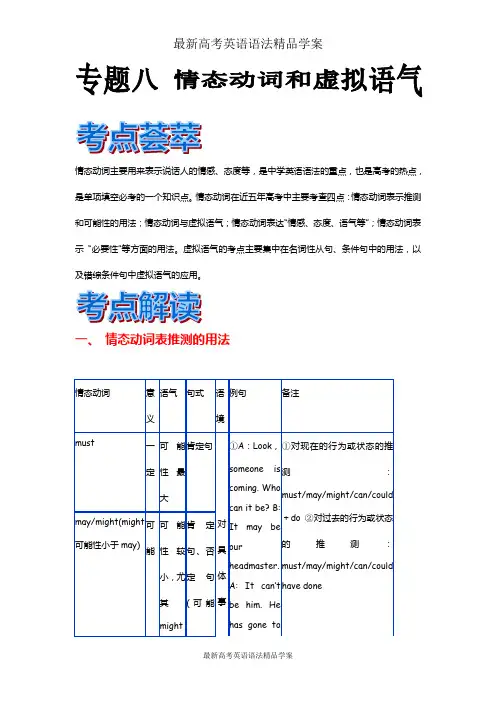
情态动词主要用来表示说话人的情感、态度等,是中学英语语法的重点,也是高考的热点,是单项填空必考的一个知识点。
情态动词在近五年高考中主要考查四点:情态动词表示推测和可能性的用法;情态动词与虚拟语气;情态动词表达“情感、态度、语气等”;情态动词表示“必要性”等方面的用法。
虚拟语气的考点主要集中在名词性从句、条件句中的用法,以及错综条件句中虚拟语气的应用。
一、情态动词表推测的用法It must beMr. Wang.He looks likeourheadmaster.②That may not be true.③He couldn't have discoveredthe truth.注意:should (ought to)表示推测是高考考查的重点和难点。
如:—When can I come for the photos?I need them tomorrow afternoon.—They ________ be ready by 12:00.A.can B.should C.might D.need【解析】B A项表示推测时常用于否定句和疑问句中。
C项表示推测语气不太肯定。
should意为“按理说,理应”,既回答了顾客的询问,不失礼貌,又为照片有可能尚未洗好,顾客到时取不到留下了回旋的余地,体现了店主的精明与用词经过仔细推敲。
二、情态动词的其他用法1.can, could, may, might2.must, should3. need, dare4.shall/will/would4.shall/will/would4.shall/will/would二、情态动词+have done四、虚拟语气虚拟语气表示说话人所说的话不是事实,而是一种假设、愿望、怀疑或推测。
1.虚拟语气在条件句中的用法If it were to rain tomorrow, I should not drive my car. 如果明天下雨的话,我就不开车了。
虚拟语气ppt课件完整版

02 03
例子
Had you come earlier, you would have met him.(= If you had come earlier, you would have met him.)(如果你早点来,你就能 见到他了。)
例子
Should it rain tomorrow, we would stay at home.(= If it should rain tomorrow, we would stay at home.)(如果明天下雨,我们就 呆在家里。)
虚拟语气用于强调句时,通常是通过 “It was ... that”结构对句子中的特 定成分进行强调。
在这种结构中,虚拟语气的使用与普 通虚拟语气略有不同,需要根据具体 情况进行判断。
虚拟语气与其他语法结构搭配使用
虚拟语气可以与定语从句、状语从句等语法结构搭配使用,表达更为复杂的语义关 系。
在这些结构中,虚拟语气的使用需要根据具体的语境和表达的语义关系进行判断。
真实条件句
表达现实中可能实现的情况, 使用陈述语气。
例子
If you study hard, you will pass the exam.(如果你努力 学习,你会通过考试。)
非真实条件句
表达与事实相反或不太可能实 现的情况,使用虚拟语气。
例子
If I were you, I would not do that.(如果我是你,我不会那
状语从句中虚拟语气使用
在if条件状语从句中
如果条件状语从句所表示的内容与实际情况相反或实现的可能性很小,则从句中的谓语动词常用虚拟语气。
在其他状语从句中
除了if条件状语从句外,还有一些其他状语从句也可以用虚拟语气,如:in order that(为了)、so that(以便 )等引导的目的状语从句中。这些从句中的谓语动词形式通常为“may/might/could/should + 动词原形”。
2019届高考英语考前培训第6讲情态动词、虚拟语气课件
5.“情态动词+have done”的含义: 结构 含义 must have done 过去肯定做了某事 couldn't/can't have done 不可能做过某事 could have done 本能够做某事 may/might have done 也许做了某事 would have done 本来会做某事 should/ought to have done 本应该做某事却没做 shouldn't/oughtn't to have done 本不应该做某事却做了 need have done 本需要做某事 needn't have done 本不需要做某事却做了
特别注意: (1)在if引导的虚拟条件句中,条件句的谓语动词中含有 had,were,should时,可以把if省略,把had, were,should提 到句首,变为倒装句。 Had you(=If you had)come earlier,you would have caught the early bus. 如果你早点来,就能赶上早班车了。 Were I(=If I were)twenty now,I would join the army. 如果我现在20岁,我就参军。 Should he come(=If he should come),tell him to ring me up. 他要是来了,让他给我打个电话。
The boy might have known the truth,but I am not quite sure. 那个男孩(当时)也许知道了真相,但我不是很确定。 You needn't have worked that late last night.It was harmful to your health. 你昨天晚上本不必工作到那么晚。那对你的身体有害。
2019年高考英语考纲解读专题08情态动词和虚拟语气教学案
专题08 情态动词和虚拟语气【2019年高考考纲解读】情态动词是各地高考试题中的必考项目,每年高考单项填空必有一道考查情态动词的项目。
考点依次是:推测(可能性)→请求/允许→必要性→特殊用法。
试题的立意不偏不怪,但有效信息越来越隐蔽,语境越来越真实,考查角度越来越细致,这些因素在很大程度上增加了试题的难度。
而虚拟语气的试题偏少,有些省份已将虚拟语气列为不考的项目。
【重点、难点剖析】第一部分、情态动词一、can/could与be able to1.can/could用来表示“一般能力”;be able to有多种时态,且用来表示在特定条件下的“具体能力”。
如:My grandma is over seventy,but she can still read without glasses.They will be able to tell you the news soon.He was able to flee Europe before the war broke out.2.表示允许可用can或could,与may/might意义接近。
could可用于现在时,只是语气更加委婉、客气,回答时则一般要用can而不用could。
—Could I have the television on?—Yes,you can./No,you can't.二、may与might1.表示允许,意为“可以,许可”,用法基本上同can与could。
如:May I use your bicycle?2.表示可能性,意为“也许,可能”。
如:According to the weather forecast, it may rain tomorrow.3.may可以放在句首,表示祝愿。
如:May good luck be yours!三、must与have to1.must用来表示说话人的主观看法;have to表示客观的需要,强调外界压力,不得已而为之。
2019版天津专用高考英语语法专练课件:专题8 情态动词和虚拟语气
A.must B.should C.can D.need 答案 C 句意:塞缪尔是我们班里最高的男孩,他可以轻松地够到书架顶层的书。本题考查 情态动词。根据语义可知应用情态动词can“可以,能够”表示能力。must必须,should应该, need需要,均不符合句意。
8.(2016天津,5)It was really annoying;I
10.(2016浙江,17)George
too far. His coffee is still warm.
A.must have gone B.might have gone C.can������ t have gone D.needn������ t have gone
答案 C 句意:乔治不可能走太远。他的咖啡还是热的。考查情态动词。can������ t have done sth.不可能做过某事;must have done sth.一定做过某事;might have done sth.可能做过某事; needn������ t have done sth.本不必做某事。
情态动词。根据语境可知此处表达“过去对某事担心过,但现在看来这种担心没有必要”,应
该用needn������ t have done,故答案为C项。
评析 情态动词是一个语法难点,尤其是 “情态动词+have done”的用法。要准确掌握几个
常见的情态动词与完成时连用时所表达的含义:是肯定推测还是否定推测,是可能性还是必要 性,是抱怨批评还是遗憾后悔。
5.(2017天津夏,2)My room is a mess, but I
clean it before I go out tonight. I can do it in the