
unit5 first aid listening and speaking 3
A :Good morning , doctor. Can I ask you a question?
B: Go ahead.
A : What should I do if my friend gets choking when he is having food? Can I give him slaps on his back? B: No , no! Let me teach you how to help him. Make a fist with one hand. Put your arms around him and grasp your fist with your other hand near the top of the stomach . Then , make a quick , hard movement , inward and upward. Understand? A : Yes , I get it. Thank you very much! B: You are welcome.
a nosebleed √ ( ) A: sit down and let her bend forward slightly ( ) B: use water to wash the nostril (鼻孔) ( √ ) C: squeeze he back
a nosebleed
choking
someone’s clothes on fire a sprained ankle
bleed[bli:d] bandage [' bændɪdʒ]
n.绷带 vt.用绷带绑扎 流血 肩胛
bend [bend]
squeeze [skwi:z] a sprained ankle [spreɪnd] ['æŋkl] shoulder blade ['ʃəuldə] [ bleid]
a sprained ankle (√ ) A: get him to sit down (√ ) B: put his foot up on a chair (√ ) C: put some ice on his ankle. (√ ) D: bandage up his ankle tightly
[mə'nu:və]
海姆利克急救法 for the person older than 3
2.Make a fist with one hand. 1.Lean [li:n]倚 the person forward slightly and stand behind him or her.
3.put your arms around the person and grasp [grɑ:sp]抓住your fist with your other hand near the top of the stomach , just below the center of the rib cage (胸 4. Make a quik , hard movement, inward and upward. 腔).
Use the knowledge about the first aid treatments from the listening exercises to make dialogues.
TASK 1
Act out the situation about the treatments for choking using the useful expressions.
someone’s clothes on fire (√ ) A: stop him running round (√ ) B: tell him to drop to the floor and cover him with a thick cloth (√ ) C: roll him on the ground till the fire goes out (√ ) D: treat him for burns
choking ( )A: let him sit down (√ )B: bend him forward ( )C: bend him backward (√ ) D: give him four quick hard slaps between his shoulder blades
×
['haimlik]
B: Till it stops.
A: Wow, it stops now. So useful. A and B: It is really useful.
Let’s review what we learned in this period.
Homework
Share what you have got we your classmates
TASK 2
Act out the situation about the treatments for a nosebleed using the useful expressions.
A: Oh , my God! I have got a nosebleed! What should I do ? B: Don’t be afraid! Let me help you. You sit down, bend forward, and lower your head. Then , squeeze your nose. A: How long should I do this?
扭伤的脚踝
屈身,弯腰
挤,捏
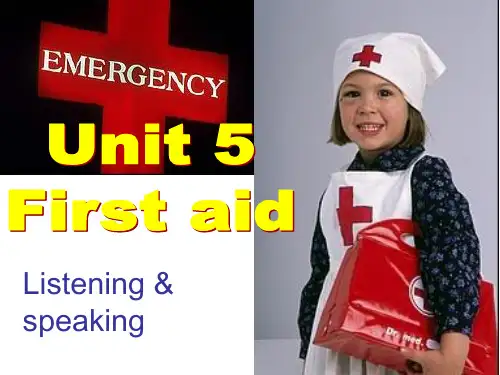
Listen to 4 situations to learn the knowledge about the first aid treatments for a nosebleed, someone’s clothes on fire, a sprained ankle and choking.
高二英语人教版Unit5 First Aid Listening and Speaking课件
4
2
1
3
Second listening
2. Listen again and complete the sentences below. Then match the advice to the pictures in Activity 1.
1 She should sit down and bend forwards slightly, so she doesn’t _ch__o_k_e_o_n__th_e__b_lo__o_d. Then ask her to squeeze her nose just below the _b_r_id_g_e_ until the bleeding stops.
Take down key words about what to do.
• choke
✓ bend him forwards and give
him several quick hard slaps
3
on his back
Take down key words about what to do.
• on a football field • sprain his ankle and sit on
the ground
• have a barbecue • clothes on fire
• have a nosebleed • be choked with food
1. Listen to the conversation about first-aid techniques. Write in the boxes the order (1-4) in which you hear these situations described.
人教版高二英语Book5Unit5 First aid listening and speaking
Summary
nosebleed
clothes on fire situations choking
sprained ankle
sit down and bend forward slightly Squeeze nose below the bridge
stop running around drop to the floor cover with thick cloth roll on the floor
bend forwards give four quick hard slaps
Task2 Four situations Situation I: nosebleed
1. What can you do when you have nosebleed? A. use water to wash the nostril (鼻孔) B. give the slaps(拍打) on the back C. sit down and bend forward slightly
1. _S_t_o_p_ him from r_u_n__n_in_g_ around. 2. Tell him to__d_r_o_p_ to the floor. 3. _C_o_v_e_r him up tightly with some__t_h_ic_k__ cloth. 4. __R_o_l_l him on the ground, until the fire __g_o_es___ __o_u_t___.
人教版高中英语必修五Unit5 First aid 听说公开课精品PPT课件
Situation III: choking
1. If he can't ___c_o_u_g__h__, ___b_e_n__d__ __h_im______ _fo__rw__a_r_d_s__.
2. Give him _fo_u__r _q_u__ic_k__h_a_r_d_ slaps between his__s_h_o_u__ld_e__r__ blades with the __h_a_n__d_s____.
为方便学习与使用课件内容, 课件可以在下载后自由调整
Learning Is To Achieve A Certain Goal And Work Hard, Is A Process To Overcome Various Difficulties For A Goal
31
2.Tell him to _d_r_o_p_ _t_o__ _t_h_e_ _f_l_o_o_r_ .
3. Cover him up tightly with ___th__ic_k___ __c_l_o_t_h______.
4. Roll him ___o_n___ ___th_e___ __g_r_o_u_n__d___ until the fire ___g_o_e_s___ ___o__u_t_____.
Choose a situation you like and act it out.
Home work
Letter writing.
Write the first aid treatments for an accident and what we
could do to prevent the accident.
Situation IV: a sprained ankle
人教必修5 Unit 5First aid Speaking, Listening and Acting
Important Numbers
120 119
Emergency medical service Fire department
110
Police department
Step3 Step3
Useful expressions
Watch out for… Follow these instructions
人教版 新课标必修5
Unit 5 First aid
Unit 5
First aid
Step1 Lead-in
What is first aid?
temporary, fall ill, injury, serious, quickly First aid is a temporary ________form of help given to ill someone who suddenly falls _____or gets injured before a doctor can be found. Often the illness or injury serious but there are other times _____is not ______, when giving first aid quickly ______can save lives.
A. True. B. False.
5. What will you do first for the casualty (伤者) ? A. Remove the wood from his leg as soon as possible. B. Stop the bleeding. C. Get him to hospital straight away.
Unit5FirstAidUsingLanguageListening听说课公开课课件-高二英语人教

Operator: Next, remove any pillows. Boy: OK. What next? Operator: Now look in his mouth. Any food there? Boy: No. Oh, he's started to breathe again. Operator: So, he's breathing? Boy: Yes, but his lips are blue! He's making strange noises!
4 Tasks
Know emergency numbers home and abroad Know when do we need to call an ambulance Know what makes a successful emergency call Know how to perform rescues in certain conditions
Listen to a 999 call in England and answer the questions..
2 Who else was in the room with the boy and his grandfather? The boy’s mother. 3 How did the boy describe the old man’s condition?
4 Tasks
Know emergency numbers home and abroad Know when do we need to call an ambulance Know what makes a successful emergency call Know how to perform rescue in certain conditions
人教版高二英语Book5Unit5FirstAid--ListeningandSpeaking
Step1 Lead-in
Q2: The best way to treat a sprained
A. Put an iacneklepisatoc:k on your ankle. B. Put a heating pad(发热垫) around your ankle. C. Keep on walking and jumping.来自Step1 Lead-in
Q3:If you get a nosebleed ,gently let your head back to stop the bleeding.
• True • False
Step1 Lead-in
A: Rub some butter on it. QB4:: THootrledat athbuern,byuournnetedptoa: rt under cold running water. C: Put salt on the burnt part.
Section 5 Teaching Emphases and Difficulties
• Key points: 1.Ss can learn about four first aid situations. 2.Ss can master some listening skills.
• Difficult points: 1.Ss can identify the liaison and assimilation. 2. Ss can use the phrases related to first aid
Section 3 Analysis of Teaching Methods
• 1. Task-based activity • 2. Scaffolding learning theory • 3. Maximize the speaking opportunity and
高中英语新人教必修五Unit5FirstAid全单元课件
Reading
FIRST AID FOR BURNS
Part 1: The functions of the skin
Part 2:Causes of burns
Part 3:Types of burns
Part 4: Characteristics of burns Part 5:
First aid treatment
A
blister
B
Tissue under them often C can be seen.
Part 5 Treatment
1. T__a_k_e__o_f_fclothing and jewelry near the burns.
2. _C_o_o_l__ the burns with cool water. 3. P_l_a_c_e__ cool, clean wet cloths on
He has a bleeding nose (a nosebleed).
Are you familiar with the following numbers?
110 Police department 119 Fire department
120 Medical emergency(急救) centre
second degree first degree third degree
burn
burn
burn
3 Answer the questions
1. Why should you put cold water on a 2. burn?
Because the cold water stops the burning process, stops the pain and reduces the swelling.
高中英语 Unit5《First aid》教案(7) 新人教版必修5
英语:Unit5《First aid》教案(7)(新人教版必修5)The Second Period ListeningTeaching goals 教学目标1. Target language目标语言a. 重点词汇和短语unconscious, emergency number, reach cupboard, involve, stress and intonation b. 重点句式So far we’ve looked at first aid treatments for burns, bleeding, choking ... Stop him from running around as that makes clothes burn faster.2. Ability goals能力目标Enable the students to listen for details and catch the specific information of first aid as much as possible.3. Learning ability goals 学能目标Help the Ss learn how to do rescue breathing by listening task.Teaching important and difficult points教学重难点Listen to the three materials about a first aid quiz and an emergency phone call and the instructions for rescue breathing, then choose the correct answers. Teaching methods教学方法Listening and cooperative learning.Teaching aids 教具准备A recorder, a projector and a computer.Teaching procedures and ways教学过程与方式Step Ⅰ RevisionHelp the Ss to check their homework on page 74. The students’ textbooks should be closed.T: Last class we learned some knowledge of first aid. Here I’d like to do a quiz about first aid. Do this first aid quiz in groups. Give reasons for your answers. Mary, which person would you help first?Read the multiple choices from A to D.S: C. Gao Yuan who is on the ground without breathing. He is in greater danger of dying than the others because he is not breathing. He needs rescue breathing to start his breathing again.T: When you are carrying out rescue breathing, where do you check for a pulse? Here are four answers.S: A. The easiest place to check for a pulse is on either of the carotid arteries, which run down both sides of the neck....Help the Ss to do the quiz.Step Ⅱ ListeningPre-listeningT: Before listening, let’s learn some difficult words and phrases. Read them and tell me the Chinese meanings.unconscious; emergency number; reach cupboard; involve; stress and intonationShow the following questions on the screen.Have you ever had to phone an emergency number? Do you know what telephone number you would call in a medical emergency?What telephone number you would call in a fire emergency?And what telephone number you would call in a police emergency?Let the Ss discuss these questions. Give some necessary help.Ss: 120 is the emergency phone number for the ambulance;110 for police station;119 for fire station.T: OK. When we make an emergency call, what should we pay attention to? Yes, we should re-member to tell where we are, what happened, the telephone number etc. Now, we are going to listen to an emergency phone call. Listen attentively and get the general idea.ListeningPlay the tape twice. And then ask the Ss some questions.T: What can you hear in the listening?S: The listening presents an emergency phone call in which a woman is asking for an ambulance for her daughter who has had an accident.T: I play it the second time; you need to fill in the blanks. While you are listening, you’d better make notes of the listening points. Listen to the conversation and complete the table on page 69, pay attention to the key words.Check the answers.Make the Ss understand all the four questions. Play the tape and ask them to answer the questions in pairs. And then check the answers with the whole class.T: Can you remember the phrases the operator used to try and make Mrs Grant feel more relaxed?S: Now calm down; Now take a deep breath.T: Are there any other phrases you didn’t understand?...Play the tape again and help the Ss to deal with the difficulties.Step Ⅲ Listening ( P73)Pre- listeningT: Now let’s go on to do another listening practice. Please turn to page 73. Here are some pictures of how to do rescue breathing. We call the way CPR. What do you think rescue breathing is?S: Rescue breathing is when you help someone who has stopped breathing to start breathing again.While listeningT: Listen to the instructions for rescue breathing, number the boxes for the correct order. Write an instruction under each picture. Now discuss the order in groups. Number the boxes to show the correct order of the pictures. Write an instruction under each picture.Ss: 7-5-2-4-8-6-1-31 check if conscious2 put into recovery position3 clear airway4 check if breathing5 blow into mouth and watch for breathing6 check pulse7 continue rescue breathing8 put into recovery positionPost-listeningT: Now let’s look at the pictures, can you use them as guide to tell each other how to do rescue breathing.Ss: 1. We should call for help, then check whether unconscious.2. We should put the person into the recovery position.3. We may clear anything in the airway.4. Then we should check for breathing.5. Blow into mouth using the mouth- to- mouth method.6. Check pulse.7. We should continue breathing at 15 breath a minute.8. At last when the person breaths again, put him/her in the recovery position. T: Yes, you are right. Rescue breathing is very important in our daily life. I hope one day when you need it, you can use it well.Step Ⅳ Listening (P39)T: Besides the rescue breathing, there are other ways to do first aids. Now, let’s learn more about first aid. Turn to page 39. Here is a quiz. While you listen to it, you don’t need to catch every detail. Only focus on the topics. Let’s listen to it and answer the questions. What topics does the teacher ask questions about? Circle the correct ones.Check the answer with the classmates. Ask some students to answer.Step Ⅴ Homework1. Search more information about first aid on the Internet.2. Prepare for reading: FIRST AID FOR BURNS.。
高中英语 unit 5《First Aid》教案 新人教版选修5
Unit 5 First aid I. 单元教学目标II.目标语言课程设计与课时分配(经教材分析,根据学情,本单元可以用六课时完成)1st period: Warming up2nd period: Listening and speaking3rd period: Reading4th period: Language study & Grammar5th period: Integrating skills6th period: Extensive reading and WritingUnit Five First aidThe First Period Warming upTeaching goalsTeaching materials: 教学材料Warming up on p 331.Target language 目标语言a. Key words and expressions:重点词汇和短语aid, first, aid; fall ill; illness; injury; bleed; sprain; ankle; choke; blood; bloody; burn; essential; organ; layer; poison; ray; treatment;b. Communicating expressions:交际用语We/you should/ ought to …Please do…Make sure…You must/have to/ought to…You must never…You ought never to…2.Ability goals能力目标a.Encourage the students to discuss accidents and first aid .b.Enable the students to talk about different accidents and how to give first aid in differentsituations.3.Learning ability goals学能目标Enable the students to be brave and calm when meeting with accident and know how to give first aid in different situations through discussion.Teaching methods教学方法Brainstorm and discussion (Group work).Teaching important and difficult points教学重难点Help the students to use the expressions to describe the accidents and how to give first aid. Teaching aids教具准备A recorder, a projector, and a computerTeaching procedures and ways 教学过程与方式Step One Homework checking1.Lead-in question: Watch a video, and fill in the blanks: what is first aid?First aid is the first kind of help given to someone who suddenly falls ill or gets injured before a doctor can be found.2. Warming-up: Brainstorming: What words can you think of when you talk about accidents and first aid?3. Learn the new words ?.b. Talk about different situations and the way they should give first aid.Qs: What happened in each picture? What kind of first aid should you give?A snake bite: The person bitten must get to a doctor or hospital at once;Speed is very important.It will help the doctor greatly if you can tell him what kind of snake it was, ordescribe.Bleeding: Try to stop the bleeding;Press a handkerchief onto the bleeding point and hold it there;Hold up the part of body which is bleeding if possible.(watch the video about how to deal with bleeding )A sprained ankle: Tied with medical bandage.It is better to avoid walking with the injured ankle.It is correct to use ice bag for removing pain and bleeding, and also not influence ourown body healing.( a video about a sprained ankle)Choking : Make him /her spit by patting him/her on the back.To avoid this, we shouldn’t talk or laugh when eating.(a video about unconscious choking)A broken arm: Do not move the patient.Send for an ambulance at once.Treat for shock if necessary.A bloody nose: Stay calm.Breathe through the mouth, not the nose.Sit up and bend the head slightly forward.Pinch捏both nostrils鼻孔shut using a thumb and forefinger.Spit out any blood that collects in the mouth.Step four Further discussion (Individual)Ask the students to give the situations.(some more situations are given and encourage the students to talk more)Drowning :Check to see if he /she is breathingTry to start his /her breathingNever swim in deep water.( a video about CPR)Traffic accident: Call for a doctor or an ambulance.Never pull her out of the carFind enough people to lift the car safely and take her to hospital at once.Look at both sides when crossing the street.Step five Quiz for first aid (on p74)1.Which person would you help first?___A Li Yan who has cut her foot on glassB Xue Jin whose nose is bleedingC GaoY uan who is on the ground not breathingD Wang Feng who has broken her arm.2. When carrying out rescue breathing, how many times a minute should you blow air into the victim’s mouth? ______.A 4B 8C 15D 203. What should the first step be when you carry out rescue breathing?____A Clear the airwayB check the pulseC blow into the victim’s mouthD check for breathing4 How would you stop severe bleeding? ___A cover the wound with plasticB wash the woundC do nothing as the bleeding will stop by itselfD put a bandage over the wound and then press on it5 A friend is choking on a piece of food and is coughing badly. What should you do?___A nothingB carry out rescue breathingC have her lie down and restD slap her four or five times on her backStep Five Homework1. Do the listening in workbook p69.2. Find more information about first aid---how to rescue breathing.Unit Five First aidThe Second Period Listening and speakingTeaching goals 教学目标Teaching materials教学材料Listening on page 69,39,73, speaking task on p744.Target language目标语言a. Key words and phrases:重点词汇和短语:unconscious; emergency number; reach cupboard; involve; stress and intonationb. Communicating expressions:交际用语We/you should/ ought to …Please do…Make sure…You must/have to/ought to…You must never…You ought never to…5.Ability goals能力目标Enable the students to listen for details and catch the specific information as much as possible.6.Learning ability goals 学能目标3.1 Enable the students to predict some important listening skills in the process of listeningand encourage the students to talk about the details after listening.3.2 Make the students have the ability to talk about the situations according to the listeningmaterials and tell dos and don’ts for first aids.Teaching methods教学方法Listening and cooperative learning.Teaching important and difficult points教学重难点How to make sure the answers of listening material;Talk about the first aid of different situations after the listening.Practise in pairs and act out a dialogue between an operator and the caller;Teaching aids 教具准备A recorder and cassette tapes , a projector, and a computerTeaching procedures and ways教学过程与方式Step one Homework checkingThe teacher may explain some difficult words and phrases to the students before listening. (unconscious; emergency number; reach cupboard; involve; stress and intonation)T: OK. Let’s listen to the tape. I’ll play it twice. The first time I play it, you should listen to it attentively and get general idea. The second time I play it, you need to fill in the blanks.Listen to the conversation and complete the table, pay attention to the key words.3. Check the answers.Post listening Listen to it again and answer the questions:1. Do you think that Mrs Grant should have rung the emergency number or should she have just taken her daughter to the doctor? Give reasons for your answer.2. How do you think Mrs Grant was feeling when she made the phone call?3. Why do you think the operator was speaking so slowly and calmly?4. What would have happened if Mrs Grant had hung up the first time she said goodbye?5. What would have been a safer way for Mrs Grant’s daughter to reach the cupboard?Step three Listening on p731. Listen to the instructions for rescue breathing, number the boxes for the correct order. Write an instruction under each picture.2.Then use the pictures to tell each other how to do rescue breathing.(Use the video to help students to talk about CPR) :Call for helpCheck the breathingClear anything in the airwayMouth-to- mouth methodCheck breathing pulseStep four Listening on p391. What topics does the teacher ask questions about ? Circle the correct ones.2. Match each picture with a topic listed in question 1.1).___sprained ankle__________2).___burning clothes_________3).___nose bleeds ____4).___choking _____________Step five speakingUse the pictures above to help you give your partner first aid instructions for each situation. Using the useful expressions:You should always…You must…Make sure that…You ought to / should …you hav e to…You should not…You should never…You must never…Never…Please don’t…Sprained ankle:Tied with medical bandage.It is better to avoid walking with the injured ankle.It is correct to use ice bag for removing pain and bleeding, and also not influence our own body healing.Burning clothes: Use a blanket to put out fire on the body.Remove clothing from burned area.Use running water to cool down.Sent for a doctor.Nose bleedsStay calm.Breathe through the mouth, not the nose.Sit up and bend the head slightly forward.Pinch捏both nostrils鼻孔shut using a thumb and forefinger.Spit out any blood that collects in the mouth.ChokingMake him /her spit by patting him/her on the back.To avoid this, we shouldn’t talk or laugh when eating.Step six Write down the instructions for each situation.Step seven Watch the movie to see some more ways to deal with first aids. Step eight Talk about safety around the house, using DOS and DONTS DOSa.Make sure that electric wires are safe and that children can’t reach them.b.If a pan of oil catches fire, turn off the gas and cover the pan quickly.c.Make sure that everyone in your family knows how to call 110 and 120.d.Learn more about first aid.DON’TSa.Don’t put poisons into other c ontainers, for example empty bottles.b.Never leave small things a baby can put in its mouth on the floor or tablec.Don’t play with electrical equipment.d.Never use ladders on a wet floor.Don’t forget to phone 110 or 120 when necessaryStep nine Home work1. Write a dialogue according to the talking Ex. on p69 .2. Prepare for reading : First aid for burnsUnit Five The Third Period Reading Teaching goals教学目标Teaching materials: 教学材料Reading on p 34-367.Target language教学语言a. Key words and expressions:重点词汇和短语burn, essential, organ, layer, poison, ray, treatment, liquid, radiation, mild, iron, heal, tissue, electric, swell, swollen, blister, watery, char, nerve, damage, jewellery, squeezing out, over and over again, bandage, in place.b. Useful sentences重点句型Burns are called first degree, second degree or third degree burns,These burns are not serious and should feel better within a day or twoFirst degree burns turn while when pressed.8.Ability goals 能力目标Enable the students to master some English expressions and phrases and to know some knowledge of first aid9.Learning ability goals学能目标Enable the students to learn how to give their correct suggestions about first aid when others are in danger,4. Teaching important points教学重点Let Ss learn to use the structures of giving suggestions5.Teaching methods教学方法Skimming method.Task-based methodRole-play method6.Teaching aids 教具准备A projector, a tape-recorder and a blackboardTeaching procedures and ways教学过程和方式Step 1 Revision1.Greet the whole class as usual2.The teacher checks the students’ homework: show some pictures about some commoninjuries and review some words, some useful expressions and the information about first aid.Step 2 Pre-readingFirst let the students talk about the picture (page 33)What kind of first aid would you perform in the situation of burning?Step 3 While-reading1) Skim for general idea. How many parts are the text and what are they?(After a few minutes)Five parts1.The purpose of skin2.Cause of burns3.Types of burns4.Symptoms of burns5.First aid treatment Scanning : read the text quickly and do the multiple choices onBEST DESIGN(page 36)3)Detail reading: Filling in the blanksWhat can skin do for our body ?•Protect you against diseases, poisons and the sun’s harmful rays.•Keep you warm or cool•Prevent you from losing water•Gives you sense of touchCauses of burnsYou can get burnt by :•hot liquids,•steam,•fire,•radiation,•the sun,•electricity and chemicalsWhat are the three types of burns?•F i r s t d e g r e e:Not serious; affect only the top layer of the skin; feel better a day or two•S e c o n d d e g r e eAffect both the top and the second layer of the skin; serious; take a few weeks to healT h i r d d e g r e eAffect all three layers of the skin and any tissue and organs under the skin; very severe injuries; victim must get to a hospital at once.Label the pictures with three degree burnsT h e s e c o n d d e g r e e b u r n T h e f i r s t d e g r e e b u r n T h e t h i r d d e g r e e b u r n Answer the questions1. Why should you put cold water on a burn?••T h e c o l d w a t e r s t o p s t h e b u r n i n g p r o c e s s,s t o p s t h e p a i n a n d p r e v e n t s o r r e d u c e s s w e l l i n g.•2. Why doesn’t a third degree burn hurt?••B e c a u s e n e r v e s i s d a m a g e d.•3. Why do you think clothes and jewellery near burns should be removed?••B e c a u s e t h i s m a y b r e a k a n y b l i s t e r s a n d t h e w o u n d m a y g e t i n f e c t e d.•4. If someone has a third degree burn, why might you see tissue?•T h e s e a f f e c t a l l t h r e e l a y e r s o f t h e s k i n a n d a n y t i s s u e a n d o r g a n s u n d e r f i r e s Language points•sense of touch sense of sightsense of hearing• sense of tastesense of smell• sense of humor• sense of beauty•sense of urgency unless: 除非……;如果不……•Don’t make it public u n l e s s I agree.•U n l e s s the destruction of the ozone layer is to stopped, the polar ice caps could melt with terrible consequences.c) Hold the bandage in place with tape.•in place•The librarian put the returned books in place.d) It shows that a knowledge of first aid can m a k e a real d i f f e r e n c e.•M a k e(s o m e,n o,e c t)d i f f e r e n c e•I t m a k e s n o d i f f e r e n c e t o m e w h e r e y o u c o m e f r o m.If you want more tips about first aids and ways to deal with common injuries, refer to the following websites./clinic/firstaid//parent/firstaid_safe//firstaid_rfrg.htm/articles/25936-7.aspHome work•1. Finish the Exes in p36.2.Read the text.Unit Five First aidThe Fourth Period GrammarTeaching goalsTeaching materials: 教学材料Learning about language and using words and expressions. on workbook p70-7110.Target languagea. Key words and expressions:aid, first aid, illness, injury, poisonous, burn, swollen, damage, treatment, wounded, infect, organ, cause, characteristics, electric. Fall ill.eful sentences1)Burns are called first degree burns, second degree burns or third degree burns.2)These burns affect both the top layer of the skin and they affect the second layer ofthe skin.11.Ability goalsLearn about Ellipsis12.Learning ability goalsLet Ss learn how to use Ellipsis4. Teaching important pointsThe use of Ellipsis5. Teaching difficult pointsHow to teach Ss to master EllipsisTeaching aidsA projector, and a blackboardTeaching procedures and waysStep 1 Revision3.Greet the whole class as usual4.The teacher checks the students’ homework.Step 2 Word StudyT: Now please open your books and turn to Page 36. Let’s learn “Learning about Language”. First let’s do Discovering useful words and expressionsplete the table with the correct verbs, nouns or adjectives.T: Let’s do some more exerc ises about new words. You are to explain the words on the screen in English and then fill in the blanks.(ask students to explain or guess the meanings of the words)plete the questions with words from the text.The students will try to complete the exercises. Later the teacher will ask some of them to read each of the sentences and tell the class the answers.Suggested answers:Step 3: GrammarT: Let’s look at the next, Grammar (page 91)Present some sentences and encourage the students to find out which words have been left out.T: Observe the following sentences and discuss with your partner to find out what have been left out. Let me show you an example. As we know, when people want the speaker torepeat what he said, they usually say “ Beg your pardon.” Then it is called Ellipsis. The subject “I” has been left out, without changing the meaning of the sentence .OK, now it’s your turn to find out what have been left out.1.Haven’t seen you for ages.2.Some more tea?3.Sounds like a good idea.4.Doesn’t matter.5.Sorry to hear that.6.Pity you couldn’t come7.This way, please.8.Terrible weather!9.Joining us for a drink?10.Going to the supermarket?Suggested answers:1.I haven’t seen you for ages.2.Would you like some more tea?3.That/It sounds like a good idea.4.It doesn’t matter.5.I’m sorry to hear that.6.It’s/ What pity you couldn’t come7.Step this way, please.8.What terrible weather it is!9.Are you joining us for a drink?10.Are you going to the supermarket?Step 4 PractisingDiscovering useful structures (page 37)1.In groups, look at these pairs of sentences. Discuss the difference between A and B ineach pair. Also discuss which is the better sentence, A or B and Why.(page 37)2.Rewrite these sentences taking out the unnecessary parts.1)The burn that she got from the iron was red and ( it was )very painful2) A boy was on the left side of the sick woman, and a girl was on the right (side ofthe sick woman.)3)She has a daughter (who is) in hospital.4)He went to the doctor because he had to go to( the doctor).5)Did she pass the first aid test that she did yesterday (or didn’t she pass)?6)She could not decide whether to send him to hospital or not (to send him tohospital).7)When your nose is bleeding, you should bend forward so that the blood runs out ofyour nose and( the blood)doesn’t run down your throat.8)Only some of the students have done a first aid course but most of the studentshaven’t (done a first aid course).3.These sentences are correct. However, one or more words have been left out. Rewriteeach sentence on the top of the next page to include the missing words.1)The cottage (that is) surrounded by a wall belongs to the local government.2)The first book I read this term was more interesting than the second (book I readthis term).3)To her teacher’s surprise, she di d better in her first aid exam than(it was) expected.4)I don’t think they have returned from the hospital, but they might have ( returnedfrom the hospital).5)He wanted to help the accident victim but his friend didn’t (want to help theaccident victim).6)You can borrow my first aid notes if you want to (borrow my first aid notes).4.Show the students the slides with some multiple choices exercises about the Ellipsis.1)---- Tomorrow is a holiday. Why are you doing your homework?-----I am doing these ex ercises now so that I won’t have _____ on Sunday.A. itB. themC. forD. to2)----Shall I invite Ann to my birthday party tomorrow evening?----Yes. It’ll be fine if you______.A. areB. canC. inviteD. do3)---- Aren’t you the manag er?-----No, and I______A.don’t want toB. don’t want to beC. don’t want beD. don’t want4)---- I’ll be away on a business trip. Would you mind looking after my cat?-----Not at all______.A. not toB. not to doC. not do itD. do not to5)----- Won’t you have another try?------ ________.A.Yes, I will haveB. Yes, I won’t haveC. Yes, I won’tD. Yes, I will6)-----I won’t do it any more.-----_______?A. Why notB. Wh y don’t do any moreC. Why not doD. Why don’t7)-----Do you think it will snow tomorrow?------______?A.I don’t thinkB. No, I don’t thinkC. I don’t think soD. No, I don’t so8)-----Have you fed the cat?------No, but______.A. I’mB. I amC. I’m just goingD. I’m just going toStep 5 Homework1. Go over the usage of Ellipsis.2. Finish listing structures on Page 71 Ex 1 and Ex 23. Prepare Reading and discussing on Page 38Unit Five First aidThe Fifth Period Integrating skillsTeaching goals教学目标Teaching material 教学材料Reading and discussingHeroic teenager receives award13.Target language教学语言a. Key words and expressions:重点词汇和短语Present, Put their hands on, ceremony, bravery, towels, pressureA number ofAmbulanceeful sentences重点句型1.John was presented with his award at a ceremony which recognised the bravery often people who had saved the life of another.They discovered that Anne Slade, mother of three, had been stabled repeatedly with a knife.3. It was John’s quick action and knowledge of first aid that saved Ms Slade’s life.14.Ability goals 能力目标Enable the students to know some knowledge about first aid after learning the text.15.Learning ability goals 学能目标Foster t he students’ ability in skimming and looking up information in references books and improve the students’ reading ability.Teaching important points教学重点Finish the exercises in post-reading by using the knowledge we have learned.Teaching methods教学方法Listening and fast readingTeaching aids教具准备A recorder, a projector, and a computerTeaching procedures and ways教学过程和方式Step One RevisionShow the students a slide with some new wordsWhat is the Chinese meaning of them?PresentPut their hands onceremonybraverytowelspressureA number ofAmbulanceStep Two Reading and listening1. S k i m m i n g t h e n e w s p a p e r a r t i c l e a n d t h e n p u t t h e s e e v e n t s i n t h e o r d e r t h a tt h e y h a p p e n e d._4_T h e a t t a c k e r r a n a w a y._1_A n n e w a s a t t a c k e d a n d s t a r t e d t o s c r e a m._6_J o h n p e r f o r m e d f i r s t a i d o n A n n e_2_J o h n w a s s t u d y i n g i n h i s h o u s e._7_T h e a m b u l a n c e a r r i v e d._3_J o h n r a n o u t s i d e w i t h h i s f a t h e r._5_J o h n f o u n d A n n e i n h e r g a r d e n w i t hterrible knife wounds.2. Listen to the tape and answer the questions1) What was John honoured for?2)W h a t d i d J o h n d o w h e n h e h e a r d t h e s c r e a m i n g?3)W h a t h a p p e n e d t o A n n e?W h a t s a v e d M s s l a d e’s l i f e?5)W h a t f i r s t a i d d i d J o h n p e r f o r m o n A n n e?W h a t a d j s w o u l d y o u u s e t o d e s c r i b e J o h n’s a c t i o n s?G i v e a t l e a s t t h r e e.S t e p T h r e e Discussion 1.Do you think John was silly or brave to get involved in the situation? Give reasons.2.Would you have done the same as John ? Give reasons3.Do you think it is worthwhile to take a course in first aid? Give reasons.Step Four Language studyDifficult sentences1.John was presented with his award at a ceremony whichrecognised the bravery of ten people who had saved the life of another.be presented with sth: be given withWhich 引导一个定语从句Who引导一个定语从句They discovered that Anne Slade, mother of three, had beenstabled repeatedly with a knife.Repeatedly 是由动词repeat的过去分词加-ly构成。
unit5-first-aid--listening-and-speaking--3
Homework
Share what you have got we your classmates
第17页,共17页。
A: How long should I do this?
B: Till it stops.
A: Wow, it stops now. So useful. A and B: It is really useful.
第15页,共17页。
Let’s review what we learned in this period.
A : Yes , I get it. Thank you very much!
B: You are welcome.
第13页,共17页。
TASK 2
Act out the situation about the treatments for a nosebleed using the useful expressions.
4. Make a quik , hard movement,
inward and upward.
第10页,共17页。
Use the knowledge about the first aid treatments from the listening exercises to make dialogues.
第14页,共17页。
A: Oh , my God! I have got a nosebleed! What should I do ? B: Don’t be afraid! Let me help you. You sit down, bend forward, and lower your head. Then , squeeze your nose.