
Unit 5 Visiting the Moon
a.we use be going to to talk about things(that may happen/ we plan to do) in the future b.we use (the base form/the –ing form) of verb after be going to
B: No, we will not.( won’t) A: Where will we go? B: We will(we’ll) go to Dongguan.
by bus
by train
A:Will wo go to Dongguan by bus? B: No, we won’t. A:How will we go? B: We’ll go to Dongguan by train
预习检测 Free Talk
7 years old, a primary school student
17 years old, a singer
People chang a lot over time
38 years old,an actor and a star father
What will your classmate be?
tomorrow
next week
A:Will we go to Dongguan tomorrow B: No, we won’t. A:When will we go? B: We’ll go to Dongguan next week.
go climbing
have a picnic
A: Will we go climbing? B:No, we won’t A:What will we do? B:We’ll have a picnic.
Mr Green: we’ll see (2)_______________________ (We/see) all of the Earth. We won’t there will be No, (4)___________________ (we/not), but (5)_____________________ (there/be) wonderful views of the Moon. Will we see Mrs Green: (3)_______________ (we/see) Mars? Mr Green:
“There be”句型的一般将来时
There is a tree in the park There are two trees in the park There will bemany trees in the park in the future There are going to be many trees in the park in the future
see, what are you going to do?)
If I have three days to see, I am going to……and......on the first day , then I am going to……and……on the second day , at last, I am going to……on the third day. I look forward to a nice day.
will we get (we/get) to the hotel? Mrs Green: How (6)____________
We’ll fly Mr Green: (7)___________________ (We/fly) up to the hotel in a spaceship. Will Tim be (Tim/be) with us? Mrs Green: (8)____________ He’ll enjoy Mr Green: Oh, yes, let’s take him too. (9)___________________ ____(He/enjoy) it.
口头表述 Please cherish your life 珍爱生命,珍爱时间
大家齐思考
They are going to read books in the library next weekend ( 1)把上述句子分改为否定句,一般疑问句(做肯否定回答) a.They are not going to read books in the library next weekend b. Are they going to read books in the library next weekend? Yes, they are./ No, they aren’t. (2)对上述句子的划线部分进行提问 Who are going to read books in the library next weekend? What are they going to do in the library next weekend? Where are they going to read books next weekend? When are they going to read books in the library
2.be going to引导的一般将来时的几种句式分别是
肯定句:主语+be(am, is, are) +going to+V原+其他 否定句:主语+be(am, is, are)+not +going to+V原+其他 一般疑问句:be(am,is,are)+主语+going to +V原+其他 肯定回答: Yes,主语+am,is,are 否定回答: No,主语+am,is,are+not 特殊疑问句:特殊疑问词+一般疑问句结构
看图说话(work in pairs and make dialogues) A: Will he be late for school? late?
B: Yes, he will A: When will he get to school? When? B: He will get to school at 10:10 a.m A: Will the teacher be angry? angry? B: Yes, he will. (No, he won’t)
P64
Mr Green sees this advertisement. Complete his conversation with Mrs Green using will (’ll) or will not (won’t) and the words in brackets.
will we see (we/see) from there? Mrs Green: That’s a good idea. What ____________
2)Will引导的一般将来时的几种句式结构分别是
肯定句:主语+will+V原形 否定句:主语+will+not+V原形 一般疑问句:will+主语+V原形 (肯定回答:Yes,主语+will 否定回答:No,主语+won’t) 特殊疑问句:特殊疑问词+will引导的一般疑问句
Practice
Mr Green: Let’s visit the Space Hotel for our next holiday!
Who is she?
Three days to see
Hellen Keller 海伦凯勒
If she has three days to see, what is she going to do?
Three days The First Day She is going to see the kind people who helped her
Practice
P65
Mr Green wants to visit the Space Hotel. He is telling his son about his plan. Complete the conversation using be (not) going to and the words in brackets. Mr Green: Come here, Tim. (1)______________ (I/tell) you something I’m going to tell We’re going to have exciting! (2) ________________ (We/have) a holiday in the Space Hotel! Are we going to drive Tim: Great! (3) ___________________ (we/drive) our car there? We are not going to drive Mr Green: No, (4) ____________________ (we/not drive) our car We’re going to travel there! (5) ________________ (We/travel) in a spaceship! Tim: Are the dogs going to come with us? They’re going to stay Mr Green: No. (6) ________________ (They/stay) here. Is Aunt Alice going to be Tim: (7) ____________________ (Aunt Alice/be) here every day to feed them? is Mr Green: Yes, (8) She ______ (she/be).
unit 5 Visiting the moon
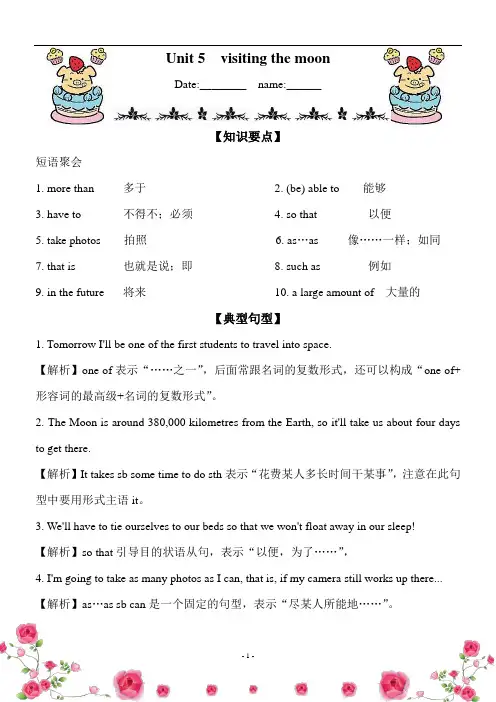
Unit 5 visiting the moonDate:________ name:______【知识要点】短语聚会1. more than 多于2. (be) able to 能够3. have to 不得不;必须4. so that 以便5. take photos 拍照6. as…as 像……一样;如同7. that is 也就是说;即8. such as 例如9. in the future 将来10. a large amount of 大量的【典型句型】1. Tomorrow I'll be one of the first students to travel into space.【解析】one of表示“……之一”,后面常跟名词的复数形式,还可以构成“one of+形容词的最高级+名词的复数形式”。
2. The Moon is around 380,000 kilometres from the Earth, so it'll take us about four days to get there.【解析】It takes sb some time to do sth表示“花费某人多长时间干某事”,注意在此句型中要用形式主语it。
3. We'll have to tie ourselves to our beds so that we won't float away in our sleep!【解析】so that引导目的状语从句,表示“以便,为了……”,4. I'm going to take as many photos as I can, that is, if my camera still works up there... 【解析】as…as sb can是一个固定的句型,表示“尽某人所能地……”。
【典型例题】根据汉语提示,完成句子。
七年级英语上册Unit5visitingthemoon(牛津深圳版)
七年级英语上册Unit5 visiting the moon(牛津深圳版)7A Unit Visiting the n知识点归纳重点单词: diar, spae, spaeship, spaesuit, nervus, leave, gravit, able, flat,tie, urselves, ithut, ea, bre athe, if, aera, r, garden, r, pstard, ahine, return重点短语able t, have t, s that, tae phts, as…as…, that is, suh as重点句子解析Reading1H ill err travel?H a err feel abut the trip?travel, trip, urne的用法辨析: 三者区别如下1) travel 泛指一般意义的旅行是不可数名词。
如travel (= travelling) 他喜欢旅行。
Travel is uh heaper than it used t be现在旅行比过去便宜多了。
注有时可用复数形式主要指时间较长的各处旅行此时通常有物主代词修饰但是尽管用了复数形式却不能与an 或数词连用。
如’s gne ff n his travels again 他又外出旅行了。
另外通常只是泛指旅行而不特指某次具体的旅行所以通常不说2) urne 通常指远距离的陆地旅行并且不一定要返回到出发地(即通常指单程)。
如t urne 祝你一路顺风。
He ade a urne t Beiing 他去北京旅行了。
注有时并不指真正意义的“旅行而只是表示走过一段距离。
如你上班要走多远?3) trip 通常指近距离的为了办事或消遣而进行旅行并且往往要回到出发点(即指双程不过有时trip 也可指远距离的长途旅行可与urne 换用比urne 更通俗。
如约翰在哪里?’s n a trip t Shanghai 他去上海旅行了。
七年级上Unit 5 Visiting the Moon知识点
Unit5 Visiting the Moon一.重点单词camera['kæmərə]/n.照相机; diary n.日记; keep/write a diary写日记; personal diary 个人日记; space太空,空间,前面一般不用冠词,有形容词前可用the; in space在太空中; space station太空站; spaceship宇宙飞船; spacesuit宇航服; gravity[ˈɡrævɪti]/n.重力,地球引力; ourselves[ˌaʊə'selvz]/pron.我们自己; by oneself(复习反身代词的用法); certainly/adv.当然,一定;=of course=sure;without[wɪ'ðaʊt]/prep.没有,缺乏;介词+doing; It is a house without a garden. with prep.带有 It is a house with a garden. weak [wiːk]/adj.虚弱的,无力的; 反义词: strong weakly/adv. 虚弱地; weakness/n. 虚弱; be weak in …不擅长…;breathe[briːð]/v.呼吸; breathe deeply深呼吸; /n. 呼吸; take a breath 吸一口气; take a deep breath深呼吸; out of breath 上气不接下气; hold one’s breath屏住呼吸; /v.breathe in /out 呼入/出; if[ɪf]/conj.如果; 引导条件状语从句-主将从现;work[wɜːk] v.工作; His father works in a computer company. /v.运转,运行; The watch doesn’t work.工作(抽象,指需要做的工作) a lot of work; He has much work to do. job 指具体的职业; 作品 works; I like reading the works of Luxun. works 常用复数作工厂; garden['gɑːdn]/n.花园;gardener /n. 园丁; rock[rɒk]/n.岩石; postcard['pəʊstˌkɑːd]/n.明信片;post v. 邮寄; poster n. 海报; machine[mə'ʃiːn]/n.机器; enough/adj.足够的; enough+n.; n.+enough; /adv. adj.+enough+to do sth.足够来做;return[rɪ'tɜːn]/v. 回来,返回=go back=comeback; return to+地点; return+地点副词; 归还= give back=return sth. to sb.; in return 作为回报; bring back 带回; tie [taɪ]/v.系,捆,绑; tie/die/lie-tying/dying/lying; tie sth to …把…系在…/n. 领带,平局; float[fl əʊt]/v.漂浮,浮动; float away漂浮; able ['eɪbl]/adj.能,能够; be able to do sth= can do sth= have an ability to do sth; ability /n.能力; enable /v. 使能够; unable /adj. 不能够的; nervous['nɜːvəs]/adj.紧张的,/adv. Nervously,/n. nervousness, be/feel nervous about/of sth 对…感到紧张; I feel nervous about the news. leave[liːv]/v.离开(left-left); leave sth+地点介词短语把…留在某地; leave sb by oneself 把某人独自留在某地; leave for sp(目的地)离开去某地; leave…for… 离开…去…; ask for leave请假; ①离开;The train leaves the station at 5. ②留下,遗忘,落下Don’t leave your books at home.③使…处于某种状态 leave+宾语+宾补 Leave the door open. feed /v.喂养; feed sth. to sb./sth.=feed sb./sth. on sth. 用食物喂某人/某物=给某人/某物喂食物;Please feed some grass to the sheep.=We feed the sheep on grass.养活; They have a large family to feed.辨析: bring, takebring表示“拿来,取来”,指从别处把某人或某物带到说话者所在的地点来。
沪教牛津版七年级英语unit5visitingthemoon知识讲解

沪教牛津版七年级英语unit5visitingthemoon知识讲解UNIT 5Visiting the MoonⅠ重点单词diary 日记复数:diaries leave 离开,剩下,留下able adj. 能;能够space 太空,不可数spaceship 宇宙飞船spacesuit 宇航服nervous adj.紧张的gravity 重力float v.漂浮ourselves 我们自己的without 缺乏,没有tie v.捆;系;绑tied, tied, tying breathe 呼吸if 如果camera 相机work v. 运转;运行garden 花园rock 岩石postcard n.明信片machine 机器return 不及物动词,回来,返回=come back 及物动词,归还=give back weak 虚弱的,无力的he is weak in English.Ⅱ重点短语leave for 动身去某地more than 超过,多余more···than 比···更be able to会,能have to 不得不so that 以便take photos拍照as ···as one can 尽某人所能as soon as possible 尽可能快地that is 也就是说such as例如at the moment 现在,此刻(可用于现在时和过去时)III常考句型1.How far ···?2.···so that ··3.I’m going to···4.That’s a good idea.IV详细讲解1.It’ll take us to the Moon.(page59)它将把我们带到月球。
Unit 5 Visiting the Moon 课件 1
我们必须把自己绑在床上,
这样我们就不会在睡梦中漂走了。
have to 不得不,必须 比较:have to 与 must
1)have to表示客观的需要, My younmgeurstb表ro示th说er话is人v主er观yhi上allv,的esto看o I法__。___ call
must the doctor.
我对这次旅行感到无比兴奋。
I ___fe__e_l__ __e_x_c_i_te_d__ _a_b__o_u_t___ the trip. feel excited about 对……感到兴奋
more than=over “多于,超过”
我们学校的学生超过六百人。
There are _m__o_r_e_ _______ 600 hundreds students intohuarnschool.
The Moon was first visited by the Soviet spacecraft Luna 2 in 1959.
The first landing was made by the Americans on July 20, 1969.
Circle these phrases on your book.
多于 在太空 能够 不得不,必须 把……系在…… 以便 漂浮 在某人睡着的时候 虚弱 做锻炼,做运动 在月球上 像……一样 也就是说:即 照相
more than in space
be able to Reading
have to tie…to so that float away in one’s sleep get week do exercises on the Moon as… as that is
七年级上英语Unit5 Visiting_the_Moon
Unit5 Visiting the Moon1.There can be more than one answer. more than= over 超过2. One of ….的其中之一,后面跟可数名词的复数。
He is one of the top students.3.The spaceship will leave the Earth at 9 a.m.①“leave+地点”表示“离开某地”。
When did you leave Shanghai?--你什么时候离开上海的②“leave for+地点”表示“动身去某地”。
Next Friday, Alice is leaving for London.下周五 爱丽斯要去伦敦了。
③“leave+地点+for+地点”表示“离开某地去某地”。
Why are you leaving Shanghai for Beijing?你为什么要离开上海去北京4.It will take us to the Moon. take... to... 带...去...5.The Moon is around 380,000 kilometers from the Earth ,so it'll take us about four days to get there.①around = about 大约②it take sb. some time to do sth. =sb spend some time doing sth. / on sth.花费sb多少时间做sth一般现在时It takes sb. some time to do sth.一般将来时It will take sb. some time to do sth.一般过去时It took sb. some time to do sth.6. leave“离开”、“留下”1)leave for 出发至某处He left for Beijing yesterday.2)leave sth for sb 把什么留给什么人She left these flowers for you.3)leave sb for sb 离开什么人去和什么人在一起He left his wife for a young lady.4)leave sth to do sth 指为做某事离开某处He left her house to catch the last bus.5)leave sb doing sth 让某人单独做某事Don't leave your children playing with fire.7. be able to 和can(1)当它们表示能力的时候,是同义的。
Unit5VisitingtheMoon讲义牛津深圳版七年级英语上册
Unit 5 Visiting the MoonGetting ready1.Read a student’s diary about a trip to space.①diary n 日记diaries (复数)keep a diary 写日记② space n 太空;空间space station 太空站space travel 太空旅行make space for 为....腾出空间2.Plan a trip to the Space Museum.plan v 计划plan to do sth 计划做某事n 计划make a plan = make plans 制定计划Reading1.There can be more than one answer.more than 多于;超过用于数词前,相当于over,反义短语less than意为“少于;不到”There were more than 50 people on stage inone scene.By now, more than 50 people have died in theearthquake.2.Nervous.nervous[形容词]紧张的be/feel nervous about/of sth. 对...感到紧张eg:Whenever I see you, I feel nervous.I'm always nervous about tests.[拓展]nervously副词紧张不安地—I'm so because the interview is ing.—Don't worry! Maybe listening to some soft music is helpful.A. shyB. activeC. nervous3.The spaceship will leave .leave[动词]离开My father leaves home at 8 a.m. every day.[拓展]①leave[动词]留下,遗忘She sometimes leaves her schoolbag on the bus.②leave[动词]为了使保留,让…处于(某种状态或某地等)常用结构:leave+宾语十宾语补足语。
牛津深圳版英语七上Uint 5《visiting》the moon grammar教学设计
牛津深圳版英语七上Uint 5《visiting》the moon grammar教学设计一. 教材分析《牛津深圳版英语七上Unit 5 the Moon》主要介绍了月球的基本知识以及人类对月球的探索历程。
本节课主要通过一个关于参观月球的故事,让学生掌握一般过去时的被动语态和特殊疑问词组“How did…”的用法。
教材内容丰富,插图生动有趣,激发了学生学习英语的兴趣。
二. 学情分析七年级的学生对新鲜事物充满好奇,具有强烈的探索欲望。
他们已经掌握了一般过去时的基本用法,但对被动语态和特殊疑问词组的运用还不够熟练。
因此,在教学过程中,需要引导学生通过观察、思考、实践来掌握这些语法知识。
三. 教学目标1.知识目标:–能理解并运用一般过去时的被动语态。
–能正确使用特殊疑问词组“How did…”进行提问。
–了解月球的基本知识和人类对月球的探索历程。
2.能力目标:–能用英语描述月球的特点和人类的探索历程。
–能通过合作、讨论等方式提高语言运用能力。
3.情感目标:–培养学生的团队合作精神,激发他们对科学的热爱和探索精神。
四. 教学重难点•一般过去时的被动语态。
•特殊疑问词组“How did…”的用法。
•一般过去时被动语态的运用。
•如何在实际语境中正确使用特殊疑问词组。
五. 教学方法1.情境教学法:通过设定月球参观的情境,让学生在实际语境中感知和运用语法知识。
2.任务型教学法:通过完成各种任务,让学生在实践中掌握语法知识。
3.合作学习法:引导学生进行小组合作、讨论,提高学生的语言运用能力和团队合作精神。
六. 教学准备1.教学课件:制作与教材内容相关的课件,包括图片、动画、视频等。
2.教学道具:准备一些与月球相关的道具,如月球地图、月球岩石等。
3.教学资源:收集一些关于月球的资料,如月球探索的历史、月球的科技应用等。
七. 教学过程1.导入(5分钟)–利用多媒体展示月球的美丽景色,引导学生谈论对月球的向往。
–提问:“If you could visit the moon, what would you like to do?”,激发学生的想象力。
牛津深圳版英语七上Uint 5《visiting》the moon reading教学设计
牛津深圳版英语七上Uint 5《visiting》the moon reading教学设计一. 教材分析本单元的主题是“Visiting the Moon”,主要让学生通过阅读了解月球的基本情况,以及人类对月球的探索历程。
文章以第一人称的视角,描述了作者乘坐宇宙飞船访问月球的过程。
文章语言生动有趣,贴近学生的生活,能够激发学生对科学的兴趣和对英语学习的热情。
二. 学情分析七年级的学生已经掌握了基本的英语语法和词汇,但对于一些关于科学的词汇和表达可能还比较陌生。
因此,在教学过程中,需要帮助学生理解文章中的科学知识,并能够运用所学的词汇和语法进行表达。
三. 教学目标1.知识目标:学生能够掌握文章中的核心词汇和短语,如“lunarmodule”、“zero gravity”等;学生能够理解文章的主旨大意,了解月球的基本情况和人类对月球的探索历程。
2.能力目标:学生能够通过阅读获取信息,提高阅读理解能力;学生能够运用所学的词汇和语法进行表达,提高口语和写作能力。
3.情感目标:学生能够激发对科学的兴趣和对英语学习的热情。
四. 教学重难点1.重点:学生能够掌握文章中的核心词汇和短语;学生能够理解文章的主旨大意。
2.难点:学生能够理解文章中的科学知识,如月球的构成、地球和月球的关系等;学生能够运用所学的词汇和语法进行表达。
五. 教学方法1.任务型教学法:通过设定各种任务,让学生在完成任务的过程中,运用所学的词汇和语法进行表达,提高口语和写作能力。
2.情境教学法:通过模拟宇宙飞船访问月球的情境,让学生在情境中学习,提高学习兴趣。
3.小组合作学习:通过小组讨论和合作,让学生共同完成学习任务,提高团队协作能力。
六. 教学准备1.教师准备:准备好文章的PPT,以及相关的教学材料和道具。
2.学生准备:学生预习文章,查阅不懂的词汇和短语。
七. 教学过程1.导入(5分钟)教师通过提问方式引导学生思考:你们对月球有什么了解?人类有没有登上过月球?激发学生对月球的好奇心,导入新课。
unit5visitingthemoon知识归纳总结及巩固练习
Unit5 Visiting the Moon一、重点单词(看英文写中文)1. diary2. space/room3. spaceship/spacesuit4. nervous5. leave/leaves/leaf6. able/enable7. tie8. without/with 9. weak二、必背词组1. more than = over2. be able to = can3. have to / must4. so that = in order that/in order to5. take photos6. as …as7. that is (to say) 8. such as/for example 9. feel about三、必背句子1. I’ll be one of the first students to travel into space.2. The spaceship will leave the Earth at 9 a.m. It will take us to the moon.3. The moon is around 380,000 kilometers from the Earth, so it will take us about four days to get there.4. So we,ll all be able to float around in the spaceship.5. We will have to tie ourselves to our beds so that we will not float away in our sleep.6. Without gravity, our bodies may get weak, we will have to do exercise every day.7. When we arrive, I am going to walk on the Moon.8. I will have to wear a spacesuit to help me breathe because there is no air on the Moon. 9. I am going to take as many as I can, that is, if my camera still works up there.四、单元语法:一般将来时1 .结构:be going to +动词原形/ will +动词原形;2 . there be 句型中需要注意的事项10. breathe/breath 11. camera 12. work/works 13. garden 14. rock/stone 15. postcard 16. machine 17. return10. in one,s sleep 11. be nervous about 12. take sb. to sp. 13. a large amount of 14. in the future 15. at the moment 16. a trip to … 17. tie …to … 18. float away单元语言点详细讲解at night, in the evening, in the morning, in the afternoon,但如果表上午,下午,晚上的词前有修饰语,即表“怎样的一个晚上/早上/下午”前面的介词都要用one.g. on Monday morning, on a rainy evening2.I ‘m so happy.①so: adv如此,用于形容词或副词前加强语气e.g. You are so kind.②so: conj因此,用于连接两个句子,表结果,so表因此时,不能和because连用e.g. I got up late, so I was late for school.①one of…..:……中之一,of后的名词要用复数形式e.g. Simon is one of the members of the Basketball Club.②the first students:第一批学生,第一组学生(此时first后的名词是复数)the first student :第一个学生(此时first后的名词是单数)③the first students to travel into space:序数词后的动词常用不定式e.g. He is always the first student _______________ (come) to school.wait to do sth等着做某事;wait for sb./ sth等着某人或某物e.g. I can,t wait to see you again.Please wait for me.① around: 大约=about对此部分提问因用How far: How far is the Moon from the Earth?②It takes +sb + time + to do sth.做某事花了某人多长时间e.g. It take Jim an hour to go to work every day.③get there:到达那儿get to sp到达某地eg: get to London;但当后面接的地点是here, there, home时,介词to要省略e.g. When do you usually get home?①no: adj没有,不是,放于名词前,相当于not any,前半句可改写为:There isn't any gravity in space.改写下列同义句:Susan has no homework today.Susan homework today.②be able to do:能够做某事=can/ could*I am able to answer the question. = I can answer the question.I was able to answer the question— I could answer the question.③ around: adv 在四周,四处,到处=here and theree.g. This is Kehan. Mrs. Xiong will show you around.7.We,ll have to tie ourselves to our bed so that we won,t float away in our sleep# ▲①have to:必须,不得不,与must意思相近,但也有一定区别have to:表客观的需要,must:表说话人主管的看法比较:My younger brother is ill, so I have to take care of him.I think we must work hard.拓展:don,t have to do不必要做... ;mustn,t do禁止做②som如以便,为的是,可用来连接两个句子,引导目的状语从句e.g. I work hard so that I am able to learn English well.8.I,m going to take as many photos an I can, that is, if my camera will work up there.★ ①as +adj/ adv+as sb can尽某人所能e.g. The rabbit runs as fast as it can.You should practice English as often as you can.拓展:as ... as possible尽可能的e.g. as soon as possible 尽可能的快as careful as possible 尽可能的仔细as hard as possible尽可能的努力②that is:那就是说;也就是说,即,一般前后用逗号隔开 e.g. I think you are kind, that is, I want to make friends with you.9.Buy great things such as Moon rocks and space postcards.★such as:例如,诸如此类的用于举例,such as和后面的例子不用逗号隔开,可列举多个例子。