
八年级英语上册 Unit 2 How often do you exercise Section A(1a-1c)
12
2.sometimes adv.有时 剖析 sometimes是副词,意为“有时”,常用于一般现在时,表示频率。 如: He sometimes goes to school on foot. 他有时候步行去上学。 拓展 (1)sometime意为“某时”,可用于过去时或将来时。如:
I saw him sometime last summer. 我去年夏天的某个时候见过他。 (2)some time意为“一段时间”。如: I stayed at my uncle’s home for some time last month. 上个月,我在叔叔的家里待了一段时间。 (3)some times意为“几次;几倍”。如: I met her in the street last year.去年我在街上遇到过她几次。
Gina often do on weekends?
—She often helps with housework
.
任务三:仿照上面的对话,根据图片2,编写类似的对话。
略
12
1.housework n.家务劳动;家务事 剖析:housework是不可数名词,意为“家务劳动,家务事”。如: —What kind of housework do you often do at home? 在家里你经常做哪种家务? —I often sweep the floor.我经常扫地。
Unit 2 How often do you exercise?
Section A (1a-1c)
请根据图片内容,完成下面的预习任务。
任务一:根据图片内容,写出相应的单词或短语。
1. help with housework 2. exercise
任务二:根据图片1,补全下面的对话,每空一词。
— What does
课堂教学流程完美展示 全书
Unit2Howoftendoyouexercise(含解析)
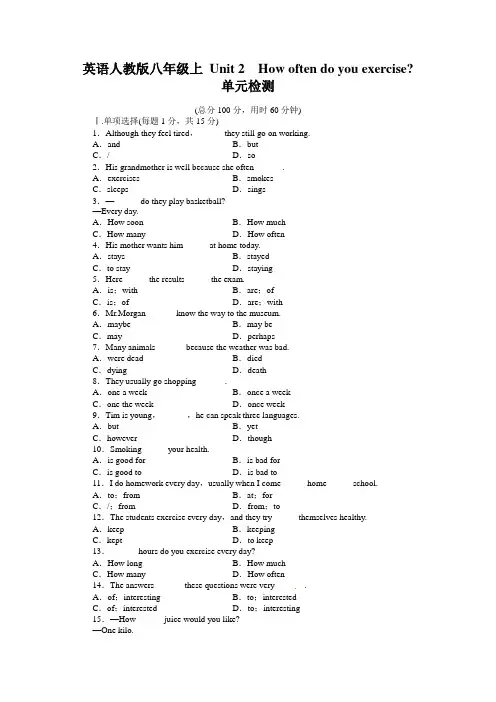
英语人教版八年级上Unit 2How often do you exercise?单元检测(总分100分,用时60分钟)Ⅰ.单项选择(每题1分,共15分)1.Although they feel tired,______they still go on working.A.and B.butC./ D.so2.His grandmother is well because she often ______.A.exercises B.smokesC.sleeps D.sings3.—______do they play basketball?—Every day.A.How soon B.How muchC.How many D.How often4.His mother wants him______at home today.A.stays B.stayedC.to stay D.staying5.Here______the results______the exam.A.is;with B.are;ofC.is;of D.are;with6.Mr.Morgan ______ know the way to the museum.A.maybe B.may beC.may D.perhaps7.Many animals ______ because the weather was bad.A.were dead B.diedC.dying D.death8.They usually go shopping ______.A.one a week B.once a weekC.one the week D.once week9.Tim is young,______,he can speak three languages.A.but B.yetC.however D.though10.Smoking______your health.A.is good for B.is bad forC.is good to D.is bad to11.I do homework every day,usually when I come______home______school.A.to;from B.at;forC./;from D.from;to12.The students exercise every day,and they try______themselves healthy.A.keep B.keepingC.kept D.to keep13.______ hours do you exercise every day?A.How long B.How muchC.How many D.How often14.The answers ______ these questions were very ______.A.of;interesting B.to;interestedC.of;interested D.to;interesting15.—How ______juice would you like?—One kilo.A.many B.muchC.heavy D.oftenⅡ.完形填空(每题2分,共20分)How can we keep healthy?One important thing is to exercise __16__.The Smith family try to exercise every day.Qiang Smith __17__ not exercise in the morning because he must be at his job at seven o'clock.But he runs every evening.He walks a lot,__18__.He walks to school every day and after school he __19__basketball with his friends.Qiang goes to a yoga(瑜伽)class__20__a week.But it isn't__21__ this st year Mr. and Mrs. Smith drove(驾车)everywhere.They thought they should use(使用)the__22__all the time.Now the Smiths don't use their car,and they all __23__ better now.And they think they mustn't be__24__.They don't have to exercise every day,but they should__25__to keep in good health.16.A.sometimes B.oftenC.never D.always17.A.may B.canC.maybe D.can be18.A.either B.alsoC.too D.well19.A.plays B.watchesC.surfs D.looks20.A.sometimes B.three timeC.three times D.some time21.A.always B.usuallyC.hardly D.sometimes22.A.skateboard B.bikeC.car D.ship23.A.have B.makeC.feel D.study24.zy B.healthyC.active D.well25.A.want B.keepC.stay D.tryⅢ.阅读理解(每题2分,共30分)AMr. King lives in a city.He owns some shops and makes a lot of money.His son,Mike,studies at a middle school.The boy likes everything but studying.He doesn't listen to his teachers in class and he never finishes his homework on time.He always plays football when he has any free time.He can never p ass the exams.Mr. King is so busy with his business that he has little time to stay at home.H e never pays any attention(关心)to his son's studies,so he doesn't know how he is doing.One day Miss Read,Mike's teacher,telephones Mr. King.On the tele phone she tells him all about the boy's studies.She wants him to try to help his son at home.When the man hears this,he doesn't feel very happy.In the afternoon when his son comes back from school,Mr. King gives him a good telling-off(责备),but soon feels sorry for it when he sees Mike crying in the bedroom.The next morning,before Mike goes to school,he says to him,“Study hard and I'll buy you a car when you pass the exam next year.”Another term is over.Mike doesn't pass the exam once more.Mr. King has a look at the school report for a few minutes and then he asks his son,“You don't pass the exam again,Mike.What did you do this term?” “I learned how to drive a car,dad,” answers the boy.26.Mr. King is ______.A.a football player B.a teacherC.a driver D.a businessman(商人)27.Mike can never pass the exams because ______.A.his father has a lot of money B.he doesn't like studyingC.his teachers are not very good D.he has to help his father in the shops28.Miss Read rings Mr. King______.A.to tell him to take his son out of schoolB.to buy things from his shopC.to tell him about Mike's studiesD.because his son passes the exam once again29.In the sentence “...,but soon feels sorry for it when he sees Mike crying in the bedroom.”,the word “it” refers to(指)______.A.Mike's exam mark(分数)B.telling his son offC.something that Miss Read tells Mr KingD.the car30.Which of the following is WRONG?A.Mike doesn't pass the exam at the end of the term.B.Mike's father buys him a car.C.Mike doesn't do well in his lessons for another term.D.Mike think s his father will buy him a car.BThe children in Miss Ling's class are not like most children.They don't watch TV.Miss Ling asked her class not to watch TV for one week.She told them that they could have more fun doing other things.The children said,“Let's find out if Miss Ling is right.” Inste ad of watching TV,they read,made things and played games with families.The children had so much fun that they are not going to watch TV for a year.Would you like to stop watching TV?31.The best title is ______.A.A Good TV ShowB.Stop to Watch TVC.Children Have Fun without TVD.Miss Ling doesn't Buy any TV32.Miss Ling asked her class not to ______.A.sleep B.eatC.read books D.watch TV33.The story says that the children ______.A.played games B.went swimmingC.grew plants D.watched TV34.Miss Ling is a ______.A.doctor B.teacherC.farmer D.child35.How long are the children not going to watch TV?A.For twelve months. B.For 365 days.C.For half a year. D.For three years.CThe aim(目的)of students who came to school is to study.But to study requires(需要)a right way,or you waste either the time or the money.The following are the ways of studying.The best time for reading is morning,because in the morning,the air is fresh and the mind is clear.For that reason,we can get good results(结果).In studying we must have patience(耐心).If we have not known a text well,we must read it again.We sh ould not read the next one till we have learned the first one.When we are studying,we must put our hearts into the book,or we can get nothing from the book while we are reading.We must always ask “whys”.If it is not well understood,write it down and ask our teachers or our parents,or friends.In any possible way,we must know it completely and what we've learned can be used well and made better.Though there are many ways for studying,yet the above mentioned(提到的)will be quite enough if we can keep them in heart and do so.36.The passage tells us ______.A.the importance of readingB.to read in the morningC.to pay att ention to the ways of studyingD.to have patience in studying37.The passage has taught us ______ ways for studying.A.three B.fourC.five D.many38.We'd better read in the morning because ______.A.it's hard to remember what we have learnedB.the air is fresh and the mind is clearC.it's difficult to get good resultsD.both A and B39.If we can't put our hearts into the book when we read,it is ______.A.easy to understand it wellB.better to get something from itC.impossible for us to get something from itD.possible to learn something from it40.In studying we must always ask “whys”in order to ______.A.understand the book wellB.write down the questionsC.do with the new wordsD.get some q uestions to ask our teachersⅣ.用所给词的准确形式填空(每题1分,共10分)41.How often______your father______(drink)wine?42.His mother ______(come)to see him once a week.43.Her sister______(not stay)at home on Sundays.44.The boy never______(eat)junk food.45.We should try______(learn)English well.46.Fifteen ______ (percent) o f the visitors are from foreign countries.47.Her eating______(habit)help her keep ______(health).48.His lifestyle is ______(difference)from mine.49.Our English teacher wants us______(read)English books every day.She ______(say)it's a good habit.50.My father likes reading ______(magazine) after supper.Ⅴ.补全对话(每题1分,共5分)A.Who wrote itB.How often do you read itC.Is it far from hereD.Me,tooE.It's excitingA:Hi,Bill!You're reading the novel again.B:Yes,Tom,I'll never be tired of (对……感到厌倦)it.A:51.______?B:Three times a week.Every time I read it,I can always learn something new.A:Really?52.______?B:Charles Dickens.I think he is a great English writer.What about you?A:53.______.He is also my favorite foreign writer.Please let me have a look at it.B:OK,here you are!...What do you think of this novel?A:54.______.I haven't seen such a novel for long.Where did you buy it?B:In the Rose Bookshop.A:I don't know where it is.55.______?B:No.Only 10 minutes' walk from here,next to the People's Cinema.A:Oh,I see.I'm going there to get one,too.Thank you!B:You're welcome!Ⅵ.书面表达(共20分)每个人都有自己的生活习惯,你的生活习惯是健康的吗?请你描绘一下,让我们评价一下。
英语八年级上册Unit2how-often-do-you-exercis
Notes
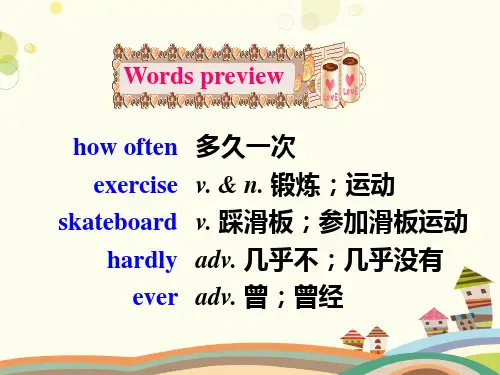
本课时我们学习的主要语法点是由 what 和 how 引导的特殊疑问句以及对应的答语。 如: What do/does …?
How often do/does …? 等。 What do you usually do on weekends? 你通常周末做什么? I usually listen to music. 我通常听音乐。
Exercise three times a week
A: How often do you exercise? B: Three times a week.
HOW OFTEN DOES HE/SHE DO THESE ACTIVITIES?
.
watch TV
twice a week
A: How often d twice a week
How often every day once a week twice a week three times a week once a month twice a month
※:对频率副词提问,应该用哪个特殊疑问词呢?
every day
once a week twice a week
How often
twice a month, three times a month, three or four times a month 等。
• 典型例题解析
“How often do you exercise?” “I often exercise every day.” “你(你们)多久锻炼一次身体?”“我通常每天 都锻炼。”
………
ORAL PRACTICE
• How often do you do those activities? Make conversations with your partner.
八年级上册Unit 2 How often do you exercise?知识点总结
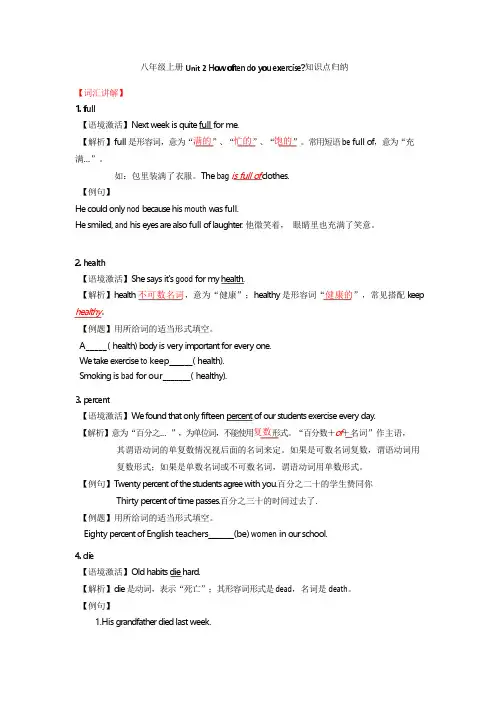
八年级上册Unit2How o ften do you exercise?知识点归纳【词汇讲解】1.full【语境激活】Next week is quite full for me.【解析】full是形容词,意为“满的”、“忙的”、“饱的”。
常用短语be full of,意为“充满...”。
如:包里装满了衣服。
The bag is full of clothes.【例句】He could only nod because his mouth was full.He smiled,and his eyes are also full of laughter.他微笑着,眼睛里也充满了笑意。
2.health【语境激活】She says it's good for my health.【解析】health不可数名词,意为“健康”;healthy是形容词“健康的”,常见搭配k eep healthy。
【例题】用所给词的适当形式填空。
A_____(health)bod y is very important for every one.W e tak e exercise to keep______(health).Smoking is bad for our_______(healthy).3.percent【语境激活】W e found that only fifteen percent of our students exercise every day.【解析】意为“百分之...”,为单位词,不能使用复数形式。
“百分数+of+名词”作主语,其谓语动词的单复数情况视后面的名词来定。
如果是可数名词复数,谓语动词用复数形式;如果是单数名词或不可数名词,谓语动词用单数形式。
【例句】T wenty percent of the students agr ee with you.百分之二十的学生赞同你Thirty percent of time passes.百分之三十的时间过去了.【例题】用所给词的适当形式填空。
人教新目标八年级上册Unit2Howoftendoyouexercise知识点.doc
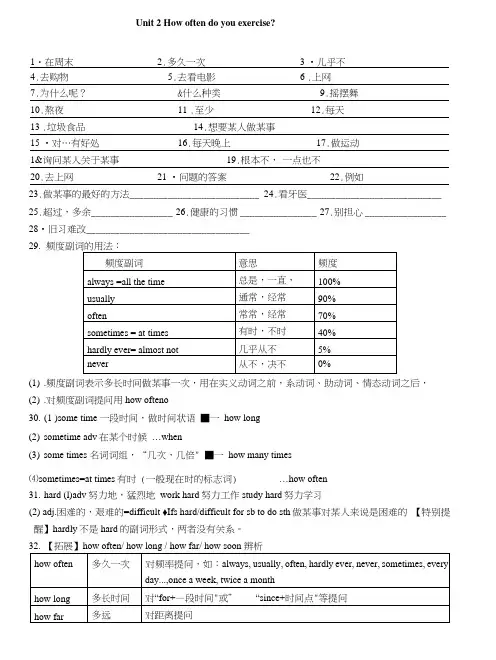
Unit 2 How often do you exercise?23.做某事的最好的方法___________________________ 24.看牙医____________________________ 25.超过,多余_________________ 26.健康的习惯________________ 27.别担心_________________ 28•旧习难改__________________________________29.频度副词的用法:(1).频度副词表示多长时间做某事一次,用在实义动词之前,系动词、助动词、情态动词之后,(2).对频度副词提问用how ofteno30.(1 )some time 一段时间,做时间状语■一how long(2)sometime adv在某个时候…when(3)some times 名词词组,“几次,几倍" ■一how many times⑷sometimes=at times有时 (一般现在时的标志词) …how often31.hard (l)adv努力地,猛烈地work hard努力工作study hard努力学习(2) adj.困难的,艰难的=difficult ♦Ifs hard/difficult for sb to do sth做某事对某人来说是困难的【特别提醒】hardly不是hard的副词形式,两者没有关系。
32.【拓展】how often/ how long / how far/ how soon 辨析33.次数的表达方法:once = one time —次twice= two times 两次三次或三次以上用:"基数词three times三次four times四次three or four times三到四次【注】:对次数提问用how many times。
help sb. (to) do sth =help sb. with sth.帮助某人做某事36.free ①adj.空闲的be free = have time有时间②adj.自由的,免费的be free to do sth.随心所欲的做某事37.full adj.忙的=busy adj.满的;充满的be full of = be filled with 充满3& least adv.最小,最少at least = not less than 至少;不少于39.health n 健康healthy adj 健康的(反[unhealthy40.although=though conj虽然,即使;不能与but连用,引导让步状语从句41.want sb. to do sth.= would like to do sth.想要某人做某事42.suchas “例如,像……一样”常常列举同类人或物中的几个例子,放在被列举的事物与前面的名词之间。
人教新目标八年级英语上册Unit 2 How often do you exercise?知识点归纳
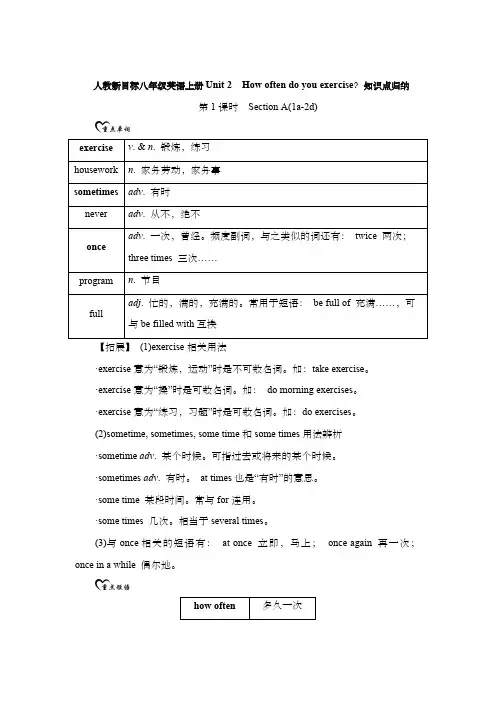
人教新目标八年级英语上册Unit 2 How often do you exercise?知识点归纳第1课时 Section A(1a2d)exercise v. & n. 锻炼,练习housework n. 家务劳动,家务事sometimes adv. 有时never adv. 从不,绝不once adv. 一次,曾经。
频度副词,与之类似的词还有:twice 两次;three times 三次……program n. 节目full adj. 忙的,满的,充满的。
常用于短语:be full of 充满……,可与be filled with互换【拓展】(1)exercise相关用法·exercise意为“锻炼,运动”时是不可数名词。
如:take exercise。
·exercise意为“操”时是可数名词。
如:do morning exercises。
·exercise意为“练习,习题”时是可数名词。
如:do exercises。
(2)sometime, sometimes, some time和some times用法辨析·sometime adv. 某个时候。
可指过去或将来的某个时候。
·sometimes adv. 有时。
at times也是“有时”的意思。
·some time 某段时间。
常与for连用。
·some times 几次。
相当于several times。
(3)与once相关的短语有:at once 立即,马上;once again 再一次;once in a while 偶尔地。
how often多久一次on weekends在周末help with帮助做家务houseworkhardly ever几乎从不once a week每周一次【拓展】(1)特殊疑问句中与how相关的疑问词组的用法·how often 多久一次。
八年级英语上册 Unit 2 How often do you exercise?单元知识归纳
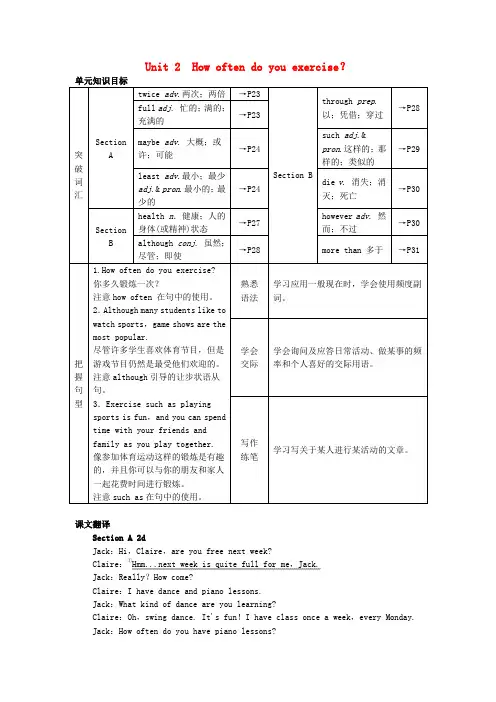
Unit 2 How often do you exercise?课文翻译Section A 2dJack:Hi,Claire,are you free next week?Claire:①Hmm...next week is quite full for me,Jack.Jack:Really?How come?Claire:I have dance and piano lessons.Jack:What kind of dance are you learning?Claire:Oh,swing dance. It's fun!I have class once a week,every Monday.Jack:How often do you have piano lessons?Claire:Twice a week,on Wednesday and Friday.Jack:Well,how about Tuesday?Claire:Oh,I have to play tennis with my friends.But do you want to come?Jack:Sure!,杰克:你好,克莱尔,下周你有空吗?克莱尔:呣……下周我很忙,杰克。
杰克:真的吗?怎么会那样?克莱尔:我上舞蹈课和钢琴课。
杰克:你学习的是什么舞蹈?克莱尔:噢,摇摆舞。
很有趣!我一周上一次课,每周一上课。
杰克:你多久上一次钢琴课?克莱尔:一周两次,在周三和周五。
杰克:噢,周二怎么样?克莱尔:哦,我要与朋友打网球。
你想来参加吗?杰克:当然了!知识详解1.How often do you exercise?你多久锻炼一次?【解读】本句是含有特殊疑问词how often 的特殊疑问句。
【解读】how often 多久一次,用于对动作发生的频率进行提问。
回答应该是频度副词或表示频率的词组,如always,usually,often,sometimes,hardly,ever,never,every day,once a week,three times a day等。
初二英语上册Unit 2 How often do you exercise_知识点总结-人教新目标版
初二英语上册(人教新目标)Unit 2 How often do you exercise?知识点总结一、重点词汇·原文再现help with housework帮忙做家务·基本用法n. housework 家务事,是不可数名词,do housework 相当于do chores。
She often helps her parents do housework.她经常帮助父母做家务。
·知识拓展---相关单词homework n. 家庭作业do one's homework 做家庭作业He usually does his homework at 6:00 o'clock every day.他每天六点做作业。
·基本用法always, usually, often, sometimes, hardly ever, never 是一组表示频率的副词,用法如下表:1. 这些副词在句子中的位置基本相同,一般放在助动词、be动词或情态动词之后,行为动词之前。
2. hardly和never均为否定副词,有二者的句子不需再加no或not构成否定,因其本身就是否定句。
3. 就这些表示拼读的副词提问时,常用how often。
·知识拓展---词义辨析hard/hardly1. hard可充当形容词和副词两种角色。
(1)用作形容词有“硬的”,“困难的、艰难的”的意思。
其中用作“难的”讲时,在口语中与difficult通用。
The problem is too hard, I can't work it out.这个问题太难了,我算不出来。
(2)用作副词,意为“努力地、刻苦地”,“猛烈地”,hard用作“猛烈地”讲时,同heavily相同。
He works hard only before exams.他只在考试前努力学习。
It is raining hard outside. You can't go out.外面正下着大雨。
人教版新目标初二英语上第二单元--how often do you excercise?
【教师寄语:Never say die. 永不放弃。
】How often do you exercise?【基础知识】一、重点句子解析:1.How often do you exercise? 你(你们)多久锻炼一次身体?解析:How often + 助动词do(does或did) + 主语 + do sth?疑问词how often是问频率(多久一次)回答一般是用表示频率的副词,如:once, twice, three times…, sometimes, often, quite, often, never, every day, once a week , twice a month , three times a month , three or four times a monthEg)——How often do you go to the factory?——Twice a week.你们多久到工厂去一次?每星期两次。
新课标第一网2.——“What do you usually do on weekends?”——“ I usually play soccer.”“周末你通常做什么?”“我通常踢足球。
”解析:第一个do为助动词, 在这起帮助构成疑问的作用;而第二个do则是实义动词。
Eg1)What do you usually do on weekends? I often go to the movies.3.——“What’s your favorite program?”——“It’s Animal World.”“你最喜欢什么节目?”“动物世界。
”4.As for homework , most students do homework every day .解析:as for...意思是“至于;关于”,常用于句首作状语如:As for him,I never want to see him here. 至于他,我永远不希望在这里见到。
人教版八年级上册英语Unit2How often do you exercise知识点
Unit2 How often do you exercise? Section A1.How often do you exercise? 你多久做一次运动?2.how often多久一次,对频率提问,如:always,everyday ,once a weekhow long多长时间,对“for+一段时间”或”,“since+时间段+ago”等时间短语提问how far 多远,对距离提问how soon 多久,对“in+一段时间“提问3.exercise v 锻炼exercise n.锻炼(不可数);体操,练习题(可数)do exercise =do sports= play sports做运动do morning exercises 做早操do eye exercises 做眼保健操4.What do you usually do on weekends? 你在周末做什么?5.频度副词always总是,一直>usually通常,经常>often常常,经常>sometimes 有时>hardly ever= almost not几乎从不>never 从不,决不【注】:频度副词用在实义动词之前,系动词、助动词、情态动词之后。
6.(1)some time一段时间,做时间状语It takes sb some time to do sth 做某事花费某人多长时间(2)sometime adv 在某个时候I hope to visit the USA sometime in the future.(3) some times 名词词组,“几次,几倍”(4)sometimes=at times 有时(一般现在时的标志词)7.on weekends =on the weekend= on Saturday and Sunday 在周末on weekdays= from Monday to Friday 在工作日8.hardly ever 几乎从不hard (1)adv 努力地,猛烈地work hard 努力工作study hard 努力学习(2) adj. 困难的,艰难的=difficult◆It’s hard/difficult for sb to do sth 做某事对某人来说是困难的【拓展】hardly adv “几乎不,从来不”,表否定意义9.twice a week 一周两次once = one time一次twice= two times两次三次或三次以上用:“基数词+times”three times 三次four times 四次three or four times 三到四次10.go shopping 去购物do some shopping 购物11.help with housework帮助做家务(1)help sb. (to) do sth=help sb. with sth 帮助某人做某事(2)help oneself to…请随便吃/喝(3)can’t help doing sth 情不自禁做某事12.go to the movies = go to the cinema = see the film 去看电影13. at least = not less than至少;不少于at most至多14. use the Internet 上网15.What’s your favorite program?=What program do you like best?你最喜欢的节目是什么?16.every day 每天= each day 做状语,放在句末,对其提问用how ofteneveryday = daily adj. 每天的,作定语,修饰名词,放在名词之前He exercises every day. 他每天都锻炼。
人教版八年级上册英语教案Unit2:How-often-do-you-exercise
Unit2 How often do you exercise?Topic: 人民教育出版Unit2 How often do you exercise?Author and work unit:单元整体说明单元教材分析本单元以“How often do you exercise ?”为话题展开教学活动。
首先学会恰当地使用频率副词及短语,再学会描述课余时间的活动安排和基本饮食结构。
通过复习七年级学习过的动词短语,及本单元的听力练习,各种方式的口语交际活动和写作练习,使学生积极参与,合作,从而培养学生的综合语言运用能力。
教材在本单元的开篇,即本课时,安排了关于谈论课余时间的各项活动,以及初步认识和使用频率副词,为进一步地使用频率副词及动词短语做语言知识上的准备。
单元知识结构语言目标:恰当使用always, usually ,often ,sometimes ,hardly ,ever, never 等频率副词和日常活动短语:watch TV , go shopping , read books , exercise等。
句型:What do you usually do on weekends?I often go to the movies.What does she do on weekends ?She often goes to the movies.语法:频率副词的运用。
单元总体目标语言目标:描述时间频度的词汇及开展周末活动的调查。
能力目标:听:能听懂谈论生活习惯、学习习惯和饮食习惯的对话材料。
说:能谈论生活习惯、学习习惯和饮食习惯。
读:能读懂介绍个人生活习惯的文章。
写:能写出section A和section B中的重点单词和重点句型,并能够描述自己的生活习惯。
情感目标:通过开展周末活动调查问卷,引导学生正确处理好学习和娱乐之间的关系。
跨学科学习:通过谈论谁的饮食习惯更健康,引导学生了解什么样的饮食习惯,才能保持健康的体质。