
Unit 13.We are trying to save the earth!优秀教学设计
五g in【视频导入】教师使用搜索,播放一段关于海牛的视频短片。
【搜索】/jilupian/20101012/n84901.html
【教师活动】1.Ask Ss some questions:Did you go to the zoo? What did you see at the zoo? What animals do you like? Which animal only live inChina?Which animal is the biggest on land? ……
Unit 13We are trying to save theearth!(section A)
教学设计
一、教案背景
1. 面向学生: 九年级
2. 教材:新目标九年级英语(Go For It)
3. 课时:一课时珍稀动物的英文介绍及相关图片等信息。
【设计目的】通过视频短片和询问,导入新课并引出本课课文中的单词进行教授。
Step 2. Presentation
【教师活动】1.Let one student ask the teacher:What animals do you like ?The teacher may answer like this:I like cheetahs. I like them because cheetahs mean that
为使学生更好完成搜集任务, 教师提供一个表格,以便学生在课上进行反馈与交流。
Endangered animals
Feature
Habitat
具有较熟练操作计算机的能力,例如正确浏览网页、保存文件等。
二、教学课题
◆Unit 13Weare trying to save theearth!(section A1a,1b,1c)
教学目标:
1.学习有关环境保护的英语语言知识。
2.学习各种动物的名称,并了解动物方面的知识,增强爱护动物的意识。
3.了解一些濒临灭绝的动物的生活习需要的知识和信息。
三、教材分析
教学内容
本单元主要围绕有关濒临灭绝的动物这一话题,学习应该怎样保护和拯救我们的地球,以及就如何拯救濒临灭绝的动物这一问题展开辩论。本单元以Protecting the environment为话题,共设计了三个部分的内容:
【学生活动】1.Guess and learn the words.
2.Match the words with the animals in the p了解有关动物和掌握知识要点。
Step 3. Teach and Practice
they are very fast and beautiful.Show a picture of a cheetah.Go on with other kinds of animals:Manatee.Kangaroo.Chimpanzee. gory/image_animal.ht92&clmp;fm=index&pv=&z=0&word=%B6%AF%CE%EF%CA%C0%BD%E7&s=0&oq=%B6%AF%CE%EF&f=3&rsp=1#
教学准备:
根据学生的具体情况,对教材内容进行整合,使每个教学活动相互关联,把有关动物的生词通过情景整合在一起,并题,让学生学得轻松、愉快和有趣味。
四、教学方法
Section B
该部分有4个模块:第一模块以How to save theearth!展开话题,列举观点(1a),并展开讨论(1b);第二模块仍然以“保护环境”为话题,继续对How to save the environment进行听力(2a-2b)、口语(2c)训练;第三模块围绕How to recycle这一话题展开阅读(3a)和写作(3b)训练;第四模块仍以Recycling为话题,以口语训练形式展开小组活动(4)。
Section A
该部分有4个模块:第一模块围绕Describing the animals这一话题展开思维(1a)、听力(1b)、口语(1c)训练;第二模块围绕We’re trying to save the manatees进行听力(2a-2b)、口语(2c)训练;第三模块以Whether to build zoos就如何保护动物这一话题展开讨论,观点一:反对建动物园(3a);观点二:支持动物园建设(3b);第四模块仍就是否需要动物园这一话题,以小组活动形式展开讨论(4)。
Self check
该部分有2个模块:第一模块以填空形式对所学词汇进行训练(1);第二模块要求利用所给句型展开自由对话,以训练学生对所学知识的实际运用能力(2)。
教学重点:
The new wordsabout animals
教学难点:
To enable the students to describe:What kind of animals you are like.I am like this animal because I am strong and intelligent.
最新unit 13 We are trying to save the earth!教案

Unit 13 We are trying to save the earth.I. Topic: Protecting the environmentII. Teaching goals:1. Knowledge:1). Words and expressions in this unit (displayed in each period);2). Sentence structures:We are trying to save the earth./The river used to be clean./The air is badly polluted./No scientific studies have shown that shark fins are good for health./We should help save the sharks.3). Grammar: 复习应用Present progressive, used to, Passive voice,Present perfect, Modal verbs.2. Skills: Talk about pollution and environmental protection.3. Process and steps: Task-based teaching4. Affect and attitude: Learn to protect the environment to save the earthand play a part in the daily life.III. Teaching focus:Talk about pollution and give suggestions for environmental protection. IV. Teaching strategies: Cooperative learning and mind map.V. Teaching arrangements:Period 11. Teaching goals:1). Words and expressions:Litter, bottom, fisherman, coal, ugly, advantage, cost, wooden, plastic, takeaway, bin, take part in, turn off, pay for, take action.2). Sentences:We are trying to save the earth. /The river used to be clean. /The air is badly polluted.3). Skills: Talk about what you are allowed to do; Agree and disagree.4). Affect: Talk about pollution and environmental protection.2. Difficulty: to tell the causes of pollution and give solutions.3. Teaching procedures:1. Teaching goals:1). Words and expressions: shark, fin, cruel, harmful, be harmful to, at the top of, chain, the food chain, ecosystem, industry, law, scientific.2). Skills: to talk about the shark saving by mind map and cooperative learning.3). Affect: To understand environment protection by saving animals.2. Difficulty: mind map3. Teaching procedures:Lead in: Show the video of sharksDiscussion: How much do you know about sharks?Reading: Read the passage and finish the mind map by cooperation.1. Teaching goals:1). Words and expressions:recycle, napkin, throw away, put sth. to good use, pull…down, upside, gate, bottle, president, inspiration, iron, work, metal, bring back, creativity.2). Skills: skimming, scanning, mind map, cooperative learning.3). Affect: to learn to protect the environment by recycling.2. Difficulty: to draw the mind map, to internalize the idea of recycling.3. Teaching procedures:1. Teaching goals:To review this unit by talking about the pollution and its causes, and give suggestions for solving the problems; and write a short passage about it.1). What is the pollution?2). What caused the problem?3). Give some suggestions to solve the problem?3. Teaching procedures:。
unit13-We-are-trying-to-save-the-earth.
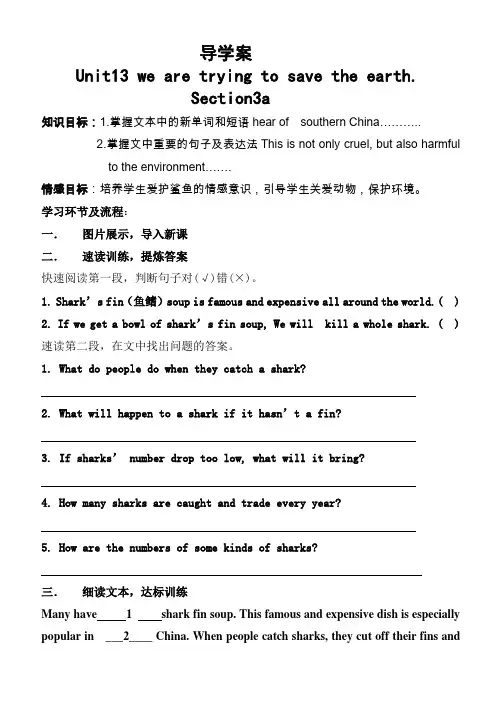
导学案Unit13 we are trying to save the earth.Section3a知识目标:1.掌握文本中的新单词和短语hear of southern China………..2.掌握文中重要的句子及表达法This is not only cruel, but alsoharmful to the environment…….情感目标:培养学生爱护鲨鱼的情感意识,引导学生关爱动物,保护环境。
学习环节及流程:一.图片展示,导入新课二.速读训练,提炼答案快速阅读第一段,判断句子对(√)错(×)。
1. Shark’s fin(鱼鳍)soup is famous and expensive all around the world.( )2. If we get a bowl of shark’s fin soup, We will kill a whole shark. ( ) 速读第二段,在文中找出问题的答案。
1. What do people do when they catch a shark?2. What will happen to a shark if it hasn’t a fin?3. If sharks’ number drop too low, what will it bring?4. How many sharks are caught and trade every year?5. How are the numbers of some kinds of sharks?三.细读文本,达标训练Many have 1 shark fin soup. This famous and expensive dish is especially popular in ___2____ China. When people catch sharks, they cut off their fins andthrow the sharks back into the ocean. But finning is____3____ cruel, but also ______4_______ the environment. The shark slowly dies because it can_____5_____ swim without a fin. Sharks are _____6____ the food chain. If the number of sharks drops too low, it will _______7_______ to all ocean life the nature. Please stop eating shark fin soup, and____ 8______ (采取行动)to save the sharks!四.借鉴学习,写作提升鱼翅汤在中国的南部很受欢迎,猎翅(finning)行为也异常猖狂。
人教版英语九全Unit 13 We're trying to save the earth!
Unit 13 We are trying to save the earth.(Section A 2a-2d)Teaching Objectives:1. Knowledge objectivesThe students can master the key words: ugly , advantage , cost, wooden, plastic, takeaway, bin.The students can master the useful expressions : throw away take the bus ,instead of, be good for, remember to do, make a difference, lead to .2. Ability objectivesThe students can learn more about pollution and environmental protection.The students can listen for the key words and talk about what they can do to save the earth.3. Moral objectivesWe have only one earth. Let's join together and save it for our future.Teaching Key Points:1. New words, expressions and some important sentences.2. Learn more about pollution and environmental protection. Teaching Difficult Points:1. Master the main ideas and details of the listening materials.2. Talk with others about what they can do to save the earth . Teaching Methods:Communicative teaching methodTask-based teaching methodTeaching Procedures:Step 1 Revision & Lead-in1. I will greet the class. At the beginning of the class, we will enjoy a song .2. Look and say. What kind of pollution has been shown in this picture? What do you think has caused this pollution? Step 2 Listening 2a &2b1.Listen to the interview. Circle the kinds of pollution that Jason and Susan talk about. Listen for twice if the students need.I will ask two students to share their answers with the class and check them.2. Listen again and complete the sentences. Listen for twice if the students need.I will ask one student to write their answers on the screen and check with the class.Step 3 Take a quiz1. Are you a friend of the earth ? What do you usually do ?2. Ask some students to choose what they usually do when they finish drinking a can of cola / when there are a lot of old newspapers at your home / when they go shopping / when they write on a piece of paper .Step 4 Watch and think1. Let’s watch a video . What you can see in it ?2 . Can we do something to save the earth?Step 5 Discussion1. What can you do to save the earth in our lives ?2. What can you do to save the earth in our school ?Step 6 Summary1. I will ask the students what are learned in this class.2. We will read the phrases on the screen together.Step 7 Homework1. Remember the new words and expressions.2. Write about what you can do to help save the earth in your life.Blackboard Design:Unit 13 We are trying to save the earth .(Section A 2a-2d)air pollution What can you do to save the earth ? noise pollution plant more treeswater pollution save waterland pollution take the bus or ride bikes ...。
UNIT13WEARETRYINGTOSAVETHEEARTH!SECTIONAGRAMMARFOC
A. didn’t feel
B. wasn’t feeling
C. don’t eel
D. haven’t felt
18. Who was the book ___D____?
A. write B. wrote C. written D. written by
【解析】本句中the book和write之间是被动关系, 故排除A和B。句意:这本书是谁写的?此处不能 省略介词by,by在此处意为“被,由”。
2. Today, smartphones are really helpful. They _a_re__u_s_ed__ (use) everywhere.
3. My aunt __h_a_s_w_o_r_k_e_d_ (work) as a nurse for 10 years. She is good with different patients.
新课讲解
can would could have to should may/ might
can/ could would/can/ could
must
新课讲解 Make a list of things that people can do to help the
4c environment and discuss your list with your partner.
可重复使用的
新课讲解
can would could have to should may/ might
must
I think it’s a great idea that you now _h_a_v_e_t_o_ pay for plastic bags in some stores. And instead of driving to 支付 school or work, you _c_a_n_/_s_h_o_u_l_d_/ _c_o_u_ld_ ride your bike or walk. If it’s far, you c_a_n_/_c_o_u_l_d_ take the bus.
人教版九年级英语下册《Unit13 We’re trying to save the earth》(
2d Underline the words in the passage based on
the words below. What are the differences?
think use usual actual build create special
rreecceenntt eennvviriroonnmmeenntt imimppoorrttaanntt pprrootteecctt ininssppiriree
Will do---taking your owm bags when shopping
Never do---turn off the shower; not riding in cars, riding a bike
1e Make a conversation using the
information from the chart above. Say what is true for you.
Unit 13
We are trying to save the earth.
Section B 1a-3b
1a What can we do to help save the planet?
Rank these items from the easiest (1) to the most difficult (5)
Things which can be done by people every day:
• take your own bags when you go shopping. • spend less time in the shower • turn off the lights when you leave a room • take public transport rather than drive • avoid using air conditioners
Unit 13 We’re trying to save the earth! 全英文说课稿
Unit 13 We’re trying to save the earth!Section A Period 1speaking lesson draftHello! Ladies and gentlemen! Good morning. Standing here, I’m very happy and excited. It’s my great honor to be here to present my lesson. Today I’ll talk about unit 13 We’re trying to save the earth! Section A Period 1 1a-2c from Book Three . My contents consist of 7 parts.Analysis of the teaching materialTeaching aims and key pointsAnalysis of the studentsTeaching methodsTeaching aidsTeaching procedureBlackboard designWell, firstly, I’ll talk about part 1 analysis of the teaching material.This unit is the last part of the middle school. It is a comprehensive lesson. It includes three kinds of tenses and two kinds of voices. It shows us it’s necessary to protect the animals.Teaching aims1.Knowledge aims: names of the animals such as manatee, kangaroo, chimpanzee,cheetah; words about description such as furry, enormous , playful, aggressive, gray, spotted, weigh, pound; words about description of animals ‘ situation .nguage aims: describe the creature of the animals and the place where the animalslive . the kinds of the tense.3.Ability aims: listening practice , speaking practice, writing practice.4.Moral aims: protect the animals and protect the environment .Let’s move on to another part, teaching key points. Important points are knowledge aims Knowledge aims are to enable the students to master the words and phrases. And thesentences: How big are the manatees? They are about 10 feet long and weighs 1000 pounds .Difficult points are ability aims . Ability aims are t o improve students’listening and speaking ability by reading and practicing the conversations.Then I’ll talk about next part analysis of the students. The students in Grade 9 know many words and lots of useful sentences . They are familiar with the teacher’s spoken English. It’s very helpful for me . But also they know more about the animals. So we get along well with each other.Next I’ll talk about teaching methods. My teaching methods are task-based approach and situational approach. During my class, I also design some interesting games for them to learn something.Next is the teaching aids. In this class, I’ll use PPT to present many situations for the students. These can get the students’ to be interested in English.Now I’ll talk about most important part teaching procedure. It includes 9 steps.Step1 is warm-up and leading in the new lesson. First ask the students the questions. I say, I’m cold. What about you ? And then greet to some students while shake hands with them or put my arms around them . I did it to make our heart close.Then I’ll use PPT to play an English song Save the Earth for the students and I’ll ask them try to think and answer my question What should we do? The students and I lead in the new lesson. We should save the earth . We are trying to save the animals . We are trying to save the manatees.Step2 is showing the teaching aims. I design a situation . I’ll take the students to the zoo and show many kinds of animals Then show description words of the animals. They are just for leading in the knowledge aims .Step 3 is Group work. After Step 1 and 2 , I give the students some chances to describe the animals using the description words. Those are the language points.Step 4 is playing the guessing game. The students are active so I design the game . It helps me check the students’knowledge and also make the students relaxed. It’s a preparation for next part. Because next part is a little difficult.Step 5 is listening practice. Because we don’t know the words very well. So I encourage the students to have a try or come on. I help them finish them. When we go on 2a, I find we can guessthe answers first . I t’s necessary for us to practice the listening. 2b is the most difficult ofall . So I design the chart by myself. I t’s useful for the students to have the final exam.Step 6 is pair work. After the listening practice , I bring the students a model conversation to finish the language aims.Step 7 is discussion. This is an important topic in this unit. I get the students to know theways to protect the animals and our environment by discussing it. Then I show them some good ideas about protecting the animals. I t’s helpful for them. And ask them to remember them.Step 8 is a challenge. This part is just checking the students . At the same time it tells the studentsto protect our pandas.Step 9 is summary . I get the students to give a word about this class. I want to check whatthey have learned in my class.My blackboard design is just presented in my PPT.In my class I want the students to finish my tasks after my guide. I’m happy to find theyhave done the jobs very well. I have finished my lesson in order and freely. I feel happy.Thank you very much.。
《Unit 13 We're trying to save the earth! Section A
《We're trying to save the earth! Section A 3a, 3b》作业设计方案(第一课时)一、作业目标1. 帮助学生掌握和运用有关环保的英语词汇和表达方式。
2. 培养学生环保意识,增强他们对地球环境保护的责任感。
3. 通过实践活动,提高学生的英语语言综合运用能力。
二、作业内容1. 阅读理解:学生阅读Section A 3a中的课文,回答课后问题。
要求能够理解文章大意,掌握关键信息,并能够用自己的语言回答问题。
2. 词汇积累:学生复习和掌握本课中的环保相关词汇和表达方式,包括但不限于recycle, plastic, pollution, environment, protect 等。
3. 写作练习:学生以小组为单位,选择一个与环保相关的主题,撰写一篇短文。
要求能够运用本课所学词汇和表达方式,表达清晰、逻辑性强。
4. 实践活动:学生通过调查家庭或社区的环保行为或问题,撰写一份调查报告。
报告需要包括调查方法、结果和分析。
三、作业要求1. 独立完成:学生需独立完成阅读理解和词汇积累部分,不得抄袭或参考他人的答案。
2. 小组合作:写作练习和实践活动需要学生以小组为单位进行,每组不超过5人,共同讨论、分工、合作完成。
3. 提交时间:阅读理解和词汇积累部分需在课后完成并提交,写作练习和实践活动需在下一节课前完成并提交。
4. 评价标准:评价标准包括答案准确性、表达是否清晰、逻辑性是否强以及调查报告的分析是否合理等。
四、作业评价1. 教师对学生提交的作业进行批改,给出分数或等级评价。
2. 根据学生作业情况,教师将问题反馈给学生,指导学生改进和提高。
3. 对于写作练习和实践活动,教师可根据小组的表现和能力给出整体评价,并给出改进建议。
五、作业反馈1. 学生根据教师批改和反馈结果,对自己的作业进行反思和总结,找出自己的不足之处并制定改进计划。
2. 学生将改进计划和成果反馈给教师,以便教师了解学生的进步情况并给予进一步的指导。
Unit 13 We'er trying to save the earth
Unit 13 We’er trying to save the earth!Section A1.起作用;有影响2.参加3.关掉4.付费;付出代价5.充满6.打扫,清理7.在.......起作用8.减少,砍倒9.代替;而不是10.at the top of .....11.cut of 12.be good for...13.be harmful to... 14.the bottom of...15.这个镇上的每个人都应该在清理(河海)中起作用!Everyone in this town should cleaningit up!16.因为,我们齐心协力就能带来变化,创造更加美好的未来!So together,our actions can and a better future!17.如果他们的数量降至过低,会给所有海洋生物带来危险。
If their numbers too low,it danger all ocean life. 18.到目前为止,没有科学研究显示鲨鱼鳍对健康有好处,所以为什么吃它们呢?,no scientific studies that shark finsHealth,so why eat them?19.对于有小孩子的父母来说,使用交通工具很难。
It’s difficult parents young children public transportation.20.我具有受过良好教育的有利条件。
I good education.21.对她有利的是,他的声音非常甜美。
,her vioce is very sweet.22.How much is your coat?Oh.it me 100 yuan.A.costB.spendC.paidD.took23.Angle,you are going to buy a flat here,aren’t you?Yes,but I can’t an expensive one.A.spendB.costC.payD.afford24.我买得起这辆轿车。
Unit 13 We're trying to save the earth2
Unit 13 We’re trying to save the earth!(二)shark /ʃaː(r)k/ n. 鲨鱼fin /fɪn/ n.(鱼)鳍cruel /'kruːəl/ adj. 残酷的;残忍的harmful /'haː(r)mfl/ adj. 有害的be harmful to 对……有害at the top of 在……顶部或顶端chain /tʃeɪn/ n. 链子;链条the food chain 食物链ecosystem /'iːkəʊ,sɪstəm/ n. 生态系统industry /'ɪndəstri/ n. 工业;行业law /lɔː/ n. 法律;法规scientific/,saɪən'tɪfɪk/adj. 科学上的;科学的Save the Sharks!Many have heard of shark fin soup. This famous and expensive dish is especially popular in southern China. But do yo u realize that you’re killing a whole shark each time you enjoy a bowl of shark fin soup?When people catch sharks, they cut off their fins and throw the shark back into the ocean. This is not only cruel, but also harmful to the environment. Without a fin, a shark can no longer swim and slowly dies. Sharks are at the top of the food chain in the ocean’s ecosystem. If their numbers drop too low, it will bring danger to all ocean life. Many believe that sharks can never be endangered because they are the strongest in their food chain. But in fact, around 70 million sharks are caught and traded in this industry every year. The numbers of some kinds of sharks have fallen by over 90 percent in the last 20 to 30 years.Environmental protection groups around the world, such as WildAid and the WWF, are teaching the public about “finning”. They have even asked governments to develop laws to stop the sale of shark fins. So far, no scientific studies have shown that shark fins are good for health, so why eat them? Help save the sharks!题一:Complete the fact sheet.take part in 参加afford /ə'fɔː(r)d/ v. 承担得起(后果);买得起turn off 关掉reusable /,riː'juːzəbl/ adj. 可重复使用的;可再次使用的pay for 付费;付出代价take action 采取行动transportation /,trænspɔː(r)'teɪʃn/ n. 运输业;交通运输Unit 13 We’re trying to save the earth!(二)题一:。
Unit 13 We're trying to save the earth
Unit 13 We’re trying to save the earth .Period 5 Section B (2a-2e)I.考点聚焦Do you often throw away things you don’t need anymore ?考点1 求同辩异:throw away /give away /put away1.-Sam , let’s ______ these old things . I don’t need them anymore.-No. We an try to put them to good use .A.pull downB. fix upC. hand outD. throw away2.我收好的那本书是一本新书。
The book that I _____________ is new one.Have you ever thought about how these things can actually be put to good use ? 考点2联想记忆:use /put sth to good use3.去年莉莉充分利用假期学习了一些电脑方面的知识。
Lily _______ her vacation ________to learn some knowledge about computers last year.4.你最好把课余时间利用好。
You’d better _______ your spare time _______ _______ _______ .The windows and doors come from old buildings around her town that were pulled down.考点3 求同辩异:pull/ pull down5.拆房容易盖房难。
It is easier to _______ _______ than to build up .6.如果我们齐心协力,就能改善环境。