
(完整版)外研版七年级下英语短语、句型、语法期末复习
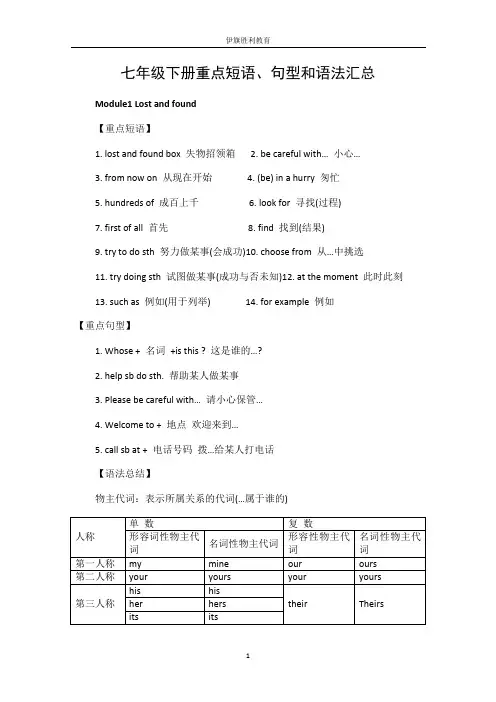
Module1 Lost and found【重点短语】1. lost and found box 失物招领箱2. be careful with…小心…3. from now on 从现在开始4. (be) in a hurry 匆忙5. hundreds of 成百上千6. look for 寻找(过程)7. first of all 首先8. find 找到(结果)9. try to do sth 努力做某事(会成功)10. choose from 从…中挑选11. try doing sth 试图做某事(成功与否未知)12. at the moment 此时此刻13. such as 例如(用于列举)14. for example 例如【重点句型】1.Whose + 名词+is this ? 这是谁的…?2.help sb do sth. 帮助某人做某事3.Please be careful with…请小心保管…4.Welcome to + 地点欢迎来到…5.call sb at + 电话号码拨…给某人打电话【语法总结】物主代词:表示所属关系的代词(…属于谁的)人称单数复数形容词性物主代词名词性物主代词形容性物主代词名词性物主代词第一人称my mine our ours 第二人称your yours your yours第三人称his histheir Theirs her hersits its形容词性物主代词:必须和名词在一起,例如my father, your teacher...名词性物主代词:相当于与之相对应的形容词性物主代词+名词,例如This shirt is mine. =This is my shirt.Module2 What can you do?【重点短语】1. get on well with sb. 与某人相处融洽2. play the piano 弹钢琴3. play table tennis 打乒乓球4. what about…?=how about…? ...怎么样?5. worry about…担心…6. be good at doing sth. 擅长做某事7. fly a kite 放风筝8. that’s all 仅此而已9. be ready to do sth. 乐于做某事【重点句型】1.What/How about doing sth? 做…怎么样?2.Would like to do sth. 愿意做某事3.promise to do sth. 承诺做某事4.play +球类名词玩…球5.play the +乐器演奏…乐器6.do (some) + 动词ing形式做…7.be sure of sth. 确信…(说话人的信念)8.be sure to do sth. 一定…(说话人的推测)【语法总结】情态动词can 的用法1.含义:表达人或物的能力,能或会.2.特点:情态动词can没有人称和数的变化,之后要加动词原形。
3.否定形式:cannot(正式用法)=can’t(口语)Module3 Making plans【重点短语】1.have a picnic 去野餐2.check one′s email 查收某人的邮件3.go over 复习4.on Sunday morning 在周日上午5.see/watch a movie 看电影6.in the park 在公园里7.have a piano lesson 上一节钢琴课8.make friends 交朋友9.summer holiday 暑假10.go on a summer camp 参加夏令营11.take a walk=go for a walk 散步12.do some sightseeing 观光【重点句型】1.I′m going to +动词原形我将要…2.look forward to +动词ing 形式期待…3.have fun(in)doing 做…很高兴4.go+动词ing 形式去…5.enjoy oneself 过得愉快6.I hope that+句子我希望…7. hope to do sth. 希望做某事8. hope for+(名词或名词短语)希望…【语法总结】一般将来时(Ⅰ)be going to 的用法1.含义:计划,打算做某事2.特点:因为有be 动词,所以be going to 可以用于各种时态。
Module4 Life in the future【重点短语】1. in the future 将来2. study at home 在家学习3. in 20 year’s time 20年之后4. on the Internet 在网络上5. be able to 能、会6. free time 空闲时间7. come true 实现8. all year﹙around﹚整年9. as well 也﹙肯定句句末,前面无逗号﹚10. not…any more 不再…11. by email 通过电子邮件12. ask a question 问问题13. the change of weather天气的变化14. do light and easy work 做轻松简单的工作【重点句型】1. be able to +动词原形能/会做...2. not …any more 不再...Tony doesn′t play football any more.托尼不再踢球了。
3.not only…but also…不仅…而且…Not only me but also he likes English. 不仅我他也喜欢英语。
(动词的形式与but also之后名词的数保持一致)【语法总结】一般将来时﹙Ⅱ﹚由shall和will引导的一般将来时1.含义:将会…2. 特点:助动词shall和will没有人称和数的变化,之后要加动词原形。
shall在一般将来时中,一般用于第一人称之后。
例如:I/We shall have an English lesson.我们将有一节英语课。
3.否定形式:shall not=shan′t will not=won′tModule5 Shopping【重点短语】1. on Mother′s Day 在母亲节这一天2. what colour/color 什么颜色3. What about…? ...怎么样?4. try on 试穿5. look at…看...6.too much 太多...(修饰不可数名词)7. wait a minute 等一会儿8. half price 半价9. pay for 为...付钱10. a few days later 几天后11. the price of…...的价格12. one day 一天13. at any time 随时14. one of them 他们中的一个15. be able to 能/会...16. because of…因为...17. online shopping 网络购物【重点句型】1.What′s the price of…?...的价格是多少?2.buy sb sth. =buy sth for sb.给某人买某物3.one of the+形容词最高级+可数名词复数最...之一one of the most famous writers最著名的作家之一。
【语法总结】特殊疑问句1.结构:特殊疑问词+ 一般疑问句?2.特殊疑问词总结:what 什么when 在什么时候where 在什么地方who 谁which 哪一个,哪些why 为什么how 怎么样what day 星期几What day is it today? 今天星期几?what size 多大尺码What size are your shoes? 你的鞋多大尺码?how many多少(提问可数名词数量)How many books do you have ?How much①多少(提问不可数名词数量)How much water is there in the glass?②多少钱(提问价格)How old 几岁(提问年龄)How long①多长(提问长度)How long is this ruler?这把尺子有多长?②多长时间(时间持续多久)How long do you go to school ?你去学校要多长时间?How often 多久(提问频率既单位时间发生多少次)How soon (还要多久时间才能开始或结束)How soon will he come back ?他多久才能回来?How far(提问距离有多远)How heavy (提问有多重)Module6Around town【重点短语】1. get to 到达2. on the left 在左边3. in front of 在…的前面4. near here 在这附近5. the way to 去…的路6. over there 在那里7. turn left 向左转8. take the underground 乘地铁9. get off 下车10. begin with 以…开始11. the middle of …的中间12. from home to school 从家到学校13. on the map 在地图上14. on a clear day 在晴朗的一天15. next to 紧挨着16. post office 邮局17. at the cinema 在电影院18. at the end of the street 在路的尽头19. bus stop 公共汽车站【重点句型】1.Betty and Lingling are standing in front of Tian'anmen Square.贝蒂和玲玲站在天安门前。
2. Can you tell me the way to Wangfujing Dajie?你们可以告诉我去王府井大街的路怎么走吗?3.Could you tell me how to get to the National Stadium?你能告诉我去国家体育馆怎么走吗?4.Go across Dong Chang’an Jie, go along the street and turn left at the third street on the left.穿过东长安街,然后沿着马路一直走,在左边的第三条马路向左拐,就到了。
5.Is there a bookshop near here?这附近有书店吗?6.How can I get there? 怎么才能到达呢?7.Why not ask the policeman over there?为什么不问问那边的警察呢?8.Take the Underground to the Olympic Sports Centre, or you can take a bus or a taxi.坐地铁到奥体中心,你也可以坐公共汽车或打车去。
外研版-▏七年级下册英语重点短语、句型和语法汇总
七年级下册重点短语、句型和语法汇总Module1 Lost and found【重点短语】1. lost and found box 失物招领箱2. be careful with… 小心…3. from now on 从现在开始4. (be) in a hurry 匆忙5. hundreds of 成百上千6. look for 寻找(过程)7. first of all 首先8. find 找到(结果)9. try to do sth 努力做某事(会成功)10. choose from 从…中挑选11. try doing sth 试图做某事(成功与否未知)12. at the moment 此时此刻13. such as 例如(用于列举) 14. for example 例如【重点句型】1. Whose + 名词+is this ? 这是谁的…?2. help sb do sth. 帮助某人做某事3. Please be careful with… 请小心保管…4. Welcome to + 地点欢迎来到…5. call sb at + 电话号码拨…给某人打电话【语法总结】物主代词:表示所属关系的代词(…属于谁的)形容词性物主代词:必须和名词在一起,例如my father, your teacher...名词性物主代词:相当于与之相对应的形容词性物主代词+名词,例如This shirt is mine. =This is my shirt.Module2 What can you do?【重点短语】1. get on well with sb. 与某人相处融洽2. play the piano 弹钢琴3. play table tennis 打乒乓球4. what about…?=how about…? ...怎么样?5. worry about… 担心…6. be good at doing sth. 擅长做某事7. fly a kite 放风筝8. that’s all 仅此而已9. be ready to do sth. 乐于做某事【重点句型】1.What/How about doing sth? 做…怎么样?5. call sb at + 电话号码拨…给某人打电话2.Would like to do sth. 愿意做某事3.promise to do sth. 承诺做某事4.play +球类名词玩…球5.play the +乐器演奏…乐器6.do (some) + 动词ing形式做…7.be sure of sth. 确信…(说话人的信念)8.be sure to do sth. 一定…(说话人的推测)【语法总结】情态动词can 的用法1.含义:表达人或物的能力,能或会.2.特点:情态动词can没有人称和数的变化,之后要加动词原形。
外研版英语七年级下册期末复习资料

形容词性物主代词+名词= 名词性物质代词 eg: This is her camera.
= This camera is hers.
•
用括号中的适当形式填空
•
1. Are these ________(you ) pencils
B. neither:两个当中两个都不要 D. none:三个及三个以上都不要
1.______ great Dpicture! Who painted it A. How B. What C. How a D. What a 2.Look at the smog (雾霾)._____bad weather it is!
感叹句! C
B
反义疑问句
【注】若前面部分seldom, hardly, never, few, little, nothing 等否定词,后面要用一定式。
She said nothing, 她什么也没说,是不是?
2. He can hardly swim, 他几乎不会游泳,是不是?
3. They seldom come late, 他们从来没有来迟到过,对不对?
He 1. Is the new watch __ Yes, it’s __.
A. you, me B. yours, mine C. your, myheDr. your, mine 2.Is that __________ uncle No, it isn’t
A. he B. she C. her D. hers
write________
• bring_________ tookdo______
最新外研版七年级英语下册期末复习归纳全册
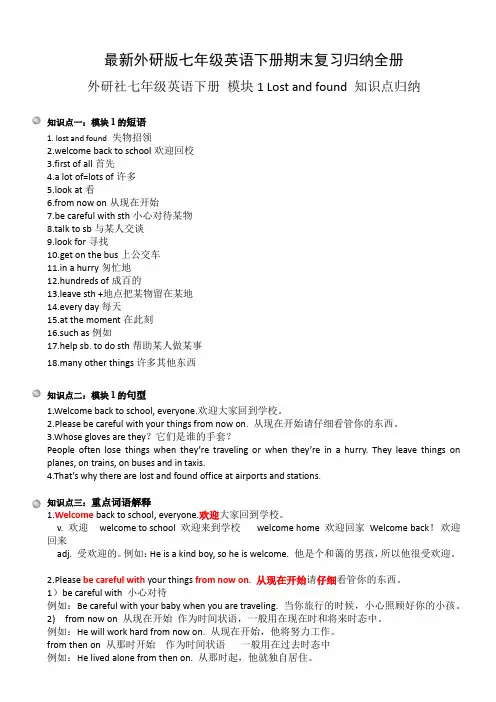
最新外研版七年级英语下册期末复习归纳全册外研社七年级英语下册模块1 Lost and found 知识点归纳知识点一:模块1的短语1. lost and found失物招领2.welcome back to school欢迎回校3.first of all首先4.a lot of=lots of许多5.look at看6.from now on从现在开始7.be careful with sth小心对待某物8.talk to sb与某人交谈9.look for寻找10.get on the bus上公交车11.in a hurry匆忙地12.hundreds of成百的13.leave sth +地点把某物留在某地14.every day每天15.at the moment在此刻16.such as例如17.help sb. to do sth帮助某人做某事18.many other things许多其他东西知识点二:模块1的句型1.Welcome back to school, everyone.欢迎大家回到学校。
2.Please be careful with your things from now on. 从现在开始请仔细看管你的东西。
3.Whose gloves are they?它们是谁的手套?People often lose things when they’re traveling or when they’re in a hurry. They leave things on planes, on trains, on buses and in taxis.4.That’s why there are lost and found office at airports and stations.知识点三:重点词语解释1.Welcome back to school, everyone.欢迎大家回到学校。
外研版七年级英语下册短语及重点句型汇总(Module4)
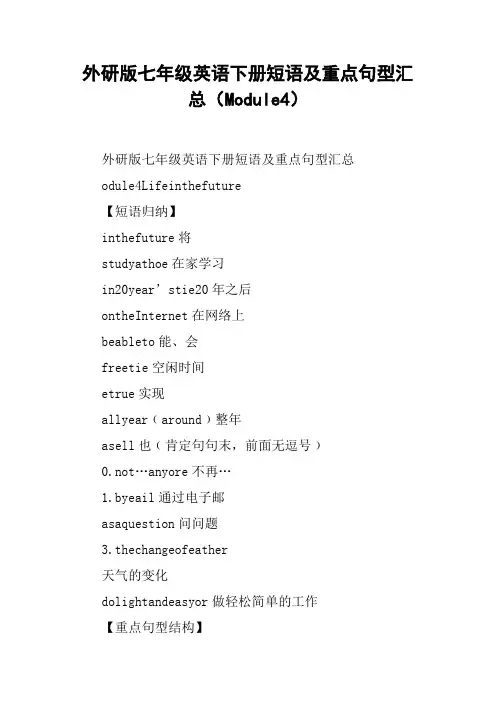
外研版七年级英语下册短语及重点句型汇
总(Module4)
外研版七年级英语下册短语及重点句型汇总
odule4Lifeinthefuture
【短语归纳】
inthefuture将
studyathoe在家学习
in20year’stie20年之后
ontheInternet在网络上
beableto能、会
freetie空闲时间
etrue实现
allyear﹙around﹚整年
asell也﹙肯定句句末,前面无逗号﹚
0.not…anyore不再…
1.byeail通过电子邮
asaquestion问问题
3.thechangeofeather
天气的变化
dolightandeasyor做轻松简单的工作
【重点句型结构】
beableto+动词原形能/会做...
not…anyore不再...
Tonydoesn′tplayfootballanyore.托尼不再踢球了。
notonly…butalso…不仅…而且…
NotonlyebutalsoheliesEnglish.不仅我他也喜欢英语。
【语法专项】
一般将来时﹙Ⅱ﹚由shall和ill引导的一般将来时
含义:将会…
特点:助动词shall和ill没有人称和数的变化,之后要加动词原形。
shall在一般将来时中,一般用于人称之后。
例如:I/eshallhaveanEnglishlesson.
我们将有一节英语课。
否定形式:shallnot=shan′tillnot=on′t。
外研版七年级下学期英语语法总结
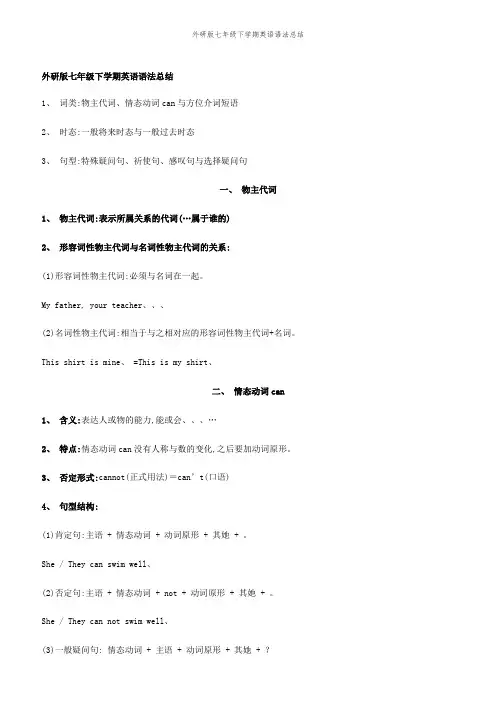
外研版七年级下学期英语语法总结1、词类:物主代词、情态动词can与方位介词短语2、时态:一般将来时态与一般过去时态3、句型:特殊疑问句、祈使句、感叹句与选择疑问句一、物主代词1、物主代词:表示所属关系的代词(…属于谁的)2、形容词性物主代词与名词性物主代词的关系:(1)形容词性物主代词:必须与名词在一起。
My father, your teacher、、、(2)名词性物主代词:相当于与之相对应的形容词性物主代词+名词。
This shirt is mine、 =This is my shirt、二、情态动词can1、含义:表达人或物的能力,能或会、、、…2、特点:情态动词can没有人称与数的变化,之后要加动词原形。
3、否定形式:cannot(正式用法)=can’t(口语)4、句型结构:(1)肯定句:主语 + 情态动词 + 动词原形 + 其她 + 。
She / They can swim well、(2)否定句:主语 + 情态动词 + not + 动词原形 + 其她 + 。
She / They can not swim well、(3)一般疑问句: 情态动词 + 主语 + 动词原形 + 其她 + ?Can she / they swim well?Yes, she / they can、 / No, she / they can’t、(4)特殊疑问句: 特殊疑问词 + 情态动词 + 主语 + 动词原形 + 其她 + ?Why can she / they swim well?Who can swim well?三、介词between、、、and、、、在两者之间Lingling sits between Tony and Daming、玲玲坐在托尼与大明之间。
among 在三者或三者以上之间Miss Li is among lots of students、李老师在许多同学之间。
四、一般将来时1、时间状语:in+一段时间;tomorrow;in the future; next+时间;this+时间(表示将来时间的状语)2、 be(is,am、are) going to do的用法。
最新外研版英语七年级下册全册知识点复习总结
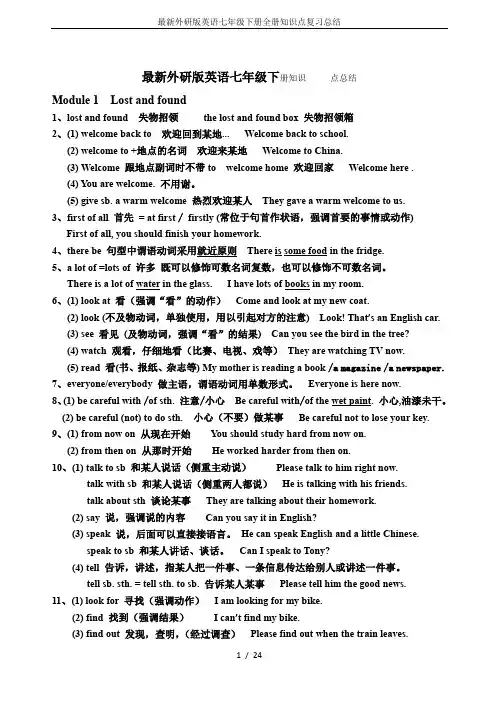
最新外研版英语七年级下册知识点总结Module 1 Lost and found1、lost and found 失物招领the lost and found box 失物招领箱2、(1) welcome back to 欢迎回到某地... Welcome back to school.(2) welcome to +地点的名词欢迎来某地Welcome to China.(3) Welcome 跟地点副词时不带to welcome home 欢迎回家Welcome here .(4) You are welcome. 不用谢。
(5) give sb. a warm welcome 热烈欢迎某人They gave a warm welcome to us.3、first of all 首先= at first / firstly (常位于句首作状语,强调首要的事情或动作)First of all, you should finish your homework.4、there be 句型中谓语动词采用就近原则There is some food in the fridge.5、a lot of =lots of 许多既可以修饰可数名词复数,也可以修饰不可数名词。
There is a lot of water in the glass. I have lots of books in my room.6、(1) look at 看(强调“看”的动作)Come and look at my new coat.(2) look (不及物动词,单独使用,用以引起对方的注意) Look! That’s an English car.(3) see 看见(及物动词,强调“看”的结果) Can you see the bird in the tree?(4) watch 观看,仔细地看(比赛、电视、戏等)They are watching TV now.(5) read 看(书、报纸、杂志等) My mother is reading a book /a magazine /a newspaper.7、everyone/everybody 做主语,谓语动词用单数形式。
(完整word版)外研社七年级英语下册Module10-A-holiday-journey知识点复习
MODULE 10 A Holiday Journey1.短语:2.go there 到那里3.enjoy…a lot 非常喜欢… a lot 很, 非常4.drive sb.to…开车送某人去…5.go back to our family home 回到我们家到达: arrive 不及物动词, 接here ,there, home等地点副词时省略介词。
arrive in+大地点arrive in Chinaarrive at +小地点arrive at the schoolarrive homeget 不及物动词get to +地点接地点副词时, 省略toreach 及物动词reach+地点6.the day before yesterday 前天the day after yesterday 后天7.at the airport 在机场8.works of art 艺术作品9.such as 例如10.have dinner 吃晚饭11.take a walk 散步=go for a walk12.street market 街头市场13.do some shopping 购物14.buy…for sb.为…买…15.hope 希望没有hope sb to do sth 这一结构hope to do 希望做…hope +句子16.have to do...不得不做17.wait in line排队等候cut in line 插队18. a special holiday 一个特殊的假期19.Pacific Ocean 太平洋20.on holiday 度假on sale 出售on duty 在值日on leave 在休假on fire 着火21.at the station 在车站22.do different things 做不同的事情23.all day一整天= the whole day24.take lots of photos 照许多照片25.at the top of 在…顶端how long 表示“多久, 多长时间”, 用来提问时间的长短, 常用“for+一段时间”或“since+时间点/一段时间+ago”或“since+从句”作答。
(完整版)外研版七年级英语下册知识点归纳及练习,推荐文档
疑问 Am I writing a letter? Is she/he listeningto music?
We are enjoying our trip.
We aren’t enjoying our trip.
Are we enjoying our trip?
They are talking to each other.
(listen ) tomusic.
9. It’s 5 o’clock now. We
(have)supper now
10.
Helen
(wash )clothes? Yes ,she is
2、句型转换: 1 They are doing housework .(分别改成一般疑问句和否定句) 2 The students are cleaning the classroom . ( 改一般疑问句并作肯定和否定回答)
规则 一般情况下,动词后直接加-ing 以不发音的 e 结尾的动词,去掉 e,再加-ing 以辅音字母+元音字母+辅音字母结尾的重 读闭音节,双写末尾辅音字母,然后加-ing
特殊变化 4、 现在进行时的否定和疑问形式结构
示例 working, buying, visiting, talking, saying taking, having, leaving, driving, writing
完整)外研版七年级下册英语语法专题复习(含练习)
完整)外研版七年级下册英语语法专题复习(含练习)YOUWIN n的初中英语内部资料为外研版七年级下册的重点知识点梳理。
以下是该资料中的语法知识点。
1.词类:物主代词、情态动词can和方位介词短语。
2.时态:一般将来时态和一般过去时态。
3.句型:特殊疑问句、祈使句、感叹句和选择疑问句。
在物主代词方面,单数包括第一人称、第二人称和第三人称。
形容词性物主代词必须和名词在一起,如my father、your teacher。
名词性物主代词相当于与之相对应的形容词性物主代词和名词的组合,如this shirt is mine,相当于this is my shirt。
在复数方面,形容性物主代词包括our、your和their,名词性物主代词包括ours、yours和theirs。
而词类方面,包括mine、yours、his、hers和its,形容词性物主代词包括my、your、his、her和its。
练题包括选择题和填空题,以检验学生对物主代词的掌握程度。
11.Mrs。
Green is my teacher。
I am her student.12.That's a cat。
Its name is Mimi.1.Mr。
Yang is our teacher。
He is from Beijing。
He teaches us English.2.Look。
there is a cat。
It is Lily's。
Its name is Mimi.3.Let me tell her about my life at school.4.This is their room。
Where is ours?5.Don't use the eraser。
It is mine.6.The lady under the tree is my aunt。
She often sings with her husband.Can is a modal verb that expresses ability or possibility。
外研版七年级英语下册期末复习资料(全)
外研版七年级英语下册期末复习资料(全) Module 1Phrases:1.Lost and found box - a box for lost and found items2.Be careful with… - be us with…3.From now on - starting now4.(Be) in a hurry - in a rush5.Hundreds of - many。
numerous6.Look for - search for7.First of all - firstly8.Find - discover。
locate9.Try to do sth - attempt to do something10.Choose from - select from11.Try doing sth - attempt to do something12.At the moment - currently13.Such as - for example14.For example - as an nKey XXX structures:1.Whose + noun + is this。
- Whose… is this?2.Help sb do sth - assist XXX3.Please be careful with… - please handle with care…4.e to + n - e to…5.Call sb at + phone number - dial… to call someone Grammar focus:Possessive pronouns: XXXSingular:PersonAdjective possessive pronoun1st personmy2nd personyour3rd personhis/her/itsNoun possessive pronounXXXyourshis/hers/itsPlural:Noun possessive pronounoursyoursXXXAdjective and noun possessive pronouns:Adjective possessive pronoun: must be used with a noun。