
2014年人教版九年级英语Unit13 we’re trying to save the earth(1a--2d)
Unit13 we are trying to save the earth
What are destroying our environment?
the waste water
the waste gas from the factory
the loud music or noise from the mall
Unit13 we’re trying to save the earth
What is happening to the earth? Why should we try to save it?
the polluted river
the foggy sky
the dying soil
the noisy street /square…
You can link the text’s listening here.
The shark fin soup
1800.00RMB It comes…. each bowl
The sharks that have no fins will be thrown back into the ocean again.
the strong flash
The worse is pollution causes the climate change and warming , the higher temperature leads to storms and floods.
What should we do to save the earth?
1.We should tell the people who drive to drive less. 2.We should tell the factories which produce the waste gas and water to produce less. 3.We should tell ourselves not to litter in the river. 4.We should tell ourselves to use shopping bags that we are carrying when we’re shopping. 5.Maybe we should write to the newspapers ,magazines or the government for help. 6.Maybe we are able to use the internet for fighting with the pollution as well. Though I always feel our voice is too weak to be heard. I still believe it’s a good idea to do something to help save our earth.
The sharks were caught.
The shark is being killed.
The man is cutting the fin off.
The fins will be delivered to the markets or the restaurants
Yao Ming ,the Chinese basketball star , are calling on us to protect sharks. As what he said in the Ad, when the buying stops, the killing can too.
2014人教版新目标英语九年级Unit_13_We're_trying_to_save_the_earth_Section_A_3a-3b
The earth is badly polluted. Please think of the ways that we can do.
• • • • •
• • • •
• •
close down the factories; help to clean up the river; take the bus or subway; ride a bike; bring a bag to go shopping, throw rubbish in the cans; turn off the lights when you leave a room; use paper or resusable bags; recycle books and paper; turn off the shower when you wash your hair; don't use napkins; rethink, reuse, recycle ... ...
Every species has its own reason to ['spi:ʃi:z] survive. Now that we human n.物种;种类;类型 appeared on the earth, we should [ˈhɑrməni] live in harmony with everything lives on it. Sometimes protecting n. 协调;融洽 一致;和谐 the wild animals is just a simple thing if everyone takes a small step.
Words Reviearmful to at the top of chain the food chain ecosystem industry law scientific
人教版九年级英语Unit 13 We're trying to save the earth! 全单元教案
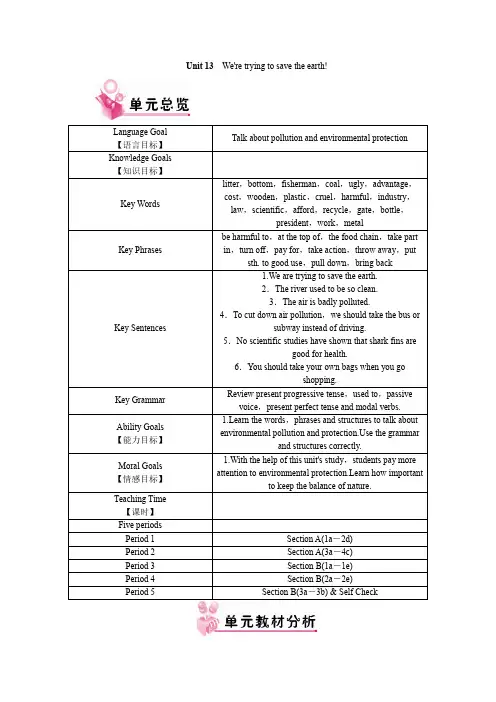
Unit 13We're trying to save the earth!本单元围绕环境保护的话题,并用主题图片表现噪音污染、空气污染、水污染等内容,目的是为了让学生对环境的破坏有一个直观的认识,从而激发学生强烈的社会责任感和对未来发展的思考。
Section A的重点是让学生掌握与环境污染和环境保护相关的词汇和句型,同时引导学生关爱动物、保护环境。
教学难点是让学生学会正确使用连词和结合生活实际讲述如何保护环境。
Section B在Section A所学的基础上,进一步谈论如何保护环境。
教学重点是让学生了解环境保护的方式,并落实到积极的行动当中,同时还有阅读策略和写作技巧的训练。
教学难点是让学生在阅读2a文章之后,根据所给词根找出衍生出的不同词汇,并理解前缀和后缀的不同用法。
The First Period—Section A(1a-2d)Teaching Important Points【教学重点】Key words & phrases:litter,bottom,fisherman,coal,ugly,advantage,cost,wooden,plasticnoise pollution,air pollution,water pollution,be full of,play a part in,turn…into,cut down air pollutionKey sentences:1.Even the bottom of the river was full of rubbish.2.It used to be so clean.3.Everyone in this town should play a part in cleaning it up.4.The air is badly polluted because there are more cars on the road these days.5.The air has become really polluted around here.6.We're trying to save the earth.Key structure:should+do;used to+do;have/has+done;be+done;be+doinge.g.Everyone should help to clean up the river.The air has become really polluted.I used to be able to see stars in the sky.The air is badly polluted.Teaching Difficult Points【教学难点】★Practice the structures to talk about pollution and environmental protection.Teaching Aids【教学工具】A tape recorder,CAI or multimedia courseware.Teaching Steps【教学过程】★Step 1Leading in【新课导入】1.Greeting2.Discussion and reviewDiscuss with the students,like this:T:What kinds of pollution are there these days?S:…T:What causes the pollution?S:…3.Review the words and expressions about the topic.★Step 2Cooperative inquiry【合作探究】1.Finish the task in 1a①Show pictures or play videos about pollution and talk about the pollution.②Read these phrases in 1a.Look at the pictures in 1a and say what they see in the pictures.Write down the words and add more words.③Ask students to say out their words in each kind of pollution.2.Finish the task in 1b①Read the instructions.Get the students to read the contents in the chart and think of what they will fill in the blanks.②Play the recording for the first time.Students listen and fill in the words.③Play the recording a second time.Ask them to check the answers.Then ask the questions.Students answer with full sentences.④Ask more questions to help students learn more details.Then play the recording for the students to role-pay the conversation.3.Finish the task in 1c①Show the key words of the conversation.Ask students to retell the contents in the chart.Like this:What:dirty;bottom,rubbish;fishWhy:littering,putting wasteHow:write to,close down;help to clean up②Read aloud the model dialogue in 1c.Then in pairs,do the oral practice with more words.③Ask two pairs to perform in class.4.Finish the tasks in 2a-2b①Use PPT or pictures to show the four kinds of pollution.Get the groups of students to havea competition to say words about the pollution one by one.land pollution:…air pollution:…noise pollution:…water pollution:…②Get the students to write down these words in their notebooks.③Play the recording for the first time.Students listen and circle the kinds of pollution.Check answers with the class.④Read the sentences in 2b.Predict the contents they will fill in.Play the recording.Students listen and complete the sentences.⑤Play the recording again.Check the answers with the whole class.5.Finish the task in 2c①Read the sample conversation in 2c.Then Read the listening materials and discuss in pairs what causes the two kinds of pollution.②Students work in pairs,making dialogues.③Ask three pairs to role-play their conversations to the class.6.Finish the task in 2d①Talk about the picture in 2d.Ask:What are your ideas for solving the air pollution/waste pollution problem?Present the new words in the conversation.Such as,coal,advantage,wooden,plastic,takeaway,bin,…②Read the conversation in 2d quickly.Find out the problems about environmental pollution in the dialogue.③Read the conversation again.Ask the students to find the ways to solve the problems of air and waste pollution.④Read aloud the conversation by the recording.⑤Learn the useful expressions:What are your ideas for doing…To cut down air pollution,we should…So together,our actions can make a difference and…⑥Role-play or read the conversation in pairs until fluently.★Step 3Homework1.What are your ideas for solving the waste pollution problem?2.Write the words about the four kinds of pollution.3.Translate the following sentences into English.(1)我们正在想办法拯救地球。
人教版九年级英语Unit 13 We’re trying to save the earth 教案
Unit 13We’re trying to save the earth!Section A(1a-2d)┃教学小结┃【板书设计】Unit 13We’re trying to save the earth!Section A(Section A(3a-4c)┃教学小结┃Section B(1a-1e)┃教学小结┃Section B(2a-2e)设计意图:读前预测,为学生在接下来的阅读中获取文章大意作准备。
思维导图可以帮助学生理清文章脉络。
Step 5:Use pictures to teach the new words.When students think about the questions in Step 3,the teacher can write down the new words on the blackboard.And teach them the new words.设计意图:适时呈现词汇,可以减轻学生的阅读压力。
While readingStep 6:Fast reading1.Ask students to look through the article quickly and find out the answer to each question.How many people are mentioned in the passage?Who are they?2.The teacher adds information to the mind-map.设计意图:扫读整篇文章,获取大意,帮助学生把握文章的整体性。
Step 7:Careful reading(Paragraph 2)1.Ask students to read Paragraph 2 carefully and fill in the chart.2.Check answers.3.The teacher adds the information to the mind-map.Step 8:Careful reading(Paragraph 3)1.Ask students to read Paragraph 3 carefully and fill in the chart.2.Check answers.Name What did she make?What materials did she use?Jessica Wong bags old clothes,especially old jeans3.The teacher adds the information to the mind-map.Step 9:Careful reading(Paragraph 4)1.Ask students to read Paragraph 4 carefully and fill in the chart.2.Check answers.Name What did he make?What materials did he use?Wang Tao beautiful art pieces iron and other materials from old cars3.The teacher adds the information to the mind-map.Which things can be done by common people every day?Which things have to be done by governments and organizations?Common people Governments Organizations2.Ask several groups to give a report.设计意图:教师让学生对所学的保护环境的措施进行归纳和分类,培养学生分析问题和解决问题的能力。
人教版英语九年级全册Unit13We'retryingtosavetheearth!优秀教学案例

4.对小组合作进行评价,关注学生的参与度、贡献度和团队合作效果。
(四)反思与评价
1.引导学生进行自我反思,思考自己在学习过程中的优点和不足,培养自我评价和自我改进的能力。
2.组织学生进行同伴评价,鼓励他们互相提供反馈和建议,培养评价能力和批判性思维。
3.创设问题情境,让学生面临真实的环保问题,如水资源浪费、垃圾分类等,引导学生主动思考和寻找解决方案。
4.利用多媒体技术,如视频、音频、动画等,营造生动有趣的学习氛围,激发学生的学习兴趣和积极性。
(二)问题导向
1.设计有挑战性的问题,引导学生深入思考环保问题的本质和影响。
2.通过提问和讨论,引导学生自主探究和解决问题,培养他们的批判性思维和问题境的影响。
3.总结本节课的主要内容和知识点,确保学生对环保知识有一个全面而准确的理解。
(五)作业小结
1.布置相关的作业,如研究报告、行动计划等,让学生将所学知识运用到实际生活中去。
2.要求学生在作业中提出自己的观点和解决方案,培养他们的创新思维和批判性思维能力。
3.引导学生关注环保问题的多样性和复杂性,培养他们的分析和综合能力。
4.鼓励学生提出自己的问题,激发他们的好奇心和探索精神。
(三)小组合作
1.组织学生进行小组讨论和合作,鼓励他们分享自己的观点和想法,培养合作能力和团队精神。
2.设计小组活动,如共同完成一篇关于环保的文章、策划一次环保活动等,让学生实际行动起来,提高实践能力。
3.鼓励学生在作业中积极表达自己的想法,注重培养他们的写作能力和表达能力。
4.对学生的作业进行认真批改和评价,提供及时的反馈和建议,帮助学生巩固所学知识,提高他们的学习效果。
人教版九年级英语下册Unit 13 We’re trying to save the earth!

答案: 1. 垃圾 2. 底部 3. fisherman 4. advantage
5. plastic 6. wooden
Ⅱ. 短语连线 1. be full of 2. turn. . . into. . . 3. cut down 4. make a difference 5. lead to
【学以致用】
①(2014·十堰中考)—Smart phones are more and more popular
答案: 1. We’re trying 2. used to be 3. are throwing
4. 这个城镇的每个人都应该参与到清理之中!
Everyone in this town
a part in cleaning
it up!
5. 这周围的空气真的已经污染了。
The air
really polluted around here.
【自主归纳】
(1)advantage名词, 意为“优点; 有利条件”, 常用复数形式。
反义词为
, 意为“缺点; 不利条件”。
(2)advantage的常用搭配有the advantage(s) of意为“……的优
点”, take advantage of sb. 意为“占某人便宜”, take the
hands.
A. experience B. advantage C. dream
答案: take; the advantage of
this as to have big D. change
3. cost v. 花费 【语境领悟】 *It’s good for health and it doesn’t cost anything! 它对健康有好处, 并且不花任何钱! *I spent a lot of money on that holiday. 那次度假花了我一大笔钱。 *I think it’s a great idea that you now have to pay for plastic bags. 现在你得付钱买塑料袋, 我认为这是个好主意。 *It takes me forty minutes to do my homework. 做作业花费我四十分钟。
人教版九年级英语全一册Unit_13_We're_trying_to_save_the_earth_Section_A_4a--4c(Grammar_Focus) (1)ppt
15.i事n f实ac上t 16.b被e 捕ca杀ug和ht交an易d traded 17.t.h...e..n的u数mb量er(s) of 18.s某om些e品ki种nds of 19.i在n t过he去la的st2200到to303年0 years 20.e环nv境ir保on护me组nt织al protection groups 21.s比uc如h as 22.d立ev法elop laws 23.t.h...e..s的al销e o售f 24.s到o 目far前为止 25.H帮e助lp拯sa救ve鲨th鱼e s。harks!
Joe: __H_a_v_eyou ever ______ t(atakkene) part in an environment
project ?
参加
Байду номын сангаас
Eric: Yes, I have. I ______h(ehleplepd) with a
Clean-Up Day last year. It was
C. Ken usiesdutsoebdetaofrsaliedepofindgoglsa.t(改e/ 为sta一y般in疑g u问p句)
______________________________?
Did Ken use to be afraid of dogs
4a Fill in the blanks with the correct forms of the verbs in brackets.
festival in China.
• 5. We can save electricity(电)by turning off the lights when leave a room.
第13单元教案docx Unit 13 We’re trying to save the earth!
Unit 13 We’re trying to save the earth!教材来源:初中九年级《英语》教科书/人民教育出版社2014年版内容来源:九年级《英语(全一册)》第十三单元主题:We’re trying to save the earth!课时:共5课时授课对象:九年级学生目标确定的依据1.课程标准相关要求课程标准五级目标要求听的方面九年级学生能听懂能根据语调和重音理解说话者的意图;能针对所听语段的内容记录简单的信息。
口语方面能在口头表达中进行适当的自我修正;能有效地询问信息和请求帮助;能根据话题进行情景对话;读的方面,能根据上下文和构词法推断、理解生词的含义;能理解段落中各句子之间的逻辑关系;能找出文章中的主题,逻辑故事的情节,预测故事情节的发展和可能的结局。
写的方面,能根据写作要求,收集、准备素材;能独立起草短文、短信等,并在教师的指导下联系修改;能使用常见的连接词表示顺序和逻辑关系;2.教材分析本单元以“保护环境”为核心话题,主题有三个,分别是噪声污染、空气污染、水污染的具体例子,课本图片的展示主要是为了让学生对环境的破坏有一个直观的认识,从而激发他们强烈的社会责任心和对未来发展的思考,同时引导学生关爱动物,保护环境。
3学情分析本单元没有新的语法项目,主要复习以前学过的语法项目。
包括现在进行时态、被动语态、现在完成时、情态动词和used to.本单元教学内容由浅入深,逐步引导学生用英语表述环境污染或者环境保护,通过学习,让学生在交际活动中学会正确地用英语谈论环境的发展和变化,培养强烈的社会责任心。
学习目标Section A:主要介绍本单元基本的语言内容,注重学生的听说能力和短语的积累。
教材通过学习环境污染和环境保护相关的话题,利用图片设置的情景导入本单元语言功能项目和语法项目,然后通过听力和口语训练来落实这些语言功能项目。
Section B:(1)通过说和读的练习,让不同的学生说出保护地球的各种方式。
人教版英语九年级全册Unit13We'retryingtosavetheearth单元优秀教学案例
3.问题导向教学,培养批判性思维
本案例采用问题导向的教学策略,引导学生围绕环保问题展开思考、讨论和分析。这种教学方式有助于培养学生的批判性思维,使他们学会独立思考问题,形成自己的观点。
-结合课本对话和文章,让学生在实际语境中学习语法。
3.通过听力练习,让学生熟悉与环保相关的新闻报道、故事和对话,提高他们的听力水平。
-播放听力材料,引导学生完成相关练习,并针对难点进行讲解。
(三)学生小组讨论
1.将学生分成小组,每组选择一个环保主题,如:气候变化、水资源保护等,进行资料收集和讨论。
-要求学生用英语记录关键信息,为后续的展示做准备。
1.设计反思性问题,如:“在本章节的学习中,你学到了哪些环保知识?”“你认为自己在环保方面有哪些改变?”等,引导学生进行自我反思。
2.组织学生进行同伴评价,让他们互相提出建议,共同进步。
3.教师对学生进行综合评价,关注学生在知识、技能、情感态度与价值观等方面的表现,鼓励他们持续进步。
四、教学内容与过程
人教版英语九年级全册Unit13We'retryingtosavetheearth单元优秀教学案例
一、案例背景
随着社会的快速发展,环境问题已经成为全球关注的焦点。在这样的背景下,人教版英语九年级全册Unit13"We're trying to save the earth"单元,以环境保护为主题,旨在培养学生对环境问题的关注和责任感。本案例将结合课本内容,通过多元化的教学活动,提高学生对环境保护的认识,激发他们积极参与环保行动的热情。在教学过程中,注重运用教育专业用词,以人性化的语言引导学生进行思考与讨论,使他们在掌握英语知识的同时,也能够关注到地球的可持续发展。
九年级英语Unit13 课文翻译
Unit13 We’re trying to save the earth ! Section A 2d采访者:贾森和苏珊,对于解决这些问题,你们有什么想法?贾森:为了减少空气污染,我们应该乘坐公共汽车或者地铁,而不是开车。
苏珊:是的,或者骑自行车。
骑自行车还有别的好处,它对健康有益而且不用花钱。
采访者:好主意!那么,垃圾污染呢?苏珊:嗯,我认为一些生活小事有助于减少垃圾污染,比如自带袋子去购物。
我去年就这样做了。
贾森:我也是。
还有,我买外卖食品的时候,从来不拿一次性木筷或者塑料叉子。
我用家里的餐具。
苏珊:还要把垃圾扔进垃圾桶,保持公共场所的整洁和美丽,(这是)为了每个人。
采访者:所以,我们一起行动,就能影响他人,创造一个更美好的未来。
Section A ,3a拯救鲨鱼很多人都听说过鱼翅羹。
这道昂贵又著名的菜在中国南方特别流行。
但是每次当你喝鱼翅羹的时候,你是否意识到你杀了一整只鲨鱼?当人们捕捉到鲨鱼的时候,他们切掉鲨鱼的鱼鳍,然后把它们扔回大海。
失去鱼鳍的鲨鱼再也不能再水里游,会慢慢死去。
这种做法不仅残忍,而且对环境有害。
鲨鱼处于海洋生态系统食物链的顶端,如果他们的数量下降得太多,将会给所有的海洋生物带来危害。
很多人认为鲨鱼永远不会濒临灭绝,因为他们是食物链的最强者。
但事实上,每年有七百万的鲨鱼被捕杀和交易。
在过去的20年到30年,某些品种的鲨鱼数量下降了超过90%。
世界各地的环保组织,如野生救援协会和世界自然基金会,都在向公众宣讲“猎翅的(残忍)行为。
他们甚至已经呼吁政府立法停止鱼翅的销售。
到目前为止,没有任何科学研究表明,鱼翅对健康有好处,那么为什么要吃他们呢?帮助拯救鲨鱼吧!Section B , 2a重新思考重新使用,重新利用你经常扔掉你不在使用的东西吗?你是否曾想过这些东西还能很好地重新利用?如果你有一个充满创意的头脑,没有东西是废品。
你可能从来没听说过艾米.海斯,但她是一个非常不寻常的女性。
人教版英语九年级Unit13《We’retryingtosavetheearth》全单元说课稿
人教版英语九年级Unit 13《We’re trying to save the earth》全单元说课稿一. 教材分析人教版英语九年级Unit 13《We’re trying to save the earth》全单元主要围绕环保主题展开,通过学习本单元,学生能够掌握与环保相关的词汇和表达方式,了解人们为保护地球所采取的行动,提高环保意识。
本单元包括两个阅读文本,分别是关于地球一小时活动和一位美国学生的环保故事。
通过阅读和实践活动,学生能够提高阅读理解能力,培养运用英语进行交流的能力。
二. 学情分析九年级的学生已经具备了一定的英语基础,能够理解和运用一些基本的英语表达。
但他们在阅读理解,尤其是对于长篇阅读材料的理解上还存在一定的困难。
此外,学生对于环保主题的认识和关注程度不同,因此在教学过程中需要引导学生深入思考,提高他们的环保意识。
三. 说教学目标1.知识目标:学生能够掌握本单元的重点词汇和表达方式,理解阅读文本的内容。
2.能力目标:学生能够运用英语进行阅读理解,提高阅读能力;能够运用所学知识进行交流和讨论。
3.情感目标:学生能够增强环保意识,认识到保护地球的重要性。
四. 说教学重难点1.重点:本单元的重点是让学生掌握与环保相关的词汇和表达方式,提高阅读理解能力。
2.难点:学生对于阅读文本的理解和运用所学知识进行交流和讨论。
五. 说教学方法与手段1.教学方法:采用任务型教学法,引导学生通过阅读、讨论、实践活动等方式,提高英语运用能力。
2.教学手段:利用多媒体教学设备,展示相关图片和视频,帮助学生更好地理解文本内容。
六. 说教学过程1.导入:通过展示地球环境的图片,引导学生思考环保问题,激发学生的学习兴趣。
2.阅读理解:学生自主阅读文本,回答相关问题,教师进行讲解和指导。
3.小组讨论:学生分组讨论,分享各自的观点和感受,教师进行巡回指导。
4.实践活动:学生根据所学内容,进行角色扮演或写作练习,教师进行评价和指导。