
译林五年级上下单词默写
5AUnit1熊 _________ 森林 _________ 有 _________ 房子_________ 汤 _________ 正合适 _________ 房间 _________ 硬的_________ 柔软的 _________害怕的_________ 他们的 _________ 她(宾格)_________ 救命 _________ 在……旁边_________ 在……中间 _________ 真正地_________ 然后_________ 找到,发现 _________ 在……前面_________Unit2学生 _________ 教室 _________ 楼层 _________ 电脑 _________第一,首先 _________ 第二_________ 第三 _________ 操场 _________秋千 _________ 推 _________ 重的 _________ 停下 _________高的 _________ 很多的,极大的_________Unit3一个....,另一个... _________ 身体_________ 没有,无_________腿_________ 也不,也没有_________ 手臂_________翅膀_________ 脚,足_________ 给_________ 兔子_________ 手指_________Unit4业余爱好_________ 擅长于_________ 与...一起_________也_________ 阅读_________ 故事_________ 很多_________弹钢琴_________ 跳舞_________ 看电影_________唱歌_________ 两个都_________ 组_________ 主意_________ 冰_________洞_________ 当心!注意!__________________ 湿的,潮的_________Unit5老师_________ 教_________ 作家_________ 写_________工作_________ 在家__________________ 医生_________帮助_________ 生病的_________ 人;人们_________工厂_________ 工人_________ 厨师_________ 驾驶员,司机_________农民_________ 护士_________ 警察_________Unit6网友_________ 等一会儿__________________ 发出(信件)_________电子邮件_________ 给_________ 住,居住_________英国_________ ...岁__________________ 学习_________澳大利亚_________ 加拿大_________ 中国_________ 美国_________去钓鱼__________________ 明天_________ 钓鱼_________别担心。
__________________ 在...旁边_________ 等待_________Unit7周末__________________ 经常_________ 拜访;参观_________祖父;祖母;外祖父;外祖母_________ 和...一起玩__________________非常__________________ 聊天_________ 网络_________ 总是,一直_________有时_________ 去看电影__________________ 那里_________ 很多__________________ 出来__________________ 出来__________________Unit8圣诞节_________ 买_________ 礼物_________ 圣诞树__________________圣诞老人__________________ 接着,然后_________ 放_________漂亮的,好看的_________ 物品,东西_________ 看起来_________圣诞夜__________________ 长筒袜_________ 等候,等待__________________最后_________ 圣诞节__________________ 早早地_________火鸡;火鸡肉_________ 布丁_________ 全都_________过得愉快__________________ 卡片_________ 孩子,儿童_________折叠_________ 信息_________ 圣诞快乐!__________________他_________ ...怎么了?___________________________ 我们_________5BUnit1王子_________ 仙女_________ 为什么_________ 因为_________衣服_________ 让_________ 穿上______________ 在...以前_________不得不,必须_________ 试穿_________ 合适_________脱下________________ 蘑菇_________ 迟的,晚的_________摘,拾_________ 明白,理解_________ 有害的__________________留下,丢下__________________Unit2离...远________________ 在..附近_________ 乘(汽车、火车)_________公共汽车_________ 步行_________ 地铁_________ 出租车_________自行车_________ 飞机_________ 轮船_________ 火车_________骑车_________ 给...看_________ 篮子_________ 城市_________Unit3问路_________ 到达_________ 搭乘_________ 上车__________________下车__________________ 走,步行_________ 书店_________ 街道_________ 在...旁边_________ 一会见__________________ 向...求助__________________ 劳驾,对不起__________________ 沿着,顺着_________向右转__________________ 交通灯__________________在你的右侧__________________ 电影院_________ 医院_________商店_________ 动物园_________ 向左转__________________超市_______________ 车站_________ 满的,饱的_________结束了,完了_________Unit4看医生__________________ 感觉_________ 检查_________ 应该_________ 休息__________________ 吃药__________________ 喝水__________________ 牙疼_________ 牙医_________ 任何东西_________ 刷牙__________________就寝时间_________ 长颈鹿_________ 指着________________ 脖子_________Unit5父或母_________ 擦,洗_________ 烧,煮_________ 扫地__________________忙碌_________ 洗碗__________________ 整理床铺__________________种植_________ 花园_________ 甜的_________ 害虫_________瓢虫_________ 走了,离开__________________Unit6运动,比赛_________ 有...气味,闻起来_________ 肉_________蔬菜_________ 西红柿_________ 马铃薯_________ 我等不及了!__________________ 找,寻找_________ 准备好_________ 好吃的_________ 喜欢,喜爱_________面包_________ 获胜_________ 太好了_________ 生气的_________斑点_________ 抓,抓走_________ 赶走__________________Unit7节日_________ 春节__________________ 一月_________ 二月_________叫做_________ 中国农历新年__________________ 团聚__________________饺子_________ 端午节__________________ 五月_________ 六月_________赛龙舟__________________ 地方_________ 粽子__________________中秋节__________________ 九月_________ 十月_________ 月亮_________月饼_________ 重阳节__________________ 十一月_________老的_________ 山脉_________ 重阳糕__________________母亲节__________________ 父亲节__________________Unit8生日_________ 第十一_________ 一起_________ 第八_________四月_________ 去购物__________________ 三月_________七月_________ 八月_________ 十二月_________ 英雄_________戏剧_________ 数字_________ 密码_________ 答案_________第四_________ 开始_________ 打仗,打架_________。
译林版五年级英语上册知识点汇总(完美版)
译林版五年级英语上册知识点汇总(完美版)译林版五年级英语上册知识点汇总Unit 1 Goldilocks and the three bears⼀、单词(默写)1.bear熊2.forest森林3.there(与be连⽤)有4.house房⼦5.soup 汤6.just right正合适7.room房间8.hard硬的9.soft柔软的10.afraid害怕的11. their他们的12.her她(宾格)13.help救命14.beside在……旁边15.between在……中间 16.really真正地17.then然后 18.find 找到;发现19. in front of在……前⾯开楼好久哦⼆、词组(默写)1、in the forest在森林⾥2、 a beautiful house⼀座漂亮的房⼦3、 hungry and thirsty⼜饿⼜渴4、some soup⼀些汤5、 too cold/hot太冷/热6、 in the room在房间⾥7、too hard/soft太硬/软8、three bears 三只熊9、have some cakes吃些蛋糕10、in the kitchen在厨房⾥11、 in the fridge在冰箱⾥12、find their cousin发现他们的表弟三、句型(默写)1. There is a house in the forest.在森林⾥有⼀个房⼦.2. There is some soup on the table.在桌⼦上有⼀些汤.3. There are three bears in front of her.在她前⾯有三只熊.4. This soup is too cold.这汤太冷了.5. What a beautiful house! 多么漂亮的房⼦!6. She is hungry and thirsty.她是⼜饿⼜渴.7.Bobby cannot(can’t) see any cakes in the fridge. 波⽐看不到冰箱⾥有蛋糕.四.语法点(理解)1.There be句型表⽰“某处有某物”(1)其中there is ⽤于单数名词或不可数名词;如:There is a pencil case in the school bag. There is some soup/milk /tea/coffee/juice/water/chocolate.(2)There are⽤于可数名词的复数;如: There are some desks in the classroom.(3)There be 句型的就近原则:be动词后⾯如果跟的是不⽌⼀种物品;就根据离它最近的物品选⽤is或are.如:There are some pictures and a telephone. There is a telephone and some p ictures.2.There be 句型的否定形式:在be动词的后⾯加not(is not可以缩写为isn't;are not可以缩写为 aren't)把some 改成any.例:There is a pencil in the pencil-box.(改为否定句) There isn't a pencil in the pencil-box.There are some crayons on the desk.(改为否定句) There aren't any crayons on the desk.3.“some”和“any”都有“⼀些”的意思.“some”⼀般⽤于肯定句;“any”⽤于否定句和⼀般疑问句.但在⼀些表⽰委婉请求;想得到对⽅肯定回答的疑问句中;也⽤“some”.例:1.There are some watermelons in the basket.(肯定句)2.There aren't any birds in the tree.(否定句)3.Are there any toy trains on the table?(疑问句)4.Would you like some tea?(表委婉请求)4.can在否定句中的⽤法:表⽰某⼈不能做某事时;通常在can后⾯加否定词not,后⾯加动词原形. Bobby cannot(can’t) see any cakes in the fridge.5. 感叹句的结构:感叹句常⽤how或what来引导(1)what引导的感叹句a.What+a/an+形容词+可数名词单数!What a beautiful house!b.What+形容词+可数名词复数! What nice dresses!c. What+形容词+不可数名词! What delicious milk!(2)how引导的感叹句How+形容词/副词! How nice!Unit 2 A new student⼀、单词(默写)1.student 学⽣2.classroom 教室3.floor楼层r电脑5. first第⼀;⾸先6.second 第⼆7.third 第三8.playground 操场9.swing秋千10.push 推11.heavy 重的12.stop 停下13.high ⾼的14.great 很多的;极⼤的⼆、词组(默写)带领……参观1.a new student ⼀名新学⽣ 2.show ……around3.how many classrooms多少间教室4.in our school 在我们学校⾥⼀些电脑室 6.a music room ⼀间⾳乐室7.on the third floor 在三楼8. a table tennis room⼀间乒乓球室9.go and have a look去看看10.sing and dance ⼜唱⼜跳11.drink some nice juice喝些美味的果汁12.go to the cinema 去电影院13.have a nice ice cream 吃⼀个美味的冰淇淋14.in the playground 在操场上15.go and play 去玩⼀玩16.on the swing 在秋千上17.so heavy 真的重18.too high太⾼19.great fun 很有趣20.play again.再玩⼀次21.go home 回家22.an art room ⼀间美术室三、句型(默写)1.Can you show her around ? 你能带领她参观吗?2.How many classrooms are there in our school ? 在我们学校有多少间教室?3.Our classroom is on the second floor.我们教室在⼆楼.有⼀些电脑室吗?5.Is there a music room ? 有电脑室吗?6.Let’s go and have a look. 让我们去看看.四、语法点(理解)1.How many...(可数名词复数) are there...? ⽤于询问某处有多少...例:How many classrooms are there in our school?2.There be 的⼀般疑问句,是将be动词提前到there的前⾯;表⽰“有......?”(1)Is there...? Yes, there is ./ No, there isn’t .例:Is there a music room ?(2)Are there any...? Yes, there are./ No, there aren’t.例:Are there any books?3.⼏个缩写isn’t = is not aren’t= are not it’s = it is they’re= they are4.序数词one ----- first two --- second three---- third four---fourthfive---fifth six---sixth5.在楼层前⽤介词on , on the first /second/ third floor 在⼀/⼆/三楼...Unit 3 Our animal friends⼀、词汇our animal friends 我们的动物朋友two fish 两条鱼the other另⼀个a big tail ⼀条⼤尾巴big bodies ⼤⾝体have no 没有four legs 四条腿nice wings 漂亮的翅膀red eyes 红眼睛long ears 长⽿朵big arms ⼤⼿臂big feet⼤脚its body 它的⾝体your fingers 你的⼿指on the farm 在农场上☆bald eagles ⽩头秃鹰☆polar bears 北极熊☆a big kangaroo ⼀只袋⿏☆in Canada 在加拿⼤☆in Australia 在澳⼤利亚☆like the rain 喜欢下⾬☆sunny weather 晴朗的天⽓☆出来☆carry an umbrella 拿⼀把⾬伞⼆、句型1. I have two animal friends. 我有两个动物朋友.2. One is red and the other is black. ⼀个是红的另⼀个是⿊的.3. They have big eyes and big bodies. 它们有⼤眼睛和⼤⾝体.4. They have no legs and arms. 它们没有腿和⼿臂.5. It has four legs and a short tail. 他有四条腿和⼀条短尾巴.6. It has two legs and two nice wings. 它有两条腿和⼀双漂亮的翅膀.7. He has a dog. 他有⼀只狗.8. She has a bird. 她有⼀只鸟.9. It can talk and fly. 它既会说话⼜会飞.10. Do you have an animal friend? Yes, I do. 你有⼀个动物朋友吗?是的;我有.11. Does it have a long tail? Yes, it does. 它有⼀条长尾巴吗?是的;它有.12. Does he have a parrot? No, he doesn’t. 他有⼀只鹦鹉嘛?不;他没有.13. Does she have two fish? No, she doesn’t. 她有两条鱼吗?不;她没有.14. Do they have animal friends? No, they don’t. 他们有动物朋友吗?不;他们没有.15. Those are not legs. 那些不是腿.16. Give it a cake. 给它⼀个蛋糕.三、语⾳Uu / Λ/ bus, duck, summer, sun, umbrella, mum, lunch, cup, rubber, run,but, much, jump, Sunday, subject,四、语法have / has 的⽤法1、表⽰某⼈有某物.2、主语是第⼀、第⼆⼈称单数和复数时⽤have, 如I;you, we, they, the students …主语是第三⼈称单数时⽤has, 如he, she, it, Helen, the bird, myfather …3、肯定句:… have / has …We have a PE lesson on Monday morning. / It has a long tail.否定句:… don’t / doesn’t +have …They don’t have animal friends. / She doesn’t have a dog.⼀般疑问句:Do / Does … have …Yes, …do / does. No, … don’t / don’t.Do you have a football? Yes, I do. / No, I don’t.Does he have a toy car? Yes, he does. / No, he doesn’t.Unit 4 Hobbies⼀、词汇sing and dance 唱歌跳舞be good at 擅长于with my brother 和我弟弟read stories 读故事in the park 在公园⾥play the piano 弹钢琴a lot of 许多watch films 看电影talk about 谈论某事my hobby 我的爱好their hobbies 他们的爱好in winter 在冬天very well 很好an idea ⼀个主意 a great idea ⼀个好主意this afternoon 今天下午on the ice 在冰上be good at skating擅长溜冰a big hole ⼀个⼤洞in the ice 在冰⾥cold and wet⼜冷⼜湿like climbing 喜欢爬⼭like swimming 喜欢游泳like drawing 喜欢画画play basketball 打篮球play table tennis 打乒乓play football 踢⾜球1. What do you like doing? 你喜欢⼲什么?I like playing basketball and football. 我喜欢打篮球和踢⾜球.2. I can play basketball well, but I’m not good at football. 我篮球打得很好;但我不擅长⾜球.3. He likes playing football too. 他也喜欢踢⾜球.4. She also likes playing the piano. 她也喜欢弹钢琴.5. They both like swimming. 她们都喜欢游泳.6. What does he like doing? 他喜欢⼲什么?He likes drawing. 他喜欢画画.7. What does she like doing ? 她喜欢⼲什么?She likes reading stories. 她喜欢读故事.8. What do they like doing? 她们喜欢⼲什么?They like watching films. 她们喜欢看电影.9. Sam and Billy talking about their hobbies. ⼭姆和⽐利谈论他们的爱好.10. Let’s go skating this afternoon. 咱们今天下午去滑冰.11. Look out! ⼩⼼!12. There is a hole in the ice. 冰⾥有⼀个洞.13.Do you like wearing yellow? 你喜欢穿黄⾊的⾐服?14. We all like climbing very much. 我们都⼗分喜欢爬⼭.三、语⾳Yy / j / year, yes, yellow, you, young1. 询问别⼈喜欢⼲某事;What do/ does … like doing ?喜欢⼲某事like doing sth, doing表⽰喜欢经常做⼀件事.主语是第三⼈称单数时注意like后⾯加s.不喜欢⼲某事don’t/ doesn’t like doing sth2.动名词的变化规律:a. ⼀般情况下在动词后⾯加ing. 如going, reading, drawing, playing…b. 以不发⾳的字母e结尾的动词;去e再加ing. 如dancing, making…c. 以“元⾳+辅⾳”结尾的重读闭⾳节单词;先双写辅⾳字母再加ing. 如swimming, running, getting, putting…Unit5 What do they do【单词】1. teacher ⽼师2. teach 教3. writer 作家4.write 写5.work ⼯作6.at home 在家7.doctor 医⽣8.help 帮助9.sick ⽣病10.people ⼈;⼈们11.factory ⼯⼚12.worker ⼯⼈13.cook 厨师14.driver 驾驶员;司机15.farmer 农民16.nurse 护⼠17.policeman 警察【词组】1. teach English 教英语2. a lot of students =lots of students许多学⽣3. What about...?= How about....? ....怎么样4. an English teacher ⼀位5. write stories 写故事6. work at home 在家⼯作7. help sick people 帮助⽣病的⼈8. a factory worker ⼀个⼯⼚⼯⼈9. make sweets 做糖果10. a lot of sweets 许多糖果11. a nice car ⼀辆漂亮的⼩汽车12. make cars 制造汽车13. so many cars 这么多汽车14. fly in the sky 在空中飞15. I wish 我希望【句⼦】1. What does your father do? 你的爸爸做什么的?2. My father is a teacher. 我的爸爸是个⽼师.3. He teaches English. 他教英语.4. He has a lot of students. 他有许多学⽣.5. What about your mother? 你妈妈呢?6. Is she an English teacher too? 她也是个英语⽼师吗?7. She’s a writer. 她是个作家.8. She writes stories. 她写故事的.9. She works at home. 她在家⼯作.10. My father is a doctor. 我的爸爸是个医⽣.11. He helps sick people. 他帮助⽣病的⼈.12. My mother is a factory worker. 我的妈妈是个⼯⼚的⼯⼈.13. She makes sweets. 她做糖果的.14. Who’s that? 那是谁?15. There are so many cars. 有那么多车.16. Your father can’t go now. 你爸爸不能⾛了现在.【语法知识】1. 如何询问他⼈的职业1)What does + 某⼈(your father, David...)do ?He / She is a / an +职业(farmer, teacher, doctor...)例如:What does your father do? He is a doctor. 你爸爸做什么的?他是⼀个医⽣.还可以这么问他⼈的职业:2)What is + 某⼈?What is your father? 你爸爸做什么的?3)What’s somebody’s job? What’s your father’s job? 你爸爸做什么的?2. 询问“你”的职业1) What’s your job? 你是做什么的?I am an English teacher. 我是⼀个英语⽼师.2)What do you do? 你是做什么的I am a worker. 我是⼀名⼯⼈.动词在第三⼈称单数形式的变化规则规则例词⼀般情况下;直接在动词的词尾加-s. run - runs look - lookssee -sees say -says以-s, -sh, -ch, -x, -o结尾的动词;⼀般teach-teaches go-goes在词尾加-es. fix-fixeswash-washes pass-passes以辅⾳字母加y结尾的动词;先边y为study-studies try- triesi, 再加-es.以元⾳字母加y结尾的动词;直接在词play-plays stay-stays尾加-s.注意:go(三单)——goes have(三单)——has五、作⽂My familyThere are three people in my family. They are my father , my mother andI . My father is a teacher. He works in a school. He goes to school by car. My mother is a doctor. She works in a hospital. She helps sick people. She likes reading books. I am a student. I like playing football . I love my family. Unit 6 my e-friend⼀、词汇my e-friend 我的⽹友in the playground 在操场上wait a minute等⼀会send this email 发这封电⼦邮件live in the UK 住在英国eleven years old 11岁speak Chinese 讲中⽂have Chinese lessons 有语⽂课at school 在学校study Chinese 学习汉语after school 放学后what subjects 什么学科like Maths and PE 喜欢数学和体育don’t worry 别担⼼swim well 游得好eat fish 吃鱼at a snack bar 在⼀家⼩吃店go fishing去钓鱼be good at fishing 擅长钓鱼teach you 教你sit by the river坐在河旁many fish 许多鱼live in Canada 住在加拿⼤be good at English 擅长英语in Australia 在澳⼤利亚in China 在中国tomorrow morning 明天早上☆know about these countries 了解这些国家☆in winter 在冬天☆turnto ice 变成冰☆the winter weather 冬天的天⽓☆wear warm clothes 穿暖和的⾐服☆Chinese addresses 中⽂地址☆write English addresses 写英⽂地址☆know about your e-friends 了解你的⽹友们⼆、句型1. Do you have an e-friend? 你有⼀位⽹友吗?Yes, I do. 是的;我有.2. Do they like swimming? 他们喜欢游泳吗?No, they don’t. 不;他们不喜欢.3. Does he have Chinese lessons? 他有语⽂课吗?Yes, he does. 是的;他有.4. Does she like singing? 她喜欢唱歌吗?No, she doesn’t. 不;她没有.5. What subjects does he like? 他喜欢什么学科?He likes Maths and PE. 他喜欢数学和体育.6.What subjects does she like? 她喜欢什么学科?She likes Music and Art.她喜欢⾳乐和美术.7. Let me send this email to my e-friend. 让我给⽹友发个电⼦邮件.8. Where does he live? 他住在哪⾥?He lives in the UK. 他住在英国.9. How old is he? 他⼏岁了?He’s 11 years old. 他11岁.10. Can he speak Chinese? 他会讲汉语吗?Yes, he can. 是的;他会.11. What does he do after school? 放学后他做什么?He studies Chinese. 他学汉语.12. What do fish eat? 鱼吃什么?They eat apples. 它们吃苹果.13. Bobby waits and waits. 波⽐等呀等.14. Let’s go fishing tomorrow. 让我们明天去钓鱼. I can teach you. 我会教你.☆15. In winter, water turns to ice. 在冬天;⽔变成冰.☆16. And sometimes it snows. 有时候下雪.☆17. We write Chinese addresses like this. 我们像这样写中⽂地址.三、语⾳Ww / w / watch water week winter woman weather we always wearwarm write swing wing with wet work workerwait worry四、语法1. Does he / she …? ⼀般疑问句句中没有be动词;变为⼀般疑问句要借助助动词do / does.助动词形态由主语的⼈称决定.Does he / she …? 主语为第三⼈称单数;⽤does其结构为:Does +主语+谓语动词+其他?2. What subjects does …like? 特殊疑问句这个句⼦⽤来询问他⼈喜欢什么科⽬的疑问句.⽤于第三⼈称单数;在本句中⽤助动词does.注意回答时like后⾯要加s. Unit 7 At weekends⼀、单词(要求会读、会背、会默写)1.参观visit2.祖⽗;祖母;外祖⽗;外祖母grandparent3.经常often4.总是always5.聊天chat6.⽹络;互联⽹Internet 7有时sometimes8.那⾥there 9.春天spring 10.夏天summer 11.秋天autumn 12.冬天winter⼆、词组(要求会读、会背、会默写)1.在周末at weekends2.看望我的爷爷奶奶visit my grandparents3.吃晚饭have dinner4.和……⼀起玩play…with…5.和他们的猫⼀起玩play with their cat6.放风筝fly a kite7.我们的⽗母our parents 8.住在英国live in the UK9.在⽹上聊天chat on the Internet 10.和她的⽹友聊天chat with her e-friend11. 和他/她聊天chat with him/her 12.和他们聊天chat with them 13.怎么样what about 14.去电影院go to the cinema 15.上舞蹈课have dancing lessons 16.踢⾜球play football17.野餐have a picnic 18.她的/他的朋友们her/his friends 19.去公园go to the park 20.我的家⼈my family21.在公园⾥in the park 22.拜访李⽼师visit Miss Li23.给我们看花show us the flowers 24.看电视watch TV25.吃很多eat a lot 26.打篮球play basketball27.去游泳go swimming 28.出来29.出去get out 30.去野餐go and have a picnic31.太胖too fat 32.喜欢野餐like picnics33.喜欢打篮球like playing basketball 34.我的⽗母my parents35.上课have lessons 36.⾮常喜欢猫like cats very much37.⼀朵漂亮的玫瑰 a nice rose三、句型(要求会读、会背、会默写)1.What do you do at weekends ?I usually visit my grandparents at weekends.你在周末做什么?我通常看望我的祖⽗母.2.What does she do at weekends? She sometimes goes to the cinema withher friends.她在周末做什么?她有时和她的朋友们去看电影.3.What do they do at weekends? They often fly a kite and have a picnic.她们在周末做什么?他们经常放风筝和野餐.4.Su Yang and I like playing with their cat very much.我和苏洋⾮常喜欢和他们的猫玩.5.I sometimes go to the park with my family.我有时和我的家⼈去公园.6.She always has dancing lessons at weekends.她在周末总是上舞蹈课.7.My grandparents live in the Uk. I usually chat with them on the Internet.我的祖⽗母住在英国.我通常在⽹上和他们聊天.8.Nancy often has dinner with her grandparents.南希经常和她的祖⽗母⼀起吃晚饭.9.I don’t like playing basketball.我不喜欢打篮球.10.He doesn’t like playing basketball.他不喜欢打篮球.11.Billy is too fat. He can’t get out. Billy太胖了.他不能出去了.12.Football is very popular in the UK.⾜球在英国很受欢迎.13.Baskettball is very popular in the US.篮球在美国很受欢迎.14.Table tennis is very popular in China.乒乓球在中国很受欢迎.四、语法:1.频率副词always , usually, often , sometimes ;按其频率⾼低排列为:always > usually > often > sometimes.2. 询问某⼈在周末做什么的句型—What (do /does ) 主语do at weekends?答句: 主语+动词原形/动词三单形式…….★do / does: 助动词,由主语的⼈称数⽽定. 主语是第三⼈称单数时,⽤does, 主语是第⼀⼈称、第⼆⼈称、第三⼈称复数时;⽤do.★答句: 如果主语是第三⼈称单数,则要⽤动词三单形式;主语是第⼀⼈称、第⼆⼈称、第三⼈称复数时⽤动词原形.Unit 8 At Christmas⼀、单词1.Christmas 圣诞节*2.buy买3.present礼物*4.next接着;然后5. thing东西;物品6.pretty 漂亮的*7. put 放*8.look看起来9.stocking长筒袜*10.finally最后*11.early早早地12.turkey⽕鸡;⽕鸡⾁13.pudding布丁14.all全部15.card卡⽚16.children孩⼦;⼉童17.message信息;消息*18.song歌曲*19.him他*/doc/5513408778.html我们*21.letter信22.storybook故事书*23.after 在…以后⼆、短语*1.玩得开⼼, 过得愉快;玩得⾼兴have a good time /have a lot of fun *2.在圣诞节at Christmas = on Christmas*3.看起来很棒/伤⼼look great/sad*4.买礼物给某⼈buy presents for sb. ( buy presents for。
(完整版)英语苏教版(译林)小学五年级下册单词默写表(分单元,含音标)
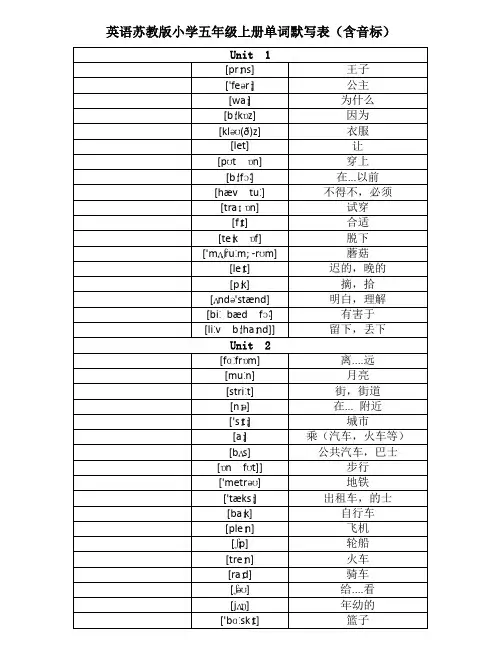
[teɪk]
搭乘
[getɒn]
上车
['steɪʃ(ə)n]车站[getɒf]下车
[wɔːk]
走,步行
['bʊkʃɒp]
书店
[nekst tuː]
在
[sʌn]
太阳
[ɑːsk fɔːhelp]
向...求助
[ɪk'skjuːz miː]
劳驾,对不起
[ə'lɒŋ]
沿着,顺着
[tɜːn raɪt]
向右转
['træfɪk laɪt]
甜的
[pest]
害虫
['ledɪbə:d]
瓢虫
[gəʊə'weɪ]
走了,离开
Unit 6
[geɪm]
运动,比赛
[smel]
有...气味,闻起来
[miːt]
(猪、牛、羊等的)肉
['vedʒtəb(ə)l;
'vedʒɪtə-]
蔬菜
[tə'mɑːtəʊ]
西红柿,番茄
[pə'teɪtəʊ]
马铃薯,土豆
[aɪkænt weɪt]
长颈鹿
[pɒɪnt æt]
指着,指向
[nek]
脖子
Unit 5
['peər(ə)nt]
父或母
[kliːn]
擦,洗
[kʊk]
烧,煮
[swiːp ðəflɔː]
扫地
['bɪzɪ]
忙,忙碌
[wɒʃðə'diʃiz]
洗碗
[meɪk ðəbed]
整理床铺
[grəʊ]
种植
['gɑːd(ə)n]
(完整word版)苏教版英语五年级1-8单元默写

五年级上册江苏译林(牛津)版英语五年级上册知识点整理Unit 1 Goldilocks and the three bears一、单词(默写)1.bear熊2.forest森林3.there(与be连用)有4.house房子5.soup汤6.just right正合适7.room房间8.hard硬的9.soft柔软的10.afraid害怕的11. their他们的12.her她(宾格)13.help救命14.beside在……旁边 15.between在……中间 16.really真正地17.then然后 18.find找到,发现19. in front of在……前面二、词组(默写)1、in the forest在森林里2、 a beautiful house一座漂亮的房子3、 hungry and thirsty又饿又渴4、some soup一些汤5、 too cold/hot太冷/热6、 in the room在房间里7、too hard/soft太硬/软8、three bears 三只熊9、have some cakes吃些蛋糕10、in the kitchen在厨11、 in the fridge在冰箱里 12、find their cousin发现他们的表弟三、句型(默写)1. There is a house in the forest.在森林里有一个房子。
2. There is some soup on the table.在桌子上有一些汤。
3. There are three bears in front of her.在她前面有三只熊。
4. This soup is too cold.这汤太冷了。
5. What a beautiful house! 多么漂亮的房子!6. She is hungry and thirsty.她是又饿又渴。
7.Bobby cannot(can’t) see any cakes in the fridge. 波比看不到冰箱里有蛋糕。
五年级上册英语译林版默写资料-带答案
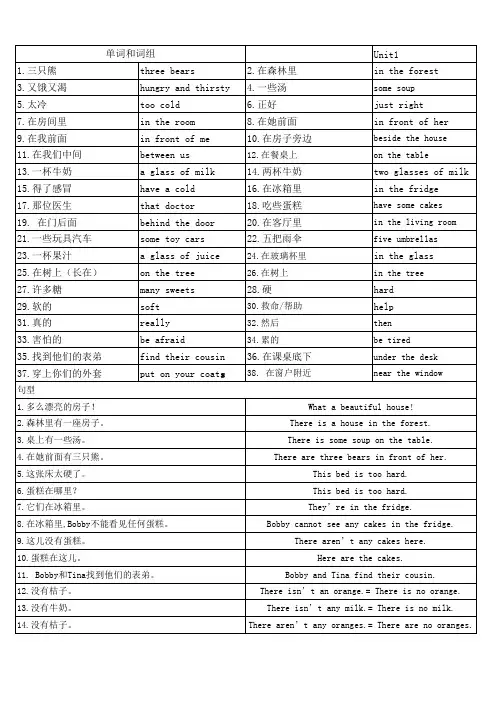
9.这儿没有蛋糕。
10.蛋糕在这儿。
11. Bobby和Tina找到他们的表弟。
12.没有桔子。
13.没有牛奶。
14.没有桔子。
2.在森林里 4.一些汤 6.正好 8.在她前面 10.在房子旁边 12.在餐桌上 14.两杯牛奶 16.在冰箱里 18.吃些蛋糕 20.在客厅里 22.五把雨伞 24.在玻璃杯里 26.在树上 28.硬 30.救命/帮助 32.然后 34.累的 36.在课桌底下 38. 在窗户附近
17.那位医生
that doctor
19. 在门后面
behind the door
21.一些果汁
a glass of juice
25.在树上(长在)
on the tree
27.许多糖
many sweets
29.软的
soft
31.真的
really
33.害怕的
be afraid
35.找到他们的表弟
find their cousin
37.穿上你们的外套
put on your coats
句型
1.多么漂亮的房子!
2.森林里有一座房子。
3.桌上有一些汤。
4.在她前面有三只熊。
5.这张床太硬了。
6.蛋糕在哪里?
7.它们在冰箱里。
8.在冰箱里,Bobby不能看见任何蛋糕。
What a beautiful house! There is a house in the forest. There is some soup on the table. There are three bears in front of her.
This bed is too hard. This bed is too hard. They’re in the fridge. Bobby cannot see any cakes in the fridge. There aren’t any cakes here. Here are the cakes. Bobby and Tina find their cousin. There isn’t an orange.= There is no orange. There isn’t any milk.= There is no milk. There aren’t any oranges.= There are no oranges.
五年级译林版英语单词默写

五年级译林版英语单词默写Unit 1 Goldilocks and the three bears.1. bear [beə(r)] n. 熊。
2. forest ['fɒrɪst] n. 森林。
3. there [ðeə(r)] (表示存在或发生)adv. 有;在那里。
4. house [haʊs] n. 房子。
5. soup [su:p] n. 汤。
6. just right [dʒʌst raɪt] 正合适;正好。
7. room [ru:m] n. 房间。
8. hard [hɑ:d] adj. 硬的。
9. soft [sɒft] adj. 柔软的。
10. afraid [ə'freɪd] adj. 害怕的。
11. in front of [ɪn frʌnt ɒv] 在……前面。
12. her [hɜ:(r)] pron. 她(宾格)13. help! [help] 救命!Unit 2 A new student.1. student ['stju:dnt] n. 学生。
2. classroom ['klɑ:sru:m] n. 教室。
3. second ['sekənd] num. 第二。
4. floor [flɔ:(r)] n. 楼层;地面。
5. computer [kəm'pju:tə(r)] n. 计算机。
6. third [θɜ:d] num. 第三。
7. first [fɜ:st] num. 第一;首先。
8. swing [swɪŋ] n. 秋千。
9. push [pʊʃ] v. 推。
10. heavy ['hevi] adj. 重的;沉的。
11. stop [stɒp] v. 停止;停下。
Unit 3 Our animal friends.1. animal ['ænɪml] n. 动物。
2. one...the other... [wʌn ði ˈʌðə(r)] 一个……另一个……3. body ['bɒdi] n. 身体。
译林版5下单词默写表打印版
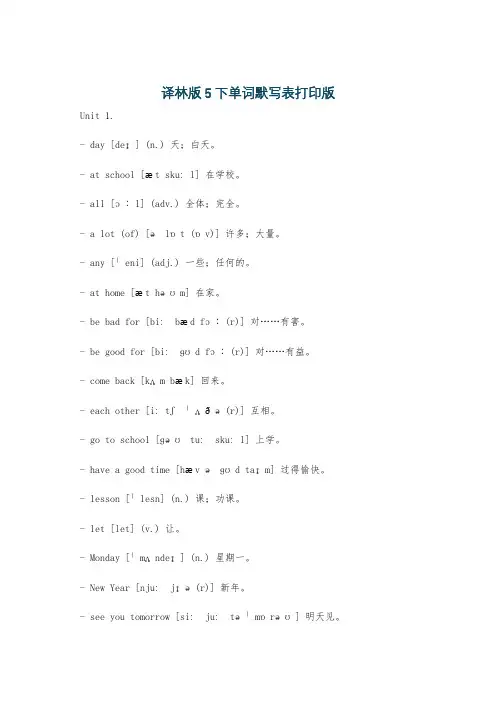
译林版5下单词默写表打印版Unit 1.- day [deɪ] (n.) 天;白天。
- at school [æt skuːl] 在学校。
- all [ɔːl] (adv.) 全体;完全。
- a lot (of) [ə lɒt (ɒv)] 许多;大量。
- any [ˈeni] (adj.) 一些;任何的。
- at home [æt həʊm] 在家。
- be bad for [biː bæd fɔː(r)] 对……有害。
- be good for [biːɡʊ d fɔː(r)] 对……有益。
- come back [kʌm bæk] 回来。
- each other [iːtʃˈʌðə(r)] 互相。
- go to school [ɡəʊ tuː skuːl] 上学。
- have a good time [hæv əɡʊ d taɪm] 过得愉快。
- lesson [ˈlesn] (n.) 课;功课。
- let [let] (v.) 让。
- Monday [ˈmʌndeɪ] (n.) 星期一。
- New Year [njuː jɪə(r)] 新年。
- see you tomorrow [siː juː təˈmɒrəʊ] 明天见。
- Tuesday [ˈtjuːzdeɪ] (n.) 星期二。
- Wednesday [ˈwenzdeɪ] (n.) 星期三。
- Thursday [ˈθɜːzdeɪ] (n.) 星期四。
- Friday [ˈfraɪdeɪ] (n.) 星期五。
- Saturday [ˈsætədeɪ] (n.) 星期六。
- Sunday [ˈsʌndeɪ] (n.) 星期日。
Unit 2.- parent [ˈpeərənt] (n.) 父;母。
- father [ˈfɑːðə(r)] (n.) 父亲。
- mother [ˈmʌðə(r)] (n.) 母亲。
五年级英语上册知识点整理(江苏译林牛津版)
Unit 1 Goldilocks and the three bears 一、单词(默写)1.bear熊2.forest森林3.there(与be连用)有4.house房子5.soup汤6.just right正合适7.room房间8.hard硬的9.soft柔软的10.afraid害怕的11.their他们的12.her她(宾格)13.help救命14.beside在……旁边15.between在……中间16.really真正地17.then然后18.find找到,发现19. in front of在……前面二、词组(默写)1、in the forest在森林里2、a beautiful house一座漂亮的房子3、hungry and thirsty又饿又渴4、some soup一些汤5、too cold/hot太冷/热6、in the room在房间里7、too hard/soft太硬/软8、three bears 三只熊9、have some cakes吃些蛋糕10、in the kitchen在厨11、in the fridge在冰箱里12、find their cousin发现他们的表弟三、句型(默写)1. There is a house in the forest.在森林里有一个房子。
2. There is some soup on the table.在桌子上有一些汤。
3. There are three bears in front of her.在她前面有三只熊。
4. This soup is too cold.这汤太冷了。
5. What a beautiful house! 多么漂亮的房子!6. She is hungry and thirsty.她是又饿又渴。
7.Bobby cannot(can’t) see any cakes in the fridge. 波比看不到冰箱里有蛋糕。
五年级英语单词默写(译林版)
深切悼念大哥路大荒先生
路鸿烈
【期刊名称】《山东图书馆学刊》
【年(卷),期】2009(000)003
【摘要】我挥笔在稿纸上写下这个题目,无意中看到桌子的右边一沓稿纸上也写
着这样一个题目,我正在思绪无边的乱想写什么,不知是什么时候写下的这个题目。
啊!已经一年多了,好长时间未曾写字了,这是去年春节刚过为纪念我家宅院被日
寇烧光七十周年,而想写点什么,由于题目写下后,牵扯到的事太多,心情太重未曾写下去,只写了这个题目。
【总页数】1页(P160)
【作者】路鸿烈
【作者单位】文史委员会
【正文语种】中文
【相关文献】
1.怀念我的爷爷路大荒——悼念路大荒先生逝世三十七周年 [J], 路应和
2.王曰才:永不陨落的巨星——深切悼念王曰才先生 [J], 《国外测井技术》编辑部
3.大山倒地亦巍然,万民为你吼老腔——深切悼念作家陈忠实先生 [J], 忽培元
4.深切悼念一代文献宗师马继兴先生 [J],
5.像蜜蜂一样勤奋的一生——深切悼念徐万林先生 [J], 杨玉华
因版权原因,仅展示原文概要,查看原文内容请购买。
新牛津译林版英语五年级上册单词默写
( 5A)Unit 11.bear 熊2.forest 森林3.there(与be连用)有4.house 房子5.soup 汤6.just right 正合适,正好7.room 房间8.hard 硬的9.soft 柔软的10.afraid 害怕的11.in front of …前面12.her 她13.Help! 救命啊!14.beside 在……旁边15.between在……中间16.really 真的17.then 然后18.find 找到,发现Unit 21.student 学生2.show …around 带…参观3.classroom 教室4.second 第二5.floor 楼层puter 电脑7.third 第三8.first 第一;首先9.playground 操场10.swing 秋千11.push 推12.heavy 重的,沉的13.stop 停下,停止14.high 高的15.great 很多的,极大的( 5A)Unit 11.________ 熊2.________ 森林3.________(与be连用)有4.________ 房子5.________ 汤6.______________ 正合适,正好7.________ 房间8.________ 硬的9.________ 柔软的10.________ 害怕的11._________________…前面12.________ 她13.________ 救命啊!14.________ 在……旁边15.________在……中间16.________ 真的17.________ 然后18.________ 找到,发现Unit 21.________ 学生2.__________________带…参观3.________ 教室4.________ 第二5.________ 楼层6.________ 电脑7.________ 第三8.________ 第一;首先9._____________ 操场10.________ 秋千11.________ 推12.________ 重的,沉的13.________ 停下,停止14.________ 高的15.________ 很多的,极大的( 5A)Unit 11.________ 熊2.________ 森林3.________(与be连用)有4.________ 房子5.________ 汤6.______________ 正合适,正好7.________ 房间8.________ 硬的9.________ 柔软的10.________ 害怕的11._________________…前面12.________ 她13.________ 救命啊!14.________ 在……旁边15.________在……中间16.________ 真的17.________ 然后18.________ 找到,发现Unit 21.________ 学生2.__________________带…参观3.________ 教室4.________ 第二5.________ 楼层6.________ 电脑7.________ 第三8.________ 第一;首先9._____________ 操场10.________ 秋千11.________ 推12.________ 重的,沉的13.________ 停下,停止14.________ 高的15.________ 很多的,极大的( 5A)Unit 11.________ 熊2.________ 森林3.________(与be连用)有4.________ 房子5.________ 汤6.______________ 正合适,正好7.________ 房间8.________ 硬的9.________ 柔软的10.________ 害怕的11._________________…前面12.________ 她13.________ 救命啊!14.________ 在……旁边15.________在……中间16.________ 真的17.________ 然后18.________ 找到,发现Unit 21.________ 学生2.__________________带…参观3.________ 教室4.________ 第二5.________ 楼层6.________ 电脑7.________ 第三8.________ 第一;首先9._____________ 操场10.________ 秋千11.________ 推12.________ 重的,沉的113.________ 停下,停止14.________ 高的15.________ 很多的,极大的Unit 31.one …, the other 一个,另一个2.body 身体3.no 没有,无4.leg 腿5.or 也不,也没有6.arm 手臂7.wing 翅膀8.foot 脚,足9.give 给10.rabbit 兔子11.finger 手指Unit 41.hobby 业余爱好2.be good at 擅长于3.with 与……一起4.also 也5.read 读,阅读6.story 故事7.a lot of 很多8.play the piano 弹钢琴9.dance 跳舞10.watch films 看电影11.sing 唱歌12.both 两个都13.group 组14.idea 主意15.ice 冰16.hole 洞17.Look out! 当心!注意!18.wet 湿的,潮的Unit 31._______________一个,另一个2.________身体3.________没有,无4.________腿5.________ 也不,也没有6.________ 手臂7.________ 翅膀8.________ 脚,足9.________ 给10.________ 兔子11.________ 手指Unit 41.________ 业余爱好2.____________擅长于3.________ 与……一起4.________ 也5.________ 读,阅读6.________ 故事7.________ 很多8._______________弹钢琴9.________ 跳舞10.________ 看电影11.________ 唱歌12.________ 两个都13.________ 组14.________ 主意15.________ 冰16.________ 洞17.________ 当心!注意!18.________ 湿的,潮的Unit 31._______________一个,另一个2.________身体3.________没有,无4.________腿5.________ 也不,也没有6.________ 手臂7.________ 翅膀8.________ 脚,足9.________ 给10.________ 兔子11.________ 手指Unit 41.________ 业余爱好2.____________擅长于3.________ 与……一起4.________ 也5.________ 读,阅读6.________ 故事7.________ 很多8._______________弹钢琴9.________ 跳舞10.________ 看电影11.________ 唱歌12.________ 两个都13.________ 组14.________ 主意15.________ 冰16.________ 洞17.________ 当心!注意!18.________ 湿的,潮的Unit 31._______________一个,另一个2.________身体3.________没有,无4.________腿5.________ 也不,也没有6.________ 手臂7.________ 翅膀8.________ 脚,足9.________ 给10.________ 兔子11.________ 手指Unit 41.________ 业余爱好2.____________擅长于3.________ 与……一起4.________ 也5.________ 读,阅读6.________ 故事7.________ 很多8._______________弹钢琴9.________ 跳舞10.________ 看电影11.________ 唱歌12.________ 两个都13.________ 组14.________ 主意15.________ 冰116.________ 洞17.________ 当心!注意!18.________ 湿的,潮的Unit 51.teacher 老师2.teach 教3.writer 作家4.write 写5.work 工作6.at home 在家7.doctor 医生8.help 帮助9.sick 生病的10.people 人;人们11.factory 工厂12.worker 工人13.cook 厨师14.driver 驾驶员,司机15.farmer 农民16.nurse 护士17.policeman 警察Unit 61.e-friend 网友2.Wait a minute. 等一会。
最新英语苏教版(译林)小学五年级下册单词默写表(分单元-含音标)
[tə'geðə]
一起
[geɪm]
游戏
[mɑːtʃ]
三月
[dʒʊ'laɪ]
七月
[ɔː'gʌst]
八月
[dɪ'sembə]
十二月
['hɪərəʊ]
英雄
[pleɪ]
戏,戏剧
['nʌmbə]
数字,数
['pɑːswɜːd]
密码
['ɑːnsLeabharlann ]答案[fɔːθ]
第四
[stɑːt]
开始
[faɪt]
打仗,打架
(一)对“漂亮女生”饰品店的分析情感性手工艺品。不少人把自制的手机挂坠作为礼物送给亲人朋友,不仅特别,还很有心思。每逢情人节、母亲节等节假日,顾客特别多。Unit 1
然而影响我们大学生消费的最主要的因素是我们的生活费还是有限,故也限制了我们一定的购买能力。因此在价格方面要做适当考虑:我们所推出的手工艺制品的价位绝大部分都是在50元以下。一定会适合我们的学生朋友。
下车
[wɔːk]
走,步行
['bʊkʃɒp]
书店
[nekst tuː]
在
[sʌn]
太阳
[ɑːsk fɔːhelp]
向...求助
[ɪk'skjuːz miː]
劳驾,对不起
[ə'lɒŋ]
沿着,顺着
[tɜːn raɪt]
向右转
['træfɪk laɪt]
交通灯
[ɒn jɔːraɪt]
在你的右侧
['sɪnɪmə; -mɑː]
出租车,的士
[baɪk]
自行车
[pleɪn]