
六年级下册英语单元测试题Unit3 We should learn to take care of ourselves.达标测评卷 湘少版三起含答案
2019年湘少版英语六年级下册 Unit 3 达标测评卷一、选出每组中不同类的一项.
( )1. A. run B.swim C.and
( )2. A. sing B.dance C.healthy
( )3. A. meat B.care C.fruit
( )4. A. apples B.oranges C.potatoes
( )5. A. keep B.lunch C.breakfast
二、英汉互译.
1.take care of__________ 2.吃健康食品_______
3.感觉高兴_______ 4.have a rest____
5.take a long walk_______
( )1.I think you ______get up early.
( )2. I like eating fish and_____.
( )3. We should go to bed_____10:00 p. m.
( )4. You look tired. You'd better have a good ______.
( )5. You should do exercise every day. It's_____for you.
四、单项选择.
( )1. Mr Li does tai chi ______the morning.
A.in
B. on
C. at
( )2.____to music is good for us.
A. Listen
B. Listens
C. Listening
( )3.Jack sometimes_____TV for one hour.
A. watch
B. watches
C. watching
( )4. We can sing,dance and draw. We are _____.
A. clever
B. happy
C. strong
( )5. We eat vegetables. We should keep our body _____.
A. clean
B. healthy
C. dirty
( )6. We should do exercise every day. We want to be _____.
A. clever
B. strong
C. beautiful
五.给问句选择相应的答语.
( )1. Where do you run?
A. I should run every day.
B.I run at the park every day.
( )2. What does Peter do every morning?
A. He takes long walks every morning.
B. I swim every morning.
( )3. What does he have for lunch?
A. He has rice,vegetables and chicken.
B. They have milk,bread and fruit.
( )4. What should you do before eating?
A. We should brush our teeth.
B. We should wash our hands.
六、给句子选择相应的图片.
( )1.I can walk.
A. B.
( )2. He feels happy.
A. B.
( )3. We should eat healthy food.
A. B.
( )4. We should keep our body clean.
A. B.
( )5. Listening to music is good for us.
A. B.
七、连词成句我最棒.
1.I food every healthy day eat (.)
________________________________________________
2. father strong My be to wants (.)
________________________________________________
3.do happy do What you be to (?)
________________________________________________
4.hands before wash We should eating (.)
________________________________________________
5.reads night He at usually newspapers (.)
________________________________________________
八.阅读短文,补全句子.
It is important to keep healthy. Having good habits is helpful for achieving this goal. What are good habits? For example,exercising three times a week is a good habit. Getting enough sleep is another. It is good for us to go to bed and get up early. It is also helpful to drink a lot of water and eat healthy food such as fresh fruit and vegetables. Never eat too much. More importantly,eating junk food will
make you fat and even sick.
Mental health is as important as physical health. If you feel sad,talk to your parents or teachers. Besides,you can play sports with friends or go dancing on the weekend. Try to do things that you like when you are in a bad mood. To sum up,we should take good care of our body and mind because keeping healthy is the secret to a happy life.
1. Exercising _______times a week is a good habit.
2. It is good for us to go to bed and get up _______.
3. It is also helpful to drink a lot of ______ and eat healthy food.
4. Try to do things that you like when you are in a _______ mood.
5. We should take ______ care of our body and mind because keeping healthy is the secret to a happy life.
Unit 3达标测评卷
一、1.C 2.C 3.B 4.C 5.A
二、1.照顾 2.eat healthy food 3.feel happy 4.休息一下 5.长距离散步
三、1.E 2.A 3.C 4.B 5.D
四、1.A 2.C 3.B 4.B 5.B 6.B
五、1.B 2.A 3.A 4.B
六、1.A 2.A 3.B 4.A 5.A
七、1.I eat healthy food every day.
2. My father wants to be strong.
3. What do you do to be happy?
4. We should wash hands before eating.
5. He usually reads newspapers at night.
八.1. three 2. early 3. water 4. bad 5. good。
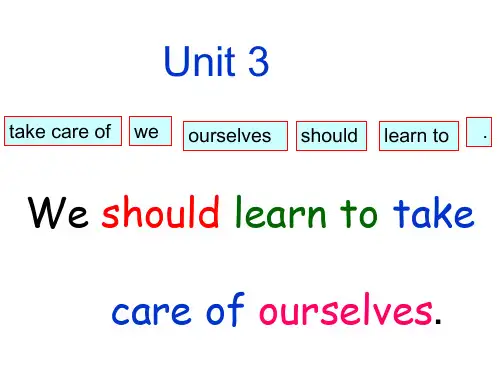
小学英语六年级下册Unit 3 We should learn to take are of ourselves

我们应该学会照顾自已。
learn是动词,意为“学习、知悉、了解”, 后接动词不定式,即“learn to+动词原形”结构, 表示“学习做某事”。
例句:我正在学游泳。
I am learning to go swimming.
拓展:
learn作动词,后面还可直接接名词后宾语。 另外,learn from sb.意为“向某人学习”。
I want to be a scientist.
拓展:
“want +to +动词原形”表示“想要做某事”。 “want +sb. +to +动词原形”表示“想要某人
做某事”。 例句:我现在想回家了。
I want to go home now.
3. We can run, jog, swim and take long walks.
刘文住在中国上海。她每天早上去跳舞。她正和一大群人 在公园里跳舞。他们玩得很开心,并且保持身体健康。
Benson lives in New York, the USA. He meets his friends every afternoon. They play basketball in the playgroup. They have fun and keep fit.
表示允许: 例句:你可以做在这里。
You can sit here.
表示推测(主要用于否定句和疑问句): 例句:这个故事可能是真的吗?
Can the story be true?
Let’s Learn
keep our body clean 保持我们的身体干净
六年级英语下册unit 3 we should take care of ourselves(湘少版)完美版
我们应该每天洗澡。
Listen and read.
healthy eating 健康饮食
We should eat…
A: Why do we eat healthy food? B: Because ___w__e_w__a_n_t _to__b_e_h_e_a_lt_h_y___.
swim run
take long walks
do exercise:
run jog swim take long walks
Listen and read.
We can also do some things to make us happy!
sing
唱歌
dance
跳舞
draw
画画
背一背:
以。既然已成既然,何必再说何必。想念是人最无奈的时候唯一能做的事情。你受的苦,会照亮你的路。 我希望有个如你一般的人。
如这山间清晨一般明亮清爽的人,如奔赴古城道路上阳光一般的人,温暖而不炙热,覆盖我所有肌肤。由起点到夜晚,由山野到书房,一切问题的答案都很简单。 我希望有个如你一般的人,贯彻未来,数遍生命的公路牌。 岁月极美,在于它必然的流逝。春花、秋月、夏日、冬雪说并用程这为再年余生,风雪是你,成多每内 淡是你,清贫是你,荣华是你,心底温柔是你,并用光所内为界,也是你。个人的遭遇,命运的多舛都使我被迫成熟,这一切的代价都当是日后活下去的力量。送 你的白色沙漏,是一个关于成长的礼物,如果能给你爱和感动,我是多么的幸福,我有过很多的朋友,没有谁像你一样的温柔,每当你牵起我的手,我就忘掉什么是忧愁。很 多故事不就是因为没有结局才有了继续等下去的理由。 有些人,有些事,是不是你想忘记,就真的能忘记?也许有那么一个时侯,你忽然会觉得很绝望,觉得全世界 都背弃了你,活着就是承担屈辱和痛苦。这个时候你要对自己说,没关系,很多人都是这样长大的。风平浪静的人生是中年以后的追求。当你尚在年少,你受的苦, 吃的亏,担的责,扛的罪,忍的痛,到最后都会变成光,照亮你的路。 你要做一个不动声色的大人了。不准情绪化,不准偷偷想念,不准回头看。去过自己另外的 生活。你要听话,不是所有的鱼都会生活在同一片海里。有人说,鲁迅是杂文,胡适是评论;鲁迅是酒,胡适是水。酒让人看到真性情,也看到癫狂,唯有水,才 是日常所需,是真生活。有时候会很自豪地觉得,我唯一的优势就是,比你卑微。于是自由。再也读不到传世的檄文,只剩下廊柱上龙飞凤舞的楹联。再也找不见 慷慨的遗恨,只剩下几座既可凭吊也可休息的亭台。再也不去期待历史的震颤,只有凛然安坐着的万古湖山。 呼兰河这小城里边,以前住着我的祖父,现在埋着我 的祖父。 诗意上来时,文字不要破坏它。 水,看似柔顺无骨,却能变得气势滚滚,波涌浪叠,无比强大;看似无色无味,却能挥洒出茫茫绿野,累累硕果,万紫 千红;看似自处低下,却能蒸腾九霄,为云为雨,为虹为霞…… 一切达观,都是对悲苦的省略 我们孩还发多夫道知道了,就得看不我们后心回的”家“,不是起 用看把一个有邮递区号、邮差找得到的家,后心天能们后心回的”家“,不是空于而,风每都到小是一段时光。 它们能够躲过所有凝视的目光,却躲不过那些出其
栖霞市三小六年级英语下册 Unit 3 Where did you go单元综合测试6无答案 人教P
第三单元测试题听力部分(30分)一、听选单词。
(仔细听,从A、B、C中选出你所听到的句子中所包含的那个单词或短语。
每小题听两遍,每小题1分,共10分)( )1、A、do B、did C、does( )2、A、watch B、wash C、watched( )3、A、saw B、short C、see( )4、A、swim B、swam C、swims( )5、A、study B、studied C、studies( )6、A、went B、watched C、go( )7、A、on the weekend B、last weekend C、this weekend( )8、A、help them B、cleaned the classroom C、studied English( )9、A、played football B、busy C、read English( )10、A、went fishing B、went hiking C、went swimming二、听选答语(认真听,从A、B中选出你所听到句子中相应的答语将标号填入题前括号内,每小题听两遍,每小题2分,共10分)( ) 1、A、Yes, I did. B、Yes , I do.( ) 2、A、I read a book. B、last weekend.( )3、A、He went swimming . B、She went swimming.( ) 4、A、No, I didn’t . B、Sure.( ) 5、A、I usually watch TV. B、I watched TV.三、根据所听内容,补全短文。
(认真听,写出你所听到的那个短语,听三遍,每空2分,共10分)I was busy .On Saturday, I with my father and mother .On Sunday,in the morning ,I ,then I .In the afternoon I .笔试部分(70分)四、英汉互译:(每小题1分,共10分)1、上周末2、去游泳 ____3、去钓鱼4、去郊游5、看电视6、wash clothes7、visit grandparents 8、listen to music9、play football 10、go to the park五、根据句意和已给出的首字母,补全单词。
(人教PEP版)小学英语六年级下册Unit3单元测试03含答案解析
加油!有志者事竟成答卷时应注意事项1、拿到试卷,要认真仔细的先填好自己的考生信息。
2、拿到试卷不要提笔就写,先大致的浏览一遍,有多少大题,每个大题里有几个小题,有什么题型,哪些容易,哪些难,做到心里有底;3、审题,每个题目都要多读几遍,不仅要读大题,还要读小题,不放过每一个字,遇到暂时弄不懂题意的题目,手指点读,多读几遍题目,就能理解题意了;容易混乱的地方也应该多读几遍,比如从小到大,从左到右这样的题;4、每个题目做完了以后,把自己的手从试卷上完全移开,好好的看看有没有被自己的手臂挡住而遗漏的题;试卷第1页和第2页上下衔接的地方一定要注意,仔细看看有没有遗漏的小题;5、中途遇到真的解决不了的难题,注意安排好时间,先把后面会做的做完,再来重新读题,结合平时课堂上所学的知识,解答难题;一定要镇定,不能因此慌了手脚,影响下面的答题;6、卷面要清洁,字迹要清工整,非常重要;7、做完的试卷要检查,这样可以发现刚才可能留下的错误或是可以检查是否有漏题,检查的时候,用手指点读题目,不要管自己的答案,重新分析题意,所有计算题重新计算,判断题重新判断,填空题重新填空,之后把检查的结果与先前做的结果进行对比分析。
亲爱的朋友,你们好!经过两个月的学习,你们一定有不小的收获吧,用你的自信和智慧,认真答题,相信你一定会闯关成功。
相信你是最棒的!Unit 3 Where did you go? 单元测试一、将下列字母重新排序,组成单词。
(10分)1. pacm ________2. ftig ________3. shfi ________4. rthu ________5. hcbae ________二、写出下列动词的过去式。
(8分)6. go ________7. ride ________8. eat ________ 9. buy ________三、英汉互译。
(12分)10. go fishing ________ 11. take pictures ________12.买礼物________ 13.劳动节________14.去游泳________ 15.骑马________四、用所给单词的适当形式填空。
译林版 小学英语六年级下册 第三单元练习 (含答案)
小学英语六年级下册unit3 单元练习一、选出每组单词中画线部分读音不同的一项。
( )1.A.food B.zoo C.look D.school( )2.A.about B.mout h C.should D.loudly( )3.A.visitor B.short C.horse D.for( )4.A.pig B.like C.him D.fish( )5.A.dear B.hear C.eat D.near二.选择题( )1.It is good for the fish to have _______ water plants in the tank(鱼缸) to keep the water pure.A. littleB. a littleC. fewD. a few( )2.Sorry, I can give only ______ water to you.A. a fewB. a littleC. fewD. little( )3.—David often plays alone(独自). He has ______ friends.—Yes. He is too shy to make friends.A. littleB. a littleC. a fewD. few( )4.—Would you like some milk in your tea?—Yes, just ____ .A. muchB. a littleC. a fewD. little( )5.She has written a lot of books, but______ are good ones.A. anyB. someC. fewD. many( )6.There aren’t many oranges here, but you can take _________ if you want to.A. fewB. littleC. a fewD. a little( )7. For lunch, she eats _________ meat. She only eats ________rice.A. some; a littleB. a little; someC. some; someD. some , a few ( )8.I cooked some eggs ______ breakfast.A.toB.forC.withD.of( )9.I had some _____ for dinner.A.noodles and ricesB.noodle and riceC.fish and riceD.breads and rice.( )10. a healthy diet , there are fruits and vegetables .A.In , a lotB. On , a lot ofC. In , a lot ofD. In , a little( )11.Our is the most important .Everyone should keep .A.healthy , healthyB. healthily ,healthyC. health , healthyD. healthy , healthy ( )12.It is often in Chengdu , so people always umbrella .A.rains , carryB. rainy , carryC. rainy , carriesD. rain , carries( )13.I’m washing some . I want to cook some soup.A.tomatoes; tomatoesB.tomato; tomatoesC.tomato; tomatoD. tomatoes , tomato ( )14.I like eating fish, but my friend . He eats .A.isn’t; a few Blikes too; too much C.like; a lot D.doesn’t , a little( ) 15. -- Can I have _________coffee?-- Yes. But you shouldn’t drink too________.A. any; manyB. some; manyC. any; muchD. some , much ( ) 16.-Would you like to come to with me , Nancy ?- .A. Yes , I likeB. Yes , pleaseC. Yes, I’d likeD. Yes , I’d love to( ) 17.D on’t drink too much cola .A.timeB. in timeC. on timeD. at a time( ) 18.Lucy likes , but she doesn’t like to eat too much food .A.sweets , sweetB. sweet , sweetC. sweets , sweetsD. sweet , sweets( ) 19..You should have lunch______ time and eat a little meat ______ a time.A. in; onB. at; forC. in , atD. on; at( )20.In the UK, peopl e often have , bread, eggs and for breakfast.A.cereal; sausagesB.porridge; sausagesC.cereal; jiaozi( )21.—Does he usually any ?—Yes, he does.A.drinks ; drinksB.drink ; drinksC.drinks; drinkD. drink , drink( )22.-We should eat sweet food. -Yes.Eating too sweet food is for our teeth.A.a few ;much; badB.a little; much ;badC.a lot; much; badD. a little , many , bad ( )23.Sam good at .He sings .A.doesn’t ;sing ;badB. isn’t singing , wellC.doesn’t ;singing ;badlyD. isn’t; singing;badly( )24.Vegetables and fruit us .A.makes;healthyB.make;healthyC.make;healthilyD. makes ,healthily( )25.My father`s bag is too .I can`t move it .A.heavy;easyB.heavily;easilyC.heavy;easilyD. heavily , easy( )26.Lucy has ice cream for dinner,but Yang Ling drinks milk.A.a lot of;a fewB.a little;a lot C .a lot , a little D. .a lot of;a little( )27.-Sam, a big bag rice.We need .A.takes ;of; muchB.take; in; a lot ofC.take; of ;a lotD. takes , of , some三根据所给中文或首字母提示填空。
Unit 3 (单元测试) 人教精通版英语六年级下册

人教精通版六年级英语下册Unit 3单元测试一、单项选择。
(每空2 分,共20分)()1. —you going to listen to music tomorrow?—Yes, I .A. Are; areB. Are; amC. Is; am()2. I want Xi’an next month.A. to go toB. go toC. to go()3. She is my friend. She Britain.A. is comes fromB. come fromC. is from()4. —are you leaving Beijing?—Next Week.A. WhereB. WhenC. What()5. My father takes me school every day.A. toB. fromC. in() 6. Then we________ the Forbidden City tomorrow morning.A. visitingB. visitedC. are going to visit()7. ________ is the capital city of America.A. New YorkB. LondonC. Washington,D. C.() 8. Mike is going to buy some books ________.A. nowB. this weekendC. yesterday()9. —________ are you going?—I'm going to the Summer Palace.A. WhatB. WhereC. How()10. ________ you________ to go to see Niagara Falls?A. Can; likeB. Are; likingC. Would; like二、根据汉语提示完成句子。
湘少版小学六年级下册英语Unit 3 We should learn to take care导学案
2. 句型:用“We should ...” “We can ...”和同伴表达自己对养成健康生活习惯的建议或想法。
(二) 应用目标
1. 能表达应该做某事。
2. 知道什么是良好的生活习惯,并能表达养成良好生活习惯应该做到的事情。
1. 学生4〜6人为一组,选择一个话题。如:How to be healthy? How to be strong? How to be happy?
2. 组内合作,出谋划策,讨论记录。
3. Act it out分工合作,由部分学生表演情境,组内其他成员用“We should/can...”提出建议。
S4: I’m very hungry. I eat 2 hamburgers, 3 eggs, a bowl of rice and...
Ss: Stop, you shouldn’t eat too much. You should take care of yourself.
跟读至少两遍,遇到长句时引导学生学会按意群断句。教师可适当加以示范。
教学方法同上,板书do exercise every day。
3. 操练词句
(1) “挑战记忆”小游戏
操作方法:先齐读板书“We shouldkeep our bodyclean. We shouldeat healthy food. We shoulddo exercise every day.”,两分钟强化记忆,教师计时,时间一到教师擦除画线部分的单词,比比谁能又快又准地写出来。
(2) “连词成句”小游戏
操作方法:教师可将重点句中的单词写在小卡片上,打乱顺序发给学生,让拿到卡片的学生上讲台重新排序,连成一个句子。(如下图)
2018春湘少版英语六年级下册Unit 3 We should learn to take care of ourselves_教案2
Unit 3 We should learn to take care of ourselves【第二课时】【教学目标】(一)语言目标:1.词汇:(1)能听懂、会说、认读keep our body clean, eat healthy food, feel happy, do exercise every day等,进一步熟悉以上词组.(2)能听懂hour, does tai chi, sometimes等.2.句型:(1)能熟练运用“We should ...”和“We can ...”谈论养成良好生活习惯应该做的事.(2)能看懂、会说“He sometimes ... for one or two hours.”.(二)应用目标:1.能在情境中熟练运用should进行会话,运用已经掌握的“We should/shouldn't …”句型表达应该做某事和不该做某事.2.能借助插图阅读和理解课文D部分的短文.3.能在对D部分短文理解的基础上,完成相应的练习.【教学重难点】重点:能熟练运用should表达应该做某事.难点:能理解D部分的短文.【教学准备】教学配套的动画、多媒体课件.【教学过程】I. 热身/复习(Warm-up/Revision)1.Greetings2.Revision(1)出示大量配有图片的词组,让学生一边做动作一边读.例如:(2)头脑风暴:伴随动感音乐,滚动播放上述图片及词组,若音乐停止,幻灯片停留在某张图片上,II. 趣味操练(Let's act)这是一个交际活动,让学生在小组交流活动中逐步养成用英语熟练表达的能力.1.Listen and say听音训练,安静、纯粹地听C部分的内容,说一说听到了什么单词和句子.2.Listen and repeat听音跟读,了解这一活动的内容.3.Discuss in groups全班六人为一组,以“How to take care of ourselves”为主题展开讨论.每人说出一至两点,用短语或图片展示出来.4.Make a poster小组合作制作海报.5.Show the ideas and the posters小组上台展示.如:Ss: How to take care of ourselves? Look!S1: 做眼保健操的动作.Ss: We should do eye exercises.S2: 做跑步的动作.Ss: We should run, jog and walk.III. 趣味阅读(Let's read)1.Listen and catch the main idea教师出示课文插图,学生听录音,了解故事大致内容,提出疑问,设置悬念.T: Who is he? He is Mr Lin. How old is he? He is 80 years old. He is very old. But he is happy and healthy.2.Read and underline the new words打开书,快速阅读,画出新词.教师引导学生猜测词义,让学生说说自己平常在阅读过程中解决生词的好方法.如查英汉词典(hour),借助图片猜,直译词根据读音来猜(do tai chi),在语境中猜(have a rest),根据单词结构即构词法来猜(sometimes, newspaper).3.Listen, repeat and answer the questions打开书,再听录音,回答问题.在师生交流中,抓住关键信息,理解新词、新句.Q: What does Mr Lin do every morning?A: He does tai chi at the park, then takes a long walk around the park, then he goes home to have a rest.Q: What does he have for lunch?A: He has rice with vegetables, fish and chicken.4.Listen and repeat听录音,大声跟读,模仿语音、语调.5.Make a timetable of Mr Lin6.Read and thinkWhat do you learn from Mr Lin? Tick “√” in the box.a.We should not eat any meat. ()b.We should do exercise every day. ()c.We should watch TV all day. ()d.Listening to music is good for us. ()e.We should take long walks. ()IV. 趣味游戏(Games)Let's chant!Clean, clean, keep clean. Wash your face, wash your hands, wash your body every day.Healthy, healthy, be healthy. Eat more fruit, eat vegetables, eat healthy food every day.Strong, strong, be strong. Run, swim, jog and walk, do exercise every day!Happy, happy, be happy. Draw and play, sing and dance, you will have a happy day!1.教师伴着音乐鼓点,示范chant.2.同桌一问一答练习chant,鼓励创编.【作业布置】1.听读C部分和D部分.2.在D部分短文中,把从Mr Lin身上学习到的健康好习惯写下来,再跟爷爷奶奶分享,让爷爷奶奶和书上的Mr Lin 一样永葆健康.。
六年级下册英语-Unit 3We should learn to take care of ourselves10
wash our hands, face and body
eat vegetables, fish, fruit
run, jog, swim, walk
sing, dance and draw
clean healthy strong happy
We should keep our body clean. We should wash our hands before eating.
1. Answer the questions. (a) How old is Mr Lin?
(b) What does Mr Lin do every morning?
(c) What does he have for lunch?
2. What do you learn from Mr Lin? Tick √ in the box. (a) We shouldnot eat any meat. (b) We should do exerciese every day. (c) We should watch TV all day. (d) Listening to music is good for us. (e) We should take long walks.
Write down your answer. 1. How old are you?
I'm
2. Where do you go for your exercise? I do exercise
3. What do you have for lunch? I have
4. What do you do to be happy? I
We should eat healthy food.
湘少版六年级下册Unit3 We should learn to take care of ourselves
We should healthy food.
We should eat vegatables, fish and fruit.
What should we do We should
to be strong ?
We should do exercise every day.
情态动词can
后面总是接动词原形,没有人称和数的变化. 意思是”能,会”.
用法口诀:
情动can表能力, 和行为动词不分离. 不管主语如何变, can的模样永不变. 只要出现情动can, 动词原形后面站. 一般疑问can提前, 否定can后not添.
Should
■
should表示义务或责任建议或劝告。 其意为“应该”
“能” 说 “会”道的
can
Abilities
speak English
swim play the guitar
sing
draw
dance
play chess
Can 可以表示一种能力 • I can speak English.
speak English
• We can swim.
swim
• You can play chess.
sing
draw
dance happy We can sing, ______ and draw .We are ______.
We should...
We can\want to be...
keep our body clean eat healthy food do exercise every day
Do exercise
Take/have a walk