
新人教版英语八年级上册--unit4课文重难点讲解
2014八年级上Unit4 What’s the best movie theater重点单词:comfortable service seat pretty screenmagician close beautifully worst winnerCheaply prize choose everybody carefullyPoor reporter seriously comfortably giveworse crowded重点短语so far comfortable seats have...in common close to homebig screens all kinds of radio stations be up totake...seriously play a role talented dancer make upfor example重点句型1. What’s the best movie theater to go to2. It has the worst service.3. What do you think of 970 AM’s up to you to decide.think that the lives of the performers are made up.语法: 形容词和副词的最高级用法。
1. comfortable 使人舒服的;舒适的 ; 反义词uncomfortableI think Red Star Cinema is the most comfortable movie theater.2.close: be close to..The church is close to the school.She is very close to her father.If you close your eyes, you can’t see anything.3.Choose 动词:选择; choice名词。
Choose from..There are too many books to choose from.I want to choose a watch for him.=I want to choose him a nice watch.She usually spends much time choosing the best shoes.Make a choice between A and B.4.service 名词:接待,服务; 动词:serveThe food was good, but the service was poor.He served in the army for three years.7.How do you like it so farHow do you like.....=What do you think of... What do you think of the film=How do you like the film So far到目前为止,与until now/up to now同义。
So far, there is no news about them.8.worst 最差的,最恶劣的。
是bad/badly/ill的最高级。
The worst runner comes last in the race.9.Thanks for telling me. Thanks for...因...而感谢:Thanks for your help. Thanks for inviting me.10.He’s much better than other actors at finding.....Be good at 比较级:be better than....at....Another, 三个或以上不定数目的“另一个”:Would you like another glass of milkOther, +复数名词;也可+单数名词但前面要加限定词:Now open your other eye.The other, 特指,两者中的另一个(the other+单数名词)或两部份中的另一部分(the other+复数名词)。
The fruit shop is on the other side of the street.Others=other+复数名词;“剩下的一些”You should take care of others(other people).The others=the other+复数名词: 特定范围内剩下的全部:One of their teachers is with them, the others (the other teachers) are having a meeting. any other, +单数名词:“其它任何一个”Li Lei is taller than any other boy in his class. =Li Lei is taller than the other boys in his class.11.loud 可当形容词,也可当副词。
与loudly同义,但用于比较级和最高级时,用loud不用loudly.He has a loud voice.Please speak loud/loudly.Who sang the loudest12.Similar, be similar to...My bag is similar to his.be the same as.... 与...一样。
My bag is the same as his.be different from...与...不同。
My bag is different from his.13.try to do sth. “努力做...” I try to open the box.Try doing sth.“试着做...”14.Talent名词:天才,才干;talented形容词: She is a talented singer.15.Look for, find, find out:Look for: 寻找: Your mother is looking for you.Find: 找到(短暂性动词):Did you find your English book发现: I find it easy to learn English well.Find out: 出现,找出,查明(多指通过调查,询问等搞清楚,弄明白): We found out that he did wrong.16.Get :Get sth. done 使某事被做: I want to get my hair cut.Get sth/sb. to do.... 使某物/人去做...: Nobody can get him to work hard.Get...from... “从...中获得...”: I got knowledge from the teacher.17.Everybody:---相当于every one。
作主语时,动词用第三人称单数形式。
---everybody与否定词连用表示部分否定;表示全部否定用no one, not...any.Everybody can’t be an actor.Not everybody in the class likes maths.18.For example 举例子Give me some examples.Follow the example of.... 以...为榜样Give an example举个例子Set an example to... 给...树立榜样。
For example一般是以同类事物或人中的一个为例,作插入语,不影响其它部分的语法关系,可位于句首,也可插入句中或句末:For example, air is invisible.Football, for example, is very popular in the world.Such as: 列举同类人或事物中的几个例子(至少两个),但不能列举全部:He bought a lot of fruit, such as apples and peaches.19.That’s up to you to decide.Be up to sb. to do sth. “应由某人做某事”Be up to sb. 由某人决定。
20.Some think that the lives of the performers are made up.Be+及物动词的过去分词构成被动语态。
人称,数和时态的变化通过BE动词的变化来表现。
可以用BY短语加在句末来表示被动词态中动作的发出者。
The students cleaned the classroom.The classroom was cleaned by the students.Make up: 编造,捏造。
21.give sb. sth= give sth. to sb.e true: 该短语后不能接宾语:Some day my dream of becoming a teacher will come true.Work hard, and Chinese Dream will come true.。
人教版8年级上册 Unit 4 第四单元 重难点详解讲义

Unit 4 What’s the best movie theater?一、重点短语1. a movie theater电影院2. close to 离…近3. a clothes store服装店4. in town在镇上5. so far 到目前为止6. a talent show才艺表演7. more and more 越来越….. 8. around the world世界各地9. have…in common有相同特征10. and so on等等11. all kinds of 各种各样的12. be up to由…决定13. play a role 发挥作用,有影响14. not everyone 并不是每个人都15. make up编造(故事,谎言等)16. for example例如17. take…seriousl认真对待….. 18. come true实现二、用法集萃1. Can I ask you some…? 我能问你一些….吗?2. How do you like…?/ what do you think of….? 你认为…怎么样?3. Thank you for doing sth 因做某事而感谢4. much+形容词或副词的比较级….得多5. watch sb do sth 观看某人做过某事6. play a role in doing sth 在做某事方面发挥作用7. give sb sth = give sth to sb 给某人某物8. one of + 可数名词复数形式….之一三、要点全解Section Afortable seats舒适的座位【解析1】comfort(n.舒适)+ -able(形容词后缀)→comfortable adj使人舒适的;舒服的比较级和最高级分别为more comfortable, most comfortable.【拓展】反义词uncomfortable. adj 不舒服的discomfortable adj不安的,不适的。
八年级英语上册-人教版-Unit4说课稿

八年级英语上册-人教版-Unit 4 说课稿一. 教材分析人教版八年级英语上册Unit 4主要围绕着“询问时间和谈论日常活动”这一主题展开。
本单元通过介绍日常生活中的活动和时间安排,帮助学生掌握询问时间、表达日常活动以及谈论未来计划的基本句型和词汇。
教材内容丰富,包括课文阅读、语法讲解、听力练习和综合技能训练等,旨在提高学生的综合语言运用能力。
二. 学情分析八年级的学生已经掌握了基本的英语语法和词汇,具备一定的听说读写能力。
但学生在实际运用英语进行交流时,往往因为害怕犯错而不敢开口,特别是在询问时间和谈论日常活动这一方面,容易受到母语的干扰。
因此,在教学过程中,需要关注学生的心理素质,鼓励他们大胆开口,提高英语实际运用能力。
三. 说教学目标1.知识目标:学生能够掌握询问时间、表达日常活动以及谈论未来计划的基本句型和词汇。
2.能力目标:学生能够在实际情境中运用所学知识进行流畅的英语交流,提高综合语言运用能力。
3.情感目标:培养学生对英语学习的兴趣,增强自信心,培养良好的学习习惯。
四. 说教学重难点1.重点:询问时间、表达日常活动以及谈论未来计划的基本句型和词汇。
2.难点:如何运用所学知识在实际情境中进行流畅的英语交流。
五. 说教学方法与手段1.交际法:通过模拟真实场景,让学生在实际交流中掌握所学知识。
2.任务型教学法:通过完成各种任务,提高学生的综合语言运用能力。
3.情境教学法:创设各种情境,帮助学生理解和学习英语。
4.多媒体教学手段:利用多媒体课件、视频等资源,丰富教学内容,激发学生学习兴趣。
六. 说教学过程1.导入:通过与时间相关的歌曲或故事,引出本课主题,激发学生学习兴趣。
2.新课呈现:介绍本课的基本句型和词汇,通过图片、实物等辅助手段,帮助学生理解和记忆。
3.实践环节:模拟真实场景,让学生在实际交流中运用所学知识。
4.听力训练:播放与本课主题相关的听力材料,提高学生的听力技能。
5.综合技能训练:通过完成各种任务,提高学生的综合语言运用能力。
人教版八年级英语上册Unit4单元说课稿
三、教学方法与手段
(一)教学策略
我将采用任务型教学法、情境教学法和合作学习法作为主要教学方法。选择这些方法的理论依据如下:
1.任务型教学法:该方法以学生为中心,注重培养学生的实际语言运用能力。通过设计各种真实、有意义的任务,激发学生的学习兴趣,引导学生积极参与,提高课堂互动性。
本单元共分为三个课时,第一课时主要学习一般过去时的基本概念和构成;第二课时通过具体语境,让学生运用一般过去时描述过去发生的事情;第三课时则是对前两课时的巩固与拓展,让学生在实际情境中运用所学知识。本节课为第二课时,重点在于让学生在实际语境中运用一般过去时描述过去的事情。
(二)教学目标
1.知识与技能目标
2.设计更多针对性练习,帮助学生巩固动词过去式的变化规则;
3.优化课堂互动设计,提高学生的参与度和合作效果。
课后,我将通过以下方式评估教学效果:
1.观察学生在课堂上的参与程度和练习完成情况;
2.收集学生的作业和作文,分析其对一般过去时的掌握程度;
3.通过课后访谈,了解学生的反馈和建议。
具体的反思和改进措施包括:
3.创设情境,展示一般过去时的句子结构和用法,让学生在实际语境中感受、理解一般过去时。
(三)巩固练习
为了帮助学生巩固所学知识并提升应用能力,我计划设计以下巩固练习或实践活动:
1.小组合作:让学生分组,根据所给话题,运用一般过去时进行对话练习,相互纠正、改进。
2.口语表达:邀请学生上台展示,用一般过去时描述自己的过去经历,提高学生的口语表达能力。
五、板书设计与教学反思
(一)板书设计
我的板书设计将采用以下布局和风格:
1.布局:板书分为左右两部分,左侧为主要知识点,包括一般过去时的构成、动词过去式的变化规则等;右侧为示例句子和练习,用以展示知识点的应用。
人教版八年级英语上册第四单元知识详解
人教版八年级英语上册第四单元知识详解一)习惯用语:get to=arrive in/at=reach 到达take the bus/ subway/ train/ taxi/ boat (to…)=(go to… )by bus /subway /train /taxi/ boat/bike坐汽车/地铁/火车/出租车/船(去…)on a bus/train/subway/plane/bike 坐<骑>汽车/火车/地铁/飞机/自行车ride a bike(bicycle) 骑自行车on foot 步行from…to…从…到…in a car/taxi/boat 坐小车/的士/船leave for… 动身去…the early bus 早班车how far多远think of 考虑/想到around the world=all over the world全世界the school bus 校车depend on 决定于…in the other parts of the world 在世界的其它地方a small num ber of…少数…in the hospital 在医院里in Chinese 用汉语Don’t worry. 别担心. so much 这么多at around half past six 大约在六点半half an hour=thirty minutes 半小时bus station/ bus stop 汽车站It takes sb. some time to do sth.=Sb. spend some time (in) doing sth.某人花费多少时间做某事.need to do sth.需要做某事.the subway station地铁站the most popular最流行的North America北美be different from与……不同二)重点句型:1.How does Emilio get to school?爱米丽欧怎么去学校?2 .How far is it from your home to school ?从你家到学校有多远?3.How long does it take you to get from home to school?从家到学校你花费多长时间?4_I ride my bike to the subway station.我骑车去地铁车站。
人教版新课标八年级上册英语Unit 4知识点归纳
人教版新标八年级上册英语Unit 4知识点归纳人教版新标八年级上册英语Unit4知识点归纳Unit4Hdugettshl?【复习目标】●学会谈论交通工具●合理安排行程,并合理选用交通工具【语言目标】●Hdugettshl?Itaethebus●Hlngdesittae?Ittaes20inutes●Hfarisit?It’s0iles【重点词汇】●gett,hfar/bile,suba,ar,train●busstp,trainstatin,busstatin,subastatin ●inute,ileter,ile,transprtatin,alendar 【应掌握的词组】gettshl到校2gethe到家3habut=hatabut……怎么样?4taethesuba乘地铁rideabie骑自行车6taethebus乘公共汽车7taethetrain乘火车8taeataxi乘坐出租车9ginaparent’sar坐父母的车0bbie,biebus,bsuba,btaxi,bar,btrain1haveaquibreafast迅速吃早饭2theearlbus早班车3hfar多远4taesbtsp带某人到某处dingsthtaessbSetie/ne=Ittaessbsetie/netdsth=sbspendssetie/ne=sbspendssetie/nedingsth=sthstssbsetie/ne=sbpasenefrsth花费某人多少时间/金钱做某事/某人花费多少金钱/时间做某事6busstp公共汽车站,trainstatin火车站,subastatin地铁站,busstatin客运站7anttdsth想做某事8altshl步行上学9inNrthAeria在北美20intherpartsftherld在世界的其他地区21dependn=dependupn依靠,靠……决定22ntall不是所有的23needtdsth需要做某事24nuberfstudents学生数2anuberf=an许多nuber前可用large,great,sall修饰其谓语是复数26thenuberf…的数量,谓语是单数27dn’trr别着急(为某人/事担心28arundtherld=allvertherld世界各地,全世界【应掌握的句子】Hdugettshl?Ialtshl你是怎样到校的?我步行。
八年级英语上册unit4重点知识讲解
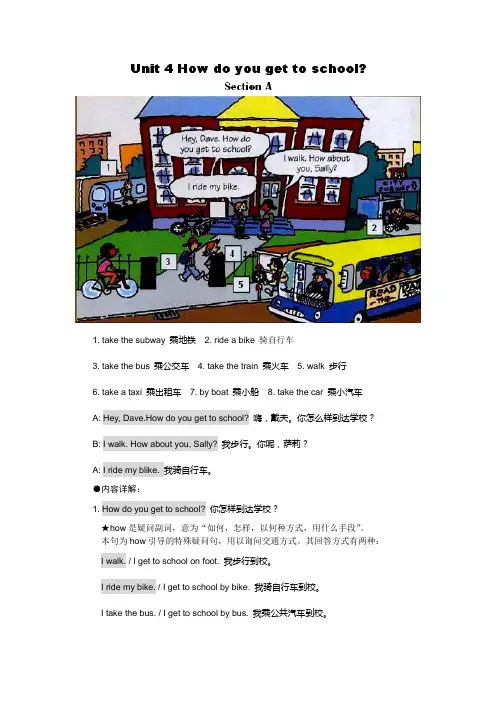
1. take the subway 乘地铁2. ride a bike 骑自行车3. take the bus乘公交车4. take the train 乘火车5. walk 步行6. take a taxi 乘出租车7. by boat 乘小船8. take the car 乘小汽车A: Hey, Dave.How do you get to school? 嗨,戴夫。
你怎么样到达学校?B: I walk. How about you, Sally? 我步行。
你呢,萨莉?A: I ride my blike. 我骑自行车。
●内容详解:1. How do you get to school? 你怎样到达学校?★how是疑问副词,意为“如何,怎样,以何种方式,用什么手段”。
本句为how引导的特殊疑问句,用以询问交通方式。
其回答方式有两种:I walk. / I get to school on foot. 我步行到校。
I ride my bike. / I get to school by bike. 我骑自行车到校。
I take the bus. / I get to school by bus. 我乘公共汽车到校。
※on foot,by bike,by bus,by subway,by train,by car等词组为固定结构,名词前不能加任何冠词或其他修饰词。
★get在句中为不及物动词,意为“到达”,常与to连用;当表示目的的词是副词here,there,home等时,则不需要用介词to。
例句:They will get to Beijing at seven tonight. 他们将在今晚7点抵京。
I will get there on time. 我将准时到达那里。
When do you get home every day? 你每天几点到家?★其他意为“到达”的词:①reach:及物动词,其后可直接接宾语;②arrive:不及物动词,若其后接宾语,需与at或in连用。
Unit4SectionA课文重点内容讲解人教版英语八年级上册
新目标八年级英语Unit4 Section A课文重点内容讲解1、It has the most fortable seats.它有最舒适的座位。
fortable 意思是"使人舒服的;舒适的"。
反义词为unfortable。
如: a fortable life 舒适的生活2、Can l ask you some questions?我可以问你一些问题吗?some 一些。
疑问句中表示“一些”常用any;如用some,则表示有所请求,期望得到肯定的答复。
如:Would you like some honey in your tea?你的茶里需要加一些蜂蜜吗?3、What's the best clothes store in town ?城里最好的服装店是哪家?in town 在城里;在镇上。
这里指说话人和听话人都知道的那个城镇.通常不加冠词。
如:Sky Market is the biggest supermarket in town.天空市场是城里最大的超市。
4、I think 970 AM is pretty bad.我觉得调幅970 电台十分糟糕。
pretty 作副词,意思是“相当;十分;很”。
表示程度。
如: He is a pretty good student.他是一个相当好的学生。
pretty 也可作形容词,意思是“漂亮的;可爱的;精致的”。
如:a pretty girl 一个漂亮的女孩 a pretty picture 一幅美丽的画巩固练习(一)单项填空。
( )1 Could you tell me how to go to this place, please? I'm new___town.C. to( )2 Helen, do you like the Sun Cinema?Yes. The seats there are very___.A. cheapB. expensiveC. importantD. fortable( )3 Boys,listen_! Don't sleep in the class!A. carefullyB. fortablyC. cheaplyD. quietly( )4Do you think this is a good movie?No, it's pretty bad. lt has themusic.B. betterC. worse( )5 Is the school far from your home, Tony?No, it'sto my home. Just five minutes on foot.A.close( )6 Tom, driving to Shanghai is expensive. The train takes you there _______.A. quietlyB. cheaplyC. quicklyD. slowly( )7 I don't want to stay in the movie theater because the air there isn't _______.A. dirtyB. fullC. thinD. fresh( )8 —What do you think of the Red Store, Henry?—It has _______ service, so few people go there to buy things.A. worstB. the worstC. bestD. the best( )9 Susie likes telling people the truth(真相), so she wants to be a _______ in the future.A. singerB. guideC. traderD. reporter( )10 —Do you like this sofa, Mrs. Green?—Of course. It's not expensive and I can sit on it _______.A. fortablyB. happilyC. beautifullyD. carefully(二)单词拼写。
人教八年级英语上册Unit4教学重点归纳
八年级英语上册Unit4教学重点归纳Unit 4 What’s the best movie theater?1,最高级的用法●用于三者或三者以上的比较eg:Which do you like best,Chinese,Math or English?●“one of+最高级+n.复数”表示“最…之一”Eg:Lu Xun is one of the greatest writers last century.●“the +序数词+最高级+n.单数+范围”表示“在…范围内…是第几…”Eg:Hainan is the second largest island in China.●先行词被最高级或序数词修饰,只能用that引导定语从句Eg:My cousin is the funniest person(that)I know.This is the first letter(that)I received from my sister.●Of all +n.复数;of the +数(≥3)+ n.复数;in/ at+地点2,Comfort v.使舒适,安慰comfortable adj. 舒适的(→uncomfortable) comfortably adv. 舒适地3,Voice嗓音(说话声、歌声、笑声、鸟鸣声) in a low voice小声地Noise杂音Sound任何可以听到的声音4,be close to靠近5,choose-chose choose from从…中选择choose to do sth选择做某事6,Can I ask you some/ a few questions?7,Welcome to+地点8,So far= until now= up to now至今为止9,Around/ near here= in the neighborhood10,thanks for +n/ V-ingThanks for your help/ thanks for helping me.Thanks for your invitation/ thanks for inviting/ asking me.—Thank you/ Thanks—No probl em/ You’re welcome/ That’s all right/ Not at all/ It’s a pleasure/ My pleasure/ That’s OK.11,talent n.天资,才能talented adj.有天赋的(→untalented)Have a talent for (doing) sth. 对(做)某事有天赋12,around the world= all over the world13,have…in common 有相同特征 in common with 同…一样14,Kind of 相当于副词,修饰形容词或副词,意为“稍微,有点”,与a little/ bit 相近A kind of 意为“一种”,some kinds of 意为“几种”,different kinds of意为“不同种类的”,all kinds of 意为“各种各样的”。
新人教版八年级上册第四单元重点单词、句子+知识点讲解和习题。(K12教育文档)
新人教版八年级上册第四单元重点单词、句子+知识点讲解和习题。
(word版可编辑修改)编辑整理:尊敬的读者朋友们:这里是精品文档编辑中心,本文档内容是由我和我的同事精心编辑整理后发布的,发布之前我们对文中内容进行仔细校对,但是难免会有疏漏的地方,但是任然希望(新人教版八年级上册第四单元重点单词、句子+知识点讲解和习题。
(word版可编辑修改))的内容能够给您的工作和学习带来便利。
同时也真诚的希望收到您的建议和反馈,这将是我们进步的源泉,前进的动力。
本文可编辑可修改,如果觉得对您有帮助请收藏以便随时查阅,最后祝您生活愉快业绩进步,以下为新人教版八年级上册第四单元重点单词、句子+知识点讲解和习题。
(word版可编辑修改)的全部内容。
Unit 4 What's the best movie theater ?第一课时 Section A(1a-2d)A)重点单词和短语1。
戏院 2。
舒适的3.座位 4。
屏幕5。
接近 6.票7.最差的 8。
便宜地9. 歌曲 10.选择11.小心地 12。
记者13。
新鲜的 14。
舒适地15.到目前为止16。
close to home17。
the biggest screens18。
the most comfortable seats19. thanks for doing sth。
20. no problemB)重点句型1。
最好的戏院是哪家?What’s the movie theater?2.她有最大的屏幕。
It’s has the .3。
它离家最近。
It’s the home. 4.你可以在那里最便宜地买衣服。
5.You can buy clothes the there。
5. 到目前为止你觉得这里怎么样?How do you like it ?6。
——-——谢谢你告诉我。
—--———没问题。
----Thanks for me。
—--—— .新知探究1。
What’s the best movie theater?该句译为:最好的戏院是哪家?1。
人教版八年级上册英语Unit 4知识点梳理及语法讲义(学生版)
八年级上册英语Unit 4知识点与语法精讲精练词汇梳理(一)完成单词梳理:名词:1. 戏院;剧场 2. 座位;坐处 3. 银幕;屏幕4. 票;入场券5. 歌;歌曲6. 记者7. 接待;服务8. 菜单9. 表演者;演员10. 天资;天赋11. 魔术师12. 作用;职能;角色13. 获胜者;优胜者14. 奖;奖品;奖金15. 早(或午、晚)餐;一餐所吃的食物16. 实例;范例动词:1. 选择;挑选 2. 提供;给副词:1. 便宜地;低廉地 2. 细致地;小心地;谨慎地3. 舒服地;舒适地4. 美好地;漂亮地5. 严肃地;严重地;认真地代词:1. 每人;人人;所有人形容词:1. 使人舒服的;舒适的 2. (在空间、时间上)接近3. 新鲜的;清新的4. 有创造力的;创造性的5. 贫穷的;清贫的6. 人多的;拥挤的;挤满的兼类词:1. (adj/adv)(bad和badly的最高级)最差(的);最坏(的);最糟(的)2. (adj/adv)(bad和badly的比较级)更差(的);更坏(的);更糟(的)3. (adv)相当;十分;很(adj)漂亮的4. (v)扮演(n)表演者(二) 词汇变形小结:1. comfortable (adj. 使人舒服的) — (adv. 舒适地) — (反义词:不舒服的) — (反义词:不舒服地)2. bad/badly (adj/adv. 糟糕的;糟糕地) — (比较级) — (最高级)3. cheaply (adv. 便宜地) — (adj. 便宜的)4. choose (v. 选择) — (过去式) — (n. 选择)5. carefully (adv. 小心地) — (adj. 小心的) — (反义词:粗心地)— (反义词:粗心的)6. report (v. 报告) — (n. 记者)7. act (v. 扮演) — (n. 演员) — (n. 动作;行动)8. creative(adj. 有创造力的) — (v. 创造)9. talent(n. 天资;天赋) — (adj. 有才能的)10. magician(n. 魔术师) — (adj/n. 有魔力的;魔术)11. beautifully(adv. 漂亮地) — (adj. 漂亮的)12. winner(n. 获胜者) — (v. 赢;赢得)13. service(n. 接待;服务) — (v. 服务;接待)14. performer(n. 表演者;演员) — (v. 表演)15. seriously(adv. 严重地) — (adj. 严肃的)16. give(v. 提供;给) — (过去式)【练一练】用所给词的适当形式填空1.Let’s go to Danny’s. The food there is ___________(cheap)in town.2.I like the movie theater Movie Palace best because I can sit ____________(comfortable).3.The radio station Oldies 102.1FM is pretty bad. It’s____________(bad)than All Talk 970AM.4.His brother is a ____________ (report).5.It’s time for class. The students should take their ____________ (seat).6.Her friend wants to be a _____________ (perform) when she grows up.7.I think Liu Qian is the most exciting _____________ (magic).8.You must take this English test _____________ (serious).9.The ____________ (win) is an 8-year-old girl in the dancing competition.10.Who can sing songs the most _____________ (beautiful) in your family?(三) 短语攻关:离……近到目前为止没问题才艺表演世界各地寻找各种各样的有相同特征是……的职责;由……决定发挥作用;有影响编造(故事、谎言等)例如认真对待……实现因……而感谢幸亏;多亏1.Thanks for telling me. 谢谢你告诉我。