
2011年12月PRETCO考试A级真题试卷及答案 - 听力
2011年12月PRETCO考试A级真题试卷---听力
Part I Listening Comprehension (15 minutes)
Directions: This part is to test your listening ability. It consists of 3 sections. Section A
Directions: This section is to test your ability to understand short dialogues. There are 5 recorded dialogues in it. After each dialogue, there is a recorded question. Both the dialogues and questions will be spoken only once. When you hear a question, you should decide on the correct answer from the 4 choices marked A), B), C) and D) given in your test paper. Then you should mark the corresponding letter on the Answer Sheet with a single line through the center. Example: You will hear:
You will read: A) New York City. B) An evening party.
C) An air trip. D) The man’s job.
From the dialogue we learn that the man is to take a flight to New York. Therefore, C) An air trip. is the correct answer. You should mark C) on the Answer Sheet with a single line through the center.
[A] [B] [C] [D]
Now the test will begin.
1. A) It’s 9:00. B) It’s 9:30. C) It’s 10:00. D) It’s 10:30.
2. A) The woman is waiting for a call. B) The telephone line is busy now.
C) Somebody is using the telephone. D) The man cannot use the telephone.
3. A) In an office. B) In a bank. C) At a bus station. D) At a restaurant.
4. A) The movie will start at 6 o’clock.
B) The movie will be put off till tomorrow.
C) They are going to meet at the school gate.
D) They want to know where the movie will be shown.
5. A) It’s not easy to find a taxi.
B) The book store is very far away.
C) The woman may walk to the book store.
D) There are a lot of buses going to the book store.
Section B
Directions: This section is to test your ability to understand short conversations. There are 2 recorded conversations in it. After each conversation, there are some recorded questions. Both the conversations and questions will be spoken two times. When you hear a question, you should decide on the correct answer from the 4 choices marked A), B), C) and D) given in your test paper. Then you should mark the corresponding letter on the Answer Sheet with a single line through the center.
Conversation 1
6. A) He’s in his office. B) He’s on holiday.
C) He’s in the meeting room. D) He’s away on business.
7. A) Call him back. B) Wait for his call.
C) Send him an e-mail. D) Visit him in person. Conversation 2
8. A) The production plan. B) Next year’s budget.
C) The sales of the company. D) The opening of a new branch.
9. A) Training of new employees. B) Development of new products.
C) Investigation of new markets. D) Improvement of the company’s sales.
10. A) Alan. B) The man. C) The woman. D) A guest speaker. Section C
Directions: This section is to test your ability to comprehend short passages. You will hear a recorded passage. After that you will hear five questions. Both the passage and the questions will be read two times. When you hear a question, you should complete the answer to it with a word or a short phrase (in no more than 3 words).The questions and incomplete answers are printed in your test paper. You should write your answers on the Answer Sheet correspondingly. Now listen to the passage.
11. How does the tour guide describe Los Angeles?
It is ___________ .
12. When will the tourists meet in front of the information desk?
Tomorrow morning at __________.
13. What will the guide tell the tourists tomorrow morning?
Details about the _________.
14. What will the man from hotel help the tourists do when they arrive at the hotel? To help them with __________.
15. Why does the tour guide ask the tourists to double check their bags?
To make sure no bags have been left __________.
答案:1-5: ADBCC 6-10: DACDA
11. a beautiful city 12. 9:00/9 o’clock
13. travelling programs 14. their bags 15. on the bus。
2011年12月听力原文,翻译答案

Section A11.W: This crazy bus schedule has got me completely confused. I can‘t figure out when my bus to Cleveland leaves?M: Why don’t you just go to the ticket window and ask?Q: What does the man suggest the woman do?12.W: I really enjoyed the TV special about drafts last night. Did you get home in time to see it?W: Oh, yes, but I wish I could have stayed awake long enough to see the whole thing.Q: What does the man mean?13.W: Airport, please. I’m running a little late. So just take the fastest way even if it’s not the most direct. M: Sure, but there is a lot of traffic everywhere today because of thefootball game.Q: What do we learn about the woman from the conversation?14.W: May I make a recommendation, sir? Our seafood with this special sauce is very good.M: Thank you, but I don’t eat shellfish. I’m allergic to it.Q: Where does this conversation most probably take place?15. W: now one more question if you don’t mind, what position in the company appeals to you most?M: Well, I’d like the position of sales manager if that position is still vacant. Q: What do we learn about the man?16. M: I don’t think I want to live in the dormitory next year. I need more privacy.W: I know what you mean. But check out the cost if renting an apartment first.I won’t be surprised if you change your mind.Q: What does the woman imply?17. M: You’re on the right track. I just think you need to narrow the topic down. W: Yeah, you’re right. I always start by choosing two boarder topics when I’m doing a research paper.Q: What do we learn from the conversation?18. W: This picnic should beat the last one we went to, doesn’t it?M: Oh, yeah, we had to spend the whole time inside. Good thing, the weather was cooperative this time.What do we learn about the speakers from the conversation?Long ConversationConversation OneM: When I say I live in Sweden, people always want to know about the seasons. W: The seasons?M: Yeah, you know how cold it is in winter? What is it like when the days are so short?W: So what is it like?Q19: What do we learn about the man from the conversation?M: Well, it is cold ,very cold in winter. Sometimes it is cold as 26 degrees below centigrade. And of course when you go out, you’ll wrap up warm.But inside in the houses it’s always very warm, much warmer than at home. Swedish people always complain that when they visit England, the houses are cold even in the good winter.Q20: What do Swedish people complain about when they visit England in winter?W: And what about the darkness?Q21: How does the man describe the short hour of daylight around Christmas in Sweden?M: Well, yeah, around Christmas time there’s only one hour of daylight, so you really looks forward to the spring. It is sometimes a bit depressing. But you see the summers are amazing, from May to July in the North of Sweden the sun never sets. It’s still light in the midnight. You can walk in the mountains and read a newspaper.W: Oh, yeah, the land of the midnight sun. M: Yeah, that’s right, but it’s wonderful. You won’t stay up all night. And the Swedes makes most of it often they started work earlier in summer and then leave at about 2 or 3 in the afternoon, so that they can really enjoy the long summer evenings. They’d liketo work hard, but play hard, too. I think Londoners work longer hours, but I’m not sure this is a good thing.Q22: What does the man say about the Swedish people?Conversation TwoW: What kind of training does one need to go into this type of job?M: That’s a very good question. I don’t think there is any, specifically. W: For example, in your case, what was your educational background?Q23. What was the man’s major at university?Q24: What was the man’s job in secondary schools?M: Well, I did a degree in French at Nottingham. After that, I did careers work in secondary schools like the careers guidance people. Here is in the university. Then I went into localgovernment because I found I was more interested in the administrative side. Then progressed on to universities. So there wasn’t any plan and there was no specific training. There are plenty of training courses in management techniques and committee work which you can attend now.W: But in the first place, you did a French degree.M: In my time, there wasn’t a degree you could do for administration. I think most of the administrators I’ve come across have degrees and all sorts of things.W: Well, I know in my case, I did an English literature degree and I didn’t really expect to end up doing what I am doing now.M: Quite.W: But you are local to Nottingham,actually? Is there any reason why you went to Nottingham University?Q25: What attracted the man to Nottingham University?M: No, no, I come from the north of England, from west Yorkshire. Nottingham was one of the universities I put on my list. And I like the look of it. The campus is just beautiful.W: Yes, indeed. Let’s see. Were you from the industrial part of Yorkshire?M: Yes, from the Woolen District.Section BPassage One26, What did Obcamp’s speech focus on? While Gail Obcamp, an American artist was giving a speech on the art of Japanese brush painting to an audience that included visitors from Japan, she was confused to see that many of herJapanese listeners have their eyes closed. Were they tuned off because an American had the nerve to instruct Japanese in their own art form or they deliberately tried to signal their rejection of her? Obcamp later found out that her listeners were not being disrespectful. Japanese listeners sometimes closed their eyes to enhance concentration. Her listeners were showing their respect for her by chewing on her words.27, Why do Japanese listeners sometimes close their eyes while listening to a speech?Some day you may be either a speaker or a listener in a situation involving people from other countries or members of minority group in North America. 28, What does the speaker try to explain?Learning how different cultures signal respect can help you avoid misunderstandings. Here are some examples. In the deaf culture of North America, many listeners show applause not by clapping their hands but by waving them in the air. In some cultures, both overseas and in some minority groups in North America, listeners are considered disrespectful if they look directly at the speaker. Respect is shown by looking in the general direction but avoiding direct eye contact. In some countries, whistling by listeners is a sign of approval while in other courtiers it is a form of insult.Passage Two29. What is Chris’s main responsibility at Taxlong Company?Chris is in charge of purchasing and maintaining equipment in his Divisionat Taxlong Company. He is soon going to have an evaluation interview with his supervisor and the personnel director to discuss the work he has done in the past year. Salary, promotion and plans for the coming year will also be discussed at the meeting. Chris has made several changes for his Division in the past year. First, he bought new equipment for one of the departments. He has been particularly happy about the new equipment because many of the employees have told him how much it has helped them. Along with improving the equipment, Chris began a program to train employees to use equipment better and do simple maintenance themselves. The training saved time for the employees and money for the company.30. What problem did Chris encounter in his Division?Unfortunately, one serious problem developed during the year. Two employees the Chris hired were stealing, and he had to fire them.31. What does Chris hope for in the near future?Chris knows that a new job for a purchasing and maintenance manager for the whole company will be open in a few months, and he would like to be promoted to the job. Chris knows, however, that someone else wants that new job, too.32. What do we learn about Kim from the passage?Kim is in charge of purchasing and maintenance in another Division of the company. She has also made several changes over the year. Chris knows that his boss likes Kim’s work, and he expects that his work will be compared with hers.Passage Three33. Why are proverbs so important? Proverbs, sometimes called sayings, are examples of folk wisdom. They are little lessons which older people of a culture pass down to the younger people to teach them about life. Many proverbs remind people of the values that are important in the culture. Values teach people how to act, what is right, and what is wrong. Because the values of each culture are different, understanding the values of another culture helps explain how people think and act. Understanding your own culture values is important too. If you can accept that people from other cultures act according to their values, not yours, getting along with them will be much easier. Many proverbs are very old.34. According to the speaker what happens to some proverbs with the passage of time?So some of the values they teach may not be as important in the culture as they once were. For example, Americans today do not pay much attention to the proverb “Haste makes waste”, because patience is not important to them.But if you know about past values, it helps you to understand the present and many of the older values are still strong today. Benjamin Franklin, a famous American diplomat, writer and scientist, died in 1790, but his proverb “Time is money”is taken more seriously by Americans of today than ever before.35 What do we learn from the study of proverbs from around the world?A study of proverbs from around the world shows that some values are shared by many cultures. In many cases though, the same idea is expressed differently.Compound Dictationown. Even if I am on vacation in the mountains, I am eating food someone else has grown, living in a house someone else has built, wearing clothes someone else has sewn from cloth woven by others, using electricity someone else is distributing to my house. Evidence of interdependence is everywhere; we are on this journey together.As I was growing up, I remember being carefully taught that independence not interdependence was everything.“Make your own way”,” Stand on your own two feet” or my mother’s favorite remark when I was face-to-face with consequences of some action: Now that you’ve made your bed, lie on it.Total independence is a dominant thing in our culture. I imagine that what my parents were trying to teach me was to take responsibilities for my actions and my choices. But the teaching was shaped by our cultural imagines. And instead, I grew up believing that I was supposed to be totally independent and consequently became very reluctant to ask for help. I would do almost anything not to be a burden, and not require any help from anybody.翻译答案:1.raise money for people who survived the earthquakeraise money for the survivors in the earthquake2.couldn’t have received my e-mail3. who always encourages me not tolose heart / give up /dismay4. take the popularity of the fiction / novel into consideration /account5. define one’s happiness only by how much money he has /money measure one’s happiness only by money / how much money one has .。
2011年全国职称英语考试真题答案综合类(A级)
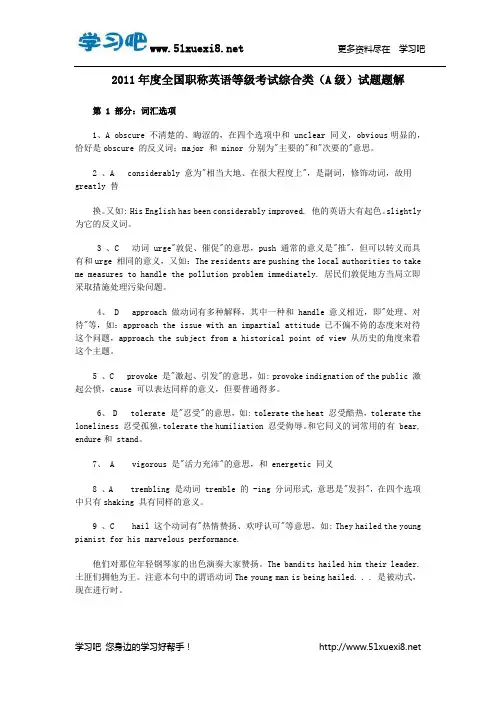
2011年度全国职称英语等级考试综合类(A级)试题题解第 1 部分:词汇选项1、A obscure 不清楚的、晦涩的,在四个选项中和 unclear 同义,obvious明显的,恰好是obscure 的反义词;major 和 minor 分别为"主要的"和"次要的"意思。
2 、A considerably 意为"相当大地、在很大程度上",是副词,修饰动词,故用 greatly 替换。
又如: His English has been considerably improved. 他的英语大有起色。
slightly 为它的反义词。
3 、C 动词 urge"敦促、催促"的意思,push 通常的意义是"推",但可以转义而具有和urge 相同的意义,又如:The residents are pushing the local authorities to take me measures to handle the pollution problem immediately. 居民们敦促地方当局立即采取措施处理污染问题。
4、 D approach 做动词有多种解释,其中一种和 handle 意义相近,即"处理、对待"等,如:approach the issue with an impartial attitude 已不偏不倚的态度来对待这个问题,approach the subject from a historical point of view 从历史的角度来看这个主题。
5 、C provoke 是"激起、引发"的意思,如: provoke indignation of the public 激起公愤,cause 可以表达同样的意义,但要普通得多。
6、 D tolerate 是"忍受"的意思,如: tolerate the heat 忍受酷热,tolerate the loneliness 忍受孤独,tolerate the humiliation 忍受侮辱。
2011年全国大学生英语竞赛A级初赛真题答案

!"#$%&’ ( !"# $%&’() *+, -. /0(1 % /.2 3.4%5(. 06 4%74.&, *8, 90 &%:(. $07.; 60& 4%74.& &.(.%&4<, **, =1 .>5%/.? 1<. 75$3.& 06 @.0@/. :7 A%7%?%,B A%7%?% <%? % @0@5/%1:07 06 C+ $://:07, *D, -. &%7 E:1< %7 %&1:6:4:%/ /.2, *F, G.4%5(. <:( 4%74.& 4%$. 3%4’, )"#$%&’ *! "C $%&’(" *H, 9 DI, 9 D", J DC, 9 DK, #$%&’()*+,-&’)./0&’(1234#5678&’(9:1.;<& ’(=>12/?@;A D+, #$%&’BCDEFG9HI(J1KLM8BN;<OPQRS&’*BTUVWX :Y9ZA +",$%&’ - !"C $%&’() D8, 2.1 :710 (<%@. D*, 40$. :7 DD, E0&’051(B@&02&%$( DF, $..1B(5:1B1%’. :710 %440571 DH, (0 @0@5/%& FI, 4.&1:6:.?B>5%/:6:.? ./0$ 1 20/’34/$%&’ !"I $%&’() F", L:1< % @0@5/%1:07 06 0M.& ",K 3://:07N A<:7% :1(./6 @&.(.71( % <52. $%&’.1 06 2&.%1 @01.71:%/ 60& 40571&:.( /00’:72 60& .4070$:4 400@.&%1:07, FC, 9<.&. :( % 105&:(1 %11&%41:07 4%//.? O%0/:7 E<:4< ;05 4%7 &.%4< :7 %3051 1E0 <05&( 3; 20:72 (051<E.(1 3; 105&:(1 35( 6&0$ -%72P<05, FK, 9<. 3.(1 (5&6%4. 6:7:(<.( %&. @&0M:?.? 3; $%4<:7:72 $.1<0?(N .(@.4:%//; 3; 2&:7?:72, F+, =1 :( 07/; E<.7 E. /.61 (4<00/ 0& 40//.2. 1<%1 E. 3.2%7 10 57?.&(1%7? 1<%1 .?54%1:07 <%? 2:M.7 5( 40571/.(( 0@@0&157:1:.(N E<:4< <%M. 70E 207. 60&.M.&, F8, Q0 6%& 1<:( 7.E 1.7?.74; :( 10 @/%4. 1<. <0$. :7 1<. :$$.?:%1. (535&3(N 351 @&0?541:07 %41:M:! 1:.(N 35(:7.(( ?.%/:72(N 20M.&7$.71 ?.@%&1$.71(N %7? .71.&1%:7$.71 (@01( :7 1<. 4:1;[( 4.71&., ./0$ 15 56 2"3$ R"I $%&’() F*, 9, FD, ST9, FF, U%$.( :( % 1.%4<.&, FH, C, HI, CH,
2011年全国职称英语等级考试综合类A级真题及详解【圣才出品】

2011年全国职称英语等级考试综合类A级真题及详解第l部分:词汇选项(1~15题,每题1分,共15分)下面每个句子中均有1个词或短语划有底横线,请为每处划线部分确定1个意义最为接近的选项。
1.For some obscure reason,the simple game is becoming very popular.A.unclearB.obviousC.majorD.minor【答案】A【解析】句意:由于某种说不清的原因,这项简单的运动变得非常流行。
划线词obscure 意为“不清楚的,不明了的”。
A项unclear意为“不清楚的”,二者是同义词。
obvious 明显的。
major主要的;重要的。
minor较小的;次要的。
2.The sea turtle’s natural habitat has been considerably reduced.A.greatlyB.suddenlyC.generallyD.slightly【答案】A【解析】句意:海龟的自然栖息地大大地减少了。
划线副词considerably意为“相当大的”。
A项greatly意为“很,大大地”,二者意思相近。
suddenly突然地。
generally 通常;普遍地,一般地。
slightly轻微地。
3.I got a note from Moira urging me to get in touch.A.instructingB.notifyingC.pushingD.inviting【答案】C【解析】句意:我从Moira那里得到一张便条,催促我尽快联系。
urge意为“催促”。
C 项push意为“努力争取;力劝…做”,二者意思相近。
instruct指导;通知。
notify通告,通知。
invite邀请。
4.It is possible to approach the problem in a different way.A.raiseB.poseC.experienceD.handle【答案】D【解析】句意:完全有可能以不同的方式来解决这个问题。
2011年高考英语试卷听力+原文+答案(新课标)

2011年全国统一高考英语试卷(新课标)听力试题第一部分听力(共两节,满分30分)做题时,先将答案标在试卷上,录音结束后,你将有两分钟的时间将试卷上的答案转涂到答题卡上.第一节(共5小题,每小题1.5分,满分7.5分)听下面5段对话.每段对话后有一个小题,从题中所给的A、B、C三个选项中选出最佳答案.听完每段对话后,你都有10秒钟的时间来回答有关小题和阅读下一小题.每段对话仅读一遍.例: How much is the shirt?A. £ 19.15.B. £9.18.C. £9.15.答案是C.1. What does the man like about the play?A. The story.B. The ending.C. The actor.2. Which place are the speakers trying to find?A. A hotel.B. A bank.C. A restaurant.3. At what time will the two speakers meet?A. 5:20.B. 5:10.C.4:40.4. What will the man do?A. Change the plan.B. Wait for a phone call.C. Sort things out.5. What does the woman want to do?A. See a film with the man.B. Offer the man some help.C. Listen to some great music.第二节(共15小题:每小题1.5分,满分22.5分)听下面5段对话或独白.每段对话或独白后有几个小题,从题中所给的A、B、C三个选项中选出最佳选项,并标在试卷的相应位置.听每段对话或独白前,你将有时间阅读各个小题,每小题5秒钟;听完后,个小题将给出5秒钟的作答时间.每段对话或独白读两遍.听第6段材料,回答6、7题.6. Where is Ben?A. In the kitchen.B. At school.C. In the park.7. What will the children in the afternoon?A. Help set the table.B. Have a party.C. Do their homework.听第7段材料,回答第8、9题.8. What are the two speakers talking about?A. A Family holiday.B. A business trip.C. A travel plan.9. Where did Rachel go?A. Spain.B. Italy.C. China.听第8段材料,回答第10至12题.10. How did the woman get to know about third-hand smoke?A. From young smokers.B. From a newspaper article.C. From some smoking parents.11. Why does the man say that he should keep away from babies?A. He has just become a father.B. He wears dirty clothes.C. He is a smoker.12. What does the woman suggest smoking parents should do ?A. Stop smoking altogether.B. Smoke only outside their houses.C. Reduce dangerous matter in cigarettes.听第9段材料,回答第13至16题.13. Where does Michelle Ray come from?A. A middle-sized city.B. A small town.C. A big city.14. Which place would Michelle Ray take her visitors to for shopping?A. The Zen GardenB. The Highlands.C. The Red River area.15. What does Michelle Ray do for complete quiet?A. Go camping.B. Study in a library.C. Read at home.16. What are the speakers talking about in general?A. Late-night shopping.B. Asian food.C. Louisville.听第10段材料,回答第17至20题.17. Why do some people say they never have dreams according to Dr Garfield?A. They forget about their dreams.B. They don’t want to tell the truth.C. They have no bad experiences.18. Why did Davis stop having dreams?A. He got a serious heart attack.B. He was too sad about his brother's deathC. He was frightened by a terrible dream.19. What is Dr Garfield s opinion about dreaming?A. It is very useful.B. It makes things worse.C. It prevents the mind from working.20. Why do some people turn off their dreams completely?A. To sleep better.B. To recover from illnesses.C. To stay away from their problems.2011年全国统一高考英语试卷(新课标)听力试题答案及原文【参考答案】1-5 CABBA 6-10 CBACB 11-15 CAABC 16-20 CABAC听力原文:第一节(共5小题,每小题1.5分,满分7.5分)听下面5段对话.每段对话后有一个小题,从题中所给的A、B、C三个选项中选出最佳答案.听完每段对话后,你都有10秒钟的时间来回答有关小题和阅读下一小题.每段对话仅读一遍.Text 1W: Jack, how do you like the play?M: It’s a simple story with a happy ending, but, luckily, they had a very strong actor, he managed to carry the whole play.Text 2M: Have w e missed it? The man said it’s only five blocks away opposite the bank. W: Wait a minute, the Chinese restaurant, the national bank, there it is, the Radisson Hotel.Text 3M: Let’s meet at 20 to 5.W: Well. Could we make it 20 past 5?W: That’s a bit lat e for me. I could manage 10 past.M: OK. See you then.Text 4M: What time are we leaving for the outing?W: I’ll phone you tomorrow. I should have everything sorted out by then.Text 5W: Thanks for all you’ve done for me. Hey, listen, would you like to go to see a film sometime?M: Yeah, that’d be great. I’d love it.第二节(共15小题:每小题1.5分,满分22.5分)听下面5段对话或独白.每段对话或独白后有几个小题,从题中所给的A、B、C三个选项中选出最佳选项,并标在试卷的相应位置.听每段对话或独白前,你将有时间阅读各个小题,每小题5秒钟;听完后,个小题将给出5秒钟的作答时间.每段对话或独白读两遍.Text 6W: Hey, where is everybody?M: They took Ben to the park. Where have you been?W: Sorry, I’m late. I picked up the cake and it took me longer than I expected. When will the party start?M: Ben invited eight children from school. And they’ll arrive at about 2 in the afternoon.W: OK. Then I’ll put the candles on the cake and leave it in the kitchen and then I’ll come and help set the table.Text 7M: So, Macy, how was your holiday?W: Oh, we loved it. Tom liked Germany best, but France was my favorite.M: So did Rachael finally go with you?W: No, she wasn’t able to. She was called away for a business trip to China.M: That’s a pity. So where exactly did you go and visit?W: Well, we traveled all over, Italy, Spain and Holland; we even bathed in a Swiss lake.M: You did, really?Text 8W: B ob, I’m sure you know about second-hand smoke.M: Of course, I do.W: But have you heard about third-hand smoke?M: Third-hand smoke? I’m afraid not. What is that then?W: Well, it is here in today’s paper. Parents may think they are protecting children from second-hand smoke when they smoke outside their home or only when the children are not there. But now researchers are warning about what they callthird-hand smoke. When you smoke dangerous matter from cigarettes get into your hair and clothing. As babies are the weakest, when you come to a baby, you pass it to the baby and increase the chances of disease in the baby.M: Is that so? In that case I have to say that I should never get close to a baby.W: That’s right. Actually all smoking parents should do the same or better give it up completely.Text 9M: Hello, welcome to our program “Today City”. I’m Larry. We’re going to Louisville Kentucky where our guest Michelle Ray comes from. She is proud of her middle-sized city with a small town feel and big city dreams. Now, Michelle, tell us about your city.W: Thank you, Larry. Here is my city. Louisville is my city. The first place I take visitors from out of town is to the Highlands for shopping and night life. When I have delicious Asian food I always go to the Zen Garden which provides wonderful all vegetable dishes.M: Wow, that’s interesting. Many people go for healthy food now.W: You can say that again. If I want to go camping and fishing, I go to the Red River area. For complete quiet I can hide away in my house with a good book from one of our public libraries.M: That all sounds very exciting. I’m sure some of our listeners will include Louisville in their travel plan for their next holiday. Thank you, Michelle.Text 10M: We are glad to have Dr. Garfield to talk to us today about dreams. Let me start by asking the first question. Does everyone dream?W: It appears that everyone does. Mostly when people say that they never dream, what they really mean is that they don’t remember their dreams or they don’t think their dreams are important. The reason behind is that they might have been made fun of with a child when they first reported their dreams or it was so frightening that they just turned off dreaming completely. The other day, someone named Davis came to me and said that he used to be a great dreamer, but suddenly he stopped having dreams. I asked him what it happened. It turned out that his brother died by heart attack and he never expected that such a terrible thing would happen to a young person. Generally, when there was some frightening event and dream about it was too terrible. People prefer not to dream about it. Actually the worst thing you can do is stop dreaming. Because it means that the bad experience would be too painful to even appear in dreams. As long as you dream about it and even the dream is frightening, your mind is working on it. My personal opinion about what dreams do is that they help us deal with our problems. We see certain patterns take place in dreams. When a person is hurt deep inside, when a person is seriously ill or when a person has been really sad, if people turn off their dreams totally, it means they don’t love themselves to even think about it.2019高中教师读书心得体会作为教师,在教授知识的提示,也应该利用空暇时刻渐渐品读一些好书,吸收书中的精华。
大学英语三级A2011年12月参考答案及解析

2011年12月英语三级(A)答案
------------------【1 号答案】-------------------------------作文Ⅴ:Natural Disasters- 自然灾害1自然灾害频繁发生,给人类带来了巨大的损失。
2在自然灾害面前,我们该怎么做?In the past hundred years, there have heen frequent natural disasters, such as floods, droughts, mud-rock flows, seismic sea waves, earthquakes, windstorms and the stretching of new deserts. Thedisasters have killed millions upon millions of people, destroyed countless homes, and wiped outnumerous pieces of fertile land.Now more and more people become aware that those disasters have much to do with what we have------------------【2 号答案】-------------------------------一选择:1highest2would not have caused3latter4including5characteristic6Forgetful7convenience8unexpectde9millionaire10could fly二填空1putting2would not make3does he say4to repair5pulled on6has painted7turned out8on the way9only take a bus10complaint三阅读理解Task11. I was still lusting in my heart after other ladies2. from 1960 to 19693.illness caused by her job….4 it denied her any clerical support5 are given work that they are unable to doTask2 1 tell the nature of life learning2 no co------------------【3 号答案】-------------------------------A卷和B 卷有区别你们看单词选答案。
2011年全国统一高考英语试卷听力+原文+答案(新课标)
2011年全国统一高考英语试卷(新课标)听力试题第一部分听力(共两节,满分30分)做题时,先将答案标在试卷上,录音结束后,你将有两分钟的时间将试卷上的答案转涂到答题卡上。
第一节(共5小题,每小题1.5分,满分7.5分)听下面5段对话。
每段对话后有一个小题,从题中所给的A、B、C三个选项中选出最佳答案。
听完每段对话后,你都有10秒钟的时间来回答有关小题和阅读下一小题。
每段对话仅读一遍。
例: How much is the shirt?A. £ 19.15.B. £9.18.C. £9.15.答案是C.1. What does the man like about the play?A. The story.B. The ending.C. The actor.2. Which place are the speakers trying to find?A. A hotel.B. A bank.C. A restaurant.3. At what time will the two speakers meet?A. 5:20.B. 5:10.C.4:40.4. What will the man do?A. Change the plan.B. Wait for a phone call.C. Sort things out.5. What does the woman want to do?A. See a film with the man.B. Offer the man some help.C. Listen to some great music.第二节(共15小题:每小题1.5分,满分22.5分)听下面5段对话或独白。
每段对话或独白后有几个小题,从题中所给的A、B、C三个选项中选出最佳选项,并标在试卷的相应位置。
听每段对话或独白前,你将有时间阅读各个小题,每小题5秒钟;听完后,个小题将给出5秒钟的作答时间。
大学英语三级A级真题2011年12月
大学英语三级A级真题2011年12月(总分:100.00,做题时间:120分钟)一、Part I Listening Comprehension (总题数:1,分数:5.00)(分数:5.00)A.It's 9:00 √B.It's 9:30C.It's 10:00.D.It's 10:30.解析:M: I think the business meeting will start at 9:30. W: Ok, We still have half an hour to get there. Q: What time is it now? [解析] 事实推理题。
此题询问“现在几点钟?”男士说:“会议将在9点半开始。
”而女士则说:“我们有半小时的时间去那儿。
”两者提到的时间对照之下,可确定现在应该是9点,故本题应选A。
[避错指南] 本题关键是抓住了两个时间,然后做一个简单地减法,但如果抓准了时间,但做了加法的话,就很容易误选C了。
A.The woman is waiting for a callB.The telephone line is busy now.C.Somebody is using the telephone.D.The man cannot use the telephone. √解析:M: Would you mind my using the telephone here? W: Sorry, the telephone doesn't work. Q: What does the woman mean? [解析] 事实细节题。
此题询问“女士的话是什么意思?”男士提出想用电话,但女士回答说:“电话坏了。
”这也就是说,男士不能使用那个电话,因此,本题应选选项D。
[避错指南] 选项A(女士在等电话)、选项B(电话占线)和选项C(有人正在用电话)都与对话中提到的“电话坏了”不符。
2011年全国职称英语考试卫生类(A级)真题及答案解析
2011年全国职称英语卫生类(A级)真题及答案解析第1部分:词汇选项(第1-15题,每题1分,共15分)下面每个句子中均有1个词或短语划有底横线,请为每处划线部分确定1个意义最为接近的选项。
1 For some obscure reason, the simple game is being very popular.A unclearB obviousC majorD minor2 The sea turtle's natural habitat has been considerably reduced.A greatlyB suddenlyC generallyD slightly3 I got a note from Moira urging me to get in touch.A instructingB notifyingC pushingD inviting4 It is possible to approach the problem in a different way.A raiseB poseC experienceD handle5 The decision to invade provoked storms of protest.A ignoredB organizedC causedD received6 Jane said that she couldn't tolerate the long hours.A spendB takeC lastD stand7 At 80, Peck was still vigorous and living in Paris.A energeticB happyC aloneD busy8 Forester stared at his car, trembling with rage.A shakingB turningC jumpingD shouting9 A young man is being hailed a hero tonight after rescuing two children.A reportedB provedC praisedD caught10 I wanted to ask her out but was scared that she might refuse.A anxiousB sureC sadD afraid11 At that time, we did not fully grasp the significance of what had happened.A giveB attachC loseD understand12 Anderson left the table, remarking that he had some work to do.A doubtingB sayingC thinkingD knowing13 He asserted that nuclear power was a safe and non-polluting energy source.A maintainedB remendedC consideredD acknowledged14 The study also notes a steady decline in the number of college students taking science courses.A relativeB generalC continuousD sharp15 She always finds fault with everything.A criticizesB simplifiesC evaluatesD examines第2部分:阅读判断(第16~22题,每题1分,共7分)下面的短文后列出了7个句子,请根据短文的内容对每个句子做出判断:如果该句提供的是正确信息,请选择A;如果该句提供的是错误信息,请选择B;如果该句的信息文中没有提及,请选择C。