
新概念65-66课
8
7 6 5
4
It’s one fifteen.
What time is it?
11
10 9 12
1
2 3
8
7 6 5
4
It’s three thirty.
4:40
10:25
four fourty twenty to five
ten twenty-five twenty five past ten
the key to the front door
键
钥匙
[hiə]
hear
[in'dʒɔi]
enjoy
vi. 听;听见
享受,喜爱
['beibi] baby
[jɔ:'self] yourself
pron. 你自己
[,auə'selvz] ourselves
n. 婴儿 pron. 我们自己
Words:
clock
What time is it?
11
10 9 12
1
2 3
8
7 6 5
4
It’s ten o’clock. o’clock. It’s It’s eight five one o’clo o’clock. It’s three
What time is it?
11
10 9 12
1
2 3
这边的all right 和前面 不同,可以用You’re we lcome替换。 Have a good time .
Yourself,ourselves是 反身代词
Good-bye. Enjoy yourself!
Jill:We always enjoy ourselves ,Mum . Bye-bye.
She must go to the library at a quarte r past one o’clock.
Question 3
Tom and I must see the dentist at a qu arter to four o’clock.
Question 4
I must type this letter at two o’clock.
Question 8
?
Sophie must drive to London at half pa st two o’clock.
Question 9
You must catch the bus at half past th ree o’clock.
Question 10
I must arrive there at three o’clock.
Challenge your eyes
better certainly yet get up rich remain mustn`tfood come upstairs another quickly rich must temperature
1. It is a circle. 2. It has three hands. 3. There are numbers in it.
I enjoy walking my dog.
doing sth.
50
Homework
• 1、熟读并微信朗读Lesson65; • 2、抄写L65-66课单词三英一中,; • 3、完成练习题
Mother:Jill’s eighteen years old ,Tom.She’s n ot a baby .Give her the key.She always com 问对方的年龄可以 es home early. 用How old…..?
Father:Oh,all right !
好吧,就这样的意思
Question 11
Question 12
They must come home at a quarter past two o’clock.
Question 13
I must meet Tom at a quarter to two o’clock.
Question 14
He must telephone me at a quarter to t hree o’clock.
4:30 1:45
one forty-five a quarter to two
four and a half half past four
1
6
2
3
4
7
5
8 10 9 11 12 13 14
Question 1
I must come home at one o’clock.
Question 2
Dad
key
enjoy
baby yourself
hear
ourselves
Dad enjoy
baby
yourself
hear
ourselves key
考考你:
myself
himself
herself
themselves
key
enjoy
hear
enjoy 2
hear
ourselves
myself 3
Father:Here you are.But you mustn’t come home aft er a quarter past eleven. Do you hear?
after:…之后 如:晚饭后after dinner
Jill:Yes ,Dad.
下课后?放学后?
Jill:Thanks ,Mum. Mother:That’s all right.
我明天将要去上学 I am going to go to school tomorrow.
Father:You mustn’t come home late . You must be home at half past ten. Jill:I can’t get home so early ,Dad!
at
+
时间 正午 深夜 周末
时间点
1.I always go to work on Wednesday. 2.I always work on Wednesday evening. 3.My birthday is on May 1st 1999.
on
+
星期 (年)月日
具体某天
Words:
[ki:] key
enjoy 1
hear 3
ourselves
myself 1
key 2
baby 1
themselves
himself 1
key
baby 4
themselves 2
himself
yourself
ቤተ መጻሕፍቲ ባይዱ
herself 1
yourself
herself 2
1. meet 遇见 Nice to meet you ! 2. meet 接某人 I’ll meet my frien ds at 9:00 tomorro w.
Question 5
Question 6
Sam and Penny must see the boss at half past one o’clock.
Question 7
George must take his medicine at a qua rter past three o’clock.
问时间点可以用:What time 或when? 如:现在几点?-----What time is it ? What’s the time? When is it ? 如:你今天什么时候起床?When do you get up today? 例句:You mustn’t come home late. You must be home at half past ten. 句中时间点提问时,要用when 疑问词 When must I be home ?
1.I always go to work in the morning. 2.It’s cold in winter. 3.It’s often rains in November. 4.I went to Shang Hai in 1999.
in
+
年 月 季节 上下午,晚上
时间段
1.I’m going to see him at ten o’clock. 2. She always eats her lunch at noon. 3.He usually reads his newspaper at nigh t. 4.I will go to Bei Jing at the weekend.
Father:What are you going to do this evening ,Jill? Jill:I’m going to meet some friends ,Dad.
一般将来时
• Be going to do(动词原形)将要做... Be动词:is am are am I … is He/She/it 第三人称单数时。 are We/They 复数时用
get home: arrive home
Jill:Can I have the key to the front door ,please? Father:No,you can’t . 1. key钥匙 a key to... I have a key to the door. ...的钥匙/答案 2. key答案 Please tell me the key to the question.
enjoy
oneself
新概念一 最新lesson 65-66
revision
better certainly get up yet rich food remain
['betə] ['sɜːtənli] [get ʌp] [jet] [rɪtʃ] [fu:d] [rɪ'meɪn]
第一人称 第二人称
第三人称
单数
myself yourself
himself herself itself
复数 ourselves yourselves themselves
反身代词
• 当宾语和主语是同一个人时,一般需要用反身代词 • 反身代词有:myself,herself,himself,ourselves,
2. 顺时表达
3:10 three ten 4:16 four sixteen
逆时表达
3.一刻钟/半点
5:15 6:30
a quarter past five
half past six
4.半小时之内用past
7:10 ten past seven 8:16 sixteen past eight
yourselves,themselves
e.g. The old lady is talking to herself.
• I— • you— • it-• she— • he— • we— • they--
myself yourself itself herself himself ourselves themselves
I __c_a_n_t_y_p_e__this letter. I _m__u_s_t_s_t_a_y_at home. She ___c_a_n_’_t _g_o___to school yet. We __m__u_s_t_n_’t__p_la_y__with matches. _C__a_n__ you _s_i_n_g__ a song? __M__u_st_ he __c_o_m_e_ home early?
新概念一第65-66课PPT课件
逆时表达
38
3.一刻钟/半点
5:15 a quarter past five
6:30 half past six 39
4.半小时之前用past
7:10 ten past seven
8:16
sixteen past eight
40
5.半小时以后用to
2:40 twenty to three 4:50 ten to five
54
you and Tom
When must you and Tom see a doctor? They must see the doctor 6 minutes to 12.
55
Mike
When must Mike take the medicine? He must take the medicine at half past 4.
10
• Mum 妈妈 (儿语) 妈妈的叫法也很多: mother 正式称呼
Mum / Mom 口语 mummy ma
11
key [ki:]
• the key to the door • the key to the front door • key to exercise(练习)
12
hear [hiə]
44
在某一个具体时间的介词用at In the morning On July 18th In July
45
JILL: Thanks, Mum. MOTHER: That's all right. Goodbye. Enjoy yourself! JILL: We always enjoy ourselves, Mum. Bye-bye.
新概念英语第二册第66课课件
Review
press vt.&vi. 按,挤,压 vt. 催促,敦促
pressure n. 压, 压力, 电压, 压迫 develop ① vt. &vi. 发展,扩展 ② v. 养成,培养(习惯、兴趣等) ③ v.开发(土地、资源、新产品)
development n. 发展 with the development of... 随着...的发展
01.New words
future ['fju:tʃə] 1)n. 未来,将来,前途 I wish you a happy future. 祝你前途美好。 in future 今后,以后 in the future 在未来,在将来 2)adj. 未来的,将来的 future generations 子孙后代
complain of 抱怨... sb. spend time on/(in) doing sth. 某人花费时间在(做)某事上 train sb. to do sth. 训练某人做某事
Dictation
1、press vt.&vi. 按,挤,压 vt. 催促,敦促 2、 be (an)expert at/in (doing) sth. 在(做...)某一方面是专家
01.New words
fair [fεə] 1)n. 游乐场 2)n. 博览会,商展 3)n. 集市
4)adj. 公平的,公正的(反义 unfair) She is fair with her students. 她对学生们一视同仁。
01.New words
fortune-teller ['fɔ:tʃən,telə] n. 算命人
fortunate adj. 幸运的['fɔːtʃ(ə)nət] unfortunate adj. 不幸的
新概念英语第二册66课
aerial adj. 航空的,从空中的 aerial bombardment 轰炸 an aerial survey 航空勘测 an aerial railway 悬浮列车
survey 1. n. 调查,测量,实地勘察 a public opinion survey 民意测验 make a survey of river pollution 调查 河流污染
package 商品以小包装形式出售 pack (美)
parcel 用来邮寄的包裹 package(美) package (英) 指携带的包裹
pack 背负的包 a backpack 背包
enthusiast n. 热心人 [c] enthusiasm n. [u] 热心,热忱,热情 He has great enthusiasm for it . with enthusiasm 热衷地,狂热地 eg. Learning English needs enthusiasm, diligence and good methods. 学习英语需要有热情,勤奋 和好的方法。
damage 3. vt. 损伤,加害于,损害(名誉) damage sth 损坏某物 Smoking can damage your health. The bridge was badly damaged by flood. The groundless rumor damages his good name. spoil 损坏,破坏(从情绪上去破坏) damage 造成损害,伤害(可恢复) destroy 毁坏,毁灭(无法修复)
1. v. 想象(不用于进行时态) imagine +n. Can you imagine life without electricity ?
新概念英语第一册第65-66课课程案例
1. 整点表达 1:00 one o’clock 2:00 two o’clock
2. 顺时表达
3:10 three ten 4:16 four sixteen
3.逆时表达 5:40 twenty to six 3:50 ten to four
3.一刻钟/半点
5:15 A quarter past five
I can’t get home so early get home 到家 [不论在家与否]
时 间 表 达 法
日期的表达:
• 通常使用介词on表示星期几(on Monday)、一天中的某段时间(on Monday morning)、日期(on April 1st)、 星期几+日期(on Monday, April 1st)、 具体时间(on that day)、周年纪念日(on Christmas Day)等。
Jill’s eighteen years old, Tom. She’s not a baby. Give her the key. She always comes home early. Oh, all right.
表示“几岁”,一般由基数词+ year(s) old构成。在 口语中,year(s)old往往可以省去,而只用数字表示年
Homework
• 1. To finish the exercises after the text. • 2. To practise the structures learned during
the class.
★yourself pron.你自己
• selfish adj. 自私的 • selfishness n. 自私 • self-centered adj.
新概念英语第一册65-66课笔记1
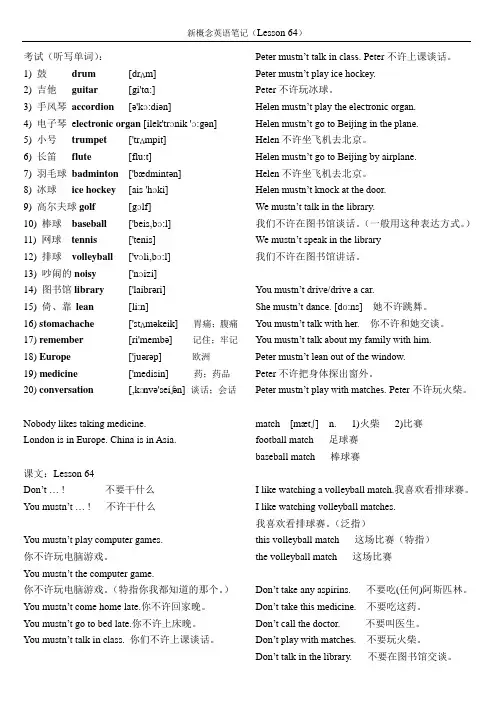
考试(听写单词):1) 鼓drum [drʌm]2) 吉他guitar [gi'tɑ:]3) 手风琴accordion [ə'kɔ:diən]4) 电子琴e lectronic organ [ilek'trɔnik 'ɔ:gən]5) 小号trumpet ['trʌmpit]6) 长笛flute[flu:t]7)羽毛球badminton['bædmintən]8) 冰球ice hockey [ais 'hɔki]9)高尔夫球golf [gɔlf]10)棒球baseball['beis,bɔ:l]11)网球tennis ['tenis]12)排球volleyball['vɔli,bɔ:l]13) 吵闹的noisy ['nɔizi]14) 图书馆library ['laibrəri]15) 倚、靠lean [li:n]16) stomachache ['stʌməkeik] 胃痛;腹痛17) remember [ri'membə] 记住;牢记18) Europe ['juərəp] 欧洲19) medicine['medisin] 药;药品20) conversation [,kɔnvə'seiʃən]谈话;会话Nobody likes taking medicine.London is in Europe. China is in Asia.课文:Lesson 64Don’t … ! 不要干什么You mustn’t … ! 不许干什么You mustn’t play computer games.你不许玩电脑游戏。
You mustn’t the computer game.你不许玩电脑游戏。
(特指你我都知道的那个。
)You mustn’t come home late.你不许回家晚。
新概念英语第一册65课-66课
oneself(反身代词)
• • • • • • • I—myself you—yourself/yourselves it--itself she—herself he—himself we—ourselves they--themselves
I have a good time!
Lesson 65 Not a baby
dad n.爸爸 father/daddy
mum n.妈妈 mother/mummy
Mum, if you love me you must look after yourself well.
key n.钥匙;(钢琴,电脑等的)键;关键,秘 诀;答案,说明;adj关键的 keyboard the key to the door the answer to the question the ticket to the ball game key point
baby n.婴儿
hear v.听见
Could you please speak louder? I can’t hear you clearly. I listened but I heard nothing.
enjoy yourself ourselves
v.玩的快活 pron. 你自已 pron.我们自己
• • • • • •
• • • •
What are you going to do this evening? be going to do….表示“打算要去做某事” 一般将来时 What are you going to do? I’m going to have my lunch. Tom is going to play football this afternoon. meet some friends =see/visit one’s friends get home=arrive home get 后面加副词的话不加to,如:get here, get there get to school / get to the station The important points
新概念英语NCE1_lesson65-66(共20页)课件
• 在1999年5月1日 on the May 1st,1999 • (3) 表示“在几点”。 • 通常用介词at six o'clock • 注意: the twenties, the thirties 等可用来表
示“几十年代”。
• 1850’s eighteen fifties 19世纪50年代
ourselves,yourselves,themselves • The old lady is talking to herself. • 这个老妇人在自言自语。 • 反身代词也可与名词连用,表达“就是那个人而不
是别人”的意思。 • They wanted to finish the work themselves. • 他们想独自完成作业。
• 情态动词can和must
• 没有人称没有数,动词原形跟在后, • 否定疑问自身变。 • must一般疑问句,否定回答是难点, • needn’t来回答,意为不必了, • mustn’t意为不可以。
1. I _c_a_n__ty_p_e___this letter. 2. I _m__u_s_t _st_a_y__at home. 3. She __c_a_n_’_t_g_o____to school yet. 4. We _m_u_s_t_n_’_t_p_l_a_y___with matches. 5.C_a_n____ yousi_n_g____ a song? ._M__u_s_t _ he c_o_m__e__ home early?
must stay Can… sing Must... come can’t go
can type mustn’t play
新概念英语第一册第65-66课Not a baby
新概念英语第一册第65-66课:Not a babyLesson 65 Not a baby不是一个孩子Listen to the tape then answer this question.Does Jill take the key to the front door?听录音,然后回答问题。
吉尔有没有拿到大门的钥匙?FATHER: What are you going to do this evening, Jill?父亲:今晚你打算干什么,吉尔?Jill: I'm going to meet some friends, Dad.吉尔:我打算去看几个朋友,爸爸。
FATHER: You mustn't come home late. You must be home at half past ten.父亲:你不准回家太晚,你必须在10点半到家。
Jill: I can’t get home so early, Dad.吉尔:这么早我到不了家,爸爸!Jill: Can I have the key to the front door, please?吉尔:我能带上前门的钥匙吗?FATHER: NO, you can't.父亲:不行,你不能带。
MOTHER: Jill's eighteen years old, Tom. She's not a baby. Give her the key. She always comes home early.母亲:吉尔都18岁了,汤姆。
她不是小孩子了。
把钥匙给她吧。
她总早早回家的。
FATHER: Oh, all right!父亲:那么,好吧!FATHER: Here you are. But you mustn't come home after a quarter past eleven. Do you hear?父亲:拿去。
2016新概念第一册 Lesson 65-66 课堂及课后练习
新概念一Lesson 65知识点一、单词:1.dad / daddy n.爸(儿语[a] mom / mammy n.妈(儿语)eg. I' m going to meet some friends, Dad. 我打算去看几个朋友2.key n.钥匙;题解;答案:乐器、电脑)的键短语:the key to the problem 问题的答案; a key to success 成功的秘诀eg. Can I have the key to the front door, please? 我能带上前门的钥匙吗?3.baby n.婴儿;宝贝babies (pl.) have a baby 生孩子baby 性别不明时,通常用it代指eg. She is not a baby . 她不是小孩子了。
4.hear v.听见;听说短语:hear from:收到……的来信hear of:听说,得知区别:listen to:强调听的动作; hear:强调听的结果eg. Do you hear ? 你听见了吗?eg: I listen carefully, but I hear nothing. 我仔细听,但什么也没听见。
5.enjoy v.玩得快活;欣赏;享受短语:enjoy oneself = have a good time enjoy + v.-ing / n. /pron.eg. We always enjoy ourselves. 我们总是玩得很开心的。
6.yourself pron.你自己Help yourself to sth. 你自己拿/取……7.yourselves pron. 我们自己8.mum n.妈妈二、课文1、be going to do 打算做(表示短期的一种打算或计划)2、this evening 今晚3、meet one's friends = see / visit one's friends. 看某人的朋友4、must 情态动词“必须”Mustn't t 绝不能5、at half past ten. 十点半(时间点要与at连用)6、can 情态动词,其否定要在can后加not,疑问把can提前,回答用can来回答。