
人教版八年级英语下册各单元知识点
各单元内容架构:Unit 1 What’s matter? (关注个人健康)单元话题:谈论如何保持身体健康的话题语法:掌握询问某人的身体情况并给对方提建议的相关句型写作话题:谈论如何保持健康,或者给针对对方的问题给对方提建议Uint 2 I’ll help to clean up the city parks.(关注社会公益活动)单元话题:谈论公益活动的话题语法:动词不定式的学习和使用,动词短语的分类写作话题:写一封求职信Unit 3 Could you please clean your room? (关注家庭关系)单元话题:谈论家务活的话题语法:掌握委婉提出请求,或征询对方许可的相关问句以及回答方式写作话题:写一篇议论文,谈谈对青少年的一些行为是赞同还是反对(如:该不该做家务,该不该穿校服)Unit 4 Why don’t you talk to your parents?(关注青少年心理健康)单元话题:谈论青少年的烦恼以及如何减压的话题语法:掌握提建议的句型,掌握until , so that,although 引导的状语从句的使用写作话题:写一篇议论文,谈谈青少年该如何减压。
写一封信给别人提建议该如何减压Unit 5 What were you doing when the rainstorm came?(关注人们面对灾难时的团结精神)单元话题:谈论回顾历史重大事件发生时的情况语法:掌握过去进行时的使用方法写作话题:介绍当某件大事发生的时候,你在做什么?你的家人或朋友在做什么?Unit 6 An old man tried to move the mountain. (关注中西方古典文学)单元话题:谈论中西方古典文学故事语法:as soon as,so...that , unless用法写作话题:讲述一个童话故事Unit 7 What’s the highest mountain in the world?(关注濒危动物的保护)单元话题:谈论各种世界之最,保护濒危动物语法:形容词、副词的原级、比较级和最高级的用法写作话题:介绍一种濒危动物,并谈谈如何保护这种动物Unit 8 Have you ever read Treasure Island? (关注西方文学和西方音乐类型)单元话题:了解一些西方古典著作,了解乡村音乐语法:现在完成时的使用(定义,结构,基本句型)写作话题:介绍一首自己喜欢的歌曲或者一本自己喜欢的书Unit 9 Have you been to a museum? (关注中外不同地域文化)单元话题:了解一些中外旅游景点语法:现在完成时中have been to , have gone to , have been in 的区别写作话题:介绍一个旅游城市Unit 10 I’ve had this bike for five years. (关注旧物利用和家乡的变化)单元话题:谈论旧物利用的话题,以及家乡变化语法:现在完成时“未完成”情况的用法。
(短暂性动词变延续性动词)写作话题:介绍童年时期你最喜欢的一件东西,以及它对你的意义。
或谈家乡的变化Unit 1 What’s the matter?语法一:询问某人的身体情况并给对方提建议一、询问某人身体情况:What’s the matter/trouble with sb? = What’s wron g with sb? = What happened to sb?注:with为介词,后跟某人。
如果接人称代词时,用人称代词的宾格形式。
二、表达身体不舒服时的常用句型:(1)主语+ have a cold/fever/cough/nosebleed/flu(流感).(2)主语+ have a ...ache .(3)主语+ have a sore + 身体部位(4)There is something wrong with sb's+ 身体部位(5)主语hurt/cut sb's +身体部位.三、给别人提建议的句型:1. ... should do sth . “......应该.....”2. ... need to do sth . “.....需要.....”3. You’d better do sth . “你最好.....”语法二:反身代词(—oneself)单数:myself , yourself , himself , herself , itself复数:ourselves , yourselves , themselves总结:1. 第一、二人称反身代词前面部分是________物主代词,第三人称反身代词前面部分是人称代词____格形式。
2. 单数反身代词后面部分是______, 复数反身代词后面部分是______。
3. 反身代词常用于一些固定短语或句型中:常用短语:teach oneself “自学” by oneself “独自”enjoy oneself “玩的开心” speak to oneself “自言自语”句型:Help yourself to some fish. 请随便吃些鱼吧。
Please make yourself at home. 把这里当自己家,别客气。
知识点:1. too much , too many 和much too 区别(1)too much , too many都翻译为“太多”,但是too much修饰不可数名词,而too many修饰可数名词。
(2)much too翻译为“太、非常”,相当于very,pretty,quite。
2.lie 的用法(1)lie动词“说谎”“躺,躺下”,动名词形式为:lying(2)lie 过去式lied ,过去分词lied ,(译为“说谎”)(3)lie 过去式lay ,过去分词lain ,(译为“躺”)(4)lie作名词(可数名词)“谎言”。
He often tells lies.3.without 和with 区别(1)with 可译为“和......一起”或”带有.......” The girl with long hair is my sister.(2)without 译为“没有”,后接名词、代词,动名词。
如: Wang Ping stopped the bus without thinking twice. “毫不犹豫”Tom went to school without breakfast.5.expect 用法短语:expect(sb) to do sth “期待(某人)做某事”6.agree 和disagree区别(1) agree “同意”,名词是agreement “同意”(2) disagree “不同意”,名词是disagreement “异议”短语:agree/disagree with sb “同意/不同意某人的观点”agree/disagree to do sth“同意/不同意做某事”7. have trouble (in) doing sth = have problem/difficulty (in) doing sth 翻译为“做某事有困难”8. thanks to ... 和thanks for ...区别(1) Thanks for ... 翻译为“因......而感谢”,强调感谢的原因(2) Thanks to ... 翻译为“多亏......”“由于.......的帮助”,同义短语是:with the help of ,后面接名词,代词或动名词。
例句:Thanks for your advice/help.Thanks to/With the help of you , I improved my English .9.on time 和in time 区别(1)on time “准时”,具体是指按照规定的时间完成了某事;(2)in time “及时”,指正赶上时候或恰好在需要的时候完成了某事10.sick 和ill 区别Tom was ill/sick yesterday. 他昨天生病了。
The sick man is in hospital. 这个病人在住院。
结论:(1)sick 可作为表语和定语,(2)ill 只可作为表语,名词为illness “疾病”11. be used to 用法Wood is used to make paper. 木材被用来造纸。
Aron is used to taking risks. Aron习惯冒险。
结论:(1)be used to do sth 翻译为“被用来做某事”,主语是物。
(2)be/get used to doing sth 翻译为“习惯做某事”,主语是人。
拓展:used to do sth “过去常常做某事”I used to swim in the river when I was young.12.run out 和run out of 区别My money ran out .I ran out of my money.(1) run out 的主语是物,“某物用完了”(2) run out of 的主语是人,of 后接某物,指“某人用完了.......”13. because 和becasuse of 区别(1)because 后接句子,表示原因。
(2)because of 后接名词、代词、动名词,表示原因14. 被动语态“be + 动词的过去分词”,组成被动语态,表示“被.......”, 后面可以跟by sb/sth ,强调动作的发出者。
Aron's right arm was caught by a big rock.Unit 1 重点短语take some medicine 吃药take one’s temperature 量体温in the same way 以同样的方式give up doing sth 放弃做某事on the side of ... 在......的边上keep on doing sth “继续做某事”to one’ s surprise 令某人惊讶的是get out of 离开;从……出来be ready to do sth · “乐意做某事” 或“准备做某事”Unit1写作话题:(1)话题1:写一篇议论文谈论如何保持健康(2)话题2:给某人写信,针对对方出现的问题给对方提出建议范文:Dear Jack,I'm sorry to hear that you have so many problems.I am worried about you.And I will try my best to help you.Firstly, I think you should be in control of your time to play computer games. I think you spent too much time playing computer games. So you have a headache and have a sore eye. Secondly I think you shouldn't stay up late to play computer games. Because if you do it, your mind will feel so excited that you have problems sleeping. And it will make you feel tired. Finally I think you should keep away from computer games. It's bad for your health and study to play computer games every day.If you want to be healthy, you should have a healthy lifestyle. I hope my advice can help you.Yours,写作参考句型:1.如今,越来越多的人知道保持健康的重要性。
初二英语下册知识点归纳人教版
初二英语下册知识点归纳人教版一、Unit 1 What's the matter?1. 重点短语。
- have a cold 感冒。
- have a stomachache 胃痛;腹痛。
- have a sore back 背痛。
- lie down 躺下。
- take one's temperature 量体温。
- have a fever 发烧。
- take breaks (take a break) 休息。
- get off 下车。
- to one's surprise 使……惊讶的是;出乎……意料。
- right away 立即;马上。
- get into 陷入;参与。
- be used to 习惯于……;适应于……- take risks (take a risk) 冒险。
- run out (of) 用尽;耗尽。
- cut off 切除。
- get out of 离开;从……出来。
- be in control of 掌管;管理。
2. 重点句型。
- What's the matter? = What's wrong? = What's the trouble? 怎么了?- Should I put some medicine on it? 我应该在它(伤口)上敷些药吗?- You should lie down and rest. 你应该躺下休息。
- He hurt himself in P.E. class. 他在体育课上伤到了自己。
- Aron Ralston is an American man who is interested in mountain climbing. 阿伦·罗尔斯顿是一个对登山感兴趣的美国人。
3. 语法。
- 情态动词should的用法:should表示“应该”,用来提出建议或劝告,后接动词原形。
例如:You should see a dentist. 否定形式为shouldn't,例如:You shouldn't go to school late.二、Unit 2 I'll help to clean up the city parks.1. 重点短语。
人教版八年级英语下册Unit-1--Unit-3-单元知识点归纳
人教版八年级英语下册Unit-1--Unit-3-单元知识点归纳free【动词】使……解脱,得到自由He could not free his arm.free from21. run out用完,用尽 When his water run out, he knew that he would have to do something to save his own life.物sth. tun out. 某物用尽了。
人sb. run out of物sth..人用尽了某物。
He run out of all his money last night.22.risk sth to do sth. 冒着...的风险去做某事 take a risk=take risks 冒险risk doing ...=take the risk of doing ...23. the importance of (doing) sth.(做)某事的重要性 We students should know the importance of (learning) English.importance n. 重要(性), important adj.重要的,unimportant adj.24.decision 【名词】决定;抉择; make a decision to do sth.decide25. be in the control of …掌管,管理 The headmaster is in the control of this new school. be out of control无法控制,无法管理 be under control被控制住,在控制之中26. 【复习】mind意为介意,Would you mind my opening the window?27. give up (doing) sth. 放弃(做)某事,give up (playing) computer games;give up后可接名词、代词和动词ing形式,也可不接,如 Never give up easily.II. 重点短语1. have a fever 发烧2. have a cough 咳嗽3. have a toothache 牙疼4. talk too much 说得太多5. drink enough water 喝足够的水6. have a cold 受凉;感冒7. have a stomachache 胃疼8. have a sore back 背疼9. have a sore throat 喉咙痛10. lie down and rest 躺下来休息11. hot tea w ith honey 加蜂蜜的热茶12. see a dentist 看牙医13. get an X-ray 拍X 光片14. take one’ s temperature量体温15. put some medicine on sth. 在……上面敷药16. feel very hot 感到很热17. sound like 听起来像18. all weekend 整个周末19. in the same way 以同样的方式20. go to a doctor 看医生21. go along 沿着……走22. on the side of the road 在马路边23. shout for help 大声呼救24. without thinking twice 没有多想25. get off 下车26. have a heart problem 有心脏病27. to one’ s surprise使....... 惊讶的28. thanks to 多亏了;由于29. in time 及时30. save a/one’s life挽救生命lose one's life 31. get into trouble 造成麻烦32. right away 立刻;马上33. because of 由于34. get out of 离开;从……出萍35. hurt oneself 受伤36. put a bandage on sth. 用绷带包扎37. fa ll down 摔倒38. feel sick 感到恶心39. have a nosebleed 流鼻血40. cut his knee 割伤他的膝盖41. put her head back 把她的头向后仰42. have problems breathing 呼吸困难43. mountain climbing 登山运动44. be used to doing sth. 习惯做某事45. run out (of) 用完;用尽46. so that 以便47. so. . . that 如此… …以至于…48. be in control of 掌管;管理49. in a difficult situation 在闲境屮50. keep on doing sth. 继续或坚持做某事51. make a decision 做出决定52. take risks 冒险53. give up 放弃III. 重点语法【反身代词】英语中共有八个反身代词,在使用时应注意和它所指的相应的对象在人称、性别、数上保持一致。
人教版Go for it!八年级下册英语各单元知识点总结
人教版Go for it!八年级下册英语各单元知识点总结Unit 1 What’s the matter?重点:1、态动词should & shouldn’t 的用法;2、have + 疾病;3. 反身代词的用法。
难点:能询问并表述身体的种.种不适以及对他人身体的种.种不适给予适当的建议。
知识点:What’s the matter? 怎么了? What’s the matter with you? = What’s the trouble with you? = What’s wrong with you? 你怎么了?have a cold = catch a cold 感冒have a stomachache 胃痛have a sore + 部位……痛lie down 躺下take one’s temperature 量体温have a fever 发烧have a cough 咳嗽take breaks 休息get an X-ray 拍X光片away from 远离on the side of the road 在马路边shout for help 大声呼救get off 下车to one’s surprise 出乎某人意料thanks to 多亏;由于in time 及时right away 马上,立即get into 陷入get into trouble 陷入困境have a toothache 牙痛put one’s head down 低头have a nosebleed 流鼻血put a bandage on sth. 用绷带包扎get hit on the head 砸到头(注意v.+ on the + 身体部位的表达方达) be interested in 对……感兴趣There were many times when …(when 引导的定语从句)be used to doing sth. 习惯做某事take risks 冒险because of 因为in …situation 处于……境地run out 用光get out of 逃离of importance = important (of + n. = adj.) be in control of 管理make a decision 做决定give up 放弃Unit 2 I’ll help to clean up the city parks.重点&难点:1、不定式作宾语、状语和宾补的用法;2、could表建议时的用法;3、掌握短语:run out of, take after, fix up, give away等;4. 学会用will 和would like表达意愿。
人教版英语八年级下册Unit 1-5 单元语法知识梳理
Unit 1 单元语法知识梳理一、情态动词should的用法情态动词should有自己的意义,但不能单独作谓语,只能和其他动词一起构成谓语,表示说话人的态度或看法,后接动词原形。
常见用法有以下几点:1.表示劝告、建议等,意为“应该”,常指根据常理认为对的事或应该去做的事。
当劝某人做或不做某事时,常用“should do sth.”或“shouldn't do sth.”。
should 比must 和ought to 语气更加委婉。
例句:You should brush your teeth before you go to bed.你在睡觉前应该刷牙。
You shouldn't watch TV every day.你不应该每天看电视。
2.通常用来表示现在或将来的责任或义务。
例句:Children should obey their parents.孩子们应该听从他们的父母。
We should respect the old.我们应该尊敬老人。
3.表示推断,意为“应该;可能”。
例句:They should be there by now,I think.我觉得现在他们应该都已经到了。
4.用于第一人称疑问句,询问对方的意愿,表示说话人的一种谦逊、客气、委婉的语气。
例句:Should I open the window? 我可以打开窗户吗?What should we do now? 我们现在该干什么呢?5.表示某种感情色彩,意为“竟会”,常用于以how, why开头引导的特殊疑问句中。
例句:Why should you be so early today? 你今天为什么会如此早?二、反身代词1.反身代词的构成反身代词是一种表示反射或强调的代词。
它由第一人称、第二人称的形容词性物主代词和第三人称代词的宾格加词尾-self或-selves构成。
其构成如下表:反身代词与它所指代的名词或代词形成互指关系,两者在人称和数上应保持一致。
人教版八年级英语下册知识点总结
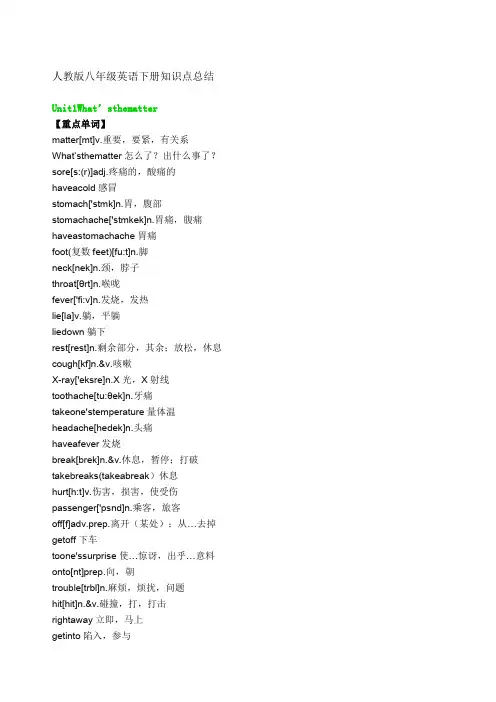
人教版八年级英语下册知识点总结Unit1What’sthematter【重点单词】matter[mt]v.重要,要紧,有关系What’sthematter怎么了?出什么事了?sore[s:(r)]adj.疼痛的,酸痛的haveacold感冒stomach['stmk]n.胃,腹部stomachache['stmkek]n.胃痛,腹痛haveastomachache胃痛foot(复数feet)[fu:t]n.脚neck[nek]n.颈,脖子throat[θrt]n.喉咙fever['fi:v]n.发烧,发热lie[la]v.躺,平躺liedown躺下rest[rest]n.剩余部分,其余;放松,休息cough[kf]n.&v.咳嗽X-ray['eksre]n.X光,X射线toothache[tu:θek]n.牙痛takeone'stemperature量体温headache[hedek]n.头痛haveafever发烧break[brek]n.&v.休息,暂停;打破takebreaks(takeabreak)休息hurt[h:t]v.伤害,损害,使受伤passenger['psnd]n.乘客,旅客off[f]adv.prep.离开(某处);从…去掉getoff下车toone'ssurprise使…惊讶,出乎…意料onto[nt]prep.向,朝trouble[trbl]n.麻烦,烦扰,问题hit[hit]n.&v.碰撞,打,打击rightaway立即,马上getinto陷入,参与herself[h:self]pron.她自己,她本身(she的反身代词)bandage['bndd]n.&v.绷带;用绷带包扎sick[sk]adj.患病的,不适的knee[ni:]n.膝盖nosebleed[nzbli:d]n.鼻出血breathe[bri:e]v.呼吸sunburned[snb:nd]adj.晒伤的ourselves[ɑ:selvz]pron.我们自己(we的反身代词)climber[klam(r)]n.登山者beusedto习惯于…适应于…risk[rsk]n.&v.风险,危险;冒险takerisks(takearisk)冒险accident[ksidnt]n.意外事件;事故situation[sitjuein]n.状况,形式,情况kg=kilogram[klgrm]n.公斤,千克rock[rk]n.岩石runout(of)用尽,耗尽knife[naif]n.刀,餐刀cutoff切除blood[bld]n.血mean[mi:n]v.意味着,意思是,意欲getoutof离开,从…出来importance[mp:tns]n.重要性decision[d'sn]n.决心,决定,抉择control[kn'trl]v.控制,支配,操纵beincontrolof掌管,管理spirit['sprt]n.勇气,意志death[deθ]n.死亡giveup放弃nurse[n:s]n.护士【重点短语】1.haveafever发烧2.haveacough咳嗽3.haveatoothache牙疼4.talktoomuch说得太多5.drinkenoughwater喝足够的水6.haveacold受凉;感冒7.haveastomachache胃疼8.haveasoreback背疼9.haveasorethroat喉咙痛10.takerisks冒险11.hotteawithhoney加蜂蜜的热茶12.seeadentist看牙医13.getanX-ray拍X光片14.takeone’stemperature量体温15.putsomemedicineonsth.在……上面敷药16.giveup放弃17.soundlike听起来像18.allweekend整个周末19.inthesameway以同样的方式20.gotoadoctor看医生21.goalong沿着……走22.onthesideoftheroad在马路边23.shoutforhelp大声呼救24.withoutthinkingtwice没有多想25.getoff下车26.haveaheartproblem有心脏病27.toone’ssurprise另某人惊讶的是28.thanksto多亏了;由于29.intime及时30.makeadecision做出决定31.getintotrouble造成麻烦32.rightaway立刻;马上33.becauseof由于34.getoutof离开;从……出来35.keepondoingsth.继续或坚持做某事36.putabandageonsth.用绷带包扎37.falldown摔倒38.feelsick感到恶心39.haveanosebleed流鼻血40.cuthisknee割伤他的膝盖41.putherheadback把她的头向后仰42.haveproblemsbreathing呼吸困难43.mountainclimbing登山运动44.beusedtodoingsth.习惯做某事45.runout(of)用完;用尽46.sothat以便47.so...that...如此……以至于...…48.beincontrolof掌管;管理49.inadifficultsituation在闲境中【重点句型】1.What'sthematterwithyou=What'thetroublewithyou=What'swrongwithyou你怎么了?2.Whatshouldshedo她该怎么办呢?3.ShouldItakemytemperature我应该量一下体温吗?4.Youshouldliedownandrest.你应该躺下休息一会儿。
人教版英语八年级下册1-4单元知识点总结

我们应该为孩子们提供一个干净舒适的环境。
①
5.mind (sb) doing sth介意做某事
你介意我打开窗户吗?
6.It is+adj.+ (for/of sb)+to do sth
形式主语真正主语
(1)当形容词描述的是人的性格、品质时用of
1这个司机看到一个老人正躺在路边。
2我经常看到他打篮球。
15.get on上车
get off下车
我们将要在下一站下车。
16.think of想起
think about考虑
think up想出
这个司机没有考虑他自己。
17.thanks to多亏;由于thanks for由于而感谢
①谢谢你邀请我参加晚会。
21.so that为了;以便
21.1.that...如此以至于
①这个地方是如此的美丽以至于他不想返回家了。
②为了赶上早班车,他每天起得很早。
22.sick既可作定语,也可做表语
ill作表语
①他生病了。
②他是一个生病的孩子。
Unit
1.volunteer to do sth义务做某事
他义务去打扫城市公园。
use up
他上个月底用光了他的钱。
8.mean doing sth意味着做某事
mean to do sth打算/计划做某事
mean that从句表示
1这意味着处在一个困难的情况中。
2我打算今天把这本书给你,但是我忘了。
3红灯表示你必须停下来。
9.the importance of的重要性
我们应该知道做好的决定的重要性。
(完整版)最新人教版八年级下册英语全册知识点大全
最新人教版八年级下册英语全册知识点大全Unit 1重点短语:have a stomachache have a cold lie downtake one’s temperature have a fever go to a doctorto one’s surprise agree to (do sth.)get into troublebe used to take risks run out (of)cut off get out of be in control ofkeep on ( doing sth.)give up语言知识归纳:1. What’s the matter (w ith you)?此句用来询问别人的病情。
类似的句子还有:What’s wrong with you?/ What’s the trouble?matter作动词用,意为“要紧”“有关系”,主要用于疑问句和否定句。
What does it matter? It doesn’t matter.【例题】Does it ________ if we can’t finish it today?A. mindB. mindsC. matterD. matters2. I have a sore throat.have “患病”,常用“have a /an+ 名词”.have a cold have a fever have a sore backhave a stomachache have a cough【例题】( )---Does he often have ______ cold? ---Yes. He also _____a cough and a sore throat.A. a; hasB. /; hasC. a; haveD. /; have3.Lie down and rest! 躺下休息lie down 躺下4.That’s probably why. 那可能就是原因。
人教版八年级英语下册各知识点归纳总结(最新最全)
人教版八年级英语下册各知识点归纳总结Unti1 what’s the matter?短语归纳1.too much 太多2.lie down 躺下3.get an X-ray 做个X光检查4.take one ’s temperature 量体温5.put some medicine on ......在....上敷药6.have a fever 发烧7.take breaks /take a break 休息 8.without thinking twice 没多想9.get off 下车 10.take sb to the hospital 送某人去医院11.wait for等待 12.to one’s surprise 使.......惊讶的13.thanks to多亏于;由于 14.in time及时15.think about 考虑 16.have a heart problem患有心脏病用法归纳1.need to do sth .需要去做某事2.see sb doing sth 看见某人正在做某事3.ask sb sth 询问某人某事4.expect sb to do sth 期望某人做某事5.agree to do sth 同意做某事6.help sb (to) do sth 帮助某人做某事7.want to do sth 想要做某事 8.tell sb to do sth 告诉某人做某事9.have problems(in) doing sth 做某事有困难 e sth to do sth用某物去做某事语法点1.询问某人的健康问题及遇到麻烦的表达方法2.情态动词should的用法3.不定代词的用法精细解读1. What’s the matter (with you)? 怎么了?出什么事了?What’s the trouble/ the problem / wrong with sb./ sth.?2. I had a cold.我感冒了。
人教版八年级英语下册各单元知识点总结完整版
Unit 1 What’s the matter?一、重点短语1. have a fever 发烧2. have a cough 咳嗽3. have a toothache 牙疼4. talk too much 说得太多5. drink enough water 喝足够的水6. have a cold 受凉;感冒7. have a stomachache 胃疼8. have a sore back 背疼9. have a sore throat 喉咙痛10. lie down and rest躺下来休息11. hot tea with honey加蜂蜜的热茶12. see a dentist看牙医13. get an X-ray拍X光片14. take one’ s temperature量体温15. put some medicine on sth在……上面敷药16. feel very hot 感到很热17. sound like 听起来像18. all weekend 整个周末19. in the same way以同样的方式20. go to a doctor 看医生21. go along 沿着……走22. on the side of the road 在马路边23. shout for help 大声呼救24. without thinking twice 没有多想25. get off 下车26. have a heart problem 有心脏病27. to one’ s surprise 使……惊讶的28. thanks to 多亏了;由于29. in time及时30. save a life 挽救生命31. get into trouble 造成麻烦32. right away 立刻;马上33. because of 由于34. get out of 离开35. hurt oneself 受伤36. put a bandage on sth. 用绷带包扎37. fall down 摔倒38. feel sick 感到恶心39. have a nosebleed 流鼻血40. cut his knee割伤他的膝盖41. put her head back 把她的头向后仰42.have problems breathing呼吸困难43. mountain climbing登山运动44. be used to doing sth. 习惯做某事45. run out (of) 用完;用尽46. so that 以便47. so…that 如此……以至于……48. be in control of 掌管;管理49. in a difficult situation 在逆境屮50. keep on doing sth.坚持做某事51. make a decision做出决定52. take risks 冒险53. give up 放弃二、知识点解析1. What’s the matter? 怎么了?若是询问“某人怎么了?”要用“What’s the matter with sb.?”拓展:What’s the matter with sb.? 的同义句:What’s wrong with sb.? / What’s the trouble with sb.?2.疾病类短语:have a +疾病. e.g. :have a fever 发烧have a cold 感冒have a cough 咳嗽.have a +身体部位-ache. e.g.: have a headache 头痛have a toothache 牙痛.have a sore+身体部位. e.g.: have a sore throat咽喉痛have a sore back背痛例题:Mom, I____________.I’m sorry to hear that, dear. We must go to see the dentist right away.A. have a headacheB. have a stomachacheC. have a toothacheD. have a fever3. lie down 躺下V. 躺,平躺。
八年级下册英语一到三单元知识点
八年级下册英语一到三单元知识点那咱开始!一单元知识点。
1. 一般将来时。
- 这可是个重要的时态哦!表示将来要发生的动作或存在的状态。
常见的结构有“will + 动词原形”和“be going to + 动词原形”。
比如说,“I will go to Beijing next week.”(我下周要去北京。
)“He is going to have a party tomorrow.”(他明天要开个派对。
)- 要注意哦,will 比较随意,be going to 通常是有计划、有打算的。
2. 短语大集合。
- fall down (摔倒)想象一下,像个大冬瓜“扑通”一下倒地上。
- look for (寻找)别和 find 搞混啦,find 是“找到”,look for 是还在努力找的过程。
- in the future (在未来)未来嘛,充满了神秘和可能!二单元知识点。
1. 情态动词 could。
- could 这个小家伙,语气比 can 更委婉、更客气。
“Could you please help me?”(你能帮帮我吗?)比“Can you please help me?”听起来更有礼貌。
- 还有,could 还能是 can 的过去式,表示过去的能力。
2. 动词短语。
- cheer up (使高兴;使振奋)就像给心情打了一针兴奋剂!- give out (分发;散发)把东西一个一个发出去。
- come up with (想出;提出)脑袋里突然蹦出个好主意。
3. 感叹句。
- What + (a/an) + 形容词 + 名词 + (主语 + 谓语)!“What a beautiful flower!”(多美的花啊!)- How + 形容词/副词 + (主语 + 谓语)!像“How fast he runs!”(他跑得多快啊!)1. 过去进行时。
- 这是在讲过去某个时刻正在进行的动作。
结构是“was/were + 动词的现在分词”。