
最新外研版七年级下册英语Module 11 Body language-Module 11 教案
Module 11 Body languageUnit 1 They touch noses!一、教学目标1. 语言知识目标:1) 能正确使用下列单词和词组:kiss, shake hands, smile, German, British,Japanese, Russian, hug, India, together, nod one’s head, each other...2) 能听懂有关手势语的对话。
2. 情感态度价值观目标:1) 学习一些见面礼仪。
2) 了解西方国家的风土人情和习俗。
二、教学重难点1. 教学重点:能听懂有关在不同国家初次见面和表达问候时的手势语。
2. 教学难点:中西方人们见面礼仪的差别;培养学生跨文化交际意识。
三、教学过程Step 1 Leading-in1.Review the key words about human body.2.Learn the new words学习新词汇,播放词汇音频。
3.Shows some body action and ask students to guess the meaning.老师自己或请两名同学上台表演,其他同学猜测肢体语言所传达的含义。
Step 2 Match1. Ask the students to look at the pictures and say what body language they can see.2. Match the pictures with the words and expression from the box.Step 3 Listening1. Play the tape, ask the students to listen and match the pictures with the nationality inActivity 2.2. Work in pairs and check the right answers each other.Step 4 Reading1.Guide the students to listen to the conversation in Activity 3 and answer the question:What so the people in China/US/India/New Zealand do when they meet?1)In China a. shake hands, kiss or hug each other2)In the US b. shake hands, smile or nod heads3)In India c. touch nose4)In New Zealand d. put their hands together and nod theirheads2. ScanningScan the language and answer the questions:1)Who will come to Linging’s school?2)What will Maori people do when they meet?3. Careful readingAsk the students to read the dialogue carefully and complete the table with the correct form of the words from the box.Step 5 Post-reading1. Let the students act out the dialogue.2. Show some pictures and things to organize the students to talk about them.3. Have the students act out their new dialogues.Step 6 listen and repeatListen to the recording and pay attention to the pronunciation.Step 7 Group workMake a conversation to talk about what you do and say when you meet.--- What do you do and say when you meet your teacher in the morning?--- I smile and say good morning.Step 8 Language points1. … in Russia, people usually kiss three times, left, right, left.kiss v.吻,亲吻eg. The mother kissed the sleeping baby on his head.妈妈亲了一下这个睡着的婴儿的额头。
kiss n.吻eg. He threw me a kiss and went away. 他给了我一个飞吻,然后走开了。
2.That’s because people do different things in different countries.That’s because …是一个常用句式,表示“那是因为……”。
eg. That’s because you were not careful enough.那是因为你不够仔细。
That’s because I didn’t know much about body language in this country.那是因为我对这个国家的肢体语言了解不够。
3. They touch noses!碰鼻礼是毛利人传统的打招呼方式,也是一种表达真挚问候的礼仪。
行礼时,相互问候的两个人要鼻尖相碰,表示交换双方的呼吸,使之融合在一起。
毛利人是新西兰的原住民,他们有自己独特的生活方式和文化。
Step 9 Exercises一、单词拼写1. “Welcome!”, she s_____ hands and smiles.2. She came and gave her grandpa’s a h .3. If you agree with my ideas, you n your head.4. Maori people in New Zealand t____ noses when they meet.5. They b to their king every morning.Keys: 1. shakes 2. hug 3. nod 4. touch 5. bow二、根据本单元所学内容,完成短文。
In _____, people shake hands and smile when they meet visitors. In ______________, people shake hands and sometimes kiss. In _____, people put their hands together and nod their heads. In ______, people usually kiss three times, In ___________, Maori people touch nosesKeys: China; America/the US; India; Russia; New ZealandStep 10 HomeworkMake a dialogue in pairs when you meet a foreigner.Unit 2 Here are some ways to welcome them.一、教学目标1. 语言知识目标:1) 能正确使用下列单词和词组:finger, foot, knee, leg, mouth, body, foreign, personal, arm in arm, hold, move, not at all, polite, wave, in fact, bring...2) 能读懂简单的介绍不同国家身势语的短文2. 情感态度价值观目标:了解不同国家的不同身势语,加强对中国文化的理解。
二、教学重难点1. 教学重点:1)掌握本部分出现的生词和词组,达到熟练运用的目标。
2) 阅读短文,获得相关的信息。
通过阅读练习,来提高阅读能力。
2. 教学难点:掌握祈使句的用法三、教学过程Step 1 Revision and lead-in1. Revise some words about body language.2. Let one student act out body language, other students say out the words.Step 2 Consolidate new wordsShow the students some pictures and have a free talk between teacher and students, teach them the new words and expression.Step 3 MatchLook at the pictures and match the parts of the body.Step 4 Reading1.ScanningAsk the students to scan the passage and find out what it is about.2. Listen to the tape carefully and answer the two questions.1)Can we stand close to people in Middle East?2)Is it polite to wave to say goodbye in Greece?3. Careful reading1) Let the students read Paragraphs 1and 2 and answer the question:Is it all right to stand close to people in the Middle East?2) Read Para 3 and 4 and do the true or false questions:a. The British like touching people.b. Americans look at people when they talk.3) Let the students listen to the tape again and answer the questions in Activity2.4) Let the students check(√) in the blanks on the table according to Activity 2. And thencheck the right answers in group.5) Read the short passage, then fill in the blanks with the words from the box of Activity4. And then the Students check the answers.Step 5 Writing1. Talk about your class rulesWork in groups. First, learn about your class rules, then talk about them in pairs.2. Make a list of class rules for new student in your classIf a new student comes to your class this term, please make a list of class rules for him in your class.Step 6 Language Points1.Chinese girls often walk arm in arm with their friends.arm in arm 臂挽臂地eg. The two girls are good friends. They like to walk arm in arm.这两个女孩儿是好朋友,他们喜欢走路时臂挽臂。
外研版七年级英语下册Module11Bodylanguage专题讲解
外研版七年级英语下册Module11Bodylanguage专题讲解外研版英语七年级下册Module11 Body language本单元提纲:1.主题功能:能够谈论身体语言。
2.重点单词:kiss, nod, head, shake, smile, hug等。
3.重点词组: nod one’s head, shake hands,talk to sb., close to 等。
4.重点句型:We Chinese often shake hands and smile when we meet visitors, and sometimes we nod our heads. That’s because people do different things in different countries.5.核心语法:祈使句6.智力背景补充:Olympics Slogans奥运口号2000 Sydney:Share the spirit分享奥林匹克精神2004 A thens:Welcome Home欢迎回家2008 Beijing:2012 London:Inspire a generation激励一代人重难点精讲We Chinese often shake hands and smile when we meet visitors, and sometimes we nod our heads. 当我们遇到来访者的时候,我们中国人经常握手,并且微笑,有时候还点头。
本句是由and连接的并列句,前一个分句还含有wh en引导的时间状语从句。
shake hands 意为“握手”shake hands with sb. 和某人握手shake one’s head 摇头题一:翻译题:1. 我见到他的时候,总是微笑。
2. 我爸爸妈妈站了起来,和老师握手。
In the US some people shake hands, and some kiss or hug each other.在美国,一些人握手,一些人相互亲吻或者拥抱。
外研版七年级下册英语Module11Bodylanguage全模块同步学案(含答案)
外研版七年级下册英语Module 11 Body language ◎第1课时Unit 1 They touch noses!1. We Chinese often shake hands and smile when we meet visitors, and sometimes we nod our heads.当我们遇到来访者的时候,我们中国人经常握手,并且微笑,有时候还点头。
(1)shake hands 意为“握手”。
shake hands with sb. 意为“和某人握手”。
【例】My parents stood up and shook hands with my teacher.我父母站了起来,和老师握手。
(2)smile此处是动词,意为“微笑”,也可作名词。
【例】There is a smile on her face. 她笑容满面。
【拓展】辨析smile和laugh①smile 一般表示不出声的微笑,可以是名词,也可以是动词。
②laugh 指出声的大笑。
laugh at sb. 意为“嘲笑某人”。
2. That’s because people do different things in different countries.那是因为不同国家的人们做法不同。
That’s because …意为“那是因为……”。
是一个常用句型,because后的句子陈述原因。
【例】That’s because she works hard.那是因为她工作努力。
3. In the US some people shake hands, and some kiss or hug each other. 在美国,一些人握手,一些人相互亲吻或者拥抱。
each other意为“互相、彼此”,是固定搭配。
【例】We should learn from each other.我们应当互相学习。
一、根据句意及汉语提示完成单词。
七年级英语下册 Module 11 Body language课件 外研版

祈使句
Ⅰ. 单项选择
1. If you are tired, ______a rest.
A. have B. having C. to have D. will have
2. The TV is too loud. Please ______.
A. turning it down
A. Not B. Won’t C. Didn’t
D. Don’t
5. Boys and girls, ______here early tomorrow please. We’ll have something important to do.
A. comes B. come
C. to come
D. coming
5. 表示请求时,可以加上please;表示比较强烈的语气时,可 以用感叹号。
本模块以“肢体语言”为话题,这是最能体现文化差异的 一个话题,也是学生非常感兴趣的一个话题, 而谈论文化差异 是模块测试和中考等试题中常考的话题作文之一。
【习作练习】
中美两国的课堂有一些不同的特点,请根据下表简要描述 一下这些特点,并谈谈自己的想法。
编后语
有的同学听课时容易走神,常常听着听着心思就不知道溜到哪里去了;有的学生,虽然留心听讲,却常常“跟不上步伐”,思维落后在老师的讲解后。这两种情况都 不能达到理想的听课效果。听课最重要的是紧跟老师的思路,否则,教师讲得再好,新知识也无法接受。如何跟上老师饭思路呢?以下的听课方法值得同学们学习:
二、同步听课法
有些同学在听课的过程中常碰到这样的问题,比如老师讲到一道很难的题目时,同学们听课的思路就“卡壳“了,无法再跟上老师的思路。这时候该怎么办呢?
外研版七年级英语下 Module_11__Body_language_Unit_2__Here_are_some_ways_to_welcome_them_hhh.
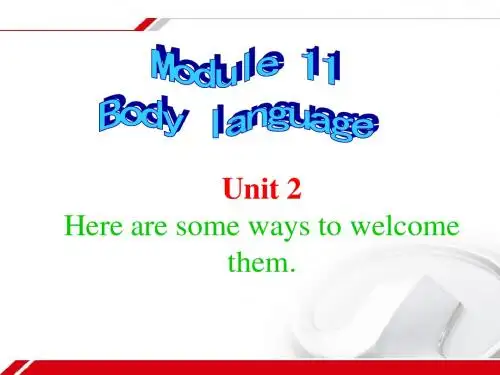
shake hands and smile when they meet. They usually __________
Where are they from?
Maybe
They are from America. They are American. How do they greet? They usually _______________ shake _________ kiss _______________________ hands, when they meet. or hug each other
In Greece, it’s not at all polite! In fact, it’s very rude.
wave to say goodbye be careful in fact
挥手告别 小心 事实上
语法讲解----祈使句
But be careful!
1.—Don’t be late again, Mike? —_______________. A. No, I don’t C. Sorry, I won’t B. Don’t worry D. I don’t know
Maybe
Where are they from? They are from New Zealand. They are Maori. How do they greet?
They touch noses.
You know, when we meet others, we often use our body to greet each other. Now, let learn about our body.
head
ear
七年级英语下册 Module 11 Body language检测卷 (新版)外研版-(新版)外研版
Module11Bodylanguage Ⅰ.单项选择(每小题1分,共10分)1.B careful!cross the road when the traffic light is red.A.Be;NotB.Be;Don’tC.Do;Can’tD.Do;Don’t2.—C do the Chinese people say hello to each other they meet? —They shake hands with each other.A.How;howB.What;whenC.How;whenD.What;how3.Of course,this is just a A opinion.D.strange4.It’s B not to talk loudly in the library.5.—Do you still plan to go to the seaside for your vacation? —No,I’d like to go C.A.anywhere elseB.else somewhereC.somewhere elseD.else everywhere6.Here C a pen and some books for you.7.How about A to school by bus?C.to go8.—Is the supermarket very B your house?—No.It often takes me half an hour to go there by bike.A.far fromB.close toC.close fromD.far to9. Her foreign teacher es from B,and he speaks.A.German;GermanB.Japan;JapaneseC.Russian;RussiaD.British;English10.—Do you know why he failed?—I think that’s A he was too careless.Ⅱ.完形填空(每小题1分,共10分)We use body language to send messages to others.It is very 11.A because others can understand you easily when you use body language.When you are talking with others,you are not just using words,but also using 12.B.For example,waving one’s hand is to say “Good-bye”.Shaking hands means wele,and clapping hands 13.C congratulations(祝贺).Nodding the head means YES,but shaking the head means NO.Different countries have 14.D body language.For example,when in 15.A,France and Arab countries,people kiss each other when they meet,16.C men in China or Australia shake hands.People in Puerto Rico like touching each other,but people in Britain do not touch each other.People in Arab countries like 17.D close to one another when they are talking,but English people must keep a distance away when they are talking.It is very important 18.C the meanings of gestures and movements in the foreign country 19.B they will help you municate with people and make you stay there much more 20.D and fortable.111213.A.to mean14.A.the same B.a sameC.the different15 B.the RussiaD.a Russia161718C.to know1920Ⅲ.阅读理解(每小题2分,共20分)APeople in different countries greet each other in different ways.Here are some. TheUnitedStatesPeople shake hands when they meet for the first time.Friends and family members often hug or kiss on the cheek(脸颊) when they see each other.Korea(韩国)Men bow and shake hands to greet each other.Women do not usually shake hands.If you address someone,you should use his or her full name.The family name es first,and then the first name.Finland(芬兰)Finns(芬兰人) greet each other with a handshake.Hugs and kisses are only for close friends and family members.ThePhilippines(菲律宾)The everyday greeting for friends is a handshake for both men and women.Men sometimes pat each other on the back.21.In which country do men sometimes pat each other on the back?AA.The Philippines.B.Finland.C.Korea.D.The United States.22.Which of the following is TRUE?BA.People shake hands whenever they meet in the United States.B.In the Philippines,friends shake hands as the everyday greeting.C.Finns greet each other with a bow.D.In Korea,the first name es before the family name.23.Of the four pictures(a,b,c,d),which is the same way to greet each other in the four countries?D24.In this passage,all the following are mentioned EXCEPT C.25.What does the writer want to tell us in the passage?AA.Different ways of greeting.B.Four countries.C.Friends and family members.nguages.BMy mother used to ask me what the most important part of the body was.I got different answers at different ages.When I was young,I thought sound was very important to us,so I said,“My ears,Mum.” But she shook her head and said no.Several years passed,and she asked me again.I believed that I got the right answer after thinking it over.So I told her,“Sight is very important to everyone,so it must be our eyes.” But she told me I was wrong.I tried many times after that,but her answer was always the same.Till last year,my grandma died.Everybody was crying,and everybody was hurt.My mom looked at me and asked me with tears in her eyes,“Do you know the answer now?” I was surprised when she asked me this question then.“Myson,the answer is your shoulder.Everyone needs a shoulder to cry on(倾诉的对象).”Finally,I realized (意识到)all she hoped is that I can have enough love and friends so that I will have a shoulder to cry on I when I need it.26.According to the passage,D are the most important part of the body.B.cars27.The writer gave B to the same question at different ages.A.the same answerB.different answersC.four answersD.the right answer28.The underlined word “Sight” means D in Chinese.A.听力B.嗅觉C.触觉29.B gave the right answer to the question at last.A.The writer’s fatherB.The writer’s motherC.The writerD.The writer’s grandma30.The writer got the right answer on the day when A.A.his grandma diedB.somebody was hurtC.his mother was cryingD.he was youngⅣ.词语运用(每小题1.5分,共15分)A.根据首字母或汉语提示完成句中单词。
七年级英语下册 Module 11 Body language练习外研版

Module 11 Body language Unit 1 They touch noses!短语互译1.shake hands (with…)2.nod one's head3.three times4.互相句型在线1.你知道新西兰的毛利人见面时做什么吗?And Maori people New Zealand do they meet?2.那是因为不同国家的人们做法不同。
people do different things in different countries.语音知识/t∫//∫//pl/ /fr/ /br/Ⅰ.汉译英1.俄语教师2.在学校3.接待访客4.在不同的国家5.电影明星Ⅱ.根据句意及首字母提示补全单词1.Don't t the dog! It's dangerous.2.In India, people put their hands t and n their heads when they meet.3.Our teacher came into our classroom, with a s on his face.4. She s hands with her old friend yesterday.5.They looked at e other and laughed.Ⅲ. 根据句意及汉语提示完成句子1.—Where is your new friend from?—(印度), an Asian country.2.There is always a big (微笑) on our teacher's face.3.Mrs Black (亲吻) her son and left home in a hurry.4. (那是因为) you got up late this morning.5.Please the red apples (把……放在一起).6.They often (点头) when they meet.Ⅳ.用所给词的适当形式填空1.They (kiss) each other and said goodbye.2.These two (German) are my new friends.3.Mr Li didn't say anything, but just (nod) his head.4.Thousands of (visit) come to visit the Summer Palace every day.5.I (meet) my pen friend tomorrow.6.Russians speak (Russia).7.Look! The little boy (smile) at his father.8.Tom shakes (hand) with his friend to welcome her coming.9. (hug) is a kind of body language.10.Each (have) his own hobby.11.Can you speak (Japan)?12.There are some differences between American English and(Britain) English.Ⅴ.按要求完成句子1.This teacher comes from Russia.(改为同义句)This is a .2.My father likes Beijing Opera because he thinks it is very interestingW. (对画线部分提问)your father Beijing Opera?3.You should speak English in class.(改为祈使句)English in class.4.We met her at the airportW.(对画线部分提问)Where you her?5.She often takes a walk after dinner. (用last year改写句子)She often a walk after dinner last year.6.Maori people touch noses when they meet. (对画线部分提问)Maori people when they meet?7.I go swimming three times a weekW. (对画线部分提问)you go swimming?8.We're going to have some Russian teachers at school tomorrow. (改为同义句)We some Russian teachers at school tomorrow.9.People put their hands together and nod their heads in this country.(改为否定句)People their hands together nod their heads in this country.10.Body language means different things in different countries. (改为一般疑问句)body language different things in different countries?Ⅵ.根据汉语意思完成句子1.他们正在拥抱彼此。
Module 11 Body language-七年级英语下单元话题满分写作(外研版)
2021-2022学年七年级英语下学期单元话题满分写作Module 11: Body language单元话题:社交礼仪范文11.假如你叫李硕,你的美国笔友Cindy要来中国,她发电子邮件说想了解中国的一些社交礼仪。
请根据下面四幅图片及文字提示给她回复一封电子邮件。
shake handsit's rude to point at others with chopsticksarrive at the party on timedon't give a clock as a present注意:(1)邮件中须包括提示中的所有要点,可适当发挥,提示词语供参考;(2)邮件中不要出现真实的地名、校名和人名;(3)词数80左右,开头和结尾已经给出,不计入总词数。
Dear Cindy,I'm glad to know that you are coming to China.____________________________________________________________________________________________________________________________________________________________________________ ______________________________________________________________________________________ ______________________________________________________________________________________ ______________________________________________________________________________________范文22.在八年级即将结束之际, 八(1) 班将举行一次主题班会, 要求同学们谈谈一年来自己的收获与变化。
外研版英语七年级(下) Module 11 .Body language
外研版英语七年级(下)Module 11 .Body language一.重点短语句型归纳。
1. body language 身体语言2. touch noses 碰鼻子touch v.接触、触摸、打动n.接触、联系、关系be/keep in touch with 和…保持联系get in touch with 和……取得联系3. nod head 点头4. in different countries在不同的国家5. shake hands 握手shake hands with…和…握手6. three times 三次7. each other 互相所有格形式:each other’seach of 后面接复数名词或代词复数,但做主语的时候,谓语要用单数。
Each of us has to take one. each 做主语。
我们每个人必须拿一个We each have to take one. we是主格,做主语。
8. best friend 最好的朋友9. film star 电影明星10. foreign students 外国学生11. talk to…与….交谈talk with…和….交谈talk about…谈论关于…12. stand close to 站得近be close to…离…近13. personal space 私人空间14. arm in arm 臂挽臂hand in hand 手拉手face to face 面对面shoulder to shoulder 肩并肩15. south Americans 南美人16. move away 离开,搬走move on 继续移动17. not at all 一点也不18. be polite to do …做…是礼貌的19. look at 看20. in other countries 在其他国家21. say goodbye 道别say goodbye to 向…道别,向…分手say hello to 和…打招呼say sorry to 向…道歉22. wave to say goodbye 挥手说再见23. be careful = Take care!=look out 小心24. in fact 事实上25. hold on to…抓紧Hold on, please. 等一会儿26. be late for class 上课迟到27. class rules 班规28. in class 在课上29. stand in line 站成一排,排队30. on time 准时in time 及时31. enter the lab alone 独自进入实验室32. many other things 许多其他事情33. greet sb. 问候某人34. bring, take与carrybring 表示“拿来,带来”,指从别处把某人或某物带到说话人所在之处take 表示“带走,拿走”,指从说话人所在地把某人或某物带走或拿走carry仅表示“携带,带着”,不含方向二、句型。
七年级英语下册 Module11Bodylanguage模块话题微写作课时作业外研版
Module 11 Body language模块话题微写作本模块的话题是“礼仪和规范”,要求学生能简单介绍不同国家的接待礼仪与不同场合的行为规范,结合各地风俗习惯介绍中国与西方国家的文化差异。
在具体的写作中,学生应做到以下几点:1.能简单了解各国在接待礼仪方面的差异并阐述;2.能准确使用祈使句来表达各种礼仪规范;3.能熟练运用各种句式,使文章条理清晰。
shake hands 握手wave to 挥手each other 互相arm in arm 臂挽臂地;手挽手地touch the nose 触碰鼻子stand too close 站得太近open the door for 为……开门put hands together 双手合十not at all 一点也不in fact 事实上1.We Chinese often shake hands and smile when we meet visitors,and sometimes we nod our heads.我们中国人见到来访者的时候经常握手、微笑,有时候点头示意。
2.That’s because people do different things in different countries.那是因为不同国家的人做法不同。
3.Our new foreign students are going to arrive very soon,and here are some ways to welcome them.我们的外国新生很快就要到了。
下面是迎接他们的一些方式。
4.How close do you stand when you talk to a friend?当你和朋友交谈时站得有多近呢?5.Chinese girls often walk arm in arm with their friends.中国女孩常常和朋友臂挽着臂一起走。
最新外研版七年级英语下册 Module 11 Body language见面基本礼仪文章背景素材
最新初中英语精品资料设计最新初中英语精品资料设计 1 见面基本礼仪1、握手 通常年长(尊)者先伸手后,另一方及时呼应。
来访时、主人先伸手以表示欢迎。
告辞时,待客人先伸手后,主人再相握。
握手的力度以不握疼对方的手为限度。
初次见面时,时间一般控制在3秒钟内。
2、介绍 介绍时应把身份、地位较为低的一方介绍给相对而言身份、地位较为尊贵的一方。
介绍时陈述的时间宜短不宜长,内容宜简不宜繁。
同时避免给任何一方厚此薄彼的感觉。
3、致意 表示问候之意。
通常在各种场合用举手、点头、欠身、脱帽等方式向相识的人打招呼。
现在详细介绍下:握手礼、名片礼、脱帽礼、拥抱礼、亲吻礼等。
名片礼:初次相识,往往要互呈名片。
呈名片可在交流前或交流结束、临别之际,可视具体情况而定。
递接名片时最好用双手,名片的正面应朝着对方;接过对方的名片后应致谢。
一般不要伸手向别人讨名片,必须讨名片时应以请求的口气,如“您方便的话,请给我一张名片,以便日后联系。
” 脱帽礼:见面时男士应摘下帽子或举一举帽子,并向对方致意或问好;若与同一人在同一场合前后多次相遇,则不必反复脱帽。
进入主人房间时,客人必须脱帽。
在庄重、正规的场合应自觉脱帽。
拥抱礼和亲吻礼:流行于欧美国家。
拥抱礼多用于官方、民间的迎送宾客或祝贺致谢等社交场合。
两人相对而立,上身稍稍前倾,各自右臂偏上,左臂偏下,右手环拥对方左肩部位,左手环拥对方右腰部位,彼此头部及上身向右相互拥抱,最后再向左拥抱一次。
亲吻礼:行亲吻礼时,往往伴有一定程度的拥抱,不同关系、不同身份的人,相互亲吻的部位不尽相同。
在公共场合和社交场合,关系亲近的女子之间可以吻脸,男子之间是拥肩相抱,男女之间一般是贴面颊;晚辈对尊长是吻额头;男子对尊贵的女宾可以吻手指或手背。
在许多国家的迎宾场合,宾主往往以握手、拥抱、左右吻脸、贴面颊的连续动作,表示最真诚的热情和敬意。