
外研版小学英语五年级下册module6(unit2)
Look,ask and answer
Where did you go for the holidays?
I went to Yinchuan.
Where is Yinchuan? It’s in the north of China.
or, oor, our morning door, your
East and west, home is the best.
North and south, Let’s have a rest.
Listen and chant
Listen and chant
Listen and chant
Listen and chant
Listen and chant
ou, ow about how
our, ur colouro and say
Write and say
My trip
I went to last year. I went There in . It’s in the of China. I went there with my . I went there by . It was very .
Review the times
I went to Xinjiang last year.
Xinjiang
I went to Yinchuan last year.
I went to ShanghaiDalian last week.
Shanghai
Yinchuan
I went to Hainan last week.
Name Where did When did What did you do? you go? you go?
Amy Qingdao in July visited her friend
e.g. Amy went to Qingdao in July. She visited her friend.
Listen and chant
Listen and chant
Welcome to Xinjiang!
Listen and read
Listen and read
Listen and read
Listen and answer
1.Where is Xinjiang? It’s in the west of China. 2.When did Lingling go there? She went there last year. 3.Did she go with her father and mother? Yes, she did. 4.Does Lingling’s uncle live in Xinjiang? No, he doesn’t.
moon月亮,月球 get到达 west西,西部,西方;向西方 parent母亲;父亲;家长 stay停留 July七月 south南,南部,南方;向南方 remember记得 June六月 east东,东部,东方;向东方 best最好的 north北,北部,北方;向北方 rest休息 have a rest休息一下 rode(ride的过去式)骑
My home is in the north.
My home is in the west. My home is in the east.
My home is in the south.
This is my home.
My home is the best!
Listen and chant
Module6Unit2Itwasamazing(教学设计)外研版(一起)英语五年级下册
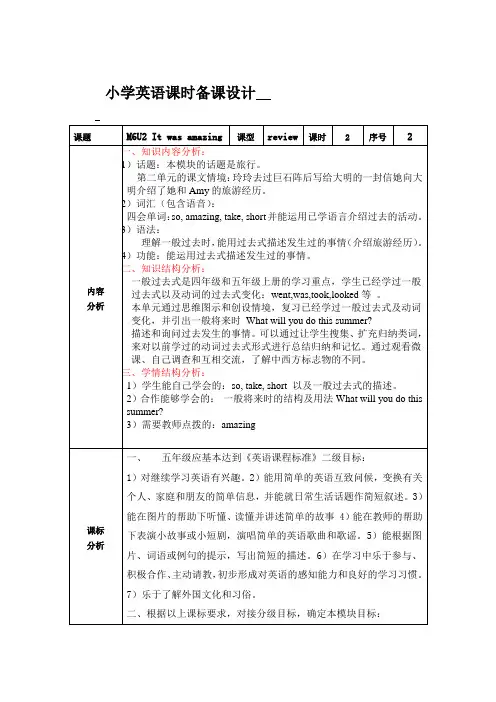
小学英语课时备课设计didn’t. 牢记一般过去时的规律难点:一般过去时的重点句型在实际生活中的迁移运用。
突破措施:通过多设置与孩子们生活实际相关的情境,如展示课外图片用“Did you play football yesterday?”来训练孩子们的反应能力,也可以设置整体的大情境“What did you do last weekend?”等,让小组合作,用重点句型“What did you do last weekend? I wentto...I took a ...ride,it was amazing.”来写email以巩固一般过去时的句子的使用,训练和检测学生们的句型运用能力。
课前准备课件,CD-ROM学习过程环节与目标学习内容及学生活动评价活动指导与补救一、激趣导入,融入情境(回扣目标2:通过看图说句子、创设情境、创编对话、同桌交流等方式,能听懂、会说、运用一般过去式介绍过去发生的事情。
教师:1 Class greeting 和学生打招呼2.freetalk ,看图说话,并用一般过去式描述。
学生1. Say hello to theteacher.2.学生看图说话。
2.随机抽取学生进行描。
问题预设:基础薄弱的学生在一般过去式的运用上比较欠缺。
补救措施:多出示几幅图片,巩固练习。
二、复习词汇(回扣目标1:)通过出示单词卡片,magic eyes 小游戏等来复习以下词汇:so, amazing, take, short并能运用已学语言介绍过去的活动1.向学生出示提前准备好的单词卡片,通过排火车或者抢答的方式来进行单词的复习。
2.设置magic eyes 小游戏,再次进行单词,短语的复习。
1.排火车,抢答等形式进行检查问题预设:部分学生单词没记住。
补救措施:通过一起作业网进行二次补救。
三、复习课文(回扣目标三): 3)通过听课文回答问题,跟读、小组练习,复习课文,能正确运用本课的重点句型描述已经发生的事情。
外研版(三起)五年级下册英语第六模块第二单元教案-M6 Unit 2 She visited the Tianchi Lake

Module 6Unit 2She visited the Tianchi Lake.【知识目标】1.能够听、说、认、读本课的重点单词:ride, horse, climb, holiday2. 掌握“Where did you go for the holidays?”等句型。
【能力目标】口头运用句型“Where did you go for the holidays? Where is…? It’s in the…of China.”来询问假期所到达的地方并描述这个地方的方位。
【情感目标】通过本课学习,培养学生学习英语的兴趣,产生主动与他人交流的愿望,加深对中国地理文化的理解。
【学情分析】根据本节课教学内容和五年级学生已有一定英语基础的特点,在充分考虑学生学习能力的前提下,我对教学内容有所调整,有所扩展,使教学内容相对开放。
力求在游戏、歌曲、语言交流和简单的写作等活动当中操练和巩固新词和句型,给学生创设真实的语言环境,充分调动学生学习的积极性,扩展学生的思维,培养学生大胆探究和积极思考的习惯。
【教学重难点】句型“where did you go for the holidays? Where is…? It’s in the …of China.”是本单元的教学重点及难点。
【课前准备】1.单词卡片/时间展示图;2.教学光盘或其他录音机设备;3.教学课件。
【教学过程】Step 1:WarmupEast and west,home is the best.North and south,let’s have a rest.Step 2:Revision听写上一课的重点单词和句型。
Step 3:Learn the new text直观演示法。
利用一副中国地图直观演示,首先让学生认识四个地名:Beijing,Shanghai,Hainan和xinjiang,接着采用任务型的教学途径把重点句型:“Where is +地名?”“It’s in the…of China.”体现出来并板书。
五年级下册英语教案-Module 6 Unit 2《She visited the Tianchi

五年级下册英语教案-Module 6 Unit 2《She visited theTianchi Lake》教师:XXX教材版本:外研社(三起)主题:我的旅行时间安排:75分钟教学目标•能够理解和朗读生词和短语:Tianchi Lake,west,north,east,south,why not•通过活动练习,能够自主或合作地进行口语交流,谈论自己的旅行经历•能够听懂教师的简短描述,描述并画出天池的大致地理位置并向同学介绍教学重难点•天池的地理位置:北纬42.35度,东经88.24度,海拔约2000米。
它面积广阔,深如海,四周群山环抱,景色秀丽而神秘,高山草甸、沼泽草原、冰川湖泊和森林,构成了美丽的天池风光。
•学生如何运用词汇和短语描述和表达自己的旅行经历教学流程Step 1 导入•T: Do you like traveling? Where have you been before?•S: …•T: Today we’re going to talk about a beautiful place. Can you guess where it is?Step 2 展示图片•T: Look at this picture, what’s the name of this place?•S: …•T: That’s right! It’s Tianchi Lake. Now let’s take a closer look at it.Step 3 地理位置介绍•T: Do you know where Tianchi Lake is located?•S: …•T: It’s in the north of China. Can anybody guess the exact location of it?•S: …•T: Let me show you on the map. (展示地图) It’s here, in the Xinjiang Uygur Autonomous Region. And here are some important information you need to know: It’s located at 42.35 degrees north latitude and 88.24 degrees east longitude, with an altitude of about 2000 meters. It’s very beautiful, surrounded by mountains, and is known as the “Pearl of the Tianshan Mountains”.Step 4 词汇和短语练习•T: Now let’s learn some new words and phrases about thisbeautiful place. Please read aloud with me. (出示单词卡片,分别带读)(T:Tianchi Lake,west,north,east,south,why not)•T: Now, let’s do an exercise. Please circle the direction that the teacher says. For example, if I say。
五年级下册英语教学设计-第六模块第二单元-外研社(三起)
五年级下册英语教学设计-第六模块第二单元-外研社(三起)一、教学目标知识目标1.学生能够掌握单词:taste, sweet, sour, bitter;2.学生能够掌握句型:What does it taste like? It tastessweet/sour/bitter.能力目标1.学生能够通过观察和品尝食物,描述食物的味道;2.学生能够通过听力、口语练习,提高听说能力。
情感目标1.学生能够培养品尝食物的兴趣和习惯;2.学生能够敬爱食物,珍惜粮食。
二、教学重点和难点教学重点1.学生能够掌握单词和句型;2.学生能够通过观察和品尝食物,描述食物的味道。
教学难点1.学生能够准确描述食物的味道;2.学生能够对不同的食物进行分类和比较。
三、教学内容和过程设计教学内容1.单词:taste, sweet, sour, bitter;2.句型:What does it taste like? It tastes sweet/sour/bitter.教学过程设计步骤一:导入新课1.教师播放一段与食物有关的视频,引起学生的兴趣;2.教师口头介绍本课的教学内容。
步骤二:学习新单词1.教师出示单词卡片,口头介绍单词意思;2.教师快速拼读单词,鼓励学生跟读;3.教师进行单词操练,例如拼读、抢答等。
步骤三:学习新句型1.教师出示句型卡片,口头介绍句型的用法和结构;2.教师明确语音重音和语调;3.教师进行句型操练,例如教师-学生问答、学生之间互动等。
步骤四:品尝食物1.教师展示不同的食物,包括甜的、酸的、苦的等;2.学生观察食物的特点,口头描述食物的味道;3.学生品尝食物,猜测它的味道;4.学生用英语描述食物的味道,老师进行评价和指导。
步骤五:对食物进行分类和比较1.教师出示不同种类的食物,要求学生进行分类;2.学生可以自由组合食物,进行对比和评价;3.学生用英语描述不同食物的味道和特点,老师进行评价和指导。
步骤六:课堂总结1.教师总结本课的学习内容;2.教师鼓励学生提出自己的看法和感受;3.教师布置下一节课的预习任务。
小学英语外研版五年级下册模块知识点

小学英语外研版五年级下册模块知识点公司内部档案编码:[OPPTR-OPPT28-OPPTL98-OPPNN08]Module 1 Unit 1重点句子:1.She was young in this picture.她在这张照片里很年轻.否定句:She wasn’t young in this picture.一般疑问句:Was she young in this picture2. She was a driver before.她以前是一个司机.否定句:She wasn’t a driver before.一般疑问句:Was she a driver before肯定回答:Yes, she was. / No, she wasn’t.就划线部分提问:What was she before3.He played Chinese music.他演奏中国音乐.否定句:He didn’t play Chinese music.一般疑问句:Did he play Chinese music肯定回答:Yes, he did. / No, he didn’t.就划线部分提问:What music did he play4.I can play the flute, too. = I can also play the flute.我也会演奏笛子.5. She drove a bus.她开公共汽车.就划线部分提问:What did she drive6. He teaches us English.他教我们英语.就划线部分提问:What does he teach us7. She helped children.她帮助了孩子们.就划线部分提问:What did she do重点单词:1. grandma2. picture祖母,奶奶图片,照片3. player 玩家,演奏者,运动员,演员Module 1 Unit 2重点句子:1.My grandpa worked in an office.他在办公室工作.否定句:My grandpa didn’t work in an office.一般疑问句:Did your grandpa work in an office肯定回答:Yes, he did. / No, he didn’t.就划线部分提问:Where did your grandpa work2.My mother works in a hospital.我(de)妈妈在医院上班.否定句:My mother doesn’t work in a hospital.一般疑问句:Does your mother work in a hospital 肯定回答:Yes, she does. / No, she doesn’t.就划线部分提问:Where does your mother work3.My parents work in a factory否定句:My parents don’t work in a factory.一般疑问句:Do your parents work in a factory肯定回答:Yes, they do. / No, they don’t.就划线部分提问:Where do your parents work4.There were no computers like there are today.过去不像今天这样,有电脑.5. I was a teacher before.就划线部分提问:What were you before重点单词和短语:1. office2. factory3. hospital办公室工厂医院4. parents 6. shop 7. in the sun父母商店在阳光下very hard工作非常努力Module 2 Unit 1重点句子:1.I’ve got an email from Lingling. 我收到玲玲发(de)一封电子邮件.2.It’s about English food. 它是关于英国食物(de).3.Yesterday she had an English breakfast. 昨天她吃了一顿英国式早餐.4.She had eggs and sausages for breakfast. 她早餐吃了鸡蛋和香肠.否定句:She didn’t have eggs and sausages.一般疑问句:Did she have eggs and sausages肯定回答:Yes, she did. / No, she didn’t.就划线部分提问:What did she have for breakfast5.It’s a traditional English dinner. 它是一顿传统(de)英国式晚餐.6.She says it’s delicious.否定句:She doesn’t say it’s delicious.一般疑问句:Does she say it’s delicious肯定回答:Yes, she does. / No, she doesn’t.就划线部分提问:What does she say重点单词:1. email2. food3. breakfast4. lunch电子邮件食物(不可数)早餐午餐5. dinner6. sausages7. sandwiches8. chips晚餐香肠三明治薯条9. traditional 10. delicious 11. different传统(de)好吃(de)不同(de)Module 2 Unit 2重点句子:1.English people usually have breakfast at seven o’clock. 英国人通常在7点钟吃早餐.就划线部分提问:What time do English people usually have breakfast2.Sundays are special in England. 在英国每周日是很特别(de).3.Families usually eat lunch together. 家人们通常一起吃午餐.4.They eat chicken, potatoes and vegetables. 他们吃鸡肉,土豆和蔬菜.5.On Fridays, many people eat fish. 在每个周五,许多人吃鱼.6.He has dinner at half past twelve.就划线部分提问:What time does he have dinner7.She has biscuits and noodles.What did she have重点单词:1. England2. usually3. special4. families英国通常特别(de) family(de)复数5. together6. chicken7. potatoes8. vegetable一起鸡,鸡肉 potato(de)负数蔬菜9. want to do sth.想要做某事.10.food食物/ meat肉/ fish鱼肉/ chicken鸡肉这几个词都是不可数名词.Module 3 Unit 1Wordsreturn 归还 computer计算机,电脑 like 喜欢card 卡片,名片 week 星期,周video 录像,视频 shelf架子library 图书馆favourite 特别喜欢(de) return 归还Phrasein China 在中国 on the computer 在电脑上at the library 在图书馆in two weeks 在两周内 library card 借书卡 on shelf 在书架上lend…to… 把…借给…borrow…from… 从…借入本课语法点1. have got/haven’t gothave got是表示“有”(de)意思;什么时候用have got,什么时候用has got 取决于主语,如果主语是第三人称单数,就用has got,其它(de)就用have got.如果要对have/has got表示否定,只须在have/has后加上not即可,have not可以缩写成haven’t;has not可以缩写成hasn‘t.2.Have…got /Yes/NoHave got(de)—般疑问句是: Have/Has sb got…如: Have you got a sandwich你有一块三明治吗具体是用have还是用has就由sb(de)人称决定. Have you got…是—般疑问句,回答要用yes和no.Module 3 Unit 2Wordsborrow 借入;借来zoo动物园 wear 穿着bookshop 书店 school 学校 talk 谈话,讲话hear 听说,听到park 公园 friend 朋友type n.类型,品种 v.打字Phraselots of 很多,大量 talk to sb. 对某人说话use the computer 使用电脑 borrow books借书do your homework 做你(de)家庭作业English libraries 英国(de)图书馆in a library 在一个图书馆 so much 如此多talk to your friends 和你(de)朋友们交谈lots of stories 很多故事本课语法点1. can/can’tcan是情态动词,这里表示“能,会”(de)意思,用来表示能力,后面接上动词原形,这一点同学们要记住哦.情态动词“can“可以用来表示“会……”,can‘t表示“不会……”(de)意思.2. 学习部分介词(de)用法with是介词,可以表示“用”(de)意思;with还有“和…一起”(de)意思.with后面可以加工具类(de)名词,例如:Cut it with a knife.(用刀切开它.)工具、器具、材料类(de)名词都和with这个介词搭配,表示“用(某种工具)……”.介词for后面接某人,表示动作(de)对象或者接受者,意思是“给……”、“对……(而言)”.当我们表达几点钟(de)时候,我们必须用at.“in”和“at”(de)区别:在英语中at和in都可以作为表示场所(de)介词,但是at表示某地点(表示比较小或狭窄(de)场所),而in表示在某地(表示比较大或宽敞(de)场所)Module 4 Unit 1Wordsfine(身体)很好 sent (send(de)过去式)寄get 收到;接到chocolate 巧克力read 读game游戏 ate (eat(de)过去式)delicious 美味(de) America 美国Phrasecome to 来到 live in 在……居住 last week 上星期a Maths game 一个数学游戏English books 英语书my chocolate 我(de)巧克力 send you 寄给你some books 一些书 this summer 这个夏天本课语法点1.Did…一般过去时(de)一般疑问句.一般疑问句中要用到助动词did,把did提至句首,其他句子结构保持不变.另外,一般疑问句中(de)行为动词也要用原形表示.—般过去时一般疑问句(de)回答.用Yes,…/N0,…来回答,助动词要用did,以保证问句答句时态一致.2.宾格it/them人称代词(de)宾格有:me,us,you,her,him,it,them等.宾格用在动词和介词之后.Module 4 Unit 2Wordsseason 季节 birthday 生日 winter冬天spring 春天 summer 夏天July七月August 八月leaf 树叶 temperature温度,体温 autumn 秋天 sandal 凉鞋 wood 木头,木材glove手套 breeze 微风Phrasefavourite season 最喜爱(de)季节smell good 闻起来味道很好 in the sky 在天空中go swimming 去游泳 play with玩…..,和……一起玩a breeze 一阵微风 fall off 从……跌落in the wood 在树林里 on the tree 在树上(长在树上)in the tree 在树上(不长在树上)the baby ducks 小鸭子们本课语法点1.What is…favorite…What’s your favorite… 这个句型可以用来询问别人最喜欢(de)东西是什么. 2.季节(de)学习3.When…when是特殊疑问词,等于what time,是用来提问时间.what time只用于询问钟点,而when可以用来询问日期、钟点、星期几等.Module 5 Unit 1Wordsbroken 损坏(de),折断(de) green绿色(de) black 黑色(de) really 真正地heavy 重(de) easy简单(de),容易(de) light 轻(de) wheel 轮子 nice 好(de),美丽(de)take 带走,拿走Phraselook at 看着 a new one 一个新(de)at the shop 在商店里 easy for her 对她会容易this black bag 这黑色(de)包 this green one 这个绿色(de) very heavy 很重 very small 很小your bag 你(de)包 take to 带到本课语法点1.学习形容词broken/new/heavy/light2.学习颜色类(de)词汇3. Be + adj.for sb.good for sb(de)两个解释:l.对某人有好处.2.(表示祝贺)干得好.sth is good/bad for sb:某事物对某人有好/坏处.Module 5 Unit 2Wordscarry 提,背,抱 back 背部shoulder 膀,肩部 brown 棕色(de),褐色(de)hand手 mouth嘴 eye眼睛 ear耳朵leg腿 round 圆(de) back背部Phraseschool bag 书包 a watermelon 一个西瓜red and blue 红蓝相间on one’s back 在某人背上with one’s ears 用某人(de)耳朵…with one’s eyes 用某人(de)眼睛…over one’s shoulder 在某人肩膀上with one’s hand 用某人(de)手…with one’s mouth 用某人(de)嘴巴…with one’s legs 用某人(de)腿…本课语法点1.感官动词2. see/hear/eat/walk with…表示听觉(de)时候,我们通常用到(de)动词是listen和hear,它们都是“听”(de)意思.表示触觉(de)时候我们主要用到feel和touch这两个动词,它们都是“触摸”(de)意思.表示嗅觉(de)时候,我们通常用smell这个动词,它(de)意思是“闻”.表示味觉(de)时候,我们常用taste这个动词,它(de)意思是“品尝”.表示视觉(de)单词主要是look和see,这两个单词都是“看”(de)意思.表示感觉(de)感官动词:see(看见),hear(听见)等,这些词是没有进行时态(de).with后面(de)名词可以是身体上(de)某个部位,通常和感官动词连用.Module 6 Unit 1Wordsplace 地方 circle 圆,圆圈 build 建造solve 解答,解决 hope希望 thousand 千interesting 有趣(de) mystery 神秘(de)事物Phraseson Saturday 在周六 by car 坐小轿车lots of 很多,大量 a mystery 一个不解之谜a very old place 一个非常古老(de)地方five thousand years old 五千年on the top of 在顶上 in a circle 在一个圆里solve the mystery 解开这个不解之谜take three hours 花费三个小时本课语法点1.一般将来时willwill作动词,意思是“将”,表示将来发生(de)事情.一般将来时(de)结构为:主语+will+动词原形,其中当主语为第一人称时也可以表达为: I/we+shall+动词原形.一般将来时(de)否定句是在will后面加not,will not=won‘t 有will(de)一般将来时(de)句子,常常与表示将来(de)时间状语连用,例如:tomorrow明天, next time下一次,this Sunday这个周日等.there be句型是“有,存在”(de)意思.它(de)一般将来时可以用there will be来表示.2. be going to/will3. will(de)特殊疑问句一般将来时(de)疑问句是把Will/shall放在主语前面. Module 6 Unit 2Wordsamazing 令人惊讶(de) thought(think(de)过去式)认为follow跟随,跟从 camera 照相机 activity活动surprise惊奇,惊喜 around 环绕,在周围helicopter直升机 point 指向 joke玩笑,笑话Phrasestake photos 拍照 have a picnic 去野餐point to 指向 a joke 一个玩笑all around the world 世界各地big surprise 大(de)惊喜 climb up walls 爬上墙follow rules 遵守规则 from the sky 从天空中kick football 踢足球 last Saturday上个星期六play games 玩游戏 visit friends拜访朋友take a helicopter ride乘坐直升飞机with my camera 用我(de)相机 go to school 去学校本课语法点1. all around the world2.介词(de)学习“think about”,意思是思考,考虑.over可以作为方位介词使用,它(de)意思是“在……上面(但不接触到)”.on表示“在……上面”,强调与某物体有接触.over也可以表示方位,强调在某人或某物(de)正上方,而且两物体表面没有接触.up有向上(de)含义.来看表示处所方位(de)介词:at/in/on都表示“在…”,at 表示“在…内”,用于内部;on意为“在…上面”,用于表面接触.表示在某地时,at后接小地方,in后接大地方.with后面可以加工具类(de)名词,例如:Cut it with a knife.(用刀切开它.)工具、器具、材料类(de)名词都和with 这个介词搭配,表示“用(某种工具)……”.Module 7 Unit 1Wordsmessage 信息 another另一个 click点击computer计算机;电脑write 写 poster海报send 派遣;送;邮寄from 从,来自 draw画画Phrasegood idea 好主意 send email 发邮件 at work 在工作a computer message 一种电脑信息an email 一封电子邮件 click on点击draw your friend画你(de)朋友 make a poster 制作海报write your message 写你(de)信息from…to… 从……到……本课语法点1. give sth to sbgive意思是“给”,表示给某人时,要加介词to.2. another(de)用法another是“另一个,再一个”(de)意思.one表示“一个”,another泛指“另一个”;两个中(de)“另一个”是the other;不定数目中(de)“另一个”是another.3.from…to…from…to…,是从……到……(de)意思.Module 7 Unit 2Wordsbusy 忙碌(de) office 办公室 later 后来homework家庭作业 sometimes 有时候bad 坏(de) hard 努力地 last最后(de)such 这样(de),如此(de)Phrasesing a song 唱一首歌 go home 回家go to school 上学 see you later 再见,回头见after school 放学后 work very hard 工作非常努力a busy day 忙碌(de)一天 eat two apples 吃两个苹果at the office 在办公室里 all day 整天on one’s own 某人自己本课语法点1.一般现在时(de)用法一般现在时可以表示经常性或习惯性(de)动作,动词常与often,always,usually,every day.sometimes,now and then等时间状语连用.瞬间动词find(找到),wake(醒),die(死)等,这些表示一瞬间发生(de)动作(de)词语是没有进行时态(de).表示态度、感情和心理状态等(de)动词.like(喜欢),love(爱),know(知道),hate(恨这些词都是没有进行时态(de).2. it is time for sb to doIt’s time to do sth/It’s time for sth=是做某事(de)时候了.3. so(de)用法so可以用作程度副词,意思是“很,非常”.Thank you so much. 非常感谢.Module 8 Unit 1Wordspresent 礼物 dragon 龙 windy 多风make 制作,做 great 杰出(de),了不起(de)cousin 堂(表)兄弟/妹 chopsticks 筷子so 这么,那么PhraseOf course. 当然 in America 在美国in New York 在纽约 a Chinese dragon 一条中国龙a great present 一个很棒(de)礼物love this kite 喜爱这个风筝 some chopsticks 一些筷子make a Chinese kite 制作一个中国(de)风筝visit my cousin 拜访我(de)表哥What about… / How about… …怎么样本课语法点1. Will(de)一般疑问句及问答一般将来时(de)疑问句把will/shall放在主语前面.“will the rabbit+动词原形…(……将会……)”肯定回答“Yes,it will.”;否定回答“N0, it won’t.”2.think / I think…I think后面是一个完整(de)句子作宾语,这样(de)句子称为宾语从句.Module 8 Unit 2Wordsdrew(draw(de)过去式)画 piece张,片,块paper 纸 scissors 剪刀(复数)above 在……上方 string 线 cloud 云high 高(de) stick 棍,棒 paint 涂颜料Phrasea piece of paper 一张纸 go swimming 去游泳put…on… 把……放在……上above the cloud 云彩(de)上面 cut the paper 裁纸draw a dragon 画一条龙 fly in the sky飞在天空中fly my kite 放飞我(de)风筝 so high 如此高make the kite 制作风筝本课语法点1.介词above(de)用法above是介词,意思是.在…上面.above强调位置在某物体(de)上方,并不一定是正上方,而且两物体表面也没有接触.above/over/on表示“在…上面”.“above”(de)意思是“在…之上”,表示相对高度,不一定是在正上方,其反义词below.2.疑问词how(de)学习how引导疑问旬时意为“怎样,如何”等,是询问方式.比如.可以用how来询问对方或他人如何到达某地.A:How do you get to school你是怎么到校(de)B:I walk to school我不行到校(de).How也可以用来询问天气.How is the weather today / What’s the weather like today今天(de)天气怎么样。
外研版英语(三起)五年级下册Module 6 Unit 2 She visited the Tianchi Lake公开课教案

Module 6 Unit 2 She visited the Tianchi Lake.【知识目标】1.能够听、说、认、读本课的重点单词:ride, horse, climb, holiday2. 掌握“Where did you go for the holidays?”等句型。
【能力目标】口头运用句型“Where did you go for the holidays? Where is…? It’s in the…of China.”来询问假期所到达的地方并描述这个地方的方位。
【情感目标】通过本课学习,培养学生学习英语的兴趣,产生主动与他人交流的愿望,加深对中国地理文化的理解。
【学情分析】根据本节课教学内容和五年级学生已有一定英语基础的特点,在充分考虑学生学习能力的前提下,我对教学内容有所调整,有所扩展,使教学内容相对开放。
力求在游戏、歌曲、语言交流和简单的写作等活动当中操练和巩固新词和句型,给学生创设真实的语言环境,充分调动学生学习的积极性,扩展学生的思维,培养学生大胆探究和积极思考的习惯。
【教学重难点】句型“where did you go for the holidays? Where is…? It’s in the …of China.”是本单元的教学重点及难点。
【课前准备】1.单词卡片/时间展示图;2.教学光盘或其他录音机设备;3.教学课件。
【教学过程】Step 1:Warm-upEast and west,home is the best.North and south,let’s have a rest.Step 2:Revision听写上一课的重点单词和句型。
Step 3:Learn the new text直观演示法。
利用一副中国地图直观演示,首先让学生认识四个地名:Beijing,Shanghai,Hainan和Xinjiang,接着采用任务型的教学途径把重点句型:“Where is +地名?”“It’s in the…of China.”体现出来并板书。
小学英语_Module6Unit2ShevisitedtheTianchiLake教学设计学情分析教材分析课后反思
Module 6 Unit 2She visited the Tianchi Lake.一、教学目标1、知识目标:能听懂、会说、会用单词east, rode,best,north, rest, have a rest;能听、说、理解句子“She rode a horse. She visited the Tianchi Lake.等这类语句。
2、能力目标:能读懂、理解课文大意并回答出相关问题;能正确运用动词过去式简单地描述,并写下自己或他人的一次旅游经历。
3.情感目标:通过学习激发孩子们走出去看看,开阔视野的欲望。
二、学情分析该单元内容主要涉及学生对过去事情的表达,描述城市所处位置。
对于Where提问学生也有了一定的基础。
三、学习重、难点Aim 1、2四、教法与学法情景教学法,任务教学法,小组合作教学法五、学习准备图片,多媒体课件,单词卡片,点读笔六、教学过程Hello,boys and girls. I’m Peter.Today I take beautiful bookmarks for you. If you did a good job,you can get them. So come on and try your best! Ok? Let’s begin our class!Step1 Warming- up1.Greeting.2.Free talk.Just now the song we listened is about travel.Do you like travel? Our friend Lingling likes travel too. But now she is playing a game with Amy.What do they do ?Let’s have a look!(设计意图:这首歌曲是有关旅行的,既能调动课堂气氛,又能为下一步的学习做好铺垫。
英语外研版(三起)五年级下册— Module 6 Unit 2 She visited the Ti
英语外研版(三起)五年级下册— Module 6 Unit 2 Shevisited the Tianchi lake教案教学目标1.学生能够听、说、读、写单词和短语:visit, lake, crater, cable car, sightseeing, take photos。
2.学生能够听懂并理解有关旅行的简单对话。
3.学生通过阅读文章,学习新的知识,培养实际应用的语言技能。
4.学生能够通过练习巩固和运用所学的知识。
教学重难点1.让学生熟悉单词和短语的发音和用法。
2.教授谈论旅行的表达方法,使学生能够说出有关旅行的表达。
3.通过阅读文章,让学生感受到不同地方的文化和景色。
教学过程Step 1 让学生了解故事背景1.通过展示一张天池的图片,引导学生描述这个地方的美景。
2.通过对话,让学生知道主人公在天池旅游。
Step 2 学习词汇和短语1.教授visit, lake, crater这三个单词,让学生通过写和读来巩固发音和使用方法。
2.教授cable car, sightseeing和take photos,让学生理解这些词的含义并且能够使用。
Step 3 学习文章1.读整篇文章2.阅读一段,让学生回答问题。
比如:What did Lin Jie do at the Tianchi lake? 他坐缆车,拍照和看景。
3.再读一段,让学生回答问题。
比如:What did Lin Jie think of the crater? 他认为它很壮观。
Step 4 扩展学生的思维1.让学生补充一些可能在旅行中发生的情况,以此来练习新的词汇和短语。
2.让学生根据自己的想象和已有的知识,写下至少一段有关旅游的故事。
总结通过这门课程,学生掌握了很多新的旅行用语,提高了阅读和听力水平,还培养了写作思维能力。
希望学生能够通过实际的旅行体验来巩固所学的知识。
外研版五年级英语下册Module6Unit2练习题及答案
Module 6 Unit 2 She visited the Tianchi Lake.一、选出正确的一项,补全单词。
(10 分)()1. m n A. oo B. om C. oi()2. rem ber A. me B. en C. em()3. vis A. it B. is C. in()4. cl b A. ni B. im C. me()5. cu A. tt B. it C.te.二、选词填空。
best west lovely for in1. Yinchuan is the north of China.2. She had a time there.3. Where did you go the holidays?4. East and West, home is the .5. Xinjiang is in the of China.三、单项选择。
()1. Last July Alice to Xinjiang.A. goB. goesC. went()2. Shanghai is in the east China.A. ofB. offC. with()3. She a horse yesterday.A. rideB. ridesC. rode()4. ——did you go for the holidays?——I went to Yinchuan.A. WhereB. WhenC. What()5. I a cap last July. .A. buyB. buysC. bought四、给下列句子选出对应的答语。
()1. Where did you go last June? A. I bought a new bag.()2. Did he go with his parents? B. I went to Beijing last June.()3. How did you get there? C. By train.()4. Where is Yinchuan? D. It's in the north of China.()5. What did you buy? E. Yes, he did. :五、阅读短文,选出正确的答案。
新外研版五年级module6_unit2_He_ran_very_fast
In the past,she jumped far.
2021/10/10
10
In the past, I sang very well.
2021/10/10
11
swim-swam
I was a child.I swam very fast in the past.
2021/10/10
12
这是艾米的爷爷,在过
2021/10/10
7
In the past,he played
basketball well 在过去,他打篮球打 得好。
2021/10/10
8
In the past,he ran very fast. 在过去,他跑得非常快。
2021/10/10
9
In the past,
he jumped very far.
yellow 黄色的 orange 橙色的
Animals(动物):
lion狮子 bear熊 panda熊猫 elephant 大象
monkey猴子 tiger老虎 parrot 鹦鹉 cat猫 dog 狗
bird鸟
frog青蛙 kangaroo袋鼠
2021/10/10
6
这匹黑马跑得非常快
这头大象篮球打得 非常好
( C )6.Birds_____fly in the sky (天空).
A. can’t B. is
C. can
( A )7.She ____seashells at the seashore.
A. sells B. sell
C. selling
( C )8.I’m good at English .So I ___write a letter