
牛津英语四年级上册Unit 7 At school3
What’s the story telling us?
Being yourself! Never give up! Find your way, you are the best!
Homework Retell and rewrite the story.
Enjoy the school,
Enjoy your life!
Story Time
A riddle
It’s cute. It has long ears. It has a short tail. It likes running and hopping. What is it?
1
2
3
Pat
1
23ຫໍສະໝຸດ 4567
8
No, Rabbit can’t swim.do? What can the animals No, Rabbit can’t climb trees. A duck can swim. A dog can swim. Can Rabbit swim? Can Rabbit climb trees? A monkey can climb trees. A cat can climb trees.
That’s not ture.
Come on,rabbit! run Let’s ____! Go and try, Rabbit!
Wow! Look at Rabbit! fast She’s ____!
I’m first! I can run ___ fast!
Act the story.
A. yes
B. no
How is Pat at first? A. happy
A. sad
Can Pat run fast?
A.yes
B.no
Is Pat a good pupil?
A.yes
B.no
Does Pat like the animal school? A.yes
A.no
Welcome to our ______. school
Come on,rabbit! swim Let’s ____.
Sorry,no! I can’t ____ swim.
Come on,rabbit! climb Let’s ______ trees.
Sorry,no! can’t climb I___ trees.
What’s the matter? I’m sad. I can’tswim ___ and I can’t climb ____ trees. I’m not a good ____.
Is there any classroom in Animal school?
A. Yes. B. No. Is there a river in Animal School? A. Yes. B. No.
Can Pat swim in the river?
A. yes
B. no
Can Pat climb trees?
How is Rabbit?
What can Rabbit do?
9
10
11
Rabbit is sad.
Rabbit can run fast. She is first in the race.She is happy.
What does Pat like doing? A. running. B. jumping
四年级英语上册Unit7Atschool练习沪教牛津版(深圳用)
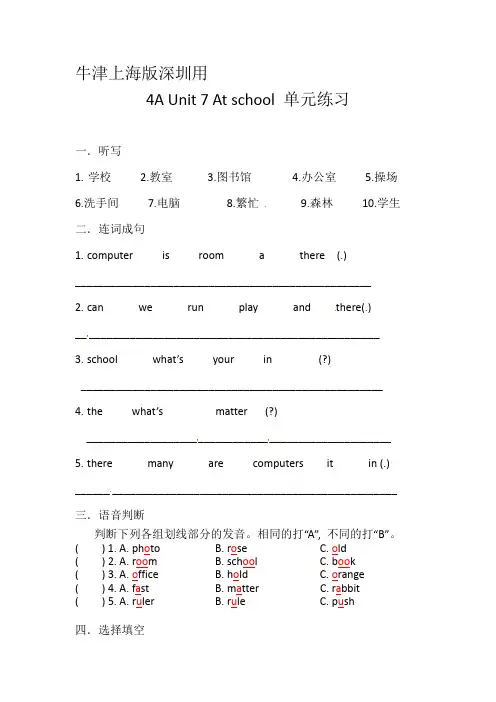
牛津上海版深圳用4A Unit 7 At school 单元练习一.听写1.学校2.教室3.图书馆4.办公室5.操场6.洗手间7.电脑8.繁忙9.森林10.学生二.连词成句puter is room a there (.)___________________________________________________2.can we run play and there(.)____________________________________________________ 3.school what’s your in (?)____________________________________________________ 4.the what’s matter (?)____________________________________________________ 5.there many are computers it in (.) _______________________________________________________三.语音判断判断下列各组划线部分的发音。
相同的打“A”, 不同的打“B”。
( ) 1. A. ph o to B. r o se C. o ld( ) 2. A. r oo m B. sch oo l C. b oo k( ) 3. A. o ffice B. h o ld C. o range ( ) 4. A. f a st B. m a tter C. r a bbit ( ) 5. A. r u ler B. r u le C. p u sh四.选择填空从每小题的三个选项中选出最佳选项。
( ) 1. ----Is there_____ office in your school? ---- Yes, there is.A. aB. theC. an( ) 2. I want to wash my hands. Where’s the ______.A. officeB. classroom C . toilet( ) 3.Welcome ____my classroom.A. inB.toC. for( ) 4. 如果你想说王老师在忙,可以说: _________.A.Miss Wang is pretty.B.Miss Wang is lovely.C. Miss Wang is busy.( ) 5. 如果你想说有一个大大的图书馆,可以说:_____________A.There is a small library.B. There is a big library.C. There is a cool library.五.阅读判断判断下列句子是否与短文相符,相符写“A”,不相符写“B”。
四年级牛津英语深圳版unit7Atschool

What’s this, Mum?
It’s a photo of a school. ...
It’s a photo of a playground.
It’s a photo of a classroom.
It’s a photo of an office.
It’s a photo of a library.
PHloacwe are the diHffoewrent placeWs?hat
school
nice
playground
classrooms
oflets
How is/are the …? It’s/They’re …
Your new school is very nice. There is a playground. It is big. You can see many tall trees and some nice flowers. There are some classrooms. They are bright. You can see many desks and chairs. There are some teachers’ offices. They are small. You can see some big desks. There is a library. It is clean. You can see many books on the shelves. There are some toilets. They are clean too. You can see some taps. Do you like your new school?
沪教牛津版英语四年级英语上册 Module 3 知识清单

Module 3Places and activities一、核心词汇1.学校设施:school学校office办公室library图书馆;图书室playground操场classroom教室toilet厕所2.食物名词:tomato番茄;西红柿(复数tomatoes)soup汤potato土豆(复数potatoes)carrot胡萝卜fish鱼;鱼肉meat肉rice大米;米饭3.方位介词:in在……里面on在……上面under在……下面beside在……旁边4.形容词:busy忙碌的;繁忙的magic神奇的;有魔力的angry生气的5.名词:computer计算机;电脑animal动物forest森林pupil小学生shop 商店glasses眼镜box盒子;箱子plate盘子;碟子table桌子lunch午餐kitchen厨房floor地板6.动词:try 尝试want 想要give 给need 需要7.其他:many 许多first 第一together 一起where 哪里thirty 三十二、拓展词汇1.学校设施:teachers’ office教师办公室computer room电脑室music room音乐教室art room美术室2.食物名词:beef牛肉chicken鸡肉bread面包noodles面条egg鸡蛋milk牛奶hamburger汉堡包sandwich三明治3.方位名词:behind在……后面near在……附近next to在……旁边above 在……上面at在……三、核心短语computer room电脑室teachers’ office教师办公室 in the forest在森林里climb trees爬树orange juice橙汁make some soup做些汤 a pair of big glasses一副大眼镜 a pair of small glasses一副小眼镜knives and forks刀叉on the table在桌子上in the box在盒子里in her kitchen在她的厨房里on the floor在地板上under the chair在椅子下四、核心句型1.This is the teachers’ office.这是教师办公室.解读:这是介绍物体的句型,this用来指代离说话人较近的物体.举一反三: This is the post office.这是邮局.2.There are many computers in it.它里面有很多台电脑.解读:这是there be句型的陈述句形式.描述某人或某物在某地.there be句型中be 动词应与最邻近的名词在数上保持一致,这就是“就近原则”.此句there are后面紧接的是many computers,是复数形式,所以be动词要用are;当there后面跟的主语是可数名词单数时或不可数名词时, be动词则用is.举一反三: There is a blackboard and six lights in the classroom.教室里有一块黑板和六盏灯.3.What’s the matter?发生了什么事?解读:“What’s the matter?”常用来询问人的身体状况、意外情况或是某物出现什么问题.可意为“发生了什么事?”“怎么了?”.举一反三: — What’s the matter,John?怎么了,约翰?— I’ve got a headache.我头疼.4.That’s not true. 不是这样的.e on!加油!解读:这是日常口语,表示鼓励或召唤他人,意为“加油”.举一反三: Come on! We can make it. 加油!我们能做到.6.Go and try. 去试试吧.解读: 此句是祈使句,祈使句是用来表示命令、请求或建议等意义的句子.祈使句通常省略主语,谓语动词用原形,朗读时一般用降调.举一反三: Please open the door. 请开门.Sit down. 坐下.7. — What would you like? 你想要些什么?— I’d like some tomatoes. 我想要一些西红柿.解读: 此句是询问某人想要什么的句型.I’d like是I would like的缩写形式,意为“我想要”,后面接名词.举一反三: — What would you like?你想要些什么?— I’d like some beef.我想要些牛肉.8.— How much are these?这些多少钱?— Thirty yuan,please.三十元.解读:这是询问价格的句型,how much意为“多少钱”.how much还可单独使用,也可构成词组how much money,但用来询问某物的价格时,英语中常省略money.其中be动词的单复数根据其后的名词或代词来决定.举一反三: — How much are these apples?这些苹果多少钱?— Ten dollars.十美元.9.Here you are.给你.解读: Here you are.是英语口语中常用的句子,其基本意思是“给你”或“你要的东西在这里”,多用于某人向你要东西或借东西,递给某人时的应答语.举一反三: — Excuse me. Is this your ruler?打扰一下.这是你的直尺吗?— Yes, it is.是的,它是.10.Can I help you?你(们)要买点什么吗?解读: 本句是店员对顾客的礼貌用语,询问某人是否需要买东西.用在看到别人需要帮助,伸出援助之手时,意为“我能帮你做些什么吗?”.举一反三: — Can I help you? 你(们)要买点什么吗?— Yes. I want to buy a pair of shoes. 是的.我想买一双鞋.11.— Where is it?它在哪里?— It’s on the table.它在桌子上.解读: 此句是用来询问某人或某物的位置的句型, where意为“在哪儿;往哪儿;去哪儿”, be动词要根据后面接的名词或代词而定.回答时常用到方位介词,常见的方位介词有in, on, under, near等.举一反三: — Where is Amy?埃米在哪儿?— She is in the classroom.她在教室里.12.— What do you need?你需要什么?— I need two eggs.我需要两枚鸡蛋.解读:这是what引导的特殊疑问句,用来询问某人需要什么.其中do的形式需要根据其后的主语变化而变化.举一反三: — What do you need?你需要什么?— I need some bread.我需要一些面包.。
小学英语四年级第三模块第七单元第二课时优秀教案

单元教学设计框架课题:Unit 7 At school一、学情分析本单元教学对象为四年级的学生,这个年龄段的孩子对学校的环境非常熟悉,喜欢用英语表达与自己学习生活相关的话题。
经过三年的英语学习,学生已经具备了一定的描述与本单元At school话题相关的地点、活动、个人喜好等内容的语言基础和表达能力。
二、教材分析本单元话题是At school,谈论的是介绍学校里面的设施和在不同的校园场所可以做的事情,教材设计通过阅读地图,互相询问等方式让学生感知理解核心词汇office,classroom,computer room,playground,library,toilet和核心句型There is/are.... We can...通过篇章阅读让学生复习和巩固There be句型,学会介绍学校里面的不同场所。
本单元是Module 3 Places and activities中的第一个单元,学习内容There be 句型为下一模块The world around us的学习做了一定铺垫。
三、单元设计思路和依据依据新课标倡导的整体设计目标,充分考虑语言学习的渐近性和持续性以及强调学习过程,重视语言的实践性和应用性的课程基本理念,本单元的设计以话题为导向,以任务驱动教学,让学生在语境中接触、体验和理解真实语言并在此基础上学习和运用语言。
Alice的学校来了一位转学生Owen, Alice带领Owen参观了新学校,并在了解了Owen的顾虑后,推荐他阅读绘本故事“Animal school”。
通过故事的学习,Owen开始树立自信和建立勇于尝试的人生态度,并且在新学校中找到了自己擅长的地方,逐渐建立自信心。
最后,同学们通过调查和讨论描述出自己的学校和在学校中最擅长的地方。
五、单元教学目标1.能在语境中正确朗读和使用核心词汇school, classroom, library, office,playground, toilet和There is/ are…描述学校里的场所及内部设施数量2.能理解语篇大意,正确朗读并有感情地分角色表演故事3.能体会和树立自信和勇于尝试的人生态度第二课时课时话题课A story about “Animal School”教学内容课Enjoy a story教学目标:1.能在语境中正确理解和跟读故事文本;2.能在语境中正确补充故事内容并有感情地分角色表演故事;3.能体会和树立自信和勇于尝试的人生态度。
牛津上海版(三起)四年级上册英语Module 3 Unit 7 At school拓展课 课件
牛津英语四年级下册Unit7 At School 拓展课教学设计《Try again, Hen! 》课标要求《英语课程标准》中要求三四年级的学生能在图片的帮助下,听懂和读懂简单的小故事,并表达简单的情感和感觉。
能根据录音模仿说英语并能做简单的角色表演。
能看懂语言简单的英语动画片或程度教学节目。
让学生通过图片来简单的描述图片内容,并感受故事所表达的情感和道理。
教材分析本模块的课题是身边的家人,朋友。
本单元的前一个课时介绍了我的朋友并学会了简单描述他/她的能力以及他/她的外貌。
本课时在此基础上,展开了绘本故事的学习。
学生能通过观察图片,描述故事中的主人公Hen和朋友Pig、sheep以及duck的外貌以及Hen经过挫折以后学会滑滑板的整个过程。
本节课的重点是让学生学会复述故事、表演故事并感受到If at first you don’t succeed, try again and again.学情分析四年级的学生心智发展到了比较重视他人、朋友或同学的信息,以及对于他人的了解有一定的程度,谈论朋友这一话题对于他们的生活很贴近,有话可聊。
四年级的孩子们更喜欢合作、表演和朗读。
学生可以通过观察图片联想起故事中Hen掉进不同的地方时的情节。
但是用英语表达需要教师通过问题引导和观察图片来对整个故事情节进行描述。
学生的难点在于故事的复述和语句的流畅表达。
依据课标要求以及教材分析、学情分析的结果,我设置了故事《Try again. Hen! 》的教学目标。
教学目标1、阅读并了解故事,准确找出关键词。
2、利用板书复述故事,体会Hen 学习滑滑板的整个过程中朋友们给与的鼓励以及她不断尝试并取得成功的经过3、问题引领,感受和体验If at first you don’t succeed, try again and again.教学重点理解并复述故事。
教学难点故事的复述,语句的流畅表达。
教学方法情景交际法,任务型教学活动,PPT.教学准备PPT的准备,多媒体的调试。
牛津译林版英语四年级上册 (Dolls)课件

Speak and do.
If I say ‘Touch your eyes’, you do it and say ’Eyes, eyes, eyes!’
Unit 8 Dolls
Read and answer
How many dolls do they have? Two.
What are they talking about?
(选一个你最喜欢的人物角色帮他/她配音。)
四人小组合作表演,丰富的表情动作也能为表演加分哦!
1.You can describe the dolls your group have got.
Work in groups of four.
四人小组合作,描述你们组的图 片娃娃。
2.One group describes, the othg about dolls’_______.
A.
B.
C.
D.
E.
F.
G.
What do the dolls look like?
1.Read the story by yourselves.(自己 读课文。)
2.Talk about dolls’ nose, mouth,and ears in groups.(小组讨论。)
动物园里的斑马
重点短语
5.eat apples with me 和我一起吃苹果
6.two fat boys 两个胖男孩 7.meet in the rain 在雨中见面
重点句型
1.—Look at our doll. 看我们的洋娃娃。
—She's beautiful. 她真漂亮。
2.Her hair is long. Her eyes are big. 她的头发长长的。她的眼睛大大的。
牛津沪教版英语四年级上Unit 7 At school 教案(公开课)3
Module 3 Unit 7 教案3一、教学重点语音:o (photo,rose)词汇:animal,pupil,try句型:There is/are …日常用语:That’s not true.Come on.Go and try.二、教学栏目Enjoy a story, Learn the sounds三、教学目标1.帮助学生学习元音字母o在开音节中的发音。
2.通过阅读故事Animal School,帮助学生进一步稳固和运用核心句型。
3. 用That’s not true. Come on! Go and try. 等日常用语表达观点或鼓励别人。
4.通过学习任务(Task),帮助学生稳固和综合运用本单元所学的知识。
四、教学步骤Pre-task preparations1.出示学校图片并提问:What’s in our school? 帮助学生复习There is/are …句型。
T: What’s in our school?S1: There’s a library in our school.S2: There’s a computer room in our school.S3: There are four offices in our school.2.出示Enjoy a story的图片,根据图片向学生提问,帮助学生理解故事大意。
T: (point to Picture1) Look! What’s this?Ss: It’s the Animal School.T: (point to Rabbit in Picture 2) This is Rabbit. Look at her. Is she happy?Ss: No, she isn’t. She’s sad.T: Why? Let’s read the story and find out.While-task procedures1.出示问题,让学生带着这些问题阅读Enjoy a story的小故事,随后让个别学生答复以下问题,确认学生是否理解故事大意。
2023年沪教牛津版四年级英语上册Unit 7 At school
►A man is not old as long as he is seeking something. A man is not old until regrets take the place of dreams. 只要一个人还有追求,他就没有老。直到后悔取代了梦想,一个人才算老。
Activity.
Classroom(s) Computer room(s) Playground(s) Teachers’ office(s) Toilet(s)
Alice’s school 24 1 1 6 10
My school 32 2 1 8 13
There are thirty-two classrooms in my school. There are two computer rooms, a playground, eight teachers’ offices and thirteen toilets in my school.
classroom. There are many desks and chairs in my classroom.
S1: What’s in your schoolbag? S2: There’s a ruler in my
schoolbag. There are many pencils, pens and books in my schoolbag.
你的妈妈怎么了? What’s the matter with your mother?
③Let’s run!我们一起跑步吧! 此句是由let引导的祈使句,其句型结构为“Let’s+
牛津版英语四年级上册英语单词表
牛津版英语四年级上册英语单词表Module 1 Getting to know youUnit 1 Meeting new peopleUnit 2 AbilitiesUnit 3 How do you feel?Module 2 Me, my family and friendsUnit 1 Jill's familyUnit 2 JobsUnit 3 I have a friendModule 3 Places and activitiesUnit 1 In our schoolUnit 2 Around my homeUnit 3 In the shopModule 4 The natural worldUnit 1 A visit to a farmUnit 2 At Century ParkUnit 3 Weather第1单元单词meet 相识;结识new 新的morning 早晨;上午classmate 同班同学her 她的name 名字sit 坐afternoon 下午his 他的第2单元单词run 跑fast 快地;迅速地;快的fly 飞;放飞draw 画画write 写字;书写jump 跳welcome 欢迎woof (狗叫声)汪汪but 但是第3单元单词happy 开心的sad 难过的;悲哀的tired 累的;疲惫的hungry 饥饿的full 饱的thirsty 口thirsty 口渴的bird 鸟see 看见bottle 瓶子drink 喝第4单元单词any 任何的cousin 表兄弟;表姐妹;堂兄弟;堂姐妹family 家庭parent 父亲;母亲grandparent (外)祖父;(外)祖母son 儿子grandfather (grandpa )(外)祖父;爷爷;外公grandmother (grandma )(外)祖母;奶奶;外婆uncle 叔叔;伯伯;舅舅;姑父;姨父aunt 姑妈;姨妈;伯母;婶婶;舅妈that 那个第5单元单词T-shirt T 恤衫brown 棕色的;棕色shorts 短裤ride 骑(马;自行车)skirt 短裙dress 连衣裙shirt (男式)衬衫tooth 牙齿(复数teeth )sharp 锋利的;尖的help 帮助a pair of 一条;一副;一双get out 出去第6单元单词nurse 护士fireman 消防员(复数firemen )teacher 老师doctor 医生bus driver 公共汽车司机kid 小孩so 如此;很;所以fire 火;火灾people 人;人们job 工作;职业play with 玩……第7单元单词school 学校office 办公室busy 忙碌的;繁忙的computer 计算机;电脑many 许多library 图书馆;图书室playground 操场classroom 教室toilet 厕所animal 动物forest 森林pupil 小学生try 尝试first 第一climb trees 爬树第8单元单词shop 商店tomato 番茄;西红柿(复数tomatoes )soup 汤potato 土豆(复数potatoes )carrot 胡萝卜thirty 三下fish 鱼;鱼肉meat 肉rice 大米;米饭glasses 眼镜want 想要together 一起magic 神奇的;有魔力的第9单元单词need 需要where 哪里in 在……里面box 盒子;箱子give 给plate 盘子;碟子on 在……上面table 桌子lunch 午餐under 在……下面beside 在……旁边kitchen 厨房floor 地板angry 生气的第10单元单词around 在……周围;到处home 家street 街道park 公园near 在……附近behind 在……后面supermarket 超市restaurant 餐馆live 住;居住old 古老的;旧的eat 吃nice 美味的;美好的food 食物a lot of 很多;大量的第11单元单词shape 形状picture 图画;照片square 正方形circle 圆;圆形star 五角星形;星星rectangle 长方形triangle 三角形today 今天well 好;健康第12单元单词weather 天气rainy 多雨的cloudy 多云的windy 风大的;多风的sunny 阳光充足的Sunday 星期天cloud 云rain 雨;下雨sun 太阳wind 风。
牛津沪教版英语四年级上Unit 7 At school 教案(公开课)2
Module 3 Unit 7 教案2一、教学重点词汇:busy,many句型:There’s a computer room.There are many computers.二、教学栏目Listen and say, Do a survey, Ask and answer三、教学目标1.学生在正确认读单词的根底上,通过阅读Listen and say的语段,了解如何用核心句型There is/are …介绍学校不同的设施。
2.通过Ask and answer问答练习,帮助学生操练There is/are …句型。
3,通过Do a survey调查活动,运用核心句型There is/are …来介绍学校的设施及其数量。
四、教学步骤Pre-task preparations1.播放一首有关学校的儿歌或歌曲,如Our school will shine today,让学生跟着录音学唱。
2.出示六张学校设施的图片,并给图片编号,要求学生两人一组,进行快速问答活动。
S1: What is No. 3?S2: It’s a library.S1: What can you do in the library?S2: I can read books in the library.While-task procedures1.出示学校的图片,用新句型There is/are …介绍学校的设施,并板书新句型,让学生跟读。
T: Look, children. This is our school. It is very nice. There’s a library in our school. We can readbooks in the library. There are many classrooms in our school too. We have lessons here …(write the example sentences on the blackboard)There is a library in our school. There are many classrooms in our school.2.播放Listen and say的录音,让学生跟着录音朗读;然后根据图片和录音提问,学生回答。