
新牛津译林版二年级上册Unit4 Autumn (1) 教案
牛津译林版英语二年级上
Unit4 Autumn第一课时教学设计
课题Autumn 单元Unit 4 学科英语年级二年级
上
学习目标1.能听懂、会说、初步认读apples potatoes oranges pears pumpkins这五个单词,发音正确。
2.能听懂What are these/those?
They are ….
3.能在情境中使用句型What are these/those?
They are ….发音正确。
4.培养学生对英语的热爱之情并激发学生的英语学习兴趣。
重点 1.能听懂、会说、初步认读apples potatoes oranges pears pumpkins这五个单词,发音正确。
2. 能听懂What are these/those?
They are ….
难点能在情境中使用句型What are these/those?
They are ….发音正确。
教学过程
教学环节教师活动学生活动设计意图
导入新课一、Warm-up
1. Brainstorm
教师与学生进行头脑风暴游戏能够配合老师
进行游戏,充
满趣味性
在玩游戏的过
程中老师将话题
自然引入本单元
教学内容。
对于低年级学生
来说,图像和动
画更能吸引他们
的注意力,让他
们很快融入情景
之中。
讲授新课二、Story time
1.Look and learn
apples potatoes oranges pears pumpkins
教师呈现单词,学生跟读学习
Let's chant
教师继续教授those these
What are these/those?
They are ….
2.Golden eyes
火眼金睛
3.Story time
教师播放对话动画,学生看动画片,试着模仿
4.Listen and repeat
教师呈现对话文本,听录音,跟读
5.Let's read
读一读
6.Let's act
根据图片内容四人进行对话表演。
What are these/those?
They are ….
六、Homework
1. Read dialogue for five times.
2. Act the story out after class. 播放课文录音
时,模仿语音
语调;
分角色朗读课
文,并上台表
演对话。
跟读对话并根
据图片内容两
人进行对话表
演。
能迅速读出单
词
配合老师玩游
戏
积极配合老师
完成练习。
引导学生用各种
形式,变化各种
声调朗读课文对
话,不断深入学
习,加深印象。
通过反复的听读
训练,掌握词汇;
通过图片方式,
巩固单词;针对
性的完成学习目
标;学习形式生
动多样化,使学
生集中注意力,
同时保持学习的
积极性。
能够达到复习新
句型,加深学生
记忆。
课堂小结大部分学生还坐不住,对于低年级学生来说,
图像和动画更能吸引他们的注意力,老师在今后
的课上还可以增加一些趣味性,让他们很快融入情
景之中,引导学生展开想象,让他们在类似的生活
生英语兴趣的基础上,才能上好英语课。
板书Unit 4 Autumn
What are these/those?
They are ….。
(新沪教牛津版)二年级英语上册《Module 4 Unit 1 第二课时》优质教案设计
Play a game
7. Talk about the park.
8.Make a dialogue.
Read together.
Prepare a picture of the sky, Say: Look at the sky, Can you see the stars?
2. Read together.
3. Sing together.
用歌曲引起学生兴趣,教师自然引入新授内容。
While-task procedure
1.Read the rhyme.
2.Ask and answer:
3.Superstar
4.Ask and answer:
5. Read the text.
1. T: I can fly. After schoolIcan fly to my home.( show thepictureof house)Then do my homework.
1. To use correct response by listening to can-questions.
e.g. Can you see the moon? Yes, I can. /No, I can’t.
2.Describe the natural objects in the sky/in the park/in the shop...
(say and act)
轻松活泼的儿歌营造英语的氛围,引导学生进入学习的状态。
复习过去的一些动词,使学生对今天所学的有所了解,做铺垫.
While-task procedure
run
fast , slowly
(新沪教牛津版)二年级英语上册《Module 4 Unit 3 第一课时》优质教案设计

Unit 3 In the street
Period 1
I. 教学内容
1. The usage of the key words in context
e.g. climb, pick, flower, tree
2. The usage of imperatives to give simple instructions
e.g. Don’t climb the tree.
II. 教学目标
知识与技能
1、能够听懂,认读单词flower, tree, 及动作词组climb the tree, pick the flower
2、能够听懂问句What’s this …?并根据实际情况作应答
3、能够用祈使句Don’t …的句型发出禁令,并根据指令用I’m sorry.应答或作出反应方法与过程
1、利用图片,多媒体,创设情景,提供学生一定的语言学习背景
2、通过童谣的编唱来操练所学词汇和句型
3、通过对子及小组活动来巩固所学知识
情感态度与价值观
1、通过学习激发学生爱护环境,保护绿化的好品质
2、在获取他人信息的过程中,促使学生形成乐于交友的良好品格
3、在活动的过程中促使学生形成乐于合作、勇于表达的良好品格
4、在活动中激发学生的学习兴趣,增强自信心与自豪感
III. 重点、难点分析
1、能够听懂,认读单词flower, tree, 及动作词组climb the tree, pick the flower
2、能够用祈使句Don’t …的句型发出禁令,并根据指令用I’m sorry.应答或作出反应。
牛津译林版九年级英语上册Unit4ReadingI优秀教学案例

(三)小组合作
1.合作任务:教师设计具有实际意义的合作任务,如讨论文章的主旨大意、分析文章结构等。
2.小组讨论:学生分组进行讨论,共同完成任务,培养学生的团队协作能力和沟通能力。
3.成果展示:各小组展示讨论成果,其他小组进行评价,教师进行点评和指导。
3.情境模拟:教师模拟博物馆的场景,邀请学生扮演不同角色,如讲解员、游客等,进行情景对话,提高学生的口语表达能力。
(二)问题导向
1.设计具有启发性的问题:教师针对课文内容,设计具有挑战性和实际意义的问题,引导学生主动探究、积极思考。
2.问题解答:学生独立思考或小组讨论,寻找答案,培养学生的解决问题的能力。
在教学设计上,我充分考虑了学生的年龄特点和认知水平,将课程内容与实际生活紧密结合,通过设置富有启发性的问题,引导学生主动探究、积极思考,从而提高他们的阅读理解能力和批判性思维。在教学方法上,我采用了任务型教学法、合作学习法等,充分调动学生的学习积极性,使他们能够在真实的语言环境中运用所学知识,提高实际交际能力。同时,我还注重培养学生的自主学习能力,引导他们养成良好的学习习惯,为终身学习奠定基础。
四、教学内容与过程
(一)导入新课
1.教师展示一组与历史博物馆相关的图片,引导学生思考:你们对博物馆有什么印象?最喜欢参观哪种类型的博物馆?
2.学生分享自己的观点,教师总结并引出本节课的主题:参观历史博物馆的经历。
3.教师播放一段博物馆的视频片段,帮助学生更好地理解课文内容。
(二)讲授新知
1.教师引导学生关注课文标题,提问:你们猜测这篇文章会讲述哪些内容?
4.教师提问:文章中描述了一对兄妹的哪些活动?他们参观了哪些展品?
二年级英语上册第二三四单元教案(牛津译林版)

Presentation&Practice
Looandlearn
Shothepicture.
T:Ihavearabbit.
Ss:It’sbig.
Ss:It’sfat.
T:It’sbig.It’sfat.It’sbigandfat.
Teachthesentence“It’s…and….”
教学准备:cD等
教学过程:
Step1.aringupandfreetal.
Step2PresentationSayarhye.
Step3consolidation
DoExerciseintheexerciseboos.
Tintroducethepicturesintheexercise.
LetSstofinishtheexercises.
Trytochantithgestures.
aeanerhye
Ssoringroupsandtrytoaeanerhye.
Ihavea
Ihavea.
It’sand.
Looaty.
ontheredat.
Haveapetition:thebestreciter
Sshaveapetition.Voteforthebestgroupandthethebestreciter.
第三课时
教学目标:
Beabletointroducetheanialscorrectlyandsillfullybyusingthesentencestructures:Ihavea….It's….It's….
BeabletochanttherhyeIhaveacat.
牛津译林版九年级上册英语(新)教案Unit4
9A Unit 4 Growing up (Reading1)PPT1PPT2 (Lead in)Boys and girls, let’s enjoy a poem first. Listen to it carefully, and try to complete it. Please read the poem together.What is the poem about?Do you have dreams?Do you believe that your dreams can come true some day?OK, we can find an answerin today’s lesson.PPT3-4 (Fast reading)This is the title of today’s reading.Open your books and find out who the shortest player is.Yes, this is Spud Webb. He is the shortest player in the NBA.When did he become the shortest player in the NBA ? (1985)What happened to him next year? (1986)How old was he when he won the Slam Dunk Contest? (23)How did you get the answer?Yes, in paragraph 1 we know he was born in Texas, the USA, in 1963.Boys and girls, do you want to know what happened to Spud these years?Can you guess what the article may tell us about these years?Next, let’s read more to find out how Spud Webb became a great NBA player.PPT5-6 (Para.1)Please read Para1 and find out two adjectives. (Small and big)How small was Spud?That’s to say, Spud was the smallest kid at school.What was his dream?The smallest man wanted to play in the NBA.Maybe it’s the biggest for him.What is Para 1 about? /Can you use these two adjectives in a phrase or sentence to express the main point/idea of Para 1Then, how do you understand the "big" dream? Can you think of other words to replace the word "big"?Is the “big” about the dream’s size?PPT7-8 (Para.2)Let’s come to Para2 to discover how Spud held fast to his big dream in junior high. Can you find out two adverbs of time in this paragraph? (at first, finally)Who can tell us what happened to him from “at first” to “finally”?When he got the chance, he became the star of the team.How could he make such a difference? (Can you find a sentence in this paragraph to explain it.)He did not lose heart. And at last he got the chance.So, some people thought Spud was lucky because the chance was waiting for him.Do you agree with it? Why or why not?If Spud never worked hard, could he score 20 points in his first game?Yes, chance favors only the prepared mind.PPT9-10 (Para.3)Now, please read paragraph3 and find out if Spud was a prepared man.Was Spud always prepared for his dream in senior high?When reading this paragraph, are there any pictures about Spud in your mind?(For example, every time I read this paragraph, the first picture that came into my mind is Spud was sitting in the stands.)The second picture is that Spud was practicing even harder.Why did he do so? (To get the coach to change his mind.)Whose mind? Spud’s or the coach’s?What was the coach's "mind"? /// Spud was too small./// Spud was not suitable to play basketball. ///...Then, supposing you're Spud, when sitting in the stands without the chance of playing the game, how would you feel and what would you do?PPT11-12 (Para.4)Let’s move onto paragraph4. Spud attended his college and university.First he played at a junior college and then he attended this university.Please read this paragraph, and find out how Spud attracted this university’s attention. What did he get in the university? ( getting a scholarship.)Was he excited about getting a scholarship?Why? ( Because he could continue his education and his big dream.)But many years later, in a TV interview Spud once said, "In fact, after the national championship, I got more than the scholarship and it was more important for me." what was"it"? /What does “it” refer to?/// It might be a chance. Because attending a university makes him get closer to his dream——playing in the NBA. /// Confidence /// Encouragement ///...PPT13-14 (Para.5)Thanks to the chance/ confidence /, Spud succeeded in getting into the NBA in1985. Now, please read para5, and find out “where did Spud play basketball before1985 ?”When did he begin to play there? (1984)How did you get the answer?What’s the name of “another basketball league”? (Why didn’t the writer tell us its name?)It was an unknown basketball league. It was not famous. What does the writer think of Spud Webb? Can you find one adjective to showthe writer's opinion in Para 5?He was a great player. He had many great achievements.Do you think Spud Webb was a great player? Why or why not?PPT15-16 (Para.6)I also consider Spud a great player because he brought us some lessons.Can we read the lessons together?What does “anything” mean to Spud according to the article?Small Spud achieved his big dream at last. It seems that he wanted to show sth. to us. Please think about: Whom did Spud want to prove to "size and body typedoesn't matter ..."?PPT17 (Title)Although size and body type doesn’t matter, the writer uses a lot of expressions to describe Spud’s size.For example, in para.1, the writer uses “very small”.Now, it’s your time to find out and underline other similar expressions in each para. Reread the passage again, and find out how Spud didn’t give up his dream para by para.For example,…From this PPT we can see thow the writer organizes his or her ideas around the the title of the article--- the shortest player in the NBA.PPT18Do you still remember the title of this unit?In the journey of growing up, Spud always held fast to his dream and never gave up. How do you understand "growing up"? What will you do?This is my understanding of "growing up".Would you like to read it together?PPT19Boys and girls, in this class we talked about dreams in the journey of growing up. Dreaming is beautiful becauseIt's hard to say what is impossible, for the dream of yesterday is the hope of today and the reality of tomorrow. Everybody who got to where they ARE had to start where they WERE. If it's to be, it's up to me.Hold fast to your dreams like Spud Webb and you will fly high.Thanks for your attention. Good bye!。
新牛津译林版高中英语选修一Unit4Exploring poetry-ExtendedReading
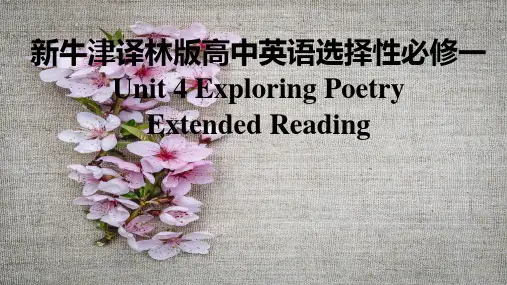
Fast reading
Features
para.5
social and historic context
A Night Stay at a Mountain TempleA hundred feet the temple towers;I can reach out for the stars in the sky.But I dare not speak in a voice loud,For fear of scaring dwellers on high.
Para.6: The significance of Li Bai and his poems
A hundred feet the temple towers;I can reach out for the stars in the sky.But I dare not speak in a voice loud,For fear of scaring dwellers on high. (“A Night Stay at a Mountain Temple”)
李白的浪漫主义风格与其自幼喜读书、好游历不无关联。他五岁就诵读经典,十岁读儒道等诸子百家的著作。他博览群书,从传奇故事到历史典故无所不窥,从而对古代经典文化谙熟于心,更重要的是,他从中汲取了先贤们的智慧。
para 2
是...的原因之一
更重要的是
使自己熟悉某事
Driven by a burning desire for adventure and travel, Li Bai left home and started to travel around in his early twenties. His footsteps covered almost the whole country. During his travels, he visited famous mountains and great rivers, encountering different customs and practices. These travelling experiences also nourished his love of nature and inspired him to write numerous poems in the romantic style.
(新沪教牛津版)二年级英语上册《Module 4 Unit 3 第一课时》优质教案设计2
Aims
1. To learn the new words: flower tree climb pick
2. To use imperatives to give simple instructions.
e.g.: Don’t pick the flowers.
Askandanswer about Mary’s and Danny’s abilities
To elicit: Can she/ he ______?
Yes, she/he can. / No, she/ he can’t.
T: CanMarysing?
Ps: Yes.
To elicit: Yes,she can.
Developing aims:
Using yes/no questions to ask about a person’s abilities. e.g.Can she/ he ______?
Yes, she/he can. / No, she/ he can’t.
Main points
To help the students make a simple dialogue to review the knowledge in this unit.
Difficult points
Making a simple dialogue to review the knowledge in this unit.
Teaching aids
Power Point
Procedures
Step
Contents
Methods
Purpose
Pre-task preparation
牛津译林版九年级英语上册Unit 4 Reading (I) 示范课教案
教师继续情境创设,完成看图回答及思考活动,并预测阅读语篇的内容。
教学活动
3. Students look at the pictures and talk.
4.Students think and answer the questions.
5.Students look at the picture and predict.
8.Students read the article andmatchthe information.
9.Students read paragraph 1 and fill in the form.
10.Students read paragraphs 2~4 and fill in the blanks.
11.Students read paragraph 5 and complete the sentences.
12.Students read paragraph 6 and answer the questions.
13. Students match the words with the correct meanings.
教学活动
1. Studentsplaya guessing game.
2. Studentsenjoyavideo and say out the basketball players’ names.
活动层次
学习理解之感知与注意
效果评价
观察学生的回答情况,了解学生已知。
环节设计意图:
活跃课堂气氛,激发学生的学习积极性,引入本课主题。
活动层次
学习理解之获取与梳理、概括与整合
英语牛津译林版二年级上册 Unit 4 Autumn_第2课时教学课件
Yes. It’s autumn.
Yang Ling
Liu Tao
Su Hai Wang Bing
他们在农场看到了什么?
These are apples. They’re red.
apples
pears
Those are pears. They’re yellow.
Look! What are those?
Group work
五人一组,画出一幅农场情境图,在图上画出 水果、蔬菜或动物。 画完后,小组成员分别用These/Those are … They’re …(颜色) 描述。 然后,任意一位成员指着图中的事物,用What are these/those?提问,其他成员回答。
辨识近处/远的事物: These/Those are … —What are these/those? —They’re …
A
合已有知识或生活实际,对内 容有创新,口语表达准确流利,
感情与肢体语言丰富。
0
What are these? They’re ducks.
What are these? They’re lambs.
What are those? They’re pigs.
What are those? They’re cows.
译林版二年级上册
Unit4 Autumn
第2课时
orange apple
Review
pear pumpkin
potato
oranges apples
Review
pears pumpkins
potatoes
It’s cool in autumn.
凉爽的秋天到了,小朋友们来农场参观。
2024年新译林版英语五年级上册Unit4精彩教案公开课
2024年新译林版英语五年级上册Unit 4精彩教案公开课一、教学内容本节课选自2024年新译林版英语五年级上册Unit 4。
教学内容包括:Lesson A中的1a2c部分,主要围绕“家庭活动”主题展开,通过描述家庭成员在周末所进行的各种活动,使学生掌握一般现在时态的用法,并学会运用相关词汇和句型进行情景交际。
二、教学目标1. 能够听懂、会说、会读本节课所学的词汇和句型,如:watch TV, read books, play chess, have a picnic等。
2. 能够运用一般现在时态描述家庭成员在周末的活动。
3. 能够在真实语境中运用所学知识进行交流,培养学生的语言运用能力。
三、教学难点与重点教学难点:一般现在时态的运用及家庭成员活动的描述。
教学重点:词汇和句型的掌握,以及在实际情境中的运用。
四、教具与学具准备教师准备:教材、PPT、录音机、卡片等。
学生准备:练习本、彩笔、单词卡片等。
五、教学过程1. 导入:通过展示一组家庭活动的图片,引导学生用英语进行描述,激发学生的学习兴趣,为新课学习做好铺垫。
过程细节:教师展示图片,学生用英语描述,教师适时纠正和补充。
2. 呈现:教师播放Lesson A 1a部分的录音,引导学生听并跟读,学习新词汇和句型。
过程细节:学生听录音,跟读,教师对重点词汇和句型进行讲解和示范。
3. 实践:学生两人一组,运用所学词汇和句型进行角色扮演,描述家庭成员的周末活动。
过程细节:教师设置情境,学生进行角色扮演,教师巡回指导。
4. 互动:教师选取几名学生进行课堂展示,其他学生认真倾听并给予评价。
5. 巩固:学生完成Lesson A 2a2c部分的练习,巩固所学知识。
过程细节:学生独立完成练习,教师个别辅导,解答疑问。
六、板书设计1. Unit 4 What do you do on the weekend?2. 主要词汇:watch TV, read books, play chess, have a picnic等。