
2020年人教版七年级英语下Unit3 How do you get to school单元试卷及答案
2020年精编人教版英语资料英语人教七年级下Unit3 How do you get to school单元测评(分数:100分时间:90分钟)第Ⅰ卷听力部分(20分)Ⅰ.听句子,选择与其意思相符的图片(有两幅多余图片)。
句子读一遍(5分)1.______ 2.______ 3.______ 4.______ 5.______Ⅱ.听五段小对话。
每段对话后面有一个问题,从题中所给的A、B、C三个选项中选出最佳选项。
对话读一遍(5分)6.A.Her bike is lost.B.There is something wrong with her bike.C.She wants to take a walk.7.A.He takes a bus. B.He takes a subway. C.He walks to school.8.A.Thirty minutes. B.An hour. C.An hour and thirty minutes.9.A.By ship. B.By air. C.By bike.10.A.Less than two miles. B.More than two miles. C.Two miles.Ⅲ.听短文,判断正(T)误(F)。
短文读两遍(10分)11.I usually go to school on foot.12.Sometimes I come home by car.13.Yang Ling is my friend.14.Yang Ling's grandmother lives in Guangzhou.15.Miss Xu goes to see her father and mother by train.第Ⅱ卷笔试部分(80分)Ⅳ.单项选择(10分)16.—How do you go to work?—______ car.A.In B.By C.On D.With17.—How do you ______ school every day?—By bike.A.get B.reach in C.arrive in D.get to18.In our school about two ______ students get to school by bike.A.hundred B.hundreds C.hundreds of D.hundred of19.—______ does it take you to walk to school?—About fifteen minutes.A.How long B.How soon C.How often D.How far20.—______ is it from your home to school?—It's two miles.A.H ow far B.How C.How long D.How often21.______ do you think ______ your school life?A.How;like B.What;ofC.How;of D.What;a bout22.I live near a ______.I often go swimming there in summer.A.river B.mountain C.town D.shop23.Tom's home is ten kilometers ______ school.A.away B.to C.away from D.far from24.Students have to ______ a boat to get ______ home.A.take;to B.take;/ C.takes;/ D.takes;to25.______ takes her about twenty minutes ______ home.A.That;get to B.It;get to C.This;to get D.It;to getⅤ.完形填空(10分)Getting to places can sometimes be difficult,especially(特别)when you are going to a place for the __26__ time.In big cities,many people take buses,trains or subways to get from __27__ to another.__28__ are a popular means of transportation.If you want to take a bus,you need to know __29__ bus to take and where you can get on.You __30__ need to be able to(能够)read the timetable rightly,so you can take the right bus and __31__ your place on time.At last,you need to know __32__ to get off and __33__ the driver the name of the station.In the countryside,transportation can be much simple.In some places,people get to school or work __34__ boat.Some children ride in long boats on the river to get to school.In __35__ places,students walk to school.26.A.first B.second C.third D.fourth27.A.one place B.the place C.places D.the places28.A.Cars B.Trains C.Bikes D.Buses29.A.what B.where C.which D.why30.A.too B.as well C.also D.either31.A.get to B.arrive C.reach in D.arrive to32.A.why B.where C.when D.how33.A.say B.talk C.speak D.tell34.A.on B.in C.by D.at35.A.other B.others C.another D.elseⅥ.阅读理解(30分)AMary always takes the subway to school.She likes watching people and relaxing.It's five miles to her school and takes about 5 minutes.Lin usually walks to school.It takes about 25 minutes.But sometimes he rides his bike.It takes about 10 minutes by bike.He can take the school bus,but he doesn't like it.He doesn't have any friends on the bus.It's boring.根据短文内容,判断句子正(T)误(F)。
36.Mary often walks to school.37.It's five miles to Mary's school.38.It takes Lin half an hour to walk to school.39.Lin has friends on the bus.40.Lin thinks the bus is boring.BMany people like to travel by plane,but I don't like it because an airport is usually far from the city.You have to get there early and wait for h ours for the plane to take off and it is often late.You can't open the windows.You can't choose the food.Planes are fast,but it takes hours to go out of the airport and into the city.I like traveling by train.I think trains are safe.Rail way stations are usually in cities.When you are late for a train,you can catch another one.You can walk around in the train and open the windows.You can see many interesting things on your way.I know it takes a little more time.I also like cars.You can start your journey when you want to,and you don't need to get to a railway station or a bus stop.Also you can carry many things with you in a car.But sometimes there are too many cars on the road.41.Why do m any people like to travel by plane?A.Because it is safe. B.Because it is fast.C.Because you can walk around in the plane. D.Because it is cheap.42.Which is NOT the good thing about the train?A.It is safe. B.It takes a little more time.C.You can open the windows. D.You can walk around in the train.43.If you want to take a lot of things with you,what can you take to go out?A.A bus. B.A car. C.A train. D.A bike.44.What is the bad thing about the car?A.You needn't go to a station.B.You can start your journey when you want to.C.There are too many cars on the road sometimes.D.You needn't go to a bus stop.45.What does the writer think of the plane,train and car?A.He thinks it takes a lot of time to go to and get out of the airport.B.He likes to take a train because it takes a little more time.C.He likes to take a car because he has a car.D.He likes to take a plane because it's fast.CJoy always rides her bike to school.It's four miles to school and it(1)______(take)her about fifteen minutes.Joy likes riding to school.She says it is good for her health.Mary and Susan usually go to school by bus.They like talking with their friends on the b us.(2)It's_about_ten_minutes'_ride_to_school_by_bus.Paul's home is near school.H e usually walks to school.It's about five minutes' walk.Paul says (3)(他喜欢饭后散步).根据短文内容完成以下任务。
人教版七年级下册英语Unit3 How do you get to school教材听力原文及译文
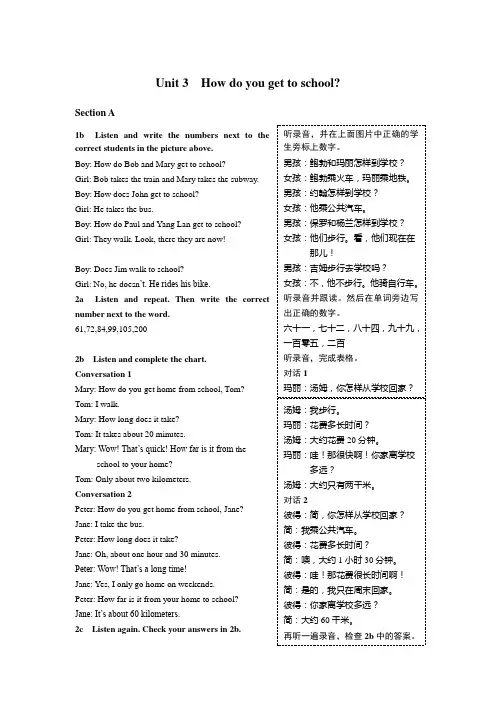
Unit 3 How do you get to school? Section A1b Listen and write the numbers next to the correct students in the picture above.Boy: How do Bob and Mary get to school?Girl: Bob takes the train and Mary takes the subway. Boy: How does John get to school?Girl: He takes the bus.Boy: How do Paul and Yang Lan get to school?Girl: They walk. Look, there they are now!Boy: Does Jim walk to school?Girl: No, he doesn’t. He rides his bike.2a Listen and repeat. Then write the correct number next to the word.61,72,84,99,105,2002b Listen and complete the chart.Conversation 1Mary: How do you get home from school, Tom? Tom: I walk.Mary: How long does it take?Tom: It takes about 20 minutes.Mary: Wow! That’s quick! How far is it from the school to your home?Tom: Only about two kilometers.Conversation 2Peter: How do you get home from school, Jane? Jane: I take the bus.Peter: How long does it take?Jane: Oh, about one hour and 30 minutes.Peter: Wow! That’s a long time!Jane: Yes, I only go home on weekends.Peter: How far is it from your home to school? Jane: It’s about 60 kilometers.2c Listen again. Check your answers in 2b. 听录音,并在上面图片中正确的学生旁标上数字。
七年级下册英语Unit-3-How-do-you-get-to-school-教案
实用文档七年级下册英语Unit 3 How do you getto school 教案和介绍后,老师可以通过展示一些图片或视频,引导学生谈论不同的出行方式,如乘坐公交车、地铁、骑自行车、步行等。
XXX1.首先,老师可以通过展示图片或视频,教授新单词和短语,如train、bus、subway、ride、bike、sixty、XXX、eighty、y、hundred、far、minute、kilometer、new、every、every day 等。
2.然后,老师可以模拟对话,让学生研究如何用英语谈论出行方式。
例如,老师可以问学生“How do you get to school?”,学生可以回答“I ride my bike”,或者老师可以问“How does Mary get to school?”,学生可以回答“She takes the subway”。
3.接下来,老师可以教授特殊疑问句,如“How far is it from…to…”和“How long does it take?”,并且教授如何回答这些问题。
例如,当学生被问到“How far is it from your home to school?”时,学生可以回答“It's 5 kilometers”,或者当学生被问实用文档到“How long does it take to get to school?”时,学生可以回答“It takes 40 minutes”。
Ⅲ。
Practice1.老师可以让学生进行小组讨论,讨论在不同情况下应该选择哪种出行方式,并且给出理由。
2.老师可以让学生进行角色扮演,模拟在不同场景下的出行方式和对话。
3.老师可以让学生完成一些练,如填空、选择题等,以检验他们对所学知识的掌握程度。
XXX1.老师可以引导学生了解不同国家的出行方式和交通规则,让学生了解和尊重不同文化和惯。
2.老师可以教授一些有关交通安全和礼仪的知识,让学生养成良好的交通惯和安全意识。
2020年春七年级英语下册Unit3Howdoyougettoschool(第1课时)分层训练(新版)人教新目标版
Unit 3 How do you get to school?第1课时分层训练[Section A1 1a2e]Ⅰ.根据句意及汉语提示完成句子1.—How old is his grandmother?—She is ________ (九十).2.It usually takes me ten ________ (分钟) to eat my breakfast.3.My father wants to buy me a ________ (新的) bike on my birthday. 4.They always ________ (骑) their bikes to work.5.She knows ________ (每一个) teacher in this school.Ⅱ.用恰当的介词填空1.—Does your mother go to work ________ car?—No. She goes to work sometimes ________ foot, sometimes ________ bike. 2.He often goes sightseeing(观光) ________ his car.3.I get ________ the hospital at 9:30.4.—How far is it ________ your home to school?—It's 5 miles.5.He goes to school ________ around seven ________ the morning.Ⅲ.根据句意及图片提示,用适当的单词填空1.My brother ________ ________ ________ to work every day.2.Kate's brother usually ________ to school.3.Let's go to the library ________ ________.4.Some students in our class ________ ________ ________ to school.5.I will go to Shanghai ________ ________ next week.Ⅰ.单项填空( )1.Does Lily often go to work ________?A.by her bike B.by bikeC.on bike D.by a bike( )2.—________ does it take to do your homework every day?—About an hour.A. How longB. How oftenC. How farD. How many( )3.Two ________ children plant ________ trees along the road. A.hundreds; hundreds ofB.hundreds; hundred ofC.hundred; hundreds ofD.hundred; hundred of( )4.________ takes her ten minutes________ there.A.It; to get B.Its; to get toC.Its; to get D.It; to get to( )5.—__________ are you going to London?—By air.A.How B.WhenC.Where D.Why( )6.—________ is it from your home to school?—Three kilometers.A.How far B.How muchC.How soon D.How longⅡ.句型转换1.Alice's father takes the subway to work every day.(改为同义句)Alice's father ________ to work ________ ________ every day.2.They ride__their__bikes to school.(对画线部分提问)________ ________ ________ get to school?3.It takes about__forty__minutes to get to the cinema.(对画线部分提问) ________ ________ ________ it ________ to get to the cinema?4.It is about__two__kilometers from my home to school.(对画线部分提问) ________ ________ is ________ from your home to school?5.He rides to work on Mondays.(改为同义句)He goes to work ________ ________ on Mondays.He goes to work ________ ________ ________ on Mondays.详解详析课内基础自测Ⅰ.1.ninety 2.minutes 3.new4.ride 5.everyⅡ.1.by; on; by 2.in3.to 4.from 5.at; inⅢ.1.rides his/a bike 2.walks 3.by bus 4.take the subway 5.by train 课后巩固提升Ⅰ.1.B by 作“乘”讲时,后面直接接交通工具名词,名词前不需加任何限定词;on/in 与交通工具名词连用时,名词前需加限定词。
人教版七年级英语下unit3howdoyougettoschool知识点归纳
◆短语归纳1. get to school/home/there/here/ 到达学校/家/那里/这里2. take a/ the subway/ bike/bus/train 乘地铁/骑自行车/乘公交/乘火车3. ride a bike to school 骑自行车去上学/drive one’s car to school 开车去上学4. go to school by bus/train/bike/subway...乘公交/骑自行车/乘地铁去上学5. how far 多远6. think of 认为/ think about 思考、考虑7. one small village 一个小村庄8. from home to school 从家到学校9. run too quickly 流得太快10. go on a rope way 乘索道11. every school day /night 上学的每一天/每个晚上12. cross the river to school 过河去学校13. an/one 11-year-old boy 一个十一岁的男孩14. bus stop 公共汽车站15. play with my classmates 和我的同学一起玩16. between…and… 在…和…之间17. be like a father to me 对我来说像一个父亲18. come true 实现19. many/ most of the students 许多/大多数学生20. have to 不得不21. have a good day 祝一天愉快22. be (not) afraid of 很(不)害怕23. be sure of something 对....确定24. live about five kilometers from school 住在离学校约5公里远的地方25. dream of sb /sth 梦见某人/某物26. pen pal 笔友◆用法集萃1. take…to…= go to…by… 乘…去…2. How do/does sb get to…? 某人是怎样到…的?3. How far is it from…to…? 从…到…有多远?4. It takes sb. some time to do sth. 做某事花费某人多长时间。
人教新目标版英语七下Unit 3《How do you get to school》教学设计4

人教新目标版英语七下Unit 3《How do you get to school》教学设计4一. 教材分析人教新目标版英语七下Unit 3《How do you get to school》主要讨论了学生上下学的交通方式。
本节课通过介绍不同的交通方式,让学生学会询问和描述他人的交通方式,并能够表达自己的看法。
教材包括听力、口语、阅读和写作等多个方面,帮助学生全面提高英语水平。
二. 学情分析七年级的学生已经掌握了基本的英语语法和词汇,具备一定的听说读写能力。
他们对新鲜事物充满好奇,愿意积极参与课堂活动。
然而,部分学生可能在口语表达和听力理解方面还存在困难,需要教师给予更多的关注和指导。
三. 教学目标1.知识目标:学生能够掌握表示交通方式的词汇和句型,如bus, trn, bybike, how do you get to school等;2.能力目标:学生能够用英语询问和描述他人的交通方式,并进行简单的交流;3.情感目标:培养学生热爱生活,关注环保的意识。
四. 教学重难点1.重点:学生能够准确地使用表示交通方式的词汇和句型进行交流;2.难点:学生能够在实际情景中灵活运用所学知识,提出问题并解决问题。
五. 教学方法1.任务型教学法:通过设置不同的任务,激发学生的学习兴趣,提高他们的参与度;2.情境教学法:创设真实的交通情境,帮助学生更好地理解和运用所学知识;3.交际教学法:鼓励学生积极参与课堂交际活动,提高他们的口语表达能力。
六. 教学准备1.教师准备:提前准备相关的交通方式图片、视频等教学资源;2.学生准备:预习本节课的生词和句型,做好听说读写的准备。
七. 教学过程1.导入(5分钟)教师通过展示不同的交通方式图片,引导学生谈论自己平时是如何上学的。
同时,询问学生是否知道其他同学的上学方式,为接下来的课堂活动做好铺垫。
2.呈现(10分钟)教师播放教材中的听力材料,让学生听懂对话内容,并回答相关问题。
七年级英语下册 Unit 3 How do you get to school交通方式的表达和提问以
交通方式的表达和提问以及How引导的特殊疑问句㈠交通方式的表达和提问方式1. 在对交通方式提问时,要用疑问副词how来提问。
How do you get to school?你怎样去学校呢?2. 对于这样的提问我们可以做出如下回答:I walk to school. 我步行去学校。
I take a bus to school. 我乘车去学校。
I go to school by bus. 我乘车去学校。
具体的表达交通方式的用法①“take+the/a+交通工具名称(+地点名词)”意为“乘……去某地”。
②“动词walk, ride, drive, fly等+to+地点名词”,意为“步行/骑自行车/开车/坐飞机去某地”。
③“by+交通工具名词”意为“乘……”。
④“on/ in+限定词+交通工具名词(单数前用a, an, the修饰)”,用以表达具体的交通方式。
注意:几种交通方式多可互换,表达意义相同。
eg. take the bus to school=go to school by bus=go to school in/ on the busdrive the/ my car to work=go to work by carfly to Shanghai=go to Shanghai by plane/ air=take the / a plane to Shanghai=go to Shanghai in/ on the/ a plane㈡ How引导的特殊疑问句how及how与一些形容词或副词组成的特殊疑问词(词组),引导特殊疑问句,用法十分广泛,是学习的重点。
1. how意为“怎样,如何”等,用以提问“程度,方式,状况”等。
2. how often意为“多久一次”,用以询问“做某事的频率”。
3. how long意为“多久,多长时间”,以此询问“做某事持续了多长时间”。
how long还表示“多长”,用以询问“长度”。
2019-2020年人教版英语七年级下册Unit 3 How do you get to schoo
2019-2020学年人教版英语七年级下册单元知识点Unit3 How do you get to school? Section A 基础部分Part1词汇:●get to, how far. bicycle, subway, car, train. early● bus stop, train station, bus station, subway station●minute, kilometer, mile, transportation , calendar句型:●How do you get to school? I take the bus.●How long does it take? It takes 20 minutes.●How far is it? It’s 10 miles.Part2.巩固练习1..搭乘(某种交通工具) v2..地铁。
地下火车n3.走。
步行。
散步v.4..(用以促使注意,表示惊异或询问)嘿。
喂int5..火车n6.四十num.7.五十num.8..六十num9..七十num10.八十num.11.九十num.12..一百num13..分钟n14.花费(时间) v.15.经、由(表示交通、传递等的方式)prep16.乘坐公共汽车17.远的。
遥远的adj.18. 多远19.公里。
千Mn. 20. &n.淋浴v.21.快的。
迅速的adj.22..自行车。
两轮脚踏车n23..车站n24..早的。
提早的adj25..英里n26..车站n27.运送。
运输28..北部的。
北方的29.北美洲30.地区。
区域n.31.事物。
事情n.32.另外的。
其他的adj.33..依赖。
依靠v34. 视……而定。
决定于35.河。
江n36.船n37.乘坐小船38. (表示推测)一定v.39..(用于形容词、副词的比较级之后)比conj40. (用于构成部分形容词及副词的比较级)(比……)更。
2020年春人教版英语七年级下册Unit 3 How do you get to school单元测试试题(含答案)
人教版英语七年级下册Unit 3 How do you get to school单元测试试题一、单选题1.The workers will build a new railroad________the two cities.A.since B.between C.as D.during2.Kate is ________ girl.She's very happy at school.A.a eighteen –year- old B.an eighteen –year- old C.an eighteen -years -old D.a eighteen years old 3.More and more people in Qingdao go to work __subway now.A.with B.on C.in D.by4.—How far is the small town from London? —It's about ______ kilometers.A.two hundred and thirty five B.two hundreds and thirty fiveC.two hundreds and thirty-five D.two hundred and thirty-five5.—______ is it from the village to your farm?—About 10 minutes’ walk.A.How often B.How soon C.How long D.How far6.—Could I ride an electric bicycle to school, Mr Wang?—No, you ______. Students under the age of 16 aren't allowed to ride electric bicycles.A.couldn't B.needn't C.can't D.shouldn't7.There are no ______ now, so we can’t cross the river.A.boats B.cars C.trains D.subways8.My parents are very strict ________me ________my lessons.A.at;in B.in;with C.with;in D.in;at9.—Could you tell me _______ it takes to walk to the Disneyland? —About 20 minutes.A.how far B.how long C.how often D.how soon10.It takes me fifteen minutes ___ from my home to school.A.walkB.walkingC.walksD.to walk二、完型填空There are different kinds of TV programs for you. When you 11 the TV programs, your brain cells (脑细胞) keep active. So it is 12 for you.Now more and more people are very 13 . They need a way to make 14 relaxed. WatchingTV is an easy 15 to make it. You can 16 your interest on TV and think less about your trouble.There are many educational programs on TV. You can get a lot of knowledge 17 watching TV. For example, you can 18 about the history of other countries. When you watch TV with your family, you can 19 your ideas with them. You will have a great time by watching a funny 20 . When you watch TV, you can learn English, and you can also learn about the latest news.11.A.read B.take C.watch D.study12.A.useless B.helpful C.terrible D.bad13.A.free B.busy C.important D.successful14.A.himself B.herself C.myself D.themselves15.A.subject B.day C.way D.lesson16.A.start B.find C.think D.buy17.A.of B.about C.by D.as18.A.make B.learn C.hold D.write19.A.share B.love C.put D.pick20.A.program B.list C.photo D.book三、阅读单选AThe Lambert family lives near (在……附近) a big river. They are a family of four. Mr. Lambert is a teacher. He teaches English in a middle school. He can also speak French and Spanish. His school is across (在……对面) the river, so he goes to work by boat every day. Mrs. Lambert has a small bookshop. The books there are all interesting. Mrs. Lambert is very nice, so people like reading (阅读) and shopping in her bookshop. Elena is Mr. and Mrs. Lambert’s daughter. She is only 5 years old. She likes riding her bike near their house. Sometimes she goes swimming in the river. She is a ver y good swimmer. Philip, the son of the family, doesn’t like swimming, but he likes the river. He likes fishing (钓鱼). His favorite thing after school is going fishing with his dad in a boat. He is only 12 years old, but he is really good at it.根据材料内容选择最佳答案。
人教版七年级英语下册unit3(详细内容)
人教版七年级英语下册Unit 3 How do you get to school一、单词回顾1、train[treɪn]火车2. bus 公交车3、subway['sʌbweɪ]地铁4、ride[raɪd]v.骑n.旅rode. [rəʊd]ridden.['rɪdn.]5、bike[baɪk]自行车6、sixty['sɪkstɪ]六十7、seventy['sev (ə)ntɪ]七十8、eighty['eɪtɪ]八十9、ninety['naɪntɪ]九十10、hundred['hʌndrəd]一百11、far[fɑː]很12、minute['mɪnɪt]分钟13、kilometer['kɪlə,mitɚ]公里14、new[n juː]新的15、every ['evrɪ]每一个16、by[baɪ]通过,被17、drive[draɪv]开车18、live [lɪv]活的,生动的19、stop[stɒp]停止20、cross[krɔs]交叉21、river ['rɪvə]河,江22、many ['menɪ]许多23、village[' vɪlɪdʒ]村庄,村民24、between[bɪ'twiːn]介于…之间25、bridge[brɪdʒ]桥26、boat [bəʊt]小船27、ropeway['rop,we]n. 索道空中缆索28、year[jɪə]n. 年;年度;岁29、afraid[ə'freɪd]害怕;惧怕30、like [laɪk]像;怎么样(介词)31、leave [liː v]离开;left (lea ve的过去式)32、dream[driːm]梦想;睡梦33、true[truː]真的;符合实际的二. 词汇辨析:1. take/spend/pay/costspend,cost,take和pay都可以表示“花费”,但用法却不尽相同。
2020年春七年级英语下册Unit3Howdoyougettoschool(第4课时)SectionB(2a_3b)课堂练习(新版)人教新目标
Unit 3 How do you get to school?第4课时Section B(2a—1.横过;越过v.__cross__2.河;江n.__river__3.许多adj.& pron.__many__4.村庄;村镇n.__village__5.介于……之间prep.__between__6.桥n.__bridge__7.小船n.__boat__8.年;岁n.__year__9.害怕;畏惧adj.__afraid__10.像;怎么样prep.__like__11.村民n.__villager__12.离开;留下v.__leave__13.梦想;睡梦n.做梦v.__dream__14.真的;符合事实的adj.__true__15.在……和……之间__between…and…__16.实现;成为现实__come__true__重点词汇1.【辨析】cross和across(1)cross v.横过;越过。
主要表示在物体表面上横穿,如横穿马路、过桥、过河等,与go across同义。
(2)across adv.& prep.横过;在……对面。
常和表示“走”一类的动词连用,着重指从物体表面的一边到另一边。
如:Let's cross/go across the road now.现在咱们过马路吧。
2.【辨析】many和much(1)many用于修饰可数名词复数。
如:How many people are there at the meeting?会上有多少人?(2)much用于修饰不可数名词。
如:There is much water in the bottle.瓶子里还有很多水。
3.【辨析】be afraid to do sth.和be afraid of (doing) sth.(1)be afraid to do sth.表示“害怕做某事”,即主语对做某事感到恐惧。
(2)be afraid of (doing)sth.表示主语内心不情愿做某事,即不希望发生某事,但自己不一定能避免。