
unit3 History of British
The Hundred Years’ War
Event - When king Edward III declared that he should become the French king, the French rejected his claim so he declared war on France in 1337. - In the early stage of the war, the English won great victories. - When the French peasants came in under Joan of Arc, French won a number of victories.
from central Europe
What kind of people are they?
farmers warlike people
Prehistoric times
1. Paleolithic Age (Old Stone Age) 700,000 years ago 2. Neolithic Age (New Stone Age) 4400—1800 BC Stonehenge and Silbury Hill were built at that time
Unit Three
History of Britain
Warm up
Think about the following questions.
1. Where did the British people come from? _______________________________
Celts are the natives of the island of Great Britain
Prehistoric times (…---55 B.C.)
Time:
Great Britain became an island 8,000 years ago.
Who are natives of Britain?
tall and golden-haired Celts
Where were they from?
Robin Hood
England’s best-loved legend Who a heroic Saxon nobleman oppressed by the Normans What ―merry men‖ robbed from the rich to give to the poor.
The Beginning of Britain
• Prehistoric times (…---55B.C.) • Roman Britain (55B.C.---410AD) • Anglo-Saxon Britain (410--- 871) • Viking Britain (871---1042) • Norman Conquest (1066)
Stonehenge 巨石阵
built about 5,000 years ago the most famous prehistoric monument and tourist attraction
Silbury Hill
tallest man-made mound in Europe
2
Britain remained part of the Roman Empire for almost 400 years.
Roman influence:
built temples, towns, theatres, markets and roads taught Celts to cultivate their land introduced Latin language, Roman numbers, the solar calendar and Roman laws, ect. built Hadrian’s Wall to resist the Picts
2. Do you know any famous historical places in Britain? ________________________________ Stonehenge, Tower of London, Westminster 3. Who are the most famous kings or queens in Britain’s history? ________________________________ Elizabeth II, Henry VIII, Charles I
Anglo-Saxon Britain (410---871)
Background
The Roman army left Britain in about 410 A.D.
Invasion Who --- the Angle, Saxon, and Jute tribes When--- 5th and 6th centuries Where---The Anglo-Saxons left their home from Northwestern Europe.
(793---1042)
• Invasion time
in the late 8th century
• Where/Who
from Denmark, Norway or Sweden (known as Danes)
• Result
From 1017 to 1041, England was ruled by Danish kings.
Norman Conquest
Significance
The best-known event in English history Duke William of Normandy, from northern France On October 14, 1066
Who
Time
Event
King Arthur
The best-known English legend In the 5th century
Story content King Arthur united the British isles with his famous ―round table" knights drove the Saxons back with his magical sword
Alfred the Great(871-899)
• King of Wessex • Pushed the Danes back • Regarded as the first king of a united England.
Westminster Abbey
By Edward, King of England, a faithful Christian one of the oldest buildings in London England’s most visited religious site a living monument to British history almost all English kings have been crowned there.
Several events in the 14th and 15th shook the foundation of the feudal society.
The Hundred Years’ War Wars of the Roses
The Hundred Years’ War
Background - At the beginning of the 14th century, England developed into a stronger state in Europe.
William and his army defeated the English army. William the Conqueror is the first Norman king of Englamd. This invasion is called Norman Conquest.
5. The Normans
e. Westminster Abby
British Invasion History
Invasion Time 43 A.D. 5th century 8th century 1066 Invaders the Romans the Angles and Saxons
Influence of Norman Conquest
French ruling
The next 300 years may be thought of as a time of Norman nobles ruling a largely Saxon population.
Language
Vikings the Normans
Medieval Britain (1066-1485)
Establishment
The Norman Conquest in 1066 was the last invasion of England by foreigners. It marked the establishment of feudalism in England.
英语国家概况 unit3 The government of tne UK
The coronation of the Commonwealth Realms' Queen Elizabeth II Westminster Abbey, 1953.
• Half-Crown coin of Oliver Cromwell, 1658. The inscription means "Oliver, by the Grace of God Protector of the Commonwealth of England, Scotland and Ireland et cetera".
Oliver Cromwell's death
mask at Warwick Castle
Plaque commemorating the reinterment of Cromwell's head at Sidney Sussex College
unit 3答案
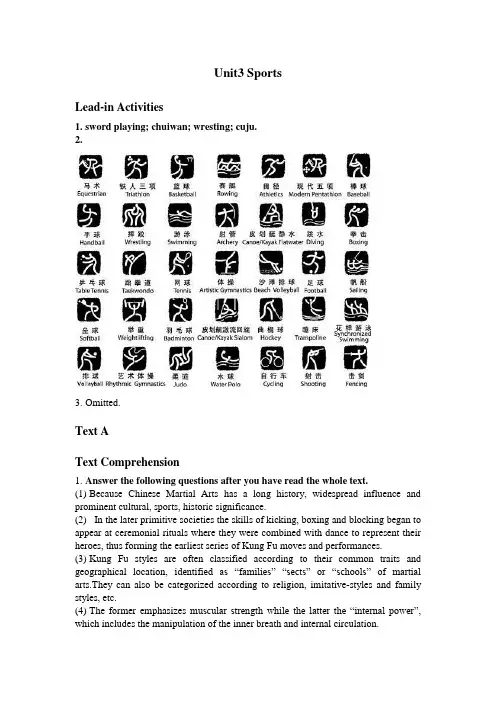
Unit3 SportsLead-in Activities1.sword playing; chuiwan; wresting; cuju.2.3.Omitted.Text AText Comprehension1.Answer the following questions after you have read the whole text.(1)Because Chinese Martial Arts has a long history, widespread influence and prominent cultural, sports, historic significance.(2)In the later primitive societies the skills of kicking, boxing and blocking began to appear at ceremonial rituals where they were combined with dance to represent their heroes, thus forming the earliest series of Kung Fu moves and performances.(3)Kung Fu styles are often classified according to their common traits and geographical location, identified as “families” “sects” or “schools” of martial arts.They can also be categorized according to religion, imitative-styles and family styles, etc.(4)The former emphasizes muscular strength while the latter the “internal power”, which includes the manipulation of the inner breath and internal circulation.(5)Aside from its function in offence & defence, Kung Fu has a considerable role to play in moral cultivation, body building, and aesthetic appreciation.(6)The Chinese character “武”(martial art) comprises of two characters: “止” (stop) and “戈” (an ancient weapon), which indicates that the essence of martial art is not to fight, but to maintain peace.(7)Chinese Kung Fu was first introduced abroad to the United States by Chinese-American Kung Fu master Bruce Lee, whose agile movements in a series of his great movies swept American audiences off their feet.(8)No. To further delight audiences, movie makers add more and more modern techniques into their films exaggerating the effect of Kung Fu.Vocabulary Exercises1.Choose appropriate words to fill in the gaps below. Change the form if necessary.(1)enchant (2) Primitive (3) render (4) prominent (5) imitative (6) exaggerated (7) deficient (8) circulation (9) survival (10) embraces2.Translate the following sentences into English with the words given below. Note that you are encouraged to use the sentences in Text A.(1)Chinese Kung Fu is effective both in battle and in building physical strength. In addition, it unites with the traditional medicine concepts of human’s meridians and collaterals, Qi and blood.(2)During thousands of years (of development),Kung Fu has developed into a comprehensive system embracing numerous sects, schools and disciplines rare seen in the world.(3)All schools of Chinese Kung Fu masters hold it a top priority to cultivate moral characters, spirit and temperament, as well as develop good manners and conduct, through practicing martial arts.(4)Different with the aggressive and brutal western boxing based on the value of individualism, Chinese martial art is imbued with Chinese people’s unique perspective on fighting, profound culture and philosophy including Confucianism, Daoism and Buddhism, thus forming a comprehensive and unique system.(5)Coming up to date, Chinese Kung Fu has become something of a necessity in movies and soap operas.Text BText Comprehensionplete the following paragraph according to the above text.The United Kingdom is notable for the diversity of its sporting interest. Sports play an important role in promoting integration and in nurturing talents in the country. The country has given birth to several major international sports such as football, rugby, cricket, golf, tennis, and track and field among others. Sport is a major source of entertainment in the UK with thousands of spectators filling stadiums and arenas to cheer on their favorite teams. Sports are also major sources of revenue in the UK for players, government, and investors.Cricket was first embedded in the UK before spreading to the rest of the Commonwealth C. The comparative slowness and quietness reflects British gentlemanly sportsmanship. Also, cricket is often believed to be associated with a set of English sportsmanship values such as “fair play”, “team spirit”and individual excellence. If any action in other spheres of life, whether in business, politics or everyday interaction does not meet these standards, particularly of honesty and fairness, it is described as “not cricket”.2.Read the text and Mark T for true statements, and F for false statements below.1.F2. T3. F4. T5. F6. T7. T8. T9.T 10. FTheme-related Exercises1.Read the following passage and fill in the gaps with words given in the box.Cricket fighting (斗蟋蟀)is a kind of sport involving the fighting of male crickets in China. Unlike most blood sports such as bullfighting and cockfighting, cricket fighting rarely causes injuries to the animals. To play the game, two crickets are matched up according to size, weight, and color. Both combatants are placed in a small fighting arena, with walls high and thick enough to prevent desertion. The cricket trainers stimulate their charges with a straw or a fine-haired brush, and then the insect warriors go at each other, antennae waving and jaws snapping.Cricket Culture in China encompasses a history of 2000 years. The two millennium of tradition may be divided into three eras. From times prior to the Tang dynasty (500 B.C. - 618 A.D.), people only appreciated the cricket’s powerful tunes. During the Tang dynasty (618 - 907A.D.), the imperial concubines used small gold cages to accommodate crickets and took them to bed to hear their singing during the night. In the Song dynasty (960 - 1279 A.D.), cricket fighting flourished as a popular sport. Such an activity was still flourishing during the Qing Dynasty (1616-1911), when the Emperor’s family, city residents or village men and scholars, all collected crickets feverishly every summer. The tradition has ancient roots and has been handed down throughout the generations to the present day.For centuries, China has regarded a cricket chirping around the house as an auspicious symbol, a deluge of cricket means wealth will come to the family. Now, cricket fighting is mainly found in the large cities of Shanghai, Beijing, Tianjin, Guangzhou, and Hong Kong. There are cricket fighting clubs and societies that cater to member’s interest at all levels of intensity. With the migration of Chinese to otherparts of the world, cricket fighting can be found in New York and Philadelphia.2.Translate the following paragraph into English with the words in the brackets.Traditional sports with distinct Chinese characteristics are very popular, including martial arts, taijiquan, qigong, Chinese chess and Go (or encirclement chess). Martial arts, combining exercise and self-defense, enjoy great popularity in China. Martial arts include bare-handed boxing as well as offence and defense with equipment, both of which has different schools. Taijiquan, or Chinese shadow boxing, is one of the internal styles of Chinese martial arts. It combines control of body, mind and breath. Qigong, a system of deep breathing exercises, is a unique Chinese way of keeping fit. It aims at enhancing health, promoting longevity, curing illnesses and improving physiological functions by concentrating the mind and regulating the breath.。
英语国家概况答案
英语作业答案Unit 1Ⅰ.Read the following statements carefully and decide whether they are True or False.1. The island of Great Britain is geographically divided into three parts: England, Scotland and Wales. (T) 英伦三岛包括英格兰、苏格兰和威尔士。
2. People in different parts of Britain like to use the name England to refer to their country.(F) British3. Today more than half of the people in Wales still speak the ancient Welsh language. (F)4. In terms of population and area,Northern Ireland is the second largest part of the United Kingdom. (F) 英格兰是面积最大,人口最多的5. The longest river of Britain originates in Wales. (T) The River Severn:赛文河6. Because of political troubles,Northern Ireland has been quite significant among the four constituent parts of the United Kingdom. (T)Ⅱ. Choose the one that best completes each of the following statements.1. The two main islands of the British Isles are .不列颠群岛是由两个大岛组成的:不列颠和爱尔兰A.Great Britain and IrelandB.Great Britain and ScotlandC.Great Britain and WalesD.Great Britain and England2. is the capital city of Scotland.A. BelfastB. EdinburghC. AberdeenD. Cardiff3. Among the four parts of the United Kingdom,is the smallest.A.EnglandB. ScotlandC.WalesD. Northern Ireland4. The introduction of Christianity to Britain added the first element of words to English.A. Danish and FinnishB. Dutch and GermanC. French and ItalianD. Latin and Greek5. The evolution of Middle English was reinforced by the influence.A. NormanB. DutchC. GermanD. Danish6. Samuel Johnson’s dictionary was influential in establishing a standard form of .A. grammarB. handwritingC. spellingD. pronunciation7. At present, nearly of the world’s population communicate in English.A. halfB. a quarterC. One thirdD. one fifthIII. Give brief answers to the following questions·1. What is the full name of the U.K.?The full name is the United Kingdom of Great Britain and Northern Ireland2. Why do tourists from all over the world like to go to Scotland?They like to enjoy the beautiful Scottish scenery, to drink Scotch whisky and to see Scotsman wearing kilts and playing bagpipes.3. How many periods can the development of the English language be divided into and what are they?The development of the English language can be divided into three periods: Old English, Middle English and Modern English.4. Why did English become more important after the Black Death(黑死病)?The laboring and merchant classes grew in economic and social importance after the Black Death, so English also grew in importance compared to French.Ⅳ. State your understanding of the following questions in about 100 words.1. who are British people?The first known inhabitants in Britain were Celts who are the ancestors of welsh, Scottish and Irish people. Then came the Anglos, the Saxons and the Jutes who brought with them English language. Many people from other European countries came later, and in modern times there are a lots of immigrants from many former Commonwealth(共和国) countries from every part of the world, and the British people are also composed of people from different ethnic and cultural backgrounds.2. What is Standard English?Standard English is based on the speech of the upper class of the southeastern England; it is widely used in media and taught at schools. It is preferred by the educated, middle-class people. Is has developed and has been promoted as a model for the correct British English. It is also the norm(标准) carried overseas. Today, Standard English is codified to the extent that the grammar and vocabulary are much the same everywhere in the world where English is taught and used.Unit 2I. Read the following statements carefully and decide whether they are True or False.1. The British history before 55 BC is basically undocumented. (T)2. The Celts became the dominant group in Britain between the 8th and 5th centuries BC. (T)3. The name of Britain came from a Celtic tribe—the Britons. (T)4. The Anglo—Saxons came to Britain in the mid-5th century. (T) (不考)5. The chief or king of the Anglo-Saxon tribes exercised power at their own will. (F)6. The Vikings began to attack the English coast in the 8th century. (T)7. Henry II built up a large empire which included England and most of France (T)8. The Magna Carta was designed to protect the rights of both the privileged class and the townspeople. (F)9. The Hundred Years’ War was a series of wars fought between England and Normans for trade and territory. (F)10. in an effort to make a compromise between different religious factions,Queen Elizabeth I actually defended the fruit of the Religious Reformation. (T)Ⅱ. Choose the one that best completes each of the following statements.1.The attack on Rome ended the Roman occupation in Britain in 410.A.Norman B.DanishC.Celtic D.Germanic2.By the late 7th century,became the dominant religion in England.A.Celtic Christianity B.Anglo-Saxon ChristianityC.Germanic Christianity D.Roman Christianity3.Westminster Abbey(威斯敏斯特教堂) was built at the time of .A.St.Augustine B.Edward the Confessor(忏悔者爱德华)C.William the Conqueror D.Alfred the Great4.The marked the establishment of feudalism(封建制度) in England.A.Viking invasion B.signing of the Magna CartaC.Norman Conquest D.Adoption of common law5.The end of the Wars of the Roses led to the rule of .A.the House of Valois B.the House of YorkC.the House of Tudor(都铎楼) D.the House of Lancaster出身于族徽为红玫瑰的兰开斯特家族的亨利·都铎结束了玫瑰战争,登上了英国王位,称亨利七世6.The direct cause for the Religious Reformation was King Henry VIII’S effort to .A.divorce his wife B.break with RomeC.support the Protestants D.declare his supreme power over the church 7. The English Civil War broke out in 1642 between .A.Protestants and Puritans B.Royalists and ParliamentariansC.nobles and peasants D.aristocrats and Christians8.was passed after the Glorious Revolution(光荣革命).A.Bill of Rights B.Act of SupremacyC.Provisions of Oxford D.Magna Carta9.The Industrial Revolution was accomplished in Britain by the middle of the century.A.17th B.18th C.19th D.20th 10.Britain faced strong challenges in its global imperial dominance by the beginning of the century.A.17th B.18th C.19th D.20thIII. Give brief answers to the following questions.1. What are the two components of the British parliament?2. What were some of Queen Victoria’s major achievements?3. What were the two camps in Europe in World WarⅠ?4. Why did Britain cooperate closely with the United States after World WarⅡ? Answers:1. They are the House of Commons and the House of Lords.2. Queen Victoria made tremendous achievements in almost every aspect. She promoted further industrial revolution, the building of railways and the growing of trade and commerce. By the end of her reign, Britain had developed to an empire including a qua rter of the global population and nearly a quarter of the world’s landmass.3. The Central Powers which included Germany, Austria-Hungary, the OttomanEmpire and Bulgaria and the Allied Powers which were mainly comprised of France, the Russian Empire, the British Empire, Italy and the United States.4. Because they were allied during the war and shared the same worries about the former Soviet Union.Ⅳ. State your understanding of the following questions.1. What were the results of the Industrial Revolution in Britain?2. The Rise and Fall of the British Empire?Answers:1. The Industrial Revolution changed Britain in many ways. First, industrial productivity increased dramatically. Britain became the most advanced industrial country and also the financial center in the world. Second, urbanization took place. Many new cities sprang up. Third, it caused great changes in the class structure. The old social classes declined, and new ones emerged and developed. The conflict between the capitalists and the proletarians became the most important political issue.2. Colonization of Newfoundland, the first British colony overseas, in 1583 marked the beginning of the British Empire. By 1837, Britain had long been an empire which included the colonies in Canada, Australia, New Zealand, India and many small states in the West Indies. By the end of the 19th century, the British Empire included a quarter of the global population and nearly a quarter of the world’s landmass. During the mid-19th century, the British government consolidated the existing colonies by bringing them under the direct control of the government. Before World WarⅠ, Britain had the largest colonial empire in the world. However, Britain suffered great loss to its manpower in the two World Wars and exhausted its reserves of gold, dollars and overseas investment. Most of Britain’s colonies gained independence since the 1940s, which inevitably led to the fall of the Empire.Unit4 Politics and Government of UKI.Read the following statements carefully and decide whether they are True or False.1.Conventions(党代会) are regarded less important than common law in the working of the British government.F2.The British monarchy has never been interrupted throughout the history.F3.In reality,the British King or Queen is the source of all government powers.F 4.British Parliament is the law-making body of the Commonwealth of Nations(英联邦国家).F5.Lords Spiritual(上议院神职议员) and Lords Temporal(上议院世俗议员) are all members in the British Upper House(上议院).T6.The members in the House of Commons(下议院) are appointed rather than elected.F 上议院是指派的,下议院是选举的。
英语国家社会与文化入门 课后题答案之欧阳地创编
Book1 Unit 1时间:2021.03.04 创作:欧阳地1.What was the British Empire? What do you know about it? In what way is the “Empire” still felt in Britain and in the international field?The British Empire comprised the dominions, colonies, protectorates, mandates, and other territories ruled or administered by the United Kingdom, that had originated with the overseas colonies and trading posts established by England in the late 16th and early 17th centuries.In the international field, Britain has great voice in politics, economy and culture and so on.2.Why impossible to sum up British people with a few simple phrases: The UK is made up of different elements. It includes 4 parts within the one nation-state. It is now a multiracial society with different religion believes. It is divided economically and it is a society with aclass-structure. And within each of the four countries there are different regions. Since this country was so complicated both in history or humanity, it is impossible to sum up their people. 3.A history of invasions: (1) Before the 1st century AD Britain was made up of tribal kindoms of Celtic people. They brought the central Europen culture to Britain. Then in 43AD, Roman Empire invaded Britain and controlled it for slave society but also disseminated their Catholicism. (2)However, in the 5th century, the Roman Empire rapidly waned in power and Britain was conquered by the Angles and the Saxons. In order to defend the Saxons, a great leader—King Arthur appeared. He created the "round table" to satisfy all the knights' requirement of having equal precedence. Thus it gradually formed the monarchy in Britain as a more democratic system. Whether Arthur's a real person in the history or not, Anglo-Saxons did succeed in invading Britain and they were the forefathers of the English. (3)In the 8thcentury, the Vikings from Denmark controlled the nothern and eastern England. A Anglo-Saxon herio, king Alfred the Great fought against the vikings with the truly English. And that's why there's a certain cultural difference between northerners and southerners in England (4)Later, the Nomans from northern France, under the leading of William of Normandy, killed the king and William became the Frist of England. They imported a rulling class that French-speaking Norman aristocracy rulled Saxon and English-speaking population. In this condition, there weren't a lot of rebellions among the English people. That directly formed an English unique character: a richly unconventional interior life hidden by an external conformity. Even today, we can still find this personality from the British people through their lifestyles.How did they influence culture:[接着上边一起看] (2) a lot of stories of King Arthur, which brought a lot of singers, poets, novelists and filmmakers. Places associated with his legend. Round table was ween asan indicator of the way in which the English have wished to see their monarch as something other than a remote dictator. (3)anglo-saxon invaders were the forefathers of the English. By Vikings' settlements the Enlish heroes were truly English. There remains to this day a certain cultural divide between northerners and southerners in england. (4)Norman aristocracy ruling a largely Saxon and English-speaking population. the legend of Robin Hood.4.General characteristic of Scotland: Scotland is the second largest of the four nations, both in population and in geographical area. It is also the most confident of its own identity because alone amongst the non-English components of the UK it has previously spent a substantial period of history asa unified state independent of the UK. (1) rugged.(2) not conquered by the Romans (3) maintain its separate political identity for more than a hundred years.(4) eager for independence.How Scotland became part of the union of Great Britain: in 1707 by agreement of the English and Scottish parliaments, Scotland joined the Union. In 1745 there was a brutal military response from the British army. The rebel army was destroyed at the battle of Culloden in northern Scotland.5.Describe Wales and the unification with Britain: (1) wales was an important element in Britain's industrial revolution, as it had rich coal deposits. It is successful in attracting investment from abroad. Wales has been dominated by England for longer than the other nations of the union. Despite this nearness and long-standing political integration Wales retains a powerful sense of its difference from England. (2)Wales has been dominated by England for longer than the other nations of the union. Despite this nearness and long-standing political integration Wales retains a powerful sense of its difference from England. In 1536, wales was brought legally, administratively, and politicallyinto the UK by an act of the British parliament. This close long-standing relationship means that modern wales lacks some of the outward signs of difference which Scotland possesses --- its legal system and its education system are exactly the same as in England. 6.Differences between England, Scotland and Wales in terms of cultural tradition: [书上说的比较散,建议参考festival那章的答案,这里只有一些零散的不系统的比较] (1) English character: a richly unconventional interior life hidden by an external conformity. But young people are not all stereotypes. But it is certainly true that the lifeless fronts of many english houses conceal beautiful back gardens.(2)The dream of an independent Scotland has not vanished. They are always eager for freedom. Scotland has a great tradition of innovation in the arts, philosophy and science. "Superficially fully integrated into the UK, but concealed beneath this is a still-strong Scottish identity." Some people speak Gaelic.(3)Wales is different, and one of thekey markers of that diffenece is the Welsh language -- the old British Celtic tongue which is still in daily use. Modern wales lacks some of the outward signs of difference which Scotland possesses. (its legal system and education system are exactly the same as in England)Unit 21.Why is Northern Ireland so significant in the UK: Though Northern Ireland is small it is significant because of the political troubles there.Its political problem: The problem is in Northern Ireland in 1921 in southern Ireland independence from Britain, Ireland North and South following the separation of issues left over by history, mixed it with historical, political, ethnic and religious conflicts, extremely complex. Ireland’s independence, to remain under British rule within the framework of the 6 in the northern island of Ireland residents of the pro-British Protestant majority (about 51%), the Catholic nationalist minority(about 38%), as a result of the two major forces in Northern Ireland On the contrary position of ownership and lead to confrontation, conflict. [因为发现实在太难sum up了,所以就搜了一下,以下是wikipedia版本]Northern Ireland was for many years the site of a violent and bitter ethno-political conflict —the Troubles —which was caused by divisions between nationalists, who are predominantly Roman Catholic, and unionists, who are predominantly Protestant. Unionists want Northern Ireland to remain as a part of the United Kingdom,[6] while nationalists wish for it to be politically reunited with the rest of Ireland, independent of British rule. [网络其它版本]Until 1921 the full name of the UK was "The United Kingdom of Great Britain and Ireland", not only "Northern Ireland", because the whole island of Ireland was politically integrated with Great Britain, and had been since 1801, while Britain's domination of the Irish dated back centuries even before that date. But Irish desires for an independent Irish state were neverlost, and one of the key issues in late nineteenth century British politics was a campaign in parliament for what was called "home-rule"—Irish political control of Irish affairs. The Home Rule Bill was finally passed in 1914, but the process was overtaken by the First World War and was suspended for the duration of the war.2.Factors in Irish and English history that affect the situation in Northern Ireland today: Along with the political campaign for home-rule there were groups who followed a more direct method of pursuing Irish independence, engaging in guerilla or terrorist activities against British institutions and the British military forces. During the First World War and immediately after, this activity increased, sometimes brutally suppressed by British forces. 3.Sum up solutions to NI's political problems of different parties and groups in the UK: Margaret Thatcher's government did not give in to this demandfor political status and 11 prisoners starved to death. This event revitalised the political campaign of Sinn Fein, the legal political party which supports the IRA's right to fight. Its leaders spoke of a twin campaign for union with Ireland, both political and military, which they called the policy of "The Bullet and the Ballot Box".4.What do you think should be the right solution to the political problem in Northern Ireland: I think they can ask the UN for help. / Keep the present status. Turn to other countries for help. [自由发挥啦]Unit 31.Characteristics of the British constitutional monarchy: The monarch of the country has limited rights because of Bill of Right. For example, while the official head of state is the queen, her powers are largely traditional and symbolic. The government at national and local levels is elected by the people and governs according to British constitutionalprinciples.How the English monarchy evolved to present constitutional monarchy: Originally the power of the monarch was largely derived from the ancient doctrine of the "divine right of kings". For a thousand years Britain has had a hereditary king or queen as the head of the state. While the King in theory had God on his side, in practice even in medieval times it was thought that he should not exercise absolute power. King John was unwilling to receive advice from prominent men, which led battles between the king and other powerful groups. Finally the king granted them a charter, named Magna Carta, of liverty and political rights. The civil war2.The civil war was rooted in a dispute over the power of the king vis-a-vis Parliament. James I and his successor Charles I both insisted on their divine right as kings. They felt Parliament had no real political right to exist, but only existed because the king allowed it to do so. It was the effort toreassert the rights of parliament that led to the civil war.English Revolution: "English Revolution" has been used to describe two different events in English history. The first was the Glorious Revolution of 1688, whereby James II was replaced by William III and Mary II as monarch and a constitutional monarchy established, was described by Whig historians as the English Revolution.[1]In the twentieth-century, however, Marxist historians used the term "English Revolution" to describe the period of the English Civil Wars and Commonwealth period (1640-1660), in which Parliament challenged King Charles I's authority, engaged in civil conflict against his forces, and executed him in 1649. This was followed by a ten-year period of bourgeoisrepublican government, the "Commonwealth", before monarchy was restored in the shape of Charles' son, Charles II, in 1660.3.History of English parliament: Traditionally, whenmedieval kings wanted to raise money he would try to persuade the Great Council, a gathering of leading, wealthy barons which the kings summoned several times a year. Later kings found this group was so small that they could not make ends meet. So they widened the Great Council to include representatives of counties, cities and towns and get them to contribute. It was in this way that the Great Council came to include the House of Lords(who were summoned) and the House of Commons(representatives of communities).What role did the parliament play in the Civil War: Since James I and Charles I both thought that Parliament didn't need to exist, the Parliament was enraged. Leading politicians and church authorities asked William of Orange to replace them two. In 1689 Parliament passed the bill of Rights which ensured that the King would never be able to ignore Parliament.4.Characteristics of British constitution: Unlike many nations, Britain has no core constitutionaldocuments.Contents: Statute laws(laws passed by Parliament); the common laws(laws which have been established through common practice in the courts); and conventions(rules and practices which do not exist legally but are nevertheless regarded as vital to the workings of government).5.Why parliament is supreme: because it alone has the power to change the terms of the Constitution. There are no legal restraints upon Parliament.Parliament's function: First, it passes laws. Second, it provides the means of carrying on the work of government by voting for taxation. Third, it scrutinises government policy, administration and expenditure. Fourth, it debates the major issues of the day.Queen/King's role: To symbolise the tradition and unity of the British state. To represent Britain at home and broad. To set standards of good citizenship and family life. She is legally head of the executive,an integral part of the legislature, head of the judiciary, commander in chief of the armed forces and "supreme governor" of the Church of England.PM's role: The Prime Minister is the leader of the political party which wins the most seats in a general election. He/She chose usually around 20 MPs to become government ministers in the Cabinet. Together they carry our the functions of policy-making, the coordination of government departments and the supreme control of government.6.The House of Lords: It was below the Queen, consisting of the Lords Spiritual(who are the Archbishops and most prominent bishops of the Church of England) and the Lords Temporal(which refers to those lords who either have inherited the seat from their forefathers of they have been appointed). The lords mainly represent themselves instead of the interests of the public. It is the upper house of the Parliament of the United Kingdom, the United Kingdom's national legislature. It remains the relationship withgovernment, debates legislation and has some power to amend or reject bills (has some legislative functions).Unit 41.Anyone who is eligible to vote can stand as an MP. It is necessary only to make a deposit of 500 pounds. Why small parties and independent candidates powerless: Voters will see it as a wasted vote because even if they were to win the seat they would be powerless in parliament against the big parties' representatives. Voting them will prevent the voters from contributing to the competition between the big parties as to which of them will form a government. 2.Three big parties in the UK: the Labour party, the Conservative party, the Liberal Democrats. Similarities: Since Conservative began to have a "fartherly" sense of obligation to the less fortunate in society, they didn't dismantle principles the Labour set up. That indicates that thus thedifference between the Labour and Conservative is one of degree, not an absolute.Dissimilarities: (1) Labour is a socialist party. They believe a society should be relatively equal in economic terms and that part of the role of government is to act as a "redistributive" agent. They think government should provide a range of public services, therefore high taxes. (2) Conservative is the party that spent most time in power. They are seen as the party of the individual, protecting individual's right to acquire wealth and to spend it how they choose, therefore low taxes. (3) Liberal Democrats is a party of the "middle", occupying the ideological ground between the two main parties. They are comparatively flexible and pragmatic in their balance of the individual and the social.3.Recent political trends [注意下一小问]: (1) Conservatives won the election under their leader Margaret Thatcher in the 1970s. During that time the economy did badly, with high inflation and low growth.(2) she dismissed being "fartherly", encourages entrepreneurship. One of the major policies was the privatisazion of nationalised industry. (3)part of the mechanism of change was a less redistributive taxation system. Tax rate were cut to allow people to keep more of what they earned.Author's opinion: The 1980s have seen British politics move to the "right", away from the "pulic" and toward the "private"; away from the "social", and toward the "individual", and all parties have had to adjust to those changes.4.How people are divided into different classes: (1) employment: manual(or blue-collar) workers usually call themselves working-class, and office(or white-collar) workers would usually call themselves middle-class. (2) cultural differences: like what newspaper they read. Working-class often read THE SUN, a newspaper with little hard news and more about soap operas, royal family and sports. Middle-class often read THE GUARDIAN, a larger newspaper with longerstories, covering national and international events.(3) education: private school or public school. (4) the UK has also retained a hereditary aristocracy.(5) the way they speak.Compare with the US and China: not similar at all. The UK has also retained a hereditary aristocracy. Among the students at the private schools attended by the upper-middle-class above would be a thin scattering of aristocratic children, who will inherit titles like baronets. This is due to Britain's different history and convention.Unit 51.Absolute decline means recession, developing in a minus speed.Relative decline means that although the UK improved, other countries developed more rapidly than the UK, which made it slid from being the second largest economy to being the sixth.Reasons: (1) The UK had gone into debt after WWII.(2) Britain spent a higher proportion of its nationalwealth on the military than most of its competitors. (Joining NATO and UN Security Council) (3)The era of empire was over. Former colonial countries announced independence, leaving Britain as a medium-size Euporean country. (4)Britain's industry survived comparatively unaffected, but its competitors did not. So the competitors invested in modern equipment and new products while British industry still continue with older ones. (5) Low rates of investment. The UK lacks a close relationship between industry and banks due to its history. A low rate of domestic industrial investment coupled with a very high rate of overseas investment.2.What did the conservative party under Mrs. Thatcher promise to do to the UK national economy in 1979: A radical programme of reform.What was her radical reform programme: Bureaucracy was reduced, (foreign exchange controls were lifted, rules governing banks loosened, for example). Throughout the 1980s an extensive programme ofprivatisation was carried out.Was is successful: It seemed in some ways to be successful in that inflation came under control, and business made profits. The negative aspect was a rapid increase in unemployment. The national economy as a whole continued to grow at lower rates than its competitors.3.Main areas in national economies: Primary industries such as agriculture, fishing and mining; secondary industries which manufacture complex goods from those primary products; tertiary/service industries such as banking, insurance, tourism and the retailing.Development of each: (1) agricultural sector is small but efficient. Energy production is an important part of the UK economy. (2)in the secondary sector, manufacturing industry remains important, producing 22% of national wealth. (3)tertiary or service industries produce 65% of national wealth.4.Why relatively shrinking of the important secondary industry and a spectacular growth in tertiary or service industries: A lot of the tertiary or service industries is domestic activity, accounting for about 10% of the world's exports of such services. 70% of the UK's workforce are employed in the service sector.Compare tertiary industries in China in the past 20 years or so: Chinese tertiary industries didn't grow as fast as the UK, though the portion was increasing. How is this growth related to the reform and opening up to the outside world: China was famous for the name of "world factory", which means Chinese workforces can produce products at low paid. China is a developing country, experiencing the transfer of manufacturing is reasonable. However, as China is developing, wages of workforces are also increasing. Comparing to India, we may lose our "advantage" gradually.Unit 61.Why Geoffrey Chaucer's work written in Middle English can still read and studied today: It is notable for its diversity, both in the range of social types amongst the 31pilgrims, and the range in style of the stories they tell.2.Do you think Elizabethan Drama occupies a significant position in British literature: Yes. Elizabethan drama, and Shakespeare in particular, is considered to be among the earliest work to display a "modern" perception of the world: full of moral doubts and political insecurities, where the right of those who wield power to do so is put in question.The most important figure in Elizabethan Drama: William ShakespeareSome of his well-known plays: (tragedies)Romeo and Juliet, Hamlet, Othello, King Lear, Macbeth; (comedies)The Taming of the Shrew, A Midsummer Night's Dream, Twelfth Night, the Tempest; (history plays)Richard III, Richard II, Henry IV, Henry V jJulius Caesar, Antony and Cleopatra.3.Some of the features of Romantic Literature: writers of romantic literature are more concerned with imagination and feeling than with the power of reason.4.Modernism: it refers to a form of literature mainly written before WWII. It is characterized by a high degree of experimentation. It can be seen as a reaction against the 19th century forms of Realism. Modernist writers express the difficulty they see in understanding and communicating how the world works. Often they seem disorganized, hard to understand. It often portrays the action from the viewpoint of a single confused individual, rather than from the viewpoint of an all-knowing impersonal narrator outside the action.Postmodernism: After WWII. Postmodernist can be thought of as abandoning the search of buried meaning below confusing surfaces.Examples to illustrate: (modernist) Virginia Woolf"Mrs.Dalloway""to the Lighthouse""Orlando";wrence "Sons and Lovers" andE.M.Forster "aPassage to India"; (postmodernist)George Orwell "1984", John Fowles "the French Lieutenant's woman"Book I Unit 7, British Education System1.What are the purposes of the British education system?Please comment on these purposes. What are the main purposes of the Chinese education system? Are there any differences or similarities in the education of the two nations?Schools in Britain do not just teach the students 3 Rs, (reading, writing and arithmetic), but to provide children with literacy and the other basic skills they will need to become active members of society.2.How does the British education system reflect socialclass?Firstly, in Britain, the school you attend can refer to your social status.And the school tie is a clear market of social class, 3.What are the major changes that have taken place sinceWorld War II? Is British education moving towardsmore progress or more equality? Pick up some examples from the text to illustrate your points.1)The old education system has disrupted due to the war.So with the help of the church and newly powerful trade unions began to reconstruct a new education system.2)The new system emphasizes equality. 1944 educationact made entry to secondary schools and universities meritocratic. Children would be able admitted to schools not because they were of a certain social class or because their parents possessed a certain amount of money, but because of the abilities they displayed. All children were given right to a free secondary education and the main concern was to make sure more children had access to a good education.3)1989, a national curriculum was introduced by thegovernment.4.Why does the author say that universities in Britainhave rather elitist?Most students in British universities are from the middle classes, attend good schools, perform well intheir A-levels and receive a fully-funded place ina university. And when they graduate, they can becomevery influential in banking, the media, the arts, education or even the government.5.What is the Open University in Britain? What do youthink of this system?The opening university offers a non-traditional route for people to take university level courses and receive a university degree. People can register without having any formal educational qualifications.They follow university courses through textbooks, TV and radio broadcasts, correspondence, videos, residential schools and a network of study centre.I think the system has been quite successful. Thanksto the system, tens of thousands of Britons, from various statuses attend the Open University each year.And this has improve the equality in Britain’s high education.Unit 8 British Foreign Relations1.What and how did the British Empire end? How did theBritain react to this reality? How did the end ofBritish imperialism influence the psychology of the British and the making of Britain’s foreign policy?1)After the World War II the British could no longerafford to maintain its empire; while Britain had won the war, it had paid a terrible price in terms of lives and in terms of economic destruction. And the British realized that countries should be granted the independence and left to run their own affairs.People and territory should not just be treated asa source of economic resources for the ruling centersof commerce in Europe.2)Many people are still alive who can remember whenBritain was one of the most powerful and rich nations on earth. It is sometimes hard to think about Britain as it really is today.3)Because Britain lost its empire so recently, britishpolicy makers frequently forget that Britain is not as influential as it used to be in world affairs.Historians argue that the British foreign policy makers retain very conservative and traditional views of Britain’s role as a world power and pointto many major foreign policy decisions as examples.2.What are the foundations of Britain’s foreignpolicy?It is greatly influenced by its imperial history and also by its geopolitical traits.Britain’s imperial history m ade the policy maker very conservative and traditional.And its geopolitical traits created a sense of psychological isolation in its inhabitants. And as Britain is an island state, it naturally developed as a nation of seafarers who roamed the globe looking for territory and economic opportunities.3.How is Britain’s foreign policy made? Does thegovernment’s foreign policy represent the desires of British citizen?1)The prime minister and cabinet decide on the generaldirection of Britain’s foreign policy. Th e main government department involved is of course the foreign and commonwealth office but many other government ministries also play a part in formulating and executing the government’s decisions.。
新视野大学英语第四册Unit3
An Author’s Speech — Overcoming Obstacles
Before Reading
Global Reading Detailed Reading
After Reading
Unit 3 Job Interview Supplementary Reading
Fill in the Blanks
Maraቤተ መጻሕፍቲ ባይዱhon
Before Reading
Global Reading Detailed Reading
After Reading
Unit 3 Job Interview Supplementary Reading
About the Author — Harvey B. Mackay
A Brief Introduction Detailed Reading
2. A Video Clip about Sir Roger’s Success
Detailed R1e.adWinghat did Bannister dream of?
For years, Bannister dreamed of being the first man to run a mile in less than 4 minutes.
Listen to the introduction to the song and fill in the following blanks.
Detailed Reading
The song you are about to hear was written by one of a group of four singers known as the Silhouettes. He wrote the song back in the _1_9_5_0_s , shortly after leaving the army. It is easy to _im__a_g_in_e_ that it may well _re_f_l_e_c_this own experience of suddenly finding himself having to look for a job. If the song is anything to go by, his wife was largely _u_n_sy_m__p_a_t_h_e_t_ic_, suspecting him of l_a_z_i_n_e_ss_
研究生英语综合教程(下)Unit 3

Starting out—Task 2
8. Do you attempt to speak the local language when you travel rather than sta`rt out in your mother tongue? 9. Do you seek to bolster, rather than deplete, resources in the areas to which you travel? 10. Do you conform to all laws in the countries to which you travel, even if you do not agree with them? 11. When you arrive home from a trip do you attempt to implement what you’ve learned into your daily life?
我试图刻画一个城市和一个政府的痛苦与挣扎这个城市和政府突然被要求参加战争还要在战争中领导别的国家参与的又是有史以来最伟大的战争实在是有些措手不及因此表现得很糟糕有时甚至很可笑
高等院校研究生英语系列教材
综合教程(下)
INTEGRATED COURSE
Unit 3
Travel
2
Content
Starting out Reading Focus Reading More Practical Translation Focused Writing Final Project
Starting out
Aerie Resort, Malahat, Vancouver Island -- One of the top hotels in the U.S. and Canada : It's in the mountains about 30 miles outside Victoria, Vancouver Island of British Columbia. They call it a resort Mediterranean mansion style __________. restaurant …They have a wonderful ______________, like so many of the restaurants in this part of Vancouver locally grown Island, they rely primarily on _________________ products. And fish, sea food drawn from the Pacific gorgeous views Ocean which, as you can see, dropped at ______________ of the Pacific, right outside the lodge.
英美文化考题翻译1-2-3
UK Unit 1 The COUNTRY1. Read the following statements carefully and then decide whether they are true or false. Puta “T” if you think the statement is true and an “F” if it is not.1.The United Kingdom and Northern Island is located in northern Europe. ( F )英国和北爱尔兰坐落在北欧。
(注:北爱尔兰是英国的一部分,而英国位于西欧,即Western Europe,是一个岛国)2.The United Kingdom consists of four political divisions ------ England, Scotland, Walesand Ireland. ( F)英国包含四个政治分区,分别是英格兰,苏格兰,威尔士和爱尔兰。
(注:爱尔兰是西欧的一个国家,此处应为“北爱尔兰”即Norther Island,这才是英国的一个地区。
)3.England is one of the two large islands in the British Isles. ( F )英格兰是不列颠群岛上的两个大岛屿之一。
(注:不列颠群岛包括大不列颠岛、爱尔兰岛、马恩岛及附近的5 500多个小岛;英国全称为大不列颠及北爱尔兰联合王国,有大不列颠岛上的英格兰,苏格兰,威尔士和爱尔兰岛上的北爱尔兰组成。
大不列颠岛和爱尔兰岛才是不列颠群岛上的两个大岛屿,英格兰是大不列颠岛上的岛屿之一。
)4.The British Isles are made up of three large islands and hundreds of small ones. ( F)不列颠群岛由三个大岛屿和许多小岛屿组成。
英语国家概况复习笔记 The UK
The UKUnit 11.The official name:The United Kingdom of Great Britain and Northern Ireland (Since 1927)national flag:The Union Flag OR popularly known as the Union Jacknational anthem(国歌):GOD SAVE THE QUEENnational capital of the country :London:Greater London大伦敦都市区: the City of London + 32 boroughs[ˈbʌrə](自治的市镇)The City of London伦敦城: at the center of the metropolitan-the financial center of the countryInner London: the City of London + its 12 boroughsOuter London: 20 boroughs [ˈbʌrə](自治的市镇)surrounding Inner London2. The location and size of the country (了解)3. The terrain [təˈreɪn](地形), rivers and mountains of the countryRoughly two kinds of terrain---highland and lowland.The highland area --- in the northern part of the country, comprising the mountainous regions of Scotland, Northern Ireland, northern England and north Wales.The lowland area --- especially in the Midland, southern and eastern England.The longest river in the UK is River Severn(塞文河).Among the most important rivers is the Thames(泰晤士河), which is second longest but is the deepest river in the county.Ben Nevis(本·尼维斯)is the highest peak of the UK.(大不列颠境内的最高山峰,海拔1,343.8米,位于苏格兰西部的格兰扁山脉)Lough Neagh (396km2)(內伊湖): the largest lake in the whole country4. The natural resources of the countryCoal 煤●Britain has a rich deposit of coal with major coal mines in central and southwest of England.●For the last decades, there has been a steady decline in both coal production and number of coal mines.Petroleum [pəˈtrəuliəm] 石油●1965 saw discovery of big oil and oil fields under the North Sea, east of Britain.5. The climate of the countryTemperate maritime climate(温带海洋性气候)What are the characteristics of the climate in Great Britain?FoggyRainyUncertain and changeable6. Major citiesLondon ;Edinburgh [ˈednˌbɜ:rə] 爱丁堡;Cardiff [ˈkɑ:dɪf] 加地夫(威尔士的主要海港);Belfast [ˈbelˌfæst] 贝尔法斯特(北爱尔兰首府);Birmingham ['bɜ:mɪŋˌhæm] 伯明翰市(英国中部城市,第二大城市)Manchester: the Guardian(卫报)Glasgow:[ˈɡlɑ:sɡəu] 格拉斯哥(苏格兰最大城市,第三大城市)7. Population Density and Population Distribution⏹Population density: 248 persons per square kilometer.The Population of the UK is the 3rd largest in Europe.⏹Population distribution: high urbanization (7 conurbations)7 conurbations:Greater London大伦敦区, W. Midlands西密德兰都市郡, South Yorkshire 南约克都市郡, W. Yorkshire西约克郡都市郡, Greater Manchester大曼切斯特都市郡, Merseyside默西赛德都市郡(England), Tyne& Wear泰恩及威尔都市郡(Scotland) (了解)8. Nations and the Languages Spoken1) Nations: English, Scottish, Welsh and IrishEnglish (80%): descendants [dɪ'sendənts] 后裔of Anglo-SaxonsWelsh, Irish & Scottish::descendants of Celts2)Languages:A) English (official language):B) Gaelic [ˈgælɪk] 盖尔语: Scotland & Northern IrelandC) Welsh [welʃ] 威尔士语: Wales [weɪlz]3) T he history and development of the English language(p.7)⏹Old English (450AD-1100 AD) influenced by Old Norse (古斯堪的纳维亚语) spoken by Vikings (北欧海盗) and was closely related to the German and Dutch (荷兰) languages. The introduction of Christianity added the first wave of Latin and Greek words to the language and ended with the Norman Conquest.⏹Middle English (1100AD-1500AD) French replaced English as the official language in England. Numerous French words came into the English vocabulary and ended with the Black Death (黑死病).⏹Modern English (1500AD- present) Assimilating(吸收) words from Latin and Greek words throughout the Renaissance (文艺复兴) such as William Shakespeare and the King James Bible.⏹Standard English= the Queen’s Englis h= BBC English⏹Explanation of Standard EnglishStandard English is based on the speech of the upper class of the southeastern England.It is preferred by the educated andit is widely used in media and taught at schools. Is has developed and has been promoted as a model for the correct British English. It is also the norm(标准)carried overseas. Today, Standard English is codified to the extent that the grammar and vocabulary are much the same everywhere in the world where English is taught and used.9. Religion⏹ 1. Britain is a multi-faith society in which everyone has the right to religious freedom.⏹ 2. Christianity is the dominant religion of the country. Most of citizens are eitherProtestant ['prɒtɪstənt]新教徒or Catholic.⏹ 3. English nation: The church of England(英格兰圣公会)is the established church of theEnglish nation.⏹ 4. The major non-Christian communities in Britain are the Jews, the Moslems and theBuddhists.10. Character and manners of British people⏹Conservatism⏹Talking about the Weather⏹Punctuality11. Traditions and custom●Trooping the Color英国皇家军队阅兵仪式around the Bucking Place in London(P.62)to celebrate the Queen’s Birthday Parade. (The Changing Guard ceremony)●Religious FestivalsChristmas ( Three Christmas Traditions )①Christmas pantomime [ˈpæntəmaɪm] (童话剧)②Queen's Christmas message③Boxing Day(节礼日)Easter纪念耶稣复活Halloween12. MediaNewspaperTraditionally British newspapers have been divided into "quality", serious-minded newspapers (usually referred to as "broadsheets宽幅印刷品" because of their large size) and the more populist ['pɒpjəlɪst] 平民化, "tabloid" varieties.Quality Press: The Times(泰晤士报), The Guardian(卫报), The Daily Telegraph(每日电讯报)Tabloid [ˈtæblɔɪd] 通俗小报: The Sun on SundayTelevision and BroadcastBBC(the British Broadcasting Corporation), ITV(Independent Television) 英国独立电视台, BSkyB(the British Sky Broadcasting Group PLC)英国天空广播集团TV programs done well by the BBC (P.60)Unit 4. British Economy1. The Relative Decline of British Economy (Why?)⏹1) The country suffered a great loss in the two World Wars.⏹2) The era[ˈɪərə]时代of the British Empire was over.⏹3) Britain was still forced to maintain a substantial and expensive military presence.⏹4) Britain failed to invest in industry after WWII.₤However, the decline is not an absolute one. The UK is not poorer than before. In fact, it iswealthier and more productive than before. The only thing is that other countries develop faster than the UK. So, the UK has experienced a relative decline.2. Recent History of British Economy⏹1970 - high Inflation rate, strikes⏹1979 - Reformation Program(改革方案)by Thatcher government→去国有化privatization [ˌpraɪvətaɪ'zeɪʃn]⏹What was the content of the program?Thatcherism [ˈθætʃə(r)zəm] 撒切尔主义:Throughout the 1980s an extensive program of privatization was carried out.---Denationalization [ˌdi:ˌnæʃnəlaɪ'zeɪʃn] 非国有化①Government expenditure [ɪkˈspendɪtʃə(r)] 花费was reduced;②Taxation reformed;③Foreign exchange controls lifted外汇管制解除④Rules governing banks loosened;⑤Worker strikes restricted.⏹What was the long-term results?①Inflation(通货膨胀) has been controlled②Unemployment rate falling③Encouraged by low interest rates, investment has increased. It is second only to the US as a destination for international direct investment. It is also itself a major source of international investment --- it is the second biggest international investor in the world.⏹Policies of Blair Government & Results (P.45)Policies: ①Blair made the Bank of England independent.②In social policy, the Blair government changed the old Labor Party’s practice of usingtax system, public expenditure[ɪkˈspendɪtʃə(r)] 花费and price controls to reduce inequality and put an emphasis on the minimum wage and supplementing low incomes. It also emphasized individual responsibility.Results:①limit government spending②keep inflation under control③reduce unemploymentBy the end of the 20th century, British economic growth surpassed that of other major European countries.3. The Current British Economy⏹1) Primary Industries⏹AgricultureA. Features: small population, high mechanization[ˌmekənaɪ'zeɪʃn]机械化and highefficiency; but can not satisfy its domestic needsB. Chief agricultural products:wheat(小麦),barley [ˈbɑ:li]大麦,sugar beet(甜菜) and potatoes⏹Energy production (5% of national wealth).Main energy resources: coal (Rio Tinto Group力拓集团),oil (Shell 壳牌, British Petroleum and British Gas)⏹ 2) Secondary Industries:P .47⏹ 3) Tertiary Industries: 65% of national wealth1. (P .50)Foreign Trade ---- Lifeline. Britain is both an importer and exporter in the world.2. FinanceThe position of London in the world economyCentral Bank----Bank of EnglandThe Big Four: Lloyds 劳埃德, Barclays 巴克莱银行, Midland 米德兰,the National Westminster Bank Group 国民西敏寺银行3. Currency :Pound Sterling [paund ˈst ə:li ŋ] 英镑Unit 3 Political System1. Political System : Constitutional Monarchy [ ˌk ɔnst ɪˈtu:ʃən əl ˈm ɔn əki ] 君主立宪制What does it mean by Constitutional Monarchy?⏹ The King or Queen reigns [re ɪn]君主统治and is the head of the country, but dose notrule the country. The country is governed, in the name the Sovereign [ ˈs ɒvr ɪn ] 君主, but by His or Her Majesty ’s [ ˈmæd ʒəsti ]陛下government---- a body of ministers who are responsible to Parliament [ ˈp ɑ:ləm ənt ]议会.2. Parliament议会(最高立法机关)、立法 政府、行政部门 司法机关 [ d ʒuˈd ɪʃəri ]上议院 下议院 君主Parliament:⏹The UK is a unitary [ ˈju:nətri ]中央集权country.⏹The British Parliament is often referred to assupreme legislative authority(最高立法机关)of the UK.⏹The Main functions are making laws and supervising(监督)government and finance.⏹The life of Parliament is fixed at five years.Sovereign: Theoretically[ ˌθɪə'retɪklɪ ]理论上, the Queen has all the power. In reality, she does everything on the advice of the Prime Minister.The significance of the Queen? P.32It represents the continuity and adaptability of the whole political system and is a symbol of British unity, an indissoluble [ ˌɪndɪˈsɒljəbl ] (牢不可破的) bond among people who retain many regional and cultural difference.( 它代表了整个政治体系的连续性和适应性,是英国团结的象征,人们保留了许多地区和文化差异的不解之缘。
英国概况3
英美文化与概况British and American Studies( British Part )Unit Three大学英语第一教研室余非2011年2月Unit 3 Politics and LawContents:1.Political Parties2.Elections3.Justice and Law Courts4.Legal Profession1.Political Parties✧In the United Kingdom, politics is under the control of political parties, and this is known asparty politics.✧There are two major political parties that contest the majority of seats of Parliament in thegeneral election.✧Britain normally holds a general election every five years for British people to elect Membersof Parliament.✧British voters regard the transfer of political powers from one party to another as an effectiveway of making the government more responsive to their demands.✧Under the British law, people are free to set up political parties, and a number of politicalparties exist in the United Kingdom. The law grants equal treatment to all political parties.✧However, only two of them are most important and they are known as the major parties.✧Consequently, politics in Britain is based on a two-party system instead of multi-partysystem.✧The two major parties are respectively called the Conservative Party and the Labor Party.British Parliament is always dominated by one or the other of these two major parties.✧Small parties, usually called minor parties, cannot win the majority seats of Parliament andhave no chance to control the government.✧The history of political parties in Britain can be traced back to the late 17th century when twopolitical parties, the Whigs and the Tories, were founded.✧The Whigs (辉格党): The name Whig is derived from a derogatory term first applied toScottish rebels.✧Towards the middle of the nineteenth century, the Whigs adopted a new name, the liberalParty.✧After the First World War, the Liberal Party disintegrated and some of its members laterjoined the Labor Party, which was founded in 1900. Its supporters are mainly from trade unions, liberals, socialists, and progressive intellectuals.✧The basic doctrine of the Labor Party was based on socialism, but its goal was to promotenational and individual growth, not the uprising of one class by overthrowing another one. It advocated class cooperation so as to achieve social and economic equality.✧For a long time in history, the Labor Party supported government control of importantindustries and a more equal distribution of wealth.✧Many of the Labor leaders are from the working class families, but the party is not arepresentative of the working class in its real sense. It represents the interests of confusingclass elements.✧According to statistics from general elections, about 20% of upper-middle class, half of themiddle class, and 60% of the manual workers vote for the Labor Party. It is for this reason that the Labor Party is said to represent the relatively poor or the lower class.✧The Tories(托利党):Those who opposed the doctrine of the Whigs were called the“ Tories ”. The name Tory, derived from an old Irish wo rd meaning runaway or fugitive.✧In the mid-19 century, the Tory Party decided to adopt the new name --- The ConservativeParty--- because of the changed situation in Britain. Tory is still often used as a synonym for Conservative.✧The main support of the Conservative Party comes from the middle and upper-middle classes,which are believed to be more conservative. For this reason, it is sometimes called “the right”, meaning conservative.✧The average educational level of the Conservatives is usually higher than that of otherpolitical parties. It can be said that the higher one goes up in social and economic class, the more likely he is to vote for the Conservatives.✧That is why some people label the Conservatives as a party of “the rich”.2.Elections✧Members of Parliament are elected in nationwide general elections. The goal of the twomajor parties is to gain the majority of the seats in the House of Commons so as to form its government.✧There are 659 seats in the House of Commons, representing the whole nation.✧To distribute the seats fairly, the United Kingdom is divided into 659 electoral districts, alsoknown as constituencies, of equal population. Each constituency is to elect one Member of Parliament.✧Every man and woman aged 18 or over has the right to vote. Each voter can vote for only onecandidate.✧Both parties have their local organizations that choose candidates of their party and help themwith the election campaign. A candidate without party affiliation is known as an independent candidate. Active supporters of the candidates use all kind of methods in the campaign. The most interesting method is “ canvassing ”.✧For the purpose of soliciting votes by canvassing, activists go from house to house and oftenrides in cars to the voting place.✧The general election is held on the same day all over the country, but voting is notcompulsory. The voter takes his ballot paper to a booth where he marks the name he intends to vote for and puts it into a large box.✧At the end of the time for voting, all the boxes containing marked ballot papers are sent to acentral point in the constituency.✧The candidate who gets most votes wins the election. As soon as the results of the generalelection are published, everyone knows which party will govern Britain for the next few years.✧If the Government (the party in power) wins the majority of the seats in Parliament, there isno need to make changes.✧If it fails to win the majority, the Prime Minister concedes his party’s defeat and resigns atonce. The Queen then appoints the leader of the new majority party Prime Minister and empowers him to organize a new government for the five years.✧The former government would become the Opposition Party and form it “ shadow cabinet ”.3.Justice and Law Courts✧Britain is a modern democracy based on the rule of law, but it dose not have a singledocument that can be called the written constitution because British values stress adherence to tradition.✧Generally speaking, the English law comprises three elements : Act of Parliament, commonlaw, and the European Union law.✧There are also various local laws known as by-laws made by local governments; however,since local are not allowed to contradict national laws, they cannot be regarded as a separate element.✧Britain has a long judicial history. Its legal system has been emulated throughout the worldand some of its key principles are reflected in the laws of other countries.✧The most important principles derived from British law include due process of law and thewrit of habeas corpus.✧Due process of law is a legal principle that has been adopted by almost all the moderncountries to protect individual rights. It was used for the first time in the Great Charter., also known as the Magna Carter that was signed by King John in 1215.Note :英国是一个没有成文宪法的国家。
写一篇七年级下册第三单元3a的英语作文
写一篇七年级下册第三单元3a的英语作文Unit 3: History LessonLast week, our history teacher Mr. Smith gave us a very interesting lesson about the history of our country. He showed us a timeline of major events and periods in our country's history, and then asked us to do some research on a specific historical event.I chose to research the American Revolution, a period of time that I found very intriguing. I spent a lot of time reading books and articles, and I even watched some documentaries to get a better understanding of this important event.The American Revolution was a time when the thirteen American colonies fought against British rule and eventually gained their independence. It was a time of great change andupheaval, and the events that took place during this period have had a lasting impact on our country.One of the key figures in the American Revolution was George Washington, who was the commander-in-chief of the Continental Army. He was a strong and fearless leader, and his leadership was crucial in the success of the revolution. The American Revolution also gave rise to many important documents, such as the Declaration of Independence and the United States Constitution, which continue to shape our country to this day.After doing my research, I realized how important it is to understand our country's history. By learning about the struggles and triumphs of those who came before us, we can gain a better understanding of the world we live in today. History teaches us important lessons about perseverance, courage, and the power of unity.I also learned that history is not just about memorizing dates and events, but about understanding the context in which these events took place. It's about asking questions, analyzing sources, and forming our own opinions based on evidence. In today's world, where information is so readily available, it's more important than ever to develop our critical thinking skills and to be able to separate fact from fiction.In conclusion, I thoroughly enjoyed learning about the American Revolution and I'm grateful to have had the opportunity to delve deeper into this fascinating period of history. I now have a greater appreciation for the struggles and sacrifices that were made to secure our freedom, and I will carry this knowledge with me as I continue to learn and grow. I look forward to uncovering more layers of ourcountry's history and using that knowledge to make a positive impact on the world around me.。