
牛津译林版英语初三上册(9A)unit3 teenage problems 第一课时课件
She doesn’t get enough sleep.
She should manage her time better and go to bed earlier.
manage the time better and go to bed earlier
plan the time carefully and try to finish the homework quickly
A: I’ve got a problem B: What is it? A: …… B: ……(advice) A: Maybe you are right. Thank you for your advice. B: You are welcome.
Problems
Advice
have no enough time to do homework
friends, homework, marks, noise, parents, sleep
Simon
I don’t have enough time to do my _h_o_m_e_w_o_r_k_.
friends, homework, marks, noise, parents, sleep
What teenage problems do they have?
teens:十几岁(n.);teenage:青少年的(adj.)
teenager:青少年(n.)
practice Millie
friends, homework, marks, noise, parents, sleep
• I don’t get enough _s_le_ep__. • I feel tired in class.
I’m getting fat. Look at my stomach.
You eat too much. Why not eat less and exercise more?
Maybe you're right.
Good. I’ll finish the food for you then.
Read and act
Kitty
The TV is always on at my home. The _n_o_is_e_ almost drives me mad.
drive sb mad 使人受不了了 mad 发疯的,生气的(adj.)
friends, homework, marks, noise, parents, sleep
3. Do you have any problems? 4. What is it/are they?
Which is your biggest problem?
• Getting too fat
survey
• Not having enough time for hobbies
• Too noisy at home
vent发泄
Share your problems with us: What problem do you have?
It is one of the best ways.
To find the way
Who would you like to tell about your problems?
Millie
Simon
Kitty
Daniel
Amy
Sandy
Listen to Millie and her mum's conversation and fill in the form
Millie’s Reason for problem her problem
Mum’s advice
She feels sleepy in class sometimes.
use the Internet
write to a pen friend
tell a youth worker on the phone
enjoy
Rainbow is always after the storm.彩虹总在风雨后。
I believe I can fly. 我相信我行。 Without the continuous bitter cold ,there can be no fragrant plum blossom. 不经一番寒彻骨,哪得梅 花扑鼻香!
1. What’s Eddie’s problem and why? He is getting fat because he eats too much.
2. What advice does Hobo give Eddie? Hobo advises Eddie to eat less and exercise more.
…
write a note to tell your parents you need them
…
outgoing and easy-going, take
part in all kinds of activities
Millie
Simon
Kitty
Daniel
Amy
Sandy
Task three:
Maybe you're right.
practice
Eddie has a ___p_r_ob_l_e_m__. He is g_e_t_t_in_g___ fat. Hobo tells Eddie because he_e_a_t_s_ too much and advises him to eat_le_s_s__, e_x_e_r_c_is_e more. He wants to eat the food himself.
• Not having enough sleep
• Getting too many tests and exams
• No communication with family members
• Having poor eyesight
• No close friends
• Feeling stressed
try to be friendly to others and chat with them after class
study harder and ask for teacher‘ he
lp
ask parents to turn down or turn off the TV
ask parents to come home early
Daniel
I don’t have any close
_fr_i_e_n_d_s to talk to.
Sometimes, I feel lonely.
friends, homework, marks, noise, parents, sleep
Sometimes I get low __m_a_rk_s_ in exams. I
Hobo, I have a
problem.
What'swrong,
Eddie?
I’m getting fat. Look at my stomach.
You eat too much. Why not eat less and exercise more?
Good. I’ll finish the food for you then.
• Parents work all day , no time for children
•get low marks in exams
•be laughed at ,feel sad
Your biggest problem is ____________
What should you do when you have these teenage problems?
Language points 1.Stomach 2.exercise 3.lonely 4.low 5.manage
1in. LRgroeolteu’ppsla; ysthseeecownvehriscathion 2ing. rRfroooulnetppolfadytohteehseclcatoshns.evebrseastito.n
feel sad.
exam 考试,测试(n.)=examination
Amy
friends, homework, marks, noise, parents, sleep
My _p_a_re_n_ts_ work all day. They don’t have time for me.
Sandy
Get on well with your parents.(相处融洽) Get on well with your friends.
Then If you learn from problems, you will feel happy , confident and powerful and have success.
What other problems do we have?
代沟
No communication (交流) with family members
Parents are too strict.
quarrelling with friends 与朋友争吵
Discuss in groups of 4:
3. Does Hobo really want to help Eddie? Why or why not? No, he wants to eat the food himself.
Read and answer
Hobo, I have a problem. What'swrong, Eddie?
牛津译林版英语九年级上册 Unit 3 《Teenage problems.》 教学设计5

牛津译林版英语九年级上册 Unit 3 《Teenage problems.》教学设计5一. 教材分析牛津译林版英语九年级上册Unit 3《Teenage problems》主要讨论了青少年时期可能遇到的各种问题,如学习压力、与父母沟通、朋友间的矛盾等。
本节课旨在通过讨论这些问题,让学生了解青少年时期的困惑和挑战,提高他们解决问题的能力。
本课的核心词汇和句型为学生提供了表达自己观点和倾听他人意见的语言工具。
二. 学情分析九年级的学生正处于青少年时期,他们面临着各种挑战和压力。
他们在学习、生活、人际交往等方面都有自己独特的困惑。
通过对学生的观察和了解,我发现他们在英语听说读写方面有较好的基础,但部分学生在表达自己观点时仍存在一定的困难。
因此,在教学过程中,我需要关注这部分学生的需求,帮助他们更好地表达自己。
三. 教学目标1.知识目标:学生能够掌握本节课的核心词汇和句型,正确运用它们表达自己的观点和倾听他人意见。
2.能力目标:学生能够在课堂上进行流畅的英语口语交流,提高他们的口语表达能力。
3.情感目标:学生能够理解青少年时期的困惑和挑战,学会关心他人,提高人际沟通能力。
四. 教学重难点1.重点:学生能够熟练运用本节课的核心词汇和句型进行英语口语交流。
2.难点:学生能够正确表达自己的观点,并在交流中倾听他人意见。
五. 教学方法1.任务型教学法:通过设计各种任务,让学生在实践中运用英语,提高他们的口语表达能力。
2.合作学习:鼓励学生之间进行小组讨论,培养他们的团队协作能力。
3.情感教学:关注学生的情感需求,营造一个轻松、愉快的学习氛围。
六. 教学准备1.教学材料:教材、多媒体课件、录音机、磁带。
2.教学工具:黑板、粉笔、挂图。
七. 教学过程1.导入(5分钟)利用多媒体展示一些青少年时期常见的问题,如学习压力、与父母沟通等。
引导学生谈论这些问题,激发他们的兴趣。
2.呈现(10分钟)呈现本节课的核心词汇和句型,让学生通过听力练习和小组讨论来熟悉这些词汇和句型。
牛津译林版英语9A Unit3 Teenage problems知识归纳与拓展

9A Unit3 Teenage problems 【单词拓展】1.deal vi.处理,对付(deal—dealt—dealt)→deal n.大量;很多;交易2.teenage adj.青少年的→teenager n.青少年→teens n.十几岁3.choice n.选择-→choose n.选择,挑选4.awake adj.醒着的--→wake v.醒来唤醒(wake--woke—woken)5.valuable adj.宝贵的;贵重的'→value n.价值;有用;重要→valueless adj.没有价值的;不值钱的6.worry n.担心;担忧的事-→worry v.担心→worrying adj.令人担忧的→worried adj.担忧的7.pronounce vt.发音→pronunciation n.发音,读音8.silence”.安静,寂静;沉默→silent adj.沉默的;寂静的→silently adv.沉默地9.s tress”.精神压力紧张→stressed adj.紧张的,感到有压力的10.suggestion n.建议→suggest vt.建议11.hardly adv.几乎不→hard adv.努力地;辛苦地12.imagine vt.&vi.想象;设想→imagination n.想象力13.worth adj.有……的价值,值得-→worthless adj.没用的;无价值的→worthy adj.值得的14.doubt vt.怀疑-→doubtful adj.不确定的;怀疑的15.solve vt.解决→solution n.解决办法【短语归纳】1,eat less and exercise more少吃多锻炼2.have enough time to do sth有足够的时间做某事3.drive sb mad使某人发狂4.have no choice but to do sth除了做某事以外别无选择5.stay up熬夜6.stay awake保持清醒7.offer sb some suggestions给某人提供一些建议8.develop our hobbies培养我们的爱好9.stay out late在外面待到很晚10.achieve a balance获得平衡11.work out算出;解决12.agree with sb同意某人(的看法)13.solve the problem解决问题14.pay no attention to 不理睬15.seem much happier显得更加高兴16.make progress in在……上取得进步17.be of sb’s age与……同龄【句型分析】1.I dream of a long holiday so that I could have more time for my hobbies.(P36) 句中的so that用来引导目的状语从句,常与may,can,will等连用,意为“为的是”,相当于“in order that”。
牛津译林版九年级上册9AUnit3 Teenage problems词汇趣味讲解(配练习含答案)
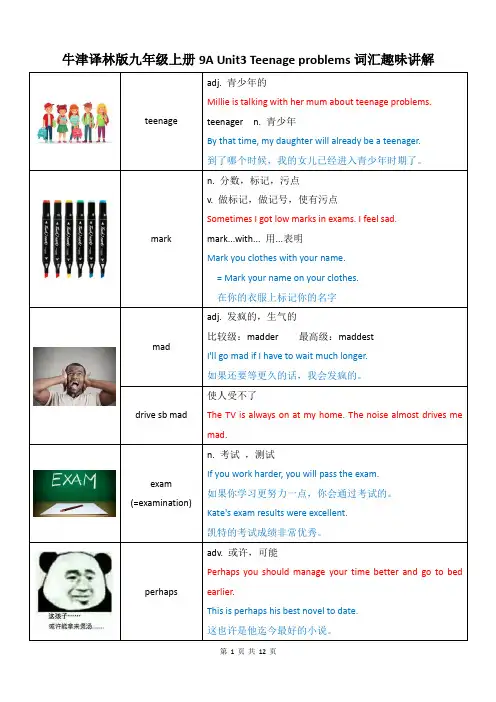
牛津译林版九年级上册9A Unit3 Teenage problems词汇趣味讲解teenage adj. 青少年的Millie is talking with her mum about teenage problems. teenager n. 青少年By that time, my daughter will already be a teenager. 到了哪个时候,我的女儿已经进入青少年时期了。
mark n. 分数,标记,污点v. 做标记,做记号,使有污点Sometimes I got low marks in exams. I feel sad. mark...with... 用...表明Mark you clothes with your name.= Mark your name on your clothes.在你的衣服上标记你的名字mad adj. 发疯的,生气的比较级:madder 最高级:maddest I'll go mad if I have to wait much longer. 如果还要等更久的话,我会发疯的。
drive sb mad 使人受不了The TV is always on at my home. The noise almost drives me mad.exam (=examination) n. 考试,测试If you work harder, you will pass the exam.如果你学习更努力一点,你会通过考试的。
Kate's exam results were excellent.凯特的考试成绩非常优秀。
perhaps adv. 或许,可能Perhaps you should manage your time better and go to bed earlier.This is perhaps his best novel to date.这也许是他迄今最好的小说。
牛津译林版英语九上9A Unit 3 Teenage problems
初中英语学习材料madeofjingetieji9A Unit 3 Teenage problems一、单项选择1.Tom is very strict _________ himself, isn’t he?A. onB. withC. forD. in2. —Can you ________ this problem by yourself?. —Yes.A. Look outB. work outC. come outD. go out3. —It’s impolite to _______ other s’ mistake.. —Yes, you are right.A. smile atB. laugh atC. point atD. look at4. I am feeling _______ about my father’s illness. He is in hospital now.A. proudB. relaxedC. worriedD. crazy5. —_________ taking a tour for the coming holiday ? —Good idea. We’re getting ready for it.A. Why notB. What aboutC. Would you likeD. Shall we6. ---Why was it so quiet in the street last night? --- It was raining, so there were ________ people outside.A. littleB. a littleC. fewD. a few7. —Do you know the boy ______ Bruce over there. —Sure He is my new neighbour.A. callB. to callC. callingD. called8. I miss you very much and please call me as ________ as possible.A. lateB. oftenC. manyD. slowly9. Jim had no choice but _______ in the plum rain(梅雨)season.A. sleepingB. sleepC. to sleepD. to sleeping10. Tom has made _________ progress in his schoolwork.A. muchB. manyC. a lotD. lot of11. _______ the news, there will be a flower show tomorrow.A. Because ofB. As a result ofC. According toD. In some ways12. --- Shall we have a cup of tea? --- ________.A. Good ideaB. Thank youC. That’s OKD. Me too13. His friend find _______ necessary to tell him everything that has happened.A. itB. thatC. whatD. how14. —Many students don’t know how to _______ stress and become worried.—I think they should ask their teachers for help .A. do withB. deal withC. agree withD. come up with15. —What do you think of the poems written by Li Bai ?—I think they are well worth _______ again and again.A. readingB. to readC. to readingD. to be read二、词汇运用。
牛津译林版-英语-九上-9A 3单元 Teenage problems

9A Unit 3 Teenage problems(2)第三单元青少年问题重点难点21.I hope I cam offer you some useful suggestions.我希望我能够提供一些有用的建议给你。
▲offer 用作动词,意为“提供;”“为…提供机会,给予”常用短语“offer sb. sth 或offer sth. For sb.”意思是“为某人提供某物”。
如:①I offered him a glass of wine.我敬了他一杯酒。
①will you offer the guests some coffee?请你给客人拿一些咖啡好吗?②I﹐ve been offered a job in Japan.日本有份工作要聘请我去做。
③The company has offered a high salary.公司提出高薪招聘。
④She offered a reward for the return of her lost bracelet.她为寻回遗失的手镯提出以报酬答谢。
⑤He offered §3,000 for the house.他提出了3000英镑买这间房子。
⑥We offered him the house for $ 20,000.我们要他出20,0000美元买这间房子。
offer to do sth.的意思是“主动提出做某事。
”如:She offered to carry the box for her mother. 她主动提出要帮她母亲拿箱子。
We offered to leave. 我们表示要走了。
He offered to lend me his bike.他表示要把自行车借给我。
Never to teach fish to swim.莫班门弄斧。
He offered to hit me. 他企图打我。
She offered to help me to learn English.她提出要帮助我学习英语。
牛津译林版9AUnit3《teenageproblems》优秀教学案例(共5课时)
2.通过口语表达和小组讨论,培养学生的交际能力,提高学生在实际情境中运用英语进行沟通的能力。
3.通过案例分析和问题解决,培养学生的批判性思维和解决问题的能力。
4.通过写作和分享,培养学生的自我表达和反思能力,提高学生用英语进行写作的能力。
(三)情感态度与价值观
1.引导学生关注自身成长过程中所遇到的问题,培养学生对青少年问题的认识和关注。
五、案例亮点
1.生活化情境的创设:本案例通过引入真实的生活情境,如学习压力、父母关系等,使学生能够更好地理解和应用所学知识。这种情境创设不仅能够激发学生的兴趣,还能够提高学生的实际应用能力,使英语学习更具有现实意义。
2.学生主动探究的学习方式:本案例引导学生提出问题、寻找答案,激发学生的思考和探究欲望。通过问题导向的方式,学生能够主动参与到学习中,培养独立思考和解决问题的能力。
4.选取小组讨论的结果进行分享和讨论,丰富学生的学习经验和视野。
(四)总结归纳
1.通过提问和讨论,引导学生对所学知识进行总结和归纳,巩固学习成果。
2.利用思维导图或概念图,将所学知识点进行整合和展示,帮助学生形成知识体系。
3.强调本节课的重要内容和知识点,提醒学生注意和复习。
4.引导学生进行自我评价和反思,让学生认识到自己的学习成果和不足之处。
3.小组合作的教学策略:本案例通过设计小组讨论和合作任务,让学生在小组内进行交流和合作,共同解决问题。这种教学策略不仅能够培养学生的团队合作意识和沟通能力,还能够促进学生之间的相互学习和共同进步。
牛津译林版英语九上9aunit3teenageproblems---reading
Task6:Summary
Millie She_____________________forherhob hardlyhassparetime Problems bies. staysup do/finish Sheoften________lateto________herex ercises. Causes Butsheacceptsitbecauseshethinksit’sim (原因) portantto_______herhomeworkontime finish . dealwith Shedoesn’tknowhowto________it. bad/stressed/worried Feelings Shefeelsquite____________________a boutit.
TheletterwrittenbySigmund DearMillie: Thankyouverymuchforyourletter.IhopeIcanhelpyou . stayedup Yousaidyouyouoften________latetofinishallyourho mework.Planyourdaycarefully.Makealistofallthe_ homework _________youhave.Thenworkouthowmuchtimey ouneedtofinishitall.Thiswillgiveyouanideaofhowm spare uch_________timeyouhave. Youalsosaidthatyoudonothaveenoughtimeforyour_ _______.Whataboutchoosingyourhobbyaccording hobbies tothetimeyourhave?Forexample,play_________if youhavealotoftime,andlistentomusicifyouonlyash volleyball orttime.Ihopeyouthinkthatmyadviceis______taki ng. worth Bestwishes SigmundFriend
牛津译林版9AUnit3《Teenageproblems》优秀教学案例(共9课时)
3.小组合作:教师组织丰富的小组活动,鼓励学生互相讨论、分享和合作。通过小组合作,学生能够提高团队协作能力,培养创新思维和解决问题的能力。
3.教师讲解西方国家关于青春期问题的相关文化背景,帮助学生更好地理解教材内容。
4.教师结合实例,讲解青春期问题的应对策略,引导学生学会正确面对和处理青春期问题。
(三)学பைடு நூலகம்小组讨论
1.教师将学生分成若干小组,每组选择一个青春期问题,进行深入讨论和分析。
2.教师引导学生从多角度、多层次思考问题,鼓励学生提出自己的观点和看法。
本案例背景旨在为学生提供了一个关于青春期问题的学习平台,通过英语语言的学习,让学生认识到青春期烦恼的存在,并学会如何应对。教材以人性化的语言呈现,注重培养学生的情感态度、价值观和思维能力,使他们在学习过程中获得启示,提高自我认知和解决问题的能力。
在教学过程中,教师需遵循教材结构,合理安排课时,注重培养学生的语言技能、思维品质和学习策略。同时,教师要关注学生的个体差异,充分调动学生的积极性,使他们在课堂活动中积极参与、主动探讨,提高课堂教学效果。
二、教学目标
(一)知识与技能
1.学生能够掌握本课核心词汇和短语,如“teenage problems”、“identity crisis”、“pressure from parents”等,并能够熟练运用这些词汇描述青春期问题。
2.学生能够理解并运用本课所学的句型和语法结构,如一般现在时、现在进行时等,表达自己的观点和感受。
3.学生能够通过听力、阅读和口语活动,提高英语听、说、读、写综合能力,增强英语语言运用能力。
牛津译林版英语九上9AUnit3 Teenage problems
敬请各位同仁批评指正金戈铁骑制作9AUnit3 Teenage problemsTranslations1. 你除了少吃多锻炼,别无选择了。
_____________________________________________________________________ 2. 我发现很难解决这个问题。
_____________________________________________________________________ 3.我希望我的建议值得采纳。
_____________________________________________________________________ 4.父母应该总是对孩子严格要求。
_____________________________________________________________________ 5.我喜欢吃甜食,但又不想长胖。
你能告诉我如何达到吃和体重之间的平衡?_____________________________________________________________________ 6.熬夜对你的健康不利。
_____________________________________________________________________ 7.我想知道他为什么经常呆在外面(不回家)。
_____________________________________________________________________ 8.何不尽可能多地复习你已经学过的内容呢?_____________________________________________________________________ 9.不要理睬那些嘲笑你的同学。
_____________________________________________________________________ 10.中国政府在控制污染上已经取得了很大进步。
牛津译林版九上《Unit 3 Teenage problems》
a. people keep their worries to themselves
b. people relax and take a holiday
c. friends try to help
causes of stress
Part Two Structure How to write a letter? ( Part B on page 58) How many parts are there in the writing plan?
conclusion
Your friend
Millie
小 结
通过这堂课的学习,学会了如何谈论 你在学习和生活中遇到的问题和困难,以 及你自己是如何解决他们的。 请同学们要 记住文章的写作结构,还要记住在文章的 主体部分一定要包含两种信息:产生压力 的原因以及你采取的措施。
Homework
1. Write a letter to your pen friend to tell him/her about the problems you have and how you deal with them. Use the beginning of Millie’s letter in Part C as a model. 2. Do some additional exercises.
Additional exercisபைடு நூலகம்s
一、用所给词的适当形式填空。
1. What will you ______(do) if someone _____ (laugh) at you? 2. Some students don’t have enough time _____ (finish) their homework. 3. They are quarrelling _____(noise) than usual. 4. Some students should give up _____ (play) computer games. 5. You are so nervous now. You should get_____ (relax).