
-2017考研英语二历年真题及答案解析说课材料
2010年考研英语二真题Section I Use of EnglishDirections: Read the following passage. For each numbered blank there are four choices marked A, B, C and D. Choose the best one and mark your answers on ANSWER SHEET l. (10 points) The outbreak of swine flu that was first detected in Mexico was declared a global epidemic on June 11, 2009. It is the first worldwide epidemic__1__ by the World Health Organization in 41 years. The heightened alert__2__an emergency meeting with flu experts in Geneva that convened after a sharp rise in cases in Australia, and rising__3__in Britain, Japan, Chile and elsewhere. But the epidemic is "__4__" in severity, according to Margaret Chan, the organization's director general, __5__ the overwhelming majority of patients experiencing only mild symptoms and a full recovery, often in the __6__ of any medical treatment. The outbreak came to global __7__ in late April 2009, when Mexican authorities noticed an unusually large number of hospitalizations and deaths __8__ healthy adults. As much of Mexico City shut down at the height of a panic, cases began to __9__ in New York City, the southwestern United States and around the world. In the United States, new cases seemed to fade __10__ warmer weather arrived. But in late September 2009, officials reported there was __11__ flu activity in almost every state and that virtually all the__12__ tested are the new swine flu, also known as (A) H1N1, not seasonal flu. In the U.S., it has __13__ more than one million people, and caused more than 600 deaths and more than 6,000 hospitalizations. Federal health officials __14__Tamiflu for children from the national stockpile and began__15__orders from the states for the new swine flu vaccine. The new vaccine, which is different from the annual flu vaccine, is __16__ ahead of expectations. More than three million doses were to be made available in early October 2009, though most of those __17__doses were of the FluMist nasal spray type, which is not__18__for pregnant women, people over 50 or those with breathing difficulties, heart disease or several other __19__. But it was still possible to vaccinate people in other high-risk group: health care workers, people __20__ infants and healthy young people.1 [A] criticized [B] appointed [C]commented [D] designated2 [A] proceeded [B] activated [C] followed [D] prompted3 [A] digits [B] numbers [C] amounts [D] sums4 [A] moderate [B] normal [C] unusual [D] extreme5 [A] with [B] in [C] from [D] by6 [A] progress [B] absence [C] presence [D] favor7 [A] reality [B] phenomenon [C] concept [D] notice8. [A]over [B] for [C] among [D] to9 [A] stay up [B] crop up [C] fill up [D] cover up10 [A] as [B] if [C] unless [D] until11 [A] excessive [B] enormous [C] significant [D]magnificent12 [A]categories [B] examples [C] patterns [D] samples13 [A] imparted [B] immerse [C] injected [D] infected14 [A] released [B] relayed [C] relieved [D] remained 215 [A] placing [B] delivering [C] taking [D] giving16 [A] feasible [B] available [C] reliable [D] applicable17 [A] prevalent [B] principal [C] innovative [D] initial18 [A] presented [B] restricted [C] recommended [D] introduced19 [A] problems [B] issues [C] agonies [D] sufferings20 [A] involved in [B] caring for [C] concerned with [D] warding off SectionSection Ⅱ Reading comprehensionPart ADirections: Read the following four passages. Answer the questions below each passage by choosing A, B ,C and D.Mark your answers on ANSWER SHEET 1.(40 points)Text1The longest bull run in a century of art-market history ended on a dramatic note with a sale of 56 works by Damien Hirst, “Beautiful Inside My Head Forever”, at Sotheby’s in London on September 15th 2008 (see picture). All but two pieces sold, fetching more than ā70m, a record for a sale by a single artist. It was a last hurrah. As the auctioneer called out bids, in New York one of the oldest banks on Wall Street, Lehman Brothers, filed for bankruptcy.The world art market had already been losing momentum for a while after rising vertiginously since 2003. At its peak in 2007 it was worth some $65 billion, reckons Clare McAndrew, founder of Arts Economics, a research firm—double the figure five years earlier. Since then it may have come down to $50 billion. But the market generates interest far beyond its size because it brings together great wealth, enormous egos, greed, passion and controversy in a way matched by few other industries.In the weeks and months that followed Mr Hirst’s sale, spending of any sort became deeply unfashionable, especially in New York, where the bail-out of the banks coincided with the loss of thousands of jobs and the financial demise of many art-buying investors. In the art world that meant collectors stayed away from galleries and salerooms. Sales of contemporary art fell by two-thirds, and in the most overheated sector—for Chinese contemporary art—they were down by nearly 90% in the year to November 2008. Within weeks the world’s two biggest auction houses, Sotheby’s and Christie’s, had to pay out nearly $200m in guarantees to clients who had placed works for sale with them.The current downturn in the art market is the worst since the Japanese stopped buying Impressionists at the end of 1989, a move that started the most serious contraction in the market since the second world war. This time experts reckon that prices are about 40% down on their peak on average, though some have been far more volatile. But Edward Dolman, Christie’s chief executive, says: “I’m pretty confident we’re at the bottom.”What makes this slump different from the last, he says, is that there are still buyers in the market, whereas in the early 1990s, when interest rates were high, there was no demand even though many collectors wanted to sell. Christie’s revenues in the first half of 2009 were still higher than in the firs t half of 2006. Almost everyone who was interviewed for this special report said that the biggest problem at the moment is not a lack of demand but a lack of good work to sell. The three Ds—death, debt and divorce—still deliver works of art to the market. But anyone who does not have to sell is keeping away, waiting for confidence to return.21. In the first paragraph, Damien Hirst's sale was referred to as “a last victory” because ____.A. the art market had witnessed a succession of victoryiesB. the auctioneer finally got the two pieces at the highest bidsC. Beautiful Inside My Head Forever won over all masterpiecesD. it was successfully made just before the world financial crisis22. By saying “spending of any sort became deeply unfashionable”(Line 1-2,Para.3),the author suggeststhat_____ .A. collectors were no longer actively involved in art-market auctionsB. people stopped every kind of spending and stayed away from galleriesC. art collection as a fashion had lost its appeal to a great extentD. works of art in general had gone out of fashion so they were not worth buying23. Which of the following statements is NOT ture?A .Sales of contemporary art fell dramatically from 2007to 2008.B. The art market surpassed many other industries in momentum.C. The market generally went downward in various ways.D. Some art dealers were awaiting better chances to come.24. The three Ds mentioned in the last paragraph are ____A. auction houses ' favoritesB. contemporary trendsC. factors promoting artwork circulationD. styles representing impressionists25. The most appropriate title for this text could be ___A. Fluctuation of Art PricesB. Up-to-date Art AuctionsC. Art Market in DeclineD. Shifted Interest in ArtsText2I was addressing a small gathering in a suburban Virginia living room -- a women's group that had invited men to join them. Throughout the evening one man had been particularly talkative frequently offering ideas and anecdotes while his wife sat silently beside him on the couch. Toward the end of the evening I commented that women frequently complain that their husbands don't talk to them. This man quickly concurred. He gestured toward his wife and said "She's the talker in our family." The room burst into laughter; the man looked puzzled and hurt. "It's true" he explained. "When I come home from work I have nothing to say. If she didn't keep the conversation going we'd spend the whole evening in silence."This episode crystallizes the irony that although American men tend to talk more than women in public situations they often talk less at home. And this pattern is wreaking havoc with marriage.The pattern was observed by political scientist Andrew Hacker in the late '70s. Sociologist Catherine Kohler Riessman reports in her new book "Divorce Talk" that most of the women she interviewed -- but only a few of the men -- gave lack of communication as the reason for their divorces. Given the current divorce rate of nearly 50 percent that amounts to millions of cases in the United States every year -- a virtual epidemic of failed conversation.In my own research complaints from women about their husbands most often focused not on tangible inequities such as having given up the chance for a career to accompany a husband to his or doing far more than their share of daily life-support work like cleaning cooking social arrangements and errands. Instead they focused on communication: "He doesn't listen to me" "He doesn't talk to me." I found as Hacker observed years before that most wives want their husbands to be first and foremost conversational partners but few husbands share this expectation of their wives.In short the image that best represents the current crisis is the stereotypical cartoon scene of a man sitting at the breakfast table with a newspaper held up in front of his face while a woman glares at the back of it wanting to talk.26. What is most wives' main expectation of their husbands?A. Talking to them.B. Trusting them.C. Supporting their careers.D. Shsring housework.27. Judging from t he context ,the phrase “wreaking havoc”(Line 3,Para.2)most probably means ___ .A. generating motivation.B. exerting influenceC. causing damageD. creating pressure28. All of the following are true EXCEPT_______A. men tend to talk more in public tan womenB. nearly 50percent of recent divorces are caused by failed conversationC. women attach much importance to communication between couplesD. a female tends to be more talkative at home than her spouse29. Which of the following can best summarize the mian idea of this text ?A. The moral decaying deserves more research by sociologists .B. Marriage break_up stems from sex inequalities.C. Husband and wofe have different expectations from their marriage.D. Conversational patterns between man and wife are different.30. In the following part immediately after this text,the author will most probably focus on ______A. a vivid account of the new book Divorce TalkB. a detailed description of the stereotypical cartoonC. other possible reasons for a high divorce rate in the U.S.D. a brief introduction to the political scientist Andrew HackerTxet3over the past decade, many companies had perfected the art of creating automatic behaviors —habits —among consumers. These habits have helped companies earn billions of dollars when customers eat snacks, apply lotions and wipe counters almost without thinking, often in response to a carefully designed set of daily cues.“There are fundamental public health problems, like hand washing with soap, that remain killers only because we can’t figure out how to change people’s habits,” Dr. Curtis said. “We wanted to learn from private industry how to create new behaviors that happen automatically.”The companies that Dr. Curtis turned to — Procter & Gamble, Colgate-Palmolive and Unilever —had invested hundreds of millions of dollars finding the subtle cues in consumers’ lives that corporations could use to introduce new routines.If you look hard enough, you’ll find that many of the products we use every day — chewing gums, skin moisturizers, disinfecting wipes, air fresheners, water purifiers, health snacks, antiperspirants, colognes, teeth whiteners, fabric softeners, vitamins —are results of manufactured habits. A century ago, few people regularly brushed their teeth multiple times a day. Today, because of canny advertising and public health campaigns, many Americans habitually give their pearly whites a cavity-preventing scrub twice a day, often with Colgate, Crest or one of the other brands.A few decades ago, many peo ple didn’t drink water outside of a meal. Then beverage companies started bottling the production of far-off springs,and now office workers unthinkingly sip bottled water all day long. Chewing gum, once bought primarily by adolescent boys, is now featured in commercials as a breath freshener and teeth cleanser for use after a meal. Skin moisturizers are advertised as part of morning beauty rituals,slipped in between hair brushing and putting on makeup.“Our products succeed when they become part of daily or weekly patterns,” said Carol Berning, a consumer psychologist who recently retired from Procter & Gamble, the company that sold $76 billion of Tide, Crest and other products last year. “Creating positive habits is a huge part of improving our consumers’ lives, and it’s essential to making new products commercially viable.”Through experiments and observation, social scientists like Dr. Berning have learned that there is power in tying certain behaviors to habitual cues through relentless advertising. As this new science of habit has emerged, controversies have erupted when the tactics have been used to sell questionable beauty creams or unhealthy foods.31. According to Dr.Curtis,habits like hand washing with soap________.[A] should be further cultivated[B] should be changed gradually[C] are deepiy rooted in history[D] are basically private concerns32. Bottled water,chewing gun and skin moisturizers are mentioned in Paragraph 5 so as to____[A] reveal their impact on people’habits[B] show the urgent need of daily necessities[C]indicate their effect on people’buying power[D]manifest the significant role of good habits33. which of the following does NOT belong to products that help create people’s habits?[A]Tide[B]Crest[C]Colgate[D]Unilver34. From the text wekonw that some of consumer’s habits are developed due to _____[A]perfected art of products[B]automatic behavior creation[C]commercial promotions[D]scientific experiments35. the author’sattitude toward the influence of advertisement on people’s habits is____[A]indifferent[B]negative[C]positive[D]biasedText4Many Americans regard the jury system as a concrete expression of crucial democratic values, including the principles that all citizens who meet minimal qualifications of age and literacy are equally competent to serve on juries; that jurors should be selected randomly from a representative cross section of the community; that no citizen should be denied the right to serve on a jury on account of race, religion, sex, or national origin; that defendants are entitled to trial by their peers; and that verdicts should represent the conscience of the community and not just the letter of the law. The jury is also said to be the best surviving example of direct rather than representative democracy. In a direct democracy, citizens take turns governing themselves, rather than electing representatives to govern for them.But as recently as in 1986, jury selection procedures conflicted with these democratic ideals. In some states, for example, jury duty was limited to persons of supposedly superior intelligence, education, and moral character. Although the Supreme Court of the United States had prohibited intentional racial discrimination in jury selection as early as the 1880 case of strauder v. West Virginia,the practice of selecting so-called elite or blue-ribbon juries provided a convenient way around this and other antidiscrimination laws.The system also failed to regularly include women on juries until the mid-20th century. Although women first served on state juries in Utah in 1898,it was not until the 1940s that a majority of states made women eligible for jury duty. Even then several states automatically exempted women from jury duty unless they personlly asked to have their names included on the jury list. This practice was justified by the claim that women were needed at home, and it kept juries unrepresentative of women through the 1960s.In 1968, the Congress of the United States passed the Jury Selection and Service Act, ushering in a new era of democratic reforms for the jury.This law abolished special educational requirements for federal jurors and required them to be selected at random from a cross section of the entire community. In the landmark 1975 decision Taylor v. Louisiana, the Supreme Court extended the requirement that juries be representative of all parts of the community to the state level. The Taylor decision also declared sex discrimination in jury selection to be unconstitutional and ordered states to use the same procedures for selecting male and female jurors.36. From the principles of theUS jury system,welearn that ______[A]both litcrate and illiterate people can serve on juries[B]defendants are immune from trial by their peers[C]no age limit should be imposed for jury service[D]judgment should consider the opinion of the public37. The practice of selecting so—called elite jurors prior to 1968 showed_____[A]the inadcquavy of antidiscrimination laws[B]the prevalent discrimination against certain races[C]the conflicting ideals in jury selection procedures38. Even in the 1960s,women were seldom on the jury list in some states because_____[A]they were automatically banned by state laws[B]they fell far short of the required qualifications[C]they were supposed to perform domestic duties[D]they tended to evade public engagement39. After the Jury Selection and Service Act was passed.___[A]sex discrimination in jury selection was unconstitutional and had to be abolished[B]educational requirements became less rigid in the selection of federal jurors[C]jurors at the state level ought to be representative of the entire community[D]states ought to conform to the federal court in reforming the jury system40. in discussing the US jury system,the text centers on_______[A]its nature and problems[B]its characteristics and tradition[C]its problems and their solutions[D]its tradition and developmentPart BDirections:Read the following text and decide whether each of the statements is true or false. Choose T if the statement is true or F it the statement is not true. Mark your answers on ANSWER SHEET1.(10 points)Copying Birds May Save Aircraft FuelBOTH Boeing and Airbus have trumpeted the efficiency of their newest aircraft, the 787 and A350 respectively. Their clever designs and lightweight composites certainly make a difference. But a group of researchers at Stanford University, led by Ilan Kroo, has suggested that airlines could take a more naturalistic approach to cutting jet-fuel use, and it would not require them to buy new aircraft.The answer, says Dr Kroo, lies with birds. Since 1914, and a seminal paper by a German researcher called Carl Wieselsberger, scientists have known that birds flying in formation—a V-shape, echelon or otherwise—expend less energy. The air flowing over a birds wings curls upwards behind the wingtips, a phenomenon known as up wash. Other birds flying in the up wash experience reduced drag, and spend less energy propelling themselves. Peter Lissaman, an aeronautics expert who was formerly at Caltech and the University of Southern California ,has suggested that a formation of 25 birds might enjoy a range increase of 71%.When applied to aircraft, the principles are not substantially different. Dr Kroo and his team modelled what would happen if three passenger jets departing from Los Angeles, San Francisco and Las Vegas were to rendezvous over Utah, assume an inverted V-formation, occasionally swap places so all could have a turn in the most favourable positions, and proceed to London. They found that the aircraft consumed as much as 15% less fuel (with a concomitant reduction in carbon-dioxide output). Nitrogen-oxide emissions during the cruising portions of the flight fell by around a quarter.There are, of course, kinks to be worked out. One consideration is safety, or at least the perception of it. Would passengers feel comfortable travelling in convoy? Dr Kroo points out that the aircraft could be separated by several nautical miles, and would not be in the unnervingly cosy groupings favoured by display teams like the Red Arrows. A passenger peering out of the window might not even see the other planes. Whether the separation distances involved would satisfy air-traffic-control regulations is another matter, although a working group at the International Civil Aviation. Organisation has included the possibility of formation flying in a blueprint for new operational guidelines.It remains to be seen how weather conditions affect the air flows that make formation flight more effi cient. In zones of increased turbulence, the planes’ wakes will decay more quickly and the effect will diminish. Dr Kroo says this is one of the areas his team will investigate further. It might also be hard for airlines to co-ordinate the departure times and destinations of passenger aircraft in a way that would allow them to gain from formation flight. Cargo aircraft, in contrast, might be easier to reschedule, as might routine military flights.As it happens, America’s armed forces are on the case already. Earlier this year the country’s Defence Advanced Research Projects Agency announced plans to pay Boeing to investigate formation flight, though the programme has yet to begin. There are reports that some military aircraft flew in formation when they were low on fuel during the second world war, but Dr Lissaman says they are apocryphal. “My father was an RAF pilot and my cousin the skipper of a Lancaster lost over Berlin,” he adds. So he should know.41. Findings of the Stanford University researchers will promote the sales of new Boeing and Airbus aircraft.42. The upwash experience may save propelling energy as well as reducing resistance.43.Formation flight is more comfortable because passengers can not see the other planes.44. The role that weather plays in formation flight has not yet been clearly defined.45. It has been documented that during World War II, America’s armed forces once tried formation flight to save fuel.Section Ⅲ Translation46.Directions: In this section there is a text in English .Translate it into Chinese. Write your translation on ANSWER SHEET2.(15points)“Suatainability” has become a popular word these days, but to Ted Ning, the concept will always have personal meaning. Having endured a painful period of unsustainability in his own life made it clear to him that sustainability-oriented values must be expressed though everyday action and choice.Ning recalls spending a confusing year in the late 1990s selling insurance. He’d been though the dot-com boom and burst and, desperate for a job, signed on with a Boulder agency.It didn’t go well. “It was a really had move because that’s not my passion,” says Ning, whose dilemma about the job translated, predictably, into a lack of sales. “I was miserable, I had so much anxiety that I would wake up in the middle of the night and stare at the ceiling. I had no money and needed the job. Everyone said, ‘Just wait, you’ll trun the corner, give it some time.’”Section ⅣWritingPart A47.Directions: You have just come back from the U.S. as a member of a Sino-American cultural exchange program. Write a letter to your American colleague to1)Express your thanks for his/her warm reception;2) Welcome him/her to visit China in due course.You should write about 100 words on ANSWER SHEET 2.Do not sign your own name at the end of the letter. Use “Zhang Wei” instead.Do not write your address. (10 points)Part B48. Directions: In this section, you are asked to write an essay based on the following chart. In your writing, you should1) Interpret the chart and2)Give your comments.You should write at least 150 words.Write your essay on on ANSWER SHEET 2. (15 points)2010年考研英语二答案Section I USE of English1 [D]2 [C]3 [B]4 [A]5 [A]6 [B]7 [D]8 [C]9 [B] 10 [A]11[C] 12 [D] 13 [D] 14 [A] 15 [C] 16 [B] 17 [D] 18 [C] 19 [A] 20 [B]Section II Reading Comprehension21 D选【D】,因为第一段段尾句As the auctioneer called out bids, in New York one of the oldest banks on Wall Street, Lehman Brothers, filed for bankruptcy. 即雷曼兄弟公司破产。
2017年全国硕士研究生入学统一考试英语(二)试题答案详解 .doc

2017年全国硕士研究生入学统一考试英语(二)试题答案详解(完整版)注意:英语试卷为花卷,以答案内容进行核对万学海文教研中心英语教研室Section I Use of English1、【答案】[C] warning【解析】此处考察词义辨析。
首句说:人们几个世纪以来一直在思索没有工作的未来。
该句含义为:现在也是如此,学者们再次_______技术正在取代人类劳动。
从句为负向,故首先排除boasting吹嘘,ensuring确保。
Denying否认与首句中心句相冲突,故答案为Warning警告,语义逻辑通顺。
2、【答案】[A] inequality【解析】此处考察词义辨析。
该句含义为:“一些人认为即将来临的不用工作的世界通过______来定义。
少数的富人拥有所有的财富,而大多数人则在一片贫穷的荒芜之地中挣扎着生存。
”后一句话为对前一句的解释,所以这是一个不平等的世界,选inequality。
3、【答案】[D] prediction【解析】此处考察词义辨析。
该句含义为:一个不同的,而并不相互排斥的_______认为未来将成为一面不同类别的荒芜之地。
此处,prediction(语言)呼应了文中future (未来),为最佳选项,且代入原文语义通顺。
Policy政策,guideline指导方针,resolution 决心,在此处都不符合题意。
4、【答案】[A] characterized【解析】此处考察词义辨析。
前文说一种与众不同的荒芜之地,one为同位语补充说明荒地特征。
该句含义为:未来将成为一面不同类别的荒芜之地,一个以漫无目的性________的荒芜之地。
Be characterized by以……为特征,此处purposelessness(漫无目的)的确是一种特征,故该选项为正确答案。
Divide分割,measure测量,balance 平衡,均语义不通。
5、【答案】[B] meaning【解析】此处考察词义辨析及词义复现。
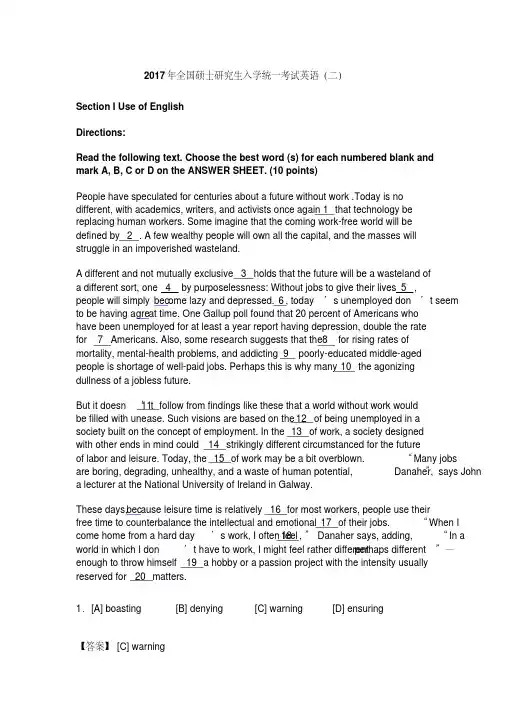
2017年考研英语(二)真题与解析

2017年考研英语(二)真题与解析作者:凯程陆老师,有问题找我SectionI Use of EnglishDirections:Read the following text.Choose the best word(s)for each numbered blank and mark A,B,C or D on the ANSWER SHEET.(10points)People have speculated for centuries about a future without work.Today is no different,with academics,writers,and activists once again1that technology be replacing human workers.Some imagine that the coming work-free world will be defined by2.A few wealthy people will own all the capital,and the masses will struggle in an impoverished wasteland.A different and not mutually exclusive3holds that the future will be a wasteland of a different sort, one4by purposelessness:Without jobs to give their lives5,people will simply become lazy and depressed.6,today’s unemployed don’t seem to be havinga great time.One Gallup poll found that20percent of Americans who have been unemployed for at least a year report having depression,double the rate for7Americans.Also,some research suggests that the8for rising rates of mortality,mental-health problems,and addicting9poorly-educated middle-aged people is shortage of well-paid jobs.Perhaps this is why many10the agonizing dullness of a jobless future. But it doesn’t11follow from findings like these that a world without work would be filled with unease.Such visions are based on the12of being unemployed in a society built on the concept of employment.In the13of work,a society designed with other ends in mind could14strikingly different circumstanced for the future of labor and leisure.Today,the15of work may be a bit overblown.“Many jobs are boring,degrading,unhealthy,and a waste of human potential,”says John Danaher,a lecturer at the National University of Ireland in Galway.These days,because leisure time is relatively16for most workers,people use their free time to counterbalance the intellectual and emotional17of their jobs.“When I come home from a hard day’s work,I often feel18,”Danaher says,adding,“In a world in which I don’t have to work, I might feel rather different”—perhaps different enough to throw himself19a hobby or a passion project with the intensity usually reserved for20matters.1.[A]boasting[B]denying[C]warning[D]ensuring【答案】[C]warning2.[A]inequality[B]instability[C]unreliability[D]uncertainty3.[A]policy[B]guideline[C]resolution[D]prediction【答案】[D]prediction4.[A]characterized[B]divided[C]balanced[D]measured【答案】[A]characterized5.[A]wisdom[B]meaning[C]glory[D]freedom【答案】[B]meaning6.[A]Instead[B]Indeed[C]Thus[D]Nevertheless【答案】[B]Indeed7.[A]rich[B]urban[C]working[D]educated【答案】[C]working8.[A]explanation[B]requirement[C]compensation[D]substitute 【答案】[A]explanation9.[A]under[B]beyond[C]alongside[D]among【答案】[D]among10.[A]leave behind[B]make up[C]worry about[D]set aside【答案】[C]worry about11.[A]statistically[B]occasionally[C]necessarily[D]economically 【答案】[C]necessarily12.[A]chances[B]downsides[C]benefits[D]principles【答案】[B]downsides13.[A]absence[B]height[C]face[D]course14.[A]disturb[B]restore[C]exclude[D]yield【答案】[D]yield15.[A]model[B]practice[C]virtue[D]hardship【答案】[C]virtue16.[A]tricky[B]lengthy[C]mysterious[D]scarce【答案】[D]scarce17.[A]demands[B]standards[C]qualities[D]threats【答案】[A]demands18.[A]ignored[B]tired[C]confused[D]starved【答案】[B]tired19.[A]off[B]against[C]behind[D]into【答案】[D]into20.[A]technological[B]professional[C]educational[D]interpersonal【答案】[B]professionalSectionIIReading ComprehensionPart ADirections:Read the following four texts.Answer the questions below each text by choosing A,B,C or D. Mark your answers on the ANSWER SHEET.(40points)Text1Every Saturday morning,at9am,more than50,000runners set off to run5km around their local park.The Parkrun phenomenon began with a dozen friends and has inspired400events in the UK and more abroad.Events are free,staffed by thousands of volunteers.Runners range from fouryears old to grandparents;their times range from Andrew Baddeley’s world record13minutes48 seconds up to an hour.Parkrun is succeeding where London’s Olympic“legacy”is failing.Ten years ago on Monday, it was announced that the Games of the30th Olympiad would be in London.Planning documents pledged that the great legacy of the Games would be to level a nation of sport lovers away from their couches.The population would be fitter,healthier and produce more winners.It has not happened.The number of adults doing weekly sport did rise,by nearly2million in the run—up to 2012—but the general population was growing faster.Worse,the numbers are now falling at an accelerating rate.The opposition claims primary school pupils doing at least two hours of sport a week have nearly halved.Obesity has risen among adults and children.Official retrospections continue as to why London2012failed to“inspire a generation.”The success of Parkrun offers answers.Parkun is not a race but a time trial:Your only competitor is the clock.The ethos welcomes anybody.There is as much joy over a puffed-out first-timer being clapped over the line as there is about top talent shining.The Olympic bidders,by contrast,wanted to get more people doing sports and to produce more elite athletes.The dual aim was mixed up:The stress on success over taking part was intimidating for newcomers.Indeed,there is something a little absurd in the state getting involved in the planning of such a fundamentally“grassroots”,concept as community sports associations.If there is a role for government,it should really be getting involved in providing common goods—making sure there is space for playing fields and the money to pave tennis and netball courts,and encouraging the provision of all these activities in schools.But successive governments have presided over selling green spaces,squeezing money from local authorities and declining attention on sport in education. Instead of wordy,worthy strategies,future governments need to do more to provide the conditions for sport to thrive.Or at least not make them worse.21.According to Paragraph1,Parkrun has.[A]gained great popularity[B]created many jobs[C]strengthened community ties[D]become an official festival【答案】[A]gained great popularity22.The author believes that London’s Olympic“legacy”has failed to.[A]boost population growth[B]promote sport participation[C]improve the city’s image[D]increase sport hours in schools【答案】[B]promote sport participation23.Parkrun is different from Olympic games in that it.[A]aims at discovering talents[B]focuses on mass competition[C]does not emphasize elitism[D]does not attract first-timers【答案】[C]does not emphasize elitism24.With regard to mass sport,the author holds that governments should.[A]organize“grassroots”sports events[B]supervise local sports associations[C]increase funds for sports clubs[D]invest in public sports facilities【答案】[D]invest in public sports facilities25.The author’s attitude to what UK governments have done for sports is.[A]tolerant[B]critical[C]uncertain[D]sympathetic【答案】[B]criticalText2With so much focus on children’s use of screens,it’s easy for parents to forget about their own screen use.“Tech is designed to really suck on you in,”says Jenny Radesky in her study of digital play,“and digital products are there to promote maximal engagement.It makes it hard to disengage,and leads to a lot of bleed-over into the family routine.”Radesky has studied the use of mobile phones and tablets at mealtimes by giving mother-child pairs a food-testing exercise.She found that mothers who sued devices during the exercise started 20percent fewer verbal and39percent fewer nonverbal interactions with their children.During a separate observation,she saw that phones became a source of tension in the family.Parents would be looking at their emails while the children would be making excited bids for their attention. Infants are wired to look at parents’faces to try to understand their world,and if those faces are blank and unresponsive—as they often are when absorbed in a device—it can be extremely disconcerting foe the children.Radesky cites the“still face experiment”devised by developmental psychologist Ed Tronick in the1970s.In it,a mother is asked to interact with her child in a normal way before putting on a blank expression and not giving them any visual social feedback;The child becomes increasingly distressed as she tries to capture her mother’s attention.“Parents don’t have to be exquisitely parents at all times,but there needs to be a balance and parents need to be responsive and sensitive to a child’s verbal or nonverbal expressions of an emotional need,”says Radesky.On the other hand,Tronick himself is concerned that the worries about kids’use of screens are born out of an“oppressive ideology that demands that parents should always be interacting”with their children:“It’s based on a somewhat fantasized,very white,very upper-middle-class ideology that says if you’re failing to expose your child to30,000words you are neglecting them.”Tronick believes that just because a child isn’t learning from the screen doesn’t mean there’s no value to it—particularly if it gives parents time to have a shower,do housework or simply have a break from their child.Parents,he says,can get a lot out of using their devices to speak to a friend or get some work out of the way.This can make them feel happier,which lets then be more available to their child the rest of the time.26.According to Jenny Radesky,digital products are designed to______.[A]simplify routine matters[B]absorb user attention[C]better interpersonal relations[D]increase work efficiency【答案】[B]absorb user attention27.Radesky’s food-testing exercise shows that mothers’use of devices______.[A]takes away babies’appetite[B]distracts children’s attention[C]slows down babies’verbal development[D]reduces mother-child communication【答案】[D]reduces mother-child communication28.Radesky’s cites the“still face experiment”to show that_______.[A]it is easy for children to get used to blank expressions[B]verbal expressions are unnecessary for emotional exchange[C]children are insensitive to changes in their parents’mood[D]parents need to respond to children’s emotional needs【答案】[D]parents need to respond to children’s emotional needs29.The oppressive ideology mentioned by Tronick requires parents to_______.[A]protect kids from exposure to wild fantasies[B]teach their kids at least30,000words a year[C]ensure constant interaction with their children[D]remain concerned about kid’s use of screens【答案】[C]ensure constant interaction with their children30.According to Tronick,kid’s use of screens may_______.[A]give their parents some free time[B]make their parents more creative[C]help them with their homework[D]help them become more attentive【答案】[A]give their parents some free timeText3Today,widespread social pressure to immediately go to college in conjunction with increasingly high expectations in a fast-moving world often causes students to completely overlook the possibility of taking a gap year.After all,if everyone you know is going to college in the fall,it seems silly to stay back a year,doesn’t it?And after going to school for12years,it doesn’t feel natural to spend a year doing something that isn’t academic.But while this may be true,it’s not a good enough reason to condemn gap years.There’s always a constant fear of falling behind everyone else on the socially perpetuated“race to the finish line,”whether that be toward graduate school,medical school or lucrative career.But despite common misconceptions,a gap year does not hinder the success of academic pursuits—in fact,it probably enhances it.Studies from the United States and Australia show that students who take a gap year are generally better prepared for and perform better in college than those who do not.Rather than pulling students back,a gap year pushes them ahead by preparing them for independence,new responsibilities and environmental changes—all things that first-year students often struggle with the most.Gap year experiences can lessen the blow when it comes to adjusting to college and being thrown into a brand new environment,making it easier to focus on academics and activities rather than acclimationblunders.If you’re not convinced of the inherent value in taking a year off to explore interests,then consider its financial impact on future academic choices.According to the National Center for Education Statistics,nearly80percent of college students end up changing their majors at least once.This isn’t surprising,considering the basic mandatory high school curriculum leaves students with a poor understanding of themselves listing one major on their college applications, but switching to another after taking college classes.It’s not necessarily a bad thing,but depending on the school,it can be costly to make up credits after switching too late in the game. At Boston College,for example,you would have to complete an extra year were you to switch to the nursing school from another department.Taking a gap year to figure things out initially can help prevent stress and save money later on.31.One of the reasons for high-school graduates not taking a gap year is that.[A]they think it academically misleading[B]they have a lot of fun to expect in college[C]it feels strange to do differently from others[D]it seems worthless to take off-campus courses【答案】[C]it feels strange to do differently from others32.Studies from the US and Australia imply that taking a gap year helps.[A]keep students from being unrealistic[B]lower risks in choosing careers[C]ease freshmen’s financial burdens[D]relieve freshmen of pressures【答案】[D]relieve freshmen of pressures33.The word“acclimation”(Line8,Para.3)is closest in meaning to.[A]adaptation[B]application[C]motivation[D]competition【答案】[A]adaptation34.A gap year may save money for students by helping them.[A]avoid academic failures[B]establish long-term goals[C]switch to another college[D]decide on the right major【答案】[D]decide on the right major35.The most suitable title for this text would be.[A]In Favor of the Gap Year[B]The ABCs of the Gap Year[C]The Gap Year Comes Back[D]The Gap Year:A Dilemma【答案】[A]In Favor of the Gap YearText4Though often viewed as a problem for western states,the growing frequency of wildfires is a national concern because of its impact on federal tax dollars,says Professor Max Moritz,a specialist in fire ecology and management.In2015,the US Forest Service for the first time spent more than half of its$5.5billion annual budget fighting fires—nearly double the percentage it spent on such efforts20years ago.In effect, fewer federal funds today are going towards the agency’s other work—such as forest conservation, watershed and cultural resources management,and infrastructure upkeep—that affect the lives of all Americans.Another nationwide concern is whether public funds from other agencies are going into construction in fire-prone districts.As Moritz puts it,how often are federal dollars building homes that are likely to be lost to a wildfire?“It’s already a huge problem from a public expenditure perspective for the whole country,”he says.”We need to take a magnifying glass to that.Like,“Wait a minute,is this OK?”“Do we want instead to redirect those funds to concentrate on lower-hazard parts of the landscape?”Such a view would require a corresponding shift in the way US society today views fire, researchers say.For one thing,conversations about wildfires need to be more inclusive.Over the past decade,the focus has been on climate change—how the warming of the Earth from greenhouse gases is leading to conditions that worsen fires.While climate is a key element,Moritz says,it shouldn’t come at the expense of the rest of the equation.“The human systems and the landscapes we live on are linked,and the interactions go both ways,”he says.Failing to recognize that,he notes,leads to“an overly simplified view of what the solutions might be.Our perception of the problem and of what the solution is becomes verylimited.”At the same time,people continue to treat fire as an event that needs to be wholly controlled and unleashed only out of necessity,says Professor Balch at the University of Colorado.But acknowledging fire’s inevitable presence in human life is an attitude crucial to developing the laws,policies,and practices that make it as safe as possible,she says.“We’ve disconnected ourselves from living with fire,”Balch says.“It is really important to understand and try and tease out what is the human connection with fire today.”36.More frequent wildfires have become a national concern because in2015they.[A]exhausted unprecedented management efforts[B]consumed a record-high percentage of budget[C]severely damaged the ecology of western states[D]caused a huge rise of infrastructure expenditure【答案】[B]consumed a record-high percentage of budget37.Moritz calls for the use of“a magnifying glass”to.[A]raise more funds for fire-prone areas[B]avoid the redirection of federal money[C]find wildfire-free parts of the landscape[D]guarantee safer spending of public funds【答案】[D]guarantee safer spending of public funds38.While admitting that climate is a key element,Moritz notes that.[A]public debates have not settled yet[B]fire-fighting conditions are improving[C]other factors should not be overlooked[D]a shift in the view of fire has taken place【答案】[C]other factors should not be overlooked39.The overly simplified view Moritz mentions is a result of failing to.[A]discover the fundamental makeup of nature[B]explore the mechanism of the human systems[C]maximize the role of landscape in human life[D]understand the interrelations of man and nature【答案】[D]understand the interrelations of man and nature40.Professor Balch points out that fire is something man should.[A]do away with[B]come to terms with[C]pay a price for[D]keep away from【答案】[B]come to terms withPart BDirections:Read the following text and match each of the numbered items in the left column to its corresponding information in the right column.There are two extra choices in the right column. Mark your answers on the ANSWER SHEET.(10points)The decline in American manufacturing is a common refrain,particularly from Donald Trump.“We don’t make anything anymore,”he told Fox News,while defending his own made-in-Mexico clothing line.Without question,manufacturing has taken a significant hit during recent decades,and further trade deals raise questions about whether new shocks could hit manufacturing.But there is also a different way to look at the data.Across the country,factory owners are now grappling with a new challenge:instead of having toomany workers,they may end up with too few.Despite trade competition and outsourcing, American manufacturing still needs to replace tens of thousands of retiring boomers every years. Millennials may not be that interested in taking their place,other industries are recruiting them with similar or better pay.For factory owners,it all adds up to stiff competition for workers—and upward pressure on wages.“They’re harder to find and they have job offers,”says Jay Dunwell,president of Wolverine Coil Spring,a family-owned firm,“They may be coming[into the workforce],but they’ve been plucked by other industries that are also doing an well as manufacturing,”Mr.Dunwell has begun bringing high school juniors to the factory so they can get exposed to its culture.At RoMan Manufacturing,a maker of electrical transformers and welding equipment that his father cofounded in1980,Robert Roth keep a close eye on the age of his nearly200workers,five are retiring this year.Mr.Roth has three community-college students enrolled in a work-placement program,with a starting wage of$13an hour that rises to$17after two years.At a worktable inside the transformer plant,young Jason Stenquist looks flustered by the copper coils he’s trying to assemble and the arrival of two visitors.It’s his first week on the job.Asked about his choice of career,he says at high school he considered medical school before switching to electrical engineering.“I love working with tools.I love creating.”he says.But to win over these young workers,manufacturers have to clear another major hurdle:parents, who lived through the worst US economic downturn since the Great Depression,telling them to avoid the lennials“remember their father and mother both were laid off.They blame it on the manufacturing recession,”says Birgit Klohs,chief executive of The Right Place,a business development agency for western Michigan.These concerns aren’t misplaced:Employment in manufacturing has fallen from17million in 1970to12million in2013.When the recovery began,worker shortages first appeared in the high-skilled trades.Now shortages are appearing at the mid-skill levels.“The gap is between the jobs that take to skills and those that require a lot of skill,”says Rob Spohr,a business professor at Montcalm Community College.“There’re enough people to fill the jobs at McDonalds and other places where you don’t need to have much skill.It’s that gap in between,and that’s where the problem is.”Julie Parks of Grand Rapids Community points to another key to luring Millennials into manufacturing:a work/life balance.While their parents were content to work long hours,young people value flexibility.“Overtime is not attractive to this generation.They really want to live their lives,”she says.【答案】41[E]says that for factory owners,workers are harder to find because of stiff competition.42[A]says that he switched to electrical engineering because he loves working with tools.43[G]says that the manufacturing recession is to blame for the lay-off the young people’s parents.44[B]points out that there are enough people to fill the jobs that don’t need much skill45[F]points out that a work/life balance can attract young people into manufacturingSection IIITranslation46.Directions:Translate the following text into Chinese.Write your translation neatly on the ANSWER SHEET.(15points)My dream has always been to work somewhere in an area between fashion and publishing.Two years before graduating from secondary school,I took a sewing and design course thinking that I would move on to a fashion design course.However,during that course I realized I was not good enough in this area to compete with other creative personalities in the future,so I decided that it was not the right path for me.Before applying for university I told everyone that I would study journalism,because writing was,and still is,one of my favourite activities.But,to be honest,I said it,because I thought that fashion and me together was just a dream—I knew that no one could imagine me in the fashion industry at all!So I decided to look for some fashion-related courses that included writing.This is when I noticed the course“Fashion Media&Promotion.”【参考译文】我一直梦想着能找到一个结合时尚与出版的工作。
考研真题【答案解析】2017年考研英语二真题答案及解析

2017年考研英语二真题答案解析Section I Use of English一、文章总体分析及结构这是一篇议论文,选自2016年《大西洋月刊》,全文共352词。
文章围绕“没有了工作的未来会怎样”展开,首先说明工作的缺失可能会造成社会的不平等;接着指出另一种可能性,即没有了工作,生活就会没有意义;之后笔锋一转,提出在一个设计合理的社会中,没有工作未必会引起不安;最后举例对现实情况做出说明,指出现阶段工作劳累,使人们无暇专注与自己的爱好。
二、语篇精读People have speculated for centuries about a future without work.Today is no different,with academics,writers,and activists once again1that technology is replacing human workers.Some imagine that the coming work-free world will be defined by2.:A few wealthy people will own all the capital,and the masses will struggle in an impoverished wasteland.若干世纪以来,人们都在设想不用工作的未来。
如今也仍然如此,许多学术界人士、作家和激进分子再次警告说技术会代替工人。
一些人猜想,不工作的世界可以用“不平等”这个词来定义:一部分富人将拥有全部资本,而普通大众将在贫穷的荒原上挣扎。
词汇详解:speculate猜测,推测;投机the masses普通百姓academic学者impoverished贫困的be defined by...被···定义wasteland荒原;荒地长难句分析:Today is no different,with academics,writers,and activists once again warning that technology is replacing human workers.本句主干是主系结构Today is no different,with引导的成分属于独立主格结构,具体来讲是with+名词/代词+动词的-ing形式。
2017年考研英语二真题和解析详细

WORD格式可编辑2016考研英语二真题及详细解析Section 1 Use of EnglishDirections: Read the following text. Choose the best word(s) for each numbered blank and mark [A], [B], [C] or [D] on ANSWER SHEET 1. (10 points)Happy people work differently. They’re more productive, more cre ative, and willing to take greater risks. And new research suggests that happiness might influence__1__firm’s work, too.Companies located in places with happier people invest more, according to a recent research paper.__2__, firms in happy places spend more on R&D (research and development). That’s because happiness is linked to the kind of longer-term thinking__3__for making investments for the future.The researchers wanted to know if the__4__and inclination for risk-taking that come with happiness would__5__the way companies invested. So they compared U.S. cities’ average happiness__6__by Gallup polling with the investment activity of publicly traded firms in those areas.__7__enough, firms’ investment and R&D intensity were correlated with the happiness of the area in which they were__8__.But is it really happiness that’s linked to investment, or could something else about happier cities__9__why firms there spend more on R&D? To find out, the researchers controlled for various__10__that might make firms more likely to invest – like size, industry, and sales – and for indicators that a place was__11__to live in, like growth in wages or population. The link between happiness and investment generally__12__even after accounting for these things.The correlation between happiness and investment was particularly strong for younger firms, which the authors__13__to “less codified decision making process”and the possible presence of “younger and less__14__managers who are more likely to be influenced by sentiment.” The relationship was__15__stronger in places where happiness was spread more__16__.Firms seem to invest more in places where most people are relatively happy, rather than in places with happiness inequality.__17__ this doesn’t prove that hap piness causes firms to invest more or to take a longer-term view, the authors believe it at least__18__at that possibility. It’s not hard to imagine that local culture and sentiment would help__19__how executives think about the future. “It surely seems pl ausible that happy people would be more forward-thinking and creative and__20__R&D more than the average,” said one researcher.1. [A] why [B] where [C] how [D] when2. [A] In return [B] In particular [C] In contrast [D] In conclusion3. [A] sufficient [B] famous [C] perfect [D] necessary4. [A] individualism [B] modernism [C] optimism [D] realism5. [A] echo [B] miss [C] spoil [D] change6. [A] imagined [B] measured [C] invented [D] assumed7. [A] Sure [B] Odd [C] Unfortunate [D] Often8. [A] advertised [B] divided [C] overtaxed [D] headquartered9. [A] explain [B] overstate [C] summarize [D] emphasize10. [A] stages [B] factors [C] levels [D] methods11. [A] desirable [B] sociable [C] reputable [D]reliable12. [A] resumed [B] held [C]emerged [D] broke13. [A] attribute [B] assign [C] transfer [D]compare14. [A] serious [B] civilized [C] ambitious [D]experienced15. [A] thus [B] instead [C] also [D] never16. [A] rapidly [B] regularly [C] directly [D] equally17. [A] After [B] Until [C] While [D] Since18. [A] arrives [B] jumps [C] hints [D] strikes19. [A] shape [B] rediscover [C] simplify [D] share20. [A] pray for [B] lean towards [C] give away [D] send out1. [标准答案] [C]how[考点分析] 连词辨析[选项分析] 根据语境,“新发现表明:快乐可能会影响工作__的稳定。
2017全国考研英语二真题和答案解析.doc
2017年全国硕士研究生入学统一考试英语(二)Section I Use of EnglishDirections:Read the following text. Choose the best word (s) for each numbered blank andmark A, B, C or D on the ANSWER SHEET. (10 points)People have speculated for centuries about a future without work .Today is nodifferent, with academics, writers, and activists once again 1 that technology bereplacing human workers. Some imagine that the coming work-free world will bedefined by 2 . A few wealthy people will own all the capital, and the masses willstruggle in an impoverished wasteland.A different and not mutually exclusive 3 holds that the future will be a wasteland ofa different sort, one 4 by purposelessness: Without jobs to give their lives 5 ,people will simply become lazy and depressed. 6 , today’s unemployed don’t seemto be having a g reat time. One Gallup poll found that 20 percent of Americans whohave been unemployed for at least a year report having depression, double the ratefor 7 Americans. Also, some research suggests that the 8 for rising rates ofmortality, mental-health problems, and addicting 9 poorly-educated middle-agedpeople is shortage of well-paid jobs. Perhaps this is why many 10 the agonizingdullness of a jobless future.But it doesn’t11 follow from findings like these that a world without work wouldbe filled with unease. Such visions are based on the 12 of being unemployed in asociety built on the concept of employment. In the 13 of work, a society designedwith other ends in mind could 14 strikingly different circumstanced for the futureof labor and leisure. Today, the 15 of work may be a bit overblown. “Many jobsDanaher,are boring, degrading, unhealthy, and a waste of human potential,” says John a lecturer at the National University of Ireland in Galway.These days, because leisure time is relatively 16 for most workers, people use theirfree time to counterbalance the intellectual and emotional 17 of their jobs. “When I18 ,” Danaher says, adding, “In a come home from a hard day’s work, I often feelperhaps differentworld in which I don’t have to work, I might feel rather different”—enough to throw himself 19 a hobby or a passion project with the intensity usuallyreserved for 20 matters.1.[A] boasting [B] denying [C] warning [D] ensuring【答案】[C] warning2.[A] inequality [B] instability [C] unreliability [D] uncertainty 【答案】[A] inequality3.[A] policy [B]guideline [C] resolution [D] prediction【答案】[D] prediction4.[A] characterized [B]divided [C] balanced [D]measured【答案】[A] characterized5.[A] wisdom [B] meaning [C] glory [D] freedom【答案】[B] meaning6.[A] Instead [B] Indeed [C] Thus [D] Nevertheless 【答案】[B] Indeed7.[A] rich [B] urban [C]working [D] educated【答案】[C] working8.[A] explanation [B] requirement [C] compensation [D] substitute 【答案】[A] explanation9.[A] under [B] beyond [C] alongside [D] among【答案】[D] among10.[A] leave behind [B] make up [C] worry about [D] set aside 【答案】[C] worry about11.[A] statistically [B] occasionally [C] necessarily [D] economically【答案】[C] necessarily12.[A] chances [B] downsides [C] benefits [D] principles 【答案】[B] downsides13.[A] absence [B] height [C] face [D] course【答案】[A] absence14.[A] disturb [B] restore [C] exclude [D] yield【答案】[D] yield15.[A] model [B] practice [C] virtue [D] hardship【答案】[C] virtue16.[A] tricky [B] lengthy [C] mysterious [D] scarce 【答案】[D] scarce17.[A] demands [B] standards [C] qualities [D] threats【答案】[A] demands18.[A] ignored [B] tired [C] confused [D] starved【答案】[B] tired19.[A] off [B] against [C] behind [D] into【答案】[D] into20.[A] technological [B] professional [C] educational [D]interpersonal【答案】[B] professionalSectionII Reading ComprehensionPart ADirections:Read the following four texts. Answer the questions below each text by choosing A, B,C or D. Mark your answers on the A NSWER SHEET. (40 points)Text 1Every Sat urday morning, at 9 am, more than 50,000 runners set off to run 5km aroundtheir local park. The Parkrun phenomenon began with a dozen friends and hasinspired 400 events in the UK and more abroad. Events are free, staffed by thousandsof volunteers. Runners range from four years old to grandparents; their times rangefrom Andrew Baddeley’s world record 13 minutes 48 seconds up to an hour.Parkrun is succeeding where London’s Olympic “legacy” is failing. Ten years ago on Monday, it was announced that the Games of the 30th Olympiad would be in London.Planning documents pledged that the great legacy of the Games would be to level anation of sport lovers away from their couches. The population would be fitter,healthier and produce more winners. It has not happened. The number of adults doingweekly sport did rise, by nearly 2 million in the run—up to 2012—but the generalpopulation was growing faster. Worse, the numbers are now falling at an acceleratingrate. The opposition claims primary school pupils doing at least two hours of sport aweek have nearly halved. Obesity has risen among adults and children. Officialretrospections continue as to why Lon don 2012 failed to “inspire a generation.” The success of Parkrun offers answers.Parkun is not a race but a time trial: Your only competitor is the clock. The ethoswelcomes anybody. There is as much joy over a puffed-out first-timer being clappedover the line as there is about top talent shining. The Olympic bidders, by contrast,wanted to get more people doing sports and to produce more elite athletes. The dualaim was mixed up: The stress on success over taking part was intimidating fornewcomers.Indeed, there is something a little absurd in the state getting involved in the planningof such a fundamentally “grassroots”, concept as community sports associations. If there is a role for government, it should really be getting involved in providingcommon goods—making sure there is space for playing fields and the money to pavetennis and netball courts, and encouraging the provision of all these activities ingreen spaces,schools. But successive governments have presided over sellingsqueezing money from local authorities and declining attention on sport in education.Instead of wordy, worthy strategies, future governments need to do more to providethe conditions for sport to thrive. Or at least not make them worse.21. According to Paragraph1, Parkrun has .[A] gained great popularity[B] created many jobs[C] strengthened community ties[D] become an official festival【答案】[A] gained great popularity.22. The author believes that London’s Olympic“legacy” has failed to[A] boost population growth[B] promote sport participation[C] improve the city’s image[D] increase sport hours in schools【答案】[B] promote sport participation23. Parkrun is different from Olympic games in that it .[A] aims at discovering talents[B] focuses on mass competition[C] does not emphasize elitism[D] does not attract first-timers【答案】[C] does not emphasize elitism24. With regard to mass sport, the author holds that governments should .[A] organize “grassroots” sports events[B] supervise local sports associations[C] increase funds for sports clubs[D] invest in public sports facilities【答案】[D] invest in public sports facilities.25. The author’s attitude to what UK governments have done for sports is[A] tolerant[B] critical[C] uncertain[D] sympathetic【答案】[B] criticalText 2Wit h so much focus on children’s use of screens, it’s easy for parents to forget about their own screen use. “Tech is designed to really suck on you in,” says Jenny Ra in her study of digital play, “and digital products are there to promote maximal engagement. It makes it hard to disengage, and leads to a lot of bleed-over into thefamily routine. ”Radesky has studied the use of mobile phones and tablets at mealtimes by givingmother-child pairs a food-testing exercise. She found that mothers who sued devicesduring the exercise started 20 percent fewer verbal and 39 percent fewer nonverbalinteractions with their children. During a separate observation, she saw that phonesbec ame a source of tension in the family. Parents would be looking at their emailswhile the children would be making excited bids for their attention.orld, and if thoseInfants are wired to look at parents’ faces to try to understand their wfaces are blank and unresponsive—as they often are when absorbed in a device—itcan be extremely disconcerting foe the children. Radesky cites the “still face experiment” devised by developmental psychologist Ed Tronick in the 1970s. Init, amother is asked to interact with her child in a normal way before putting on a blankexpression and not giving them any visual social feedback; The child becomesincreasingly distressed as she tries to capture her mother’s attention. “Parent have to be exquisitely parents at all times, but there needs to be a balance and parentsneed to be responsive and sensitive to a child’s verbal or nonverbal expressions of an emotional need,” says Radesky.On the other hand, Tronick himself is concerned th a t the worries about kids’ use ofscreens are born out of an “oppressive ideology that demands that parents shouldalways be interacting” with their children: “It’s based on a somewhat fantasized, v white, very upper-middle-class ideology that says if y ou’re failing to expose yourbec ause achild to 30,000 words you are neglecting them.” Tronick believes that justparticularly ifchild isn’t learning from the screen doesn’t mean there’s no value to it—it gives parents time to have a shower, do housework or simply have a break fromtheir child. Parents, he says, can get a lot out of using their devices to speak to a friendor get some work out of the way. This can make them feel happier, which lets then bemore available to their child the rest of the time.26.According to Jenny Radesky, digital products are designed to ______.[A] simplify routine matters[B] absorb user attention[C] better interpersonal relations[D] increase work efficiency【答案】[B] absorb user attention-testing exercise shows that mothers’ use of devices ______.27.Radesky’s food[A] takes away babies’ appetite[B] distracts children’s attentiondevelopment[C] slows down babies’ verbal[D] reduces mother-child communication【答案】[D] reduces mother-child communication28.Radesky’s cites the “still face experiment” to show that _______.[A] it is easy for children to get used to blank expressions[B] verbal expressions are unnecessary for emotional exchange[C] children are insensitive to changes in their parents’ mood[D] parents need to respond to children’s emotional needs【答案】[D] parents need to respond to children’s emotional needs29. The oppressive ideology mentioned by Tronick requires parents to_______.[A] protect kids from exposure to wild fantasies[B] teach their kids at least 30,000 words a year[C] ensure constant interaction with their children[D] remain concerned about kid’s use of screens【答案】[C] ensure constant interaction with their children30. According to Tronick, kid’s use of screens may_______.[A] give their parents some free time[B] make their parents more creative[C] help them with their homework[D] help them become more attentive【答案】[A] give their parents some free timeText 3Today, widespread social pressure to immediately go to college in conjunction withincreasingly high expectations in a fast-moving world often causes students tocompletely overlook the possibility of taking a gap year. After all, if everyone youknow is going to college in the fall, it seems silly to stay back a year, doesn’after going to school for 12 ye ars, it doesn’t feel natural to spend a year doingsomething that isn’t academic.But while this may be true, it’s not a good enough reason to condemn gap years.There’s always a constant fear of falling behind everyone else on the sociallyperpetuated “race to the finish line,” whether that be toward graduate school, medical school or lucrative career. But despite common misconceptions, a gap year does nothinder the success of academic pursuits—in fact, it probably enhances it.Studies from the United States and Australia show that students who take a gap yearare generally better prepared for and perform better in college than those who do not.Rather than pulling students back, a gap year pushes them ahead by preparing themfor independence, new responsibilities and environmental changes—all things thatfirst-year students often struggle with the most. Gap year experiences can lessen theblow when it comes to adjusting to college and being thrown into a brand newenvironment, making it easier to focus on academics and activities rather thanacclimation blunders.If you’re not convinced of the inherent value in taking a year off to explore interests,then consider its financial impact on future academic choices. According to theNational Center for Education Statistics, nearly 80 percent of college students end upchanging their majors at least once. This isn’t surprising, considering the basic mandatory high school curriculum leaves students with a poor understanding ofthemselves listing one major on their college applications, but switching to anotherafter taking college classes. It’s not necessarily a bad thing, but depending on the school, it can be costly to make up credits after switching too late in the game. AtBoston College, for example, you would have to complete an extra year were you toswitch to the nursing school from another department. Taking a gap year to figurethings out initially can help prevent stress and save money later on..31. One of the reasons for high-school graduates not taking a gap year is that[A] they think it academically misleading[B] they have a lot of fun to expect in college[C] it feels strange to do differently from others[D] it seems worthless to take off-campus courses【答案】[C] it feels strange to do differently from others32. Studies from the US and Australia imply that taking a gap year helps .[A] keep students from being unrealistic[B] lower risks in choosing careers[C] ease freshmen’s financial burdens[D] relieve freshmen of pressures【答案】[D] relieve freshmen of pressures.33. The word “acclimation” (Line 8, Para. 3) is closest in meaning to[A] adaptation[B] application[C] motivation[D] competition【答案】[A] adaptation34. A gap year may save money for students by helping them .[A] avoid academic failures[B] establish long-term goals[C] switch to another college[D] decide on the right major【答案】[D] decide on the right major35. The most suitable title for this text would be .[A] In Favor of the Gap Year[B] The ABCs of the Gap Year[C] The Gap Year Comes Back[D] The Gap Year: A Dilemma【答案】[A] In Favor of the Gap YearText 4Though often viewed as a problem for western states, the growing frequency ofwildfires is a national concern because of its impact on federal tax dollars, saysProfessor Max Moritz, a specialist in fire ecology and management.In 2015, the US Forest Service for the first time spent more than half of its $5.5billion annual budget fighting fires—nearly double the percentage it spent on suchefforts 20 years ago. In effect, fewer federal funds today are going towards thesuch as forest conservation, watershed and cultural resourcesagency’s other work—management, and infrastructure upkeep—that affect the lives of all Americans.Another nationwide concern is whether public funds from other agencies are goinginto construction in fire-prone districts. As Moritz puts it, how often are federaldollars building homes that are likely to be lost to a wildfire?“It’s already a huge problem from a public expenditure perspective for the wholea minute,country,” he says.” We need to take a magnifying glass to that. Like, “Wait is this OK?”“Do we want instead to redirect those funds to concentrate onlower-hazard parts of the landscape?”Such a view would require a corresponding shift in the way US society today viewsfire, researchers say.For one thing, conver sat ions about wildfires need to be more inclusive. Over the pastdecade, the focus has been on climate change—how the warming of the Earth fromgreenhouse gases is leading to conditions that worsen fires.While climate is a key element, Moritz says, it shouldn’t come at the expense of the rest of the equation.the landscapes we live on are linked, and the interactions go“The human systems andboth ways,” he says. Failing to recognize that, he notes, leads to “an overly sim view of what the solutions might be. Our perception of the problem and of what thesolution is becomes very limited.”At the same time, people continue to treat fire as an event that needs to be whollycontrolled and unleashed only out of necessity, says Professor Balch at the Universityof Colorado. But acknowledging fire’s inevitable presence in human life is an attitude crucial to developing the laws, policies, and practices that make it as safe as possible,she says.“We’ve disconnected ourselves from living with fire,” Balch says. “It is really important to understand and try and tease out what is the human connection with firetoday.”36. More frequent wildfires have become a national concern because in 2015they .[A] exhausted unprecedented management efforts[B] consumed a record-high percentage of budget[C] severely damaged the ecology of western states[D] caused a huge rise of infrastructure expenditure【答案】[B] consumed a record-high percentage of budget.37. Moritz calls for the use of “a magnifying glass” to[A] raise more funds for fire-prone areas[B] avoid the redirection of federal money[C] find wildfire-free parts of the landscape[D] guarantee safer spending of public funds【答案】[D] guarantee safer spending of public funds38. While admitting that climate is a key element, Moritz notes that .[A] public debates have not settled yet[B] fire-fighting conditions are improving[C] other factors should not be overlooked[D] a shift in the view of fire has taken place【答案】[C] other factors should not be overlooked39. The overly simplified view Moritz mentions is a result of failing to .[A] discover the fundamental makeup of nature[B] explore the mechanism of the human systems[C] maximize the role of landscape in human life[D] understand the interrelations of man and nature【答案】[D] understand the interrelations of man and nature40. Professor Balch points out that fire is something man should .[A] do away with[B] come to terms with[C] pay a price for[D] keep away from【答案】[B] come to terms withPart BDirections:Read the following text and match each of the numbered items in the left column to its corresponding information in the right column. There are two extra choices in the right column. Mark your answers on the ANSWER SHEET. (10 points)The decline in American manufacturing is a common refrain, particularly fromDonald Trump. “We don’t make anything anymore,” he told Fox News, whiledefending his own made-in-Mexico clothing line.Without question, manufacturing has taken a significant hit during recent decades,and further trade deals raise questions about whether new shocks could hitmanufacturing.But there is also a different way to look at the data.Across the country, factory owners are now grappling with a new challenge: insteadof having too many workers, they may end up with too few. Despite trade competitionand outsourcing, American manufacturing still needs to replace tens of thousands ofretiring boomers every years. Millennials may not be that interested in taking theirplace, other industries are recruiting them with similar or better pay.For factory owners, it all adds up to stiff competition for workers—and upwardsays Jaypressure on wages. “They’re harder to find and they have job offers,”Dunwell, president of Wolverine Coil Spring, a family-owned firm, “They may becoming [into the workforce], but they’ve been plucked by other industries that arealso doing an well as manufacturing,” Mr. Dunwell has begun bringing high schooljuniors to the factory so they can get exposed to its culture.At RoMan Manufacturing, a maker of electrical transformers and welding equipmentthat his father cofounded in 1980, Robert Roth keep a close eye on the age of hisnearly 200 workers, five are retiring this year. Mr. Roth has three community-collegestudents enrolled in a work-placement program, with a starting wage of $13 an hourthat rises to $17 after two years.At a worktable inside the transformer plant, young Jason Stenquist looks flustered bythe copper coils he’s trying to assemble and the arrival of two visitors. It’s week on the job. Asked about his choice of career, he says at high school heconsidered medical school before switching to electrical engineering. “I love work wit h tools. I love creating.” he says.But to win over these young workers, manufacturers have to clear another majorhurdle: parents, who lived through the worst US economic downturn since the GreatDepression, telling them to avoid the factory. Millennials “remember their father an mother both were laid off. They blame it on the m anufacturing recession,” says BirgitKlohs, chief executive of The Right Place, a business development agency for westernMichigan.These concerns aren’t misplaced: Employment in manufacturing has fallen from 17million in 1970 to 12 million in 2013. When the recovery began, worker shortagesfirst appeared in the high-skilled trades. Now shortages are appearing at the mid-skilllevels.“The gap is between the jobs that take to skills and those that require a lot of skill,says Rob Spohr, a business profes sor at Montcalm Community College. “There’reenough people to fill the jobs at McDonalds and other places where you don’t nee have much skill. It’s that gap in between, and that’s where the problem is. ”Julie Parks of Grand Rapids Community points to another key to luring Millennialsinto manufacturing: a work/life balance. While their parents were content to worklong hours, young people value flexibility. “Overtime is not attractive to this generation. They really want to live their lives,” she says.[A] says that he switched to electrical engineering because he lovesworking with tools.41. Jay Deuwell [B] points out that there are eno ugh people to fill the jobs that don’t need much skill.42. JasonStenquist[C] points out that the US doesn’t manufacture anything anymore.43. Birgit Klohs [D] believes that it is important to keep a close eye on the age of his workers.44. Rob Spohr [E] says that for factory owners, workers are harder to find because of stiff competition.45.Julie Parks [F] points out that a work/life balance can attract young people into manufacturing.[G] says that the manufacturing recession is to blame for the lay-off the young people’s parents.【答案】41 [E] says that for factory owners, workers are harder to find because of stiff competition.42 [A] says that he switched to electrical engineering because he loves working with tools.43 [G] says that the manufacturing recession is to blame for the lay-off the young people’s parents.44 [B] points out that there are enough people to fill t he jobs that don’t need much skill45 [F] points out that a work/life balance can attract young people into manufacturingSection III Translation46.Directions:Translate the following text into Chinese. Write your translation neatly on the ANSWER SHEET. (15 points)My dream has always been to work somewhere in an area between fashion and publishing. Two years before graduating from secondary school, I took a sewing and design course thinking that I would move on to a fashion design course. However, during that course I realized I was not good enough in this area to compete with other creative personalities in the future, so I decided that it was not the right path for me. Before applying for university I told everyone that I would study journalism, because writing was, and still is, one of my favourite activities. But, to be honest, I said it ,—I knew that no one because I thought that fashion and me together was just a dreamcould imagine me in the fashion industry at all! So I decided to look for somefashion-related courses that included writing. This is when I noticed the course “Fashion Media & Promotion.”【参考译文】我一直梦想着能找到一个结合时尚与出版的工作。
2017真题-英语二-(解析版)

2017真题-英语⼆-(解析版)2017年全国硕⼠研究⽣⼊学统⼀考试英语(⼆)真题Section I Use of EnglishDirections:Read the following text.Choose the best word(s)for each numbered blank and mark A,B,C or D on the ANSWER SHEET. (10points)People have speculated for centuries about a future without work.Today is no different,with academics,writers,and activists once again_1_that technology be replacing human workers.Some imagine that the coming work-free world will be defined by_2_.A few wealthy people will own all the capital,and the masses will struggle in an impoverished wasteland.A different and not mutually exclusive_3_holds that the future will be a wasteland of a different sort,one_4_by purposelessness:Without jobs to give their lives_5_,people will simply become lazy and depressed._6_,today's unemployed don't seem to be having a great time.One Gallup poll found that20percent of Americans who have been unemployed for at least a year report having depression, double the rate for_7_Americans.Also,some research suggests that the_8_for rising rates of mortality,mental-health problems,and addicting_9_poorly-educated middle-aged people is shortage of well-paid jobs.Perhaps this is why many__10_the agonizing dullness of a jobless future.But it doesn't__11__follow from findings like these that a world without work would be filled with unease.Such visions are based on the__12__of being unemployed in a society built on the concept of employment.In the__13__of work, a society designed with other ends in mind could__14__strikingly different circumstanced for the future of labor andleisure.Today,the__15__of work may be a bit overblown."Many jobs are boring,degrading,unhealthy,and a waste of human potential,"says John Danaher,a lecturer at the National University of Ireland in Galway.These days,because leisure time is relatively__16__for most workers,people use their free time to counterbalance the intellectual and emotional__17__of their jobs."When I come home from a hard day's work,I often feel__18__,"Danaher says, adding,"In a world in which I don't have to work,I might feel rather different"—perhaps different enough to throwhimself__19__a hobby or a passion project with the intensity usually reserved for__20__matters.1.[A]boasting[B]denying[C]warning[D]ensuring动词词义辨析。
2017年全国硕士研究生招生考试英语二试题和答案
Directions:Read the following text. Choose the best word(s) for each numbered blank and mark A, B, C or D on ANSWER SHEET 1. (10 points)People have speculated for centuries about a future without work .Today is no different, with academics, writers, and activists once again 1 that technology be replacing human workers. Some imagine that the coming work-free world will be defined by 2 . A few wealthy people will own all the capital, and the masses will struggle in an impoverished wasteland.A different and not mutually exclusive 3 holds that the future will be a wasteland of a different sort, one 4 by purposelessness:Without jobs to give their lives 5 , people will simply become lazy and depressed. 6 , today’s unemployed don’t seem to be having a great time. One Gallup poll found that 20 percent of Americans who have been unemployed for at least a year report having depression, double the rate for 7 Americans. Also, some research suggests that the 8 for rising rates of mortality, mental-health problems, and addicting 9 poorly-educated middle-aged people is shortage ofwell-paid jobs. Perhaps this is why many 10 the agonizing dullness of a jobless future.But it doesn’t11 follow from findings like these that a world without work would be filled with unease. Such visions are d on the 12 of being unemployed in a society built on the concept of employment. In the 13 of work, a society designed with other ends in mind could 14 strikingly different circumstanced for the future of labor and leisure. Today, the 15 of work may be a bit overblown. “Many jobs are boring, degrading, unhealthy, and a waste of human potential,” says John Danaher, a lecturer at the National University of Ireland in Galway.These days, because leisure time is relatively 16 for most workers, people use their free time to counterbalance the intellectual and emotional 17 of their jobs. “When I come home from a hard day’s work, I often feel18 ,” Danaher says, adding, “In a world in which I don’t have to work, I might feel rather different”—perhaps different enough to throw himself 19 a hobby or a passion project with the intensity usually reserved for 20 matters.1.[A] boasting [B] denying [C] warning [D] ensuring2.[A] inequality [B] instability [C] unreliability [D] uncertainty3.[A] policy [B]guideline [C] resolution [D] prediction4.[A] characterized [B]divided [C] balanced [D]measured5.[A] wisdom [B] meaning [C] glory [D] freedom6.[A] Instead [B] Indeed [C] Thus [D] Nevertheless7.[A] rich [B] urban [C]working [D] educated8.[A] explanation [B] requirement [C] compensation [D] substitute9.[A] under [B] beyond [C] alongside [D] among10.[A] leave behind [B] make up [C] worry about [D] set aside11.[A] statistically [B] occasionally [C] necessarily [D] economically12.[A] chances [B] downsides [C] benefits [D] principles13.[A] absence [B] height [C] face [D] course14.[A] disturb [B] restore [C] exclude [D] yield15.[A] model [B] practice [C] virtue [D] hardship16.[A] tricky [B] lengthy [C] mysterious [D] scarce17.[A] demands [B] standards [C] qualities [D] threats18.[A] ignored [B] tired [C] confused [D] starved19.[A] off [B] against [C] behind [D] into20.[A] technological [B] professional [C] educational [D] interpersonal【试题精析】1. [答案][C] warning考点:上下文语义理解解析:空格之后的宾语从句部分“technology is replacing human workers.”结合选项,应该选择warning。
2017年考研英语二真题及答案解析
2017年考研英语二真题及答案解析2017年考研英语二真题Section I Use of EnglishDirections:Read the following text. Choose the best word (s) for each numbered blank and mark A, B, C or D on the ANSWER SHEET.(10 points)People have speculated for centuries about a future without work.Today is no different,with academics,writers,and activists once again 1 that technology is replacing human workers. Some imagine that the coming work-free world will be defined by 2 . A few wealthy people will own all the capital,and the masses will struggle in an impoverished wasteland..A different and not mutually exclusive 3 holds that the future will be a wasteland of a different sort,one 4 by purposelessness:Without jobs to give their lives 5 ,people will simply become lazy and depressed. 6 today’s unemployed don’t seem to be having a great time. One Gallup poll found that 20 percent of Americans who have been unemployed for at least a year report having depression,double the rate for 7 Americans. Also,some research suggests that the 8 for rising rates of mortality,mental-health problems,and addicting9 poorly-educated middle-aged people is shortage of well-paid jobs. Perhaps this is why many 10 the agonizing dullness of a jobless future.But it doesn’t 11 follow from findings like these that a world without work would be filled with unease. Such visions are based on the 12 of being unemployed in a society built on the concept of employment. In the 13 of work,a society designed with other ends in mind could 14 strikingly different circumstances for the future of labor and leisure. Today,the 15 of work may be a bitoverblown. “Many jobs are boring,degrading,unhealthy,and a waste of human potential,” says John Danaher,a lecturer at the National University of Ireland in Galway.These days,because leisure time is relatively 16 for most workers,people use their free time to counterbalance the intellectual and emotional 17 of their jobs. “When I come home fr om a hard day’s work,I often feel 18 ,” Danaher says,adding,“In a world in which I don’t have to work,I might feel rather different”—perhaps different enough to throw himself 19 a hobby or a passion project with the intensity usually reserved for 20 matters.1. [A] boasting [B] denying [C] warning [D] ensuring2. [A] inequality [B] instability [C] unreliability [D] uncertainty3. [A] policy [B]guideline [C] resolution [D] prediction4. [A] characterized [B]divided [C] balanced [D]measured5. [A] wisdom [B] meaning [C] glory [D] freedom6. [A] Instead [B] Indeed [C] Thus [D] Nevertheless7. [A] rich [B] urban [C]working [D] educated8. [A] explanation [B] requirement [C] compensation [D] substitute9. [A] under [B] beyond [C] alongside [D] among10. [A] leave behind [B] make up [C] worry about [D] set aside11. [A] statistically [B] occasionally [C] necessarily [D] economically12. [A] chances [B] downsides [C] benefits [D] principles13. [A] absence [B] height [C] face [D] course14. [A] disturb [B] restore [C] exclude [D] yield15. [A] model [B] practice [C] virtue [D] hardship16. [A] tricky [B] lengthy [C] mysterious [D] scarce17. [A] demands [B] standards [C] qualities [D] threats18. [A] ignored [B] tired [C] confused [D] starved19. [A] off [B] against [C] behind [D] into20. [A] technological [B] professional [C] educational [D] interpersonalSection II Reading ComprehensionPart ADirections:Read the following four texts. Answer the questions below each text by choosing A, B, C or D. Mark your answers on the ANSWER SHEET. (40 points)Text 1Every Saturday morning, at 9 am, more than 50,000 runners set off to run 5km around their local park. The Parkrun phenomenon began with a dozen friends and has inspired 400 events in the UK and more abroad. Events are free, staffed by thousands of volunteers. Runners range from four years old to grandparents; their times range from Andrew Baddeley's world record 13 minutes 48 seconds up to an hour.Parkrun is succeeding where London's Olympic "legacy" is failing. Ten years ago on Monday, it was announced that the Games of the 30th Olympiad would be in London. Planning documents pledged that the great legacy of the Games would be to level a nation of sport lovers away from their couches. The population would be fitter, healthier and produce more winners. It has not happened. The number of adults doing weekly sport did rise, by nearly 2 million in the run-up to 2012-but the general population was growing faster. Worse, the numbers are now falling at an accelerating rate. The opposition claims primary school pupils doing at least two hours of sport a week have nearly halved. Obesity has risen among adults and children.Official retrospections continue as to why London 2012 failed to "inspire a generation." The success of Parkrun offers answers.Parkun is not a race but a time trial: Your only competitor is the clock. The ethos welcomes anybody. There is as much joy over a puffed-out first-timer being clapped over the line as there is about top talent shining. The Olympic bidders, by contrast, wanted to get more people doing sports and to produce more elite athletes. The dual aim was mixed up: The stress on success over taking part was intimidating for newcomers.Indeed, there is something a little absurd in the state getting involved in the planning of such a fundamentally "grassroots", concept as community sports associations. If there is a role for government, it should really be getting involved in providing common goods-making sure there is space for playing fields and the money to pave tennis and netball courts, and encouraging the provision of all these activities in schools. But successive governments have presided over selling green spaces, squeezing money from local authorities and declining attention on sport in education. Instead of wordy, worthy strategies, future governments need to do more to provide the conditions for sport to thrive. Or at least not make them worse.21. According to Paragraph1, Parkrun has_____.A.gained great popularityB.created many jobsC.strengthened community tiesD.become an official festival22. The author believes that London's Olympic "legacy" has failed to_____.A.boost population growthB.promote sport participationC.improve the city's imageD.increase sport hours in schools23.Parkrun is different from Olympic games in that it_____.A.aims at discovering talentsB.focuses on mass competitionC.does not emphasize elitismD.does not attract first-timers24.With regard to mass sport, the author holds that governments should_____.A.organize "grassroots" sports eventsB.supervise local sports associationsC.increase funds for sports clubsD.invest in public sports facilities25. The author's attitude to what UK governments have done for sports is_____.A.tolerantB.criticalC.uncertainD.sympatheticText 2With so mu ch focus on children’s use of screens, it's easy for parents to forget about their own screen use. “Tech is designed to really suck on you in,” says Jenny Radesky in her study of digital play, "and digital products are there to promote maximal engagement. It makes it hard to disengage, and leads to a lot of bleed-ov er into the family routine.”Radesky has studied the use of mobile phones and tablets at mealtimes by giving mother-child pairs a food-testing exercise. She found that mothers who sued devices during the exercise started 20 percent fewer verbal and 39 percent fewer nonverbalinteractions with their children. During a separate observation, she saw that phones became a source of tension in the family. Parents would be looking at their emails while the children would be making excited bids for their attention.Infants are wired to look at parents’ faces to try to understand their world, and if those faces are blank and unresponsive—as they often are when absorbed in a device-it can be extremely disconcerting foe the children. Radesky cites the “still face experiment” devised by developmental psychologist Ed Tronick in the 1970s. In it, a mother is asked to interact with her child in a normal way before putting on a blank expression and not giving them any visual social feedback; The child becomes increasingly di stressed as she tries to capture her mother’s attention. "Parents don't have to be exquisitely parents at all times, but there needs to be a balance and parents need to be responsive and sensit ive to a child’s verbal or nonverbal expressions of an emotiona l need," says Radesky.On the other hand, Tronick himself is concerned that the worries about kids' use of screens are born out of an “oppressive ideology that demands that parents should alwa ys be interacting” with their children: “It’s based on a somewha t fantasized, very white, very upper-middle-class ideology that says if you’re failing to expose your child to 30,000 words you are neglecting them.” Tronick believes that just because a child isn’t learning from the screen doesn’t mean there’s no value to it-particularly if it gives parents time to have a shower, do housework or simply have a break from their child. Parents, he says, can get a lot out of using their devices to speak to a friend or get some work out of the way. This can make them feel happier, which lets then be more available to their child the rest of thetime.26. According to Jenny Radesky, digital products are designed to ______.A.simplify routine mattersB.absorb user attentionC.better interpersonal relationsD.increase work efficiency27. Radesky’s food-testing exercise shows that mothers’ use of devices ______.A.takes away babies’ appetiteB.distracts children’s attentionC.slows down babies’ verbal developmentD.reduces mother-child communication28.Radesky’s cites the “still face experiment” to show that _______.A.it is easy for children to get used to blank expressionsB.verbal expressions are unnecessary for emotional exchangeC.children are insensitive to cha nges in their parents’ moodD.parents need to respond to children's emotional needs29. The oppressive ideology mentioned by Tronick requires parents to_______.A.protect kids from exposure to wild fantasiesB.teach their kids at least 30,000 words a yearC.ensure constant interaction with their childrenD.remain concerned about kid's use of screens30. According to Tronick, kid’s use of screens may_______.A.give their parents some free timeB.make their parents more creativeC.help them with their homeworkD.help them become more attentiveText 3Today, widespread social pressure to immediately go to college in conjunction with increasingly high expectations in a fast-moving world often causes students to completely overlook the possibility of taking a gap year. After all, if everyone you know is going to college in the fall, it seems silly to stay back a year, doesn't it? And after going to school for 12 years, it doesn't feel natural to spend a year doing something that isn’t academic.But while this may be true, it’s not a good enough reason to condemn gap years. Ther e's always a constant fear of falling behind everyone else on the socially perpetuated “race to the finish line,” whether that be toward graduate school, medical school or lucrative career. But despite common misconceptions, a gap year does not hinder the success of academic pursuits-in fact, it probably enhances it.Studies from the United States and Australia show that students who take a gap year are generally better prepared for and perform better in college than those who do not. Rather than pulling students back, a gap year pushes them ahead by preparing them for independence, new responsibilities and environmental changes-all things that first-year students often struggle with the most. Gap year experiences can lessen the blow when it comes to adjusting to college and being thrown into a brand new environment, making it easier to focus on academics and activities rather than acclimation blunders.If you're not convinced of the inherent value in taking a year off to explore interests, then consider its financial impact on future academic choices. According to the National Center forEducation Statistics, nearly 80 percent of college students end up changing their majors at least once. This isn’t surprising, considering the basic mandatory high school cur riculum leaves students with a poor understanding of themselves listing one major on their college applications, but switching to another after taking college classes. It’s not necessarily a bad thing, but depending on the school, it can be costly to make up credits after switching too late in the game. At Boston College, for example, you would have to complete an extra year were you to switch to the nursing school from another department. Taking a gap year to figure things out initially can help prevent stress and save money later on.31. One of the reasons for high-school graduates not takinga gap year is that_____.A.they think it academically misleadingB.they have a lot of fun to expect in collegeC.it feels strange to do differently from othersD.it seems worthless to take off-campus courses32. Studies from the US and Australia imply that taking a gap year helps_____.A.keep students from being unrealisticB.lower risks in choosing careersC.ease freshmen’s financial burdensD.relieve freshmen of pressures33. The word “acclimation”(Line 8, Para. 3)is closest in meaning to_____.A.adaptationB.applicationC.motivationD.competition34.A gap year may save money for students by helping them_____.A.avoid academic failuresB.establish long-term goalsC.switch to another collegeD.decide on the right major35. The most suitable title for this text would be_____.A.In Favor of the Gap YearB.The ABCs of the Gap YearC.The Gap Year Comes BackD.The Gap Year: A DilemmaText 4Though often viewed as a problem for western states, the growing frequency of wildfires is a national concern because of its impact on federal tax dollars, says Professor Max Moritz, a specialist in fire ecology and management.In 2015, the US Forest Service for the first time spent more than half of its $5.5 billion annual budget fighting fires-nearly double the percentage it spent on such efforts 20 years ago. In effect, fewer federal funds today are going towards the agency's other work-such as forest conservation, watershed and cultural resources management, and infrastructure upkeep-that affect the lives of all Americans.Another nationwide concern is whether public funds from other agencies are going into construction in fire-prone districts. As Moritz puts it, how often are federal dollars building homes that are likely to be lost to a wildfire?“It’s already a huge problem from a public expenditure perspective for the whole country,” he says. We need to take a magnify ing glass to that. Like, “Wait a minute, is this OK?”“Dowe want instead to redirect those funds to concentrate on lower-hazard parts of the landscape?”Such a view would require a corresponding shift in the way US society today views fire, researchers say.For one thing, conversations about wildfires need to be more inclusive. Over the past decade, the focus has been on climate change-how the warming of the Earth from greenhouse gases is leading to conditions that worsen fires.While climate is a key eleme nt, Moritz says, it shouldn’t come at the expense of the rest of the equation.“The human systems and the landscapes we live on are linked, and the interactions go both ways," he says. Failing to recognize that, he notes, leads to "an overly simplified view of what the solutions might be. Our perception of the problem and of what the solution is becomes very limited.”At the same time, people continue to treat fire as an event that needs to be wholly controlled and unleashed only out of necessity, says Professor Balch at the University of Colorado. But acknowledging fire's inevitable presence in human life is an attitude crucial to developing the laws, policies, and practices that make it as safe as possible, she says.“We’ve disconnected ourselves from living with fire,” Balch says. “It is really important to understand and try and tease out what is the human connection with fire today.”36. More frequent wildfires have become a national concern because in 2015 they_____.A.exhausted unprecedented management effortsB.consumed a record-high percentage of budgetC.severely damaged the ecology of western statesD.caused a huge rise of infrastructure expenditure37. Moritz calls for the use of "a magnifying glass" to _____.A.raise more funds for fire-prone areasB.avoid the redirection of federal moneyC.find wildfire-free parts of the landscapeD.guarantee safer spending of public funds38. While admitting that climate is a key element, Moritz notes that _____.A.public debates have not settled yetB.fire-fighting conditions are improvingC.other factors should not be overlookedD.a shift in the view of fire has taken place39.The overly simplified view Moritz mentions is a result of failing to _____.A.discover the fundamental makeup of natureB.explore the mechanism of the human systemsC.maximize the role of landscape in human lifeD.understand the interrelations of man and nature40.Professor Balch points out that fire is something man should _____.A.do away withB.come to terms withC.pay a price forD.keep away fromPart BDirections:Read the following text and match each of the numbered items in the left column to its corresponding information in the right column. There are two extra choices in the right column. Mark your answers on the ANSWER SHEET. (10 points)The decline in American manufacturing is a common refrain,particularly from Donald Trump. "We don't make anything anymore," he told Fox News, while defending his own made-in-Mexico clothing line.Without question, manufacturing has taken a significant hit during recent decades, andfurther trade deals raise questions about whether new shocks could hit manufacturing.But there is also a different way to look at the data.Across the country, factory owners are now grappling with a new challenge: instead of having too many workers, they may end up with too few. Despite trade competition and outsourcing, American manufacturing still needs to replace tens of thousands of retiring boomers every years. Millennials may not be that interested in taking their place, other industries are recruiting them with similar or better pay.For factory owners, it all adds up to stiff competition for workers-and upward pressure on wages. "They're harder to find and they have job offers," says Jay Dunwell, president of Wolverine Coil Spring, a family-owned firm, "They may be coming [into the workforce], but they've been plucked by other industries that are also doing an well as manufacturing," Mr. Dunwell has begun bringing high school juniors to the factory so they can get exposed to its culture.At RoMan Manufacturing, a maker of electrical transformers and welding equipment that his father cofounded in 1980, Robert Roth keep a close eye on the age of his nearly 200 workers, five are retiring this year. Mr. Roth has three community-college students enrolled in a work-placement program, with a starting wage of $13 an hour that rises to $17 after two years.At a worktable inside the transformer plant, young JasonStenquist looks flustered by the copper coils he's trying to assemble and the arrival of two visitors. It's his first week on the job. Asked about his choice of career, he says at high school he considered medical school before switching to electrical engineering. "I love working with tools. I love creating." he says.But to win over these young workers, manufacturers have to clear another major hurdle: parents, who lived through the worst US economic downturn since the Great Depression, telling them to avoid the factory. Millennials "remember their father and mother both were laid off. They blame it on the manufacturing recession," says Birgit Klohs, chief executive of The Right Place, a business development agency for western Michigan.These concerns aren't misplaced: Employment in manufacturing has fallen from 17 million in 1970 to 12 million in 2013. When the recovery began, worker shortages first appeared in the high-skilled trades. Now shortages are appearing at the mid-skill levels."The gap is between the jobs that take to skills and those that require a lot of skill," says Rob Spohr, a business professor at Montcalm Community College. "There're enough people to fill the jobs at McDonalds and other places where you don't need to have much skill. It's that gap in between, and that's where the problem is."Julie Parks of Grand Rapids Community points to another key to luring Millennials into manufacturing: a work/life balance. While their parents were content to work long hours, young people value flexibility. "Overtime is not attractive to this generation. They really want to live their lives," she says.Section III TranslationDirections:Read the following text carefully and then translate the underlined segments into Chinese. Your translation should be written neatly on the ANSWER SHEET. (10 points)46. My DreamMy dream has always been to work somewhere in an area between fashion and publishing. Two years before graduating from secondary school, I took a sewing and design course thinking that I would move on to a fashion design course. However, during that course I realised that I was not good enough in this area to compete with other creative personalities in the future, so I decided that it was not the right path for me. Before applying for university I told everyone that I would study journalism, because writing was, and still is, one of my favourite activities. But, to be absolutely honest, I said it, because I thought that fashion and me together was just a dream - I knew that no one, apart from myself, could imagine me in the fashion industry at all!Section IV WritingPart A51 Directions:Suppose you are invited by Professor Williams to give a presentation about Chinese culture to a group of international students. Write a reply to1)Accept the invitation, and2)Introduce the key points of your presentation.You should write neatly on the ANWSER SHEET.Do not sign you own name at the end of the letter, use “Li Ming ” instead.Do not write the address .(10 points)52. Directions:Write your essay on ANSWER SHEET. (15 points)You should1) interpret the chart, and2) give your comments.You should write about 150 words on the ANSWER SHEET. (15points)2017英语二真题解析试题精析[答案][C] warning考点:上下文语义理解解析:空格之后的宾语从句部分“technology is replacing human workers.”结合选项,应该选择warning。
2017年考研英语二真题(附答案解析)
2017年考研英语二Section I Use of EnglishDirections:Read the following text. Choose the best word (s) for each numbered blank andmark A, B, C or D on the ANSWER SHEET. (10 points)People have speculated for centuries about a future without work.Today is no different,with academics,writers,and activists once again 1 that technology is replacing human workers. Some imagine that the coming work-free world will bedefined by 2 . A few wealthy people will own all the capital,and the masses will struggle in an impoverished wasteland..A different and not mutually exclusive 3 holds that the future will be a wastelandof a different sort,one 4 by purposelessness:Without jobs to give their lives 5 ,people will simply become lazy and depressed. 6 today’s unemployed don’t seem to be having a great time. One Gallup poll found that 20 percent of Americans who havebeen unemployed for at least a year report having depression,double the rate for 7Americans. Also,some research suggests that the 8 for rising rates of mortality,mental-health problems,and addicting9 poorly-educated middle-aged people is shortage of well-paid jobs. Perhaps this is why many 10 the agonizing dullness of ajobless future.But it doesn’t 11 follow from findings like these that a world without workwould be filled with unease. Such visions are based on the 12 of being unemployedin a society built on the concept of employment. In the 13 of work, a societydesigned with other ends in mind could 14 strikingly different circumstances for thefuture of labor and leisure. Today,the 15 of work may be a bit overblown. “Many jobs are boring,degrading,unhealthy,and a waste of human potential,” says JohnDanaher, a lecturer at the National University of Ireland in Galway.These days,because leisure time is relatively 16 for most workers,people usetheir free time to counterbalance the intellectual and emotional 17 of their jobs.,I often feel 18 ,” Danaher says,“When I come home from a hard day’s workadding,“In a world in which I don’t have to work,I might feel rather perhaps different enough to throw himself 19 a hobby or a passion different”—project with the intensity usually reserved for 20 matters.1. [A] boasting [B] denying [C] warning [D] ensuring2. [A] inequality [B] instability [C] unreliability [D] uncertainty3. [A] policy [B]guideline [C] resolution [D] prediction4. [A] characterized [B]divided [C] balanced [D]measured5. [A] wisdom [B] meaning [C] glory [D] freedom6. [A] Instead [B] Indeed [C] Thus [D] Nevertheless7. [A] rich [B] urban [C]working [D] educated8. [A] explanation [B] requirement [C] compensation [D] substitute9. [A] under [B] beyond [C] alongside [D] among10. [A] leave behind [B] make up [C] worry about [D] set aside11. [A] statistically [B] occasionally [C] necessarily [D] economically12. [A] chances [B] downsides [C] benefits [D] principles13. [A] absence [B] height [C] face [D] course14. [A] disturb [B] restore [C] exclude [D] yield15. [A] model [B] practice [C] virtue [D] hardship16. [A] tricky [B] lengthy [C] mysterious [D] scarce17. [A] demands [B] standards [C] qualities [D] threats18. [A] ignored [B] tired [C] confused [D] starved19. [A] off [B] against [C] behind [D] into20. [A] technological [B] professional [C] educational [D] interpersonalSection II Reading ComprehensionPart ADirections:Read the following four texts. Answer the questions below each text by choosing A, B, C or D. Mark your answers on the ANSWER SHEET. (40 points)Text 1Every Saturday morning, at 9 am, more than 50,000 runners set off to run 5km around their local park. The Parkrun phenomenon began with a dozen friends and has inspired 400 events in the UK and more abroad. Events are free, staffed by thousands of volunteers. Runners range from four years old to grandparents; their times range from Andrew Baddeley's world record 13 minutes 48 seconds up to an hour.Parkrun is succeeding where London's Olympic "legacy" is failing. Ten years ago on Monday, it was announced that the Games of the 30th Olympiad would be in London. Planning documents pledged that the great legacy of the Games would be to level a nation of sport lovers away from their couches. The population would be fitter, healthier and produce more winners. It has not happened. The number of adults doing weekly sport did rise, by nearly 2 million in the run-up to 2012-but the general population was growing faster. Worse, the numbers are now falling at an accelerating rate. The opposition claims primary school pupils doing at least two hours of sport a week have nearly halved. Obesity has risen among adults and children. Official retrospections continue as to why London 2012 failed to "inspire a generation." The success of Parkrun offers answers.Parkun is not a race but a time trial: Your only competitor is the clock. The ethos welcomes anybody. There is as much joy over a puffed-out first-timer being clapped over the line as there is about top talent shining. The Olympic bidders, by contrast, wanted to get more people doing sports and to produce more elite athletes. The dual aim was mixed up: The stress on success over taking part was intimidating for newcomers.Indeed, there is something a little absurd in the state getting involved in theplanning of such a fundamentally "grassroots", concept as community sportsassociations. If there is a role for government, it should really be getting involved inproviding common goods-making sure there is space for playing fields and themoney to pave tennis and netball courts, and encouraging the provision of all theseactivities in schools. But successive governments have presided over selling greenspaces, s queezing money from local authorities and declining attention on sport ineducation. Instead of wordy, worthy strategies, future governments need to do more toprovide the conditions for sport to thrive. Or at least not make them worse.21. According to Paragraph1, Parkrun has_____.A.gained great popularityB.created many jobsC.strengthened community tiesD.become an official festival22. The author believes that London's Olympic "legacy" has failed to_____.A.boost population growthB.promote sport participationC.improve the city's imageD.increase sport hours in schools23. Parkrun is different from Olympic games in that it_____.A.aims at discovering talentsB.focuses on mass competitionC.does not emphasize elitismD.does not attract first-timers24.With regard to mass sport, the author holds that governments should_____.A.organize "grassroots" sports eventsB.supervise local sports associationsC.increase funds for sports clubsD.invest in public sports facilities25. The author's attitude to what UK governments have done for sports is_____.A.tolerantB.criticalC.uncertainD.sympatheticText 2With so much focus on children’s use of screens, it's easy for parents to forgetabout their own screen use. “Tech is designed to really suck on you in,” says Je Radesky in her study of digital play, "and digital products are there to promotemaximal engagement. It makes it hard to disengage, and leads to a lot of bleed-overinto the family routine.”Radesky has studied the use of mobile phones and tablets at mealtimes by givingmother-child pairs a food-testing exercise. She found that mothers who sued devicesduring the exercise started 20 percent fewer verbal and 39 percent fewer nonverbalinteractions with their children. During a separate observation, she saw t hat phonesbecame a source of tension in the family. Parents would be looking at their emailswhile the children would be making excited bids for their attention.Infants are wired to look at parents’ faces to try to understand their world, and if those faces are blank and unresponsive—as they often are when absorbed in a device-it can be extremely disconcerting foe the children. Radesky cites the “still f aceexperiment” devised by developmental psychologist Ed Tronick in the 1970s. In it, amother is asked to interact with her child in a normal way before putting on a blankexpression and not giving them any visual social feedback; The child becomesincreasingly distressed as she tries to capture her mother’s attention. "Parents don'thave to be exquisitely parents at all times, but there needs to be a balance and parentsneed to be responsive and sensitive to a child’s verbal or nonverbal expressions of an emotional need," says Radesky.On the other hand, Tronick himself is concerned that the worries about kids' useof screens are born out of an “oppressive ideology that demands that parents should always be interacting” with their children: “It’s based on a somewhat fantasized, v white, very upper-middle-class ideology that says if you’re failing to expose yourchild to 30,000 words you are neglecting them.” Tronick believes that just because a child isn’t learning from the screen doesn’t mean there’s no value to it-particularly ifit gives parents time to have a shower, do housework or simply have a break fromtheir child. Parents, he says, can get a lot out of using their devices to speak to a friendor get some work out of the way. This can make them feel happier, which lets then bemore available to their child the rest of the time.26. According to Jenny Radesky, digital products are designed to ______.A.simplify routine mattersB.absorb user attentionC.better interpersonal relationsD.increase work efficiency-testing exercise shows that mothers’ use of devices ______.27. Radesky’s foodA.takes away ba bies’ appetiteB.distracts children’s attentionC.slows down babies’ verbal developmentD.reduces mother-child communication28. Radesky’s cites the “still face experiment” to show that _______.A.it is easy for children to get used to blank expressionsB.verbal expressions are unnecessary for emotional exchangeC.children are insensitive to changes in their parents’ moodD.parents need to respond to children's emotional needs29. The oppressive ideology mentioned by Tronick requires parents to_______.A.protect kids from exposure to wild fantasiesB.teach their kids at least 30,000 words a yearC.ensure constant interaction with their childrenD.remain concerned about kid's use of screens30. According to Tronick, kid’s use of screens may_______.A.give their parents some free timeB.make their parents more creativeC.help them with their homeworkD.help them become more attentiveText 3Today, widespread social pressure to immediately go to college in conjunctionwith increasingly high expectations in a fast-moving world often causes students tocompletely overlook the possibility of taking a gap year. After all, if everyone youknow is going to college in the fall, it seems silly to stay back a year, doesn't it? Andafter going to school for 12 years, it doesn't feel natural to spend a year doingsomething that isn’t academic.But while this may be true, it’s not a good enough reason to condemn gap years. There's always a constant fear of falling behind everyone else on the sociallythe finish line,” whether that be toward graduate school, medical perpetuated “race toschool or lucrative career. But despite common misconceptions, a gap year does nothinder the success of academic pursuits-in fact, it probably enhances it.Studies from the United States and Australia show that students who take a gapyear are generally better prepared for and perform better in college than those who donot. Rather than pulling students back, a gap year pushes them ahead by preparingthem for independence, new responsibilities and environmental changes-all thingsthat first-year students often struggle with the most. Gap year experiences can lessenthe blow when it comes to adjusting to college and being thrown into a brand new environment, making it easier to focus on academics and activities rather than acclimation blunders.If you're not convinced of the inherent value in taking a year off to exploreinterests, then consider its financial impact on future academic choices. According tothe National Center for Education Statistics, nearly 80 percent of college students endup changing their majors at least once. This isn’t surprising, considering the basicmandatory high school curriculum leaves students with a poor understanding ofthemselves listing one major on their college applications, but switching to anothernot necessarily a bad thing, but depending on theafter taking college classes. It’sschool, it can be costly to make up credits after switching too late in the game. AtBoston College, for example, you would have to complete an extra year were you toswitch to the nursing school from another department. Taking a gap year to figurethings out initially can help prevent stress and save money later on.31. One of the reasons for high-school graduates not taking a gap year is that_____. A.they think it academically misleadingB.they have a lot of fun to expect in collegeC.it feels strange to do differently from othersD.it seems worthless to take off-campus courses32. Studies from the US and Australia imply that taking a gap year helps_____. A.keep students from being unrealisticB.lower risks in choosing careersC.ease freshmen’s financial burdensD.relieve freshmen of pressures(Line 8, Para. 3)is closest in meaning to_____.33. The word “acclimation”A.adaptationB.applicationC.motivationD.competition34. A gap year may save money for students by helping them_____.A.avoid academic failuresB.establish long-term goalsC.switch to another collegeD.decide on the right major35. The most suitable title for this text would be_____.A.In Favor of the Gap YearB.The ABCs of the Gap YearC.The Gap Year Comes BackD.The Gap Year: A DilemmaText 4Though often viewed as a problem for western states, the growing frequency of wildfires is a national concern because of its impact on federal tax dollars, says Professor Max Moritz, a specialist in fire ecology and management.In 2015, the US Forest Service for the first time spent more than half of its $5.5 billion annual budget fighting fires-nearly double the percentage i t spent on such efforts 20 years ago. In effect, fewer federal funds today are going towards the agency's other work-such as forest conservation, watershed and cultural resources management, and infrastructure upkeep-that affect the lives of all Americans.Another nationwide concern is whether public funds from other agencies are going into construction in fire-prone districts. As Moritz puts it, how often are federal dollars building homes that are likely to be lost to a wildfire?“It’s already a huge problem from a public expenditure perspective for the wholecountry,” he says. We need to take a magnifying glass to that. Like, “Wait a min-hazardthis OK?”“Do we want instead to redirect those funds to concentrate on lowerparts of the landscape?”Such a view would require a corresponding shift in the way US society today viewsfire, researchers say.For one thing, conversations about wildfires need to be more inclusive. Over thepast decade, the focus has been on climate change-how the warming of the Earthfrom greenhouse gases is leading to conditions that worsen fires.While climate is a key element, Moritz says, it shouldn’t come at the expense of the rest of the equation.“The human systems and the landscapes we live on are linked, and theinteractions go both ways," he says. Failing to recognize that, he notes, leads to "anoverly simplified view of what the solutions might be. Our perception of the problemand of what the solution is becomes very limited.”At the same time, people continue to treat fire as an event that needs to be whollycontrolled and unleashed only out of necessity, says Professor Balch at the Universityof Colorado. But acknowledging fire's inevitable presence in human life is an attitudecrucial to developing the laws, policies, and practices that make it as safe as possible,she says.Balch says. “It is really “We’ve disconnected ourselves from living with fire,” important to understand and try and tease out what is the human connection with firetoday.”36. More frequent wildfires have become a national concern because in 2015they_____.A.exhausted unprecedented management effortsB.consumed a record-high percentage of budgetC.severely damaged the ecology of western statesD.caused a huge rise of infrastructure expenditure37. Moritz calls for the use of "a magnifying glass" to _____.A.raise more funds for fire-prone areasB.avoid the redirection of federal moneyC.find wildfire-free parts of the landscapeD.guarantee safer spending of public funds38. While admitting that climate is a key element, Moritz notes that _____.A.public debates have not settled yetB.fire-fighting conditions are improvingC.other factors should not be overlookedD.a shift in the view of fire has taken place39. The overly simplified view Moritz mentions is a result of failing to _____.A.discover the fundamental makeup of natureB.explore the mechanism of the human systemsC.maximize the role of landscape in human lifeD.understand the interrelations of man and nature40. Professor Balch points out that fire is something man should _____.A.do away withB.come to terms withC.pay a price forD.keep away fromPart BDirections:Read the following text and match each of the numbered items in the left column to its corresponding information in the right column. There are two extra choices in the right column. Mark your answers on the ANSWER SHEET. (10 points)The decline in American manufacturing is a common refrain, particularly from Donald Trump. "We don't make anything anymore," he told Fox News, while defending his own made-in-Mexico clothing line.Without question, manufacturing has taken a significant hit during recent decades, and further trade deals raise questions about whether new shocks could hit manufacturing.But there is also a different way to look at the data.Across the country, factory owners are now grappling with a new challenge: instead of having too many workers, they may end up with too few. Despite trade competition and outsourcing, American manufacturing still needs to replace tens of thousands of retiring boomers every years. Millennials may not be that interested in taking their place, other industries are recruiting them with similar or better pay.For factory owners, it all adds up to stiff competition for workers-and upward pressure on wages. "They're harder to find and they have job offers," says Jay Dunwell, president of Wolverine Coil Spring, a family-owned firm, "They may be coming [into the workforce], but they've been plucked by other industries that are also doing an well as manufacturing," Mr. Dunwell has begun bringing high school juniorsto the factory so they can get exposed to its culture.At RoMan Manufacturing, a maker of electrical transformers and welding equipment that his father cofounded in 1980, Robert Roth keep a close eye on the age of his nearly 200 workers, five are retiring this year. Mr. Roth has three community-college students enrolled in a work-placement program, with a starting wage of $13 an hour that rises to $17 after two years.At a worktable inside the transformer plant, young Jason Stenquist looks flustered by the copper coils he's trying to assemble and the arrival of two visitors. It's his first week on the job. Asked about his choice of career, he says at high school he considered medical school before switching to electrical engineering. "I love working with tools. I love creating." he says.But to win over these young workers, manufacturers have to clear another majorhurdle: parents, who lived through the worst US economic downturn since the Great Depression, telling them to avoid the factory. Millennials "remember their father and mother both were laid off. They blame it on the manufacturing recession," says Birgit Klohs, chief executive of The Right Place, a business development agency for western Michigan.These concerns aren't misplaced: Employment in manufacturing has fallen from 17 million in 1970 to 12 million in 2013. When the recovery began, worker shortages first appeared in the high-skilled trades. Now shortages are appearing at the mid-skill levels."The gap is between the jobs that take to skills and those that require a lot of skill," says Rob Spohr, a business professor at Montcalm Community College. "There're enough people to fill the jobs at McDonalds and other places where you don't need to have much skill. It's that gap in between, and that's where the problem is."Julie Parks of Grand Rapids Community points to another key to luring Millennials into manufacturing: a work/life balance. While their parents were contentto work long hours, young people value flexibility. "Overtime is not attractive to this generation. They really want to live their lives," she says.41.Jay Deuwell [A] says that he switched to electrical engineering because he loves working with tools。
2017考研英语(二)完整真题与答案解析
2017年考研英语(二)完整真题及答案解析Section I Use of EnglishDirections:Read the following text. Choose the best word (s) for each numbered blank and mark A, B, C or D on the ANSWER SHEET. (10 points)People have speculated for centuries about a future without work .Today is no different, with academics, writers, and activists once again _1_ that technology be replacing human workers. Some imagine that the coming work-free world will be defined by _2_ . A few wealthy people will own all the capital, and the masses will struggle in an impoverished wasteland.A different and not mutually exclusive _3_ holds that the future will be a wasteland of a different sort, one _4 _by purposelessness: Without jobs to give their lives _5_ , people will simply become lazy and depressed. _6_ , today's unemployed don't seem to be having a great time. One Gallup poll found that 20 percent of Americans who havebeen unemployed for at least a year report having depression, double the rate for _7_ Americans. Also, some research suggests that the _8_ for rising rates of mortality, mental-health problems, and addicting _9_ poorly-educated middle-aged people is shortage of well-paid jobs. Perhaps this is why many __10_ the agonizing dullness of a jobless future.But it doesn't __11__ follow from findings like these that a world without work would be filled with unease. Such visions are based on the __12__ of being unemployed in a society built on the concept of employment. In the __13__ of work, a society designed with other ends in mind could __14__ strikingly different circumstanced for the future of labor and leisure. T oday, the __15__ of work may be a bit overblown. "Many jobs are boring, degrading, unhealthy, and a waste of human potential," says John Danaher, a lecturer at the National University of Ireland in Galway.These days, because leisure time is relatively __16__ for most workers, people use their free time to counterbalance the intellectual and emotional __17__ of their jobs. "When I come home from a hard day's work, I often feel __18__ ," Danaher says, adding, "In a world in which I don't have to work, I might feel rather different"—perhapsdifferent enough to throw himself __19__ a hobby or a passion project with the intensity usually reserved for __20__ matters.1.[A] boasting [B] denying [C] warning [D] ensuring动词词义辨析。