
2014人教新目标九年级Unit4I-used-to-be-afraid-of-the-dark全单元课件
✔ ______quiet
2b Listen again and complete the chart about how Paula has changed.
In the past Now
1. Paula used to be really______. quiet She was always silent in class. She wasn’t outgoing She very________. was never brave enough to ask questions.
Gina: I used to see him reading in the library every day. Alfred: That’s because he was a really good student. He studied hard and got good scores on his exams. Gina: Did he use to wear glasses? Alfred: Yes, and he used to be thin, too. But look how big and strong he is now! Gina: He’s so popular now. Look at all the girls around him!
3. She was always silent in class. 在课堂上她总是很沉默。 silent作形容词,意为“不说话的;沉默的”,其 名词形式为silence (沉默;寂静) ►She was silent when her mother asked her questions. 她妈妈问她问题时她沉默不语。 1)Silent 的副词形式是silently (默默的;静静的) ► He went in to the classroom and sat down silently. 他走进教室静静地坐下来。 2)keep silent意为“保持安静” ► Please keep silent in public places. 在公共场合下请保持安静。
4. She still play the piano from time to time. 她仍然时常弹钢琴。 (1)still 副词,意为“仍然”,用来说明某人或 某物没有变化。still 在句中通常放在实义动词 前,助动词、情态动词、连系动词后面。 ► The woman still lives in shanghai. ► He is still in the classroom. (2) From time to time 意为“时常;有时”相当于 sometimes /at times. ► She goes to the movies from time to time.
Look at the pictures and describe the people. What does he/she look like? short/ brown hair 短/黄头发 long /black hair 长/黑头发 curly hair 卷发
What does he/she look like?
Who has changed most?
Past Hair Height Build personality Hobby Now
2d Role-play the conversation.
Alfred: This party is such a great idea! Gina: I agree. It’s been three years since we last saw our primary school classmates. Alfred: It’s interesting to see how people have changed. Gina: Billy has changed so much! He used to be so shy and quiet. Alfred: Yeah, his face always turned red when he talked to girls!
Turn 连系动词,变成,接形容词作表语。Turn , become,get Turn变成,用于颜色或性质方面的变化,强调变 化的结果。The man turned blue with fear. Become变得,成为指身份职位的变化,强调变 化的过程已经完成。She become an English teacher. Get变得,用于口语,表示变化过程。In winter, the days get shorter.
与时间有关的短语: on time 准时 in time 及时 all the time 总是 ahead of time 提前 at one time 曾经,一度 at any time 随时 at no time 绝不 in no time 立刻,马上
His face always turned red when he talked to girls.
Review
Use “used to” and “but now” to describe the following picture.
She used to play soccer, but now she plays tennis.
She used to be short, but now she is tall.
1c Look at the picture in 1a and make
conversations.
A: Did Mario use to be short?
B: Yes, he did. He used to be really short. A: What’s he like now? B: He’s tall now.
She was also good in______________. music class She used to play the ______. piano
2c Make conversations about Paula using the information in 2b.
A: Paula used to be really quiet. B: I know. She was always silent in class.
short . He used to 1.Mario used to be______ glasses wear_______. 2. Amy used to be________. She used to tall short have _______hair. red and______ curly hair. 3. Tina used to have_____
VS
He was ugly when he was a student, but he is really handsome now.
He used to be ugly, but now he is really handsome.
VS
He was shy when he was a child, but he is really smart now. He used to be shy but now he is really smart.
She used to have long hair, but now she has short hair.
I used to be afraid of snakes. But now I’m not afraid of them. How about you?
3a Skim the article and identify
1a Fill in the chart with words to describe people.
Appearance tall
Personality outgoing
straight hair
funny
heavy young
smart unfriendly
1b Listen. Bob is seeing some friends for the first time in four years. What did his friends use to look like?
Explanations
1. Mario, you used to be short, didn’t you? 马里奥,你过去很矮,对吗? 本句是一个反义疑问句,反义疑问句的特点 是“前否后肯”或“前肯后否”,而且后半句在时 态、人称和数等方面必须与前半句保持一致。 ► You are a doctor, aren’t you? 你是个医生,是吗? ► we can’t take books out, are we? 我们不能把书带出去,对吗?
1. Now she’s more interested in_________. She plays ______ sports soccer almost every day. She’s also on a ________ team. swim
In the past
Now
piano 2. She got good 2. She still plays the ________ science grades in ________. from time to time.
When I was young shy short funny be interested in drawing like cartoons curly hair
now outgoing tall serious be interested in thinking like movies straight hair
tall/ good looking 高/相貌好看的
九年级Unit4-I-used-to-be-afraid-of-the-dark知识点
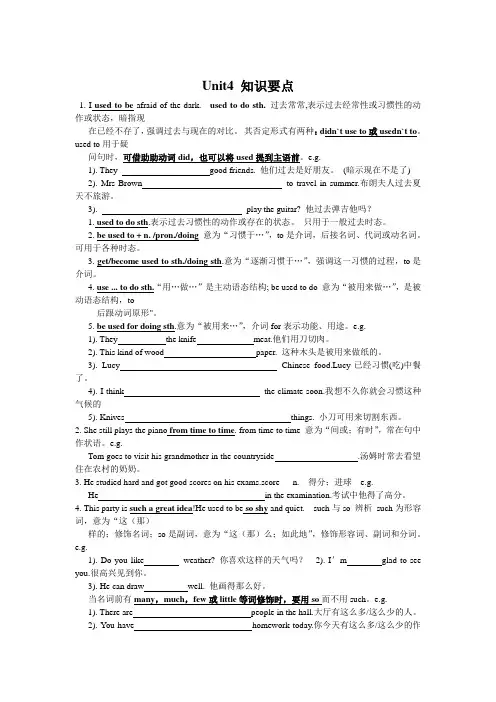
Unit4 知识要点1. I used to be afraid of the dark. used to do sth.过去常常,表示过去经常性或习惯性的动作或状态,暗指现在已经不存了,强调过去与现在的对比。
其否定形式有两种:didn`t use to或usedn`t to。
used to用于疑问句时,可借助助动词did,也可以将used提到主语前。
e.g.1). They good friends. 他们过去是好朋友。
(暗示现在不是了)2). Mrs Brown to travel in summer.布朗夫人过去夏天不旅游。
3). play the guitar? 他过去弹吉他吗?1. used to do sth.表示过去习惯性的动作或存在的状态。
只用于一般过去时态。
2. be used to + n. /pron./doing意为“习惯于…”,to是介词,后接名词、代词或动名词。
可用于各种时态。
3. get/become used to sth./doing sth.意为“逐渐习惯于…”,强调这一习惯的过程,to是介词。
4. use ... to do sth.“用…做…”是主动语态结构; be used to do 意为“被用来做…”,是被动语态结构,to后跟动词原形"。
5. be used for doing sth.意为“被用来…”,介词for表示功能、用途。
e.g.1). They the knife meat.他们用刀切肉。
2). This kind of wood paper. 这种木头是被用来做纸的。
3). Lucy Chinese food.Lucy已经习惯(吃)中餐了。
4). I think the climate soon.我想不久你就会习惯这种气候的5). Knives things. 小刀可用来切割东西。
2. She still plays the piano from time to time. from time to time 意为“间或;有时”,常在句中作状语。
人教版新目标九年级英语Unit4_I_used_to_be_afraid_of_the_dark_Section_B-2

2. affect
3. a school which some or all of the pupils live in during the school term
4. by oneself
cause可用于cause sb. sth. (给某人带来„„)和 cause sb. to do sth. (使某人做某事)结构中。 His unhealthy diet caused him some illness. 他的不健康的饮食给他带来了一些疾病。 I'm afraid I'm causing you much trouble. 恐怕我给你增添很多麻烦。 What caused you to do that? 什么原因促使你那么做?
2. seldom adv. 不常;很少 Lazy people seldom succeed. 懒惰的人很少会成功。 He is a gentle man and seldom gets angry. 他是个生性温顺的人, 很少生气。
【注意】 She seldom arrives home before midnight, does she? 她很少午夜之前回家,是吗? seldom本身带有否定意义, 构成附加疑问句时 不用否定词not。 Seldom have I met him recently. 最近我很少见到他。 seldom放在句首时,句子的主谓必须部分倒装。 类似的词还有never, hardly, scarcely等。
go to the zoo
When I was a child, I used to like going to the zoo with my parents.
人教版九年级Unit4-I-used--to-be-afraid-of-the-dark.
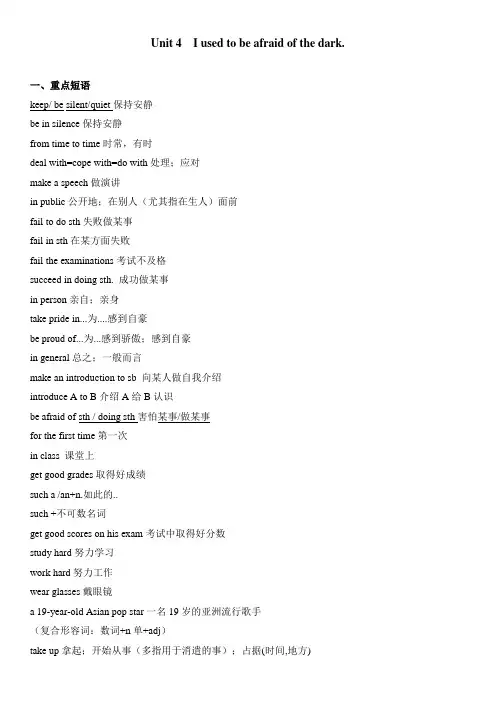
Unit 4 I used to be afraid of the dark.一、重点短语keep/ be silent/quiet保持安静be in silence保持安静from time to time时常,有时deal with=cope with=do with处理;应对make a speech做演讲in public公开地;在别人(尤其指在生人)面前fail to do sth失败做某事fail in sth在某方面失败fail the examinations考试不及格succeed in doing sth. 成功做某事in person亲自;亲身take pride in...为....感到自豪be proud of...为...感到骄傲;感到自豪in general总之;一般而言make an introduction to sb 向某人做自我介绍introduce A to B介绍A给B认识be afraid of sth / doing sth害怕某事/做某事for the first time第一次in class 课堂上get good grades取得好成绩such a /an+n.如此的..such +不可数名词get good scores on his exam考试中取得好分数study hard努力学习work hard努力工作wear glasses戴眼镜a 19-year-old Asian pop star一名19岁的亚洲流行歌手(复合形容词:数词+n单+adj)take up拿起;开始从事(多指用于消遣的事);占据(时间,地方)dare to do sth敢于做某事not..anymore=no more=not...any longer=no longer不再all the time一直get tons of attention成为大众的焦点;得到大量关注worry about sth担心某事,焦虑某事=be worried about sth appear to sb出现在某人面前sb be prepared to do sth有能力且愿意做...give up your normal life放弃你的正常生活think about doing sth考虑做某事fight on继续战斗requir sb to do sth要求某人做某事a number of =a lot of许多;大量a small number of少部分的..the number of.. ...的数量make it to the top攀上顶尖位置;做到最好scary movie恐怖片country music 乡村音乐at least至少be on the soccer team成为足球队的一员in the past在过去walk to school步行去学校do well in sth=be good at sth擅长...look for jobs找工作take (good) care of = look after照顾take after长的像..be absent from..缺席...make decisions/a decision to do sth决定做某事decide to do sth决定做某事send sb to sp送某人去某地a boarding school一所寄宿学校be able to do sth有能力做某事make friends with sb与某人交朋友advise sb to do sth建议某人做某事talk with sb与某人交谈(谈心)talk to sb与某人说话;责备某人take a 24-hour train and a 5-hour bus ride乘坐了24小时火车又坐了5小时汽车even though=even if即使;尽管think of思念;认为have communication with sb与某人联系have influence on.. 对...有影响have difficulty in doing sth做某事有困难二、重点句子及用法1.---Cindy, you used to be short, didn’t you? Cindy, 你以前很矮,是吗?---Yes, I did.是的,我以前是。
英语教案人教版新目标九年级英语全册Unit 4 I used to be afraid of...

Unit 4 I used to be afraid of the darkGrade: 9Language Skills: Listening, Speaking, Reading, WritingObjectives:Students will be able to talk about their past experiences and how they have changed. Students will be able to use past simple and present perfect verb tenses.Students will be able to use adjectives to describe feelings and emotions.Students will be able to write a personal narrative.Materials:Textbook: Unit 4 of New Standard English 9Worksheets and handoutsWhiteboard and markersProcedure:Introduction:Greet the students and introduce the topic of the lesson: talking about past experiences and changes.Ask the students to share a past experience that they used to be afraid of but now are not.Vocabulary:Introduce new vocabulary words related to emotions and feelings.Ask the students to match the words with their definitions.Review the answers with the class.Speaking:Ask the students to work in pairs or small groups and discuss a time when they used to be afraid of something, but now they are not.Ask a few groups to share their experiences with the class.Listening:Give the students a handout with a listening task.Play the audio and ask the students to listen for specific information.After the audio, have the students compare their notes with a partner.Ask a few students to share their notes with the class.Reading:Ask the students to read a short personal narrative.Have them underline any new vocabulary words.Ask a few students to share their findings with the class.Grammar:Introduce past simple and present perfect verb tenses.Give the students examples and ask them to practice forming sentences using these structures. Ask the students to work in pairs or small groups and create a short dialogue using the past simple and present perfect verb tenses.Writing:Ask the students to write a personal narrative about a time when they overcame a fear or challenge.Remind them to use adjectives to describe their feelings and emotions.Ask a few students to read their narratives aloud to the class.Conclusion:Review the main points of the lesson.Ask the students to share what they have learned.Assign any homework, if necessary.Assessment:Participation in class discussions and activitiesCompletion of handouts and worksheetsQuality of writing in the personal narrative.For homework, please ask the students to:Write a short paragraph about a time when they were afraid of something but overcame that fear. They should use adjectives to describe their emotions and feelings.Practice using the past simple and present perfect verb tenses by writing five sentences in each tense.Watch a video or read an article about a famous person who has overcome a fear or challenge, and write a brief summary of their story.Practice vocabulary related to emotions and feelings by creating flashcards and reviewing them regularly.。
九年级-unit-4-I-used-to-be-afraid-of-the-dark-课文重难点讲解

Unit 4 I used to be afraid of the dark.Section A 课文重难点精讲精选【解析1】:1. use v.使用→useful adj. 有用的 use up 用完Eg: Studying English is__________(use).2. use sth to do sth 用某物做某事Eg:We use Internet __________(find) information.3. used to do sth 过去常常做某事,表示过去做过的事现在已经不做,只用于过去时态。
◆变成否定句或疑问句时要借助助动词didn’t/did【拓展】:1. 肯定形式:主+used to+do… Eg: I used to get up at six.2. 否定形式:主+ usedn’t /didn’t use +to do … Eg: He usedn’t to study hard.= He didn’t use to study hard.3. 疑问形式:① Used +主语+ to do sth … 答语: Yes, 主语+used to./ No, 主语+ usedn’t to② Did + 主语+ use + to do …. 答语: Yes,主语+ did./ No, 主语+ didn’tUsed he to go to school on foot= Did he use to go to school on foot4. 反意疑问句:①肯定句+ didn’t /usedn’t+ 主语 Eg: He used to be very rich, didn’t he/ usedn’t he②否定句+ did /used +主语 Eg: He didn’t use to smoke, did /used he练习:① My mother used_________(tell)us story when we were young. ( )② He used to ____short and ____ short hair when he was young. ( )A. have; beB. be; haveC. be; beD. have; have【辨析】:辨析:used to do something.,be used to do something.与be used to doing something.1. used to do sth. “过去常常做某事”(而现在已经不做了),表示过去习惯性、经常性的动作或状态,和现在对比,暗示现在不做了。
2014_新目标_九年级英语_unit_4_I_used_to_be_afraid_of_the_dark_Section_A全课件

He _______ listen to pop music, but now he _______ dancing. A. is used to; used to B. use to; is used to C. used to; is used to D. used to; used to
【点拨】选C。句意:他过去常听流行音乐, 但现在他习惯于跳舞。
• I was shy.
Personality
I used to be…
= I used to be shy.
• She was friendly. = She used to be friendly. • He was funny. = He used to be funny.
VS
She liked reading when she was a student, but she likes singing now.
VS
He was ugly when he was a student, but he is really handsome now.
He used to be ugly, but now he is really handsome.
VS
He was naughty when he was a child, but he is really cool now.
2. What’s he like now? What’s he like?相当于What does he look like?,意思是“他长什么样?” --- What’s he like? --- He is tall and thin.
知识链接
What’s ... like ? 还可以用来询问“某事、某 物或者某人怎么样?” What’s Spring like in your hometown?
2014秋人教版新目标英语九年级Unit 4 I_used_to_be_afraid_of_the_dark Section A 1a-2c
friendly友好的
serious严肃的
funny 有趣的
what else??
Look at the pictures and guess personality
Serious Funny Smart Friendly Shy Unfriendly
tall medium height big eyes straight hair
She has long hair now.
Did Tina use to have red hair?
Yes, she did. She used to have red and curly hair.
What’s she like now?
She has straight and blonde hair now.
Unit 4
I used to be afraid of the dark Section A 1a-2c
What does he/she look like? He/She is---
tall
short
medium height
What does she look like? She is/has---
Yes, he did.
Past
Doggy
Now
He ___________ used to play football, now he _____basketball. plays He used to play basketball, didn’t he? No, he didn’t.
Bob hasn’t seen his friends for four years. What
2a
Listen and check (√) the words you hear.
2014秋人教版新目标英语九年级Unit 4 I_used_to_be_afraid_of_the_dark Section A 1a-2c
. I used to be afraid of the dark. used to do sth. 过去常常做某事 表示过去经常性或习惯性的动作 或状态,暗指现在已经不存了, 强调过去与现在的对比。 used to的否定形式有两种:didn’t use to或usedn’t to。
used to用于疑问句时,可借助助动词 did,也可以将used提到主语前。 e.g. They used to be good friends. 他们过去是好朋友。 (暗示现在不是了) Mrs Brown didn’t use to / usedn’t to travel in summer. 布朗夫人过去夏天不旅游。 Did you use to / Used you to play the guitar? 他过去弹吉他吗?
2a
Listen and check (√) the words you hear.
___ outgoing ___ humorous ___ active ___ quiet
___ friendly ___ serious ___ silent ___ brave ___ helpful
2b Listen again and complete the
Listen again and answer the questions.
1. What class were they? They were in science class. ________________________________ 2. What was Paula never brave to do in class? ________________________________ She was never brave to ask questions ________________________________ to teachers.
人教新目标九年级Unit4I-used-to-be-afraid-of-the-dark全单元讲义
在公共场合下请保持安静。
quiet , calm, silent, still, peaceful这些形容词 均含“平静的,无声无息”之意。
girls around him!
3. She was always silent in class. 在课堂上她总是很沉默。
silent作形容词,意为“不说话的;沉默的”,其 名词形式为silence (沉默;寂静) ►She was silent when her mother asked
her questions. 她妈妈问她问题时她沉默不语。 1)Silent 的副词形式是silently (默默的;静静的) ► He went in to the classroom and sat down
VS
He was shy when he was a child, but he is really smart now. He used to be shy but now he is really smart.
When I was young
shy short funny be interested in drawing like cartoons curly hair
She used to play soccer, but now she plays tennis.
She used to be short, but now she is tall.
She used to have long hair, but now she has short hair.
2014人教新目标九年级Unit4I-used-to-be-afraid-of-the-dark全单
She used to be short, but now she is tall.
She used to have long hair, but now she has short hair.
I used to be afraid of snakes. But now I’m not afraid of them. How about you?
girls around him!
3. She was always silent in class. 在课堂上她总是很沉默。
silent作形容词,意为“不说话的;沉默的”,其 名词形式为silence (沉默;寂静) ►She was silent when her mother asked
her questions. 她妈妈问她问题时她沉默不语。 1)Silent 的副词形式是silently (默默的;静静的) ► He went in to the classroom and sat down
last saw our primary school classmates. Alfred: It’s interesting to see how people have
changed. Gina: Billy has changed so much! He used to
be so shy and quiet. Alfred: Yeah, his face always turned red when
now
Kate is tall now. But she was
very short in the past.