
最新牛津译林版高中英语必修五Unit1 Grammar and usage课件
ing form
主 /表 / 宾 / 定
to +the base form of a verb
不定式 Infinitive
n. adj. 主 /表 / 宾 / 定 /补 /状 adv.
不定式和动名词的 时态和语态
不定式的时态和语态
时态
主
动
被
动
一般式 to do 完成式 to have done 进行式 to be doing
Unit 1 Getting along with others
Grammar and usage
To recognize the basic forms of “to infinitive” and “bare infinitive” To learn how to use “to infinitive” and “bare infinitive” in different situations To learn how to use the “verb-ing” form as a noun in various situations
4 …wanted to make… 5 …wanted to meet… 不定式 To-infinitive 6 …to see… 7 …was shocked to discover… 8 ...mean to hurt
1 …regretted chatting… 2 ... remembered 动名词 discussing… Gerund 3 …felt like crying
Form of the verb
1 … regretted chatting… 2 … wanted to make… 3 … remembered discussing… 4 … wanted to meet … 5 … to see … 6 … was shocked to discover … 7 … felt like crying … 8 … mean to hurt …
discussing She remembered ___________ (discuss) music with a girl, who called herself Joanne. The two met up often in the chat room, and after some time, Joanne wanted ________ to meet (meet) Sarah in real life. Sarah felt nervous and excited on the bus journey _______ to see (see) her new friend.
words in brackets. Change the form where necessary.
One teenage girl in the UK, Sarah, regretted chatting (chat) online after her online friend turned out to be a boy from her class playing a joke on her. Sarah said that she wanted to _______ make (make) some new friends, so she entered an Internet chat room.
Free talk
To make friends, which way of communication do you prefer, chatting online or talking face to
face? Why?
Fill the blanks
Complete the passage using the
动名词的时态和语态
时态
主
动
被 动 being done
一般式
doing
完成式
having done
having been done
感谢你帮我这么多忙。
Thank you for having helped me so much.
在使用之前该药物必须要被检验。
Before being used, the machine must be checked.
When she arrived, she was shocked to _________ discover (discover) that her new friend was a boy and that she already knew him. Sarah felt crying like _______(cry) when she found out that she had been chatting online with a boy called Joe from her class. Joe explained that he did to hurt not mean _______(hurt) Sarah. He just wanted to play a joke on her.
to be done to have been done 无
老板经过他时,他假装正在卖力的 工作。 He pretended to be working hard when his boss passed him. 对不起让你久等了。 I’m sorry to have kept you waiting.
To infinitive (动词)不定式
不定式是非谓语动词常见的一种 形式,通常由“to + 动词原形” 构成,其否定形式为“not to + 动 词原形” ,在句中可以做主语、 宾语、宾语(主语)补足语、定语、 表语或状语等。
1. ‘to infinitive’ used as the subject 不定式(短语)作主语 eg. To obey law is everyone's duty. 遵纪守法是每个人的职责。 To see is to believe. 眼见为实。 To talk with your mouth full is rude. 满嘴食物地讲话是不礼貌的。
2019-2020年牛津译林版高中英语必修5 Unit 1 Grammar and usage教案
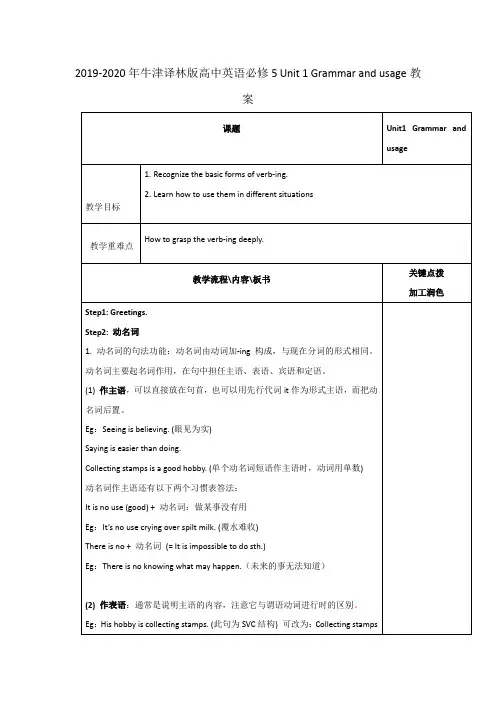
How to grasp the verb-ing deeply.
教学流程\内容\板书
关键点拨
加工润色
Step1: Greetings.
Step2:动名词
1.动名词的句法功能:动名词由动词加-ing构成,与现在分词的形式相同。动名词主要起名词作用,在句中担任主语、表语、宾语和定语。
(1)作主语,可以直接放在句首,也可以用先行代词it作为形式主语,而把动名词后置。
C. arriving, leaving D. arriving, to leave
在下列句型中动名词作真正宾语:动词+it(形式宾语)+宾补+动名词(真正宾语)
Eg:I think it no use telling them.
We think it no good inviting to him.
(3)作宾语
A.动词后
建议考虑坚持练suggest advise consider insist on practise
允许想象弃冒险permit allow imagine give up risk
阻止抵抗否逃跑prevent resist deny escape
不禁介意保持完can’t help mind keep finish
有些动词,如forget, remember, regret, try后接动名词与不定式作宾语,意义差别较大
forget doing sth.忘记已做了某事forget to do sth.忘记要做某事
try doing sth.试着做某事try to do sth.尽力做某事
remember doing sth.记得已做某事remember to do sth.记得要做某事
牛津译林版高中英语必修五unit1《gettingalongwithothers》grammarandusage教学设计2(精品).doc
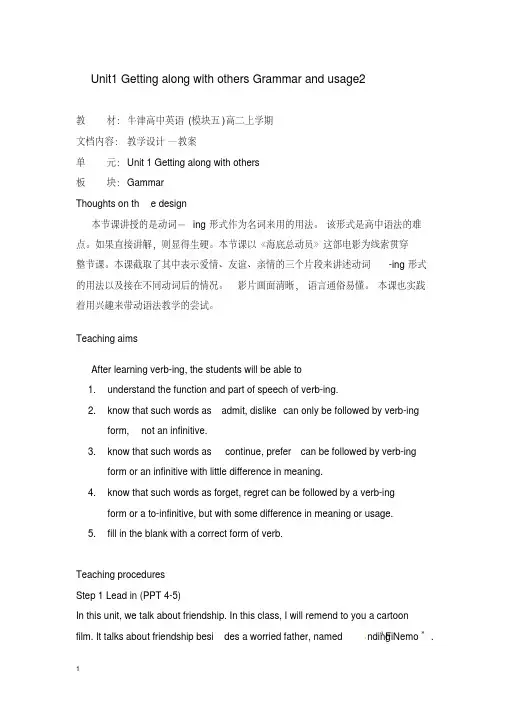
Unit1 Getting along with others Grammar and usage2教材:牛津高中英语(模块五)高二上学期文档内容:教学设计—教案单元:Unit 1 Getting along with others板块:GammarThoughts on th e design本节课讲授的是动词-ing形式作为名词来用的用法。
该形式是高中语法的难点。
如果直接讲解,则显得生硬。
本节课以《海底总动员》这部电影为线索贯穿整节课。
本课截取了其中表示爱情、友谊、亲情的三个片段来讲述动词-ing形式的用法以及接在不同动词后的情况。
影片画面清晰,语言通俗易懂。
本课也实践着用兴趣来带动语法教学的尝试。
Teaching aimsAfter learning verb-ing, the students will be able to1. understand the function and part of speech of verb-ing.2. know that such words as admit, dislike can only be followed by verb-ingform, not an infinitive.3. know that such words as continue, prefer can be followed by verb-ingform or an infinitive with little difference in meaning.4. know that such words as forget, regret can be followed by a verb-ingform or a to-infinitive, but with some difference in meaning or usage.5. fill in the blank with a correct form of verb.Teaching proceduresStep 1 Lead in (PPT 4-5)In this unit, we talk about friendship. In this class, I will remend to you a cartoonnding Nemo”. film. It talks about friendship besi des a worried father, named “FiWe watch some parts of the story and make some conclusions at the end ofeach part.Step 2 Enjoy Part 1(about the love between Marlin and Coral) (PPT6-17)1. filling the blanksAt the beginning of the story, Marlin and Coral were talking about____1_____ (move) to a new place with awesome neighbors. They indeedliked this large ocean with large room. They had a large house, which could bedivided into ____2_____ (live) rooms and bedrooms. They couldn’t help______3______ (imagine)______4______ (bee) parents in couple of days.The happy couple were considering _____5______ (give) these “children” names. Marline felt like ______6______(name) them Marlin Junior and CoralJunior. But Coral suggested _____7______ (call) them Nemo. After____8_____ (talk) about their children, they called up the memory of their firstdate. “Would you mind _____9______ (check) if there is a hook in my mouth, Miss?” This is what Marlin said to Coral when they first met each other. Theywere rising out of the coral when they saw a shark. ____10_____(fight) with ashark is of no use to a small fish. It ate the wife, Coral up and left the husband,Marlin into a a(昏迷). On his ___11_____ (wake) up, Marline found only oneegg left. He couldn’t stand _____12______(lose) Coral and cried. He promisednot to let anything dangerous happen to the only baby to be born.[Students can fill in blanks in any form they like. Then I will tell them thatonly verb-ing can be used in the blanks.]Orders Answers Orders Answers1 moving 7 calling2 living 8 talking3 imagining 9 checking4 being 10 Fighting5 giving 11 waking6 naming 12 losingFrom the summary of part 1, we can see verbs such as imagine, consider, suggest are followed by verb-ing forms instead of infinitives. Can you think ofany other verbs?practise, finish, enjoy, avoid …2. study the part of speech and function of blanks 1, 2, 5, 10, 11Blank 1 moving n. object after prepositionsBlank 2 living room. “living” is used in a pound noun.Blank 5 giving n. object after a transitive verbBlank 10 Fighting n. subject of the sentenceBlank 11 waking n. after possessive pronouns3. conclusion of this part1) Such words as admit, dislike, imagine, delay, consider, mind, understand, avoid, enjoy, practice, miss, finish, keep, suggest, escape, keep,risk are followed only by verb-ing.2) Such phrases as cannot help, look forward to, feel like, cannot stand,put off, keep on are followed by verb-ing.are3) Such sentence patterns as Would you mind …,It’s no use/good …followed by verb-ing.4) Verb-ing forms can be used as nouns.5) Verb-ing forms can function as the subject of a sentence6) Verb-ing forms can be used as the object of a sentence or an objectafter prepositions.7) Verb-ing forms can also be used after possessive pronouns.8) Verb-ing forms can also be used to form pound nouns. Verb-ing may describe the use of the noun followed by it, e.g. washing machine, swimmingpool, living room[Explanation]节选电影的第一部分,Marlin和Coral之间的爱情关系,可以吸引学生的眼球。
牛津译林版 必修5 unit1 Grammarandusage (共24张PPT)
Robert is said ___C____ abroad, but I don’t
know what country he studies in.
Robert is said ___B____ abroad, but I don’t
know what country he will study in.
不定式作主语常见句型:
It’s my duty to teach you.
It takes a lot of time to know a man.
a)foIotlisish,+kinadd,j.ca(reealessys,…im) +po不rt定an式t, difficult,
b) It is + n. (a pity, a pleasure, one’s duty, a shame…) + 不定式
▪ 4.当名词被序数词或last, only修饰时,常 用不定式作定语
不定式作状语
1. Tim sat near the fire _to__g_e_t_ (get) warm. 2. He is brave enough _t_o_g_o__(go) out alone
at night. 3. The reporter hurried to the airport, only
I have nothing to do but ____w_a_i_t _ (wait). I have no choice but _t_o_w__a_it__ (wait).
“前有do,后无to; 前无do, 后有to”. 不定式用在介词but, except, besides后时,
如果这些介词前有行为动词do的各种形式,那么 介词后的不定式不带to,相反则带to.
牛津译林版高中英语必修五Unit 1《Getting along with others》(Grammar and usage)教案1

Unit1 Getting along with others Grammar and usage1教材:牛津高中英语(模块五)高二上学期文档内容:教学设计—教案单元:Unit 1 Getting along with others板块:GrammarThoughts on the design:本课语法教学主要使学生掌握不定式的功能和用法。
本课采用语法教学与单元话题紧密结合的方式,使学生在使用英语讨论朋友和友谊这一话题中,发现、归纳、掌握并适当操练不定式的用法。
整堂课以上一课时阅读中的内容为线索,给语法教学创设真实的语境,并通过游戏、竞赛等活动,活跃课堂氛围,使学生快乐学习语法。
总体教学思路如下:引用Agony aunt Annie给Sarah和Andrew的回信引出不定式的概念和基本构成;学生在教师的鼓励下,找出信中所有的不定式结构,并在老师的指导下,总结归纳不定式在句中的不同功能;采用游戏“传声筒”引出学生对不定式不同构成的思考和总结概括;采用竞赛方式鼓励学生在探讨友谊的同时适当运用不定式结构并同时引出Bare infinitive的概念和规则;在最后的运用环节,学生通过完成Sarah给Annie的感谢信,在具体的情境中,操练本课所学的不定式的用法。
Teaching aims:1.Students will find out and learn the functions of To-infinitive in a sentenceand its different forms by involving themselves in different activities, games and competitions;2.Students will know how to use Bare infinitive;3.Students will further learn how to get along well with friends.Teaching procedures:Step 1 lead in (PPT 4-7)Teacher reminds students of the letters that Agony Aunt Annie wrote to Sarah and Andrew.Q: What can we learn from her letters about friendship?Students express their ideas freely. Then teacher concludes in this way:1.To talk to a friend openly and sincerely when something unpleasant happens isvery important if we are to keep the friendship. ( to do as subject and predicative of a sentence)2.We should always remind ou rselves to trust our friends whatever happens. (todo as object complement of a sentence)Students are asked to pay attention to the parts in bold, and thus To-infinitive is introduced.[Explanation]用上一课时的话题和材料导入新课,使课与课之间关系紧密,一气呵成,学生易于接受。
牛津译林版高中英语模块五 U1 Grammar and usage(1) 课件 (共39张PPT)

注5.
做定语的不定式如果是不及物动词,不定式 后面须有相应的介词。例如: • She had only a small room to live in. • I need a pen to write with.
注6 试比较: Do you have anything to wash? 你有什 么要洗吗?(不定式to wash的动作执行者 是you) Do you have anything to be washed? 你 有什么要(别人)洗吗?(不定式to wash 的动作执行者是别人,而不是you)
这时的形容词常为easy, difficult, hard, good, useful, wrong, right, necessary, impossible, important 等。 名词或词组常为a fact, a great day, a great thing, a pity 等。
• It作形式主语,不定式作真主语常见句型: • a) It is + adj. (easy, important, difficult…) + 不定式 • b) It is + n. (a pity, a pleasure, one’s duty, a shame…) + 不定式 • c) It takes/needs/requires + some time (hours, months, days, patience…) + 不定式 • E.g • It’s my duty to teach you how to learn English well. • It requires patience to be a good teacher.
作表语
译林牛津版高中英语Module 5 unit 1 grammar and usage 教学课件 (共

The to infinitive can be the object complement:
Practice:
1. I’ll get someone _t_o__re_p_a_i_r(repair) the bike for you. 2. What caused him _to__c_h_a_n_g_e(change) his mind?
总结Biblioteka 不定式作表语说明主语的内容,常表示一次性的 动作或__将__来__的动作.
The to infinitive can be the attributive:
Practice: ? to be done
BACK
1. I have a lot of work __t_o__d_o___(do). 2. I have a large house to _to__li_v_e__in_. (live)
3. Be confident and develop good habits of learning English.
Task one: (learn and summarize)
1. To find the finite verb(谓语动词)and the non-finite
verb(非谓语动词(短语)) in the following sentences.
牛津译林版高中英语必修五《Unit 1 Getting along with others》Grammar and usage 教案 1
e.g.: To say is one thing and to do is another..
但在很多情况下,为了保持句子平衡,通常用it作为形式主语,而把不定式移到谓语之后,
2.作表语.不定式作表语说明主语的具体内容或表示目的。
e.g.: His wish is to become an engineer.
Eg.:I want you to speak to Tom.
(1)在感官动词以及使役动词(let, have, make)后作宾语补足语,不定式都不带to.变为被动语态时,原不带to的不定式要变成带to的不定式.“一感(feel)二听(hear, listen to )三让(let, have, make )四观看(see, observe, watch, look at)”
To-infinitive in
The sentences
And then make
Some sentences
To consolidate
The Grammar.
教
学
过
程
教 学 内 容
个案调整
教师主导活动
学生主体活动
在find, make, think, consider等动词后,如果宾语带有宾语补足语时,常用it作形式宾语,而把真正的宾语放在宾语补足语后.
Turntopage 8 and page 9 to
Learn the
to-infinitive and bare infinitive.
Read the
Introductions andunderline the
important
牛津译林版高中英语必修五Unit1 Grammar and usage课件PPT文档79页
25、学习是劳动,是充满思想的劳动。——乌申斯基
谢谢!
牛津译林版高中英语必修五Unit1 Grammar and usage课件
1、纪律是管理关系的形式。——阿法 纳西耶 夫 2、改革如果不讲纪律,就难以成功。
3、道德行为训练,不是通过语言影响 ,而是 让儿童 练习良 好道德 行为, 克服懒 惰、轻 率、不 守纪律 、颓废 等不良 行为。 4、学校没有纪律便如磨房里没有水。 ——夸 美纽斯
5、教导儿童服从真理、服从集体,养成儿童 自觉的 纪律性 ,这是 儿童道 德教育 最重要 的部分 。—— 陈鹤琴
21、要知道对好事的称颂过于夸大,也会招来人们的反感轻蔑和嫉妒。——培根 22、业精于勤,荒于嬉;行成于思,毁于随。——韩愈
牛津译林版高中英语模块五 U1 Grammar and usage(1) 课件 (共45张PPT)
(2) would rather,had better句型后。 (3) Why not...句型后。 (4) help后可带to,也可不带to。 (5) but和except后。but前有实义动词do时,后面出现的不定式不带to。 比较: He wants to do nothing but go out. 他只想出去玩。 He wants to believe anything but to take the medicine. 除了吃药,他什么都信。
谓语动词的动作之后。例如:
He seems to know this. 我希望再见到你。 他似乎知道这事。
I hope to see you again.=I hope that I’ll see you again.
2.进行式表示动作正在进行,与谓语动词表示的动作同时发生。例如:
He seems to be eating something.
你准备参加下周举行的会议吗?
6.作状语
(1)作目的状语
常用结构为to do,in order to do,so as to do,so (such)...as to...。例如:
He ran so fast as to catch the first bus.
他飞快地跑以便赶上第一班车。
I come here to say goodbye to you.
具有名词、形容词或副词的某些语法功能,又有动词的
时态和语态的特点及作用。
二、不定式的作用
1.作主语
Too see is to believe.
眼见为实。
不定式作主语,往往用it作形式主语,真正的主语不定式放至句子的后面。
It’s so nice to hear your voice.
高中英语译林版必修五Unit-1-Grammar-and-usage-To-infinitive课件
tourists like me, pandas are its top 61 (attract).
So it was a great honour not-for-profit Panda Base,
wtohbeereintaivtcitktreeadtctmbioaoncnkesytahgeelpast
wild.
My
ambassadorial
非 1.不定式:多表特定的、具体的、将来的动作。
谓 2.动名词:接近于名词,多表抽象的、习惯性
语
的动作。
现在分词:表主动、正在进行。
动
词 3.分词 过去分词:表被动、已经完成。
非谓语动词在句中充当的成分
非谓语动词的形式
to do to be doing to have done to have been doing doing having done
高 中 英 语 译 林版必 修五U nit-1-G ramma r-and-usage-T o-infini tive课件
高中英语译林版必修五
Unit-1-Grammar-and-usage-Toinfinitive
高 中 英 语 译 林版必 修五U nit-1-G ramma r-and-usage-T o-infini tive课件
There is nothing to worry about. 但不定式所修饰的名词如果是time, place或way时,不定式后面的 介词习惯上省去。
He had no place to live.
分词作定语的几种形式:
1.当被修饰的名词与非谓语动词为主动关系时,用v.-ing; 2.当被修饰的名词与非谓语动词为被动关系且表正在进行时,