
稻城亚丁英语介绍
介绍亚丁稻城的英语作文

介绍亚丁稻城的英语作文英文回答:When dawn broke over the horizon of Yanjing, I stepped out of my comfort zone to embark on a journey of a lifetime, a pilgrimage to the sacred lands of Yi Ding. From the bustling city to the tranquil sanctity of nature, my adventure took a dramatic turn filled with awe, humility, and a thirst for enlightenment. It’s not every day onegets to step into the realms that have been blessed by the divine touch of Mother Earth.The air was crisp and clean, invigorating my lungs with each deep breath. The echo of the wind carried tales of ancient legends and fabled creatures that once roamed the wild and untamed peaks. Around every corner, mountainvistas unfolded, revealing stunning vistas that stretchedas far as the eye could see, painting the sky with hues of blues and greens and the earth with the vibrancy of life.I began my trek to Daocheng. The terrain was rugged, challenging my physical strength and mental resilience. My muscles ached, my breath labored, yet with every step forward, the journey became more rewarding. The towering snow-covered mountains whispered secrets of strength and endurance. The clear lakes glistened like diamonds under the piercing sun, reflecting the sky and the soul.As I made my way through the lush valleys and over the icy passes, I felt a profound sense of connection to the land. This was the land of Daocheng, where nature andspirit harmoniously coexist, a place where you could feel the heartbeat of the universe in every whisper of the wind.In the evenings, as I rested under the ever-expanding canvas of stars, I found a peace that eludes the modern world. It was here that I felt a metamorphosis of the soul. The hardships of the journey had sculpted a new appreciation for the simple pleasures of life, things that money couldn't buy.My journey through Yi Ding and Daocheng was a testament to the resilience of the human spirit and the beauty of nature that surrounds us. It was a pilgrimage not just of the body but of the mind, a quest for inner peace and external beauty. As I returned, with a heart filled with memories and a spirit enlightened by the stark beauty of the landscape, I realized that the journey was a process of self-discovery and inner growth.Conclusion: As the journey ended, I was left with a renewed perspective on life. Yi Ding and Daocheng had touched my soul, reminding me of the importance of slowing down, reconnecting with nature, and appreciating the little things. For those looking to embark on a similar adventure, I encourage you to set aside your preconceptions and let the journey reshape you. It’s a trip that will leave you with indelible memories and a sense of awe that will stay with you forever.中文回答:当黎明破晓,我毅然决然地从安逸的舒适区踏出一步,开始了终身难忘的朝圣之旅,前往神圣的土地——亚丁稻城。
川藏线318自驾游英语作文

川藏线318自驾游英语作文Embarking on a self-drive adventure along Sichuan-Tibet Highway 318 is an exhilarating journey that offers breathtaking landscapes, cultural experiences, and personal growth. This renowned route, stretching from Chengdu in Sichuan Province to Lhasa in Tibet, is renowned for its challenging terrain, diverse scenery, and profound cultural significance.The journey begins in Chengdu, a vibrant city known for its panda-breeding centers and spicy cuisine. As you drive westward, the scenery gradually transforms from rollinghills and farmland to towering mountains and deep gorges. The road zigzags through hairpin turns, offering breathtaking views of snow-capped peaks and lush valleys.One of the most memorable stops on the route is稻城亚丁, a hidden gem in the southwestern Sichuan Province. Here, you'll find stunning natural landscapes, including thethree sacred mountains and the blue-green Milk Lake. The serene atmosphere and the raw beauty of nature are truly captivating.As you continue your journey, the road leads you through the towering mountains of Tibet, passing through villages and towns where local cultures and traditions are still intact. Interacting with the locals, learning about their way of life, and trying their traditional cuisine are all enriching experiences that add depth to the trip.One of the highlights of the trip is the ascent to the highest point on the route, the pass at over 5,000 meters above sea level. The air is thin and the wind is strong, but the views are absolutely worth it. Standing at the top, you can see the vast Tibetan plateau stretching out below, a breathtaking sight that leaves a lasting impression.The final leg of the journey takes you to Lhasa, the capital of Tibet. Here, you can explore the Potala Palace, a magnificent structure that stands as a symbol of Tibetan culture and religion. Wandering through the narrow streets of the old city, you'll find monasteries, shops selling traditional handicrafts, and locals going about their daily lives.The self-drive adventure on Sichuan-Tibet Highway 318 is not just a trip about seeing beautiful scenery; it'salso a journey of self-discovery and personal growth. Driving through challenging terrain and navigating unfamiliar roads tests your skills and resilience. Interacting with people from different cultures broadens your horizons and enriches your understanding of the world. In conclusion, a self-drive adventure on Sichuan-Tibet Highway 318 is an unforgettable experience that combines the thrill of exploration with the beauty of nature and the richness of cultural exchanges. It's a trip that will leave you with lasting memories and a deeper appreciation for the diversity and wonder of the world.**川藏线318自驾游**沿川藏线318进行自驾游是一次激动人心的旅程,它提供了令人叹为观止的风景、文化体验和个人成长。
稻城亚丁10日旅游日程表(英文)
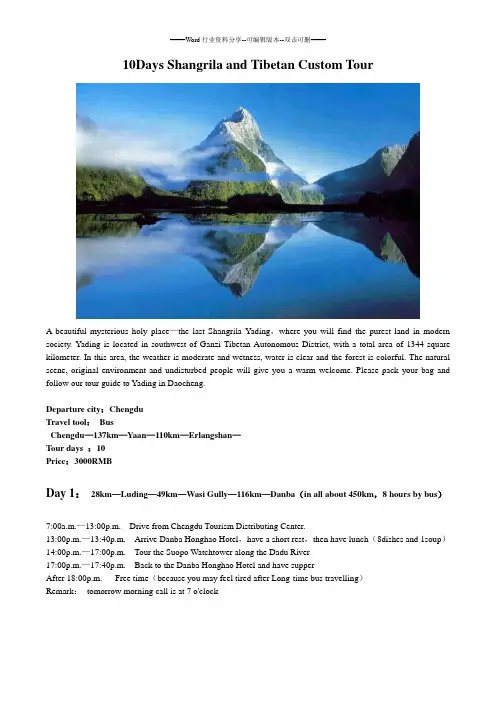
10Days Shangrila and Tibetan Custom TourA beautiful mysterious holy place—the last Shangrila Yading,where you will find the purest land in modern society. Yading is located in southwest of Ganzi Tibetan Autonomous District, with a total area of 1344 square kilometer. In this area, the weather is moderate and wetness, water is clear and the forest is colorful. The natural scene, original environment and undisturbed people will give you a warm welcome. Please pack your bag and follow our tour guide to Yading in Daocheng.Departure city:ChengduTravel tool:BusChengdu—137km—Yaan—110km—Erlangshan—Tour days :10Price:3000RMBDay 1:28km—Luding—49km—Wasi Gully—116km—Danba(in all about 450km,8 hours by bus)7:00a.m.—13:00p.m. Drive from Chengdu Tourism Distributing Center.13:00p.m.—13:40p.m. Arrive Danba Honghao Hotel,have a short rest,then have lunch(8dishes and 1soup)14:00p.m.—17:00p.m. Tour the Suopo Watchtower along the Dadu River17:00p.m.—17:40p.m. Back to the Danba Honghao Hotel and have supperAfter 18:00p.m. Free time(because you may feel tired after Long-time bus travelling)Remark:tomorrow morning call is at 7 o'clockDanba has the name of the Nation of Thousand Engraves. The Daduhe River Valley in Danba is one of China's most beautiful canyons .Day 2:Danba—116km—塔公—45km—新都桥(in all about 161km,5 hours by bus)Tagong means the place that the Bodhisattva loves.It's one of famous temples of Shakya in Kangding.—7:30a.m.. Morning call7:30a.m.—8:00a.m. Have breakfast8:10a.m.—12:00a.m. Tour Jiaju Tibetan Village12:00a.m.—13:00p.m. Have lunch in the Jiaju Tibetan Village(enjoy the local flavor)13:00p.m.—17:00 Tour Tagong Temple18:00p.m.—18:40p.m. Have supper in Xinduqiao Gaoyuanhong Hotel19:00p.m.—22:00p.m. Join the party in JiajuTibetan Village(at your own expense)Day3:Xinduqiao—80km—Yajiang—145km—Litang—146km—Daocheng(in all about 449km,8hours by bus)7:00a.m.—7:30a.m. Morning call7:30a.m.—8:00a.m. Breakfast8:10a.m.—12:00a.m. Tour the Maoya Prairie12:00a.m.—13:00p.m. Have lunch in Litang(enjoy the wild snow-fish of plateau)13:20p.m.—16:00p.m. Tour the Haizishan Natural Protect Area16:00p.m.—18:00p.m. Enjoy the beautiful scenery of plateau and gully along the road,thenTour Daocheng18:00p.m.—18:40p.m. Have supper at Shengshan Hotel in DaochengDay 4Daocheng(稻城)-78km-Riwa(日瓦)-40km-Yadingcun(亚丁村)【The trip is about 118km,it will take us 3and half an hours.】7:00-7:30 Have breakfast7:30-9:30 Go to Daocheng.9:30-10:20 Visit the Gonggalangjiling temple10:20-14:00 Go to Riwa.14:00-17:00 Visit the pearl lake17:00-18:00 Go back to the wood house hotel18:00-20:30 Have dinner with the local people20:30---- Free timeYou can ride horse or walk to the zhuomalacuo holy lake,to appreciate the beautiful landscape.Live with the Tibetan,enjoy the hospitality of Tibetan and the wonderful food.I beg you will have a happy trip.Day 5Yading-(亚丁)40km-Riwa(日瓦)-78km-Daocheng(稻城)【The trip is about 118km,it will take us 3and half an hours.】7 -7:30 Have breakfast7:30-8:10 Ride horse to Chonggu temple8:10-11:10 Walk to the Luorong cattle ranch 11:10-12:00 Have a rest12:00-13:00 Have lunch in the local family 13:00-15:40 Enjoy your time there15:40-19:30 Back to hotel19:30-19:40 Have a rest19:40-20:30 Have dinner20:30-------- Free timeTourists can ride horse or walk to Chonggu temple.The scenery there is so wonderful.You can visit the Xiannairi holy mountain.Xiannairi holy mountain means avalokitesvara,about 6023m high.When you are climbing,you can see the Xianuoduoji holy mountain,it means vajradhara,about 5958m high,you can also see the Yangmaiyong holy mountain,it means golden manjusri buddisattva,about 5958m high.You can see the wild animal living so happy there.You can feel the feeling that the flowers and tress,snow mountains,forest,ice,lake and stream living so harmonious with people.When you are standing there,you will feel as if you were unconsciously merging into the beautiful landscape there.Bid farewell to the three saint mountains,you are approaching the Shangri-la step by step.Tips:The weather is changeable,please take umbrella and gloves.Be careful when you are riding horses.If it is raining or snowing there,it probably has no signal.Day7:Brief introduction of Yubengvillage: Yubeng village is a misterious place .it is surrounded by verdent forests ,a few people live there ,you can see ood trees and holy waterfalls.7:00a.m.—8:00a.m. breakfast8:00.am:heading for xidang village{2 hour by car or 3 hour by riding horse }about 11:00am arrive at the destination12:30pm :have lunch in yubeng restaurant12:30p.m.—14:00p.m. Have lunch and havea rest14:00p.m.—17:00p.m. climb kawadgarbo,enjoy the snow clad mountain18:00p.m.—19:00p.m. come back to havesupper at the same restaurant19:00p.m.—20:00p.m. appreciate the localresidengt's dance21:00p.m. go to bed at Yubeng HouseDay8:7:00-8:00 have breakfast at yubeng restraurant8:00 set up to holy waterfall by car then by foot ,located in the south of kawadgarbo ,rushing over the cliff abou 1000meters fall .called yubeng holy waterfall ,it is said that you will be blessed by the waterfall if you are wet by the water10:00 arrive there, take photos and enjoy yourself12:00-14;00 have lunch at the local rearaurant and have a rest14:00 continue to tour the kawadgarbo17:00 prepare to come back .we will go to Feilai temple by car about 2 hours19:00 - 20:00 have supper at Feila itemple 8:00 stay at Feilai temple and prepare to go to bed。
介绍九寨沟的英语作文高中
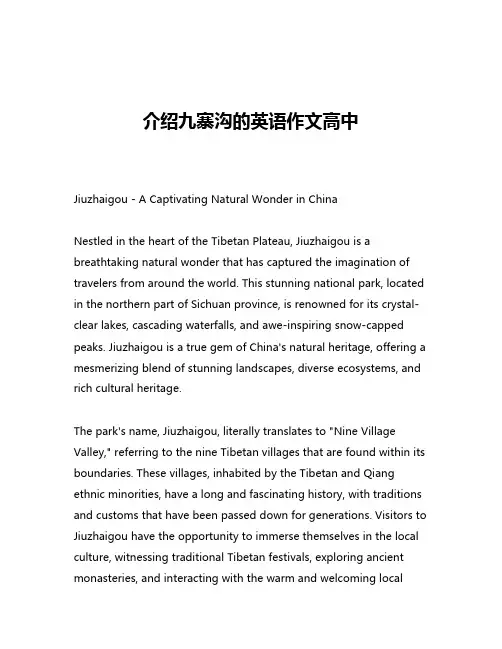
介绍九寨沟的英语作文高中Jiuzhaigou - A Captivating Natural Wonder in ChinaNestled in the heart of the Tibetan Plateau, Jiuzhaigou is a breathtaking natural wonder that has captured the imagination of travelers from around the world. This stunning national park, located in the northern part of Sichuan province, is renowned for its crystal-clear lakes, cascading waterfalls, and awe-inspiring snow-capped peaks. Jiuzhaigou is a true gem of China's natural heritage, offering a mesmerizing blend of stunning landscapes, diverse ecosystems, and rich cultural heritage.The park's name, Jiuzhaigou, literally translates to "Nine Village Valley," referring to the nine Tibetan villages that are found within its boundaries. These villages, inhabited by the Tibetan and Qiang ethnic minorities, have a long and fascinating history, with traditions and customs that have been passed down for generations. Visitors to Jiuzhaigou have the opportunity to immerse themselves in the local culture, witnessing traditional Tibetan festivals, exploring ancient monasteries, and interacting with the warm and welcoming localpeople.One of the most captivating features of Jiuzhaigou is its stunning array of lakes. The park is home to more than 140 lakes, each with its own unique color and character. The most famous of these is the breathtaking Nuorilang Falls, a multi-tiered waterfall that cascades down a series of terraced pools in a stunning display of natural beauty. The waters of Jiuzhaigou are renowned for their incredible clarity, with visibility often extending to depths of 20 meters or more. The colors of the lakes, ranging from deep turquoise to vibrant emerald green, are the result of the high mineral content of the water and the presence of various types of algae and aquatic plants.In addition to its stunning lakes, Jiuzhaigou is also renowned for its diverse and well-preserved ecosystems. The park is home to a wide variety of plant and animal species, many of which are endemic to the Tibetan Plateau. Visitors can spot a range of wildlife, including the elusive giant panda, the Sichuan golden monkey, and the Tibetan antelope, as well as countless species of birds, insects, and other creatures.One of the most remarkable aspects of Jiuzhaigou is the way in which the landscape changes with the seasons. During the spring and summer months, the park is a vibrant tapestry of colors, with lush green forests, blooming wildflowers, and crystal-clear lakes. Inthe autumn, the foliage transforms into a stunning display of reds, oranges, and yellows, creating a breathtaking contrast against the snow-capped peaks. And in the winter, the park is transformed into a winter wonderland, with frozen lakes, snow-covered landscapes, and the opportunity to witness the stunning natural phenomenon of "fairy tale" forests, where trees are encased in a layer of ice and snow.Jiuzhaigou's natural beauty is not only a source of wonder and awe for visitors, but it is also a testament to the importance of environmental conservation. The park has been designated as a UNESCO World Heritage Site, in recognition of its outstanding natural and cultural significance. Efforts to protect and preserve the delicate ecosystem of Jiuzhaigou have been ongoing for decades, with strict regulations in place to limit the impact of tourism and ensure the long-term sustainability of the park.Despite its remote location and the challenges of accessing the park, Jiuzhaigou has become a popular destination for travelers from around the world. The park's stunning landscapes, rich cultural heritage, and abundant wildlife have made it a must-visit destination for anyone exploring the natural wonders of China. Whether you are a nature enthusiast, a cultural explorer, or simply someone who appreciates the beauty of the natural world, Jiuzhaigou is sure to leave a lasting impression.In conclusion, Jiuzhaigou is a truly remarkable natural wonder that deserves to be celebrated and protected. Its stunning landscapes, diverse ecosystems, and rich cultural heritage make it a truly unique and captivating destination. Whether you are planning a trip to China or simply curious about the natural wonders of the world, Jiuzhaigou is a destination that is sure to leave a lasting impression.。
2023届安徽省“江南十校”联考英语参考答案

2023届安徽省“江南十校”联考英语试题评分参考听力:1-5 ABCAB 6-10 CABCA 11-15 ACBAC 16-20 BCCAB阅读:21-23 ACC 24-27 DBBA 28-31 CABD 32-35 CDAB 36-40 DACEG完型填空:41-45 BDABC 46-50 CABAD 51-55 CADBC语法填空:56.surrounded 57. extremely 58. imagination 59. in 60. photos61. has reached 62. an 63. Walking 64. its 65. that第一部分听力(听力材料附后)第二部分阅读【第一节】A篇语篇:应用文语境:人与社会——文学、艺术与体育——艺术活动概况主旨大意:文章主要介绍了美国四场不同的艺术活动及具体信息。
21.A 简单计算根据Handel: Messiah的价格信息“$35 Adult $30 Seniors (62+) $20 Youth under 18”可知。
22.C 理解具体信息根据题干中的关键信息“tiny”可将解题线索定位至活动标题中的“fine”一词及“Description”中的“miniature works of art, none larger than 6 inches in any direction”.23.C 理解具体信息根据“Dates & Times”一栏可知答案为C。
B 篇语篇:记叙文语境:人与自我——生活与学习——认识自我,丰富自我,完善自我主旨大意:从教师的视角记叙了一位有听力障碍的学生--Fiona, 在一次意外事件中发现了写作的力量,并以此为契机成为了更好的自己。
24.D 理解具体信息根据第一段“They were upset that their child’s kindergarten teacher cautioned them not to have high hopes for her academically. Based upon assessment results, the teacher painted adiscouraging picture for their little girl’s future.”可知。
2023 年全国导游人员资格考试英语导游词篇7(稻城亚丁)
2023 年全国导游人员资格考试英语导游词(7/8篇)7.Yading Village(稻城亚丁)P1:Good morning. ladies and gentlemen! Our coach will arrive at Yading Village very soon. Before we get there, I'd like o say something about this area.P2: Yading is located in Shangri-La Town,Daocheng County, Ganzi Tibetan autonomous prefecture(甘孜藏族自治州),Sichuan Province.It is a natural ecological nature reserve established with the approval of the State Council in 2001.In the year 2003,it was included by UNESCO as a member of the "World Network of Human and Biosphere Reserve"(世界人与生物圈保护区网络). In December. 2020, it was ratified as a national 5A level scenic site in China. Covering an area of over 1457 square kilometers, this nature reserve is mainly composed of three sacred mountains . Xiannairi,Yangmaiyong and Xianuoduoji(仙乃日、央迈勇、夏诺多吉)-and the surrounding rivers, lakes and alpine meadows. As one of the most well-preserved and original natural ecosystems in China, it presents to us the mcredible world-class natural scenery of the mountainous canyon. Domestically. Yading has been repeatedly listed in the Top Ten Most Beautiful Mountains in China, and China's Most Beautiful Places etc. However to many international tourists, it is know as "the last pure land on the blue planet". "a paradise for photography loves". Its landscape remains as pure as it has ever been on earth.Because of its unique landform and original ecological natural scenery. it is known as "the last Shangri-La" in China.P3: Maybe you are wondering. what does Daocheng mean? Daocheng was named Daoba(稻坝) in ancient times. In Tibetan language, it means "opening at the entrance of the valley". During the late 19 century.the county experimented with rice cultivation and so it was renamed Daocheng. meaning "success in growing rice." Later the word "success”(成) was replaced by its homophone which means "city"(城)But in fact, it was first introduced to the world when the famous American adventurer Joseph Rock published an article and the photos of Daocheng in the National Geographic in 1928. According to his article, the snow-capped mountains, steep cliffs, crystal clear lakes, vast pastures, as well as the dense woods composed a harmonious Utopian land. Because of its serenity. peace, pureness, a romantic combination of mountain and water, human and nature,Daocheng is known as the "Soul of Shangri-La". P4:Then, what does Yading mean? In Tibetan Language, Yading means the“place that faces the sun". In addition to the breath-taking Sanhuzhu(三祜主)Holy Peaks, the lakes at their foot and the rich vegetation, the charm of Yading also comes from its primitive village.P5:Yading Village is located in the core area of Shangri-La tourism circle in the south of Daocheng County, on a tableland surrounded by mountains. It is quite small in size, with only 28 households and 183villagers. It was named "Yading" because of the long hours of sunshine. Yading scenic area is just named after Yading Village. There is a beautiful legend about the origin of Yading Village. Many years ago, there lived a family, and the owner was called Guo Huanjia(郭还家) Generations of Guo family lived here alone, leading a quiet and traditional life: going out to work at sunrise and going back home at sunset.-Not far from his home, there was a mountain called Mount Namu(拿母山). One day; the family lost a yak during grazing. Next day in the early morning. Guo's daughter, Quzhen(曲珍)went to Namu mountain to look for the yak. When she was passing through a cave, she happened to find a living Buddha who was doing some spiritual practise. The living Buddha said to the little girl: “My name is Ranjianggongjiujiangcuo(然降公纠降错).Now that you have seen me, I have to eat something or will die. The living Buddha asked her to bring him food everyday, and she could not tell anyone. If the girl could do this for three years, the living Buddha could become an immortal. But Quzhen did not agree. The living Buddha then asked for three months' food, Quzhen did not give him her promise. When the living Buddha asked for three days' food, this time, Quzhen agreed. Then Quzhen sent him food as she had promised. Three days later. the living Buddha came to the girl's family and stayed with them. One day, something strange happened: when Quzhen was herding sheep on the grassland at the back of the house, she heard faint sound of pigs, dogsand other animals, and sometimes even the cries of people, but she could see nothing. What was even more surprising was that sometimes, she could find small bundles of barley by the ditch. Back home, she told what she had experienced to the living Buddha and her family. The living Buddha asked: "Does your family need someone else for company?" Guo Huanjia answered:"of course we need. My family has been living here for generations without any contact with anybody else. Not only do we feel lonely, but the continuation of the family will be a problem." Then. that night, the living Buddha chanted for a long time with bunches of barley that Quzhen had picked up. On the following day, he asked Quzhen to scatter those bunches of barley on the grassland.Quzhen followed his instruction. Suddenly there rose smoke everywhere around her. After the smoke cleared, Quzhen was surprised to find a village appear in front of her. This village was the current YadingVillage.Scientifically, this area was the result of the orogenic movement of the Himalayas but I still like this story.P6: In the 1920s, American adventurer,Joseph Rock paid a visit to Daocheng. In his book. he described what he saw when he arrived at Yading Village: "Looking through the thick woods, I saw a tranquil village sitting on the flat land half way up the mountain. The village was surrounded by dense forests with several Tibetan buildings standing in a golden cornfield. Smoke rose from the chimneys of the building..." Rock'sdescription attracted many people. Similar to the feelings of Rock, more people feel that the small village of Yading is a tranquil and ideal place after they visit here. To some of them, it is like a fairyland, but it exists in human world. Its being there enables the holy Shambhala(香巴拉) to be within our reach.P7: There is an old saying in China, “What you hear about may be false; what you see is true' Next, let's walk into the image world of photographers and let's find whether Rock's description t true or false. Please follow me.。
四川稻城亚丁景区城市旅游招商推介词导游词宣传片文案(含英文版)
四川稻城亚丁景区城市旅游招商推介词导游词宣传片文案(含英文版)这里被誉为香格里拉之魂、"蓝色星球上的一片净土";是无数人心驰神往的世外桃源。
这里,就是稻城亚丁。
大家好,很荣幸向大家介绍香格里拉寻梦之旅——稻城亚丁。
亚丁之美——美在形态稻城亚丁位于四川甘孜藏族自治州,地处青藏高原东部、横断山脉中段、沙鲁里山系。
亚丁主体景观为终年积雪不化的三座雪山,其造型独特,形态各异,举世无双,是中国最美十大名山之一。
仙乃日、央迈勇、夏诺多吉三座雪山高 6000 米左右,相距很近却又主体分隔,“品”字形排列亦构成一体,呈现出了世界高山中独一无二的组合形态。
雪山之下分布着在冰川作用形成的高山湖泊,如翡翠、碧玉般镶嵌于山间。
雪山山形优美,在蓝天下勾勒出的天际轮廓线,百媚千姿、蔚为壮观。
北峰仙乃日犹如一尊大佛端坐于莲花台上,南峰央迈勇犹如一把锋利的宝剑直指苍穹,东峰夏诺多吉犹如一只巨型蝙蝠,欲展翅高飞,冲往天际。
亚丁之美——美在生态亚丁拥有第四纪以来多数地区已绝迹的动植物活化石,被称为青藏高原地质历史博物馆和物种基因库,也是青藏高原保存最完整、最原始的高山自然生态系统,壮丽的雪山、炫彩的森林、斑斓的花朵、广袤的草甸、碧透的海子……雪域高原最美的一切几乎都汇聚于此。
春天和夏天总是交织在一起,雪山圣洁,各类花草竞相绽放,森林、溪流、湖泊展现生机,宛似一幅水彩画。
秋季是最令人心醉的季节,金黄的草地、绚烂的彩林、剔透的流水,如同一幅油画。
冬季褪去了金秋的绚烂,用另一种唯美装饰着这里,雪山、溪流仿佛被冰封一样,成为了充满禅意的水墨画。
亚丁之美——美在文态亚丁是传说中的人间圣地。
亚丁即为向阳之地,藏语为念青贡嘎日松贡布,其意思是“终年积雪不化的三座护法神山圣地”。
传说,公元8世纪,佛学大师莲花生亲自将佛教密宗三位本尊菩萨之名赋予三座雪山,仙乃日是观世音菩萨的化身、央迈勇是文殊菩萨的化身、夏诺多吉是金刚手菩萨的化身,是慈悲、智慧与力量完美结合的圣山,佛名“三怙主雪山”,在世界佛教二十四大圣地中排名第十一位。
英语作文介绍去稻城旅游
英语作文介绍去稻城旅游Title: A Mesmerizing Journey to Daocheng Yading。
Embarking on a journey to Daocheng Yading is akin to stepping into a realm where nature's grandeur unfolds inits purest form. Nestled in the serene landscapes ofwestern Sichuan, China, Daocheng Yading offers an unparalleled adventure for travelers seeking solace amidst breathtaking beauty.The journey begins with a scenic drive through winding mountain roads, revealing panoramic vistas of lush valleys and snow-capped peaks. As one delves deeper into the heartof Daocheng County, the tranquil ambiance envelops the soul, beckoning exploration and discovery.Arriving at the gateway to Daocheng Yading, one is greeted by the majestic Mount Chenrezig, also known as Jambeyang. Rising majestically to the heavens, its snow-capped summit glistens in the sunlight, casting aspellbinding allure upon all who behold it.Venturing further into the pristine wilderness, the ethereal beauty of Yading Nature Reserve unfolds before the eyes. Three sacred peaks—Mount Chenrezig, Mount Jampelyang, and Mount Chenadorje—stand in silent reverence, their towering presence evoking a sense of awe and wonder.Trekking along ancient trails, travelers are immersedin the untamed splendor of the landscape, where emerald meadows carpet the valley floor, and crystal-clear streams meander through the verdant terrain. The air is imbued with the fragrance of wildflowers, and the melodious chirping of birds fills the air, creating a symphony of nature's symphony.For the adventurous souls, hiking to the pristine Milk Lake offers a chance to witness nature's masterpiece in its purest form. Surrounded by towering peaks and glacial valleys, the tranquil waters of Milk Lake reflect the azure sky above, creating a scene of unparalleled serenity.As the day draws to a close, the setting sun bathes the landscape in a warm golden hue, casting long shadows upon the rugged terrain. Nestled in cozy lodges, travelers are treated to hearty meals prepared with locally sourced ingredients, offering a taste of authentic Tibetan cuisine.In the embrace of night, the starlit sky unfolds above, revealing a tapestry of celestial wonders. Away from the glare of city lights, the heavens come alive with countless stars, casting a spell of enchantment upon all who gaze upon them.As dawn breaks upon the horizon, painting the sky in hues of pink and gold, travelers bid farewell to Daocheng Yading, their hearts filled with memories of an unforgettable journey. Though the adventure may end, the spirit of Daocheng Yading lingers on, a testament to the enduring beauty of nature's creation.In conclusion, a sojourn to Daocheng Yading is not merely a journey, but a pilgrimage to the very heart of Mother Nature herself. Amidst the towering peaks andverdant valleys, one discovers a sanctuary of serenity and splendor, where the soul finds solace and the spirit is renewed. Truly, Daocheng Yading is a destination like no other, a place where dreams take flight amidst the majesty of the mountains.。
考研考博英语面试--介绍家乡四川稻城县
My Hometown -Daocheng第一篇Good morning/afternoon. My name is [Your Name] and I come from Sichuan Province in China. Specifically, I come from a town called Daocheng. Daocheng County is located in the Southwest of Sichuan Province, China. It is an alpine county at the foot of Yading Mountain and is known as the "last pure land on the blue planet. The county is full of primitive and virgin scenery. The average altitude of the whole county is 3500 meters, with an average annual temperature of 13.1 degrees Celsius.Daocheng County is also rich in culture and history. It has its own unique Tibetan language and culture, and is home to the famous ancient Tibetan temple of Yading. In addition, there are many other cultural activities in this area such as the "Three Granaries Festival" and the traditional Sichuan Opera.The unique landscape and culture of Daocheng County has attracted many tourists from all over the world. Visitors can enjoy the stunning views of snow-capped mountains, glaciers, blue sky, and grasslands. In addition, visitors can also admire the beauty of thelocal Tibetan villages and explore the vibrant culture and customs.Moreover, Daocheng County also offers a variety of local delicacies. A must-try is the famous Daocheng yartsa gunbu, also known as caterpillar fungus. Other local delicacies include yak meat, yak butter tea, cheese and yak yogurt.Finally, the economy of Daocheng County is dependent mainly on agriculture and tourism. The main agricultural products are potatoes, barley, and wheat, while the main tourist attractions are Yading Nature Reserve and the ancient Tibetan temple. With the increasing number of tourists each year, the local economy is developing at a steady pace.That's all for my introduction of Daocheng. If you have any questions about my hometown, feel free to ask me. Thank you!第二篇Daocheng County, located in the western part of Sichuan Province, China, is a beautiful and culturally rich hometown. The area is known for its breathtaking scenery, unique Tibetan culture,and delicious food.As for the human geography, Daocheng County has a population of around 33,000, with the majority being ethnic Tibetans. The county is home to several villages, each with its own distinct cultural traditions and customs, such as traditional Tibetan dance and music.Regarding historic culture, Daocheng County has a long and interesting history dating back to the Tang Dynasty (618-907). The county has several historic relics, including the Bowa Gompa Monastery and Yading Nature Reserve, which are known for their unique Tibetan architecture and religious significance.When it comes to natural scenery, Daocheng County is a truly extraordinary place. The Three Sacred Mountains (Yangmaiyong, Xianuoduoji and Xiaruoduoji) of Yading Nature Reserve, as well as the natural hot springs and crystal-clear streams of the area, offer visitors a one-of-a-kind experience.For tourists, Daocheng County is a popular destination for its natural beauty and unique cultural heritage. Tourists can enjoyhiking and camping, as well as experience local Tibetan customs and traditions.In terms of food, Daocheng County is well-known for its delicious Yak meat dishes, Tibetan butter tea, and Chang (a kind of Tibetan barley wine). Visitors should also try the local specialty -Zanba, a Tibetan staple food made from roasted barley flour mixed with yak butter or cheese.Finally, as for the economy, Daocheng County has been developing rapidly in recent years, with the local government promoting sustainable tourism and eco-agriculture, as well as investing in infrastructure and education.In conclusion, Daocheng County is a unique and fascinating place with its stunning natural scenery, rich cultural heritage, and delicious food. It is a perfect destination for those who want to experience the beauty of China's western region.That's all for my introduction of Daocheng. If you have any questions about my hometown, feel free to ask me. Thank you!。
关于稻城亚丁的英语作文
Embracing the Splendor of Daongdujia and Yading in English and Chinese**English Section**Nestled in the deep heart of the Hengduan Mountains, Daodujia and Yading are two jewels that shine brightly, telling tales of nature's unparalleled beauty and human resilience. These two destinations, often referred to asthe "Last Paradise on Earth," offer a profound experience that is both visually stunning and spiritually enriching.Daodujia, a Tibetan village hidden away in the shadowsof snow-capped mountains, is a testament to the harmonythat exists between man and nature. Here, the rustic charmof traditional Tibetan architecture complements the breathtaking vistas of green meadows, crystal-clear streams, and snow-capped peaks. The serenity of this place isfurther enhanced by the friendly smiles of the local villagers, who warmly welcome every visitor with a cup of fragrant buttered tea.Yading, on the other hand, is a sacred place for boththe Tibetan and the Monlam Buddhist faiths. It stands as asymbol of religious faith and cultural heritage, attracting pilgrims and tourists alike. The grandeur of the Yading Trinity -consisting of the sacred peaks of Shennoxia, Yangma, and Xiaoxia - is truly breathtaking. Their snow-covered summits shine in the sun, casting a magical aura over the surrounding landscape.The journey to these two destinations is an adventure in itself. The route, often described as one of the most scenic drives in the world, takes one through a series of hairpin turns and breathtaking vistas. Along the way, one can witness the diverse flora and fauna of the region, including rare wildlife such as the snow leopard and the blue sheep.The people of this region are as charming as their landscape. With a rich cultural heritage and a strong sense of community, they have preserved their traditional way of life despite the influx of modernization. Visiting their villages and interacting with them offers a glimpse into a world that is both ancient and vibrant.In conclusion, the beauty of Daodujia and Yading lies not just in their natural landscapes but also in the richcultural heritage and the warm spirit of their people. To truly appreciate this paradise, one must immerse oneself in its every detail, allowing the sights, sounds, and smellsto tell their own stories.**Chinese Section**稻城亚丁,藏语意为“向阳之地”,位于横断山脉深处,是两个闪耀的明珠,诉说着大自然无与伦比的美和人类坚韧不拔的精神。