
Module3 At the weekend. 外研版小学英语五年级上册第三单元
• • • • •
What did you do at the weekend? I或 We visited lots of places. I watched TV. I played games. I did my homework.
• • • •
Where did you go? We went to the British Museum. Where did you go last Sunday? I went to the park.
• • • • • • • Unit 1 We visited lots of places 单词复习 the British Museum 大英博物馆 the London Eye 伦敦眼(摩天轮) understand 明白,理解 hour 小时 one hour two hours(一/两小时) at the weekend 在周末
Unit 2 What did Daming do?
• • • • • • • 单词复习 the Great Wall 万里长城 by bus 坐公交车 by bike骑自行车 by plane坐飞机 lots of people 许多人 re did you go at the weekend? I ____ to school. I went to school by bike. I_____ the Great Wall. I visited the Great Wall by bus.
复习
• • • • • How____ cheese do you want? How ____books do you want? How____ water do you want? How____bananas do you want? How ____milk do you want?
用and 将两个句子连起来
• • • • • • • •
When did they go? They went at the weekend. How did they go? They went by bus. What did they do? They took photos of the mountains. What did Daming do? Daming took a photo of his father.
• Where did you go at the weekend? • When did you go? • How did you go?
• What did you do?
• A:I had a book. • B: I bought ice cream.(假如你是B)
• • • • •
Do you like noodles? Yes, I ___. No, I_____. 一瓶果汁________. 一盒牛奶________.
Module3 At the weekend.
外研社英语五年级上册Module3单元知识汇总
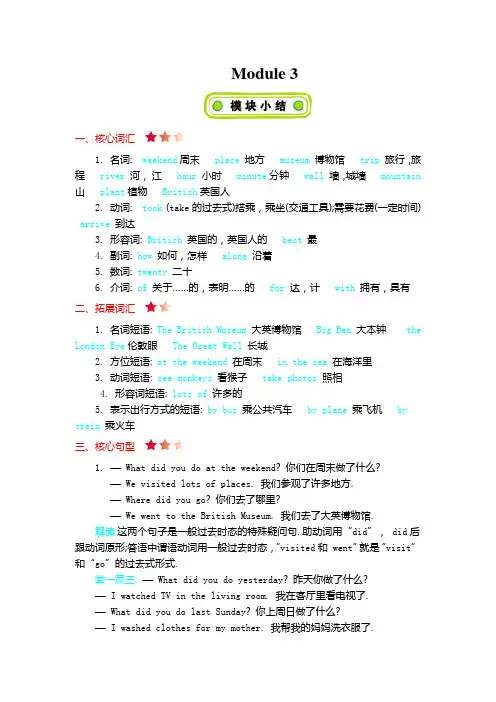
Module3一、核心词汇1.名词:weekend周末place地方museum博物馆trip旅行,旅程river河,江hour小时minute分钟wall墙,城墙mountain 山plant植物British英国人2.动词:took(take的过去式)搭乘,乘坐(交通工具);需要花费(一定时间) arrive到达3.形容词:British英国的,英国人的best最4.副词:how如何,怎样along沿着5.数词:twenty二十6.介词:of关于……的,表明……的for达,计with拥有,具有二、拓展词汇1.名词短语:The British Museum大英博物馆Big Ben大本钟the London Eye伦敦眼The Great Wall长城2.方位短语:at the weekend在周末in the sea在海洋里3.动词短语:see monkeys看猴子take photos照相4.形容词短语:lots of许多的5.表示出行方式的短语:by bus乘公共汽车by plane乘飞机by train乘火车三、核心句型1.—What did you do at the weekend?你们在周末做了什么?—We visited lots of places.我们参观了许多地方。
—Where did you go?你们去了哪里?—We went to the British Museum.我们去了大英博物馆。
解读:这两个句子是一般过去时态的特殊疑问句。
助动词用“did”,did后跟动词原形;答语中谓语动词用一般过去时态,“visited和went”就是“visit”和“go”的过去式形式。
举一反三:—What did you do yesterday?昨天你做了什么?—I watched TV in the living room.我在客厅里看电视了。
—What did you do last Sunday?你上周日做了什么?—I washed clothes for my mother.我帮我的妈妈洗衣服了。
外研版五年级英语上册Module 3 周末或假期活动 附答案
外研版五年级英语上册Module 3 周末或假期活动一重点语音。
选出下列每组单词中画线部分发音不同类的一项。
( )1. A. father B. class C. plant D. place ( )2. A. bottle B. kilo C. along D. box ( )3. A. doctor B. horse C. short D. morning ( )4. A. took B. look C. book D. food ( )5. A. animal B. talk C. wall D. walk ( )6. A. zoo B. cook C. room D. cool ( )7. A. art B. park C. warm D. dark二重点词汇。
(英汉互译)(一)有关时间的表达1. 分钟_____________________________2. 小时_____________________________3. weekend _____________________________4. at the weekend _____________________________5. at ten o’clock _____________________________6. in the morning _____________________________7. for one hour _____________________________8. one hour and twenty minutes _____________________________(二)景物及景点1. 植物_____________________________2. 河,江_____________________________3. museum _____________________________4. mountain _____________________________5. Big Ben _____________________________6. the Great Wall _____________________________7. British Museum _____________________________(三)动作1. 搭乘,乘坐(交通工具);需要花费(一定时间) _____________________________2. arrive _____________________________3. take a boat trip _____________________________4. have a good day _____________________________5. take photos/pictures _____________________________(四)其他1. 关于……的,表明……的_____________________________2. 达,计_____________________________3. 最_____________________________4. 拥有,具有_____________________________5. 如何,怎样_____________________________6. twenty _____________________________7. British _____________________________8. trip _____________________________9. along _____________________________10. lots of people _____________________________11. a photo of _____________________________12. very long and very old _____________________________三重点句子。
外研版小学英语(三年级起点)五年级上册Module3 模块整体教案
Module3 模块整体教案模块教材分析本模块在前面学过过去时的一般疑问句、陈述句、由what, how many, how much 引导的特殊疑问句的基础上继续学习一般过去时的特殊疑问句,并作相应的回答。
教学内容主要围绕着去了哪里、怎样去的、做了什么事情而展开。
教学的重心应放在如何让学生运用一般过去时来询问他人去过什么地方、怎样去的、在那里做了什么事情,要求掌握词汇place,how,took,river,minute,of,long, for, with, flower, plant。
第一单元创设情景,引出话题并进入重点语言知识的学习,主要句型是:Where did you go? How did you go to these places? What did you do at the weekend?等。
第二单元主要学习描述他人在过去做了什么事情,及字母和字母组合a,o,ar,or,al,oo,ou的发音,主要句型是:主语+动词过去式+其他,该句型表示“某人在过去做过什么事情”。
模块教学目标☆知识目标1、能理解并会说唱Unit 1 Activity 1 Listen and chant.(活动1)和Unit 2 Activity 5 Listen and say. Then sing.(活动5)的内容。
2、能听、说、读、写Unit 1 Activity 3 Listen and say. (活动3)和Unit 2 Activity 1 Look, listen and say. (活动1)中的单词和句子。
3、能听、说、认、读Unit 1 Activity 2 Listen, read and act out (活动2)和Unit 2 Activity 6 Make funny sentences. (活动6)&- Activity 7 Do and say. (活动7)中的句子和做其中的活动。
最新外研版小学英语五年级上册第三册m3
《英语》(新标准)(三年级起始用)第三册东关小学王琴Module 3 ActivitiesUnit 1 She’s writing a letter.一、Teaching Aims:通过谈论图片学习如何讲述正在发生的事情短语:writing a letter taking pictures talking to her friends playing with a toy train二、Teaching Steps:1、热身复习Greetings.教师随便提问:what do you do at the weekend? 引导学生复习以前学过的词组。
教师可提前将词组板书到黑板上,如:play basketball, play table tennis, watch TV, swim, play football等。
热身活动之后,老师向学生讲述自己的喜好,并用照片进行说明,例如:在一个学生说自己周末经常打篮球之后,老师可以拿着自己打篮球的照片说:I like playing basketball,too.Look! I’m playing basketball.使用这种方法呈现更多新语言。
老师对学生说:Please show us what you like doing.But how? You can show us a photo of you doing that.You don’t know how to say,right? Ok,let's learn the text first.让学生打开课本,对照着课本听课文,依此熟悉故事内容和情节。
引出句型,并出示幻灯。
writing a letter 点击writing超链接到原形write。
点击图片链接到letter.Pairwork: 一个问:what are you doing? 一个回答:writing a letter 并展示。
外研版(三起)英语五年级英语上册Module 3知识清单
Module 3一、核心词汇1. 名词: weekend周末 place 地方 museum 博物馆 trip 旅行,旅程 river 河,江 hour 小时 minute分钟 wall 墙,城墙 mountain 山 plant植物 British英国人2. 动词: took(take的过去式)搭乘,乘坐(交通工具);需要花费(一定时间) arrive 到达3. 形容词:British 英国的,英国人的 best 最4. 副词:how如何,怎样 along 沿着5. 数词: twenty二十6. 介词:of 关于……的,表明……的 for 达,计 with 拥有,具有二、拓展词汇1. 名词短语:The British Museum大英博物馆 Big Ben 大本钟 the London Eye伦敦眼 The Great Wall 长城2. 方位短语:at the weekend 在周末 in the sea 在海洋里3. 动词短语:see monkeys 看猴子 take photos 照相4. 形容词短语:lots of 许多的5. 表示出行方式的短语:by bus 乘公共汽车 by plane 乘飞机 by train 乘火车三、核心句型1. — What did you do at the weekend?你们在周末做了什么?— We visited lots of places. 我们参观了许多地方.— Where did you go?你们去了哪里?— We went to the British Museum. 我们去了大英博物馆.解读:这两个句子是一般过去时态的特殊疑问句.助动词用“did”, did后跟动词原形;答语中谓语动词用一般过去时态,“visited和 went”就是“visit”和“go”的过去式形式.举一反三:— What did you do yesterday?昨天你做了什么?— I watched TV in the living room. 我在客厅里看电视了.— What did you do last Sunday?你上周日做了什么?— I washed clothes for my mother. 我帮我的妈妈洗衣服了.2. — Did Lingling like the museum?玲玲喜欢这个博物馆吗?— Yes, she did./No, she didn t. 是的,她喜欢./不,她不喜欢.解读:这是一般过去时态的一般疑问句.变成一般疑问句时,把助动词“did”放在句首,后面的动词要用原形.“did”可与各种人称连用,它是do, does 的过去式形式.举一反三:— Did you go to the Great Wall last Sunday?你上周日去长城了吗?— Yes, I did. 是的,我去了.3.— How did you go to these places?你们怎样去的这些地方?— We went by bus. 我们乘公共汽车去的.解读:这是询问过去某个时间出行方式的句型及其答语.助动词用“did”,did后跟动词原形;回答时要指出交通方式.举一反三:— How did you go to school?你怎样去的学校?— I went by bike. 我骑自行车去的.— How did you go to the library?你怎样去的图书馆?— I walked there. 我步行去的那里.四、了解句型1. — What did you do at the weekend?你们在周末做了什么?— We visited lots of places. 我们参观了许多地方.解读:这是一个询问对方过去做过某事的疑问句及其回答.答句中的动词要用它的过去式.2. — Where did you go?你们去了哪里?— We went to the British Museum. 我们去了大英博物馆.解读:这是一个谈论过去到过哪儿的句型及其回答.答句中的动词要用它的过去式.3. — How are you?你好吗?— I m fine, thanks. 我很好,谢谢.解读:这是一个向某人问好的句型及其回答.有两种用法:①用作熟人之间的招呼用语,意为:你好;你好吗?②用来问候健康,意为:你好;你好吗?它的回答有三种,①I m fine, thanks. ②Very well, thanks. ③Fine, thank you.,意思均为“我很好,谢谢.”4. — Did Lingling like the museum?玲玲喜欢这个博物馆吗?— Yes, she did./No, she didn t. 是的,她喜欢./不,她不喜欢.解读:这是一个询问某人是否喜欢某地的一般疑问句及其回答.5. You had a good day!你们度过了美好的一天!解读:这是一个叙述某人度过了美好的一天的句型.6. — Who took this picture?谁拍的这张照片?— Daming did. 大明拍的.解读:这是一个询问是谁做了某事的句型.五、开拓眼界美国人们的日常生活见闻1. 在任何公共场合随处可见席地而坐的人,他们对地板是否干净似乎不需要考虑.2. 厕所里始终有手纸,你不必担心忘带手纸时的尴尬.3. 任何公共场合的门口,都设有为残疾人开门的按钮,只要按按钮,大门随即打开免费.4. 校车是免费的,交规中对它的让行和保护非常严格.5. 图书馆是小孩子的乐园,总有一块领地是属于孩子的,他们可以非常自在地看书,看DVD,上网,甚至嬉戏.6. 一般钓上来的鱼不吃,而是放生.他们吃带刺儿的鱼肉不专业,只好买已经削成薄片的海鱼.7. 住宅几乎都是木制的,混凝土的建筑只有写字楼可见到.8.许多学校的食堂,除了吃饭还是学习的场所,许多学生都带着电脑、书什么的,还有做作业的,而且比较干净.。
外研版第五册 五年级上册3~10模块短语知识点

Module3 Unit11.where 什么地方2.what 什么3.when 什么时候4.how 如何怎样5.tell me 告诉我6.go(过去式)went 去7.at the weekend 在周末8.visit (过去式)visited 参观9.lots of 许多10.place(复数)places 地方11.the British Museum 大英博物馆12.Big Ben 大本钟13.the London Eye 伦敦眼14.these paces 这些地方15.by bus 乘公共汽车16.like the museum 喜欢博物馆17.like(过去式)liked 喜欢喜爱18.the bus ride 乘公车19.like...best 最喜欢...20.take(过去式)took 拍摄搭乘花费21.take a boat trip 乘船旅行22.along the river 沿着河流23.one hour 一小时24.twenty minutes 二十分钟25.have (过去式)had 度过有吃26.have a good day度过美好的一天过得愉快Module3 Unit21.arrive(过去式) arrived 到达2.walk(过去式)walked 走路步行散步3.are (过去式)were 是4.take this picture 拍这张照片5.this one 这一(张;个;双)6.go to the Great Wall 去长城7.at the weekend 周末8.by bus 乘公车9.arrive there 到达那里10.at ten o’clock 在十点钟11.in the morning 在上午12.very old and very long 非常古老非常悠长13.walk on the wall 在城墙上散步14.for one hour 一小时15.lots of people 许多人16.took photos of... 拍......的照片17.mountain (复数)mountains 山18.with 拥有19.beautiful flowers 美丽的花20.flower (复数)flowers 花21.green plants 绿色植物22.plant (复数)plants 植物23.Daming and his father 大明和他的爸爸24.by plane 乘飞机25.by train 乘火车26.in the sea 在海里Module4 Unit11.this pair of shorts 这条短裤2.I don’t want shorts. 我不想要短裤3.I want trousers. 我想要长裤。
五年级外研版上册三模块单词读音
五年级外研版上册三模块单词读音外研版五年级上册分为三个模块,分别是Unit 1 My School,Unit 2 My Family,Unit 3 My Week。
下面我将分别介绍每个模块中的单词读音。
模块一:Unit 1 My School这个模块主要介绍学校的各个部分和学习用品等。
以下是一些重要的单词读音:1. library /ˈlaɪ.brər.i/图书馆2. playground /ˈpleɪ.ɡraʊnd/操场3. canteen /kænˈtiːn/食堂4. classroom /ˈklæs.ruːm/教室5. desk /desk/课桌6. chair /tʃer/椅子7. blackboard /ˈblæk.bɔːrd/板书8. bookcase /ˈbʊk.keɪs/书柜9. computer /kəmˈpjuː.tər/电脑10. pen /pen/钢笔模块二:Unit 2 My Family本模块主要介绍家庭成员和他们的职业。
以下是一些重要的单词读音:1. father /ˈfɑː.ðər/父亲2. mother /ˈmʌð.ər/母亲3. sister /ˈsɪs.tər/姐妹4. brother /ˈbrʌð.ər/兄弟5. grandmother /ˈɡrænˌmʌ.ðər/奶奶6. grandfather /ˈɡrænˌfɑː.ðər/爷爷7. aunt /ænt/姑妈8. uncle /ˈʌŋ.kəl/叔叔9. cousin /ˈkʌz.ən/堂兄弟姐妹10. doctor /ˈdɑːk.tɚ/医生模块三:Unit 3 My Week这个模块介绍了一周七天的单词,以及每天的活动等。
以下是一些重要的单词读音:1. Monday /ˈmʌn.deɪ/星期一2. Tuesday /ˈtuːz.deɪ/星期二3. Wednesday /ˈwenz.deɪ/星期三4. Thursday /ˈθɝːz.deɪ/星期四5. Friday /ˈfraɪ.deɪ/星期五6. Saturday /ˈsæt͡ʃːr.deɪ/星期六7. Sunday /ˈsʌn.deɪ/星期日8. morning /ˈmɔːr.nɪŋ/早晨9. afternoon /ˌæf.tərˈnuːn/下午10. evening /ˈiː.vniŋ/晚上以上是我为大家整理的五年级外研版上册三个模块中的一些重要单词的读音。
小学英语外研版(三起)五年级上Module3本模块综合与测试-章节测试习题(10)
章节测试题1.【答题】阅读短文,根据短文内容补全句子。
Lucy and her sister went to the Yangtze River last Sunday. They went there at nine o'clock in the morning. They went there by bike. Then they walked for one hour along the river. There were lots of people. Lucy met two friends. They took photos of the river. Lucy took a photo of her sister. Her sister took photos of Lucy and her friends too.(1)Lucy and her sister went to the Yangtze River ______ ______.(2)They went there ______ ______ ______ in the morning.(3)They went there ______ ______.(4)They walked for ______ ______ along the river.(5)They ______ ______ ______ the river.【答案】(1) last Sunday (2)at nine o'clock (3)by bike (4)one hour (5)took photos of【分析】本题考查阅读填空。
【解答】(1)根据Lucy and her sister went to the Yangtze River last Sunday. 可知答案为last Sunday。
(2)根据They went there at nine o'clock in the morning. 可知答案为at nineo'clock。
外研社英语(三起)五年级上册第三模块教学课件
二、根据图片回答问题。 1. What did you do?
I rowed a boat on the lake. 2.Where did you go?
I went to the Great Wall. 3.How did you go to the library?
I went there by bus. 4.What did you see?
Module 3
──── How did you get there? ──── By car.
────How did you know it? ──── Amy told me.
──── How do you go to school? ──── On foot.
take a bus = by bus took a bus = by bus
A. a B. i C. r D. e e E.来自u F. i n G. o u
二、英汉连线。
1. lots of 2. Big Ben 3. along the river 4. by bus
A. 沿着河 B. 乘公共汽车
C. 许多 D. 大本钟
三、用括号内所给单词的适当形式填空。
It 1._w_a_s__ (be) sunny last Sunday. Daming and his father 2.__w_e_n_t_ (go) to the Great Wall. They 3._w_e_n_t (go) there at ten o’clock in the morning. They 4._t_o_o_k__(take) a bus to Badaling. Then they 5._w_a_l_k_e_d(walk) for an hour. They 6._s_a_w__ (see) lots of people and they 7._t_o_o_k_ (take) photos of the mountains. The people 8._t_a_lk_e_d_ (talk) to each other. They 9._h_a_d__ (have) a lovely time. They 10._w_e_r_e_ (be) very happy.
外研版小学英语(三起)五年级上册Module3单词词组解析
外研版小学英语(三起)五年级上册Module3单词词组解析Words and Expres sion s in Module3单词词组解析SB P.66 Words and Expressions in Each Module:Module3week(星期)+end(结束)=weekendweekday周工作日place-places place-plane/plate/palacethe British英国人English Chinese the Ukmuseum-museums museum-libraryhow about/what about how many/muchwell的最高级well的比较级better★★★weekend的用法:this/that weekend这个/那个周末last weekend上个周末,next weekend下个周末at the weekend在(特指的这个)周末at weekends在(每个)周末Last weekend I visited my uncle.上个周末我看望了我的叔叔。
I’ll go shopping at the weekend.周末我要去购物。
(特指的这个周末)I often go to the park at the weekend.我经常在周末去公园。
I don’t work at weekends.我周末不上班。
(哪个周末也不上班)★★★place的用法:these/those places这些/那些地方some placeslots of /a lot of/many places许多地方I visited this place last year.去年我参观过这个地方。
I will go to that place by train.我将乘火车去那个地方。
Dalian is a beautiful place.大连是个美丽的地方。