
2017年人教版小学六年级英语教学计划
2018学年人教版六年级英语教学计划(上学期)
—、指导思想:
适应知识经济时代的创新要求,贯彻素质教育的精神,以党的教育方针和邓小平同志的三个面向为指导,遵循第二语言教学的客观规律,以提高整个中华民族的思想道德素质和科学文化素质,为符合多元化的社会需要培养人才。
二、学情分析:
本学期我新接手任教六年级三个班的英语教学。
三个班各有其特点,从上学期期末考试成绩来看都有不同程度的进步,一班和三班合格率和优秀率都比较高,班级悬殊比以前有所缩小,总的说还是养成了一些好的习惯,英语学习兴趣较浓,师生感情比较融洽。
但成绩还是不够理想,仍然存在两极分化,学生个体差异大,成绩悬殊大,好的打满分,也有不能及格的。
针对上述情况,教师在教学过程中,既要注重对优生的培养,又要注重对希望生的辅导,做到全体学生全面发展,要培养学生养成良好的学习习惯,继续注重正确的语音、语调的学习,注重方法的指导,为学好英语打好坚实的基础。
在思想方面要经常教育学生爱国守法,明理守信,团结友爱,勤俭自强。
三、学期教学目标:
本着激发学生学习英语的兴趣,培养他们学习英语的积极心态,使他们初步建立学习英语的自信心;培养学生具有一定的语感和良好的语音、语调、书写基础,以及良好的学习习惯;使他们初步具备用英语进行简单日常交流的能力。
同时培养学生的观察、记忆、思维、想象和创造能力。
适当介绍中西方文化,培养学生的爱国主义精神,增强世界意识,为学生的进一步学习奠定良好的基础。
1、能听懂、会说12组会话,并能进行适当的交流。
2、能听、说、认读66个单词和词组并能听、说、读、写76个单词和24个句子(包括交通方式、时间、衣服、天气、购物、农场动物、数字、颜色、爱好、等几个话题),并能简单运用。
3、能掌握国际音标。
4、能学会3个小制作。
5、能唱8首英语歌曲。
6、能听、说、唱8首歌谣。
7、能完成6个自我评价活动。
8、能阅读懂14篇英语短文。
9、能看懂六个英语故事。
10、能了解6项简单的中西方文化知识。
四、教材分析:
本教材是以话题为纲,以交际功能为主线,兼顾语言结构,侧重学生的听说能力培养,逐步引导学生运用英语完成有实际目的的语言任务,即:话题-功能-结构-任务。
全册书分为6个单元,两个复习单元。
每个单元分为A、B、C三个部分。
从听说入手,逐步向读写展开,比较注重评价体系建设,加大了文化板快的内容。
书中编排大量的彩图,尽力做到图文并茂,引起兴趣,激发学生学习英语的积极性。
课本中所提供的语言材料与插图,便于学生在具有接近实际意义的生活环境中进行听说训练与会话交流。
本册教材具有以下几个特点:
1、注重语言的实践性、交际性,让学生在运用语言活动和任务中体验和感受语言,提高语言运用能力。
2、注重语言的整体性、文化性和教育性,让学生在中外文化中积淀文化底蕴,树立跨文化意识、国家意识和民族意识。
3、注重教学方法的趣味性、科学性,让学生对英语学习保持浓厚的兴趣和持久的学习动力。
4、以文为主,情景画面为话题和交际服务,突出了语言的内容和形式,有利于学生把注意力集中在语言上。
5、注意跨学科教育,教材内容涉及较广,如有语文、数学、地理、音乐、社会、人文、自然、思品等多方面的知识。
6 、注重能力培养,引导学生在学习中反思,在反思中学习,有效地增进他们的自我意识,以利于学生的终身学习和发展。
十一、评价措施:
1、知识与能力的评价
从英语朗读、口语交际、模仿写作、对话表演等方面考察。
分平时与期中期末进行。
2 、学生自我反思学习过程的评价,以加分累计制进行。
3、教师评价,同学互评,分单元进行。
4、家长对学生的评价,从家庭作业和问卷调查进行。
总之,对学生的评价要注意整体性与综合性结合,形成性与终结性结合,达到全面综合的评价目的。
2017年秋季最新人教PEP版小学六年级上册英语教案全套

最新人教PEP版小学六年级英语上册全册教案2017年秋季学期小学六年级英语教学计划一、教材分析本册教材是PEP改版的新教材,该教材注重学生语言应用能力的培养,教材在整体构思、内容安排、活动设计和教学方法选用等方面紧密联系学生的生活实际,把知识和技能目标融会在完成任务的过程之中,充分体现了交际教学的思想,但是Let’s talk 部分难度加大,课文中的每一个对话都可以视为一篇完整的阅读理解。
更加考验学生对英语知识的综合理解及运用能力。
本册课本共6个单元,其中有2个复习单元。
二、指导思想为贯彻落实国家的教育方针,学习并实践习总书记的“中国梦”重要思想,为孩子的终生发展奠基,围绕学校的中心工作,结合实际,力求做到有计划、有目的地实施教学大纲的要求,以便使学生获得一些最基本的语言知识和技能,培养他们良好的学习习惯,为以后继续学习英语奠定良好的基础。
三、教具、媒体单词图片、flash动画和ppt教学。
.四、各单元的教学目标、教学重难点和课时安排Unit 1 How can I get there ?教学目标:要求学生能够简单描述城市、城镇或乡村内公共设施的大致位置,如:Where is the museum? It’s near the hospital. 能够询问路线并简单回答如:How can we get there? Turn left at the bookstore.要掌握Let’s learn , Let’s talk 中的四会短语、四会单词和句子帮助学生了解交通规则,并在生活中自觉遵守交通规则。
教学重点:学习如何问路并回答。
教学难点:学生能够熟练使用所学语言询问并回答某地的方位和感叹句。
课时安排:6课时(第1---3周)Unit 2 Ways to go to school .教学目标:要求学生能够正确询问并回答乘坐何种交通工具去某地,如:How do you go to school? I often go by bus.能够描述人们日常出行的方式.要求学生掌握Let’s learn , Let’s talk 中的四会的短语、单词和句子.帮助学生了解交通规则,并在生活中自觉遵守交通规则,特别是要学会看交通信号灯,安全的过马路。
人教版2017小学六年级(上 册)英语 全册教案 WORD版

Unit 1 How do you go there?Period OneTeaching contents: Part A Let’s learn & Let’s playTeaching aims:1.To enable the students to master the four skills phrases: on foot,by bike,by bus,by train, by plane,by ship,by subway2.To enable the students to ask about the ways of traffic with the following sentence patterns: How do you go to school? Or How do you go to Canada…?‖and answer with―I go by…‖Teaching focus:To master the four skills phrases: by train ,by plane, by subway, by ship , by bike, on footTeaching difficulty:To differ ―subway‖ from―train‖Teaching methods:Communicative ApproachTeaching aids:1.Word cards2.Tape recorder and tape3.Multi-media playerTeaching procedure:1. (Warm-up)Greeting: Good morning , class !Glad to meet you again. How are you?What day is it? What ‗s the date?What‘s the weather like today?2. PresentationShow a picture of busT: What‘s this? S: It‘s a bus.T: I go to school by bus. How do you go to school?(Show a pict ure of bike and help a student to answer with ―I go to school by bike.‖)(In the same ways )Teach ―by subway‖ and ―by train‖ ―by ship‖ ―by plane‖ ― on foot‖.Subway: It's an underground railway in a city.It travels very fast.we can see subway in Hong Kong, Beijing, Shanghai, Gongzhou…Explain the differences between subway and trainPay attention to the pre. ― by‖& ―on‖3.Play gamesAsk one S to the front and stick the word cards next to the phrases written on the Bb when T read the new phrases quickly and the other Ss put up their cards. The one who reflect fastest and correctly is the winner.4.Listen to the tape of Part A Let‘s learn and follow it.Pay attention to the tone and pronunciation5.Practice: Let‘s playT Offer many places (the USA. England Australia Hong Kong Shanghai Guangzhou the moon…)and traffic ways (by car/ taxi/ bus… on foot)Ss practice with above places and ways in pairs:A: How do you go to school?B: I go to school on foot.Encourage the Ss to make up as many sentences as they can.6.Spelling competitionDivide the class into tow groups. Show the pictures of traffic tools and ask Ss to spell the phrases. The first one who puts up hand gets the chance to spell. The group spell out more phrases are the winners.HomeworkCopy the new words and phrasesFinish Page1 of the ABBb design:Unit One How do you go thereHow do you go to school/ Canada?I go to school on foot/ by subway/ bus/ train/ taxi…Teaching reflection:Unit1 How do you go there?Period TwoTeaching contents: Let’s try & Let’s talkTeaching aims:1.To master the four skills sentence: ―How do you go to school? Usually I go to school onfoot.Sometimes I go by bike.‖2.To enable the Ss to ask and answer about traffic ways and explain the simple reason whyhe or she chose this traffic way.I go to school on foot, because my home is near.3.To make the Ss understand the listening material in ―Let‘s try‖Teaching focus:To use and write the following key sentences:How do you go to school?Usually I go to school by bike. Sometimes I go on foot.Teaching difficult points:To write the key sentences: How do you go to school?Usually I go to school on foot.Sometimes I go by bike.To use Adverbs of frequency: usually, sometimesTeaching aids:Tape recorder Teaching cards a piece of paperTeaching procedure:1. (Warm-up)T: Good morning! How do you go to school today? What about you? Do you go by bus,too?‖2. Have a dictationAsk the Ss to dictate the new words learnt in the last lesson.On foot by bus by train by plane by subway…3. Let'stryGuide the Ss to look at the pictures and askWho‘s the boy? He‘s Mike. How does Mike go to sch ool?Play the tape and listen:John:How do you go to school,Mike?Mike:I usually go to school by bike.Sometimes I go 0n foot.John:Is your home near our school?Mike:Yes.it is.J0hn:That's fine!4. (Presentation)Let's talkT: How do I go to school,do you know? Ask me,please!Draw a bike, a bus, a taxi on the Bb and write the price by each picture. bus 1 yuan taxi 10 yuanEncourage the Ss to ask―How do you go to school?T: Usually I go to school by bike, because it's good exercise.Sometimes I go by bus,because it's cheap.It costs l yuan. Sometimes I go by taxi,because it's fast,but it's tooexpensive.It costs 1o yuan.Explain that we use usually and sometimes to express frequency.T: ―How does Sarah go to school? Listen.‖Ask th e S to imitate Sarah‘s tone to answerSarah: Usually I to go school on foot. Sometimes I go bike.Ss read after the tape. Then practice in pairs to make up the new dialogue according toeach picture.Ask several pairs to act out the dialogue.5.Group workRead the dialogue .Then practice in groups of four. They can expand their dialogue likethe following:A:How do you go to school/ hometown?B:Usually I go by bus.A:Can you go by bike?B: Yes,I can,but it's too far.Sometimes I go by taxi,because it‘s fast, but it's expensive.What about you?A:I go to school on foot,because my home is near.6.Play finding order gamesShow the following word cards and ask Ss to form correct sentences.How, do , go , to , school, youI , usually, on , go , school , to , footSometimes, by, bike, go , IHomework:Finish AB Page2Bb designUnit1 How do you go thereHow do you go to school?Usually I go to school on foot, because it‘s near.Sometimes I go by bike, because it‘s fast.Period ThreeTeaching contents: Let’s readTeaching aims:1.To improve reading skill2.To consolidate the traffic ways3.To improve understanding ability.4.Teaching focus:How do we go to the park?It‘s easy.How to finish answering the questions in the bookTeaching difficult points:How to express the different ways to a placeTeaching aids:Tape recorder a piece of paper masks of Zhang Peng and SarahTeaching procedure:1.ReviewFree talk2.DictationHow do you go to school?Usually I go to school on foot.Sometimes I go by bike. What about you?3.Review different placesT: This is a very nice place. There are many students and teachers. There are many rooms, such as classroom, art room, music room… What‘s it?It‘s a beautiful place. Many people like to play in it. There are nice flowers, trees and grass. There are toys. What is it?It‘s a park.4.PresentationT: Where is my home? Do you want to know?Describe with different traffic ways and use ―first‖ ―next‖ ―then‖ .It‘s a little far from here. First I go to Zenbu bus stop on foot. Then I can go by the No.74 bus to the East Bus Station... We live on the ninth floor,Room902.Explain ―then‖5.T ask individual :Where is your home?Is it near the park? Which floor?In pairs practice above questions6.Play the tape and students follow it.Ask: How can we go to Sarah‘s home?How can they go to the park?Finish answering the questions, then check the answers.7.PracticeRead the text. Boys to be Zhang Peng,and girls to be Sarah.Work in pairs to read the dialogue.Ask several pairs to act out.8.Make up new dialoguesHomework:Do Page 5 in ABMake a survey and fill in the following formBb design:How do we go to the park?It‘s easy.Which floor?The fifth floor, Room 5APeriod FourTeaching cont ents: Let’s learn and Let’s playTeaching aims:1.To master the phrases: Stop at a red light. Wait at a yellow light. Go at a green light.5.To know some traffic rules about traffic lightsTeaching focus:To understand the traffic lights commands and do the action:Stop at a red light.Wait at a yellow light.Go at a green light.Teaching difficult points:The meaning of the three traffic lights and do the correct action of the commandsTeaching aids:Tape recordera flash card of traffic lightsword cardsTeaching procedure:1.Free talk2.Warm-upAsk Ss to do actions when they hear the orderStand up , touch your ears,turn Left, right, go , turn around…3.ReviewHow do you go …?Ss should make a true answer and give the reason.4.Revise the words of colours5.T: ( show traffic lights)What are they?They are traffic lights.T: How many colour?What colours are they?What do they mean?T show a red light and say:It‘s a red light. I must stop at a red light.It‘s a yellow li ght. I must wait at a yellow light.It‘s a green light. I can go at a green light.Do you know the traffic rules?Draw three traffic lights on the Bb and write the traffic rules next to themStop at a red light.Wait at a yellow light.Go at a green light.6.Play the tape and Ss follow it.Explain ―remember‖ by doing gesture.7.Let‘s playAsk ten students to the front to do actions of traffic lights commandsFive girls are Group A. The other boys are Group B. When T show the yellow light they must wait. If not the one who disobeysShould get back to the seat. In the end the group with more people win the game.8. Consolidation and extensionDiscuss the different traffic ways and rulesHow do you go to school?I go to school On foot.Can you tell me any traffic rules?You must watch the traffic 1ights.I go to school by bus.Can you tell me any traffic rules?Don't run in the bus.Don't stick your head Or arms out Of the window.I go to school by bike.Can you tell me any traffic rules?Don't go too fast.Never go into the sideways.Homework:Copy the traffic rules written on the BbFinish AB Page4Bb design:Traffic lights traffic rulesRed light Stop at a red light.Yellow light Wait at a yellow lightGreen light Go at a green light.Teaching reflection:Period 5Teaching contents: Let’s readTeaching aims:1.To improve reading skill2.To consolidate the traffic rules and know different countries have different traffic rules.3.To improve understanding ability and make Ss get right information from the readingmaterial.Teaching focus:Understanding the the meaning of the text and finishing the ―tick or cross‖Teaching difficult points:To improve the reading skillsTo understanding the following sentences:In China/the US,drivers drive on the right side Of the road.In England and Australia,however,drivers drive On the 1eft side Of the road.Teaching aids:Tape recorder flash card of traffic lightsA photo of Singapore streetTeaching procedure:1.Free talk2.ReviewStop at a red light.Wait at a yellow light.Go at a green light.Let the Ss do the actionsDictate the above sentences.3.T: (put up the right hand) This is my right hand. Show me your right hand! Then show meyour left hand.Do actions as I tell you:Turn left. Turn right. Turn back. Touch your left ear…4.Discuss traffic rulesT: Red means ―stop‖ .if the light is red ,you must stop.Yellow means________ ,if the light is yellow you must ______.Green means _________, if the light is green you can ________.5.Show a photo of Singapore street and ask the Ss to find out the differences.T: The traffic lights are the same in every country. But what about other traffic rules? Look at the picture. It‘s in Singapore. what ‗s the differences.Help the Ss to answer:In Singapore, the driver is on the left side. In China the driver is on the right side.6.ReadAsk the Ss to read the passage and do the exercises.Check the answer together.Teach new words:Find difference every countryAlways drive if mustKnow England Australia howeverExplain the following sentences:In China, drivers drive on the right side of the road.In England and Australia, however, drivers drive on the left side of the road.Read the text again and put up any questions.HomeworkAsk Ss to find more traffic rulesBb designThe same every country alwaysMean drive right side England AustraliaHowever if must knowTeaching reflectionPeriod 6Teaching contents: Part A Let’s try & Let’s talkTeaching aims:1.To enab le the students to master the four skills sentences: ―How Can I get to Zhongshan Park?You can go by the No.15 bus.2.To enable the students to use polite words in dialogue:Excuse me. Thank you. You‘re welcome.3.To Review the names of places: post office , supermarket, cinema, bank, hospital, fast foodshop…Teaching focus:How can I get to Zhongshan Park?You can go by the No.15 bus.Teaching difficulty:How to use ―how can I get to …?‖‖you can go by…‖correctlyThe meaning of ―If you like‖Teaching methods:Communicative ApproachTeaching aids:1.Tape recorder and tape2.Multi-media player3.A map of Dongguan city.Teaching procedure:1.Free talk2.What day is it today?How many students are there in your class?Who is No.1/2…?3.Go over the traffic rules:It's a yellow light,I must wait.Now the light is green,I can go.Don't go at a red light. A car may hit you.4.Go over the numbers from 1-100.Pay attention to 30, 13 40, 14, 50, 15, 16, 60 ,70, 17, 18,80 ,90 ,195.Let's tryPlay the tape of this part and students listen and tick.Man:Excuse me, how can I get to Dongfang Primary School?Zhang:You can go by the No.14 bus.It's next to the nature park.Man:Thank you.Zhang:You're welcome.Play again and Ss repeat.6. PresentationLet's talkShow a traffic map of Dongguan and askWhere is (place/ bus number)?Show the map in the bookWhat‘s near the bus stop?Teach: supermarket , cinema, bank, hospital, fast food shop , bookstore, schoolLet‘s the students find the places on the map.Play the tape of this part and get the Ss read after it.Explain: If you like.Ask:T: I want to buy some fruit and clothes . Where should I go?Where is the supermarket?How can I get to the supermarket?Show the traffic map of Dongguan.Get the Ss ask and answer:A: Excuse me , How can I get to Walmarket?B: You can go by the No….bus.Ask several pairs to act out.Homework:Do Exercise 3& 4 of Ab Page5Bb design:How can I get to Ahongshan Park?You can go by the No.15 bus.If you like.Period Seven●Teaching contents : Good to know ,Let‘s sing,●Teaching aims:1.To recognize some usual traffic signs .2.To improve the student‘s traffic consciousness3.To understand and sing the song ―How do you go to school?●Teaching focus :Ss can say these traffic rules according to the traffic sings:Crosswalk No entry Turn right NO bikes One way No left turn●Teaching difficult points :To recognize the traffic signs●Teaching methods :Read and perform●Teaching aids :Tape recorder Powerpoints●Teaching procedure:Step 1.Review1.Duty report :Good morning ,everyone.. I‘m on duty today. Today is Monday ,September19th.It is sunny today .Everyone is here .Thank you!Step 2.DictationDictate the new words we have learned last week.Step 3.Review the traffic rules1Ask some students: ―How do you go to school ?Why ?‖Get Ss to talk freely.2.Review the traffic rules .Show the traffic lights ,ask ―What are these ? What colours are they ?What does it mean ?‖Get Ss to answer .3.T : The traffic lights are the same in every country ,but the traffic rules are different.For example :In China ,drivers drive on the right side of the road ?What about in England and Australia ? Get Ss to answer :Drivers drive on the left side of the road .Step4. Presentation1.T: If you go by car, by bike or on foot ,you must know some traffic rules .What other rules do you know ?Encourage Ss to say some traffic rules .2.Show some traffic signsT: Where can you see there pictures ? ( In the street./On the road .)Do you know what they means ?Show the pictures one by one and tell them the traffic rules :Crosswalk :If you cross the road ,you must walk on the crosswalk .Turn right : You can turn right if you see this picture .Turn left : You can turn left if you see this picture.One way : In one directionNo entry :Don‘t come in .No bike : Don‘t ride a bike .No left turn : Don‘t turn left .No right turn: Don‘t turn right .Step 5 .PracticeGet Ss to match the signs with the words.Ss can make some other traffic signs by themselves.Step 6.Sing a songPlay the tape ,Ss listen and try to sing the song ―How do you go to school ?‖Homework :Finish Exercise 5 on page3 of the activity book.Make a survey .Ask the classmates :How do you go to school ?And complete the form on page 10.Bb design :Crosswalk No entry Turn right Turn leftNo bikes One way No left turn No right turnTeaching reflection:The eighth lessonTeaching contents :Story timeTeaching aims :To understand the story of this part ,and Ss can perform the story.To train the Ss to obey the traffic rules .Teaching focus :Ss can understand the story and train their good reading habit.Teaching difficulty :1.Students can perform the story in roles .Teaching methods :Read and performTeaching aids :1.Tape recorder and tape2.The head portraits of Zip ,Zoom and policeman3.Some pictures of bike ,car ,taxi and traffic lightsTeaching procedure :Step 1. Review1.Duty report2.Make a survey .Ask :How do you go to school ? Get Ss to answer and make a statistics .How many Ss go to school by car /by bus /on foot.3.Review the traffic rules .Step 2. Presentation1.Show a picture of a people who is walking ,ask : What is he doing ?(He is walking .)Do you like walking ? I like walking .Because It‘s a good exercise .Write good exercise on the Bb .2. Play the game of Let’s play .Ask a student say :stop ,wait ,go .The other Ss do the actions .T: You are good children because you know the traffic rules .Let me do it .I make some wrong actions ,when the Ss remind me , write be against the traffic rules on theBb. Say .I am against the traffic rules .Step 3.ReadAsk Ss to look at the pictures on page 13 ,introduce Zip and Zoom to them.Then play the tape and Ss read after it.Then try to ask then some questions :1.How many dollars do they have ?2.Where are they going ?3.Do the go by taxi ?Why not?If they can not answer ,give them some help.Step 4.PerformanceSs read the story again .Then get them perform the story .If someone does very well ,give them praise cards.Step 5 .ExtensionAsk the Ss ,If you are Zip and Zoom ,How do you go to the restaurant .Get Ss to discuss this question .Homework :Finish Part 5 on page 6 of the activity book .Bb design:good exercisebe against the traffic rulesTeaching reflection :The ninth lesson●Teaching contents: Let‘s start. Task time●Teaching aims :1.To master the important sentences :How do you go to school ?I go to school ... Ss can use by bike ,by car ,by bus ,on foot to answer.How can I get to ... ? You can go by the No. bus .2. To finish the task of task time .3. To understand the contents in Let’s try .●Teaching focus :Ss can use these two sentences correctly :How do you go to school ? I go to school by bike ,by car ,by bus .How can I get to ...? You can go by No. bus .●Teaching difficulty:To finish the task in Task time .●Teaching methods:Ask and answer .●Teaching procedure:1 .Review1.Duty report.2.Dictate the new words and phrases in Unit one .by bike by bus by subway by train by ship on footgo to school traffic lights traffic rules stop wait get to2.Look at the pictures of Let’s start ,say ;there are many ways to go somewhere ,do youknow what they are. Ss point out the ways in the pictures. Tell them the first one is by horse .3. Show the flashcards in Let‘s learn and review the words .such as on foot by bike by carby bus by ship by plane by ship4. Open the books on page3 ,show the picture to the students ,Get students to look at the pictures and ask and answer in pairs .5Let‘s chant .Play the tape ,students listen and read after it .Make sure they can understand the meaning of the sentences .6Make a survey.Ss can ask four students in the class :How do you go to school ? Complete the form on page 10 . Write down the names and tick the ways the go to school .Make sure they can use on foot /by bike /by bus /by car /… to answer.7. Make a chart .According to the information of part one .Finish the work of part two .Then get them to make a summary : A goes to school on foot.B andC go to school by bus.D goes to school by car .E goes to school by subway.HomeworkRead the phonetic symbols they have learned last week.Bb design:How do you go to school ?I go to school on foot /by bike /by bus /by car .Teaching reflection :The tenth lesson●Teaching contents : Pronunciation, Let‘s check●Teaching aims :1.To recognize and read the phonetic symbol /i: / / i/ /p / /b / /t / /d /2.To read the syllable that these phonetic symbol make up .3.Ss listen to the passage in Let‘s check and tick .●Teaching focus :To recognize the phonetic symbols.●Teaching difficulty :Ss can read the syllables include the phonetic symbols the have in this lesson●Teaching methods :Read and listen●Teaching aids :Tape recorder and tapeSome cards of phonetic symbolsMulti-media playerSome word cards.●Teaching procedure:1 Review .Duty report .Ask the Ss freely: How do you go to school ?2 The phonetic teaching and practice(1) Write two houses on the Bb ,one is high ,the other is low .The teacher points to the first house ,say :This is Miss Eagle‘s house .How do you go toMiss Eagle‘s house ? We can go by plane.Show a word card with peak and say :Hello ,I’m Peak .I’m in Miss Eagle’s house .Then put this word in the house .Then show other words cards ,and get students put them in the right places .Then get students to read these words and the phonetic symbols/p / /b / /t / /d / /i: /Tell the Ss ,in a word ,the letters ee and ea usually sound /i: /(2) Then show the house of Mr Pig and use the same way to teach / i/(3) Play the tape ,get students read the phonetic symbols and words after the tape.(4) Match the phonetic symbols with the right words.(5) Read some wordsbe bean beef bee dean deed teach pea tea eatbid bit did dig dip pick till tick tip pink(6) Read some tongue –twisters1.This is a big pink pig ,a big pink pig .Is it a big pink pig? Yes ,it is ,Yes, it is .2.P .P. P, can we eat some peas ?Please ,please ,please ,eat some peas!3.Teacher,teacher,teacher . Can we eat the pizza ? No, no, no, please eat green beans!3. ListeningPlay the tape ,get students to listen and do the exercise.① John: How do you go to school ,Amy?Amy: I usually go to school on foot .My home is not far from school.② John : How can I get to the post office ,please ?Zhang: You can go by bike .It‘s just in front of our school.③Liu: Where is the zoo ,please ?Mike: It‘s near my home.You can go by the No.4 bus .Liu : Can I go by subway ?Mike : Sure ,If you like.④ Chen : Is the park far from here ?Amy: Yes ,it is .You can go by the No.5 bus .Chen : Can I go by bike?Amy: No ,that‘s too far.Homework:1.Read the tongue-twisters after class .2.Finish the exercises on page 7 of the activity book.Teaching reflection :The eleventh lesson●Teaching contents: Review the words and sentences in Unit one.●Teaching aims:1.Review the words in this unit: by foot bike bus train plane ship subwayhow go to school traffic traffic light traffic rule stop wait get to2.The main sente nces :How do you go to school ? I go to school …How can I get to …? You can go by No. bus .3. Review the traffic rules .a. Stop at a red light .b. Wait at a yellow light .c. Go at a green light .d. Drivers drive on the right side of the road in China.Drives drive on the left side of the road in England ,Australia and HongKong.4. Review the phonetic symbols /i: / / i/ /p / /b / /t / /d /●Teaching focus:Ss can master the words and sentences .●Teaching difficulty:Ss can use the words and sentences to make a dialogue .●Teaching methods:Read and practice●Teaching procedure:1. T: Today we will review what we learned in this unit .Show the powerpoints of Let’s learn and ask How do you go to school ?Get Ss to answer :I go to school by bike /by car /by bus /on foot.Write the sentences and words on the Bb .The twelfth lesson●Teaching contents:Do some exercises.●Teaching aims:To review the words and sentences in Unit One .●Teaching focus:To practice the words and sentences they have learned .●Teaching methods:Students do the exercises by themselves .●Teaching aids:Multi-media player●Teaching procedure:Do the exercises1.Read and fill in the blanks .阅读,填空1._______ do you go to Hainan? I go by ship .2.I usually go to visit my grandma ___ foot .________ (有时) I go ___ bike .3 I am a student ,____ ____ you ? I‘m a student too .4.---Let‘s go to the park this afternoon .--- Ok ,see you ____ 3 o‘clock .--- _______ _______ then .2.Read and choose .选择填空( ) 1. Go _____ a green light . A. to B. at C. in( ) 2. The ______ are the same in every country .A.traffic lightsB.traffic rules C . traffic( ) 3. In the Us, drivers drive ______ the right side.A. in B . on C. to( ) 4 . Look at the lights .Yellow ______ ― wait‖.A. means B meaning C . mean( ) 5. Now I am standing on the left side ____ the road .A. inB. onC. of( ) 6. ______ can you get to the zoo ? By bus.A. How B . What C. Where3. Read and write .朗读,填空1. Look at me ! I _______ (经常) go to school _____ _____.2. Please remember the _____ _____ (交通规则). ______ at a green light .3. I go school _____ bike .But _____(有时) I go ______ taxi.4. _____ at a red light .5.Look at the ______ ______ (交通灯)。
【最新】2017-2018学年pep人教版英语六年级第二学期教学工作计划
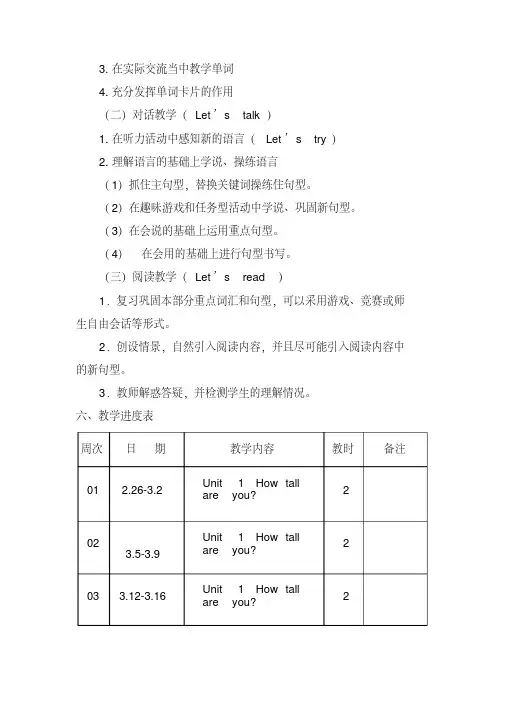
教时 2
备注
05 3.26-3.30 Unit 2 Last weekend 2
4.2-4.4
06
Unit 2 Last weekend
(3 天)
4.8-4.13
07
Unit 2 Last weekend
(6 天)
1
清明节放假 5-7
3
08 4.16-4.20
Unit 3 Where did you go?
2
14 5.28-6.1
Unit 4 Then and now
2
15 6.4-6.8
期末总复习
2
周次 日 期 16 6.11-6.15
教学内容 期末测试
教时
备注
3. 在实际交流当中教学单词 4. 充分发挥单词卡片的作用 (二)对话教学( Let ’s talk ) 1. 在听力活动中感知新的语言( Let ’s try ) 2. 理解语言的基础上学说、操练语言 ( 1)抓住主句型,替换关键词操练住句型。 ( 2)在趣味游戏和任务型活动中学说、巩固新句型。 ( 3)在会说的基础上运用重点句型。 ( 4) 在会用的基础上进行句型书写。 (三)阅读教学( Let ’s read ) 1.复习巩固本部分重点词汇和句型,可以采用游戏、竞赛或师 生自由会话等形式。 2.创设情景,自然引入阅读内容,并且尽可能引入阅读内容中 的新句型。 3.教师解惑答疑,并检测学生的理解情况。 六、教学进度表
2
4.23-4.28 09
(6 天)
5.2-5.4 10
(3 天)
11 5.7-5.11
Unit 3 Where did you go?
3
Uni期中复习及测评
2
人教版小学六年级英语教学计划(精选14篇)
人教版小学六年级英语教学计划人教版小学六年级英语教学计划时间过得真快,总在不经意间流逝,又迎来了一个全新的起点,写好计划才不会让我们努力的时候迷失方向哦。
相信大家又在为写计划犯愁了吧?以下是小编为大家收集的人教版小学六年级英语教学计划(精选14篇),欢迎阅读,希望大家能够喜欢。
人教版小学六年级英语教学计划1一、班级学生情况分析本班共有学生49名,其中男生26名,女生23 名。
学生性格比较好动,个性外向,但从学习情况来看,学生的英语基础知识比较扎实,但是学习习惯差:没有养成认真仔细的学习习惯,甚至有个别学生作业不能自觉、认真、按时完成;课外知识不够丰富,知识面不广,没有良好的自觉阅读的习惯;表达能力差,不善于表达自己的思想;特别是学生的独立阅读能力及写作能力差,本学期将继续以培养学生写作能力和阅读能力为重点,扎实提高学生的综合语言运用能力。
二、教材概况六年级下册是小学阶段的最后一册课本。
小学在升入初中前的最后一个学期内要对整个小学阶段所学的主要词汇和语音进行比较全面和系统的复习。
为了更加符合这一学期的教学实际,为小学进入初中阶段的英语学习打下更为扎实的基础,编者将本册六个单元新语言的学习凝缩成为四个单元;并把学期中的Recycle 1和学期末的Recycle 2合并、扩展成为两个综合复习单元。
三、教学目标1、能听、说、读、写61个短语和单词以及7组句子和4个单句(包括长度、重量、高度、看病、情感、周末和假期活动、旅行、晚会等几个话题)。
要求能在真实语境中正确运用并能读懂简短语篇。
2、能听懂、会吟唱6首歌谣。
3、能听懂、会唱6首歌曲4、能完成4个自我评价活动。
5、能理解6个幽默小故事。
四、课堂教学(1)教师上课应当语言、举止文明,精神饱满,满腔热忱地对待教学工作,公正、公平对待学生,为学生树立良好的榜样。
(2)课堂教学过程中,要充分发挥教学目标的“定向”、“激励”、“评价”和“反馈”作用;要根据目标设计问题情境并将问题情境转化为活动情境,师生在良好教学活动中完成教学任务;既要按照课时计划与教案上课,又要不拘泥于教案,根据课堂上的实际教学进程灵活地展开教学活动,要注意活动的多样性,活动的实效性,活动的科学性;要有重点、有条理,一环扣一环地上好每堂课。
2016-2017学年人教版小学英语六年级下册教学计划
2016-2017学年人教版小学英语六年级下册教学计划XXX XXXI。
Guiding ideologyBased on the "English Curriculum Standards," in response to the needs of the new curriculum reform。
and facing all students。
we focus on students' humanistic literacy。
practical ability。
and XXX' ns and values。
pay n to their comprehensive quality。
and lay a XXX.XXXThe textbook used for sixth-grade English this semester is the People'XXX' English listening。
speaking。
reading。
XXX。
It centers on students。
with the activities of the main characters as the mainline。
XXX content around the most commonly used and basic English vocabulary。
sentence patterns。
XXX It conforms to the age。
psychological characteristics。
and language teaching laws of primary school students and has strong scientificity。
Thebook has four units。
each with eight lessons。
for a total of 32 lessons。
2017年人教版小学六年级上册英语教学计划

2017年人教版小学六年级上册英语教学计划新的学期已经来临,为使英语教学工作顺利开展,最好还是先制定教学计划。
下面是爱汇网小编为大家整理的2017年人教版小学六年级上册英语教学计划,供大家阅读!一、学生情况分析本年级共有60人,他们英语基础好,接受新知识速度快,学习英语的积极性也很高,能按时完成作业,但个别学生书写不认真。
所以本学期应抓好学生良好的学习习惯,引导学生端正学习态度,掌握良好的学习方法。
二、指导思想围绕基础教育课程改革, 以“天天有自信,日日在提高”的理念为指导,加大教改力度,深化教学方法和学习方式的研究。
大力加强学生学习习惯的养成教育,探索符合新课程理念的创新课堂教学模式,实施有效教学。
深入开展主题化系列教研活动。
加强自身建设,搞好校本研修,全面推进素质教育,促进数学教学质量的提高。
三、教学目标和奋斗目标1、形成学习英语的兴趣和爱好,形成在动态真实的环境中使用英语进行活动的积极性。
2、能运用英语在日常学校生活和课堂情景中与老师和同学进行的日常口头交际,如问候有关个人、家庭和朋友的简单信息。
3、能参加运用英语组织和开展日常课堂教学和生活游戏及其他课内外活动,做到大胆开口,发音正确。
4、能听懂指令并做成适当的反应,能读懂配图小故事,能根据图片进行简要的口头描述,能唱教过的英语歌曲,并诵读一些英语诗歌和歌谣。
5、养成响亮清晰读英语、说英语的习惯,认真模仿语音、语调,以培养语感。
6、培养学生良好的书写习惯,能做到书写整洁、规范。
7、乐于了解英语国家儿童的兴趣和爱好及外国人的风俗习惯。
四、教材重点难点1、能按四会、三会的要求掌握所学单词。
2、能按四会要求掌握所学句型。
3、能使用日常交际用语,活用四会句型,进行简单的交流,做到大胆开口,发音正确。
4、能在图片、手势、情境等非语言提示的帮助下,听懂清晰的话语和录音。
5、养成良好的书写习惯,能做到书写整洁、规范。
五、主要教学措施1、以活动为课堂教学的主要形式,设计丰富多彩的教学活动,让学生在乐中学、学中用,从而保证学生英语学习的可持续性发展。
2017—2018学年pep人教版小学英语六年级下册教学计划
2017—2018学年pep人教版小学英语六年级下册教学计划___ ___I。
Guiding IdeologyBased on the "English Curriculum Standards" and in line with the needs of the new curriculum reform。
this plan is designed forall students。
emphasizing their humanistic literacy。
practical abilities。
and ___' ns and values。
as well as their ___。
___.______ grade English class is the People'___' English listening。
speaking。
reading。
and writing abilities。
and ___ content and a large number of fun ___ the activities of the main characters。
___。
sentence patterns。
and n dialogues。
which are in line with the age。
psychological characteristics。
and language teaching rules of primary school students。
making it highly scientific.The textbook consists of four units。
each containing eight lessons。
for a total of 32 lessons。
It includes over 100 words and 50 ___.___: 1.Emphasis on language use。
人教版小学六年级英语教学工作计划(通用10篇)
人教版小学六年级英语教学工作计划(通用10篇)人教版小学六年级英语教学工作计划一、英语教学英语教学是指对于英语是或者不是第一语言的人进行教授英语的过程。
英语教学涉及多种专业理论知识,包括语言学、第二语言习得、词汇学、句法学、文体学、语料库理论、认知心理学等内容。
二、人教版小学六年级英语教学工作计划(通用10篇)时间稍纵即逝,又将迎来新的工作,新的挑战,这也意味着,又要准备开始写教学计划了。
相信大家又在为写教学计划犯愁了吧,下面是小编为大家收集的人教版小学六年级英语教学工作计划(通用10篇),仅供参考,欢迎大家阅读。
人教版小学六年级英语教学工作计划1一、学生情况分析:通过一学期的教学,大多数学生英语学习有进步,英语字写得漂亮了,学习态度有所好转,上学期通过采用边学习新知识和复习旧知识相结合的方法,他们的学习有所进步。
但是因为教材衔接有问题,学生学习这套教材有一定难度。
这学期他们将步入六年级的第二学期,学生的学习负担会越来越重,他们将面临着毕业和升中学考试的压力,会把更多的精力放在语文和数学上,有的甚至会放弃英语,干脆不学了。
二、针对情况采取的措施:针对学生的具体情况,我将采取以下措施:1、注重情景教学,创设英语环境,营造学习气氛,使学生有更多的机会接触英语,感触英语,应用英语。
2、结合学生的年龄特点,结合教学内容,设计适合六年级学生的课堂教学活动,调动学生的学习积极性。
3、针对学生记,背单词难这一问题,向学生介绍优秀学生的学习方法,大家互相交流,共同进步。
老师向学生介绍一些好方法,如:分类记忆法,滚学球记忆法,想象记忆法等。
4、对学生进行语音知识训练,教授国际音标,让学生从简单机械地模仿式学习,过渡到有正确的语音知识知指导英语学习的阶段,也为自学铺路。
5、加强阅读训练和语法知识的渗透学习。
6、渗透英语背景知识的学习,使学生扩大视野,了解国外的风土人情,异国文化,习俗等,进一步了解英语,运用英语。
7、进一步加强毕业班学生的思想工作,做好小学毕业与中学的衔接工作。
人教版2017小学六年级(上册)英语 全册教案 WORD版
Unit1 My new teachers第一课时一、教学重点本课时的教学重点是Let’s learn部分的单词:old,short thin,tall,strong, young, funny, kind等。
要求学生能听懂句型,并结合这些句子表达的情境,学会恰当地替换句中的单词。
逐步学会听、说、读、写单词:old,short,thin,tall,strong。
二、教学难点本课时的教学难点是如何利用所提供的对话和情景,以旧引新,让学生进入学习状态。
Let’s start部分在学生用书当中首次出现,教师应正确理解此部分的辅垫作用,可根据实际教学需要进行使用,并帮助学生熟悉教材内容的变化。
三、课前准备1.教师准备教学过程中所需要的图片、声音、课件,以及本课时的八张单词卡。
2.准备一些教师的照片或图片。
3.教师准备录音机及录音带。
四、教学过程1.Warm-up(热身)(l)教师播放Let’s start下面歌谣的录音,让学生听歌谣猜单元话题,激发学生对新学期第一单元英语学习的兴趣。
还可以使用四年级上册第三单元学过的句型:“I have a new friend. He’s tall. He’s strong, too.”并结合相关人物的图片,引导学生复习 strong, tall, short,thin等词,为本课时听、说、读、写这些单词做好准备。
(2)日常口语练习,内容可参考如下:T:Hello, everyone! Welcome back to school! Nice to see you!Ss: Nice to meet you!(3) 问学生几个问题,引出本课重点内容。
具体会话可参考如下:T:Hi,everyone!Nice to see you again.What grade are you in now?Ss:We’re in Grade 5.T:Do you like your new English books(new classroom, new teacher)?Ss:Yes!T: What are we going to talk about in Unit 1?Guess!What’s the topic of Unit 1?2. Presentation(新课呈现)(l)教师出示Let’s start部分图片,介绍说: Rabbit has many new teachers in her school. Do you have new teachers? 引导学生根据情景图的提示描述新教师。
人教版2017小学六年级(上册)英语 全册教案WORD版
Unit 1 : You should obey the rules.Lesson 1Date:Time arrange: The first periodType of class: New lesson \ oral classI Teaching Aims:1、Knowledge aim:(1) Understand and speak out the words : ask question actively, do not make noise, bequiet, do not eat in class.(2) Understand and speak out the sentences : Listen to the teacher carefully. Do not be late for class \ school. May I ask you a question? Hand in your homework on time.2、Ability aim:(1)Make the sentence with the words.(2) Can express about some rules.(3) Develop students ’ imagination.3、Emotion aim \Teaching affection.(1) Can discern action which good or bad .(2) Be confident during studying English.(3) Learn to cooperate with others and communicate with their partners.(4) Get fun from English studying.II Important teaching point and difficult point(1)Apply the sentences to the real situation.(1)Speak out the sentences in right tone.III Teaching Aids:1、Some papers for making class rules.2、A little blackboard of class rules, sone cards, a recorder, tape.IV Activity conception \ Teaching methods(1)Group-works(2)Listening and speakingV Teaching ProceduresStep 1 Warming-up \ Revision (3’)Sing a song: Nice to see you again.Step 2 Presentation (12’)(1)T: Hi ! Boys and girls, How is your holiday ?(2)Ss:------(3)T:New semester is begin, how are you going to study in the new semester?(4)Ss:------(5)Please, have a look, How is Gao Wei going to do in the new semester.(6)Ss : Open the book and observe the picture..(7)Listen to the tape and answer some questions.(8)T : may I ask you a question? How student is Gao Wei?(9)Ss : Gao Wei is good student.(10)T: Why to say that?(11)Ss: He comes to school early. He listen to his teacher carefully. He is a groupleader.(12)T :Yes, he knows everyone in school should obey the rules. T:Write the blackboard design: Unit1 You should obey the rules.(13)Ss :Read the topic.(14)T : How about you, boys and girls ?(15)Ss :------(16)T: Gao Wei’s group is making a list of rules for the class. What rules do youknow? Let’s read the class rules. (Show the class rules with little blackboard)(17)T: Teach the sentences and words with some actions.Step 3 Practice (20’)(1)T : May I ask you some questions ? Who’s your group leader ? Is he \she fit forthis task ? Why do you say that ?(2)Ss:------(3)Make our class rules in your group, please.Step 4 Assessment (5’)(1)Report the class rules.(2)Read the class rules.(3)T: Let’s obey the class rules. You should obey the rules.VI HomeworkRead the class rules to your group leader .VI The blackboard designUnit 1 You should obey the rules. Lesson 1Listen to teacher carefully.Hand in you homework on time.Don’t be late for class.Don’t make noise in class.VII Back courtingLesson2 Date:Time arrange: The second periodType of class: Practice lessonI Teaching Aims1、Knowledge aim:(1) Can act with sentences.(2)Can advise others how to obey the class rules.(3) Can correctly write the words and sentences .(4) Can read and chant : Let’s read and chant 2、Ability aim :(1) Develop the student’s imagination.(2)Can apply the sentences to the real situation.3、Teaching affection :(1) Foster the Ss have a good habit.(2)Improve the Ss’ discrimination.(3) To promote the Ss’ interest.II Important teaching point and diffeculte teaching point1、Can advise correct suggestion to others in the real situation.2、Pay attention to the Ss’ pronunciation and tones.III Teaching Aids :Some objects for action, recorder ,picture card.IV Teaching Methods(1)TPR happy teaching method(2)Listening and Speaking(3)Direct Method(4) Group workV Teaching ProceduresStep 1 Warm up \ Revision (5’)(1)Duty-reportAct out with the card.Step 2 Presentation (15’)Let’s talk(1)T: What’s he \ she doing ? She \He right or wrong ? (Show the card) Tellthem to obey the school rules,please.(2)Observe the picture of ―Let’s tall‖. Tell them how to obey theschool rules . Talk to your group.(3)Write the word and sentence.Step 3 Practice (10’)Let’s read and chant(1)Read to your partner.(2)Listen to the tape.(3)Chant together.Step 4 Assessment (10’)Write the words and sentences .VI HomeworkDictation the words and sentence.VII The blackboard designUnit 1 Lesson 2School rules :Don’t ------You should ------ VIII Back courtingLesson 3Date :Time arrange :The third periodType of class : New lessonI Teaching Aims1 Knowledge aim :(1) Understand and speak out the words: help to set the dinner table, go to bed early, keep your room clean, make a mess, should, shouldn’t.(2) Understand and speak out the sentences: You should help to set the dinner table. You should go to bed early. You should keep your room clean. You shouldn’t read in bed. You shouldn’t watch TV till late. You shouldn’t make a mess in your room.2 Ability aima :(1) Make sentences with the words .(2) Can advise correct suggestion to others .3 Teaching affection :(1) Be confident during studying English .(2) Learn to cooperate with others and communicate with their partners .(3) Get fun from English studying.II Teaching important and difficult points(1)Can speak out the sentences in right tone.(2)Apply the sentences to the real situation.III Teaching AidsPicture card, recorder-tape, stickers.IV Teaching Methods1 Situational teaching method2 Direct teaching method3 Listening and speaking4 TPR happy teaching methodV Teaching proceduresStep 1 Warming up \ Revision (5’)Have a race: Make sentences .Step 2 Presentation (15’)(1)Listen and discrimminate wich manner is good or bad.(2)Let’s have a look some picture of the lesson 3. Guess ,is Peter a goodstudent or good boy ?(3)Listen to the tape and answer the question.(4)Teach the words and sentences.(5)Do you want to talk with Peter ? Tell him how should to do.(6)Thing over it ,what does Peter’s mother write for him ?(7)Read the home rules.Step 3 Practice (15’)Talk about your home rules in your group.Step 4 Assessment (5’)Read the home rules to your group leader.VI HomeworkMake a home rule for yourself.VII The Blackboard designUnit 1 Lesson 3You should--------You shouldn’t------VIII Back courtingLesson 4Date:Time arrange: The fourth periodType of class: Consolidation lessonI Teaching Aims1 Knowledge aim:(1)Understand and speak out the words : keep your desk clean , make a mess , help to set the dinner table , go home too late .(2) Understand and speak out the sentences : You should go to bed early . You shouldn’t make a mess in your room .(3)Make alest of home rules put it in your living room .(4)Let’s read and chant .3、Ability aim:(1) Make sentences with words.(2)Make home rules fom yourself.(3) Develop the Ss ’imagination.3、Teaching affection(1)Be confident during English .(2) Learn to cooperate with others and communicate with their partners .(3) Get fun from English studying.II Important teaching point and difficult pointSpeak out the sentences in right tone and apply the sentences to the real situation .III Teaching Aidspicture card , recorder , stickers .IV Teaching Methods1 TPR teaching method2 Situational teaching method3 Direct teaching method4 Listening and speakingV Teaching ProceduresStep1 Warming-up \ Revision(1)Duty-reportTalk about you home rule .Step 2 Presentation(1)Apprase these manner right or bad each other .(2)Advise others how to make the home rule and obey the rules .(3)Write the sentences in your excisese bookStep 3 PracticeLet’s read and chantStep 4 AssessmentRead the words and sentences to your group leader.VI HomeworkWrite the sentences and dictation the words and the sentences .VII The blackboard designWe should ------We shouldn’t -------Lesson 5Date :Time arrange: The fifth periodType of class : Oral lessonI Teaching Aims1 Knowledge aim:(1) Understand and speak out the words: take good care of young children , keep off the grass , play on the street , spit on the ground , litter , wait , must .mustn’t.(2) Understand and speak out the sentences : Look out ! You must wait .You mustn’t pick the flowers . You mustn’t cross the road now . You must wait for the green light .2 Ability aim :(1) Can make sentences with the words .(2) Apply the sentences to the real situation .(3) Develop the Ss’ imagination .3 Teaching affection(1) To promote the Ss’ interest .(2) To foster the dialogue confidence .(3) Learn to cooperate with others and communicate with their partners . II Important teaching poit and difficult point(1)Can speak out the words and sentences in right tone .(2)Apply the sentences to the real situation .III Teaching Aidspicture cards , recorder , some objects .VI Teaching Methods1Situational teaching method2Direct teaching method3TPR teaching methodV Teaching proceduresStep 1 Warming-up \ Revision (3’)Let’s sing : Traffic lightStep 2 Presentation (17’)(1) T :Shows the picture cards : What’s he \ she doing ?That’s right or wrong ?Ss : You should ------You shouldn’t ------T : We must ------We mustn’t ------(3)Listen to the record and reapt(4)Read the dialogue in your group .Step 3 Practice (15’)Have a race : Act the dialogue .Step 4 Assessment (5’)Write the words and sentences .VI HomeworkRead the dialogue to your group leader .VII The Blackboard designUnit 1 Lesson5Look out !You must wait !You mustn’t ------ VIII Back courtingLesson 6Date :Time arrange : The sixth periodType of class : Practice lessonI Teaching Aims1 Knowledge aim(1) Act and speak out the words : respect old people and help them ,take good care of young children , keep off the grass , play on the street , spit on the ground , litter .(2)Can act the sentences : Look out ! You mustn’t cross the road now ! You must wait .(3) Can write and dictation the words and sentences .(4) Make a sign to tell people what they mustn’t \ must do .(5) Let’s read and chant2 Ability aimCan advise others how to obey the traffic rules and helps others .4Teaching affection(1)To foster the Ss’ cooperation .(2)To foster the dialogue confidence .(3)To foster the Ss’ interest .II Teaching important and difficult points(1)Apply the sentences to the real situation .(2)Pay attention to the Ss’ pronunciation .III Teaching AidSome objects , picture card , recorder .IV Teaching Methods1Direct Teaching Method2Situational Teaching Method3TPR happy Teaching MethodV Teaching proceduresStep 1 Warming-up \ revision (5’)(1)Listen and do(2)Sing the traffic song .Step 2 Presentation (15’)(1)Pick up some one and speak out traffic rules with their action .(2)Listen and act .(3)Read the pictures cards .(4)Make a traffic sign and talk in your group .(5)Write the words and sentences .Step 3 Practice (10’)Let’s read and chantStep 4 Assessment (10’)Write the words and sentences .VI HomeworkDictation the words and sentences to your group leader . VII The blackboard designUnit1 Lesson 6You must ------You mustn’t ------RevisionDate :Time arrange : The seventh perionType of lesson : Consolidation lessonI Teaching Aims1 Knowledge aim(1) Can read and understand the story .(2) Can speak out these rules to others .2 Ability aim(1) Can act the story to the real situation .(2) Can advise correctly suggestion to others .(3) Develop the Ss’ imagination .3 Teaching affection(1) To promote the Ss’ interest .(2) To foster the Ss’ cooperation .(3) To foster the dialogue confidence .II Teaching important and difficult points(1)Apply the sentences to the real situation .(2)Pay attention the Ss’ pronunciation .III Teaching AidsObject , recorder , picture card ,stickers ,headprops . IV Teaching Methods1Situational teaching method2Direct teaching method3TPR happy teaching method4 Listening and speakingV Teaching proceduresStep 1 Warming-up \ Revision (5’)Listen and doStep 2 Presentation (15’)(1)Look at the picture and listen to the tape . Then , try to answer thesequestions : who are they ? What are thy doing ? What sign is the dog holding up ? What sign is the panda holding up ? What sign is the rabbit holding up ? What sign is the Mimi holding up ? What sign is the Micky holding up ?(2)Read the story in your group .Step 3 Practice (15’)Act the story .Step 4 Assessment (5’)Make dialogu in your partners .VI HomeworkRead the story to your leader .VII The Blackboard designThe panda’sign : keep off the grass !The dog’ sign : no crossing !The rabbit’ sign : Be quiet !The cat’ sign : Look out !The Micky’ sign : No littering !VIII Back courtingUnit 2 I usually go to school by bus .Lesson 7Date :Time arrange : The first periodType of class : Oral lessonI Teaching Aims1 Knowledge aim(1) Understand and speak out the words : go to school , morning , at , AM .(2) Understand and speak out the sentences : I go to school at 7:00 in the morning .(3) Study e-mail’s format .(4) Can write the words and sentences .2 Ability aim(1) Can make sentences with the words .(2) Can apply the sentences to the real situation .3 Teaching affection(1) To promote the Ss’ cooperation .(2) To foster the Ss’ interest .(3) To foster the Ss’ confidence .(4) To foster the Ss’ good habit(5) To know the west ’ cultures .II Teaching important and difficult point .1Apply the sentences to the real situation .2Pay attention the Ss’ pronunciation and tones . III Teaching AidsCountry flags , recorder , picture card , stickers .IV Teaching Methods1Direct teaching method2Situational teaching method3Listening and speaking4TPR happy teaching methodV Teaching proceduresStep 1 Warming-up \ Revision (3’)(1)Sing a song : I want to be your friend .(2)GreetingStep 2 Presentation (17’)(1)T : Guess, where does they come from ?( Show the pictur.)(2)Listen and answer some questions : Where does Lucy come from ? What’sthe e-mail about ?(3)Talk about your daily life .(4)Read the e-mail .Step 3 Practice (10’)Talk about your daily life to partners .Step 4 Assessment (10’)Read the words and sentences to your group leader .VI HomeworkWrite the words and sentences .VII The Blackboard designLesson 7Lucy’ daily life :Get up : Go to school:Have classes : Go home :Watch TV : Go to bed :VIII Back courtingLesson 8Date:Time arrange :The second periodType of class : Practice lessonI Teaching Aims1 Knowledge aim(1) Understand and speak out the words : have breakfast ,have lunch , have dunner ,go to school , have classes , go home , watch TV , go to bed , 7:00 AM , 12:00 , 6 :00 PM .(2) Understand and speak out the sentences : I go to school at 7 :00 in the morning . I go to bed at 9 :oo in the evening .(3) Can dictation the words and the sentences .(4) Let’s make motes .(5) Let’s read and chant .2 Ability aim(1) Can introduce my daily life to others .(2) Can make notes .(3) Develop the Ss’ imagination .3 Teaching Affection(1) Have a nice habit .(2) To promote the Ss’ cooperation .(3) To foster the Ss’ confidence .II Teaching important and difficult point(1)Apply the sentences to the real situation .(2)Attention the Ss’ pronunciation and tones .(3)Can dictation the main words and sentence .III Teaching Aidspicture card , recorder , stickers , clock .IV Teaching Methods1 Direct Teaching Method2 Listening and SpeakingV Teaching ProceduresStep 1 Warming-up \ Revision (5’)Sing a song : I have --- in the ---Read the wordsStep 2 Practice (15’)(1)T: We usually go to school .What time do you usually go to school ?(Show the clock . )(2)Introduce your daily life .(3)Listen to the tape and repeat .Step 3 Practice (15’)Make the sentences with words .Make your daily life note in your group .Let’ read and chant .Step 4 Consolidation (5’)Write the main words and sentence .VI The homeworkDictation the master words and sentence to your group leader . VII The black board designUnit 2 Lesson 8I have breakfast at__________________I have lunch at _____________________I have dinner at __________________________I go to school at 7:00 in the morningVIII Back CourtingLesson 9Date :Time arrange :The third periodType of class : Oral lessonI Teaching Aims1 Knowledge aim(1) Understand and speak out the words : get up , get home , take a long walk ,water the flowers ,play with his pet dog ,best wishes .(2) Understand and speak out the text .2 Ability aim(1) Make the sentence with the words .(2) Can introduce about others’ daily life .(3) Affection aim(1) To promote the Ss’ conffidence and interest .(2) To teach the Ss have a good habit in daily life .II Teaching Important and Difficult point .(1)Can understand and speak out the text .(2)Can speak in right tones .III Teaching Aidsrecorder –tape , picture card , stickers .IV Teaching Methods1 Direct Teaching Method2 Listening and SpeakingV Teaching ProceduresStep 1 Warming-up \ Revision (5’)Duty—report :Let me tell you something about my family .Step 2 Presentation (15’)(1)T: You have a happy family . And whom do you love best I your family ?Why ?(2)Listen to the tape . Try to answer the questions : What is Lucy talking ?How does Lucy’ grandpa daily life ?(3)Read text together .(4)Teach the words .Step 3 Practice (10’)(1)Read the text one by one in you group .Step 4 Assessment (10’)(1)Have a race :Ask and answer some questions .VI HomeworkAnswer the questions :What tune does her grandpa get up ?What does he do from 6:15 to 7:00 ?What does he usually do in the afternoon ?Does he go out in the evening ?What time does he go to bes ?VII The blackboard DesignUnit 2 Lesson 9My grandpa’ daily lifeHe gets up at 6:00 every morning .He take a long walk from 6:15 to 7:00 in the morning .He reads the newspapers in the morning .He usually waters the flowers in his garden or plays with his pet dog in theafternoon .He don't go out in the evening .He goes to bed at about 9:30 in the evening .VII IBack CourtingLesson 10 Date :Time arrange : The fruoth periodType of class : Practice lessonI Teaching Aims1 Knowledge aim(1) Understand and speak out the words : go to the cinema , play the piano , stay up very late , gets home very late , go shopping ,in the evening , doesn’t , don’t , go out , get up .(2) understand and speak out the sentences : I get up at 7:00 in the morning . He gets up at 6:00 in the morning .(3) Talk about others daily life .(4) Let’s read and chant .2 Ability aim(1) Can make sentences with the words .(2) Can introduce others daily lefe .3 Affection aim(1) To promote the Ss’ interest and cofidence .(2) To foster the Ss’ cooperation .(3) To foster the Ss’ good habit .II Teaching Important and Difficult point(1)Apply the sentences to the real situation .(2)Pay attention the Ss’ pronunciation and tones .(3)Can introduce others daily life .III Teaching Aidspicture card , recorder-tape , some photos , stickers .IV Teaching Methods1Direct TeachingMethod2Listening and Speaking3TPR happy Teaching MethodV Teaching ProceduresStep 1 Warming-up \ Revision (5’)(1)Listen and do .(2)Read the cards .Step 2 Presentation (15’)(1) Duty –report :Talk about my daily life .(2) Make sentences with the words .(3) Listen to the tape and repeat .(4) T :Look at the picture . This is my mother . She usually goes to work by bike .And look at my father . He usually goes to the cinema .How about your mother or your father ? How about your friend ?Step 3 Practice (15’)(1)Bring a few photos of your family or friends and talk about them in group .(2)Let's read and chant .Step 4 Assessmemt (5’)Dictation the main words and sentences in you groupleader.VI HomeworkRead the words and sentences .VII The blackboard DesignUnit 2 Lesson 10I get up at 7:00 in the morning .She gets up at 6:00 in the morning .Lesson 11Date :Time arrange : The fifth periodType of class : Oral lessonI Teaching Aims1 Knowledge aim(1) Understand and speak out the wouds : usually , office , afternoon , in the afternoon ( PM ) .(2) Understand and speak out the text .2 Ability aim(1) Can act the dialogue .(2) Can make the sentences with the words .3 Affection aim(1) To teach the Ss get information from others .(2) To promote the Ss’ interest and confidence .II Teaching Important and Difficult point(1)Can ask others and get some informations .(2)Can understand and act out the dialogue .(3)Pay attention the Ss’ pronunciation and tones .III Teaching Aidssome scientist photos , picture card , recorder-tape , stickers .IV Teaching Methods1 Direct Teaching Method2 Listening and SpeakingV Teaching ProceduresStep 1 Warming-up \ Revision (5’)Ask and answer about others daily life .Step 2 Presentation (15’)(1)Teach the words :scientist , office , work , usually .T :Who is in the picture ? (Show the scientist photos.)This is famous scientist Mr ---. Can you tell me some things about his daily life ?How does he usually wouk ?(2)Listen to tape and try to answer some questions .(3)Can you speak out the scintist’ daily life ? Do you like him ? Why ?(4)Read The dialogu .Step 3 Practice (15’)Reaed dialogu in your group and act it .Step 4 Assessment (5’)Make sentences with the words : always , usually , often , sometimes .seldom , never .VI HomeworkRead the text to your groupler .VII The blackboard DesignUnit 2 Lesson 11How hard Mr Li works !He usually works in the office in the morning .He often works from 6: 00 to 12:oo in the morning .Sometimes he meets other sientists .He seldom goes shopping .He never eats out .He always has his meals in the office ,or even in the lab .Lesson 12Date :Time arrange : The sixth periodLesson Type : Practice lessonI Teaching Aims1 Knowledge aim(1) Can understand the words and sentences .(2) Can speak out in right tone .(3) Apply the sentences and words in the real situation .(4) Let’s read and chant .2 Ability aim(1) Can make the sentence with the words .(2) Can go on a field trip\ interview .3 Affection aim(1)To promote the Ss’ cooperation .(2) To foster the Ss’ confidence and interest .II Teaching Aidspicture card , recorder-tape , stickers .III Teaching Important and Difficult point(1)Apply the sentences to the real situation .(2)Pay attention the Ss’ pronunciation and tones .(3)Write and dictate the sentences and wordsIV Teaching Methods1Situational Teaching Method2Listening and SpeakingV Teaching ProceduresStep 1 Warming-up \ Revision (5’)Duty-report : The person I like best .Read the words .Step 2 Presentation (10’)(1)Have a race : What does Mr Li always \ usually \ often \ sometimes \ seldom\ never do ? (Show the picture .)(2)Listen to the tape and repeat .Step 3 Practice (20’)(1)Let’s go on a field trip .(2)Group work .(3)Let’ read and chant .Step 4 Assessment (5’)Write the words and sentences .VI HomeworkDictation the words and sentences .VII The blackboard DesignUnit 2 Lesson 12The person I like best :He \ She ___________________________________________________ VIII Back CourtingRevisionDate :Time arrange :The seventh periodLesson Type : Consolidation lessonI Teaching Aims1 Knowledge aim(1) Consolidate the main words and sentences in the Unit 2 .(1) Can speak out in right tone .2 Ability aim(1) Can apply the words and sentences to the real situation .(2) Can act the story .3 Affection aim(1) To promote the Ss’ confidence and interest .(2) To foster the Ss’ cooperation .(3) To teach the Ss to hard work .II Teaching Important and Difficult point(1)Apply the sentences and words in the Unit 2 to the real situation .(2)Pay attention the Ss’ pronunciation and tones .(3)Can advise good suggestion to others .III Teaching AidsHeadprops , picture card , recorder-tape , stickers .IV Teaching Methods1Situational Teaching Method2Listening and Speaking3Group workV Teaching ProceduresStep 1 Warming-up \ Revision (5’)Sing a song : Sing , sing together .T: You can sing sweetly . I can not sing sweetly. But I want to sing sweetly . Why are you singing so sweetly ? Can you help me ?Step 2 Presentation (15’)(1)Observe the pictures in the story . Talk about the picture .(2)Listen to tape and answer some questions : Do Micky and Mimi get up veryearly ? Who do they see ? What is the bird doing ? What does micky want to do ? How does he learn to sing ? Can he sing sweetly now ?What’s the bird’s idea ? Can you guess ?(3)Talk about suggestion in your group .Step 3 Practice (15’)Act the story .Step 4 Assessment (5’)Write the good suggestion .VI HomeworkRead the story to you groupleader .VII The Blackboard DesignUnit 2 RevisionWhat’s the bird’s idea ?Our suggestion :________________________________________________ VIII Back CourtingUnit 3:What’s your hobby?言语技能目标1、能够用英语向别人简单介绍自己的兴趣和爱好。