
2016学年人教版七年级英语下册全单元教学课件unit2 sectionB2a-2c.ppt
He usually … at…
根据上表完成作文
Yao Ming is a b asketballstar. He is very healthy. He usually __g_e_ts__(起床) at 7:00 in the morning. He eats breakfast (吃早餐)at 7:30. After breakfast, he usually plays basketball (打篮球) for two hours. And then, he has lunch at 12:10. He likes to play computer games very much. He sometimes(有时) plays them at 1:40. Every day ,he runs(跑步)at half past two(两点 半). He goes to bed at 10:00. His life is exciting.
2a Check ( ) the activities you think are healthy.
_√_ go to bed early
__eat quickly
_√_ play sports
__ eat ice-cream
_√_ eat vegetables _√_ take a walk
Ask and answer
I get up at…and I go to bed at… I like eating … and… I run/play… every day.
Divide these activities into two parts:
A: get up early
B: go to bed at 10:30
Unhealthy habits Healthy activities
Tony get up at eight
get up early
have breakfast quickly Don’t have breakfast
usually eat hamburgers
quickly Don’t usually eat hamburgers
4.Is ice-cream good for Mary? No, it’s not good for her.
5.Does Mary take a walk after dinner? Yes, she does.
6.Why does Mary like ice-cream? Because it tastes good.
tastes good! 她知道这对她(健康)不利,但它
(指冰激凌)却很好吃。 be good for…表示“对……有益;
对……有好处” taste 表示“吃上去;吃起来;品尝”
2c Write down the unhealthy habits of each person. Then think of healthy activities for them.
Interviewer: Hello, Mary. I want to know about you. Mary: OK. I: When do you get up? M: When do I get up? Hmm. Usually about 6. :30
Then I take a showerand eat a good breakfa.st I: What time do you go to school? M: Oh, I go to school at 8:30.
I: Do you like junk food? M: No, I don′t . I eat lots of fraunitd
vegetables for lunch.
I: DO you play sports? M: Yes, sometimes I play volle.yball
I: Do you like ice cream?
Everyone needs to be healthy: Let’s eat a good breakfast. Let’s exercise every day. Let’s get up and go to bed early
Make sentences
I have a healthy habit.(健康的习惯)
6.After dinner → eats ice-cream
7.In the evening → does her homework,
swims,takes a walk
8.At nine thirty → goes to bed
After reading
An Interviewer is asking some questions about healthy habits. Finish the conversation between the Interviewer and Mary.
C :eat very quickly D :eat ice-cream after dinner
E: brush teeth after dinner
F: sometimes play basketball G: eat hamburgers
H: either watch TV or play computer games
Mary eat ice-cream after Don’t eat ice-cream
dinner
after dinner
Task3 retelling Hi, I’m…I don’t…
1.in the morning
get up… 8:00
→Then go to school…
8:30
I don’t…much..for…So I usually eat breakfast quickly
get up at six thirty eat a good breakfast eat lots of fruit and vegetables
play volleyball
swim or take a shower
Task2:read and answer the questions 1.What time does Tony get up?
2.for lunch → usually eat hamburgers
3.after school
→ sometimes play basketball for half an hour
4.When
I
get
hom→e
always
do
my
(长达半小时)
homework first
5.in the evening
M: Yes, I always eat ice cream.
I: Oh, it′s not good for you is it? M: No, but I like it. It tastesgood.
I: whendo you go to bed? M: I usually go to bed at 9:3. 0 I: The last question. Do you exercise? M: Yes, I always swimand take a w. alk
hfoarlf an hour.
5.I think it’s good of Tony to get up early.
6. twelve, She hasfolurnch school.
同义A句t I have lots of vegetables . at
I have
vegetables.
I have many
1. In the evening, I either watch TV or play computer games.
晚上我要么看电视要么玩电脑游戏。
either…or…表示“要么……要么……;不是…… 就是……;或……或……”。
2. She knows it’s not good for her, but it
He gets up at eight.
2.Does Tony do his homework at home? Yes,he does.
3.What does Tony do in the evening? He either watches TV or plays computer games.
Health=food(饮食)+sports(运动)+sleeping(睡眠)
Everyone needs to be healthy: Let’s eat a good breakfast. Let’s exercise every day. Let’s get up and go to bed early
take a shower
eat lunch
play computer games
7:00a.m. 7:30a.m. 8:15a.m. 11:45a.m. 12:10p.m. 1:40p.m.
run
2:30p.m.
watch TV
7:00p.m.
What time does Yao Ming usually …?
What time does he/she…? When does he/she…?
get up
Tony MISS Yan
8:00
6:30
go to bed
10:30 9:30
eat hamburgers after lunch
play volleding for the 1st time
Unit 2 What time do you go to school?
合集下载
人教版七年级英语下 Unit 2SectionB 2a-2d(共28张PPT)
2a Talk about the activities you think are healthy.
√ eat ice-cream go to bed early__ __
eat quickly __
play sports√ __
eat vegetables√ __
take a walk √ __
Mary
always eats ice-cream after dinner .
healthy habits Tony …play basketball for
half an hour … brush my teeth
unhealthy activities
…don’t like to get up early … usually eat very quickly … for lunch, I usually eat hamburgers …watch TV or play computer games … at ten thirty… I go to bed
Language notes:
Tony’s routines
In the morning
get up late/8:00
usually
watch TV/ play /lunch computer after then sometimes games school go to school/8:30 play basketball so usually brush teeth/10:30 When… eat quickly get homealways then do homework
Language notes:
2. At twelve, she eats lots of fruit and vegetables for lunch. lot adv. 许多;很多 lots of = a lot of 大量;许多 相当于many或much
人教版英语七年级下册Unit 2 Section B(2a-2c)新版课件
【拓展】在形容词词尾加-ly构成副词的例词如下:
ruesaulHa(l(i真!通正I常’的m的)T)→o→nreuyas.lulyIa(ldly真o(n正通’地t常l)地ik)e to get up easye(ar容ly易.的In)t→heeamsilyo(rn容i易ng地,)I get up at eight.
be good(2a)tta擅st长e作于名…词…,意为“味道;滋味”。 be good(3t)o类对似…的…感好官动词还有look(看起来),smell(闻起 be good来w)it,h 善so于un应d(付听…起…来的);,对fe…el…(有摸办起法来;感觉)等。
Task 6
2c Write down the unhealthy habits of each person.
sometimes play basketball for half an hour.
W【 sohm辨ee析tnim】Iessgo频me度teth副imo词ems,, seo意,mI为e at“imlw有esa时, ys”osm,deto相imm当e与于ysaohtmoteimmtiemes。we ork first. Is是nom可the数etim名eev词s名e,n词意in短为g语,“I,次e意;it为h回“e”r几。w次a;tc几h倍T”V,o其r中ptliamye cs来oomm的ep某etiiutm个hteee不副r.r..确词ogr切,a...m的意意时为为es间““. A。要某t么个t…时en…候t要”h么,ir…常ty…表, I;示b或过r者去us或h将my teeth as不nomd可e数…的tthim名成…een词分或名,。者I词g意其…短o为中…语t“”eo,i,t时hb意表ee间r为作示d”“.连选。一词择段,,时意用间为来”“连,或接其者两中”个t。并im列e是
ruesaulHa(l(i真!通正I常’的m的)T)→o→nreuyas.lulyIa(ldly真o(n正通’地t常l)地ik)e to get up easye(ar容ly易.的In)t→heeamsilyo(rn容i易ng地,)I get up at eight.
be good(2a)tta擅st长e作于名…词…,意为“味道;滋味”。 be good(3t)o类对似…的…感好官动词还有look(看起来),smell(闻起 be good来w)it,h 善so于un应d(付听…起…来的);,对fe…el…(有摸办起法来;感觉)等。
Task 6
2c Write down the unhealthy habits of each person.
sometimes play basketball for half an hour.
W【 sohm辨ee析tnim】Iessgo频me度teth副imo词ems,, seo意,mI为e at“imlw有esa时, ys”osm,deto相imm当e与于ysaohtmoteimmtiemes。we ork first. Is是nom可the数etim名eev词s名e,n词意in短为g语,“I,次e意;it为h回“e”r几。w次a;tc几h倍T”V,o其r中ptliamye cs来oomm的ep某etiiutm个hteee不副r.r..确词ogr切,a...m的意意时为为es间““. A。要某t么个t…时en…候t要”h么,ir…常ty…表, I;示b或过r者去us或h将my teeth as不nomd可e数…的tthim名成…een词分或名,。者I词g意其…短o为中…语t“”eo,i,t时hb意表ee间r为作示d”“.连选。一词择段,,时意用间为来”“连,或接其者两中”个t。并im列e是
人教版七年级英语下册教学课件(RJ) Unit 2 Section B (1a-2c)

… brush my teeth
…don’t like to get up early
… usually eat very quickly
… for lunch, I usually eat hamburgers
…watch TV or play computer game
… at ten thirty… I go to bed
—When does Tom usually …? — He usually …
—When does Tom usually …? — He usually …
when 和 what time 的区别
what time: 问时间,一般指具体时刻。 when: 问时间,既指具体时刻,也指大的时间。
美国有许多著名的电影明星。
3. 1) be good for… 表示“对……有益”; be bad for… 表示“对……有害”。
例如:
It’s good for our health to go to bed early and get up early. 早睡早起对我们的健康有好处。
It’s good for… 对……有益 It’s bad for… 对……有害
In the evening, I either watch TV or play computer games. At ten thirty, I brush my teeth and then I go to bed. Mary is my sister. She usually gets up at six thirty. Then she always takes a shower and eats a good breakfast. After that, she goes to school at eight thirty.
…don’t like to get up early
… usually eat very quickly
… for lunch, I usually eat hamburgers
…watch TV or play computer game
… at ten thirty… I go to bed
—When does Tom usually …? — He usually …
—When does Tom usually …? — He usually …
when 和 what time 的区别
what time: 问时间,一般指具体时刻。 when: 问时间,既指具体时刻,也指大的时间。
美国有许多著名的电影明星。
3. 1) be good for… 表示“对……有益”; be bad for… 表示“对……有害”。
例如:
It’s good for our health to go to bed early and get up early. 早睡早起对我们的健康有好处。
It’s good for… 对……有益 It’s bad for… 对……有害
In the evening, I either watch TV or play computer games. At ten thirty, I brush my teeth and then I go to bed. Mary is my sister. She usually gets up at six thirty. Then she always takes a shower and eats a good breakfast. After that, she goes to school at eight thirty.
(新)人教版七年级英语下册 Unit2 SectionB(2a-2c)课件 (共28张PPT)
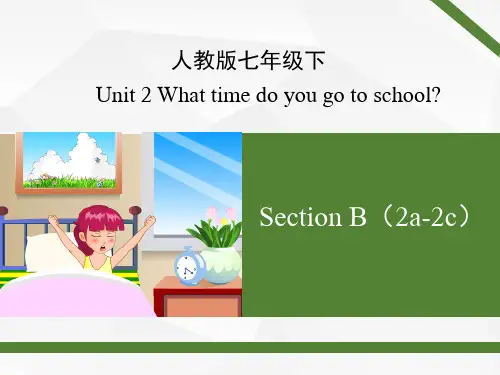
人教版七年级下 Unit 2 What time do you go to school?
我们毕业啦
其实是答辩的标题地方
Section B(2a-2c)
1.学会在语境中理解新词和短语意义。
学 习 目 标
2.通过找关键语句,及文章叙述的时间顺 序来掌握并理清文章结构的方法。 3.通过模仿能够运用目标语言对自己的作
in the evening
息时间进行有条理的描述。
Lead-in
Pre-reading
While-reading
Post-reading
Language Points
Duty report
My daily routine
Lead-in
Pre-reading
While-reading
Post-reading
Language Points
Unhealthy habits
get up late eat very quickly Tony eat hamburgers for lunch watch TV play computer games go to bed late
Healthy habits play basketball brush teeth
Lead-in
Pre-reading
While-reading
Post-reading
Language Points
Skimming
Skim the passage and match the main idea with each paragraph.
Para.1
Para.2
A: Mary’s daily activities
我们毕业啦
其实是答辩的标题地方
Section B(2a-2c)
1.学会在语境中理解新词和短语意义。
学 习 目 标
2.通过找关键语句,及文章叙述的时间顺 序来掌握并理清文章结构的方法。 3.通过模仿能够运用目标语言对自己的作
in the evening
息时间进行有条理的描述。
Lead-in
Pre-reading
While-reading
Post-reading
Language Points
Duty report
My daily routine
Lead-in
Pre-reading
While-reading
Post-reading
Language Points
Unhealthy habits
get up late eat very quickly Tony eat hamburgers for lunch watch TV play computer games go to bed late
Healthy habits play basketball brush teeth
Lead-in
Pre-reading
While-reading
Post-reading
Language Points
Skimming
Skim the passage and match the main idea with each paragraph.
Para.1
Para.2
A: Mary’s daily activities
人教英语七年级下册Unit2Section B(1a--1e)(共28张PPT)
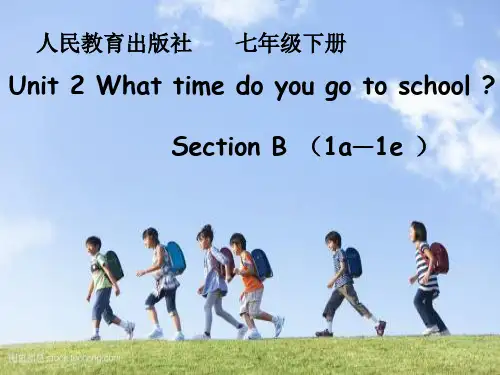
1b Check your answers with your partner.
A: When do students usually eat dinner ? B: They usually eat dinner at a quarter
to seven in the evening .
A: When do students usually … ? B: They usually … at…
Write a short passage about your daily life .
6:23
分钟past小时
2.We use “half past” to say times at the 30 minutes 整点o’clock
刚好三十分钟 结构:half past(=30)
逆读法2 [hɑ:f]half past小时
1:30 3:30 6:30
超过
to 30分
钟
3.We use “to” to say times after 30 minutes until full hour 表示差几分到几点(>30) 结构: (60-分钟数)to(小时+1)
Work in pairs
1e Ask and answer questions about Tom.
When does Tom
usually get up?
He usually gets up
at half past five .
—When does Tom usually …? — He usually (+s/es)… at …
Let’s give a report of Tom’s day .
A: When do students usually eat dinner ? B: They usually eat dinner at a quarter
to seven in the evening .
A: When do students usually … ? B: They usually … at…
Write a short passage about your daily life .
6:23
分钟past小时
2.We use “half past” to say times at the 30 minutes 整点o’clock
刚好三十分钟 结构:half past(=30)
逆读法2 [hɑ:f]half past小时
1:30 3:30 6:30
超过
to 30分
钟
3.We use “to” to say times after 30 minutes until full hour 表示差几分到几点(>30) 结构: (60-分钟数)to(小时+1)
Work in pairs
1e Ask and answer questions about Tom.
When does Tom
usually get up?
He usually gets up
at half past five .
—When does Tom usually …? — He usually (+s/es)… at …
Let’s give a report of Tom’s day .
人教版英语七年级下册Unit 2 Section B 2a-2c 课件
go to bed early__ √ eat ice-cream __
eat quickly __
play sports __√ eat vegetables __ √ take a walk __ √
Circle the healthy activities
2b 判断正(T)误(F)
( F)1.Tony likes to get up early. ( T)2.Tony goes to school at half past eight. ( F)3.Mary usually gets up at six. ( F)4.Mary never eats ice-cream after dinner. ( F)5.Tony and Mary go to bed at 10:00.
3. A: When does Jim do__(h_i_s_)_h_o_m__e_w_o_r_k?
B: He usuallyd_o_es__ his h__o_m_e_w__o_rk_ at __ _a__q_u_a_rt_e_retioght in the __e_v_e_n_in_g.
4. A: When does Eric _t_a_k_e_a w__a_lk_?
2. I either watch TV or play computer games.
Revision
Ask and answer.
A: Can you say the time in the three ways? B: Yes/No. A: What time is it? B: It’s ...
学习目标
重点单词: quickly, either, lot, sometimes, taste. 重点短语: either…or…,be good for, lots of. 重点句式: 1.I don’t have much time for breakfast, so I usually eat very quickly.
人教版初中英语七年级下册全单元精品课件Unit2period2
Interviewer: ________ do you go to work?
Scott: At eleven o’clock, so I’m never late ______ work.
2d Role-play the conversation. (Three)
Interviewer: Scott has _____________. He __________. ___________ is your radio show? Scott: ______________________________________. Interviewer: _________________ get up?
He usually gets up at eight thirty at night. Q3. Is he always late for work?
No, he is never late for work.
2d Role-play the conversation. (One)
Interviewer: Scott has an interesting job. He works at a
Anna never eats breakfast. 5. What time does your best friend go to school?
She always goes to school at … ______________________________________
3b Write about something you always do, something you usually do and something you never do.
人教版七年级英语下册 Unit 2 Section B 2a—2c 课件(共30张PPT)
Language notes: either … or … “要么……要么……” “不是……就是……” “或者……或者……”
用来连接两个独立的词、短语、甚至句子 。 如果连接两个主语,要用“就近原则”。
You can come either today or tomorrow. Either you leave now or I’ll call the police. Either he or I _______(be) a student. am Either he or she _______(have) a computer. has
many + 可数名词复数 一般用于否定句和疑问句中 much + 不可数名词 lots of + 可数名词复数或不可数名词 常用于肯定句中 a lot of
Lots of eggs are in the bag. They eat lots of broccoli.
Language notes: 9. She knows it’s not good for her, but it tastes good! be good for … 对……有益/好处 be bad for … 对……有害/坏处 It’s good for your health to go to bed early and get up early. Don’t read in the dark. It’s bad for your eyes.
Language notes: 10. In the evening, she does her homework and usually swims or takes a walk. and/or/but 连接两个平行的(动)词 Come and have a look. She likes singing and dancing. He likes football and plays it every day. Tom doesn’t sing or dance. Lily __________(not do) homework but _______ doesn’t do watches (watch) TV on weekends. walk n. & v. have/take a walk go for a walk
Unit2SectionB(2a2c)课件初中英语人教版新目标七年级下册(1)
2.阅读2b短文,找出Tony和Mary的日常活动时间并完成表
格。
Time __A__t_e__ig__h_t___ A_t_e_i_g_h__t_t_h__ir_t_y
At noon After school
Tony
Activities
Get up
Go to school
Ea_t__h_a_m__b__u_r_g_e__rs
3.能理解短文,并能描述自己或他人的日常生活作息习惯。
预习导学
同学们,你们认识加菲猫吗?下面让我们来看一看加菲猫在 日常生活中是什么样的。你认为它的生活方式健康吗?
一、选一选 完成教材上2a的练习,勾选出你认为健康的活动。
二、写一写 写出自己每天的生活习惯。 略。
三、填一填
请写出你健康和不健康的习惯。
3.你有哪些健康的和不健康的生活习惯,请写下来和同伴分 享。
·知识拓展· 常 见 的 食 物 类 名 词 , 除 课 本 上 出 现 的 外 , 还 有 salad “ 沙 拉”、tofu“豆腐”;mutton“羊肉”;sandwich“三明治”等。
阅读训练 ◎学法指导:阅读短文时,重点关注与生活习惯有关的短 语。有疑问时与同伴探讨或向老师求助。
Mary
Activities Get up
Go to school
Eat lots of fruit and vegetables P_l_a_y__v_o_l_le__y_b_a_l_l E_a_t__ic_e__-_c_r_e_a_m__
Do homew_o_r_k_,_s_w__i_m__o__r_take a walk Go to bed
Either you or I am right. 要么你对,要么我对。
人教版七年级英语下册unit2 Section B 2精品课件(15张PPT)
3a Number these sentences in order to
make a story about a daily routine.
3
eats
goes to
2
breakfast
school
5
4
6 7
8 9
life作名词,意为“生活”,指生活方式, 是可数名词。其复数形式为lives。 We have a happy life in China.
4. He _h_a_s__a_g_o_o_d__jo_b___. He works at a radio station.
5. Here are your clothes. Go and _g_et__d_r_es_s_e_d_ quickly!
6. I don’t have time to _c_le_a_n__m_y__r_o_o_m__ from Monday to Friday. So I clean it on weekends.
Complete the conversations with
2 questions and answers. Use the
words in the brackets to help you. 1. A: _______? (your mother/usually/get
up) B: ____________ (5:45) A: _____________ (why/get up/so early) B: ___________ (always make
late morning.
Check the answers.
1. A: W__h_e_n_d_o_e_s_y_o_u_r_m__ot_h_e_r_u_s_u_a_ll_y_g_e_t _u_p_? B: _S_h_e_u_s_u_al_ly__g_et_s_u_p__at_a__q_u_a_rt_e_r_t_o_s_ix_._ A: W__h_y__d_o_e_s_s_h_e__g_et__u_p_s_o__ea_r_l_y_?_______ B: S_h__e_a_l_w_a_y_s_m__a_k_e_s_b_r_e_a_k_f_a_s_t _fo_r__m_e_._
make a story about a daily routine.
3
eats
goes to
2
breakfast
school
5
4
6 7
8 9
life作名词,意为“生活”,指生活方式, 是可数名词。其复数形式为lives。 We have a happy life in China.
4. He _h_a_s__a_g_o_o_d__jo_b___. He works at a radio station.
5. Here are your clothes. Go and _g_et__d_r_es_s_e_d_ quickly!
6. I don’t have time to _c_le_a_n__m_y__r_o_o_m__ from Monday to Friday. So I clean it on weekends.
Complete the conversations with
2 questions and answers. Use the
words in the brackets to help you. 1. A: _______? (your mother/usually/get
up) B: ____________ (5:45) A: _____________ (why/get up/so early) B: ___________ (always make
late morning.
Check the answers.
1. A: W__h_e_n_d_o_e_s_y_o_u_r_m__ot_h_e_r_u_s_u_a_ll_y_g_e_t _u_p_? B: _S_h_e_u_s_u_al_ly__g_et_s_u_p__at_a__q_u_a_rt_e_r_t_o_s_ix_._ A: W__h_y__d_o_e_s_s_h_e__g_et__u_p_s_o__ea_r_l_y_?_______ B: S_h__e_a_l_w_a_y_s_m__a_k_e_s_b_r_e_a_k_f_a_s_t _fo_r__m_e_._