
Unit1_SectionB(1a-1d)
Treat ments
Problems
Someone had a √ nosebleed. Someone hurt his back. Someone got √ hit on the head.
Treat ments
b, c
Lead-in
Presentation
Pre-listening
While-listening
Lead-in
Presentation
Pre-listening
While-listening
Post-listening
2.Ben has a toothache. He should (see a dentist / get some sleep).
My advice:_______________________. He should see a dentist
Pre-listening
While-listening
Post-listening
prediction
What we will listen?
What should you do when you have accidents at school?
See the school doctor.
Lead-in
2. If I have a ________, what should I do? What shouldn’t I do?
Lead-in
Presentation
Pre-listening
While-listening
Post-listening
Free talk: What should he/she do?
Treat ments Problems Treat ments
Problems
Someone √ felt sick. Someone cut his √ knee. Someone had a fever.
b, c
d, a ,
b, c
Someone had a nosebleed. Someone hurt his back.
Post-listening
4.Kate hurts herself playing soccer and has a sore back. She should (lie down and rest / take her temperature). My advice:______________________. She should lie down and rest
Lead-in
Presentation
Pre-listening
While-listening
Post-listening
Section B, 1b, lc Teacher: Hello, Jenny! You look tired. Nurse: Well, today was a busy day in my office.One boy hurt himself in P.E. class. Teacher: What happened? Nurse: He was running under the hot sun and then he felt sick and fell down. Teacher: Yes, the weather is very hot today.
Circle the best advice for these health problems. Then add your advice.
Lead-in
Presentation
Pre-listening
While-listening
Post-listening
1.Cheng Hong cut her finger.
She shouldn’t exercise today _______________________________.
Lead-in
Presentation
Pre-listening
While-listening
Post-listening
Did you ever have accidents (意外)?
Lead-in
Presentation
Pre-listening
While-listening
Post-listening
1c
Listen again. Write the letter of each treatment next to the problems you checked in the chart above.
A:I cut my finger when I was cooking. What should I do? B: I’m sorry to hear that. I think first, you should…, next , you should…, last…
Lead-in
Presentation
3.Mary and Sue have colds.
They shouldn’t (sleep / exercise).
My advice:_____________________. They shouldn’t exercise
Lead-in
Presentation
Pre-listening
While-listening
Section B
Period 1 (1a — 1d)
Lead-in
Presentation
Pre-listening
While-listening
Post-listening
Take out your body paper. 1. I can say the health problems in different ways.
Lead-in
Presentation
Pre-listening
While-listening
Post-listening
Nurse: He cut his knee, so I washed the cut and put some medicine on it. Then I put a bandage on it. Teacher: Was the cut serious? Nurse : Not really, but I also took his temperature. Luckily he didn't have a fever. I told him he should rest.
Lead-in
Presentation
Pre-listening
While-listening
Post-listenБайду номын сангаасng
1a
When these accidents happen, what should you do? Put the actions in order.
3 Put a bandage on it.缠上绷带 ____ 1 Run it under water.在水下冲洗 ____ ____ 2 Put some medicine on it. ____ 1 Go to the hospital. ____ 2 Get an X-ray. ____ 3 Rest for a few days. 休息几天
Lead-in
Presentation
Pre-listening
While-listening
Post-listening
____Press the sides of your nose.捏住鼻梁 2 ____ 1 Put your head down.低下头 ____Clean your face. 3
Lead-in
Presentation
Pre-listening
While-listening
Post-listening
Did these accidents happen to you? When they happen, what should you do? get hit on the head 头部受撞击/ 打在头上
Lead-in
Presentation
Pre-listening
While-listening
Post-listening
Work in pairs:
Make a conversation about an accident ,give your advice in order. (谈论一个你生活中的意外,注意有序给出意见。)
Lead-in
Presentation
Pre-listening
While-listening
Post-listening
Teacher: What else happened? Nurse : One girl had a nosebleed. I told her to put her head down and then press the sides of her nose. Oh, and another boy got hit on the head with a baseball bat. Teacher : That sounds bad. I hope he's OK … Nurse : I hope so, too. He was taken to the hospital to get an X-ray.
She should (get an X-ray / put some medicine on the cut). She should put some My advice:___________________
Unit1 SectionB(1a-1d)优质课教案

eabouttheschooleventsJohnandSallyhavethismonth
①Matchthebertheevents
②Saybingotoguesstheschoolevent
设计意图:巩固练习新词,通过完成书本的配对练习,以及猜谜游戏,增加练习新词的次数,同时明确专有名词和普通名词的区别。
Unit1SectionB(1a-1d)优质课教案
教材分析
学情分析
Thestudentshavelearnedsomewordsaboutschooleventssuchassoccergame,s
eabouttheimericabyasing“Whenis”
Guesstheim
ericaandasstudentstonotedowntheschooleventstheyseeinthevideo
:
—Whenis…
—It’son
教学反思
ates:
—Whenis
—It’son…
:Ithin…ison
设计意图:听音填表,听录音,把学校活动的时间填进月历里,听前要求做到听前预测,做好准备;听中注意填表;听后注意利用目标语言进行对答。
embersharestheireventsinwintervacation,drawsorwritesaboutthetwoeventsofhisonthecalendarandfinallyre
mariethewordsandsentences
Readthewordsandsentences
设计意图:以图片的形式回顾本课新学习关于学校活动的新词,同时复习句型。
Homewor:
rbirthdaySectionBla-1d
人教版七年级英语上册 Starter Unit 1 SectionB (1a-1d)教学设计

2024-2025学年人教版七年级英语上册Starter Unit 1Section B (1a-1d)教学设计第2课时教学设计课题Section B How do you start a conversation? (1a-1d)课型读写课语篇研读【What】本课时有2个语篇,均为读写活动的对话类型,展现了同学们在学校第一天打招呼的情境,第1个对话是两名互不相识的学生在教室里互相问候、询问姓名以及姓名的拼写;第2个对话是另外两名熟识的学生在教学楼遇见打招呼并简短交流。
【Why】通过语篇学习,帮助学生了解陌生人初次见面和熟人再次见面时的礼貌性问候用语,从而更加地道地使用语言;鼓励学生在新学校与新同学开展交际,结交新的朋友,增进同学之间的友谊。
【How】第一篇对话共三轮对话,分别从打招呼、询问姓名、拼写姓名、问候等方面进行交流;第二篇对话共三轮对话,分别从问候、告别方面开展交际。
两个语篇基本以问答的形式构成。
在进行问候的时候,用“May I have your name?”更有礼貌地询问姓名;用“How do you spell your name?”询问如何拼写姓名;初次相识,用“Nice to meet you.”表示礼貌地问候;在表示告别时,用“Goodbye/Bye.”来结束对话。
教学目标通过本节课的学习, 同学们将能:1、能根据语篇内容,对人物关系进行推断;2、能在听、读的过程中,习得如何与陌生人、与熟悉的同学进行对话,并积极回应对方。
3、能围绕主题,运用所学的语言,与他人进行简单日常的交流。
并在书面表达中,能围绕图片内容或模仿语篇,补全对话。
4、能在真实的语言环境中,感知“May I have your name?”、“How are you?”、“Nice to meet you!”等礼貌的表达,感悟中外社会生活中关心他人、尊重他人的传统美德。
能在人际交往过程中,适当调整表达方式,体现出礼貌、得体与友善。
人教版七年级英语上册Unit1 SectionB(1a~1d)课件

While-reading
Read again and complete the table with the information.
➢ play with sb. 和某人一起玩 ➢ after school 放学后
1. 她喜欢和汤姆玩。 She likes to play with Tom. 2. 我们过去去找他们玩吧。 Let’s go over and play with them. 3. 放学后他们会去踢足球。 They will play football after school. 4. 放学后我们去跟他们玩吧。Let’s play with them after achool.
➢ 由普中通名国词:构t成h的e专R有P名C词?前面C要hi加n定a冠?词the
➢ 定冠美词国the:通常th用e于U特S指?某A些m独一er无ic二a的?人或事物
地球: the earth
异同美国点:?the US
月亮: the moon
中国: the RPC
Pre-reading
Look at two students’ photo boards. Label the photos with the words in the boxes.
parrot Beijing roast duck the UK Singapore guitar the Great Wall tennis
Singapore parrot tennis
guitar the Great Wall
the UK
Beijing roast dusk
Pre-reading
parrot Beijing roast duck the UK Singapore guitar the Great Wall tennis
英语人教版八年级下册Unit1 SectionB(1a-1d)
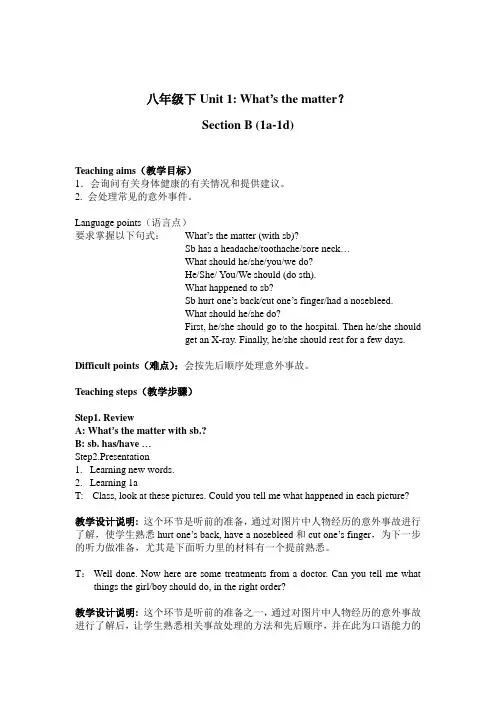
八年级下Unit 1: What’s the matter?Section B (1a-1d)Teaching aims(教学目标)1.会询问有关身体健康的有关情况和提供建议。
2. 会处理常见的意外事件。
Language points(语言点)要求掌握以下句式:What’s the matter (with sb)?Sb has a headache/toothache/sore neck…What should he/she/you/we do?He/She/ You/We should (do sth).What happened to sb?Sb hurt one’s back/cut one’s finger/had a nosebleed.What should he/she do?First, he/she should go to the hospital. Then he/she shouldget an X-ray. Finally, he/she should rest for a few days.Difficult points(难点):会按先后顺序处理意外事故。
Teaching steps(教学步骤)Step1. ReviewA: What’s the matter with sb.?B: sb. has/have …Step2.Presentation1.Learning new words.2.Learning 1aT: Class, look at these pictures. Could you tell me what happened in each picture?教学设计说明: 这个环节是听前的准备,通过对图片中人物经历的意外事故进行了解,使学生熟悉hurt one’s back, have a nosebleed和cut one’s finger,为下一步的听力做准备,尤其是下面听力里的材料有一个提前熟悉。
Unit 1 Section B(1a-1d)课件人教版2024新教材七年级上册英语
play tennis big family
She is 14 years old. She is from Singapore. She has a pet bird. I like to play tennis.
1d Compare yourself with either Pauline or Peter.
1. What can you see in the pictures?
A guitar, the big ben in the UK and Beijing roast duck.
2. Where are pictures?
They are on a board.
3. What are the pictures used for?
each other 彼此
Prediction(预测) Look at the picture and answer these questions.
1. What can you see in the pictures?
A parrot, Merlion in Singpore and a badmiton.
Review
按要求写出正确的单词、词组或句子。
1. 在同一个班级 (短语)in__t_h_e_s_a_me class 2. 班主任 (短语) _c_l_a_ss__te_acher
Unit1第4课时SectionB(1a-1d)(教案)
今天的学习,我们了解了描述人物特征的基本词汇、句型和现在进行时态的运用。同时,我们也通过实践活动和小组讨论加深了对这些知识点的理解。我希望大家能够掌握这些知识点,并在日常生活中灵活运用。最后,如果有任何疑问或不明白的地方,请随时向我提问。
五、教学反思
在今天的教学过程中,我发现学生们对描述人物特征的词汇和句型掌握程度有所不同。有的学生能够迅速理解并运用所学知识进行角色扮演,而有的学生在听力理解和口语表达方面还存在一些困难。这让我意识到,在今后的教学中,需要更加关注学生的个体差异,针对性地进行辅导和指导。
3.给学生提供更具体的讨论指导,提高讨论效率。
4.调整课堂管理策略,营造良好的学习氛围。
(三)实践活动(用时10分钟)
1.分组讨论:学生们将分成若干小组,每组讨论一个与描述人物特征相关的实际问题。
2.角色扮演:为了加深理解,我们将进行角色扮演活动。这个活动将让学生实际运用所学词汇和句型来描述组内成员。
3.成果展示:每个小组将向全班展示他们的讨论成果和角色扮演的结果。
(四)学生小组讨论(用时1特征”这一主题展开讨论。他们将被鼓励提出自己的观点和想法,并与其他小组成员进行交流。
2.引导与启发:在讨论过程中,我将作为一个引导者,帮助学生发现问题、分析问题并解决问题。我会提出一些开放性的问题来启发他们的思考。
3.成果分享:每个小组将选择一名代表来分享他们的讨论成果。这些成果将被记录在黑板上或投影仪上,以便全班都能看到。
(3)语法:现在进行时态在描述人物特点时的运用。
举例:在1b听力活动中,学生需要根据听到的描述,匹配相应的人物。此时,掌握词汇和句型是关键,如能熟练运用这些表达方式,就能轻松完成匹配任务。
2.教学难点
新目标(人教) 八年级下册英语教学课件 Unit1 Section B(1a-1d)
bandage press sick kneeห้องสมุดไป่ตู้
nosebleed
n.绷带 v.用绷带包扎 v. 压;按;挤 adj. 生病的;有病的 n. 膝;膝盖 n.鼻出血
bandage n. 绷带 v. 用绷带包扎
1. His leg was hurt. Please put a bandage on it . (n.名词)
A. I fell down from the stairs. B. Do you have a sore back? C. What's wrong with you? D. Remember to put some ice on your knee. E. When did it start? F. But you should get an X-ray. G. Can I have a look at it ?
you hurt it? B: 3._____A______.
A: I see. Well, I don't think it's serious. 4.___F______ . Let the nurse take you to the third floor(楼层) and come back with your X-ray. And then I will know if your knee is broken or not.
B: OK. I will. (After ten minutes)
A: Let me have a look. Nothing seems to be broken. I think all you need is some rest. 5._____D_______ .
Unit1SectionB(1a-1d)课件 人教版八年级英语下册
b. took his temperature
c. told him to rest
d. put some medicine on it
e. took him to the hospital to get an X-ray
f. told her to put her head down
10
Listen again and fill in the blanks .
8
1b Listen to the school nurse. Check (√) the problems you hear.
Problems Someone felt sick.
Treatment s
Problems
√ b, c
Someone had a nosebleed.
Treatments
He hurt his knee. He fell down from the bike. He got hit on the head.
He cut a finger.
He had a nosebleed.
4
Ask and answer.
Problem
Advice
fall 1.go to the hospital down 2.get an X-ray
Section B (1a—1d)精品公开课
1
一、教学目标 1.学习和掌握本节课重点单词和短语。 2.通过练习巩固表达健康问题及提出建议的词。 3.学会照顾自己和他人,了解一些意外事故的处理方法。
二、教学重点 1.学习和掌握本节课重点单词和短语。 2.通过练习巩固表达健康问题及提出建议的词。
三、教学难点 1.学会照顾自己和他人,了解一些意外事故的处理方法。
人教版八年级英语上册Unit1SectionB 1a--1d教学设计
interesting people。
A:19。___________________
B:Yes,I did。I bought something nice for my mother.
A:20。______________________
听力指导:在听时要抓重点内容.第一次听要求我们回答问题,因此在听的时候,应重点将与这些问题相关的内容方面的听清,其他作为非重点内容。另外,要注意要速记下重点内容。
在完成1d部分时要注意听的重点是放在Lisa对这五个方面的事情所做评价,因此应听清楚那些形容词。
Ⅳ。Retelling Lisa’s vacation
2.Who cooked the fish?It was _________.
3.We had an ________ trip to Zhangjiajie.
4.He didn't go to school because he felt ________.
5.My family doesn’t have much money so we often buy
难点
.听力训练和听力技巧培养。
五、教学过程设计
Ⅰ. Warming—up and revision
Ⅱ.Writing
Work on1a:
1. Point to the six words. delicious, expensive, exciting, cheap, terrible, boring
4。Let Ss match each word with a picture。Then check the answers with the students。
Unit1SectionB1a-1d教案
五、教学反思
在今天的教学中,我尝试了多种方法来帮助学生掌握《Unit 1 Section B 1a-1d》这一章节的知识点。首先,通过提问生活中的实际问题,引起了学生对一般现在时和物品位置描述的兴趣。在讲授过程中,我注重理论与实践相结合,让学生在实际语境中学习词汇和句型。
在课堂上,我发现学生们对一般现在时的疑问句和否定回答掌握得不是很好,这让我意识到这个部分是学生的一个难点。因此,我决定在接下来的教学中,加强对这一难点的讲解和练习。同时,我也注意到,通过分组讨论和角色扮演活动,学生们在互动交流中能够更好地消化吸收知识。
3.文化意识:使学生了解并尊重不同文化背景下人们对物品摆放的习惯,增进跨文化交际意识。
4.学习能力:激发学生的学习兴趣,培养其自主学习、合作学习和探究学习的能力,为终身学习奠定基础。
本章节核心素养目标紧密围绕新教材要求,关注学生语言能力、思维品质、文化意识及学习能力的全面发展,旨在培养具有国际视野的英语人才。
(二)新课讲授(用时10分钟)
1.理论介绍:首先,我们要了解一般现在时的基本概念。一般现在时是描述经常发生的事情或状态的时态。它在日常交流中非常重要,帮助我们描述物品的位置和日常活动。
2.案例分析:接下来,我们来看一个具体的案例。这个案例展示了如何使用一般现在时来询问和描述物品位置,以及它如何帮助我们解决找不到东西的问题。
举例:教师可以通过设置真实情境,让学生运用介词in, on, under, near等描述物品位置,如:“The keys are under the chair.”