
八年级英语听力人教版必备
八年级英语听力人教版必备
初二英语听力练习
二、听对话,选择正确答案。
6. What are they talking about
A. The boy’s schoolwork.
B. The boy’s future.
C. The boy’s school.
7. Where will the man live
A. In Shanghai.
B. In Harbin.
C. In Hangzhou.
8. Who think(s) there will be more trees in twenty years
A. The woman.
B. The man.
C. Both of them.
9. Where will the girl study
A. At home on computer.
B. At school.
C. At home on TV.
10. Why doesn’t the man hope there will be more robots in factories
A. Robots won’t do the work well.
B. More people will have no jobs.
C. There will be less pollution.
三、听对话,选择正确答案。
11. Tom wants to be ______ in ten years.
A. a bank clerk
B. a computer programmer
C. an artist
12. _______ runs a computer company.
A. Tom’s uncle
B. Tom’s father
C. Tom’s mother
13. There are _______ people in Tom’s family.
A. two
B. three
C. four
14. Julia will live in _______. A. London B. New York C. Paris
15. Julia likes _______. A. drawing B. dancing C. singing
四、听短文,选择正确答案。
16. When did the boy go to the World Expro 2023 in Shanghai
A. Last June.
B. Last July.
C. Last August.
17. What did the robot look like
A . He had one hand and one eye. B. He had one hand and two eyes.
C. He had two hands and two eyes.
18. How long could the robot work a day
A. Twelve hours.
B. Twenty hours.
C. Twenty-four hours.
19 . What could the robot do
A. Talk with people.
B. Show people around.
C. Know people’s health problems.
20. What does the boy hope to do
A. Make a robot.
B. Have a robot.
C. Be a doctor.
初二英语听力材料试题
听对话,回答问题
What color does the woman like
A)Blue
B)Green
C)Brown
D)None of the above.
Whom does the woman want to speak to
A)Dick Green.
B)Mr Caron.
C)Marry.
D)Mr King.
What is the woman going to do
A)Make a phone call again next morning.
B)Ask the man to pass her message.
C)Call again in the afternoon.
D)Talk to the teacher by herself.
How often does the train start
A)More than ten minutes.
B)Twenty minutes.
C)Less than 30 minutes.
D)More than 30 minutes.
How is the woman going to Hong Kong
A)By plane.
B)By train.
C)By bus.
D)By ship.
What day is the girl talking to the boy
A)On Friday.
B)On Saturday.
C)On Sunday.
D)On Monday.
What does the girl ask the boy to do
A)To wear school suit.
B)To wear old clothes.
C)To plant trees.
D)Both B and C.
初二英语听力综合试题
以下各题各有一段对话,每段对话后有一个问题,选择正确的选项回答该问题,每段对话读两遍。
A)Thanks for telling me, Mike.
B)How do you do, Dr Smith Nice to meet you, Dr Smith.
C)Hello, have you ever been to China
D)How are you these days
A)But I don t think so.
B)I m sorry to hear that.
C)It s very kind of you to tell me the news.
D)Congratulations.
A)I don t know if I can.
B)Thanks for asking me.
C)No, I m afraid not.
D)With pleasure.
A)I m sorry to hear that.
B)Late is better than never.
C)I afraid it s too late. Shall we make it earlier
D)Either B or C.
A)I m afraid not. The water in the river is very dirty now.
B)Yes, it s much better than swimming in the pool.
C)It s a pleasure to swim with you.
D)Enjoy yourselves with your friends.
八年级英语听力人教版。
(完整)八年级英语(下)(人教版)教材听力原文及译文
UNIT 1 Section A1b Listen and look at the picture. Then number the names[1-5].Conversation 1Nurse:You don’t look well. What’s the matter, Sarah?Sarah:I was playing with my friends at the park yesterday. Then it got windy, but I didn’t put onmy jacket. Now I have a cold.Conversation 2Nurse:What’s the matter, David? Are you OK? David:I ate too much junk food at my friend’s birthday party. So last night, I got a stomachache.I almost couldn’t get myself out of bed thismorning.Conversation 3Nurse:What’s the matter, Ben? Can you move? Ben:Not really. I was playing soccer the other day and I hurt myself. It seemed OK at first, but nowI have a really sore back.Conversation 4Nurse:You look really tired. What’s the matter, Nancy? Nancy:I didn’t sleep very well last night. I have a toothache. It’s terrible! I can’t really eatanything either. It hurts a lot.Conversation 5Nurse:What’s the matter, Judy?Judy:I’m sorry, but it’s very difficult for me to talk.Nurse:Oh, dear. What’s the matter?Judy:I talked too much yesterday and didn’t drink enough water. I have a very sore throat now. 听录音并看图。
人教版英语八年级上册Unit 7听力原文及翻译
Unit 7 Will people have robots?Section A, 1bBoy 1:Do you think people will have robots in their homes in 100 years?你认为百年内人们家中都会有机器人吗?Boy 2:Yes, I do. I saw a robot on TV, and it cleaned the kitchen.是的,我在电视上看到一个机器人清扫厨房。
Boy 1:Well, I don’t think people will use money.哦,我认为人们将不会使用钱币。
Boy 2:Do you think everything will be free?你认为一切都将会是免费的吗?Boy 1:Yeah, probably.是,很可能。
Boy 2:I think there will be only one country.我认为将只会有一个国家。
Boy 1:Only one country in the world? Will there be world peace?世界上只有一个国家?那将会有世界和平吗?Boy 2:I hope so.我希望如此。
Boy 1:I think kids won’t go to school. They’ll study at home on computers.我认为孩子将不会去学校。
他们将会在家通过电脑学习。
Boy 2:Oh, I disagree.哦,我不同意。
Boy 1:You do?是吗?Boy 2:Yeah, there will always be schools.是的,学校将会一直存在。
Section A, 2a, 2bMs. Steen:OK, now I want to hear everyone’s predictions about the future.好,现在我想听听大家对未来的预测。
八年级英语(下)(人教版)教材听力原文及译文
UNIT 1 Section A1b Listen and look at the picture. Then number the names[1-5].Conversation 1Nurse:You don’t look well. What’s the matter, Sarah?Sarah:I was playing with my friends at the park yesterday. Then it got windy, but I didn’t put onmy jacket. Now I have a cold.Conversation 2Nurse:What’s the matter, David? Are you OK? David:I ate too much junk food at my friend’s birthday party. So last night, I got a stomachache.I almost couldn’t get myself out of bed thismorning.Conversation 3Nurse:What’s the matter, Ben? Can you move? Ben:Not really. I was playing soccer the other day and I hurt myself. It seemed OK at first, but nowI have a really sore back.Conversation 4Nurse:You look really tired. What’s the matter, Nancy? Nancy:I didn’t sleep very well last night. I have a toothache. It’s terrible! I can’t really eatanything either. It hurts a lot.Conversation 5Nurse:What’s the matter, Judy?Judy:I’m sorry, but it’s very difficult for me to talk.Nurse:Oh, dear. What’s the matter?Judy:I talked too much yesterday and didn’t drink enough water. I have a very sore throat now. 听录音并看图。
八年级英语下 人教版 教材听力原文及译文
UNIT 1Section A1b Listen and look at the picture. Then number the names [1-5]. Conversation 1Nurse :You don ’t look well. What ’s the matter, SarahSarah :I was playing with my friendsatthe park yesterday. Then it got windy, but I didn ’t put on my jacket. Now I have a cold. Conversation 2Nurse :What ’s the matter, David AreyouOKDavid :I ate too much junk food at myfriend ’s birthday party. So last night, I got a stomachache. I almost couldn ’t get myself out ofbed this morning. Conversation 3 Nurse :What ’s the matter, Ben Can youmove Ben :Not really. I was playing soccerthe other day and I hurt myself. It seemed OK at first, but now I have areally sore back. Conversation 4Nurse :You look really tired. What ’sthematter, Nancy Nancy :I didn ’t sleep very well lastnight. I have a toothache. It ’s terrible! I can ’t really eat anything either. It hurts a lot. Conversation 5Nurse :What ’s the matter, Judy听录音并看图。
八年级英语(下)(人教版)教材听力原文与译文
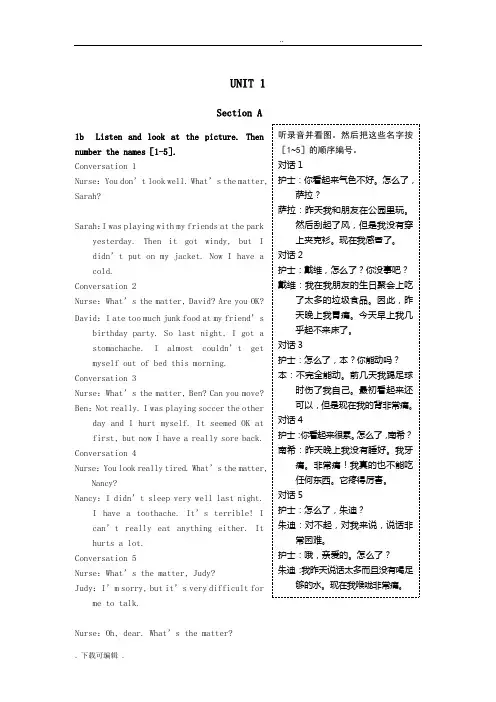
UNIT 1 Section A1b Listen and look at the picture. Then number the names[1-5].Conversation 1Nurse:You don’t look well. What’s the matter, Sarah?Sarah:I was playing with my friends at the park yesterday. Then it got windy, but Ididn’t put on my jacket. Now I have acold.Conversation 2Nurse:What’s the matter, David? Are you OK? David:I ate too much junk food at my friend’s birthday party. So last night, I got astomachache. I almost couldn’t getmyself out of bed this morning. Conversation 3Nurse:What’s the matter, Ben? Can you move? Ben:Not really. I was playing soccer the other day and I hurt myself. It seemed OK atfirst, but now I have a really sore back. Conversation 4Nurse:You look really tired. What’s the matter, Nancy?Nancy:I didn’t sleep very well last night.I have a toothache. It’s terrible! Ican’t really eat anything either. Ithurts a lot.Conversation 5Nurse:What’s the matter, Judy?Judy:I’m sorry, but it’s very difficult for me to talk.Nurse:Oh, dear. What’s the matter? 听录音并看图。
人教版英语八年级上册听力材料及答案
罗田县初中2016年秋季期中联考八年级英语试题听力材料和参考答案第一部分:听力材料注意:回答听力部分时,请先将答案标在试卷上。
听力部分结束前,你将有2分钟的时间将你的答案转填到客观题答题卡上。
第一节听下面五段小对话,从每小题A、B、C三个选项中,选出与对话内容相符的图片。
听完每段对话后,你将有5秒钟的作答时间。
每段对话仅读一遍。
Text 1 W: Which is the fastest, a bike, a plane or a ship?M: The plane is the fastest.Text 2 W: What is the man’s favorite pet?M: He likes the dog best.Text 3 W: Where did you go last Saturday?M: I went to summer camp on the beach.Text 4 W: What does Jenny want to do?M: She wants to talk about it on the phone.Text 5 W: Where does Tom often go?M: He often goes to the library to borrow books.第二节听下面6段对话,每段对话后面有几个小题,从题中所给的A、B、C三个选项中选出最佳选项。
听完每段对话后,你将有10秒钟的作答时间。
每段对话读两遍。
听第6段对话,回答第6、7两个小题。
Text 6W: Jack, where did you go on vacation?M: I went to visit my uncle.W: Where is your uncle?M: He is in Shanghai.听第7段对话,回答第8、9两个小题。
Text 7W: How was your vacation, Bob?M: It was pretty good. What about you, Kate?W: It was really boring. I only stayed at home.听第8段对话,回答第10、11两个小题。
八年级上册人教版英语听力
八年级上册人教版英语听力In the journey of academic exploration, the eighth-grade English textbook serves as a critical guide, especially its listening section. This aspect of the curriculum not only sharpens our auditory skills but also enhances our comprehension of spoken English. As students, we are constantly challenged to improve our listening comprehension, which is an integral part of language learning.The listening section of the eighth-grade English textbook covers a diverse range of topics, from school life to cultural exchanges. Each listening passage is designed to engage students' interest and encourage active participation. The pace and difficulty of the passages gradually increase, preparing students for more challenging listening tasks in the future.One of the standout features of the textbook is its emphasis on real-world scenarios. Listening to conversations in a school cafeteria, for example, helps students imagine themselves in that setting and apply their listening skills to understand the exchange of ideas andinformation. This approach makes learning more relevant and enjoyable.Moreover, the textbook encourages active listening by including questions and tasks that require students to analyze and respond to the listened material. This active engagement not only improves listening comprehension but also cultivates critical thinking skills.In addition to the traditional listening exercises, the textbook also incorporates interactive activities such as role-plays and discussions. These activities promote collaboration among students and provide opportunities for them to practice their listening skills in a fun and engaging manner.However, the success of the listening section does not solely rely on the textbook. Effective teaching methods and a supportive learning environment are equally important. Teachers play a crucial role in guiding students through the listening exercises and encouraging them to actively participate. A classroom that fosters active listening and open discussion creates a positive learning atmosphere where students can thrive.Furthermore, regular practice is essential for improving listening skills. By dedicating time each day to listen to English, students can gradually improve their comprehension and fluency. Resources like podcasts, online videos, and English songs can provide additional practice opportunities.In conclusion, the listening section of the eighth-grade English textbook serves as a foundation for developing strong auditory skills. Its diverse content, real-world scenarios, and interactive activities make learning enjoyable and engaging. With effective teaching methods, a supportive learning environment, and regular practice, students can master the art of listening and excel in their language learning journey.**八年级上册人教版英语听力:探索与实践**在学术探索的旅程中,八年级英语教科书是一本至关重要的指南,特别是其中的听力部分。
八年级英语(下)(人教版)教材听力原文及译文
UNIT 1 Section A1b Listen and look at the picture. Then number the names[1-5].Conversation 1Nurse:You don’t look well. What’s the matter, Sarah?Sarah:I was playing with my friends at the park yesterday. Then it got windy, but I didn’t put onmy jacket. Now I have a cold.Conversation 2Nurse:What’s the matter, David? Are you OK? David:I ate too much junk food at my friend’s birthday party. So last night, I got a stomachache.I almost couldn’t get myself out of bed thismorning.Conversation 3Nurse:What’s the matter, Ben? Can you move? Ben:Not really. I was playing soccer the other day and I hurt myself. It seemed OK at first, but nowI have a really sore back.Conversation 4Nurse:You look really tired. What’s the matter, Nancy? Nancy:I didn’t sleep very well last night. I have a toothache. It’s terrible! I can’t really eatanything either. It hurts a lot.Conversation 5Nurse:What’s the matter, Judy?Judy:I’m sorry, but it’s very difficult for me to talk.Nurse:Oh, dear. What’s the matter?Judy:I talked too much yesterday and didn’t drink enough water. I have a very sore throat now. 听录音并看图。
八年级英语下人教版教材听力原文及译文
1 / 18 UNIT 1Section A1b Listen and look at the picture. Then number the names [1-5]. Conversation 1Nurse :You don ’t look well. What ’s the matter, Sarah?Sarah :I was playing with my friends at the parkyesterday. Then it got windy, but I didn ’t put on my jacket. Now I have a cold. Conversation 2Nurse :What ’s the matter, David? Are you OK? David :I ate too much junk food at my friend ’sbirthday party. So last night, I got a stomachache. I almost couldn ’tgetmyself out of bed this morning. Conversation 3Nurse :What ’s the matter, Ben? Can you move? Ben :Not really. I was playing soccer the other dayand I hurt myself. It seemed OK at first, but now I have a really sore back. Conversation 4Nurse :Y ou look really tired. What ’s the matter, Nancy? Nancy :I didn ’t sleep very well last night. I have atoothache. It ’sterrible! I can ’t really eat anything either. It hurts a lot.Conversation 5Nurse :What ’s the matter, Judy?Judy :I ’m sorry, but it ’s very difficult for me to talk.Nurse :Oh, dear. What ’s the matter?Judy :I talked too much yesterday and didn ’t drinkenough water. I have a very sore throat now.2a Listen and number the pictures [1-5] in the order you hear them. Conversation 1Girl 1:You don ’t look well. Your face looks a bit red.Girl 2:Yeah, and my head feels very hot. What should I do? Girl 1:Maybe you have a fever. You should take your temperature. Girl 2:Yes, you ’re right. Conversation 2Girl 1:What ’s the matter?Girl 2:I didn ’t take good care of myself. I didn ’twearenough听录音并看图。
人教版八年级第三单元上册英语课文听力
人教版八年级第三单元上册英语课文听力全文共3篇示例,供读者参考篇1Unit 3 Listening Exercises: A Student's PerspectiveHey there! I'm an 8th grader and I've got to tell you about the listening exercises we did in Unit 3 of our English textbook. Let me just say, some of them were pretty challenging but also really helpful for improving my English listening skills.The first listening exercise was called "An Interview About Dreams." It was an interview with a psychologist talking about the meaning and importance of dreams. I'll be honest, some of the vocabulary was a bit over my head at first - words like "subconscious" and "phenomena." But the speaker spoke clearly and at a good pace, so I was able to catch the main ideas. The big takeaway was that dreams are a window into our inner thoughts and feelings. Pretty deep stuff for an 8th grade listening!Next up was a dialogue called "Asking for Directions." This one was more straightforward - just two people having a conversation about finding their way around a city. The tricky part was understanding the specific street names and turns theywere describing. But by listening carefully to phrases like "turn left on Main Street" and "go straight until you reach the park," I was able to visualize the route they were taking. Essential skills for not getting lost on a trip!Then we had "A Radio Interview About Summer Jobs." This was probably my favorite because I could really relate to wanting a summer job. The interviewer asked some high school students what kinds of jobs they wanted and why. Their answers were interesting - things like being a camp counselor, working at a grocery store, or having an internship. They talked about making money, gaining work experience, and exploring potential career paths. It got me thinking about what kind of summer job I might want next year!One of the hardest exercises was "A News Report on Environmental Issues." With so much new vocabulary around climate change, pollution, and conservation efforts, I really had to concentrate to piece together the overall meaning. The reporter used some terrific descriptive language, like "the relentless rise of emissions" and "eco-friendly alternatives." Taking notes while listening helped me identify key facts and central ideas. I realized how crucial listening skills are for staying informed about real-world issues.Finally, we did "A Short Play About Making Choices." This one took the form of a short drama between a brother and sister trying to decide what activities to do over summer break. With different characters' voices and back-and-forth dialogue, it was tricky following the various perspectives and opinions being expressed. But focusing on recognizing expressions of agreement/disagreement ("I guess so" vs. "No way!") helped me keep track of the conversation flow. Plus the role-play format was a fun change of pace.Overall, I'd say these listening exercises were both educational and engaging. Hearing authentic English conversations, interviews, and reports is such valuable practice compared to just reading along. It really forces you to concentrate and think on your feet as you're processing the language.Of course, at this level, the content is still simplified to some degree. The speech is a bit slower and clearer than everyday chat. And the subject matter sticks to accessible, high-interest topics for teenagers. But that's all perfect for an 8th grade learner like me who's still building up those crucial listening skills.I'm definitely becoming a better listener thanks to these exercises. Now if I could just get my little brother to listen to meonce in a while, that would be great! But really, the variety of accents, speaking styles, and situations we cover is helping me prepare for the "real world" of English beyond the classroom. Who knew 8th grade listening could be so fun and illuminating?篇2Listening to English, Loud and ClearHey there! I'm an 8th grader and I've got to tell you all about the listening exercises we did in Unit 3 of our English textbook. I know listening can be really tough, but these exercises actually helped me get better at understanding spoken English.The first listening was a dialogue between two friends, Amy and Sam, who were talking about after-school activities. It started off with Sam asking Amy what clubs she was in this semester. I had to listen carefully to catch all the details as Amy listed a few different activities like hiking club, art club, and student council.One part that tripped me up a bit was when they were discussing the hiking club. Amy said something about going on "challenging trails" and I didn't quite catch that phrase at first. But after listening again, I got the meaning. The dialogue also mentioned some vocabulary about outdoor activities that wasnew to me, like "trek" and "panoramic views". Paying close attention to context clues in the conversation helped me deduce what those words meant.By the end of that listening exercise, I felt like I had a better grasp on the back-and-forth of a natural English conversation between friends. Okay, on to the next one!This listening was a longer monologue by a teenage boy telling a funny story about getting lost on his way to soccer practice. As he narrated how he took a wrong turn, got turned around in an unfamiliar neighborhood, and finally had to ask for directions, I could really picture the whole situation in my mind. The narrator had an animated speaking style which made it easier to stay engaged.There were a couple of idiomatic expressions he used, like "a creature of habit" and "won't hurt a fly", that went over my head at first. But our teacher stopped and explained what those meant, which I appreciated. The narrator also spoke at a pretty natural pace, so that was good practice for my ears.One strategy that helped me a lot was trying to pick out key phrases and sentences that summarized the main idea of each paragraph in the monologue. Like when he said "I've lived in this city my whole life, but I had no clue where I was" - that capturedhis total confusion in one sentence. Focusing on those content-rich sentences helped me follow along better.The third listening was super interesting - a short news report about a teenager who started her own non-profit organization. I'm always motivated when I learn about young people doing inspiring things! The reporter had a straightforward, clear delivery which made the content pretty accessible. Though at times, I had to replay certain parts to catch specific numbers, dates, and other details.What struck me most was how the reporter used a variety of descriptive language to make the story come alive. Vivid verbs and adjectives like "spearheaded", "grassroots", and "environmentally sustainable" turned a plain news report into a dynamic portrait of this teenager's initiative. I realized I should try to incorporate more of those higher-level vocabulary words into my own English writing and speaking.By the time I got to the final listening task, an excerpt from a documentary about the history of animation, I felt much more prepared to tackle it. Sure, there was some dense, academic language thrown in there from the professor being interviewed. But I could apply strategies like listening for contextual redefinition of difficult terms and focusing on key information.Overall, these listening exercises exposed me to a range of different accents, language levels, and formats like dialogues, monologues, news reports, and more. They really helped improve my listening comprehension skills and awareness of different elements of spoken English like idioms, descriptive language, and varied speech patterns.I'm feeling a lot more confident to keep practicing and taking on even more challenging listening material. Honestly, a huge part of improving any language skill is just...listening. And listening some more. Repeatedly exposing my ears to fluent English speakers has trained my brain to better process vocabulary, grammar, and meaning on the fly.So thanks, Unit 3 listening exercises! You've helped make my English listening skills a little sharper and reinforced that the best way to get better at listening is just to listen as much as possible. Maybe I'll scan the upcoming units for some cool audio files to load onto my music player. A little daily listening practice could go a long way toward making English input feel as natural as my native language. Lay it on me - my ears are ready!篇3Listening Lessons from Unit 3 Book 1Hey there! I'm here to give you the inside scoop on the listening exercises we covered in Unit 3 Book 1 of our PEP English textbook. As an 8th grader, let me tell you, some of those listening activities were pretty wild! But don't worry, I've got all the juicy details right here for you.First up, we had this listening exercise about a girl named Emily and her pet parrot, Polly. Now, I have to admit, I was a bit skeptical at first. A talking parrot? Come on, that's just something you see in cheesy pirate movies, right? But boy, was I wrong! This parrot had quite the impressive vocabulary. The dialogue went something like this:Emily: "Polly, can you say 'Hello'?"Polly: "Hello!"Emily: "That's a good bird! Now can you say 'How are you?'"Polly: "How are you?"I was absolutely floored. A real-life talking parrot! My mind was blown. But just when I thought it couldn't get any crazier, Polly started reciting the entire alphabet and counting to twenty. Talk about an overachiever parrot! I have to give Emily props for training that feathery friend so well.Next, we listened to a conversation between two friends,let's call them Jack and Jill, discussing their plans for the weekend. Jack was really excited because he had scored tickets to see his favorite band perform live in concert. Can you imagine? An actual rock concert! As an 8th grader, that's like the holy grail of weekend activities.Jill, on the other hand, had a different idea in mind. She was planning on going camping with her family. Now, don't get me wrong, camping can be fun and all, but when your best friend is about to experience the thrill of a lifetime at a rock show, it's kind of hard to get pumped about roasting marshmallows over a campfire, you know?The conversation went back and forth, with Jack trying to convince Jill to ditch the camping trip and join him at the concert. He even offered to split the cost of the ticket with her. But Jill was determined to stick with her family's plan, citing the fresh air and quality time together as her main reasons.In the end, they agreed to go their separate ways for the weekend, but made plans to swap stories about their adventures on Monday. Personally, I would have chosen the rock concert hands down, but hey, to each their own, right?Moving on, we had this wild listening exercise about a group of friends who decided to start their own small business. Now, as an 8th grader, the idea of running a business seems totally out of this world, but these kids were really ambitious!The plan was to start a dog-walking service in their neighborhood. They made flyers, posted ads online, and even went door-to-door to drum up customers. And you know what? It actually worked! Before long, they had a decent-sized client base and were raking in some serious cash (well, serious for an 8th grader, at least).Of course, it wasn't all smooth sailing. There were a few mishaps along the way, like the time one of the dogs accidentally got loose and led them on a wild chase through the park. Or the time they forgot to bring enough doggy bags and had to get a little too up-close-and-personal with the, uh, clean-up process, if you catch my drift.But overall, they learned some valuable lessons about responsibility, time management, and the importance of customer service. Plus, they got to hang out with a bunch of adorable pups all day, which is basically every kid's dream, am I right?Last but not least, we had this fascinating listening exercise about a group of scientists who were studying the behavior of dolphins. Now, I'll be honest, I didn't expect to be all that interested in this one. Dolphins are cool and all, but how exciting could a bunch of scientists talking about them really be?Boy, was I wrong again! These researchers had somemind-blowing stories to share. Like the time they witnessed a pod of dolphins working together to herd a school of fish into a tight ball, then taking turns swimming through the middle to catch their prey. It was like a well-choreographed dance routine, but with dolphins instead of dancers!Or the time they observed a mother dolphin patiently teaching her calf how to use echolocation to navigate and hunt. The level of intelligence and social cooperation these creatures displayed was truly remarkable.But the story that really blew me away was about a dolphin that seemed to have formed a special bond with one of the researchers. Whenever this particular scientist was in the water, the dolphin would swim right up to them and engage in what could only be described as playful behavior. It would nudge them gently with its snout, swim circles around them, and evenbring them little "gifts" in the form of shiny objects from the ocean floor.The researcher hypothesized that the dolphin might have mistaken them for another dolphin, or perhaps it was just a particularly friendly and curious individual. Either way, it was a heartwarming example of the potential for cross-species connection and understanding.So, there you have it, folks – the listening exercises from Unit 3 Book 1 in all their glory. From talking parrots to ambitious kid entrepreneurs to the fascinating world of dolphin behavior, we covered a lot of ground. And you know what? Despite my initial skepticism about some of these topics, I have to admit, they really opened my eyes to the wonders of the world around me.Who knows, maybe one day I'll be the one training a parrot to recite Shakespeare, or starting my own successful small business, or even studying the incredible intelligence of dolphins up close. The possibilities are endless when you keep an open mind and a curious spirit. So, here's to many more wild and wonderful listening lessons to come!。