
2013外研版八年级上Module 4 Unit 1He lives the farthest from school
underground
My uncle goes to work by underground.
--How can I go to Hong Kong ? --I think you can go there by…
train
plane
boat
A boat is fast. A train is faster.
Three. They are Tony, Lingling and Daming.
3. How does Tony go to school? He goes to school by bus. 4. Does Lingling always go to school by bike? No, she doesn’t. She goes to school by foot. 5. How does Daming go to school?
Art Maths Chemistry P.E. Science History Computer I think … is the easiest.
the most boring.
…
Lingling’s family
In Lingling’s family, I think … is the busiest. the tallest. …
the cheapest.
Cadillac the best. …
How does she go to school every day?
She walks to school. She goes to school on foot.
by ____bicycle by _____bus by _____train by _____ plane/air by _____ boat by _____ taxi
Practice
同义句转换。 1. I walk home every evening.
I go home _____ foot on ______ every evening.
2. Can I ride a bicycle to the park? Can I go to the park ____ bicycle / bike by ______________?
comfortable more comfortable the most comfortable
A plane is the fastest.
Do you know? quick fast busy
quicker
faster busier
quickest
fastest
thin
modern famous crowded comfortable
Read and answer the questions. 1. Why was Betty late for school today? Because there was a road accident, and the traffic was very heavy.
2. How many people are Betty and her mum talking about in the conversation? Who are they?
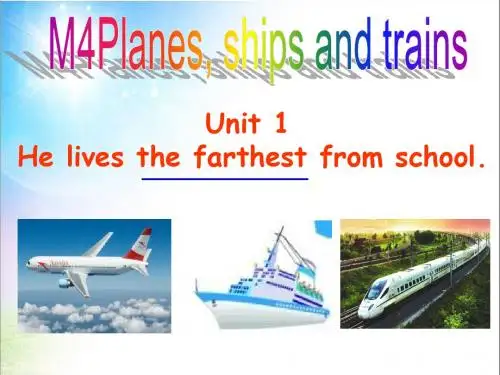
Unit 1 He lives the farthest from
school.
• • • • • • • • • •
road • [rəʊd] 公路 accident [ˈ æks ɪdənt] 交通事故,意外事 件 except • [ɪkˈs ɛpt] 除了、、、之外 choice classmate • [tʃɔɪs] 选择 • [ˈkl :smeɪt] 同班同学 ɑ far far from • [fɑ:(r)] 远的 close crowded • [kləʊs] 近的 • ʊdɪd] 拥挤的 all the time [ˈkra
good/well — better — best
bad/badly/ill — worse — worst
many/much — more — most
little — less — least
1.This chair is the most uncomfortable one. I won’t buy it. 2.Tony lives farthest from the school.
-- How does Daming go to school? -- He goes to school by bus.
Language points
by +交通工具名词 ―by +交通工具名词(如bus, car, bicycle等)‖
常用来表示交通方式, 意为 ―乘坐……‖;询
问某人的交通方式, 常用 ―How do you go /
Practice
1. I go to school ___. B A. take a train B. by bike 2. He ____ to his office. B A. on foot B. takes a train C. by bike 3. He ______ ____ taxi (乘出租车) to the gym. takes a ___ 4. She gets to the post office ____underground . by ___________ 5.– How do you go to work? -- I ______ there. B A. by car B. walk C. by bus D. on foot
modern
cheap
expensive cheap
busy
Listen and check the true sentences. 1. Betty and Daming were late for school today. F 2. By taxi is the most comfortable way but it’s the most expensive. T 3. By bike is a good chance but it’s a bit dangerous for Betty. T 4. Tony lives nearest from school. F 5. Lingling’s home is the closest to school. T 6. Daming and Betty go to school by bus. T
试比较以下例句: I usually take a bus to school. = I usually go to school on a bus. = I usually go to school by bus. 我经常乘公共汽车去上学。 3. 要表达―步行‖, 可用短语on foot来代替walk。 如: He goes to school on foot every day. 他每天步行去上学。
--How do you get to school every day? --I get to school by does your uncle go to work every day? It’s modern. It’s a little crowded. It’s comfortable. It’s cheap.
Match the words and math the pictures.
A. bus B. ship C. taxi D. train E. underground
D
B
C
E
A
Listen and math the words.
A. bus B. ship C. taxi D. train E. underground busy cheap expensive modern
the most interesting of the three. I think … is the most tiring …
Kobe
Yao Ming
Allen
I think … is the most popular. the tallest / best. …
Toyota
Benz
I think … is the most expensive.
get to ...?‖, 意为“你怎么去……?‖ 。如:
Lily goes to school by bus. 莉莉坐公共汽车上学。 —How do you go to the zoo? 你怎么去动物园呢? —By bike. 骑自行车。 注意: 用“by +交通工具名词‖表示交通方式时, 交通工具名词只能用单数, 不能用复数, 也不能 被冠词或物主代词等限定, 如by bike (骑自行车 ), by bus (乘公共汽车), by plane (乘飞机)等。
Listen and underline the words the speaker stresses.
1. --- Who lives the closest to school? --- Lingling lives the closest. 2. --- What is the most comfortable way to go to school for Betty? --- By taxi.
[拓展] 常见的交通方式表达法还有: 1. in / on + one’s / 冠词+ 交通工具名词。如: I come here in a taxi. 我乘出租车来这儿的。 2. take a (the) +交通工具名词, 但―骑自行车‖ 要用ride a bike来表示。如: Will you take a bus to go there? 你乘公共汽车去那儿吗?
外研版八年级上册Module 4 Unit 1 he lives the farthest from school
¥50 ¥500 ¥3,506
2. (cheap)
— Which one is the ___c_h_e_a_p_e_s_t____?
— The clock.
3. (popular)
— Which subject is the
_m__o_s_t_p_o_p_u_l_a_r with the
Going by train is Cheaper .
Going by bike the cheapest
is
.
Complete the sentences with the correct form of the words .
Tom
Jack
Mike
1. (fast)
— Who runs the__fa__s_te_s_t___ of the
Unit 1 He lives the farthest from school.
What ways can you travel?
bike
bus
taxi plane
underground subwa
train ship
P26 1 Match the words in the box with the pictures.
How do you go to school? Why?
How does your father go to work? Why?
My friend x x usually goes to school by _____, because it’s ________.
His/Her father…….because it’s……,
外研版八年级英语上册Module 4 unit1 He lives the farthest from school.教案

walk by bus by bike by underground
Betty
Tony
Lingling
Daming
Ways to go to school
.Listen again and check the true sentences.
C.Shanghai-Beijing train
5.A.By busB. By ship C.By underground
.Listen and answer the question.
1.How many people are Betty and her mum talking about in the conversation? Who are they?
4.Read and complete the passage.
vedio
1.Put the students in groups of 3-4 to talk about problems travelling to school.
2.Play the recording. Ask the students to find out the problems and different ways of travelling to school talked about in the conversation.
tape
1.Read through the list of words and ask the students to repeat them after you.Make sure they understand them all.
外研版八年级英语上册Module4Unit1Helivesthefarthestfromschool教案
Helivesthefarthestfromschool教学目标1.Words:road,accident,except,choice,classmate,far,farfrom,close,crowed,all thetime.2.Tounderstandconversationsabouttripsandtransports.3.Totalkabouttheyhowtogotoschooleveryday.教学重点Keystructures:Whathappened?Don’tworry.MaybeIshouldgotoschoolbytaxi.It’sthemostcomfortableway,butit’salsothemostexpensive.教学难点Totalkaboutwholivesthefarthest/closestintheirclass.学情分析Manystudentsgotoschoolbybus,soIthinktalkaboutthistopiciseasyand familiarto them.学法指导(1)Toteachyourselves(2)Tohelpeachother(3)Topractiseinpairsandgroups教学过程教学内容教师活动学生活动效果预测(可能出现的问题补救措施修改意见)一Module4Planes,sh ipsandtrains. Unit1Helivesthef arthestfromschoo l.二.Activity1三.Activity2四Activity3五Activity六Activity5七Activity6 Step1Warming-upReviewthewordsoftransportation.Step2.workinpairs.Howdoyouoftengotoschool?Step3.Matchthewordsintheboxwiththepictures.Step4.ListenandmatchthewordsintheboxwiththepicturesinActivity1Step5.ListenandreadStep6.Readandfindouttherightanswers.pletethesentenceswi1.Lookandsay.2.LookatthepicturesandsaytheEnglishwords.e.g.bus-bybus/train–bytrain/…3Askandanswer.4.Writethewordsnexttothepictures.5Readthesewordstogether.6.Matchthewordswithpicturesaccordingtothelistening.7.Lookat thepi ctures,andsaysomethingaboutthepictures.8.Studentscompletethetableaccord八Activity7 ththecorrectformofthewordsinthebox.Step8Completethesentenceswiththewordsorexpressioninthebox.Step9PronunciationandspeakingStep10Workinpairs.-What’sthemostexpensivewaytogotoschool?-Goingbytaxiisthemostexpensive.…ingtothelistening.9.Checkanswersintheirgroups.10.Readthepassageandfindouttheright.11.Checkintheirgroups12.Checkanswersinthewholeclass.13.Doitbythemselves.14.Checkintheirgroups.15.Filltherightwordsintheblanks.16.Listentothetapefirst17.Underlinethewordsthespeakerstresses.18.Workinpairs.Listenagainandrepeat.18.Readthe wordstogether,andansw erquestionsaboutthewaysofgoingto school.板书设计Unit1Helivesthefarthestfromschool.-Howdoyougotoschool?-Wholivesthefarthestfromschool?-Igotoschoolbybus/bike/…-Linglinglivesthefarthestfromschool.参考书目及推荐资料《英语八年级上册》教材、《教师用书》教学反思本堂课依据教材的编排内容和听说课型特点进行课堂教学设计,突出重难点。
外研社八年级上册Module 4 Unit 1 He lives the farthest from school 教案

Module 4 Planes, ships and trains一、教学内容:Unit 1 He lives the farthest from school.二、课型:Listening and speaking三、教学目标:1、能正确运用词汇:road, accident, except, far, far away, crowded, choice, classmate, all the time, journey, book, outside, close, park, however, cost2、能听懂含有形容词、副词最高级形式的对话及旅行方式和交通工具的描述。
3、能够使用形容词、副词最高级形式谈论并比较旅行方式和交通工具。
四教学重难点:能够使用形容词、副词最高级形式谈论并比较旅行方式和交通工具。
五教学准备:本课指导学生通过听力获取信息,培养学生听力技能。
课堂上采用多媒体手段辅助教学,多媒体课件。
六预习要求:根据音标自学本课新单词。
达标训练题A. 随学随练:写出下列单词的最高级形式:1. short _________________2. nice _________________3. big _________________4. thin _________________5. early _________________6. slowly _________________7. beautiful _________________8. carefully _________________9. badly _________________ 10. much _________________11. little _________________ 12. far __________________B. 单项选择:( ) 1. Debbie is growing fast. She is even________ than her mother.A. tallB. tallerC. tallestD. the tallest ( )2.—Dad, would you please drive ________?— No hurry. We have enough time before the plane takes off.A. fasterB. more slowlyC. more carefully( ) 3.—Do you know Lin Shuhao?—Yes. He is one of _____ basketball players in the NBA.A. popularB. more popularC. the most popular( ) 4. Is Lily’s home _____ away from school than Linda’s?A. farB. fartherC. farthest .( ) 5.—Who ran ______ of all in the sports meeting?—Hector did, I think.A. fastB. fasterC. the fastestD. most fast ( ) 6. Li Na is ________ tennis player in China now.A. most famousB. the most famousC. more famous。
外研版八年级英语上册Module 4 unit 1 He lives the farthest fr
外研版八年级英语上册Module 4 unit 1 He lives the farthest from school.教案Module 4 Unit 1 He lives the farthest from school.Ⅰ.Teaching modelListening and speakingⅠ.Teaching methodPWP approachⅠ. Teaching aims1. To be able to describe and compare modes of transportation.2. To be able to master the Superlative adjectives and adverbs (-est, most); irregular superlatives.3. To be able to listen and understand familiar topics (transportation)Ⅰ. Teaching important and difficult pointsSuperlative adjectives and adverbs (-est, most); irregular superlatives.Ⅰ.Teaching aidsA multimediaⅠ.Teaching StepsStep 1 lead in1. Work in pairs. Show some pictures and ask “How do you often go to school ”2. Look at the pictures, and say something about the pictures.3. Introduce the new words.4. Learn the new words.5. Read the new words.Step 2 presentation and practice1. Ask the students to read the words in Activity 1.bus ship taxi train underground2. Look at the pictures in Activity 1 carefully.3. Now match the words with the pictures.5. Ask the students to check their answer with a partner.6. Call back the answer from the whole class and check the answer.Step 3 pre-listening1. Ask the students to read the words in Activity2.busy cheap expensive modern2. Play the recording and ask the students to listen to the recording carefully.3. Listen and match the words in the box with the pictures in Activity 1. You need to use one word more than once.4. Ask the students to check their answer with a partner.5. Call back the answer from the whole class and check the answer.Step 4 Listening and reading1. Show some pictures, and ask the students to talk about them.2. Ask the students to read the conversation silently.3. Play the recording and ask the students to listen and read the conversation.4. Read the conversation.5. Act it out.6. Learn “Everyday English”1) What happened2) Don’t worry.Step 5 Reading practice1. Ask the students to read the conversation again.2. Now complete the table.Betty Tony Lingling DamingWays to go to school3. Ask the students to check with a partner.4. Check the answers:Step 6 practice1. Ask the students to read the words in the box in Activity 4.close comfortable good far2. Read through the sentences.1) Lingling lives the ________ to school, so she always walks.2) The _________ way to go to school is by taxi.3) Tony lives the ___________ from school.4) For Betty, going to school by bike is the _________ choice.3. Complete the sentences with the correct words from the box.4. Ask the students to check with a partner.5. Check the answers:Step 7 Complete the sentences.1. Ask the students to read the words or expression in the box in Activity 5.crowded except modern road accident2. Read through the sentences.1) All the students take the bus to school ___________ Sam.2) The ___________ train in the world is the Shanghai airport train.3) I saw a(n) __________ on the way to school yesterday.4) I do not take the bus to school because it is usually very ___________.3. Complete the sentences with the correct words from the box.4. Ask the students to check with a partner.5. Check the answers:Step 8 speaking1. Play the recording once without stopping.2. Play the recording again and ask the whole class to repeat.1) —Who lives the closest to school— Lingling lives closest.2) — Whah is the most comfortable way to go to school for Betty— By taxi.3. Ask the students to listen and mark the intonation.4. Now listen again and repeat.Step 9 speaking practice1. Ask the students to read the words or expression in the box in Activity 7.2. Read through the example with the class.— What’s the most expensive way to go to school— Going by taxi is the most expensive.3. Work in pairs.Step 10 Important and difficult points1. Maybe I should go to school by taxi. 或许我应该坐出租车去上学。
外研版八年级英语上册 Module 4 Unit 1 He lives the farthest from school教学设计
Module 4 Unit 1 He lives the farthest from school教学设计教学目标语言知识目标:功能:能够描述并比较各种交通方式。
语法:形容词、副词的最高级(规则与不规则变化);by+交通工具词汇:road, accident, except, far, far from, crowded, all the time, choice语音:掌握重读的规律及其所传递的信息。
语言技能目标:听:能够听懂含有形容词和副词最高级形式的对话及对旅行方式和交通工具的描述。
说:能够使用形容词和副词的最高级形式谈论比较旅行方式和交通工具。
运用:能够介绍自己或他人的旅行计划以及乘坐的交通工具。
情感态度目标:了解各地风景名胜,热爱祖国的大好河山,能够通过比较选择合理、安全的出行方式。
学情分析本班共24人,英语基础较好,一半以上学完新概念一。
重点难点重点:形容词和副词的最高级难点:能够熟练地运用形容词和副词的最高级谈论自己和他人的出行方式。
教学过程教学活动【导入】Planes,ships and trainsGreeting.Warming- upQuestion: How do you go to school every day?Students: I go to school by bike/ by bus/ on foot.Question: Except these three ways, what other ways do you know?Students: train/ plane/ underground/ car/ taxi/ ship…Question: What is going by plane/ taxi/ underground/ bus/ train like?Students: It is fast/ dangerous/ expensive/ modern/ busy/ crowded/ cheap/ comfortable. Read these words together.PresentationActivity 1In our book, there are also some pictures of the ways of going, let’s have a look togethe r.Question: What’s this?Students: Train/ bus …Activity 2Listen and match the words with the pictures.Check the answers together.Listen again and match the phrases together, and pay attention to the whole sentence. Check the answers one by one.Read the sentences together.Activity 3Betty took the bus to school today, but she was late. And now she is talking about some thing with her mum, let’s listen and try to find out what they are talking about.Listen and answer 3 questions.Question 1: What are they talking about?Question 2: Who lives the farthest from school?Question 3: Finally, how does Betty go to school?Listen again and complete the table.WhyWhat’s it like?By bikeQuestion: How does Tony go to school and why?Question: What is going by underground like?Question: How about Lingling?/ Why?/ What is going on foot like?Question: How about Daming?/ What is going by bus likeTeacher: There is still another way of going in our dialogue, remember? What is that? Students: By taxi.Teacher: What is it like?Students: It is the most comfortable way, but it’s also the most expensive.Teacher: After comparing so many ways, finally, Betty decides to go to school by …Wha t is it like?Students: Bike, dangerous.Teacher: so in the end, what does her mum say?Students: Remember to be careful all the time.Teacher: Excellent! How does her mum feel?Students: worried!Teacher: Yes, her mum is worried about Betty, so are your parents. When you go out or when you go to school, your parents must be very worried about you too. So what shoul d you do?Students: Remember to be careful all the time!Read after the radio. Pay attention to you intonation.Practice reading or retelling in pairs.Check reading or retelling, and try to act it out. (6组)ConsolidationWork in groupsLeading- inWe all know that the National Day is coming, do you have some plans of travelling? So me students say yes, but some say no.T: Hello, Zhao Rui, do you have some plans during the National Day?S:No, I don’t.T: Really? How about going to the Labor Park with me?S: Er… That’s a good idea! How are you going there?T: I’m going there by underground, because it is the fastest way and it’s also the most c omfortable. How about you?S: I don’t like going there by underground, because it is the most boring way. I am goin g there on foot, because my home is the closest to it, and it is also the most relaxing an d the most interesting way. I can also have a lot of fun on my way there.T: Yes, you are right! I will go there on foot, too. See you then.S: Bye-bye!Make it clear.Make an interview: about the ways to go there.1 reporter3 studentsSomewhere togetherBy bus/ bike/ car/ plane/ ship/ coach/ underground…Superlative adjectivesSee? Work in groups. Suppose you are going somewhere together, but you have different ideas about the ways to go there. Of course you should tell us why, just like what Zhao Rui and I did just now. And try to use superlative adjectives and adverbs here. Four stud ents work in a group, and one student is the reporter. He or she is making an interview with the other three students about the ways to go there. Understand? Let’s do it togethe r!Practise in groups3 groups act their dialogue out at the front.More exercises about the superlative adjectives and adverbs.Do it together and one student come the blackboard.Check the answers one by one by reading it aloud.Read the sentences together and pay attention to the superlative adjectives and adverbs. SummaryWatch the video.HomeworkA+B or A+C, it is up to you!Thank you!。
外研版初中英语八年级上册Module 4 Unit 1 He lives the farthest from school课件
形容词、副词的最高级
两者比较用形容词或副词的比较级,当我 们要将三个或以上的事物进行比较时,要用它 们的最高级。例如: 1. Lingling’s home is the closest to school. 玲玲家离学校最近。 (形容词的最高级前要用the) 2. It is the most comfortable way but it’s the most expensive. 这是最舒适的方式,同时也 是最贵的方式。
A3(2).Listen again and complete the table.
Betty Tony
Lingling Daming
Ways by bus by bus to go by underground to walk / on foot school
Why
the farthest
the closest
表示交通方式的还有其他不同的表达,如: on foot/walk步行 drive a car开车 ride a bike骑自行车 fly to…乘飞机去
e.g.我步行去学校。 我骑自行车去公园。
我开车去广州。
我乘飞机去英国。
2.Why? What happened?发生了什么事?
What happened to sb.? 某人发生了什么事? 3.There was a road accident.发生了交通事故。
It’s the most comfortable way.
ship
The Green’s are going to travel to by ship London___________.
underground
take the underground People____________________to work. It’s crowded. subway
外研版八年级英语上Module 4Unit 1 He lives the farthest from school说课稿
外研版初二英语上Module 4 Unit 1 He lives the farthestfrom school 说课稿各位老师,大家好!今天我说课的内容为外研版初二英语上第七模块第一单元。
我将从教材分析、教学目标、学情分析、教学方法、学法指导、教学步骤六个方面进行阐述。
一、教材分析:1本单元主要围绕"Modes of transportation "这一主题展开各种教学活动,并以这一主题引出形容词及副词的最高级这一语言功能.本单元旨在创造一个轻松愉快的学习交流环境,主要通过听,说来培养学生综合运用这些知识的能力.并让学生能在"做中学"(learning by doing),通过有限的课堂实践活动,拓展以往的经历,能准确地用英语来表达.2教材的地位和作用: 八年级上He lives the farthest from school 讲述的是形容词副词最高级的用法,这是初中非常重要的语法之一。
学生们能够用这一语法内容来比较人和事物的不同之处是很重要的。
我们更要使学生不仅理解枯燥的语法,还要让学生们会用新学的语法知识来表达思想.3教材的处理: 由于本班大部分学生厌学情绪高,学习兴趣不浓。
根据这一实际情况,及结合本单元的教学内容,我对本单元的内容进行如下处理,我将本单元分为两个课时。
第一课时主要让学生掌握本单元生词,读熟课文,基本掌握形容词副词最高级的用法。
第二课时,学生能熟练掌握形容词副词最高级的用法,并能进行简单的交谈。
4教学重点。
(1)指导学生掌握和熟练运用所学单词、句型和句子,如It’s the most comfortable way……(2)指导学生口头熟练表达就交通方式这一话题展开的对话内容。
(3)形容词、副词最高级的用法。
5.教学难点。
学生根据实际情境需要真正开口讲英语二教学目标(1)技能目标。
学生能听懂本对话录音,能听懂师生之间就本对话内容而展开的、切形式的问答,会和别人展开对话,了解和传递信息;掌握形容词比较级的用法。
外研版八年级上册Module4 Unit1He lives the farthest
Tom missed the school bus abd he was late for school.
1.I took the bus. 我坐公交车。
英语中交通方式的表达方法:
① “take a/the + 交通工具” eg:take a bus/taxi
3.That's a good choice. 那是一个好的选择。 choice意为“选择”,名词,其动词形式为choose 常用于以下搭配: make a choice 做出选择 have no choice (but to do sth.) 别无选择(只能做某事)
4. ...but remember to be careful all the time. 但记得要时刻保持小心。 remember意为“记得”, 常用于以下两种搭配,注意区分: remember doing sth. 记得做过…(已做) remember to do sth. 记住要做…(未做) eg:我记得见过他一次。
A. Beijing
B. France
C. England
3.How is the Tokyo underground? C
A. It is the most modern underground in the world
B. It is the cheapest underground in the world
choice意为“选择”,名词,其动词形式为choose 常用于以下搭配: make a choice 做出选择 have no choice (but to do sth.) 别无选择(只能做某事)
a bit 有点儿
外研版-英语-八上-英语中交通方式的表达方法
2013年八年级英语上册Module 4 Planes , ships and trains Unit 1 He lives the farthest from school. Betty: I was late for school today. Mum: Why ? What happened ?Betty: I took the bus. There was a road accident, and the traffic was very heavy. But nobody was late, except me. Maybe I should go to school by taxi.Mum: It’s the most comfortable way, but it’s also the most expensive.Betty: Then what about going by bike ?Mum: That’s a good choice, but it’s a bit dangerous. There’s so much traffic.Betty: But most of my classmates ride bikes, and it’s quite safe. Don’t worry. I’ll be careful.Mum: How does Tony go to school ?Betty: He lives the farthest from school, so he takes the underground.Mum: And what about Lingling? Betty: Her home is the closest to school, so she walks.Mum: How about Daming ?Betty: He goes by bus too, the same as me. But its so crowded! And the traffic is heavy.Mum: All right. You can ride your bike to school, but remember to be careful all the time.Read the passage and number the ways of travelling from the most expensive to the least expensive.Question : What is the best way to travel from London to Amsterdam?Unit 2 What is the best way to travel?I am planning to travel from London to Amsterdam. How long does the journey take and what is the best way to travel? Could you please tell me about the trains or ships to get there ? The more information ,the better . Thanks.Best answer: There are four ways to travel.A journey by train is more relaxing than by coach, but a lot more expensive. When you go by train, buy your ticket a long time before you travel. It is usually cheaper.You can go by car and by ship across the North Sea. This is the most comfortable way to travel but also the most expensive . Book your ticket before you book your hotel. Remember that parking in Amsterdam is very expensive, so stay outside the city centre and travel in by bus or by train.The third choice is by coach. This is usually the cheapest , but in summer the coaches sometimes get crowded! And it takes you about twelve hours to get there. However , it will not cost as much as going by train.Finally , you can fly. It is the fastest and the second cheapest , but you may have to wait for hours at the airport because of bad weather.Well , I hope this helps! Have a great trip!U11.road 路,公路2.accident 事故3.except 除。