
译林牛津2020年中考英语高频考点复习(八年级下册)
八年级下册考点整理课时1 Unit 1高频词汇考点1 married adj. 已婚的,结婚的(教材P8 Reading)[知识精讲] married的动词形式为marry,名词形式为marriage。
1. marry sb./get married to sb.表示动作,意为“和某人结婚”,不能和表示一段时间的状语连用。
2. be married (to sb.)表示状态,能和表示一段时间的状语连用,用于完成时态中。
考点精练11. (2019•扬州邗江二模)— When did your parents ________?— They ________ since 15 years ago.A. marry; marriedB. get married; have been marriedC. be married; have got marriedD. marry with; have been married考点2 move away 搬离(教材P8 Reading)[知识精讲] move作动词可意为“移动”或“使感动”。
move into 搬进move to 搬到move house 搬家move out of ... 从……搬走考点精练22. They don't live here any longer. They ________ Chengdu last month.A. moved outB. moved toC. moved awayD. moved from考点3 yet adv. 还,仍(教材P14 Grammar)[知识精讲] yet为现在完成时的标志,用于否定句和疑问句中。
already意为“已经”,用于肯定句中。
现在完成时的一般疑问句可用not yet作简略的否定回答。
考点精练33. (2019•安顺)— Have you seen the hot film The Wandering Earth ________?— Yes, I have. ________ wonderful science fiction movie it is!A. yet; How aB. already; HowC. yet; What aD. already; What考点4 return vi. 返回(教材P16 Integrated skills)[知识精讲] return 作不及物动词,意为“返回”,相当于go/come back,后接表示地点的名词时要用介词to或from。
return to ... 回到…… return from ... 从……回来后接表示地点的副词时不用介词。
return 不能与back连用。
return用作及物动词时,表示“归还”,相当于give back。
return sth. to sb. =return sb. sth. 把某物还给某人考点精练44. — Your father has gone to Shenzhen on business, hasn't he?— Yes. And he will ________ in two weeks.A. reviewB. repeatC. reduceD. return考点5 keep in touch 保持联系(教材P16 Integrated skills)[知识精讲] 表示“保持联系”还可以用stay in touch,其反义短语为lose touch(失去联系)。
表示“与某人保持联系”用keep in touch with sb.。
考点精练55. (2019·连云港赣榆模拟)More and more old people are learning _______________(与……保持联系) their children by WeChat.考点6 communication n. 交流,交际(教材P16 Integrated skills)[知识精讲] communication的动词形式为communicate。
communicate with sb. 与某人交流考点精练66. WeChat is one of the most convenient ways of ________.A. informationB. competitionC. communicationD. pollution易混词汇考点1 however与but(教材P9 Reading)[知识精讲] however是副词,but是并列连词,however可以置于句首、句中或句末,而but不能置于句末。
另外,but之后一般不能使用逗号,但however位于句首时,通常其后用逗号,位于句中时,通常在其前后各加一个逗号。
考点精练11. — What happened just now?— A car hit an old lady at the crossing. She was hurt, ________ not too badly.A. andB. butC. orD. however考点2 since与for(教材P8 Reading)[知识精讲] “since +时间点/具体时间”表示“自从……以来,从……以后”,用来说明动作的起始时间。
如:He has lived in China since he was born.他自从出生以来就住在中国。
“for +时间段”用来说明动作延续的时间长度,因此句中的谓语动词也是延续性动词。
如:I have been here for three days. 我来这儿已经三天了。
考点精练22. — It has been much easier for me to go to work ________ shared bikes appeared.— But they also caused plenty of problems.A. sinceB. forC. unlessD. though核心句型考点1 Y ou used to share food with me! 你过去常常和我分享食物的!(教材P6 Welcome) [知识精讲]1. used to 意为“过去常常”,其后跟动词原形,表示过去的习惯、经常发生的动作或状态。
2. be used to doing sth.意为“习惯做某事”,其中to是介词,后接名词或动名词。
3.be used to do sth.是被动语态,意为“被用来做某事”。
考点精练11. (2019•常州)He is used to ________(have) a cup of tea first after getting up.2. — Did your father use to ________ to work?— Yes, but now he likes using public transportation. He is used to _________ the bus.A. drive; takingB. driving; takingC. driving; takeD. drive; take考点 2 Has the town changed a lot over the years? 这些年这个镇变化大吗?(教材P8 Reading)[知识精讲] change a lot 变化大,a lot是副词短语,表示程度大。
如:Thanks a lot for helping me. 非常感谢你帮助我。
1. a lot意为“很,非常,很多”,常用于谓语动词之后作状语,不可用于名词之前表数量。
2. a lot of意为“许多”,相当于lots of,用于名词之前作定语,既可以修饰可数名词,也可以修饰不可数名词。
考点精练23. Though I have learned English ________ two years, I can communicate with my friend in English.A. forB. inC. sinceD. during4. — How are you today?— I'm feeling ________ better now.A. a lotB. lots ofC. a lot ofD. lot of考点3 It's really nice to have a beautiful modern town. 有一个漂亮的现代化城镇的确好。
(教材P9 Reading)[知识精讲] “It is +形容词+to do sth.”意为“做某事是……”,其中It是形式主语,无实际意义,真正的主语是后面的动词不定式(to do sth.)。
考点精练35. (2019•湘潭)________ is unhealthy for us to go to school without eating breakfast in the morning.A. ThatB. ThisC. ItD. These6. (2019·苏州)对中国人而言,在春节团聚是常见的。
____________________________________________________________________重点语法考点1 现在完成时(教材P12 Grammar)[知识精讲] 基本结构为:助动词have/has +动词的过去分词(done)1. 表示过去发生的行为、动作或情况对现在造成的影响或导致的结果。
常用的时间副词有just(刚刚), already(已经), still(仍然), recently(最近), yet(还,尚), ever(曾经), never(从不)。
其中just, already用于肯定句;yet, ever, never常用于否定句或疑问句;still, recently可用于肯定句、否定句或疑问句。
如:Have you ever been to Hong Kong?你曾经去过香港吗?I haven't got the letter from my uncle yet.我还没收到我叔叔的信。
2. 现在完成时也常与so far(迄今为止), in the past several years(在过去的几年里), ever since(迄今), in/during/over the past/last few years(在过去的几年里)这类表示从过去到现在的时间状语连用。
译林牛津八年级下册知识点梳理
牛津初中英语8B unit1—unit8 知识点归纳8B Unit1【考点精讲】一、核心词汇1.past n.[考点点拨]past作名词,意为“过去”,其还可作介词和形容词,可用于如下情况:in the past(n.)在过去;half past(prep.)five 5点半;in the past(adj.)three years在过去的3年里。
如:When he walks past our desks, he always knocks ourbooks and pens off the desks.当他走过我们课桌的时候,他总是把我们的书本和钢笔从课桌上碰掉下来。
The boy finished his homework with the help of his father in the past.这个男孩过去是在他父亲的帮助下完成作业的。
2.present n.[考点点拨]present作名词,意为“现在,目前”。
At present=at the moment=right now 目前;其还可作形容词,your present job你目前的工作;present用作名词,还可表示“礼物”,a birthday present -份生日礼物。
如:He is washing his clothes at present.现在他正在洗衣服。
3.northern adj。
[考点点拨] 方位词:north-northern; west-western; south-southern; east-eastern。
如:in the north of China = in the northern part of China在中国北部East China华东;North China华北The northern part of the city used to be sparsely populated, but has now become acultural centre.城北过去人口稀少,但现在成了文化中心。
2020年中考英语高频考点复习(八年级下册)
八年级下册考点整理课时1 Unit 1高频词汇考点1 married adj. 已婚的,结婚的(教材P8 Reading)[知识精讲] married的动词形式为marry,名词形式为marriage。
1. marry sb./get married to sb.表示动作,意为“和某人结婚”,不能和表示一段时间的状语连用。
2. be married (to sb.)表示状态,能和表示一段时间的状语连用,用于完成时态中。
考点精练11. (2019•扬州邗江二模)— When did your parents ________?— They ________ since 15 years ago.A. marry; marriedB. get married; have been marriedC. be married; have got marriedD. marry with; have been married考点2 move away 搬离(教材P8 Reading)[知识精讲] move作动词可意为“移动”或“使感动”。
move into 搬进move to 搬到move house 搬家move out of ... 从……搬走考点精练22. They don't live here any longer. They ________ Chengdu last month.A. moved outB. moved toC. moved awayD. moved from考点3 yet adv. 还,仍(教材P14 Grammar)[知识精讲] yet为现在完成时的标志,用于否定句和疑问句中。
already意为“已经”,用于肯定句中。
现在完成时的一般疑问句可用not yet作简略的否定回答。
考点精练33. (2019•安顺)— Have you seen the hot film The Wandering Earth ________?— Yes, I have. ________ wonderful science fiction movie it is!A. yet; How aB. already; HowC. yet; What aD. already; What考点4 return vi. 返回(教材P16 Integrated skills)[知识精讲] return 作不及物动词,意为“返回”,相当于go/come back,后接表示地点的名词时要用介词to或from。
牛津译林版八年级下册英语各单元语法知识点复习提纲(全面!)
牛津译林版八年级下册英语各单元语法知识点复习提纲Unit1 Past and present一、同步知识梳理知识点1:past and present(P6)(1)pastn. 过去,以前;in the past 在过去adj. 过去的,以前的;in the past few years 在过去的几年里prep. 经过walk past the post office走过邮局【例句】In the past, there was no underground in Nanjing.Let’s not make the past mistakes.When I walk past the post office, I see a bird flying over the tree.(2)presentadj.现在的; 目前的; 出席的n.现在; 礼物; at present 现在;a present for you=a gift for you给你的礼物vt.介绍; 出现; 提出; 赠送;【例句】Everyone can be present ed a present at present.知识点2:You’ve changed, Eddie. You used to share food with me.(P6) 你变了。
你以前跟我分享食物的。
(1)change: vt./vi. 改变,变更; change into变成n.变化,改变; change(s) to ...的变化【例句】Great changes to Nanjing have taken place.(2)use n.用途; 使用能力; 运用头脑(或身体)的能力;vt.用,使用; 行使,【常用短语】①used to (do sth.) “过去常常(做某事)”批注:否定形式:didn’t use to / usedn’t to①get/be used to(doing sth. )“习惯于(做某事)【例句】He used to go fishing every Saturday. But since he changed his job, he’s barely(几乎不) had a chance. He thinks he’ll never be used to this busy lifestyle.【拓展】useful adj. 有用的;useless adj. 无用的知识点3:I first lived in the northern part of the town with my parents.(P8)【例句】Beijing is in the northern part of China.批注:注意in the north与in the northern part of 的同义句转换。
牛津译林版英语八年级下册笔记整理(考点1-40) PDF
8B 笔记整理(考点1 ~ 40)1. 现在完成时的信号词:2. 现在完成时的基本结构:肯定句:主语+ have / has + 过去分词否定句:主语+ have / has + not + 过去分词一般疑问句:Have / Has + 主语+ 过去分词3. used to do sth. 过去常常做某事;used to be 过去曾是…be used to doing sth. / get used to doing sth. 习惯做某事注意:观察used 前面有没有be 动词或者get / got4. Asia 亚洲Asian 亚洲的/ 亚洲人Europe 欧洲European 欧洲的/ 欧洲人Africa 非洲African 非洲的/ 欧洲人America 美洲American 美洲的/ 欧洲人* a European country 虽然元音字母开头,但是发音为辅音,所以用a* Americans and Europeans 美洲人和欧洲人; Asians and Africans 亚洲人和非洲人5. Canada 加拿大Canadian 加拿大的/ 加拿大人;Australia 澳大利亚Australian 澳大利亚的/ 澳大利亚人;Germany 德国German 德语/ 德国人的/ 德国人France 法国Fr e nc h 法语/ 法国人的/ 法国人注意:名词所有格Canadian s’ books 那些加拿大人的书the Canadian’s book 那个加拿大人的书6. ①mind doing sth.介意做某事Do you mind my opening the window? / Do you mind me opening the window?②Never mind. (口语交际)没关系,不介意③ A moment of fear went through my mind. 【名词】头脑,大脑7. 句型The best time to do sth.The best time to visit the UK is … / from … to …Sunshine Park is a wonderful place to fly kites.* 与time / place 相关的句型(表示最佳时间、最佳地点)使用to do 结构;* 短语have a good time doing sth. 使用doing 结构8. east 东方east ern东方的;west 西方west ern西方的;south 南方south ern南方的;north 北方north ern北方的;at the southern end of …在…的最南端;Western restaurants 西餐馆(表示西方文化、艺术的时候需要大写)9. can’t help / stop doing sth. 情不自禁做某事/ 忍不住做某事stop doing sth. 停止正在做的事;stop to do sth. 停下手中的事去做一件新事情10. to do 不定式表示目的(理解句意,在翻译句子的基础上理解目的的表达)We must try our best to stop the pollution to live (live) a happy life. 为了…11. be interested in doing sth. She is interested in reading novels. 对…感兴趣show an interest in doing sth. She shows an interest in reading novels.interested (感到)有兴趣的interesting 令人感兴趣的bored (感到)无聊的boring 令人感到无聊的excited (感到)兴奋的exciting 令人感到兴奋的relaxed (感到)放松的relaxing 令人放松的12. 序数词第…in the early / late twentieth century 在(第)二十世纪早/晚期区分:in the / one’s thirties 名词复数形式意思是30~39之间She is in his thirties.thirtieth 序数词意思是第三十celebrate her thirtieth birthday基数词变序数词14. hear / see sb. do sth. 听见/看见某人做事的全过程hear / see sb. doing sth. 听见/看见某人做事的一瞬间注意:经常听见或看见的是全过程I often hear the birds sing.比较级的基本结构:比较级+ than最高级的基本结构:the + 最高级16. 区分:形容词的比较级和形容词变副词* I find it easier than before to complete the task.* Susan can work out the problem easily. 轻松地解决难题副词修饰动词* 修饰比较级much / even / a little + 比较级+ than* 注意:further information / study / help …(程度)更进一步的;Further on …再往前区分:tasty = delicious 美味的;tasteful 有品味的;雅致的18. 反义词前缀un-, in-, im- 意思是not注意:读懂句意,准确判断词性,在理解句子意思的基础上补充词缀。
2024年中考英语牛津译林版英语八年级下册u1-u8核心知识点考点汇总
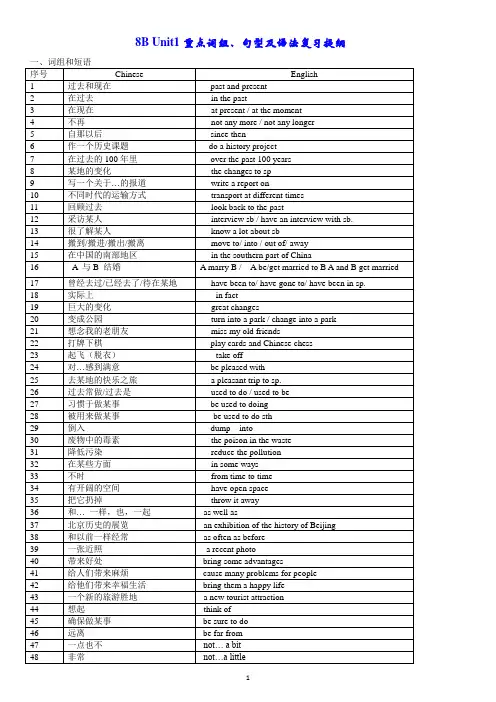
8B Unit1重点词组、句型及语法复习提纲49 周围的青山绿水green hills and rivers around50 把某物落在某地leave sth sp51 和某人一起拍照take photos with sb52 拍某人的照片take photos of sb53 处于使用中be in service / be in use54 乘… 去某地take … to sp / go to sp by….55 靠近next to56 更少的发展less development57 放学后在学校和朋友聊天stay after school to chat with friends58 同意某人的观点agree with sb59 同意做某事agree to do60 有更多的时间放松自己have more time to relax oneself61 在小学in primary school62 有同感have the same feeling63 自然美景natural beauty64 顺便问一下by the way二、重点句子及句型:1. ----Eddie,have you seen my food ? ----Yes. I’ve just eaten it.2.The factory used to dump its waste into the river.(didn’t use to do/used not to do)3.I have known the place since I was very young.4.We lived together till 1965 when I got married.5.China has changed a lot. = Great changes have happened to China.= There have been great changes in China.6.Many of them have moved to other areas and I feel a bit lonely from time to time.7.They cannot see their friends as often as before.8.The government realized it was a very serious problem and took action to reduce the pollution.9.Eddie has lived with Millie since he was born./last year/3years ago.10.They have gone to the cinema already. John has been to the USA a few times.11.I come to school by bus on my own12.He thinks he is unlucky enough to see the changes to Sunshine Town.13.I will stay there for a whole week to enjoy the sun and the beach.14.I wish you a happy holiday. = I wish you will have a happy holiday.15.The changes to Moonlight Town have brought many benefits but they have also caused many problems for people.16. Some animals and plants have lost their living areas because of these changes.17. It no longer provides a good environment for wildlife. = It does n’t provide a good environment for wildlife any longer.18.Now, let me show you how to get to the train station.三、语法:1.现在完成时用法一:表示过去发生的动作对现在产生影响。
译林牛津八年级下册8B知识点梳理
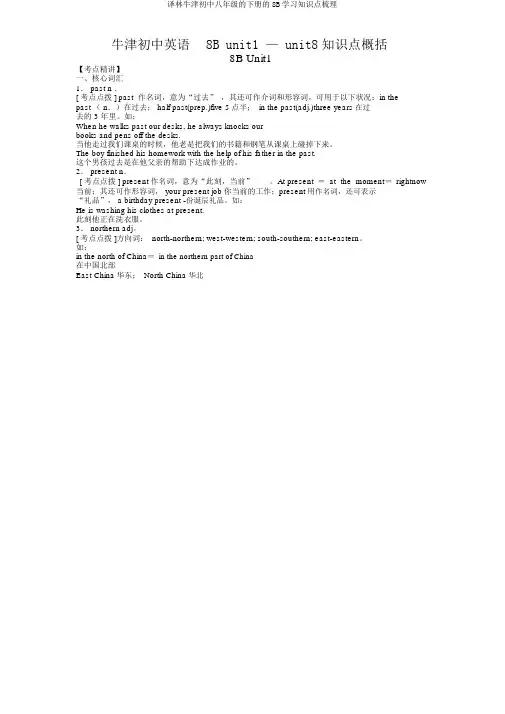
牛津初中英语8B unit1 — unit8知识点概括8B Unit1【考点精讲】一、核心词汇1. past n .[ 考点点拨 ] past 作名词,意为“过去” ,其还可作介词和形容词,可用于以下状况:in thepast ( n.)在过去; half past(prep.)five 5点半;in the past(adj.)three years在过去的 3 年里。
如:When he walks past our desks, he always knocks ourbooks and pens off the desks.当他走过我们课桌的时候,他老是把我们的书籍和钢笔从课桌上碰掉下来。
The boy finished his homework with the help of his father in the past.这个男孩过去是在他父亲的帮助下达成作业的。
2. present n.[ 考点点拨 ] present作名词,意为“此刻,当前”。
At present=at the moment=rightnow 当前;其还可作形容词, your present job你当前的工作;present用作名词,还可表示“礼品”, a birthday present -份诞辰礼品。
如:He is washing his clothes at present.此刻他正在洗衣服。
3. northern adj。
[ 考点点拨 ]方向词:north-northern; west-western; south-southern; east-eastern。
如:in the north of China=in the northern part of China在中国北部East China华东;North China华北The northern part of the city used to be sparsely populated, but has now become acultural centre.城北过去人口稀罕,但此刻成了文化中心。
2020中考英语牛津译林版八年级下册Unit7 复习总结课件
标
小 测
【典例】(1)[2019·青海改编]We all D little Mary because she won
the first place in the piano competition.
A. was proud to
B. was afraid of
C. took part in
D. took pride in
courses after work.
8. 它也致力于防止一些重疾的传播,如艾滋病在年轻人中(的传播)。 句 It also works to prevent the spread of some serious diseases, 型 like AIDS, among young people. 再 9. 她习惯于乘飞机往来各地。 现 She is getting used to travelling by plane .
达 标
【拓展】development n. 发展,进展,开发
小 测
developing adj. 发展中的
developed adj. 发达的
【典例】As the story C , the secret of the castle is discovered little
by little.
A. ends
考
job is to C food and clothes.
点
聚
A. sell out
B. work out
焦
C. hand out
D. find out
随 堂
(2)The teacher handed the exercise books out D the students.
牛津译林英语八年级下册全册语法复习
牛津译林英语八年级下册全册语法复习牛津译林英语八年级下册全册语法复8B Unit1现在完成时的用法现在完成时有三种用法:1.表示过去发生的动作和现在有联系,即该动作对现在有影响。
例如:Have you had your lunch。
你吃过午饭了吗?Yes。
I have。
I've just had it。
是的,我吃了,我刚吃过。
(现在我不饿了)I have already posted those photos。
我已经邮寄了那些照片。
(那些照片现在已不在我这里了)2.表示从过去某一时间开始一直持续到现在(包括“现在”在内)的动作,并且表示一段时间的状语连用,谓语动词多用延续性动词。
例如:I've known him for 3 years。
我认识他已经3年了。
They have lived here since 1996.自从1996年以来他们一直住在这里。
3.表示到现在为止多次发生的动作。
例如:XXX twice。
这部电影他已经看过两遍了。
My XXX has told me the story several times。
我爷爷已经把这个故事给我讲了好几遍。
现在完成时的构成现在完成时的构成为:肯定句:主语 + have/has + 动词的过去分词 + 其他。
否定句:主语 XXX 动词的过去分词 + 其他。
一般疑问句:Have/Has + 主语+ 动词的过去分词+ 其他?肯定回答:Yes,主语 + have/has。
否定回答:No,主语 + XXX't。
需要注意的是,主语是第三人称单数时用has,其他人称用have。
例如:XXX has heard from his XXX。
XXX这个月已收到了他爸爸的两次来信。
We have already cleaned our classroom。
我们已经打扫了教室。
现在完成时的标志词现在完成时的标志词包括:already,yet,ever,recently,just,before(用于句末),so far,for + 一段时间,since + 过去时间或一般过去时的句子。
2020中考英语牛津译林版八年级下册Unit4 复习总结课件
4. 我一次可以借几本书? How many books can I borrow at a time ?
5. 他们很快又爬起来,继续在我身上走动。
They soon got up again and continued moving across my body.
6. 丹尼尔没有说和谁谈论这本书。 句 Daniel did not say who to talk to about this book. 型 7. Kitty不能决定先选哪一个。 再 Kitty can't decide which to choose first. 现 8. 我想:“我必须逃离他们。”但我不知道该如何逃脱。
聚 焦
“give…back”。 return sth. to sb. 意为“将某物归还给某人”。
You can use my bicycle, but you must return it this evening.
随
堂
你可以用我的自行车,但今晚一定要归还。
达
标
小
测
核 心
【拓展】return 还意为“返回;回报;回应”。return to sp 意为“返回某处”,
考 点
霍波,你已经决定怎样处理这些书了吗?
聚
焦
【点拨】(1)句中“what to do with”为“疑问词+不定式”结构,在句中作宾
牛津译林版八年级英语下册 重要知识点梳理
Unit1 Past and present1、I’ve lived here since I was born.since 可以作介词,连词意为“自从”和“既然”【用法1】与现在完成时或过去完成时连用,since可以接短语,如since 1994(自从1994年),since leaving school(自从离开学校),since也可以接句子,since I was born(自从我出生以来)【用法2】since表示“既然”,引导原因状语从句【例句】We’ve lived here since 1993.自从1993以来我们就住在这里了。
Since we are here, we should visit our teacher.既然我们在这,我们就应该去看看我们的老师。
【经典练习】She’s been off work _____ Tuesday. 星期二以来,她一直没上班【解析】since2、When I got married in 1965, my wife and I moved two blocks away.marry 作动词,意思是“娶、嫁”,married作形容词,意思是“已婚的”【用法1】marry sb. 娶某人,嫁给某人【用法2】be/get married to sb.和某人结婚【用法3】marry A to B 把A嫁给B【例句】He married the girl last year. 他去年娶了那个女孩。
He was married to the girl last year.Her father will marry her to the man tomorrow. 她父亲明天就要把她嫁给那位男性。
【经典练习】---When did you______ your husband?--- Two years ago.【解析】marry3、Now the government has turned part of the town center into a new park.turn 可以作动词,意为“转变”,作名词,意为“(依次轮到的)机会”【用法1】It’s one’s turn to do sth.该轮到某人做某事了【用法2】turn out 原来是,结果是;turn into变成;turn on 打开;turn off 关闭;turn up 出现;把声音调高;turn down 拒绝;把声音调低【例句】It’s your turn to do the cleaning.该轮到你打扫卫生了。