
【最新试题库含答案】投资学第9章习题及答案
投资学第9章习题及答案
篇一:投资学第九版课后习题答案--第10、11章
第10章
5、因为投资组合F的β=0,所以其预期收益等于无风险利率对于投资组合A,风险溢价与β的比率为(12-6)/1.2=5 对于投资组合E,风险溢价与β的比率为(8-6)/0.6=3.33
对比表明,这里有套现机会存在。
例如,我们能创建一个投资组合G,其包含投资组合A和投资组合F,并且两者有相等的权重,使它满足β等于0.6;这样投资组合F的期望收益和β为:
E(rG ) = (0.5 × 12%) + (0.5 × 6%) = 9%
βG = (0.5 × 1.2) + (0.5 × 0%) = 0.6
对比投资组合G和投资组合E,投资组合G跟E具有相同的β值,但具有更高的期望收益。
因此通过买入投资组合G,并卖出相同数量投资组合E资产就可以实现套现机会。
这种套现利润:
rG – rE =[9% + (0.6 × F)] ? [8% + (0.6 × F)] = 1%
6、设无风险利率为rf,风险溢价因素RP,则:
12% = rf + (1.2 × RP)
9% = rf + (0.8 × RP)
解之得: rf=3%,RP=7.5%
7、
a、由题目知,买进100万美元等权重的正α值的股票并同时卖出100万美元的等权重的负α值的股票;假定市场风险为0;则预期收益为:$1,000,000*0.02-$1,000,000*(-0.02)=$40,000
b、对于分析师分析的20只股票,每只股票持有时都分别为$100,000,市场风险为0,公司持有的收益标准差为30%,所以20只股票的方差为
20 ×[($100,000 ×0.30)* ($100,000 ×0.30)] =
$18,000,000,000
故标准差为$134,164
a、如果分析师分析的是50只股票,那么每只股票持有时都分别为$40,000,计算收益方差:
50 × [(40,000 × 0.30)* (40,000 × 0.30)] = 7,200,000,000
故标准差为$84,853;由于总投入资金不变,α值不变,故其期望收益也不变,为$40,000
8、
2a、?2??2?2
M??(e)
2?A?(0.82?202)?252?881
222?2
B?(1.0?20)?10?500
2?C?(1.22?202)?202?976
b、如果资产种类很多,并且具有相同的收益特征,每一个种类的充分分散投资组合将存在唯一的系统风险,因为非系统性风险随着n的无穷大会趋近于0,因此充分分散的投资组合的超额收益方差的均值为:
2 ?A?256
2?B?400
?C2?576
C、市场中不存在套现机会
第11章
9、答案:C。
如果股票市场是弱有效的,那么可以预测的回报方式是不可能发生的,C项内容明显与“股票市场是弱有效的”相抵触。
10、答案:A。
市场无效性在短期比长期更容易得到利用而得到利益,A项中由于卖出一大股股票而致使股票价格暂时性下跌,就是利用了市场。
投资学精要(博迪)(第五版)习题答案英文版chapter9&10

Essentials of Investments (BKM 5th Ed.)Answers to Suggested Problems – Lecture 7Bond Pricing Examples for Exam 3:Problem 9(a) in Chapter 9 provides an example of a bond price calculation (answer shown below). As additional examples, page 69 in your course packet provides several bond pricing problems for bonds with various maturity, yield, and coupon characteristics. The bond prices for these examples are as follows (note all bonds pay coupons semi-annually):8% coupon, 8% market yield, 10 years to maturity: B = $1,000.008% coupon, 10% market yield, 10 years to maturity: B = $875.388% coupon, 6% market yield, 10 years to maturity: B = $1,148.778% coupon, 8% market yield, 20 years to maturity: B = $1,000.008% coupon, 10% market yield, 20 years to maturity: B = $828.418% coupon, 6% market yield, 20 years to maturity: B = $1,231.156% coupon, 8% market yield, 10 years to maturity: B = $864.106% coupon, 10% market yield, 10 years to maturity: B = $750.766% coupon, 6% market yield, 10 years to maturity: B = $1000.00Chapter 9:4. Lower. Interest rates have fallen since the bond was issued. Thus, the bond is selling at apremium and the price will decrease (toward par value) as the bond approaches maturity.5. True. Under the Expectations Hypothesis, there are no risk premia built into bond prices.The only reason for an upward sloping yield curve is the expectation of increased short-term rates in the future.7. Uncertain. Liquidity premium will increase long-term yields, but lower inflationexpectations will reduce long-term yields compared to short-term rates. The net effect is uncertain.8. If the yield curve is upward sloping, you cannot conclude that investors expect short-terminterest rates to rise because the rising slope could either be due to expectations of future increases in rates or due to a liquidity premium.9. a) The bond pays $50 every 6 monthsCurrent price = $1052.42Assuming that market interest rates remain at 4% per half year:the price 6 months from now = $1044.52b) Rate of return = [1044.52 - 1052.42 + 50]/1052.42 = .04 or 4% per 6 months14. Zero 8% coupon 10% coupona) Current prices $463.19 $1,000 $1,134.20b) Price in 1 year $500.25 $1,000 $1,124.94change $37.06 $0.00 $-9.26PriceCouponincome $0.00 $80.00 $100.00$37.06 $80.00 $90.74incomeTotalRate of return 8.00% 8.00% 8.00%33. a) The forward rate, f, is the rate that makes rolling over one-year bonds equally attractiveas investing in the two-year maturity bond and holding until maturity:(1.08)(1 + f) = (1.09)2 which implies that f = 0.1001 or 10.01%b) According to the expectations hypothesis, the forward rate equals the expected shortrate next year, so the best guess would be 10.01%.c) According to the liquidity preference (liquidity premium) hypothesis, the forward rateexceeds the expected short-term rate for next year (by the amount of the liquiditypremium), so the best guess would be less than 10.01%.35. a. We obtain forward rates from the following table:Maturity(years)YTM Forward rate Price (for part c)($1000/1.10)1 10.0% $909.09[(1.112/1.10) – 1] $811.62 ($1000/1.112)12.01%2 11.0%[(1.123/1.112) – 1] $711.78 ($1000/1.123)14.03%3 12.0%b. We obtain next year’s prices and yields by discounting each zero’s face value at theforward rates derived in part (a):Maturity(years)Price YTM1 $892.78 [ = 1000/1.1201] 12.01%2 $782.93 [ = 1000/(1.1201 x 1.1403)] 13.02%Note that this year’s upward sloping yield curve implies, according to theexpectations hypothesis, a shift upward in next year’s curve.c.Next year, the two-year zero will be a one-year zero, and it will therefore sell at: ($1000/1.1201) = $892.78Similarly, the current three-year zero will be a two-year zero, and it will sell for $782.93. Expected total rate of return:two-year bond: %00.101000.0162.811$78.892$==− three-year bond: %00.101000.0178.711$93.782$==−37. d) 2e) 3f) 2g) 4Chapter 10:1. ∆∆B B D y y =−⋅+1 -7.194 * (.005/1.10) = -.03272.If YTM=6%, Duration=2.833 years If YTM=10%, Duration=2.824 years6.a) Bond B has a higher yield since it is selling at a discount. Thus, the duration of bond B is lower (it is less sensitive to interest rate changes).b) Bond B has a lower yield and is callable before maturity. Thus, the duration of bond B is lower (it is less sensitive to interest rate changes).9.a) PV = 10,000/(1.08) + 10,000/((1.08)2) = $17,832.65Duration = (9259.26/17832.65)*1 + (8573.39/17832.65)*2 = 1.4808 yearsb) A zero-coupon bond with 1.4808 years to maturity (duration=1.4808) would immunize the obligation against interest rate risk.c) We need a bond position with a present value of $17,832.65. Thus, the face value of thebond position must be:$17,832.65*(1.08)1.4808 = $19,985.26If interest rates increase to 9%, the value of the bond would be:$19,985.26/((1.09)1.4808) = $17,590.92The tuition obligation would be:10,000/1.09 + 10,000/((1.09)2) = $17,591.11or a net position change of only $0.19.If interest rates decrease to 7%, the value of the bond would be:$19,985.26/((1.07)1.4808) = $18,079.99The tuition obligation would be:10,000/(1.07) + 10,000((1.07)2) = $18,080.18or a net position change of $0.19.**The slight differences result from the fact that duration is only a linear approximationof the true convex relationship between fixed-income values and interest rates.11. a) The duration of the perpetuity is 1.05/.05 = 21 years. Let w be the weight of the zero-coupon bond. Then we find w by solving:w × 5 + (1 – w) × 21 = 1021 – 16w = 10w = 11/16 or .6875Therefore, your portfolio would be 11/16 invested in the zero and 5/16 in theperpetuity.b) The zero-coupon bond now will have a duration of 4 years while the perpetuity willstill have a 21-year duration. To get a portfolio duration of 9 years, which is now theduration of the obligation, we again solve for w:w × 4 + (1 – w) × 21 = 921 – 17w = 9w = 12/17 or .7059So the proportion invested in the zero has to increase to 12/17 and the proportion in theperpetuity has to fall to 5/17.12. a) The duration of the perpetuity is 1.1/.1 = 11 years. The present value of the payments is$1 million/.10 = $10 million. Let w be the weight of the 5-year zero-coupon bond andtherefore (1 – w) will be the weight of the 20-year zero-coupon bond. Then we find wby solving:w × 5 + (1 – w) × 20 = 1120 – 15w = 11w = 9/15 = .60Therefore, 60% of the portfolio will be invested in the 5-year zero-coupon bond and 40%in the 20-year zero-coupon bond.Therefore, the market value of the 5-year zero must be×.60 = $6 million.$10millionSimilarly, the market value of the 20-year zero must be$10× .40 = $4 millionmillionb) Face value of the 5-year zero-coupon bond will be× (1.10)5 = $9.66 million.$6millionFace value of the 20-year zero-coupon bond will be$4 million × (1.10)20 = $26.91 million.18. a) 4b) 4c)42d)21. Note that we did not discuss swaps in detail. For that reason, I would not expect you to beable to answer this type of question on the exam. The question is meant to provide youwith a brief summary of some potential motivations for swaps.a) a. This swap would have been made if the investor anticipated a decline in long-terminterest rates and an increase in long-term bond prices. The deeper discount, lowercoupon 6 3/8% bond would provide more opportunity for capital gains, greater callprotection, and greater protection against declining reinvestment rates at a cost of only amodest drop in yield.b. This swap was probably done by an investor who believed the 24 basis point yield spreadbetween the two bonds was too narrow. The investor anticipated that, if the spreadwidened to a more normal level, either a capital gain would be experienced on theTreasury note or a capital loss would be avoided on the Phone bond, or both. Also, thisswap might have been done by an investor who anticipated a decline in interest rates, andwho also wanted to maintain high current coupon income and have the better callprotection of the Treasury note. The Treasury note would have unlimited potential forprice appreciation, in contrast to the Phone bond which would be restricted by its callprice. Furthermore, if intermediate-term interest rates were to rise, the price decline ofthe higher quality, higher coupon Treasury note would likely be “cushioned” and thereinvestment return from the higher coupons would likely be greater.c. This swap would have been made if the investor were bearish on the bond market. Thezero coupon note would be extremely vulnerable to an increase in interest rates since theyield to maturity, determined by the discount at the time of purchase, is locked in. This isin contrast to the floating rate note, for which interest is adjusted periodically to reflectcurrent returns on debt instruments. The funds received in interest income on the floatingrate notes could be used at a later time to purchase long-term bonds at more attractiveyields.d. These two bonds are similar in most respects other than quality and yield. An investorwho believed the yield spread between Government and Al bonds was too narrow wouldhave made the swap either to take a capital gain on the Government bond or to avoid acapital loss on the Al bond. The increase in call protection after the swap would not be afactor except under the most bullish interest rate scenarios. The swap does, however,extend maturity another 8 years and yield to maturity sacrifice is 169 basis points.e. The principal differences between these two bonds are the convertible feature of the Zmart bond and the yield and coupon advantage, and the longer maturity of the LuckyDucks debentures. The swap would have been made if the investor believed somecombination of the following: First, that the appreciation potential of the Z martconvertible, based primarily on the intrinsic value of Z mart common stock, was nolonger as attractive as it had been. Second, that the yields on long-term bonds were at acyclical high, causing bond portfolio managers who could take A2-risk bonds to reach forhigh yields and long maturities either to lock them in or take a capital gain when ratessubsequently declined. Third, while waiting for rates to decline, the investor will enjoyan increase in coupon income. Basically, the investor is swapping an equity-equivalentfor a long- term corporate bond.23. Choose the longer-duration bond to benefit from a rate decrease.a) The Aaa-rated bond will have the lower yield to maturity and the longer duration.b) The lower-coupon bond will have the longer duration and more de facto call protection.c) Choose the lower coupon bond for its longer duration.30. The price of the 7% bond in 5 years is:PVA(C=$70, N=25, r=8%) + PV($1000, N=25, r=8%) = $893.25You also get five $70 coupon payments four of which can be reinvested at 6% for a total of $394.59 in coupon income.HPR = ($893.25 - 867.42 + 394.59)/867.42 = 48.47%The price of the 6.5% bond in 5 years is:PVA(C=$65, N=15, r=7.5%) + PV($1000, N=15, r=7.5%) = $911.73You also get five $65 coupon payments four of which can be reinvested at 6% for a total of $366.41 in coupon income.HPR = ($911.73 - 879.50 + 366.41)/879.50 = 45.33%**The 7% bond has a higher 5-year holding period return.。
投资学习题答案完整版机工版
习题(1章)1.根据你自身的情况,计算你自己的理想收益率与必要收益率。
这些收益率是有可能实现的吗?你觉得选择本章中讲到的哪些金融工具有可能帮助你实现这些收益率?参考解答:(1)理想收益率和必要收益率的计算请见Excel文件,可以在课堂上根据同学自身情况进行模拟计算或调整数值。
2.试讨论你对自己风险态度的认识,并询问一下你的家庭成员或者你身边的朋友的风险态度。
尝试对这些人(包括你自己)做一个风险排序。
参考解答:可以根据教材中第一章提供的专栏1-1进行打分,提供风险态度依据。
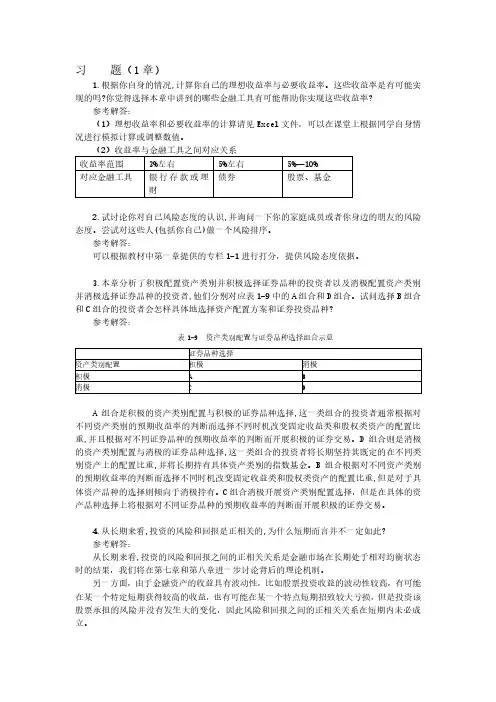
3.本章分析了积极配置资产类别并积极选择证券品种的投资者以及消极配置资产类别并消极选择证券品种的投资者,他们分别对应表1-9中的A组合和D组合。
试问选择B组合和C组合的投资者会怎样具体地选择资产配置方案和证券投资品种?参考解答:表1-9 资产类别配置与证券品种选择组合示意A组合是积极的资产类别配置与积极的证券品种选择,这一类组合的投资者通常根据对不同资产类别的预期收益率的判断而选择不同时机改变固定收益类和股权类资产的配置比重,并且根据对不同证券品种的预期收益率的判断而开展积极的证券交易。
D组合则是消极的资产类别配置与消极的证券品种选择,这一类组合的投资者将长期坚持其既定的在不同类别资产上的配置比重,并将长期持有具体资产类别的指数基金。
B组合根据对不同资产类别的预期收益率的判断而选择不同时机改变固定收益类和股权类资产的配置比重,但是对于具体资产品种的选择则倾向于消极持有。
C组合消极开展资产类别配置选择,但是在具体的资产品种选择上将根据对不同证券品种的预期收益率的判断而开展积极的证券交易。
4.从长期来看,投资的风险和回报是正相关的,为什么短期而言并不一定如此?参考解答:从长期来看,投资的风险和回报之间的正相关关系是金融市场在长期处于相对均衡状态时的结果,我们将在第七章和第八章进一步讨论背后的理论机制。
另一方面,由于金融资产的收益具有波动性,比如股票投资收益的波动性较高,有可能在某一个特定短期获得较高的收益,也有可能在某一个特点短期招致较大亏损,但是投资该股票承担的风险并没有发生大的变化,因此风险和回报之间的正相关关系在短期内未必成立。
金德环《投资学》课后习题答案
金德环《投资学》课后习题答案习题答案第一章习题答案第二章习题答案练习题1:答案:(1),公司股票的预期收益率与标准差为:Er,,,,,,,0.570.350.2206,,,,,,,,A1/2222,, ,0.5760.3560.22068.72,,,,,,,,,,,,,,A,,(2),公司和,公司股票的收益之间的协方差为:Covrr,0.5762510.50.3561010.5,,,,,,,,,,,,,,,,,AB ,,,,,,0.22062510.590.5,,,,(3),公司和,公司股票的收益之间的相关系数为:Covrr,,,,90.5AB ,,,,,0.55AB,8.7218.90,,AB练习题2:答案:如果,,,的投资投资于,公司,余下,,,投资于,公司的股票,这样得出的资产组合的概率分布如下:钢生产正常年份钢生产异常年份股市为牛市股市为熊市概率 0.5 0.3 0.2 资产组合收益率(,) ,, ,., -2.5 得出资产组合均值和标准差为:Er=0.516+0.32.5+0.2-2.5=8.25,,,,,,,,,,组合1/22222,, ,=0.516-8.25+0.32.5-8.25+0.2-2.5-8.25+0.2-2.5-8.25=7.94,,,,,,,,组合,,1/22222,=0.518.9+0.58.72+20.50.5-90.5=7.94,,,,,,,,,,,,,,,组合,,练习题3:答案:尽管黄金投资独立看来似有股市控制,黄金仍然可以在一个分散化的资产组合中起作用。
因为黄金与股市收益的相关性很小,股票投资者可以通过将其部分资金投资于黄金来分散其资产组合的风险。
练习题4:答案:通过计算两个项目的变异系数来进行比较:0.075 CV==1.88A0.040.09 CV==0.9B0.1考虑到相对离散程度,投资项目B更有利。
练习题5:答案:R(1)回归方程解释能力到底如何的一种测度方法式看的总方差中可被方程解释的方差所it2,占的比例。
证券投资学习题第9章 证券投资组合
第九章证券投资组合一、名词解释1.马柯维茨有效组合:在构造证券资产组合时,投资者谋求在既定风险水平下具有最高预期收益的证券组合,满足这一要求的组合称为有效组合,也称马柯维茨有效组合.2.市场组合:指由风险证券构成,并且其成员证券的投资比例与整个市场上风险证券的相对市值比例一致的证券组合。
3.β系数:指证券的收益率和市场组合收益率的协方差,再除以市场组合收益率的方差,即单个证券风险与整个市场风险的比值。
Β=1说明该证券系统风险与市场组合风险一致;β>1说明该证券系统风险大于市场组合风险;β<1说明该证券系统风险小于市场组合风险;β=0、5说明该证券系统风险只有整个市场组合风险的一半;β=2说明该证券系统风险是整个市场组合风险的两倍;β=0说明没有系统性风险4.最优组合:最优证券组合的选择应同时符合以下条件:①最优组合应位于有效边界上,只有在有效边界上的组合才是有效组合。
②最优组合又应同时位于投资者的无差异曲线上,而且应位于左上方的无差异曲线上。
③无差异曲线与有效边界的切点是投资者对证券组合的最优选择,而且是唯一的选择。
5. 无风险借贷:存在一种无风险资产,任何投资者可以不受限制地以无风险利率进行借入和贷出二、单选题1.某人投资了三种股票,这三种股票的方差一协方差矩阵如下表,矩阵第(i, j)位置上的元素为股票i与j的协方差,已知此人投资这三种股票的比例分别为0.3,0.3,0.4,则该股票投资组合的风险是(C)。
A.8.1 B.5.1 C.6.1 D.9.22.假设某股票组合含N种股票,它们各自的非系统风险是互不相关的,且投资于每种股票的资金数相等。
则当N变得很大时,投资组合的非系统风险和总风险的变化分别是( B )。
A.不变,降低B.降低,降低C.增高,增高D.降低,增高3.X股票的β系数为1.7,Y股票的β系数为0.8,现在股市处于牛市,请问你想短期获得较大的收益,则应该选哪种股票? (A )A、XB、YC、X和Y的某种组合D、无法确定4.某人投资四种股票,投资状况见下表,则其所投资的股票组合的年预期收益率为( B )。
投资学题库及答案

《投资学》(第四版)练习题第1章投资概述习题一、单项选择题1、下列行为不属于投资的是()。
CA. 购买汽车作为出租车使用B. 农民购买化肥C. 购买商品房自己居住D. 政府出资修筑高速公路2、投资的收益和风险往往()。
AA. 同方向变化B. 反方向变化C. 先同方向变化,后反方向变化D. 先反方向变化,后同方向变化二、判断题1、资本可以有各种表现形态,但必须有价值。
()√2、证券投资是以实物投资为基础的,是实物投资活动的延伸。
()√3、从银行贷款从事房地产投机的人不是投资主体。
()×三、多项选择题1、以下是投资主体必备条件的有()ABDA.拥有一定量的货币资金 B.对其拥有的货币资金具有支配权C.必须能控制其所投资企业的经营决策 D.能够承担投资的风险2、下列属于真实资本有()ABCA.机器设备 B.房地产 C.黄金 D.股票3、下列属于直接投资的有()ABA.企业设立新工厂 B.某公司收购另一家公司60%的股权C.居民个人购买1000股某公司股票 D.发放长期贷款而不参与被贷款企业的经营活动四、简答题1、直接投资与间接投资第2章市场经济与投资决定习题一、单项选择题1、市场经济制度与计划经济制度的最大区别在于()。
BA. 两种经济制度所属社会制度不一样B. 两种经济制度的基础性资源配置方式不一样C. 两种经济制度的生产方式不一样D. 两种经济制度的生产资料所有制不一样2、市场经济配置资源的主要手段是()。
DA. 分配机制B. 再分配机制C. 生产机制D. 价格机制二、判断题1、在市场经济体制下,自利性是经济活动主体从事经济活动的内在动力。
()√2、产权不明晰或产权缺乏严格的法律保护是造成市场失灵的重要原因之一。
()×3、按现代产权理论,完整意义上的产权主要是指对一种物品或资源的支配使用权、自由转让权以及剩余产品的收益权。
()×四、简答题1、市场失灵、缺陷第3章证券投资概述习题一、单项选择题1、在下列证券中,投资风险最低的是()AA、国库券B、金融债券C、国际机构债券D、公司债券2、中国某公司在美国发行的以欧元为面值货币的债券称之为()BA.外国债券 B.欧洲债券 C.武士债券 D.扬基债券3、中央银行在证券市场市场买卖证券的目的是()DA、赚取利润B、控制股份C、分散风险D、宏观调控4、资本证券主要包括()。
投资学题库及答案
《投资学》(第四版)练习题第1章投资概述习题一、单项选择题1、下列行为不属于投资的是()。
CA. 购买汽车作为出租车使用B. 农民购买化肥C. 购买商品房自己居住D. 政府出资修筑高速公路2、投资的收益和风险往往()。
AA. 同方向变化B. 反方向变化C. 先同方向变化,后反方向变化D. 先反方向变化,后同方向变化二、判断题1、资本可以有各种表现形态,但必须有价值。
()√2、证券投资是以实物投资为基础的,是实物投资活动的延伸。
()√3、从银行贷款从事房地产投机的人不是投资主体。
()×三、多项选择题1、以下是投资主体必备条件的有()ABDA.拥有一定量的货币资金 B.对其拥有的货币资金具有支配权C.必须能控制其所投资企业的经营决策 D.能够承担投资的风险2、下列属于真实资本有()ABCA.机器设备 B.房地产 C.黄金 D.股票3、下列属于直接投资的有()ABA.企业设立新工厂 B.某公司收购另一家公司60%的股权C.居民个人购买1000股某公司股票 D.发放长期贷款而不参与被贷款企业的经营活动四、简答题1、直接投资与间接投资第2章市场经济与投资决定习题一、单项选择题1、市场经济制度与计划经济制度的最大区别在于()。
BA. 两种经济制度所属社会制度不一样B. 两种经济制度的基础性资源配置方式不一样C. 两种经济制度的生产方式不一样D. 两种经济制度的生产资料所有制不一样2、市场经济配置资源的主要手段是()。
DA. 分配机制B. 再分配机制C. 生产机制D. 价格机制二、判断题1、在市场经济体制下,自利性是经济活动主体从事经济活动的内在动力。
()√2、产权不明晰或产权缺乏严格的法律保护是造成市场失灵的重要原因之一。
()×3、按现代产权理论,完整意义上的产权主要是指对一种物品或资源的支配使用权、自由转让权以及剩余产品的收益权。
()×四、简答题1、市场失灵、缺陷第3章证券投资概述习题一、单项选择题1、在下列证券中,投资风险最低的是()AA、国库券B、金融债券C、国际机构债券D、公司债券2、中国某公司在美国发行的以欧元为面值货币的债券称之为()BA.外国债券 B.欧洲债券 C.武士债券 D.扬基债券3、中央银行在证券市场市场买卖证券的目的是()DA、赚取利润B、控制股份C、分散风险D、宏观调控4、资本证券主要包括()。
博迪《投资学》(第10版)章节题库-第九章至第十章【圣才出品】
第三部分资本市场均衡第9章资本资产定价模型一、选择题1.如果一个股票的价值是高估的,则它应位于()。
A.证券市场线的上方B.证券市场线的下方C.证券市场线上D.在纵轴上【答案】B【解析】证券市场线(SML)如图9-1所示,它主要用来说明投资组合报酬率与系统风险程度β系数之间的关系。
图9-1被高估的证券预期收益率低于市场收益率,因此位于证券市场线下方。
2.无风险利率和市场预期收益率分别是3.5%和10.5%。
根据资本资产定价模型,一只β值是1.63的证券的预期收益是()。
A.10.12%B.14.91%C.16.56%D.18.79%【答案】B【解析】根据资本资产定价模型:E(r i)=r f+β[E(r M)-r f]=3.5%+1.63×(10.5%-3.5%)=14.91%。
3.资本资产定价模型给出了精确预测()的方法。
A.有效投资组合B.单一资产与风险资产组合期望收益率C.不同风险收益偏好下最优风险投资组合D.资产风险及其期望收益率之间的关系【答案】D【解析】根据资本资产定价模型,每一证券的期望收益率应等于无风险利率加上该证券由β系数测定的风险溢价。
4.假定一只股票定价合理,预期收益是15%,市场预期收益是10.5%,无风险利率是3.5%,这只股票的β值是()。
A.1.36B.1.52C.1.64D.1.75【答案】C【解析】既然α值假定为零,证券的收益就等于CAPM设定的收益。
因此,将已知的数值代入CAPM,即15%=[3.5%+(10.5%-3.5%)β],解得:β=1.64。
5.根据CAPM模型,市场期望收益率和无风险收益率分别是0.12和0.06,β值为1.2的证券A的期望收益率是()。
A.0.068B.0.12C.0.132D.0.142【答案】C【解析】根据资本资产定价模型,E(r i)=r f+[E(r M)-r f]βi=0.06+(0.12-0.06)×1.2=0.132。
威廉夏普投资学课后习题答案解析第九章
1. There are ten key assumptions underlying the CAPM:1. Investors evaluate portfolios by analyzing expected returns and standarddeviations over a one-period time horizon.2. Everything else equal, investors prefer portfolios with greater expectedreturns.3. Everything else equal, investors prefer portfolios with lower standarddeviations.4. Assets are infinitely divisible.5. Investors may borrow or lend at a single riskfree interest rate.6. Taxes and transaction costs are immaterial.7. All investors have the same one-period time horizon.8. All investors borrow and lend at the same riskfree rate.9. All investors have immediate and costless access to all relevant information.10. Investors possess homogeneous expectations regarding the expected returnsand risks of securities.3. The separation theorem states that an investor's optimal risky portfolio can bedetermined without reference to the investor's risk-return preferences.Assuming that every investor has the same expectations regarding expected returns and risks for available securities, and assuming that everyone faces the same riskfree rate, then the efficient set must be the same for all investors. This implies that every investor will hold the same risky portfolio. (That risky portfolio is represented by the point of tangency between a ray emanating from the riskfree asset and extending into risk-return space and tangent to the curved Markowitz efficient set.) The only difference in portfolios held by investors will be with respect to the amount of riskfree lending or borrowing undertaken, which will depend on the investors' individual risk-return preferences.6. If investors wish to hold more units of a security than are available, then they willbid up the price of the security, thereby reducing its expected return. The lower expected return will cause investors to reduce their desired holdings of the security.Conversely, if investors wish to hold fewer units of a security than are available, then they will bid down the security's price, thereby increasing its expected return.The higher expected return will cause investors to wish to hold more units of the security.This process will drive the price of the security toward its equilibrium value at which point the number of units investors wish to hold will equal the number of units outstanding. This equilibrating process will produce market clearing prices for all securities. Further, the riskfree rate will move to a level where the total amount of money borrowed will equal the supply of money available for lending.7. Investor does not require any adjustments by an investor in the market portfolio.Every security in the market portfolio is represented in proportion to its marketvalue relative to the market value of all securities. The market value of a secu rity is the units of the security outstanding times the market price of the security. Thus as relative prices of securities change, their relative market values and therefore their proportions of the market portfolio change concomitantly. No adjustment is required on the part of the investor.10. The equation of the Capital Market Line (CML) is:r p = r f + [(r M - r f )/ M ]* pIn this case, the market portfolio is composed of two securities, A and B . Thu s the expected return of the market portfolio is:r M = (X A ⨯ r A ) + (X B ⨯ r B )= (.40 ⨯ 10%) + (.60 ⨯ 15%)= 13.0%The standard deviation of the market portfolio is:[]2/122222B A AB B A B B A A M X X X X σσρσσσ++== {[(.40)² ⨯ (20)²] + [(.60)² ⨯ (28)²]+ [2 ⨯ (.40) ⨯ (.60) ⨯ (.30) ⨯ (20) ⨯ (28)]}½= [64 + 282.2 + 80.6]½ = 20.7%Therefore the equation for the CML is:r p = 5.0% + [(13.0% - 5.0%)/20.7%] ⨯ p= 5.0% + .39p12. The standard deviation of the market portfolio can be shown to equal the squareroot of the weighted average of the covariances of all its component securities with it. In the case of the this four security portfolio: M = [.20 ⨯ 242 + .30 ⨯ 360 + .20 ⨯ 155 + .30 ⨯ 210]½= (250.4)½ = 15.8%14. According to the CAPM, all investors will hold the market portfolio combinedwith riskfree borrowing or lending. Therefore all investors will be concerned with the risk (or standard deviation) of the market portfolio. The standard deviation of the market portfolio can be shown to be a function of the covariances with it of each of the securities that make up the market portfolio. Therefore th e contribution that each security makes to the market portfolio's risk will be directly related to its covariance with the market portfolio. Risk averse investors will demand higher returns from securities exhibiting higher covariances with the market portfolio.15. With respect to risk, the investor ultimately is concerned with the standarddeviation of his or her portfolio. Therefore, in evaluating a well-diversified portfolio, the relevant measure of risk is standard deviation. However, the contribution of an individual security to a portfolio's standard deviation is not the standard deviation of the security. That is, a portfolio's standard deviation is n ot simply the weighted average of the standard deviations of the component securities. The appropriate measure of a security's risk is the contribution that it makes to the standard deviation of a well-diversified portfolio. That contribution is reflected in the security's covariance with the portfolio.18. Oil is incorrect. The CAPM implies that it is possible for a security to have apositive standard deviation and an expected return less than the riskfree rate. Th e CAPM relationship specifies that:r p = r f + (r M - r f ) iM Thus a security with a negative covariance with the market portfolio would havean expected return less than the riskfree rate. In practice, however, few, if any , securities have a negative covariances with surrogates for the market portfolio.19. The beta of a security is calculated as:βσσi iM M =2Therefore:βA ==292151302.βB ==180150802. βC ==225151002.20. The beta of a portfolio is given by:ββp i i i n X ==∑1In Kitty's case:ßp = (.30 ⨯ .90) + (.10 ⨯ 1.30) + (.60 ⨯ 1.05)= 1.0322. a.b. r i = r f + (r M - r f )βi= 6% + (10% - 6%)ßi= 6% + (4%)ßi c. r A = 6% + (4%)(.85)= 9.4% r B= 6% + (4%)(1.20) = 10.8%24. A security that plots above the SML would be considered an attractive investment.The expected return offered by such a security is greater than that required given its risk. Investors should wish to add such a security to their portfolios.26. Market (or systematic) risk is the portion of a security's total risk that is related tomovements in the market portfolio and hence to the beta of the security. By definition, because the market portfolio is perfectly diversified, market risk in a portfolio cannot be reduced through diversification.Nonmarket (or unique or unsystematic) risk is the portion of a security's total riskthat is not related to moves in the market portfolio. Rather, it is related to even ts specific to the security. As a result, unique risk in a portfolio can be reduced through diversification.28. Two relationships are necessary to identify the missing data in the table:(1) r i = r f + (r M - r f )βi61218240.000.50 1.00 1.50 2.00E x p e c t e d R e t u r n (%)BetaR f =(2) ()2222i M p i εσσβσ+= Using these equations, consider security D first: 7.0 = r f + (r M - r f ) ⨯ 0 r f = 7.0% Next consider security B : 19.0 = 7.0 + (r M - 7.0) ⨯ 1.5 r M = 15.0% Next consider security C : 15.0 = 7.0 + (15.0 - 7.0) ßC ßC = 1.0 Further: (12)² = (1.0)² ⨯ σM 2 + 0 σM 2 = 12% Next consider security A : r A = 7.0 + (15.0 - 7.0)(.8) r A = 13.4% Further: A = [(.8)² ⨯ (12)² + 81]½= 13.2% Returning to security B : B = [(1.5)² ⨯ (12)² + 36]½ = 19.0% Finally, consider security E : 16.6 = 7.0 + (15.0 - 7.0) ßE ßE = 1.2 Further: (15)² = (1.2)² ⨯ (12)² + 2i εσ 2i εσ = 17.6。
投资学第9章习题及答案
本章习题1.简述利率敏感性的六个特征。
2.简述久期的法则。
3.凸性和价格波动之间有着怎样的关系?4.简述可赎回债券与不可赎回债券的凸性之间的区别。
5.简述负债管理策略中免疫策略的局限性。
6.简述积极的债券投资组合管理中互换策略的主要类型。
7.一种收益率为10%的9年期债券,久期为7.194年。
如果市场收益率改变50个基点,则债券价格变化的百分比是多少?8.某种半年付息的债券,其利率为8%,收益率为8%,期限为15年,麦考利久期为10年。
(1)利用上述信息,计算修正久期。
(2)解释为什么修正久期是计算债券利率敏感性的较好方法。
(3)确定修正久期变动的方向,如果:a.息票率为4%,而不是8%b.到期期限为7年而不是15年。
(4)说明在给定利率变化的情况下,修正久期与凸性是怎样用来估计债券价格变动的?第九章本章习题答案1. 在市场利率中,债券价格的敏感性变化对投资者而言显然十分重要。
为了了解利率风险的决定因素,可以参见图9-1。
该图表示四种债券价格相对于到期收益变化的变化百分比,它们有不同的息票率、初始到期收益率以及到期时间。
这四种债券的情况表明,当收益增加时,债券价格下降;价格曲线是凸的,这意味着收益下降对价格的影响远远大于等规模的收益增加。
通过观察,可以得出以下两个特征:(1)债券价格与收益呈反比,即:当收益升高时,债券价格下降;当收益上升时,债券价格上升。
(2)债券的到期收益升高会导致其价格变化幅度小于等规模的收益下降。
比较债券A和B的利率敏感性,除到期时间外,其他情况均基本相同。
图9-1表明债券B比债券A期限更长,对利率更敏感。
这体现出其另一特征:(3)长期债券价格对利率变化的敏感性比短期债券更高。
这不足为奇,例如,如果利率上涨,则当前贴现率较高,债券的价值下降。
由于利率适用于更多种类的远期现金流,则较高的贴现率的影响会更大。
值得注意的是,当债券B的期限是债券A的期限的6倍的时候,它的利率敏感性低于6倍。
投资学第9章习题及答案
投资学第9章习题及答案第10章5、因为投资组合F的β=0,所以其预期收益等于无风险利率对于投资组合A,风险溢价与β的比率为(12-6)/1.2=5 对于投资组合E,风险溢价与β的比率为(8-6)/0.6=3.33对比表明,这里有套现机会存在。
例如,我们能创建一个投资组合G,其包含投资组合A和投资组合F,并且两者有相等的权重,使它满足β等于0.6;这样投资组合F的期望收益和β为:E(rG ) = (0.5 × 12%) + (0.5 × 6%) = 9%βG = (0.5 × 1.2) + (0.5 × 0%) = 0.6对比投资组合G和投资组合E,投资组合G跟E具有相同的β值,但具有更高的期望收益。
因此通过买入投资组合G,并卖出相同数量投资组合E资产就可以实现套现机会。
这种套现利润:rG – rE =[9% + (0.6 × F)] ? [8% + (0.6 × F)] = 1%6、设无风险利率为rf,风险溢价因素RP,则:12% = rf + (1.2 × RP)9% = rf + (0.8 × RP)解之得: rf=3%,RP=7.5%7、a、由题目知,买进100万美元等权重的正α值的股票并同时卖出100万美元的等权重的负α值的股票;假定市场风险为0;则预期收益为:$1,000,000*0.02-$1,000,000*(-0.02)=$40,000b、对于分析师分析的20只股票,每只股票持有时都分别为$100,000,市场风险为0,公司持有的收益标准差为30%,所以20只股票的方差为20 × [($100,000 × 0.30)* ($100,000 × 0.30)] =$18,000,000,000故标准差为$134,164a、如果分析师分析的是50只股票,那么每只股票持有时都分别为$40,000,计算收益方差:50 × [(40,000 × 0.30)* (40,000 × 0.30)] =7,200,000,000故标准差为$84,853;由于总投入资金不变,α值不变,故其期望收益也不变,为$40,0008、2a、?2??2?2M??(e)2?A?(0.82?202)?252?881222?2B?(1.0?20)?10?5002?C?(1.22?202)?202?976b、如果资产种类很多,并且具有相同的收益特征,每一个种类的充分分散投资组合将存在唯一的系统风险,因为非系统性风险随着n 的无穷大会趋近于0,因此充分分散的投资组合的超额收益方差的均值为:2 ?A?256?C2?576C、市场中不存在套现机会第11章9、答案:C。