
人教版英语八年级上册Unit 9知识点总结详解
Unit 5 Can you come to my party? 知识点详解一、词汇精讲1、 suresure常用于口语中,为说话人较有把握的肯定回答,意为“当然可以,愿意”,相当于certainly或yes。
— May I use your pen? 我能用一下你的钢笔吗?— Sure. 当然可以。
【拓展】sure的其他用法:(1)祈使句“Be sure+不定式”表达说话人向对方所提出的要求,意为“务必,千万”。
Be sure to give it back in time. 务必要及时归还。
(2)“be sure+不定式”还可意为“一定,肯定”,往往表示说话人的一种推测或判断,主语可以是人,也可以是物。
It’s sure to rain tomorrow. 明天一定会下雨。
(3)be sure of/about表示主语“相信”或“对…有把握”,后接名词、代词或动词-ing形式,主语必须是人。
He is sure of success.= He is sure that he will succeed. 他自信会取得成功。
(4)“be sure+从句”表示“肯定,有把握”,主句的主语必须是人。
I’m sure who he is. 我知道他是谁。
2、情态动词can 的用法can是最常用的情态动词,其后接动词原形,否定形式为can’t。
(1)can表示有能力做或能够发生,有“能,会”的意思。
I can run fast. 我能跑得快。
She can speak Japanese. 她会说日语。
注意:can在表示“能力”时可与be able to互换使用,be able to 有更多的时态,常被用来表示can所不能表示的将来时或完成时。
They will be able to run the machine on their own in three months.三个月后,他们能自己操作这台机器。
(2)can表示允许,意为“可以”。
Can I read your newspaper? 我可以看一下你的报纸吗?You can put your bike here. 你可以把自行车放在这里。
(3)can用于疑问、否定或感叹句中,意为“会,可能”。
This can’t be true. 这不可能是真的。
Today is Sunday. He can’t be at school. 今天是周日,他不可能上学。
(4)can 表示可能性,意为“可以,可能”。
Our classroom can seat 50 students. 我们教室能坐50名学生。
3、 have tohave to意为“不得不,必须”,表示客观情况要求某人必须做某事,有人称和时态的变化,后接动词原形。
She isn’t very well these days and she has to stay at home.她这些天身体不太好,不得不待在家里。
You don’t have to tell me this. 你不必告诉我这件事。
Do you have to do everything? 什么事都得你做吗?She doesn’t have to come this af ternoon. 今天下午她不必来。
【拓展】must与have to的辨析:have to侧重于客观需要,含有“不得不”或“被迫”之意,有多种时态形式;否定式为don’t have to意为“不必”。
must侧重于说话者的主观看法,认为有必要或有义务去做某事;只有现在时一种形式(在宾语从句中可以表示过去);否定式mustn’t 意为“一定不要;不允许”。
You must do your homework first. 你必须先做作业。
It’s raining. I have to stay at home. 正在下雨,我不得不待在家里。
口诀:“主观职责”说“必须”,must赶紧用上去;若是“环境”“不得不”,赶紧换用have to。
4、 joinjoin是动词,意为“参加,加入”。
宾语有以下几种形式:(1)join+表示团体或组织的名词,join意为“加入(某团体),成为…(成员)”。
Yao Ming joined the NBA. 姚明加入了NBA。
(2)join+指人的名词或代词,join意为“加入…之中”。
Will you join us for lunch? 和我们一起吃午饭好吗?(3)join+in+活动类名词,join in意为“参加(活动)。
”Can you join in the game? 你能参加这个游戏吗?【拓展】join、join in和take part in 的辨析:(1)join指加入某党派、某组织或某社会团体,以及参军等,并成为其中一员。
(2)join in指参加某项比赛或活动,常用于口语中,也可用于join sb in (doing)sth;意为“加入…(做)…”。
(3)take part in指参加群众性的活动、会议、劳动、游行等,往往指参加者持有积极的态度,起一定作用,有时与join in互换。
I joined the army in 1996、我是1996年参军的。
I didn’t take part in the sports meeting yesterday because I was ill.我没有参加昨天的运动会,因为我病了。
May I join in the football match? 我可以参加这场足球比赛吗?5、 callcall意为“给…打电话”。
I called my mother just now. 我刚才给妈妈打了一个电话。
【拓展】(1)给某人打电话的表达方式:call/ring/phone/telephone sbcall/ring/phone sb upgive sb a call/ringmake a telephone/phone call to sb(2)call的其他用法:1)call意为“叫喊”,动词。
Why didn’t you come out when I called your name?当我喊你名字的时候,为什么不出来?2)call意为“给…取名;称呼”,动词。
Don’t call me Lucy, I’m Lily, we are twins.别叫我Lucy,我是Lily,我们是双胞胎。
3)call on sb意为“拜访某人”。
He wasn’t in when I called on him yesterday.昨天当我去拜访他的时候,他不在家。
4)call at some place意为“去某地拜访”。
Let’s call at John’s house. 咱们去约翰家吧!6、 keep quietkeep是系动词,意为“保持某种状态”,其后接形容词作表语。
My mother keeps busy all day. 我妈妈整天都很忙。
【拓展】(1)keep sth意为“保存某物,保管某物”。
How long can I keep the book? 这本书我能借多长时间?(2)keep+名词/ 代词+ 形容词,意为“使…保持某种状态”。
Keep the door open, please. 请让门开着。
(3)keep sb doing sth使(某人)不停做某事。
I’m sorry for keeping you waiting for so long. 对不起,让你久等了。
7、 match(1)match是可数名词,意为“比赛;火柴”,其复数形式为matches。
Who won the football match? 谁赢了那场足球赛?Here is a box of matches for lighting the fire.这里有一盒火柴可用来点火。
(2)match作动词,意为“和…较量;相配;和…相匹配”。
Match the words with the pictures. 把词语和图片搭配起来。
Match yourself against experts in the competition.在这次的比赛中和专家较量一下吧。
8、 whole & allwhole和all都可作形容词,都有“整个的,完全的”之意,但用法不同。
all the family=the whole family(1)whole“全部的,全体的”:1)用在表示整体的单数名词前、限定词之后:限定词+whole+单数名词 the whole year2)可接复数名词:限定词+ whole+of+复数名词the whole of students3)whole不能修饰不可数名词或物质名词,不能说the whole water(2)all“全,都”:1)用在表示整体的单数名词和限定词之前,all+限定词+单数名词all the year2)可接复数名词,all+限定词+复数名词all the students3)all 能用于各种情况all the water 所有的水注意:当whole和all与复数名词连用时,whole强调“完整的;整体的”,而all强调“所有的”。
It snowed for fifteen whole days this January.今天一月整整下了十五天雪。
I’m glad that all my friends can come to my birthday party.我很高兴,所有的朋友都能来参加我的生日聚会。
9、 come over tocome over to是“动词+副词+介词”结构,意为“顺便拜访…”,相当于call on 或drop in。
They will come over to my home for dinner tonight.他们今晚要来我家吃饭。
【拓展】come over to还可作“走过来;走近;靠近”,表示从远处靠近之意。
He came over to me and shook my hand. 他向我走来并和我握手。
二、句式精讲1、向别人发出邀请、请求或征求意见时的常用表达(1)Would you like…? 你想要/愿意…吗?其后可接名词、代词或动词不定式,用来提出建议或发出邀请。
Would you like some orange? (接名词)你要些橘汁吗?Would you like to play basketball with us?(接动词不定式)你愿意和我们一起打篮球吗?(2)Will/Would/Could you please…? 请你…好吗?其后接动词原形。
八年级上人教版unit9知识点
八年级上人教版unit9知识点八年级上人教版Unit 9知识点八年级上人教版英语Unit 9主要讲述了旅行和文化的相关话题。
下面就让我们来了解这一单元的重要知识点。
一、词汇1. 旅行相关词汇① pack:打包② boarding pass:登机牌③ itinerary:旅行行程④ sightseeing:观光⑤ souvenir:纪念品⑥ travel agency:旅行社⑦ tourist attraction:旅游胜地2. 语法1. 一般现在时旅行相关对话使用一般现在时,例如:① What do you usually pack when you travel?② What kind of souvenirs do you usually buy?2. 一般过去时旅行中出现的时间过去时使用一般过去时,包括:① went,took,saw,bought,visited等② What did you do last weekend?3. 现在进行时旅行计划中的动作通常使用现在进行时,例如:① I am packing my bags for the trip.② She is planning to visit Beijing next week.4. 现在完成时表示已经去过或者做过某事情,使用现在完成时,例如:① I have been to the Great Wall.② Have you ever tried the local food when you travel?5. 选择疑问句提出选择性质问题时使用选择疑问句,例如:① Do you prefer traveling alone or with a group?② Would you rather visit a big city or a small town?二、常用句型1. 问路句型Excuse me, how can I get to…?Can you tell me the way to…?Is it far from here to…?2. 寻找帮助句型Excuse me, could you help me?I wonder if you could tell me…Do you know where I can find…?3. 对话句型① What are you going to do this weekend?I am going to…/I am planning to…② Did you go anywhere special on your last vacation? Yes, I went to…/No, I didn't go anywhere special.三、文化知识在旅行中,我们还需要了解一些文化知识,这对于我们更好地了解当地的风俗习惯,与当地人交流有很大帮助。
人教版英语八年级上第九单元知识点
Unit 9 Can you come to my party?一、单词及短语1、prepare 动词意为使…做好准备,把…准备好;常用短语①prepare for……为…做准备;其名词形式是preparation 意为准备,准备工作Eg:I can’t go to your party ,because I must prepare for the math exam.The farmers are preparing the ground for planting。
农民们正在为种植准备耕地。
②prepare sb for/to do sth 使某人对……做好准备eg:The teachers are preparing the students for the final examination.老师们正让学生们准备期末考试.He took out a picec of paper and prepared to write to his friend.他拿出一张纸,准备给他的朋友写信。
③prepare sb sth 为某人准备……eg:the host prepared us a delicious meal.主人为我们准备了美味的晚餐.2、exam examination 名词意为考试常见的短语:entrance exam 入学考试pass the exam 通过考试fail the exam 考试及格have /take an exam 参加考试3、have the flu 患感冒have a cold 感冒了have a fever 发高烧have a headache 头痛注意:其中的have不是有的意思,通常意为患有……4、available 形容词意为有空的;可获得的,和free的意义相同be available===be freeEg:I am available (free)in this afternoon. 下午有空。
人教版英语八年级上册Unit9 知识点总结
1. prepare 使做好准备v. preparation (n.)prepare for sth. 为…做好准备prepare sth. for sb. 为某人准备…2. flu 流感n. have the flu 患流感3 . available 有空的,可获得的adj. be available 有空 the time available现有的时间4. until 直到…为止prep. wait until 12 等到12点not…until直到…才5. hang 悬挂,垂下 v. hang out 闲逛hang on 不挂断6. catch 及时赶上,接住 v.catch you on Monday 周一见 catch up with the bus 赶上公车7. invite 邀请 v. invitation (n.)invite her to the party邀请她去晚会8. accept 接受 v. accept the party invitation 接受晚会邀请9. refuse 拒绝 v. refuse to do sth 拒绝做某事10. weekday 工作日 n. on weekday 在工作日11. reply 回复 v. reply in writing 书面回复reply to sb 回复某人12. forward 发送v. 前进 adv. look forward tohearing from you期待收到你的来信13. glad 高兴 adj. be glad to help out 乐意分担14. without 没有 prep. leave without sayinggoodbye 没说再见就离开15. surprised 惊奇的 adj. be surprised at 对…吃惊 surprise n. to my surprise (to one’s + n) 16. opening 开幕式 n. prepare for the opening 为开幕式做准备17. event 比赛项目 n. great event 重大事件18. calendar 日历 n refer to the calendar 查看日历19. daytime 白天 n. in the daytime 在白天day school boarding school 寄宿学校20. turn down拒绝 turn sb. down 拒绝某人。
人教版英语八年级上册Unit9 单元知识归纳总结
Unit9 单元知识归纳总结【词汇归纳】prepare v.使做好准备;把……准备好hang v. (hung)悬挂;垂下exam n.( = examination)考试catch v.及时赶上;接住;抓住flu n.流行性感冒;流感invite v.邀请available adj.有空的;可获得的accept v.接受until conj. & prep.到……时;直达……为止refuse v.拒绝weekday n.工作日(星期一至星期五的任何一天)preparation n.准备;准备工作invitation n.邀请;请柬without prep.没有;不(做某事)reply v.回答;答复surprised adj.惊奇的;感觉意外的forward v.转寄,发送;adv.向前,前进opening n.开幕式;落成典礼delete v.删除concert n.音乐会;演奏会print n.打印;印刷event n.大事;公开活动;比赛sad adj.(令人)悲哀的;(令人)难过的guest n.客人;宾客calendar n.日历;日程表glad adj.髙兴;愿意【短语归纳】prepare for为……做准备have the flu 患流感not... until 直到……才study for为……学习another time其他时间;别的go to the doctor 看医生hang out 闲逛;常去某处have to 必须,不得不the day before yesterday 前天reply to 回信the day after tomorrow 后天take a trip去旅行look after 照料;照顾go to a concert 去听音乐会look forward to 盼望;期待at the end of 在……结尾be sure 确信go shopping 去购物【典句必背】1.—Can you come to my party on Saturday afternoon?——星期六下午你能来参加我的聚会吗?—Sure, I’d love to.——当然了,我愿意去。
Unit 9知识归纳人教版英语八年级上册
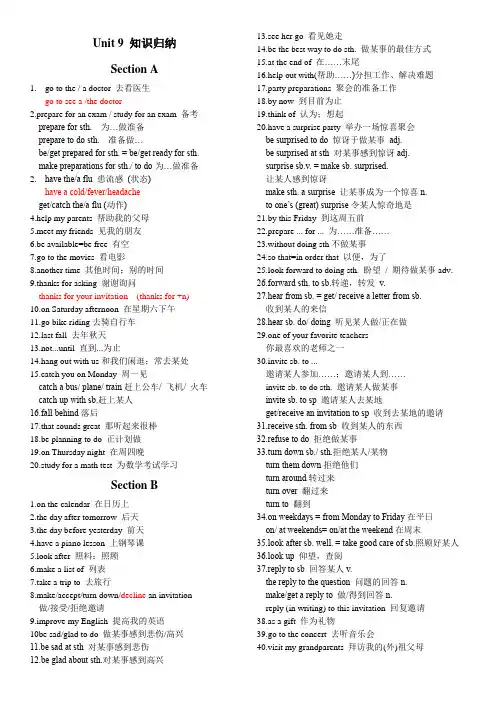
Unit 9 知识归纳Section A1.go to the / a doctor 去看医生go to see a /the doctor2.prepare for an exam / study for an exam 备考prepare for sth. 为…做准备prepare to do sth. 准备做…be/get prepared for sth. = be/get ready for sth. make preparations for sth./ to do为…做准备2.have the/a flu 患流感(状态)have a cold/fever/headacheget/catch the/a flu (动作)4.help my parents 帮助我的父母5.meet my friends 见我的朋友6.be available=be free 有空7.go to the movies 看电影8.another time 其他时间;别的时间9.thanks for asking 谢谢询问thanks for your invitation (thanks for +n)10.on Saturday afternoon 在星期六下午11.go bike riding去骑自行车st fall 去年秋天13.not...until 直到...为止14.hang out with us和我们闲逛;常去某处15.catch you on Monday 周一见catch a bus/ plane/ train赶上公车/ 飞机/ 火车catch up with sb.赶上某人16.fall behind落后17.that sounds great 那听起来很棒18.be planning to do 正计划做19.on Thursday night 在周四晚20.study for a math test 为数学考试学习Section B1.on the calendar 在日历上2.the day after tomorrow 后天3.the day before yesterday 前天4.have a piano lesson 上钢琴课5.look after 照料;照顾6.make a list of 列表7.take a trip to 去旅行8.make/accept/turn down/decline an invitation做/接受/拒绝邀请9.improve my English 提高我的英语10be sad/glad to do 做某事感到悲伤/高兴11.be sad at sth 对某事感到悲伤12.be glad about sth.对某事感到高兴13.see her go 看见她走14.be the best way to do sth. 做某事的最佳方式15.at the end of 在……末尾16.help out with(帮助……)分担工作、解决难题17.party preparations 聚会的准备工作18.by now 到目前为止19.think of 认为;想起20.have a surprise party 举办一场惊喜聚会be surprised to do 惊讶于做某事adj.be surprised at sth 对某事感到惊讶adj.surprise sb.v. = make sb. surprised.让某人感到惊讶make sth. a surprise 让某事成为一个惊喜n.to one’s (great) surprise令某人惊奇地是21.by this Friday 到这周五前22.prepare ... for ... 为……准备……23.without doing sth不做某事24.so that=in order that 以便,为了25.look forward to doing sth. 盼望/ 期待做某事adv.26.forward sth. to sb.转递,转发v.27.hear from sb. = get/ receive a letter from sb.收到某人的来信28.hear sb. do/ doing 听见某人做/正在做29.one of your favorite teachers你最喜欢的老师之一30.invite sb. to ...邀请某人参加……;邀请某人到……invite sb. to do sth. 邀请某人做某事invite sb. to sp 邀请某人去某地get/receive an invitation to sp 收到去某地的邀请31.receive sth. from sb 收到某人的东西32.refuse to do 拒绝做某事33.turn down sb./ sth.拒绝某人/某物turn them down拒绝他们turn around转过来turn over 翻过来turn to 翻到34.on weekdays = from Monday to Friday在平日on/ at weekends= on/at the weekend在周末35.look after sb.well. = take good care of sb.照顾好某人36.look up 仰望,查阅37.reply to sb 回答某人v.the reply to the question 问题的回答n.make/get a reply to 做/得到回答n.reply (in writing) to this invitation 回复邀请38.as a gift 作为礼物39.go to the concert 去听音乐会40.visit my grandparents 拜访我的(外)祖父母Grammar1.---What’s today?---It’s Monday the 14th.---What day is (it) today?---It’s Thursday.---What’s the date today?---It’s May 2nd.2.感叹句What+(a/an)+adj.+n.+(主语+谓语)!What a lovely girl (she is)!How+adj./adv.+(主语+谓语)!How fast the train runs!3.can 能够,会(could)(情态动词无人称和数的变化,其后跟动词原形)1).意思和be able to相同。
最全面人教版八年级上册英语第九单元知识点归纳总结

Unit 9 Can you come to my party?一、词汇与短语● 重点单词A部分1.exam n. 考试2.flu n. 流行性感冒;流感3.available adj. 有空的;可获得的4.until conj. & prep.到…时;直到…为止5.hang v. 悬挂;垂下6.catch v. 及时赶上;接住;抓住7.invite v. 邀请8.accept v. 接受9.refuse v. 拒绝B部分1.weekday n. 工作日2.invitation n. 邀请;请柬3.reply v. 回答;答复4.forward v.转寄;发送adv.向前;前进5.delete v. 删除6.print v. 打印;印刷7.sad adj. (令人)悲哀的;(令人)难过的8.goodbye interj. & n. 再见9.glad adj. 高兴;愿意10.preparation n. 准备;准备工作11.glue n. 胶水12.without prep. 没有;不(做某事)13.surprised adj. 惊奇的;感觉意外的14.housewarming n. 乔迁聚会15.concert n. 音乐会;演奏会16.event n. 大事;公开活动;比赛项目17.guest n. 客人;宾客18.daytime n. 白天;日间● 重点短语A部分1.prepare for…… 为……做准备2.go to the/a doctor 去看医生3.have the flu 患感冒4.go to the party 去聚会5.another time 其他时间;别的时间6.have an exam 参加考试7.not ……until…… 直到……才……8.hang out 闲逛;常去某处9.plan to do sth. 计划做某事10.study for a math test 备考数学考试B部分1.the day before yesterday 前天2.the day after tomorrow 后天3.look after 照料;照顾4.turn down 拒绝; 调小(声音)5.the best way to do sth. 做某事最好的方法6.take a trip 去旅行7.at the end of this month 在这个月末8.so that 以便;为了9.help out (帮助……)分担工作、解决难题10.look forward to 盼望;期待11.make it 成功12.hear from接到(某人的)信、电话等13.reply in writing 书面回复● 重点句子A部分1.--Can you come to my party on Saturday? --Sure, I'd love to.--周六你能来参加我的聚会吗?--当然,我想来。
人教版初中英语八上unit9知识点
人教版初中英语八上unit9知识点以下是人教版初中英语八年级上册第九单元的知识点:1. 重点短语:- on weekend 在周末- have a piano lesson 上钢琴课- look after 照顾;照看- accept an invitation 接受邀请- turn down an invitation 拒绝邀请- take a trip 去旅行- at the end of 在……末尾- help out 帮助摆脱困境- look forward to 期待;盼望- hear from 收到某人的来信- the day before yesterday 前天- the day after tomorrow 后天- have a surprise party 举办一个惊喜派对- reply in writing 书面回复- go to the concert 去听音乐会- not…until… 直到……才……- meet my friend 会见我的朋友- study for a test 为考试学习2. 重点语法:- 用can 来表达邀请- Can you come to my party on Saturday?- Sure, I'd love to.- Sorry, I can't. I have to prepare for an exam.- 用must 来谈论职责和义务- I must finish my homework first.- I have to look after my sister.- 用might 来表示可能性- He might come to the party.- She might not be able to come.3. 重点句型:- Can you come to my party? 你能来参加我的聚会吗?- I'd love to, but I'm afraid I can't. 我很愿意,但恐怕不能。
人教版八年级上册英语Unit 9 知识点语法归纳总结
Unit 9 Can you come to my party?1.短语归纳2.典句必背3.用法集萃(1)—Can you come to my party on Saturday afternoon? 星期六下午你能来参加我的聚会吗?—Sure, I’d love to. 当然了,我很乐意去。
❖“Can you..?”可用来向别人发出邀请或询问对方能否做某事。
肯定答语是:Sure, I’d love to./Certainly./Of course, I can. 等。
否定答语常用:I’d love to, but I have to.../Sorry, I have to.../I’m sorry, I can’t. 等。
例:Can you go to the movies with me tonight? 今晚你能与我一起去看电影吗?Sure, I’d love to. 当然,我很乐意去。
(2)I have to prepare for an exam. 我必须为考试做准备。
❖prepare 意为“(为.....做准备;把....准备好”。
其用法如下:(3)I have too much homework this weekend. 这周末我有太多的家庭作业。
❖too much修饰不可数名词,用来强调其“量”超出了正常的范围。
too用来修饰形容词或副词,表示“太”的意思,其程度比very、so quite要强得多。
例:He sometimes finds his teacher leaves them too much homework to do.他有时发现老师留给他们做的家庭作业太多了。
I don’t want to eat too much food every day. 我不想每天吃太多的食物。
❖辨析(4)I remember we went bike riding together last fall when he visited you.我记得他去年秋天来拜访你的时候我们一起骑自行车兜风了。
人教版八年级英语上册Unit9知识点精讲
Unit 9 Can you come to my party?一、词汇精讲1. prepare forprepare作动词,意为“准备”。
其用法归纳如下:(1)prepare sth.意为“准备……”,宾语是所准备的内容。
例如:Mother was preparing dinner in the kitchen. 妈妈在厨房准备饭菜。
He had a speech to prepare that evening. 那天晚上他得准备一个报告。
(2)prepare to do sth. 表示“准备做某事”。
例如:Taking out a piece of paper, he prepared to write to his parents. 他拿出纸,准备给父母写信。
He is preparing to go on a trip. 他正准备去旅行。
(3)prepare for sth.表示“为……做准备”。
例如:He is busy preparing with great care for the Congress.他们正忙着精心准备这次代表大会。
Hope for the best and prepare for the worst. 抱最好的希望,做最坏的准备。
(4)prepare sth. for... 表示“为……准备某物”。
例如:Please prepare the table for the dinner. 请摆好桌子吃饭。
You must prepare a room for the guest. 你必须为客人准备一个房间。
2. hang outhang out是动副结构的短语,意为“闲逛”。
例如:I hung out with my friends and took lots of photos. 我和朋友们一起闲逛,还拍了许多照片。
【拓展】hang的其他搭配:hang about=hang around 闲逛,徘徊,逗留;hang up挂断(电话);hang on不挂断;hang意为“逗留,悬挂”时,过去式和过去分词都是hung;hang还有“吊死,绞死”的意思,但当hang 意为“吊死,绞死”时,其过去式和过去分词都是hanged。
人教版八年级上册英语-Unit-9单元知识点总结
Unit 9 Can you come to my party? 情态动词定义: 说话人对某一动作或状态的态度情态动词有一定的词义must 必须can/could 能,会may/might 可以need 需要should 应该would 愿,要have to 不得不情态动词不能单独做谓语——情态动词+do情态动词没有人称,数的变化基本句型:肯定句:主语+情态动词+do+......否定句:主语+情态动词+not+do+......疑问句:情态动词+主语+do+......用法Can 和 could 的用法:表能力、许可、可能性表示能力时一般译为“能、会”例:She can swim fast, but I can’t.她能游得很快,但我不能I can see with my eyes. 我用眼睛看be able to do sth. 常常指经过努力,花费了时间和劳力之后才能做到某事表推测,可能性可能常用于否定句和疑问句中can’t不可能例:Can the news be true? 这个消息会是真的吗?—Can it be our teacher? 那个人有可能是我们老师吗?—No, it can’t be our teacher. He is on a visit to the Great Wall.could 在疑问句中,表示委婉的语气,此时could 没有过去式的意思例:—Could I use your pen? 我能用一下你的钢笔吗?—Yes, you can.可以(用 could 问,不能用 could 答。
)may 和 might 的用法表请求、许可,比 can 正式例:May I borrow your bike? 我可以借你的自行车吗?You may go home now. 现在你可以回家了表推测,谈论可能性可能,或许一般用于肯定句中may not 翻译为“可能不”例:It may rain tomorrow. 明天可能会下雨She may be at home. 她可能在家呢may 的过去式为 might ,表示推测时。