
英语A级考试作文辅导
• 测试要求:A级考试一般都侧重于应用性文 应用性文 字(摘要,通告,信函,简历表,申请书, 协议书等)翻译或写作。 • 测试形式:测试形式为主观题。总题数为1 题。考试时间为25分钟。 • 测试目的:测试考生套写,书写,填写,翻 译应用性短文,信函,填写英文表格及其他 简短的实用性文字的能力。
4、工作经历(Work Experience): paid, unpaid, and part-time /full-time 、 employment, job titles, employers, dates, skills, accomplishments, duties and responsibilities (有薪,无薪,正式/非正式工作,职位,公司或单位, 时间---一般从最近一次工作的时间看是往前推算,技能,成就,职责) 5、其他需要说明的情况(Other Information): 这一部分主要是个人兴趣爱 、 好,相关的资料证明,推荐信等,相关证明材料可作为简历的附件. 特殊技能: 外语,计算机等 (Foreign languages, computer applications) ; Qualifications任职资格; Main achievements主要成就; Honors & Awards荣誉和证书; Certificates / Licenses(证书或执照); Professional Affiliations / Professional membership专业协会会员资格; Training培训; Publications出版物; Hobbies and interests兴趣爱好
简历
简历也叫履历,是提供个人学习,工作经历的常见应用文,文本形式 一般采用表格或短文两种,以表格形式为主,英文是curriculum vitae,简 称CV, 美国英语中用resume表示.
履历的基本组成部分: 履历的基本组成部分:
1、标题 (Heading): 居中 2、个人信息(Personal Details):name, sex, age, marital status, birth 、 place, height, weight, health, positive personality, willingness to relocate / travel, other information supporting work objective (姓名, 性别,年龄,婚姻状况,出生地,身高,体重,健康状况,个性,服 从调谴,愿意出差,及其它能反映工作意愿的信息) 3、教育背景(Education): degrees, majors, schools, dates, major 、 courses, special training(学历,专业,学校,时间,专业课程,特殊 培训等)
12.Thank you for the information about ... 13.Will you please kindly let me know ... 14.We thank you for your enquiry(询价) of 10th September and are pleased to send you … 15、Our quotation (报价)for ... 16、We would be appreciated for your help and we await your earliest reply.
格式
:
英文书信通常由六个部分组成:信头(heading),信内地址(inside address),称 呼(salutation),正文(body of letter),信尾谦称(complementary close),签名 (signature),有时有附启。 1) 信头(the heading) 信头指发信人的地址和写信曰期。通常写在第一页的右上角,行首可齐头写, 也可以逐行缩进去写,地址由小到大,可包括公司、单位名称、地址、电话号 码、电报挂号、传真号、邮编等。如: New Orientaion Fashion House 112 Wangalo P, Bangkok 1300, Thailand Tel:638-1277 Fax: 638-1232 Website: [ZZ(Q]Http://www. newofh@ 112. thai May 02, 2003 English Department, class 2002 Foreign Language Department Hubei University of Ecnomics Wuhan, China July 8, 2003
2) 信内地址(the inside address): 信内地址即收信人的姓名、地址,写在对收信人的称呼上 面,在私人信件中这一部分常省略。 3) 称呼(the salutation): 对收信人的称呼与左边线对齐写在收信人姓名、地址下面 两行处,英国人常在称呼后面用逗号,美国人用冒号。如: Dear Professor / Prof. Smith:/, Dear Mr./Ms. Green:/, To whom it may concern:(敬启者:仅用于推荐信,证明信, 鉴定书之类的正规文体) Dear colleague:(用与称呼同一类职业的人,可供多人传阅)
4) 正文(the body of the letter):正文是整封信的最主要部分, 或者说是内容。正文要根据信中涉及的事情多少,用一段或 多段写完,做到眉目清秀,有条不紊。 5) 结束用语(the complementary close):结束用语指写信人 对收信人的谦称,一般写在信纸的右下方,如:Faithfully yours, Respectfully yours, Sincerely yours 等等。 6) 签名(the signature):签名一般是在结束用语之下的一至二 行的地方,一般用钢笔亲手签名,再在下面用打字机打出姓 名职务打在打字姓名的下方。 附言一般情况下不用。如非用不可,可缩写成P.S.。 商务信函语言应注意简洁明了,完整具体,谦虚有礼,避免 纠纷,不需要用一些华丽的词藻。
6. Looking forward to your early reply. 7. We hope that you will be able to join us and look forward to seeing you then. 8. Thank you for your kind early reply. 9. In compliance with your request, we are quoting therefore for your decision ... 10.We sincerely appreciate your inquiry. If you need additional information, please feel free to contact us. 11.Awaiting your early and favorable reply.
书信
书信是重要的交际工具,普通高校高职高专应用考试大 纲要求考生能写简短的英文书信,并对格式等作出了相应的 要求。这一类书信主要包括事务信函和私人信函。事务信函 一般谈论或处理重要事务,包括诸如推荐信、谋职信、申请 信、邀请信、贸易邀约和答复、感谢信、索赔信等等。所有 这一类信件均为相对来讲正式的文体,应遵循一定的格式和 套用礼貌语等。
下面一些开头结尾常用句型可供参考: 下面一些开头结尾常用句型可供参考:
1. With reference to your advertisement in today’s China Daily, I should like to apply for the job of ... 2. In answer to / In reply to / With reference to your advertisement in today’s 3. Thank you for your letter of 2nd June, we are interested in your ... 4. I am writing to you to express my wish to join in your company ... 5. I should be very grateful if you could let me have details of ...
写作评分原则及标准
作文评分标准从表达和语言两方面,只给一个分数,即给印象分 (global/impression marking)。评分时应给考生应得(rewarding)分数评定, 不要扣分(penalty)方式评定。分数可以为四个等级,即: 1) 11分:内容完整,表达清楚;语言上仅有很少的错误。 2) 8分:内容较完整,表达尚清楚;有一些语言错误,可以有个别句子结构 上的错误。 3) 5分:内容大体完整,表达可被勉强理解;有较多的语言错误,包括少量 严重错误。 4) 2分:内容不完整,但是没有离题;表达上有较大的困难;语言有很多错 误,包括少量严重错误。 如果试卷的得分可高于或低于某一得分等级,则应加1分或减1分,例 如:高于11分者可给12分,低于8分者可给7分,如果不按提示写作文或语 言表达完全无法理解,应给0分。总之,评分时力求准确,防止趋中倾向。 字数不得少于80字 字数不得少于 字。字数不够,会扣分,每少10个字扣1分。
写作技巧指导 常用文体: 1 商务信函 2 电子邮件 3 征稿启事 4 招聘广告 5 通知公告
• • • • •
普通高校专科英语应用能力考试 写作主要以测试学生应用文写作 为主,主要包括商务信函、报告、 合同、通知、履历等等。根据以 往考试情况,出现频率较高的主 要有信函和履历等内容。
应试指导
• 1 审题 • 首先应该确定要采用的文体。 • 2 构思 • 构思是对审题的进一步延伸。因此考生应该考虑如 何突出文章的写作要求。 • 3 动笔 • 在写作过程中英尽可能用自己有把握的词语和熟练 运用的句型来表达思想。
2012年6月大学英语A级考试作文指导

招聘Fantastic English Institute是一家著名的英语培训机构,总部设在北京,在全国有15个培训中心。
为了拓展机构,现招聘学习顾问一名。
该职位负责帮助学生成功完成学习任务。
职位要求:·工作地点:深圳·英语院校本科毕业·良好的英语口语和写作能力·具有至少3年以上的教学或培训经验·有耐心、责任心,同时拥有独立工作以及团队工作的能力有意者请将简历发至recruit-fei@。
For One Study AdviserFantastic English Institute is a famous English training institute with its headquarters in Beijing and 15 branch centers in China. In order to further develop our institute, we now need one study adviser to work in Shenzhen. This position is responsible for helping students successfully achieve their study objectives. And the Qualifications required are as follows:Language school graduates of English with a bachelor’s degreeExcellent command of both spoken and written EnglishAt least 3 years of teaching or training experienceExcellent personal skills as being patient and responsibleThe ability to work independently and as part of a teamAnyone who would like to apply for this position, please send an email attached with your resume to recruit-fei@.说明:按下列所给信息写一则招聘广告。
三级(A级)作文范文解析
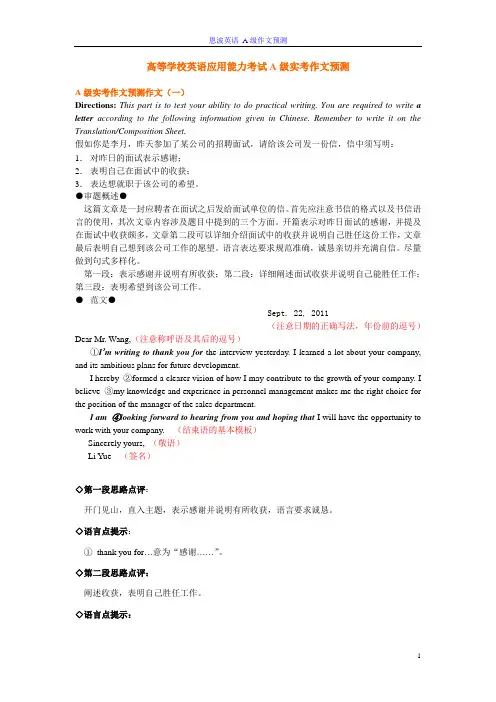
高等学校英语应用能力考试A级实考作文预测A级实考作文预测作文(一)Directions: This part is to test your ability to do practical writing. You are required to write a letter according to the following information given in Chinese. Remember to write it on the Translation/Composition Sheet.假如你是李月,昨天参加了某公司的招聘面试,请给该公司发一份信,信中须写明:1.对昨日的面试表示感谢;2.表明自己在面试中的收获;3.表达想就职于该公司的希望。
●审题概述●这篇文章是一封应聘者在面试之后发给面试单位的信。
首先应注意书信的格式以及书信语言的使用,其次文章内容涉及题目中提到的三个方面。
开篇表示对昨日面试的感谢,并提及在面试中收获颇多,文章第二段可以详细介绍面试中的收获并说明自己胜任这份工作,文章最后表明自己想到该公司工作的愿望。
语言表达要求规范准确,诚恳亲切并充满自信。
尽量做到句式多样化。
第一段:表示感谢并说明有所收获;第二段:详细阐述面试收获并说明自己能胜任工作;第三段:表明希望到该公司工作。
●范文●Sept. 22, 2011(注意日期的正确写法,年份前的逗号)Dear Mr. Wang,(注意称呼语及其后的逗号)①I’m writing to thank you for the interview yesterday. I learned a lot about your company, and its ambitious plans for future development.I hereby ②formed a clearer vision of how I may contribute to the growth of your company. I believe ③my knowledge and experience in personnel management makes me the right choice for the position of the manager of the sales department.I am ④looking forward to hearing from you and hoping that I will have the opportunity to work with your company. (结束语的基本模板)Sincerely yours, (敬语)Li Yue (签名)◇第一段思路点评:开门见山,直入主题,表示感谢并说明有所收获,语言要求诚恳。
高职高专英语A级考试辅导材料写作部分辅导资料
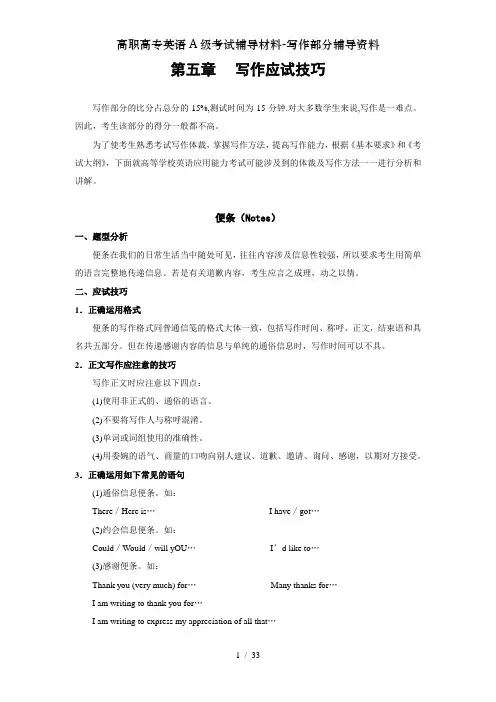
第五章写作应试技巧写作部分的比分占总分的15%,测试时间为15分钟.对大多数学生来说,写作是一难点。
因此,考生该部分的得分一般都不高。
为了使考生熟悉考试写作体裁,掌握写作方法,提高写作能力,根据《基本要求》和《考试大纲》,下面就高等学校英语应用能力考试可能涉及到的体裁及写作方法一一进行分析和讲解。
便条(Notes)一、题型分析便条在我们的日常生活当中随处可见,往往内容涉及信息性较强,所以要求考生用简单的语言完整地传递信息。
若是有关道歉内容,考生应言之成理,动之以情。
二、应试技巧1.正确运用格式便条的写作格式同普通信笺的格式大体一致,包括写作时间、称呼、正文,结束语和具名共五部分。
但在传递感谢内容的信息与单纯的通俗信息时,写作时间可以不具。
2.正文写作应注意的技巧写作正文时应注意以下四点:(1)使用非正式的、通俗的语言。
(2)不要将写作人与称呼混淆。
(3)单词或词组使用的准确性。
(4)用委婉的语气、商量的口吻向别人建议、道歉、邀请、询问、感谢,以期对方接受。
3.正确运用如下常见的语句(1)通俗信息便条。
如:There/Here is…I have/got…(2)约会信息便条。
如:Could/Would/will yOU…I’d like to…(3)感谢便条。
如:Thank you (very much) for…Many thanks for…I am writing to thank you for…I am writing to express my appreciation of all that…I am writing to tell you how grateful I am for…(4)道歉便条。
如:I’m so/terribly/extremely sorry that…I would like tO express my apologies for…(5)邀请便条。
如:Would you like to…Would it be possible for you to…We should be very glad if you could…(6)请求、询问便条。
英语A级作文必考考点

When preparing for the English Alevel exam, its crucial to understand the key points that are most likely to be tested in the composition section. Heres a breakdown of the essential topics and skills you should focus on:1. Argumentative Writing: Learn how to construct a clear argument, present evidence, and refute opposing views. Practice writing an introduction that states your position, body paragraphs that develop your argument with supporting details, and a conclusion that summarizes your main points.2. Descriptive Writing: Develop the ability to vividly describe people, places, objects, or experiences. Use sensory details, figurative language, and precise vocabulary to create a mental image for the reader.3. Narrative Writing: Practice telling a story in a compelling way. This includes setting the scene, developing characters, and maintaining a clear plot with a beginning, middle, and end.4. Persuasive Writing: Understand how to persuade readers to adopt a certain point of view or take a specific action. Use logical reasoning, emotional appeal, and credibility to convince your audience.5. Expository Writing: Learn to explain, inform, or describe a topic in a logical and organized manner. This often involves presenting facts, definitions, and examples to clarify a concept.6. Comparative Writing: Get comfortable with comparing and contrasting two or more subjects, ideas, or issues. This requires identifying similarities and differences and organizing them in a clear and coherent way.7. Cause and Effect Writing: Understand how to analyze the reasons behind a phenomenon and its consequences. This involves identifying causes and effects and presenting them in a logical sequence.8. ProblemSolution Writing: Learn to identify a problem and propose solutions. This type of writing requires a clear statement of the problem, an analysis of its causes, and the presentation of possible solutions with their advantages and disadvantages.9. Writing for Specific Purposes: Be prepared to write in various formats such as letters, emails, reports, and reviews. Each format has its own conventions and structure.10. Language Proficiency: Ensure your writing is free from grammatical errors, spelling mistakes, and punctuation errors. Use a wide range of vocabulary and sentence structures to convey your ideas effectively.11. Time Management: Practice writing under timed conditions to ensure you can complete your composition within the allotted exam time.12. Critical Thinking: Develop the ability to think critically about the topics you write about. This involves analyzing complex ideas and presenting a wellreasoned argument.13. Cultural Awareness: Be aware of cultural nuances and sensitivities, especially when writing about topics that may have different perspectives across cultures.14. Research Skills: If your exam requires researchbased writing, learn how to gather, organize, and cite information from various sources.15. Proofreading and Editing: Always review your work for clarity, coherence, and correctness. Make sure your writing flows well and that your ideas are presented in a logical order.By focusing on these areas, you can ensure that you are wellprepared for the composition section of your English Alevel exam. Regular practice, feedback from teachers or peers, and a deep understanding of the exam format will further enhance your performance.。
英语a级常见的作文题型
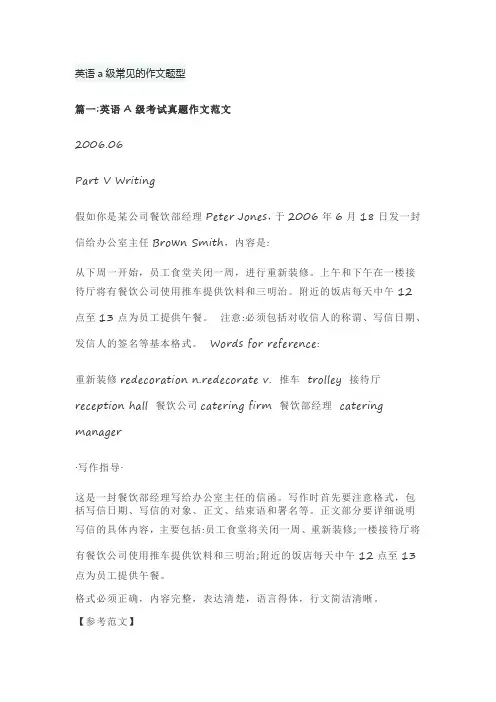
英语a级常见的作文题型篇一:英语A级考试真题作文范文2006.06Part V Writing假如你是某公司餐饮部经理Peter Jones,于2006年6月18日发一封信给办公室主任Brown Smith,内容是:从下周一开始,员工食堂关闭一周,进行重新装修。
上午和下午在一楼接待厅将有餐饮公司使用推车提供饮料和三明治。
附近的饭店每天中午12点至13点为员工提供午餐。
注意:必须包括对收信人的称谓、写信日期、发信人的签名等基本格式。
Words for reference:重新装修redecoration n.redecorate v. 推车trolley 接待厅reception hall 餐饮公司catering firm 餐饮部经理cateringmanager·写作指导·这是一封餐饮部经理写给办公室主任的信函。
写作时首先要注意格式,包括写信日期、写信的对象、正文、结束语和署名等。
正文部分要详细说明写信的具体内容,主要包括:员工食堂将关闭一周、重新装修;一楼接待厅将有餐饮公司使用推车提供饮料和三明治;附近的饭店每天中午12点至13点为员工提供午餐。
格式必须正确,内容完整,表达清楚,语言得体,行文简洁清晰。
【参考范文】June 18, 2006Mr. Brown Smith DirectorCompany Office Dear Mr. Smith,Our company staff canteen will be closed for a week from next Monday on. Please inform the staff in your office that we will have the staff canteen redecorated. It will be closed for one week from next Monday on.The catering firm’s trolley will serve beverages and sandwiches on the first。
大学A级英语写作辅导ppt课件

精选PPT课件
7
三是根据收信人的身份冠以学位、头衔等。 常用的有:
• Dr.(Doctor)
冠于博士的姓名前
• Prof.(Professor) 冠于教授姓名前
• Pres.(President) 冠于总经理、会长、大 学校长、总统姓名前
精选PPT课件
8
4)信函正文 信函正文即书信的主要部分。每段第一行向右缩进3
majoring in ______ in _______ . I have been working as ______ in ______ for nearly years since I graduated. I would like to furnish you with further information about my education and working experience. I’m an outgoing talkative and optimistic girl with great enthusiasm about everything around. With the kind of experience which I have accumulated I expect my salary not less than 4000RMB.
New Britain , CONN. 06050
U.S.A.
精选PPT课件
4
3)在信封左下角,有时可附加投递方式的说明语: Registered 或Reg.挂号信;By (Via)Air Mail (或PAR AVION)航空;Via Air Mail Registered 航空挂号; Express 快信;Printed Matter印刷品;Photo enclosed 内附照片;With parcel另附包裹。
大学英语应用能力考试A级作文专业课件(一)
大学英语应用能力考试A级作文专业课件(一)
随着社会的发展和全球化的趋势,英语逐渐成为一种全球性语言。
在
日常生活和工作中,我们需要运用英语进行交流和沟通。
而大学英语
应用能力考试A级作文专业课件则是帮助我们提高英语应用能力的有
效途径。
下文将从以下几点进行探讨。
一、课件的构成
该课件主要包括课件使用说明、课件目录和模板、写作内容解析及范
文等几个部分。
通过这些部分的学习,我们可以从细节处熟练掌握英
语写作技巧,从而达到提高英语应用能力的效果。
二、如何使用课件
用户可以从课件使用说明中了解到该课件的使用方法以及注意事项。
在使用课件之前,我们需要认真阅读目录和模板,了解各种写作样式
和篇章结构的有关知识。
接着,我们可以通过阅读范文和写作内容解
析来熟悉和了解写作的常用技巧,并尝试将这些技巧应用到自己的写
作中。
三、课件的价值
该课件对于提高我们的英语应用能力具有重要价值。
首先,该课件旨
在提高我们的写作能力,使我们能够更加熟练地运用英语进行表达和
交流。
同时,通过学习和运用课件中提供的各种技巧,我们还能够提
高我们的创造力和思维能力,提高我们的综合素质。
总之,大学英语应用能力考试A级作文专业课件是帮助我们提高英语
应用能力的重要教育资源。
通过认真学习和运用该课件,我们能够进一步提高自己的英语水平,更好地应对日常工作和生活中的英语应用需求。
英语应用能力A级辅导(写作)讲解版
英语应用能力A级写作一、书信(Letters)英文书信一般可分为商务信件(Business letter)和私人信件(Private letter),二者在结构上并无太大区别,语言上前者较后者更为正式。
英语书信通常由以下几部分组成:信端、信内地址、称呼、正文、结束语、签名、附件和再启。
(1)信端(Heading):位于信纸的右上角,一般包括发信人的地址和日期。
信端的目的是使收信人一看便知道书信来自何处,何时发出以便复信或日后查阅。
(2)信内地址(Inside address):包括收信人的姓名和地址,位于信纸的左上角,低于信端一、二行。
(3)称呼(Salutation):对收信人的称呼用语,位于信内地址下方一、二行处。
对于没有头衔的男性多用Mr.及其姓氏。
如:Mr.Smith;Mr.White。
对于女性的称呼常用Miss,Mis.或Ms,。
Miss常用在姓氏之前称呼未婚女性;Mrs.常用在丈夫的姓氏之前称呼已婚女子;Me.常用在姓氏之前可以称呼所有女士。
对收信人的称呼也可用头衔或职位的名称,如Prof.Brown,Dr.Smith。
事务信件中如不知道收信人的姓名常用Dear Sir,Dear Madam;如果也不能确定其性别可用Dear Sir or Madam。
(4)正文(Body):是信件的主体部分,在事务信件中,正文一般开门见山,简明扼要。
(5)结束语(Complimentary close):位于正文下方一、二行处,第一个词开头字母大写,末尾要用逗号,是写信人对自己的谦称。
常见的结束语包括:a.写给熟人或朋友常用:Yours,Yours truly,Yours sincerely,Sincerely yours,Yours faithfully,等等。
b.写给亲友或好友常用:love,With love,Yours affectionately,Yours ever,Much love,Lovingly yours等c.写给上级或长者常用:Yours respectfully,Respectfully yours,Yours gratefully,Yours appreciatively,Faithfully yours,等等。
英语a级备考资料作文
英语a级备考资料作文Title: Strategies for Effective Preparation for English A-Level Exam。
Preparing for the English A-Level exam requires a comprehensive strategy to ensure success. Here are some effective approaches to enhance your preparation:1. Understanding the Exam Structure: Begin by thoroughly understanding the exam structure, including the types of questions, time allocation, and grading criteria. This will help you tailor your study plan accordingly.2. Developing Strong Reading Skills: Reading comprehension is a crucial aspect of the English A-Level exam. Practice reading a variety of texts, includingliterary works, essays, and articles, to improve your comprehension skills. Pay close attention to the author's tone, argument, and main ideas.3. Enhancing Writing Skills: Writing is another key component of the exam. Work on improving your writingskills by practicing different types of essays, such as argumentative, descriptive, and analytical essays. Pay attention to grammar, punctuation, and coherence in your writing.4. Expanding Vocabulary: A rich vocabulary is essential for expressing ideas effectively in both writing and speaking. Make a habit of learning new words regularly and using them in context. Reading extensively and using vocabulary-building tools can help in this regard.5. Strengthening Grammar and Syntax: Mastery of grammar and syntax is crucial for achieving high scores in the English A-Level exam. Review grammar rules and practice sentence construction exercises to improve your proficiency in this area.6. Analyzing Literary Texts: Familiarize yourself with different literary genres and techniques used by authors. Practice analyzing literary texts by examining themes,characters, symbolism, and narrative techniques. This will help you respond effectively to literature-based questions on the exam.7. Practicing Past Papers: One of the most effective ways to prepare for the exam is by practicing past papers. This will familiarize you with the exam format, types of questions, and time constraints. Analyze your performance in practice tests to identify areas for improvement.8. Seeking Feedback: Don't hesitate to seek feedback from teachers, tutors, or peers on your writing and speaking skills. Constructive criticism can help you identify weaknesses and refine your strategies for improvement.9. Managing Time Effectively: Time management is crucial during the exam. Practice answering questions within the allocated time limits to ensure that you can complete the exam on time. Prioritize questions based on difficulty and allocate time accordingly.10. Maintaining a Positive Mindset: Lastly, maintain a positive mindset throughout your preparation journey. Believe in your abilities and stay focused on your goals. Approach the exam with confidence and a calm demeanor.In conclusion, effective preparation for the English A-Level exam requires a combination of strategies focusing on reading, writing, vocabulary, grammar, analysis, and time management. By following these tips and consistently practicing, you can enhance your chances of success in the exam.。
英语三级a级作文技巧
英语三级a级作文技巧Tips for Writing CET-3 A-Level English Compositions。
As one of the most important language proficiency tests in China, the College English Test (CET) is widely recognized by universities and employers. The CET-3 A-Level exam requires candidates to write a 300-word composition in 30 minutes. Here are some tips to help you improve your writing skills and ace the CET-3 A-Level English composition.1. Understand the requirements。
Before you start writing, make sure you fully understand the requirements of the task. Read the topic carefully and identify the key words and phrases. Think about the purpose of the composition, the target audience, and the tone you should use. Remember to follow the instructions and stick to the word limit.2. Plan your writing。
Planning is essential for a successful composition. Spend a few minutes brainstorming ideas and organizing your thoughts. Create an outline with a clear introduction, body paragraphs, and conclusion. Use linking words and phrasesto connect your ideas and make your writing flow smoothly.3. Use a variety of vocabulary and sentence structures。