
沪教牛津版-英语-八上-Unit 3 Computers Reading 课件
sub-headings
A sub-heading usually tells us the topic of the paragraph(s) below it.
Look at the pictures, the title and the sub-headings of the article on page 35.
4 S1: One day, computers may be able to do a better job than human beings.
S2: For example? S1:They__m__a_y_b_e__b_e_t_te_r__t_h_a_n_d_o_c_t_o_r_s_a_t_d_o_i_n_g_t_h_e_i_r_j_o_b_. __.
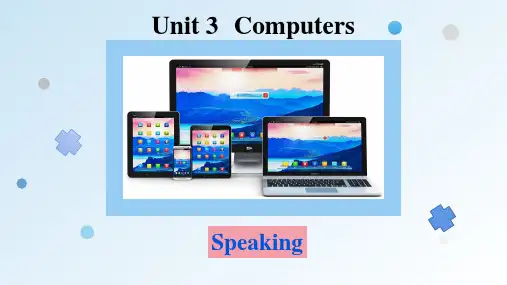
How much do you know about computers? Look at the photo below and complete the sentences with the correct names.
1 The _________ shows words and pictures. 2 We use the _________ for typing. 3 The “brain” of a computer is in the ___________. 4 We move the _________ to control the computer. 5 We hear sound from the __________.
What will happen to us if computers can do all our jobs? Will we have nothing to do? Computers may change our lives, but will they make them better?
C1 The words in italics explain the meanings of some words on page 35. Find these words to complete the sentences. Change their forms if necessary.
Oxford English
Unit Module 2 Science and technology
3
Computers
Period 1
Getting ready Reading (I) Culture corner
¥12,000
¥3,600
Brainstorm
Computer
type
calculate
3 S1: Computers can do some important jobs. S2: For example? S1: They can_o_p_er_a_t_e__r_ai_lw__a_ys_ and f_l_y_p_l_a_ne_s__a_n_d_s_p_a_c_e_s_h_ip_s_.
一、译出下列短语
• 1. be unaware of 没有意识到
• 2. depend on 依靠
• 3. more than 超过
• 4. do with
处理
• 5. use sth to do sth 用某物去做某事
• 6. at a faster speed 以更快的速度
• 7. in addition 另外
Is a computer cleverer than me?
The answer is “No”. Your brain can produce new ideas but computers cannot. However, one day computers may be able to do a better job than human beings. For example, they may be better than doctors at doing their job.
good time. _____________, we learnt a lot. (line 14) 4When we make a machine work, we _____________ it.
(line 16)
C2 Complete the conversation below with the words from the box.
Before you read
Look at the pictures, the title and the sub-headings of the article on page 35.
Then tick (✓) the facts that the article probably talks about.
Some computers are tiny. You may be unaware of them. There is probably one inside your TV or washing machine. You depend on computers more than you realize.
1 If something is very small, it is _____________. (line 5) 2Some young people always need help from their parents. They should learn to _____________ themselves. (line 8) 3We had fun and learnt something new as work as doctors.
✓
4 Computers are expensive.
Vocabulary
Computer facts
Smaller and better
In the 1940s, the first computers were bigger than cars. Now computers are becoming smaller and better.
1 Computers are getting smaller and better. 2 Computers can do important jobs like flying planes. 3 Computers may work as doctors. 4 Computers are expensive.
• 完形填空: • 1-5 BACDA 6-10 DBCBA • 阅读理解: • 1—4 : B D A C
2. Why are we unaware of some computers? _B_e_c_a_us_e__t_h_e_y_a_r_e_t_i_n_y_. ______________________________
3 Are computers cleverer than you and me? Why or why not? _N_o_,_t_h_e_y__a_r_e_n_’t_. _B_e_c_a_u_se__o_u_r_b_r_a_i_n_s_c_a_n_p_r_o_d_u_c_e_n_e_w__i_d_e_a_s _b_u_t_c_o_m__p_u_te_r_s__c_a_nn_o_t_.______________________________
1 Do you depend on computers a lot in your daily life? Give examples.
2 Do you agree that computers will be able to do all our jobs in the future? Give reasons.
Complete the outline of the article.
Part 1
The ___s_i_ze_s____ of computers in different times
Computer facts
The ____u_s_e_s___ of computers Part 2 in daily life
Part 3
The _re_l_a_ti_o_n_s_h_ip_ between human beings and computers in the future
Discussion
D3 Discuss and answer the questions below with your classmates.
Then tick (✓) the facts that the article probably talks about.
1 Computers are getting smaller and better.
✓
2 Computers can do important jobs like flying planes. ✓
D2 Answer the questions below in complete sentences.
1 What were the first computers like? _T_h_e_y__w_e_r_e_b_i_g_g_e_r_t_h_a_n_c_a_r_s_._________________________
• 8. operate railways 操控火车 • 9. produce new ideas 产生新的主意 • 10. be better at doing 更好的做某事 • 11. happen to 发生 • 12. have nothing to do 无所事事 • 13. change our lives 改变我们的生活
牛津上海英语八年级上册 Unit3Reading 教学设计课件(共19张PPT)

Because he must compete the project before school. 3. What happened to Mrs Li? She fell over and hurt her leg.
g) He会答r改对o,者de找加t答分o 案。sc线h索oo,l Chs组aapd只pliyl要ya求t 会la读st,. 会改F就行。)
Read the story below and answer the questions.
1. When did Chen Yu wake up in the morning?
thought…had an idea…
rode quickly…called an ambulance…
Five minutes later…picked up…rode…happily
Let’s share:
What are the troubles in 游y戏o设ur计六da“il我y的li代fe表?作” 每个组经讨论后, 选行W出即h自场己批a认改t 为。c最错a满误n意最y的多o答的案组u交不d到能o老得师分w手,i上其th,他由组t老各h师得e进1m?
He r_o_d__e_ to school quickly to finish it before class. On his way, he saw an old lady _fa_l_l__ over and _h_u_r_t___ her leg. Hew__a_n_t_e_d_ to help her, but he didn’t have time. But he felt _g_u_i_lt_y_ not to help her. He t_h_o_u__g_h_t hard and had an idea. He _c_a_l_le_d__ an ambulance for Mrs Li. When the ambulance came and p_i_c_k_e_d__ up Mrs Li 5 minutes later, ChenYu rode to school ____h__a_p.pily
牛津上海英语八年级上册 Unit3reading(共22张PPT)

Listen and find out: (para. 1)
A diary often tells us:
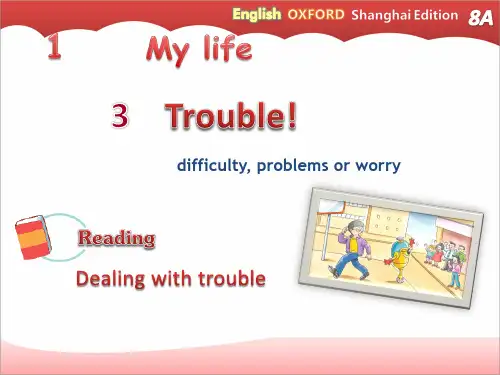
1. When did OthneFrsitdoary,y28haJupnpeen? 2. Where did Atht ethestfeorrryy phiaerppen? 3. What was Ahnaparpgeunminegntthen? 4. Who had Ttwroouwbolme?en tourists and a
Байду номын сангаас
Fill in the blanks: One day, when Paul and his
father were waiting for the ferry, something u_n_u_s_u_al_/_e_xc_i_ti_n_g happened to them. There was a big argument near the ferry. One woman told his father that the man _s_t_o_le_ her friend’s purse. Then the man _h_u_r_r_ie_d_ aboard the ferry and the two women _f_o_ll_o_w_e_d_ him.
young man
Guess:
Para. 2—3
What did the other people do when they heard the argument?
looked at them and kept silent
(The crowd)
came up and asked what had happened
沪教牛津版-英语-八上-课件:8A Unit 3 computers words

car 这个年轻人正在向他的朋友们卖车。
popular adj.受欢迎的
This type of computers are more popular than that one.
这款电脑比那台受欢迎。
5. We shouldn’t ___d_e_p_e_n_d__(依靠)too much on our parents.
6. This mobile phone is very e_x_p_e_n_s_iv_e___. 7. What is the p_r_ic_e_____of this CD player? 8. Miss Li is very p_o_p_u_la_r_____with his
order
n. 〔C〕 订货, 订购 短语:place an order 下一个订单 He placed an order for ten computers. 他下了一个订单订购十台电脑。 May I __t_a_k_e_your order now? 我可以为你点菜了吗?
n. 〔U〕秩序 短语:keep order 维持秩序 in good order 整齐 in bad order 不整齐 n. 〔C〕命令 Soldiers should obey the orders. 士兵应该遵从命令。
ll
sell –sold-sold v. 出售 We sold 10 computers of this type
yesterday. 昨天我们卖出了十台这种类型的电脑。 sell sth to sb / sell sb sth.把某物卖给某人 The young man is selling his car to his
沪教牛津版八年级上册 Computers Speaking课件
the the
most important word is.
1. The extra stress is to emphasize one idea in the sentence.
2. The extra stress can be anywhere, including the words like a, the, is and have.
things from it. stress? Benny: Yes, I'm sure I will. It's always useful to have
an encyclopaedia around the house. Daisy: True. It'll be a great help with your studies.
2
Amy
Laptops, I think.
Laptops are _______. They're ___________ ____________!
Well, then a desktop is probably ________ _________________.
What do you usually do with computers? surf the internet watch movies listen to music
*…
• Have you ever used the computer to ...? • Would you like to use the computer to ...? • Would you like to have more programs on your
computer? What kind of programs? • Do you study English with the help of the computer? • Do you often do on line shopping? • Do you usually read the online news? • Which is your favourite website?
沪教牛津版-英语-八上-:Unit3教案3

教案3课题课型Reading (Ⅱ)备课时间1 period教材分析教学目标1.The students can use the expressions and the useful sentence structures freely.2.To master some usages of some useful expressions and develop an ability ofhow to get a further u nderstanding of the te xt.教学重点Compare sth with sth , work as , be unaware of , depend on , in addition, lookforward to doing sth教学难点Compare sth with sth, g rand total, operate on教学关键Can use the language points to make sentences教法与学法指导Competition, Self-study, Partner work教学环节主要教学步骤或内容学生主体活动教师活动设计意图时间分配第一环节复习回顾平移的基本性质,引入课题StepⅠ: War ming up1.Free talk2. Recite the text1 . Talk about: How mucdo you depend oncomputers2 recite the se condpart of the unit,1.Askquestions : Doyou depend oncomputers inyour daily life?1.Reviewthe text as wellas t rain thestudents’ability ofspeaking5第二环节观察操作、探索归纳平移的作法Step Ⅱ: Detailed reading.Filling the blanks.2.Fill the blanksabout the text andfind out the usefulexpressions andstructures in the textlike : compare,expensive , tiny , speed,operate , price , total, sell,popular, unaware ,addition, forward2.finish theblank fillingexerciseaccording to thetext , and missthe importantphrases anddifficult pointin the blankfilling2.Let them topay attention tothe details andcultivate theirability ofthinking.StepⅢ:Important phrases and sentence structures learning. 3. Make sentences withthese importantpoints in the text andtake notes of theexplanations of thei mportant points:compare, expensive ,tiny , speed, operate ,price , total, sell, popular,unaware , addition,forwardexercise3. Show somepictures by PPT,and explain theusage of theimportantphrases and themain languagepoints ,thebasicstructures ofthe text. Thenprepare severalpaper whichcontain thesentence madewith theimportantphrases3.To develop thestudents’ability ofcooperation andto make everysure studenttake part in thework.第三环节课堂练习StepVI: More practice 4. Use the right formsof the expressions tofinish the sentences.5. Translate the4.Give them anexample to dothe exercise.5. work in group4. to consolatethe usage of thekey points ofthe text5. let students初中-英语-打印版Chinese sentences into English by using the important phrases in the text to check theanswers.use the usefulexpressionsthey learned第四环节课时小结StepⅥ: sum up6.write down andremember theimportant points ofthis class.6.Show a PPT andsum up the mainpoints of thetext a nd leadstudents to readit.第五环节课后作业Step V: Homework 1. remember theimportant points andprepare for thedictation2. Make sentenceswith the importantpoints and structureslearned in this class课堂教学流程Free talk→ Reciting→ Get the important points and play games →Useful-structure→ Exercise效果评价与反思初中-英语-打印版。
牛津上海英语八年级上册 Unit3 Reading(共31张PPT)
Give short answers to these questions.
1 How can we get to Pudong?
By ferry.
2 Have you ever been on a ferry?
3 What number do you to call the police?
4. Three thieves ran away. F
Who probably had the purse? a One of the other two men. b A young woman in the shop. c The man on the ferry.
onto the ferry Then the gates opened. The man hurried aboard, and the two women tourists went after him.
How did Paul and his father go across the river? Did the police catch the thief? Why say so?
C Retell Paul’s story
something unusual happened heard a big argument What’s going on? What’s happening? steal --- stole --- stolen had stolen her friend’s purse ran away hurried aboard followed him went after him
4 What happened ?
沪教牛津版八年级上册英语 Unit 3 period 4 教案
2. Translate the English words into Chinese:order____________ compare____________ monitor_____________ speaker_____________ main unit_____________ keyboard____________ mouse_____________ type_____________ brain_____________ control___________ expensive____________ tiny_____________depend_____________ speed____________ operate_____________railway_____________ calculate____________ work as____________3. 完成What do you know about…?部分,即A部分。
4. 课文朗读:朗读文章注意语音语调,了解文章大意,并完成Before you read部分问题:2. 出示学习目标:3.探究点一:(完成单元卡通图)Look at the cartoon on page 57 and answer the questions1. Where are Hi and Lo?_________________________________________________________________________2. What is Lo doing?_________________________________________________________________________3.Why is Lo never short of money?_________________________________________________________________________探究点二:(词汇处理)一、Listen to the radio.二、Read the article by themselves.三、Find the words on Page35 :1.If something is very small, it is __________. (line5)2.Some young people always need help from their parents.They should learn to ____________ themselves.(line8)3.We had fun and learnt something new as well. We had a good time.__________. We learnt a lot.(line14)4.When we make a machine work, we __________ it. (line16)探究点三:(对文章大意的理解)(1)Read the article and answer the questions:1 What were the first computers like?_______________________________________________________2 Why may you be unaware of some computers in your home?_______________________________________________________3 What can we do with computers?_______________________________________________________4 Is a computer cleverer than me? Why?________________________________________________________ (2)完成教材D1部分练习.(3)完成教材D2部分练习.一、根据汉语提示写单词1.The woman is making a phone ________(订购) .2.__________(对比)the two pictures and find the differences.3.Please write an email about _______(显示器).4.The mouse is used for ________(控制) the computer?5.Keyboard are used for ________(打字)6.I’d like to buy a new _________(键盘)from the store.7.There is something wrong wit h the little bou’s __________(脑)8.Look! The car is running at a high _________(速度)in the street.9.They built the ___________(铁路)between these two cities last year.10.We shoud learn to __________(依靠)on ourselves as we grow older.二单项选择( ) 1. My mother works in a hospital. She works_______ a doctor.A. likeB. forC. asD. with( ) 2. We use the _________ to listen to music.A. keyboardB.speakersC. monitorD. mouse( ) 3. We can see words and pictures from the _________A. monitorB. speakersC. keyboardD. mouse( ) 4. Your mobile phone _________ in your pocket.A.maybeB. perhapsC. probablyD. may be( ) 5.It was too tiny that I was __________ of it.A.wareB. awareC. unawareD. waring三句子翻译1. 我们可以用电脑来进行计算We can _________computers __________ _________ ?2. 你对电脑的依赖要远远超出你的想象。
沪教牛津版-英语-八上-:Unit3computers reading
(√ ) 3. Computers may work as doctors
4. Computers are expensive.
(√ )
(√ )
(X )
Reading and note
1. in the 1940s
在20世纪四十年代
My father was born in the 1950s.
4. S1: One day, computers may be able tn human beings .
S2: For example?
S1: They ______m___a__y__b__e___b__e_t_t_e__r than doctors at
我父亲出生在五十年代。
2. smaller and bigger
又小又好
比较级:cheaper and better
又便宜又好
3.be unaware of =don’t know 不知道 He was unaware of the danger ahead. =He didn’t know the danger ahead.
8. In addition , computers can do important jobs like operating railways and flying planes and spaceships.
In addition 另外 In addition , he is good at painting . 另外,他还擅长画画。 like 在这里是一个介词, “像”的意思,后面动词用动名词形式。 He likes sports very much like ________(play) basketball.
八年级英语上册 chapter3 reading教学设计 上海牛津版
(2)Learn how to do some extensive reading,because it’s the basic ability to learn English.It’s very useful in their future study.
2.Teachingpoints
(1)The uses of words and phrases,because they’re the accumulation of knowledge.
IV.Teaching difficulties and teachingpoints
1.Teaching difficulties
(1)The past form of the verbs in this lesson,because this is the first time for students to contact the past tense,and there’s no past tense in Chinese.So it’s not easy for students to understand it.
III.Teachingobjectives
1. Knowledgeobjectives
沪教牛津版-英语-八上-课件:U3 Reading(1)
Vocabulary-Task 1
The words in italics explain the meaning of some words on page 35. Find these words to complete the sentences. Change their forms if necessary.—Exercise C1
□
STRATEGY
Sub-headings
• Sometimes a long passage has several small parts. Each part has a title. We call the title a sub-heading. It usually tells us the topic of the paragraph(s) below it.
• Q2: What’s the relationship between Lo and the ATM?
• a. teacher and student • b. doctor and patient • c. shop assistant and customer • dd.. rreellaattiivveess
• 1. If something is very small, it is _t_i_n_y_. (line 5) • 2. Some young people always need help from