
Unit 9 Have you ever been to a museum单元测试题(人教新目标版八年级英语下册)
Unit 9 Have you ever been to a museum单元测试题(人教新目标版八年级英语下册)Unit 9 单元提优测试题(满分100分)姓名得分题号Ⅰ Ⅱ Ⅲ Ⅳ Ⅴ Ⅵ Ⅶ Ⅷ 得分Ⅰ.单项选择题(本大题共15小题,每小题1分,共15分) 题号 1 2 3 4 5 6 7 8 9 10 11 12 13 14 15 答案1. ―Have you ________ visited the old house by the river? ―No,________. A.ever;ever B.ever;never C.never;ever D.never;never 2. ―Wh at did you do last weekend,Jenny? ―I went camping with my classmates. We ________ a tent by ourselves. A.put away B.put on C.put up D.put down 3. ―Where would you like to spend your winter vacation? ―I'd like to go ________.I don't like cold places. A.somewhere warm B.warm somewhere C.anywhere warm D.warm anywhere 4. ―Do you know who ________ the light bulb(电灯泡)? ―Of course,Edison. A.invented B.found C.discovered D.caused 5. Cindy's grandparents often encouraged her ________ to dance when she was very young. A.learn B.learning C.to learn D.learned 6. ―I am afraid I will fail in the English exam again. ―Don't worry.I believe you will make a ________ because of your hard word. A.progress B.decisions C.resolution D.situation 7. There are four ________ in our college. A.Germen B.Germany C.Germans D.Germanies 8. ―Is Mr.Green at home? ―No,he ________ Shanghai. A.has been to B.has gone to C.is going to D.went to 9. The ________ has many important________. A.invention;inventor B.inventor;inventions C.inventions;inventor D.inventors;invention 10.I think autumn is the best time ________ Beijing. A.to visit B.visiting C.visited D.visit 11. Andy,with his parents,________ to Hong Kong,and they will stay there for a week. A.have gone B.has gone C.have been D.has been 12. Do you have any problem ________ English? A.learning B.to learnC.learn D.learned 13. Come to my home and let's have some tea ________ you are free. A.whatever B.whenever C.wherever D.however 14. ―Mum,________ of my classmates ________ glasses. ―Oh,my God. You need to protect your eyes well. A.three-fourths;wears B.three-fourth;wear C.three-fourth;wears D.three-fourths;wear 15. The island is quite warm all year round,because it is ________ the equator. A.next B.close to C.far from D.across from Ⅱ.完形填空(10分) What is a museum?A museum is a good place to keep 1 and beautiful things. A museum may be a place to learn about science. A museum can be a place2 art of humans or animals. What is inside a museum? Some museums3 old cars and airplanes.4 museums have pictures and sculptures. Others have rocks and old bones. One museum even has5 coal mine inside! It has shops and people's statues doing business. It looks so real that one might feel that he was back to the old time. Many cities have museums.Some very small6 have museums,7 .Indiana- polis has a8 museum. Children do not have to pay to get in. Children often go to the museum. They like9 at the dinosaur bones. They see a white bear which is ten feet tall. They go inside an old log cabin(小木屋). On Saturdays,Indianapolis children can 10 talks about animals and trees. They see movies. They take hikes. They even learn to make things there. ()1. A.new B.old C.bad D.broken ()2. A.for B.in C.about D.on ()3. A.has B.have C.there is D.there are ()4. A.A bit B.A little C.Much D.Many ()5. A.the B.an C.a D./ ()6. A.homes B.towns C.farms D.countries ()7. A.too B.also C.either D.neither ()8. A.adults' B.people's C.children's D.boy's ()9. A.see B.to see C.look D.to look ()10. A.listen B.listening C.hear D.hearing Ⅲ.阅读理解(30分) A Many years ago, there lived a very rich man who wanted to do something for the people of his town. Butfirst he wanted to find out whether they were good enough to get his help. So he placed a very large stone in the center of the main road into town. Then he hid behind a tree and waited. Soon an old man came along with his cow. "Who put this stone in the center of the road?" said the old man, but he did not try to move the stone away. Instead, he passed around the stone and continued on his way. Another man came along and did the same thing; then another came, and another. All of them complained about the stone in the center of the road, but none of them tried to move it away. Late in the afternoon, a young man came along. He saw the stone and said, "It will be very dark at night. Some people will come along later in the dark and will fall against the stone." The young man then began to move the stone. He pulled with all his strength to move it to one side. But imagine his surprise when he found a bag full of money and this message under the stone: "This money is for the thoughtful person who takes this stone away from the road. Thank you." ()1. What did the rich man aim to do? A.To offer help to the people of his town. B.To show his people how rich he was. C.To give money to anybody in need. D.To find out how good his people are. ()2. Why did the rich man put a large stone on the road? A.To make life harder for the people of his town. B.To find out the strongest man in his town. C.To stop people from getting into his town. D.To find the right person to receive his help. ()3. The first old man found the stone and walked around it because . A.he was too old to take the stone away all by himself B.he thought it was good to have a stone on the road C.he didn't want to move the stone away for others D.he didn't want the money from the rich man ()4. How many people complained but didn't try to move the stone? A.Two. B.Three. C.Four. D.Five. ()5. Why did the young man decide to move the stone? A.Becausehe was strong enough to do the job. B.Because he had others' safety on his mind. C.Because he knew there was money under it. D.Because he wanted to make it safe for himself. B Pack up and Fly away Hainan Island Hainan Island is a wonderful place of sun,sand and sea.It is in the south of China.It's famous for its underwater beauty.Tianyahaijiao is also very famous.It attracts lots of tourists around the world every year. Thailand Thailand is in the heart of Southeast Asia.Its capital Bangkok has some of Thailand's greatest buildings,like the Grand Palace(大皇宫).Chiang Mai(清迈) is a big city in Thailand.There are many historic temples(庙) there,such as the Wat Phra Singh Temple.The temple has a history of over 500 years. Australia This country is a land of beauty and diversity (多样性).It is famous for Sydney Opera and Ayers Rock(艾尔斯岩).Ayers Rock is 3,600 meters long and 348 meters high.What's more,children can also see many animals here like koalas,kangaroos and sheep. South Korea's Jeju Island(韩国济州岛) As a volcanic(火山) island,Jeju once was chosen as one of the New Seven Wonders(奇迹) of Nature.Not only that,Jeju attracts children with its Teddy Bear Museum.There,people show historical events with teddy bears. ()6. The information above can't be from ________. A.a magazine B.a storybook C.a newspaper D.a tour guidebook ()7. Hainan Island is________. A.in the Indian Ocean B.in Europe C.in the south of China D.in Africa ()8. If you like historic temples,you can go to ________. A.Hainan Island B.Thailand C.Australia D.South Korea's Jeju Island ()9. People in South Korea's Jeju Island show historical events with ________. A.teddy bears B.toy cars C.heroes D.pictures ()10. Australia is known for ________. A.the Grand Palace and the Wat Phra Singh Temple B.Sydney Opera and Ayers Rock C.Tianyahaijiao and theunderwater beauty D.Teddy Bear Museum and a volcanic island C Tony Wheeler was born to travel. His father worked for an airline. For the first 16 years of his life, Tony and his family lived in many different countries. In the early 1970s, Tony met a young woman named Maureen. They soon married. Before getting jobs, Tony and Maureen wanted to travel. They took a year-long trip from England, through Asia, to Australia. On the trip, they visited places like Iran (伊朗), India, and so on. When Tony and Maureen arrived in Australia, people asked many questions about their trip. To answer these questions, Tony wrote a book called Across Asia on the Cheap. The book told people about different countries' weather, customs (风俗), and places to see. But unlike other travel books then, Tony Wheeler's book also talked about places most tourists did not go. He also wrote about unusual things to see and do. The book was very popular. Tony and Maureen started a company called Lonely Planet. They continued travelling. They wrote books for each place they visited. Today, 800 people work for Lonely Planet. The company has over 650 books. Tony Wheeler, the great traveller, still writes about travels to many places and will bring us more surprises. ()11. Tony Wheeler and his wife ended the year-long trip in . A. England B. Iran C. India D. Australia ()12. Tony Wheeler wrote the book Across Asia on the Cheap to . A. make money for his next trip B. tell people about his new company C. draw people's attention to his family D. answer people's question about his trip ()13. How was the book Across Asia on the Cheap different from other travel books then? A. It was longer and more popular. B. It was the first travel book in the world. C. It talked about places most tourists did not go. D. It talked about a country's weather and customs. ()14. Which of the following is TRUE about Tony Wheeler's company? A. Hisfather started it. B. It is an airline company. C. Hundreds of people work for it. D. It has no books about traveling. ()15. The passage mainly talks about . A. a great traveler and his books B. a tour of different countries C. a great writer and his family D. different kinds of companies Ⅳ.根据句意及首字母或汉语提示完成单词(5分) 1.He e (鼓励) me to take more after-school activities. 2.I come from Hubei P (省).What about you? 3.Two G (德国人) are visiting the Great Wall. 4.I have never met a foreigner who speaks such p (完美的) Chinese. 5.We are happy that space research has p (进展) greatly. Ⅴ.用所给单词的适当形式完成句子(5分) 1.The old man loves living in the (peace) countryside. 2.I think his (perform) is the best one in the show. 3.She (buy) the blouse last week. 4.My mother (not be) to the water park. 5.Do you know this (India) girl can speak Chinese? Ⅵ.根据汉语意思完成句子,每空一词 (10分) 1.难以置信的是麦克通过了所有的考试。
unit9haveyoueverbeentoamuseum知识点梳理及单元复习
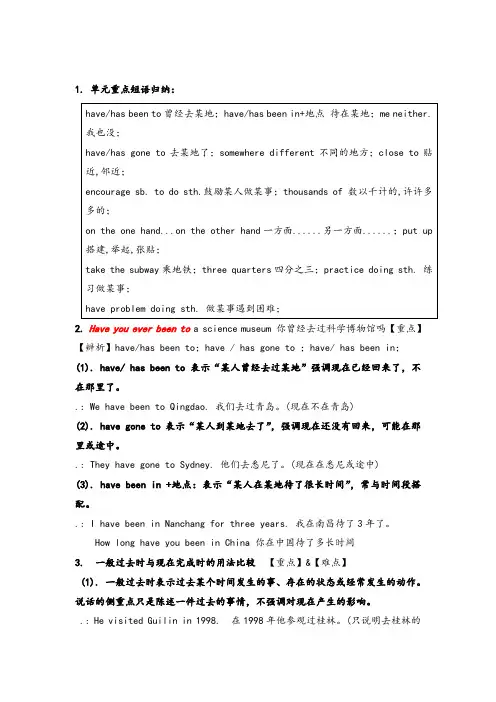
1. 单元重点短语归纳:2. Have you ever been to a science museum 你曾经去过科学博物馆吗【重点】【辨析】have/has been to;have / has gone to ;have/ has been in;(1). have/ has been to 表示“某人曾经去过某地”强调现在已经回来了,不在那里了。
.: We have been to Qingdao. 我们去过青岛。
(现在不在青岛)(2). have gone to表示“某人到某地去了”,强调现在还没有回来,可能在那里或途中。
.: They have gone to Sydney. 他们去悉尼了。
(现在在悉尼或途中)(3). have been in +地点:表示“某人在某地待了很长时间”,常与时间段搭配。
.: I have been in Nanchang for three years. 我在南昌待了3年了。
How long have you been in China 你在中国待了多长时间3. 一般过去时与现在完成时的用法比较【重点】&【难点】(1). 一般过去时表示过去某个时间发生的事、存在的状态或经常发生的动作。
说话的侧重点只是陈述一件过去的事情,不强调对现在产生的影响。
.: He visited Guilin in 1998. 在1998年他参观过桂林。
(只说明去桂林的时间)(2). 现在完成时表示动作发生在过去,对现在造成了影响或产生了结果。
不能与确定的过去时间状语连用。
.: Jill has bought a new computer. 吉尔买了一台新电脑。
I have taught here for fifteen years. 我在这儿教学已经15年了。
I have seen the film. 我看过这部电影。
(我了解这部电影的内容)I saw the film last week. 我上周看了这部电影。
新目标英语八年级下Unit 9 Have you ever been to a museum单元学案
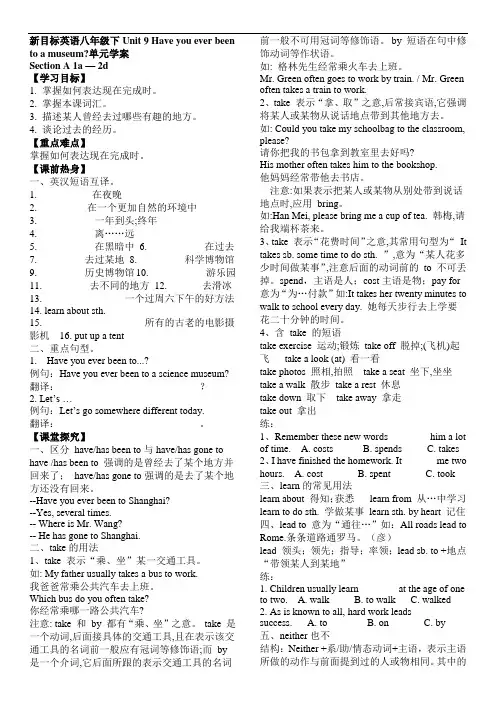
新目标英语八年级下Unit 9 Have you ever been to a museum?单元学案Section A 1a — 2d【学习目标】1. 掌握如何表达现在完成时。
2. 掌握本课词汇。
3. 描述某人曾经去过哪些有趣的地方。
4. 谈论过去的经历。
【重点难点】掌握如何表达现在完成时。
【课前热身】一、英汉短语互译。
1.__________ 在夜晚2._________ 在一个更加自然的环境中3. __________ 一年到头;终年4. __________ 离……远5. __________ 在黑暗中6. __________ 在过去7. ________ 去过某地8. ________ 科学博物馆9. ________ 历史博物馆10. __________ 游乐园11. ________ 去不同的地方12.______ 去滑冰13. _______________ 一个过周六下午的好方法14. learn about sth. __________15. ___________________ 所有的古老的电影摄影机16. put up a tent __________二、重点句型。
1. Have you ever been to...?例句:Have you ever been to a science museum? 翻译:____________________________?2. Let’s …例句:Let’s go somewhere different today.翻译:____________________________。
【课堂探究】一、区分have/has been to与have/has gone to have /has been to 强调的是曾经去了某个地方并回来了;have/has gone to强调的是去了某个地方还没有回来。
--Have you ever been to Shanghai?--Yes, several times.-- Where is Mr. Wang?-- He has gone to Shanghai.二、take的用法1、take 表示“乘、坐”某一交通工具。
人教版新目标初中英语八年级下册Unit9-Have-you-ever-been-to-a-museum单元检测题及答案

Unit 9 Have you ever been to a museum?单元检测题第Ⅰ卷听力部分(共20小题,每小题1分,满分20分)第一节、听句子,根据所提问题选择与之相符的图片回答问题。
每个句子听一遍。
()1. Where has the man been?()2. When would they like to go camping?()3. Where did they go yesterday?()4. How can they go to the train station?()5. What does Mr. Li often take us to do?第二节、听下面五段对话,根据每段对话内容及问题选择正确答案。
每段对话读两遍。
听第一段对话,回答第6小题()6. How long is the history of China?A. Over 5,000 years.B. About 5,000 years.C. Less than 4,000 years.听第二段对话,回答第7小题()7. Where is Mr. Green?A. In the library.B. At home.C. In the office.听第三段对话,回答第8小题()8. When did Mr. Smith move to New York?A. In 2005.B. Six years ago.C. In 2000.听第四段对话,回答第9小题()9. Which mount did the man visit?A. Mount Hua.B. Mount Tai.C. Mount Heng.听第五段对话,回答第10小题()10. Whose backpack is it?A. Nancy’s.B. Sally’s.C. Cindy’s.听第六段对话,回答第11和12小题。
每段对话读两遍。
( )11. Where did Dad put the meat?A. On the tableB. On the chairC. In the fridge(冰箱)( )12. Why do they need some more meat?A. Because dad forgot to bring the meat home.B. Because mum ate it for lunch.C. Because grandfather and grandmother are coming.听第七段对话,回答第13至15小题。
人教新目标八年级英语下册Unit9 Have you ever been to a museum-单元练习【含答案】
人教新目标版八年级下册Unit9 Have you ever been to a museum?单元练习一、听力(听力)(共20小题;共20分)I. 听句子,选择正确答语。
1. A. I'm afraid you can't. B. That's great. C. It doesn't matter.2. A. Good idea. B. At 7 o'clock. C. Not at all.3. A. No, please do it.B. Yes, you can do it.C. It's very kind of you.4. A. She is better now.B. She likes dancing.C. She is tall and pretty.5. A. Since last month. B. September. C. Six o'clock.II. 听对话,选择正确答案。
6. How long has he stayed in China?A. Two weeks.B. A week.C. A month.7. What is she going to be?A. An English teacher.B. A tour guide.C. A math teacher.8. Who has ever been to a water park?A. Sarah.B. Ben.C. Tina.9. How many English-speaking countries has she been to?A. Three.B. Four.C. Five.10. How long did the film last?A. An hour and a half.B. Two hours.C. 150 minutes.III. 听对话,选择正确答案。
人教版新目标Unit9_Have_you_ever_been_to_a_museum全单元
TALK
neither have I = me neither .
I have been to the zoo a lot of times. 答语
______________ .\
. ( 我也是)
I’ve never been to a water park. 答语
____________ \ _______ . ( 我
• 1 h过某地(去过已回来);
• 2 have / has gone to +地名 去了某地(还没回来);
• 3 have / has been in +地名 在某地住了有多长。
• A: Have you ever been to the Great Wall? • B:Yes, I have. What about you? • A: Me too. • =So have I. • =I have ever been there, too. • So+助动词/be动词/情态动词+主语.
4. A: How about __g_o_i_n_g___ (go) to the art museum? There are some special German paintings there right now.
B: Sure. When do you want _t_o_g_o___ (go) ? 5. A: Have you ever __v_is_i_te_d___ (visit) the
• A: Have you ever been to the Great Wall? • B: No, I haven’t. What about you? • A: Me neither. • =Neither have I. • =I haven’t been there, either. • Neither+助动词/be动词/情态动词+主语.
(完整版)优秀课件unit-9-Have-you-ever-been-to-a-museum

zoo
A: Have you ever been to a zoo? B: Yes, I’ve been to a zoo.
space museum 太空馆
A: Have you ever been to a space museum? B: No, I’ve never been to a space museum.
6.He has been in London for half a month. 他来伦敦已有半个月了。
1.sb.have /has been to sp. 意为“某人曾经去过某地”,
但现在已不在那里了, ”已经回来,侧重指经历,后 可接次数, 如once, twice, three times等, 表示 “去过某地几次”, 也可和 just, never, ever等连用。
4.我了解了一些电影的知识。 I _le_a_r_n_e_d_a_b_o_u_t_ some information about movie. 5.他的粗心导致了这次失败。 His carelessness _l_e_d_ _t_o_ this failure.
选用have, has填空: 1.I __h__a_v_e_ told him the news. 2.She ___h_a_s___ come back from school. 3.You ___h_a_v_e__ won the game.
2.sb.have/has gone to sp.
意为“某人已经去某地了”, 可能在去某地的路上, 也可能到达了某地。总之, 说话时该人不在现场, 一般不用第一人称、第二人称代词作句子的主语。
3.sb.have/has been in sp.
表示“在某地呆了多少时间”, 常与时间段状语连用
Unit 9Unit_9_Have_you_ever_been_to_a_museum B 3a-3c
6. — What about these two sweaters,madam? — _____of them fits me. Could you show me another one? A. Both B. Either C. None D. Neither 7. — Where is Zhang Ming? — Oh, don’t you know he _____ to Beijing to see his parents and he’ll be back tomorrow? A. has gone B. has been C. had gone
One great thing about … is …
One
great thing about Hainan is that you can try many kinds of sweet fruit in Hainan. If you go to Hainan, I’m sure you will enjoy yourself.
(3a)
Pre-writing
Make a list of facts about your hometown or a place you have been to. Think about these topics.
Size and location:_________________ Population:_______________________ Weather:________________________
Things:___________________________
Hainan Island
Have you ever tried/seen/been…?
Unit-9--Have-you-ever-been-to-a-museum--知识整理
Unit 9 Have you ever been to a museum?1.—Have you ever been to …? ---你曾经去过…吗?Yes ,I have. / No ,I haven ’t. ever 曾经 (用于现在完成时。
ever 用于疑问句、否定句)2.(1). have/ has been to + 地名;“曾经去过某地”,现在已经回到原地。
(2). have gone to “已经去某地了”,说话时该人不在现场。
(3). have been in +地点 待在某地,常与时间段搭配。
3. 在英语中,表示“也”的知识归纳如下:A. 否定句中的“也”主语 + neitherneither +助动词/be + 主语 完整的否定句后加either ,但要加逗号隔开。
B. 肯定句中的“也”主语 + tooso +助动词/be+ 主语 完整的肯定句后加too ,且要用逗号隔开。
4.Let sb. do sth 让某人做某事 (sb.应用人称代词的宾格形式)5. go somewhere different 去不同的地方 6. invent v 发明→inventor n 发明家→ invention n 发明lead to sth 导致……lead sb. to sw 引导某人去某地lead sb. to do sth 引导某人干某事7.take the subway 乘地铁①take the/a +交通工具+to +地点“乘坐……” (放于句中) take the train 乘火车 ②by+交通工具 “乘坐……” (放于句尾) by bus 乘公共汽车Eg :I go to school by bus.=I take the bus to school.8.It is a great way to do sth 这是一个做某事的好方法9. go skating 去滑冰10. .on the weekend 在周末11. science museum 科学博物馆history museum 历史博物馆12.all the old movie cameras所有的古老的电影摄影机13.camp in the mountains 在大山里露营14.learn about 了解获知,得知learn about sth.了解有关……的情况15. an amusement park 一个游乐场16. the International Museum国际博物馆17. put up a tent 搭帐篷put up 搭起;举起;张贴rmation信息;资料(不可n.)some informationa piece of information 与about 连用,表示:“关于……的信息”19.It’s unbelievable that+从句“令人难以置信的……”20. make progress 取得进步make progress in 在......方面取得进步21.in such a rapid way 以如此迅猛的方式22.play chess 下棋23.be able to+V原能够做某事24.in the future在将来25.wonder 想要知道= want to know①后接从句eg:I wonder who she is.②也可接“疑问词+不定式”eg: I wonder what to do next.26.I couldn’t believe my eyes我无法相信我的眼睛。
八下新目标英语Unit_9_Have_you_ever_been_to_a_museum?
【2012贵州贵阳】 “Have you ever been to Tokyo?” “Yes, I ______ there twice. It’s a modern city.”
A. have gone B. have been C. had gone
【答案】B
考查动词时态及动词的用法。问句用的是现 在完成时,答句也应该用现在完成时,前后 时态一致。have gone意为“去过,但还没回 来”;have been意为“去了,回来了”。根 据句意:你去过东京吗?我去过两次,它是 一个现代城市。故选B.
the final.
— I think so. He ________ for it for months.
A. is preparing
B. was preparing
C. had been preparing
D. has been preparing
2. By the time he realizes he _________ into a
D. Did; show
8. — Hi, Tracy, you look pale.
— I am tired. I ______ the living room all day.
A. painted
B. had painted
C. have been painting D. have painted
C. considered D. is going to consider
7. —______ you ______ him around the museum
yet?
—Yes. We had a great time there.
A. Have ; shown
河南省八年级英语下册Unit9Haveyoueverbeentoamuseum必考知识点归纳
河南省八年级英语下册Unit9Haveyoueverbeentoamuseum必考知识点归纳单选题1、The Great Wall is a place of interest. All of us ________ there before.A.has beenB.have beenC.has goneD.have gone答案:B句意:长城是个名胜古迹。
我们所有人以前都去过那里。
考查现在完成时。
have/has been表示去过某地又回来了;have/has gone表示去了某地还没回来。
主语“All of us”是复数,用have而不用has,排除AC;根据before可知应该是去过,现在已经回来,用have been而不用have gone,排除D。
故选B。
2、—I have ________ been to Tibet. How about you?—Me. neither.A.neverB.everC.already答案:A句意:--我从没去过西藏。
你呢? --我也没有去过。
根据neither “我也没有去过”提示,可知问句是没去过,never从不,ever曾经,already已经;故选A。
3、David has never been to Australia, ________?A.hasn’t heB.doesn’t heC.has heD.does he答案:C句意:大卫从未去过澳大利亚,是吗?考查反义疑问句。
题干中“has never been”是现在完成时,助动词为has,never表否定。
反义疑问句中如果陈述句为否定,反义疑问句的后半部分应用肯定疑问句。
故选C。
4、— ________ you ever ________ to Hong Kong?— Yes, only once.A.Did; goB.Have; goneC.Do; goD.Have; been答案:D句意:——你去过香港吗?——是的,只有一次。