
(译林版)6A Unit2 What a day知识点梳理
6A Unit2 What a day!知识点梳理
四会单词
sunny晴朗的 become变为,成为 windy有风的 cloudy多云的 sky天空bring 带来 drink饮料 rainy多雨的 meet遇见
三会单词
show展览,展示 interesting有趣的,有意思的 weather天气 high 在高处honey蜂蜜 ant蚂蚁 bee蜜蜂 cloud云 rain下雨 lose丢失、know知道cold寒冷的warm暖和的cool凉爽的snowy多雪的hot炎热的 foggy多雾的重点短语
1、What a day!天气多变的一天!
2、20th September 九月二十日
读作:the twentieth of September \ September the twentieth
3、sun 太阳(名词)-----sunny晴朗的(形容词)
4、wind风(名词)-----windy有风的(形容词)
5、cloud云(名词)------cloudy多云的(形容词)
6、rain雨(名词)------rainy有雨的(形容词)
7、go 去----went(过去式)
8、go to the park by bike 骑自行车去公园
9、a parrot show 一场鹦鹉表演
10、see 看见-----saw(过去式)
11、some interesting parrots 一些有趣的鹦鹉
12、the bad weather 坏天气
13、become 变成-----became(过去式)
14、windy and cloudy 有风且多云
15、fly kites 放风筝
16、fly飞------flew(过去式)
17、in the sky 在空中
18、It was time for lunch.
=It was time to have lunch.该是吃饭的时候了。
19、bring 带来-------brought (过去式)
20、bring带来(反义词)take 拿走
21、some dumplings 一些饺子
22、some bread and honey一些面包和蜂蜜
23、some drinks 一些饮料
24、some ants \bees一些蚂蚁\蜜蜂
25、can 能---could(过去的)
26、eat our lunch 吃我们的午餐
27、black clouds 乌云
28、be hungry and wet 又饿又湿
29、do\does----did(过去式)
30、take 拿走-----took(过去式)
31、pick three cards 挑三张卡片
32、in the playground 在操场上
33、well done 干得好
34、the New Year 新年
35、Let’s cheer together !让我们一起欢呼吧!
36、here 这儿(同音词)hear
37、go away 走开
38、come again another day改日再来
39、look sad\happy看上去悲伤\开心
40、What’s the matter (with you )?你怎么啦?
41、lose丢失(过去式)lost
42、want to know why 想知道为什么
43、What happened (then )?(然后)发生什么事了?
44、climb up爬上
45、climb up the hill 爬上小山
46、climb 爬(过去式)climbed\d\
47、fly high 飞得高
48、fly too high 飞得太高
49、hold onto抓紧
50、fly away 飞走
51、find 发现(过去式)found
52、near the hill 在小山附近
53、on Monday morning 在周一上午
54、have a picnic 野餐
55、have\has有(过去式)had
重点句子
1.这是怎样的一天啊 What a day!
2.这是有趣的一天啊 What an interesting day!
3.昨天天气怎么样? What was the weather like yesterday?
4.昨天天气晴朗。
It was sunny.
5.该吃午饭了。
It was time for lunch.= It was time to have lunch.
6.他们没有吃午饭。
They did not have lunch.
7.新年就要来了。
The New Year is nearly here.
8.让我们一起来欢呼吧。
Let’s cheer together.
9.我们不能吃我们的午饭。
We could not eat our lunch.
10.在空中有一些乌云。
There were black clouds in the sky.
11.在公园里有一个鹦鹉表演。
There was a parrot show in the park.
12.他带来了一些面包和蜂蜜。
He brought some bread and honey.
13.我在操场上放风筝的。
I flew a kite in the playground.
14.我丢了我的新风筝。
I lost my new kite.
15.在公园里没有风。
It wasn’t windy in the park.
16.我在小山附近找到了它。
I found it near the hill.
17.在星期天早上多云。
It was cloudy on Sunday morning.
18.我昨天在六点钟起床。
I got up at 6:00 yesterday.
19.我刚才没能找到我的书。
I could not find my book.
20.昨天我去游泳和野炊了。
I went swimming and had a picnic.
语法:
1)1 rain+y rainy 2 cloud+y cloudy
3 wind+y windy
4 sun(双写n)+y sunny
2)一般过去式中不规则的动词变化
(不规则的动词变化需要同学们逐个去记忆,以下是本单元出现的不规则变化)
become(became) bring(brought) can(could) fly(flew) go(went)
see(saw) take(took) have (had) get (got) tell (told) 3)rain,rainy的用法
1. There is a lot of rain in spring. (不可数名词,雨水)
2. It often rains in spring. (动词,下雨,一般现在时) It rained yesterday. (动词,下雨,一般过去时)
It is raining now. (动词,下雨,现在进行时)3. It was rainy two days ago. (形容词,多雨的)。
六年级上册英语-Unit2 what a day 单元知识点梳理 译林版

Unit 2 What a day!一、语法1.日记的格式:星期和日期写在左上角,天气写在右上角。
日期格式用月日年(美式)或日月年(英式)都可以。
月份可以缩写,与年之间用逗号隔开。
如果写星期,将星期写在日期前面,用逗号隔开。
2. What a day! 糟糕的一天;忙碌的一天;累人的一天等等(表达的含义很多,根据具体语境来看)这里指“糟糕的一天”3. A:How is the weather? = What is the weather like? 天气怎么样?什么天气?B:It’s sunny. / The weather is sunny. 天气是晴朗的.A:How was the weather? = What was the weather like?B:It was sunny. / The weather was sunny.4. sun 太阳——sunny 晴朗的wind 风——windy 有风的cloud 云——cloudy 多云的rain 雨——rainy 有雨的snow 雪——有雪的fog 雾——foggy 有雾的storm 暴风雨——暴风雨的a sunny/ windy / rainy/ cloudy day 晴朗的/刮风的/下雨的/多云的一天It’s sunny/ windy / rainy/ cloudy. 天气是晴朗的/刮风的/下雨的/多云的。
It became sunny/ windy / rainy/ cloudy. 天气变成了晴朗的/刮风的/下雨的/多云的。
5. rainy 下雨的(形容词)rain (1)名词:雨(不可数):a lot of rain(2)动词:下雨snowy 下雪的(形容词)snow (1)名词:雪(不可数):a lot of snow(2)动词:下雪例句:a) It rained yesterday. 昨天下雨了。
b) Look! It is raining now! 看!现在正在下雨。
译林版六年级上册英语Unit2 what a day 单元知识点梳理
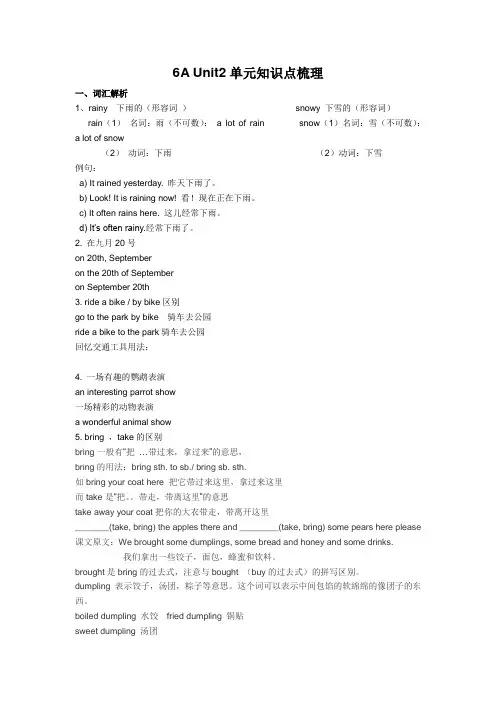
6A Unit2单元知识点梳理一、词汇解析1、rainy 下雨的(形容词)snowy 下雪的(形容词)rain(1)名词:雨(不可数):a lot of rain snow(1)名词:雪(不可数):a lot of snow(2)动词:下雨(2)动词:下雪例句:a) It rained yesterday. 昨天下雨了。
b) Look! It is raining now! 看!现在正在下雨。
c) It often rains here. 这儿经常下雨。
d) It’s often rainy.经常下雨了。
2. 在九月20号on 20th, Septemberon the 20th of Septemberon September 20th3. ride a bike / by bike区别go to the park by bike 骑车去公园ride a bike to the park骑车去公园回忆交通工具用法:4. 一场有趣的鹦鹉表演an interesting parrot show一场精彩的动物表演a wonderful animal show5. bring ,take的区别bring 一般有“把…带过来,拿过来”的意思,bring的用法:bring sth. to sb./ bring sb. sth.如 bring your coat here 把它带过来这里,拿过来这里而take 是“把。
带走,带离这里”的意思take away your coat 把你的大衣带走,带离开这里_______(take, bring) the apples there and ________(take, bring) some pears here please 课文原文:We brought some dumplings, some bread and honey and some drinks.我们拿出一些饺子,面包,蜂蜜和饮料。
【】江苏译林版英语六年级上册知识点整理全(牛津版)
六年级上册复习资料内含:6A各单元知识点,语法知识,易错题及适当形式填空6AUnit1Theing’snewclothes姓名:一,/新衣服你制作新衣服maesthforsb4.showtheinghisnewclothes皇帝展示新衣服showsb.sth.=showsth.tosb.穿tryonthecoat=trythecoatontryit/themonmagicclothes有魔力的衣服walthrough步行穿8.inhisnewclothes穿着他的新衣服9.shoutatsb.看⋯.指向⋯非常适合一个美国牛仔一位格人一个故事一句在山上下一句住在房子里个男孩一个故事tellsb.sth.’sturn 某人的时机努力思考不得不havetodosth.在⋯.前面〔外部〕inthefrontof 在⋯前面〔内部〕路27.benicetosb. 某人好照成二,句型Longlongago,therewasaing.很久很久以前,有一位国王。
Theingwashappy.国王很开心。
Heliednewclothes.他喜新衣服。
1.Twomenvisitedtheing.两个男人拜了位国王。
三、1.用所的适当形式填空。
1.Threedaysago,I(bring)anewbie.(live)withmygrandparentswhenIwasyoung.(notwear)anyclothesthatday,allthepeople(point)athim.4.Longlongago,there(be)manyoldmeninthemountain.5.Loo,thegirlis(wear)anicedress.2.正确答案。
()1.Longlongago,there aboycalledMaLiang.()2.I________TVamomentago.(theblacboard,thenwecopiedthewords.()4.Doyouwant________?(onepicture.(hisdoll. ((( ⋯⋯⋯⋯with)7.Thelionalwayswals______theforesteveryd ay.A.onB.underC.through)8.Werethere________peop leinthestreet?A.someB.anyC.much)9.What________ beautifulgirl!( A./Ban)10.Theshoesareverycool,buttheyme.’tfitUnit2Whataday!姓名:一,单词/词组Whataday!糟糕的一天;忙碌的一天;累人的一天等等〔表达的含义很多,根据具体语境看〕这里指“糟糕的一天〞1. the19thofSeptember在九月十九号晴朗的/刮风/下雨的一天alotofrain许多雨〔不可数〕alotofsnow许多雪〔不可数〕see/watchaparrotshow观看一场鹦鹉表演seesomeinterestingparrots看见一些有趣的鹦鹉aninterestingfilm一部精彩的电影becomewindyandcloudy变成大风和阴天〔多云〕3.flyiteshighinthesy风筝放得高带一些饺子带午餐一些面包和蜂蜜一些饮料14.hungryandthirsty又饿又渴潮湿的衣服吃我们的午饭乌云meetme/him/her/them/you遇见我/他/她/他们/你loosad/happy看起很伤心/开心今天早晨/下午/晚上爬上山七点起床骑自行车去上学野餐看电影在空中一整天走了丢了我的风筝想要知道为什么出了什么事飞得太高找到它在小山附近在你的日记里词组〔三会〕抓紧它飞走了在山的附近找到它在你的日记里cheertogether一起欢呼二、句型:1、今天的天气怎么样?是晴朗的。
新译林版英语六年级上册Unit2各板块重点短语语法

Unit 2 What a day! 短语单三、Grammar time1.★表述天气的形容词都由名词转换而来的,在用法上注意区分词性。
★表述天气用it 作主语,后接be动词,再加上表示天气的形容词。
It is/ was…It was yesterday, we saw some clouds in the sky.★rain 有两种词性:不可数名词“雨”这里雨量充足。
There is a lot of here.动词“下雨”看,外面正下着雨。
Look! It is outside.在南通,夏天经常下雨。
It often in summer in Nantong.昨天下了场雨。
It yesterday.明天会下雨。
It rain tomorrow.★rainy 形容词“多雨的”It is a day.2.日期的表达月份首字母大写一月January 二月February 三月March 四月April五月May 六月June 七月July 八月August九月September 十月October 十一月November 十二月December序数词的写法★ one → first two→second three→third★以ve 结尾的基数词改ve 为f 再加thfive→ twelve→★直接加h, eight→★去e 加th, nine→★从20 到90对的整十数字,将基数词后y去掉改为ie 再加thtwenty→ sixty→thirty→ seventy→forty→ eighty→fifty→ ninety→★从 20开始的第几十几的序数词,几十用基数词表示,几用序数词表示,别忘了连词符。
21→ twenty-first 22→ 45→★英语的日期表达9月20 日 the twentieth of September 20th September英语日期表达的格式: the + 几号(序数词) + of + 月份(首字母大写)英语日期数字表达格式:几号写在前面(序数词) + 月份(首字母大写)10 月 1 日4 月2 日3.不规则动词的过去式run→meet→see→have/has→get→make→speak→ do/does→tell→say→eat→find→go→lose→hold→wear→fly→★过去式和原形一样read→put→cut→let→★“i”改”a”give→sit→swim→drink→sing→begin→ring→★“i”改”o”write→drive→ride→★词尾“aw”/”ow”改”ew” ( show →showed)draw→grow→know→★“o”改”a”★去掉”e”加”t”keep→sleep→sweep→feel→★改”ought”★改”aught”★改”oo”四Fun time& Sound time & Song time1.pick cards 抽取卡片2.well done 做得好3. be nearly here 就在这里4. cheer together 一起欢呼5. go away 走开。
Unit2Whataday!_Cartoontime知识点讲解译林版英语六年级上册(1)
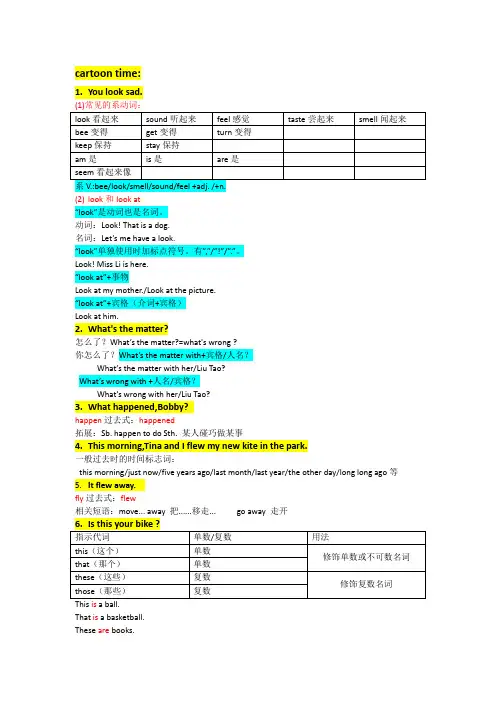
cartoon time:1.You look sad.(2)look和look at“look”是动词也是名词。
动词:Look! That is a dog.名词:Let’s me have a look.“look”单独使用时加标点符号。
有”,”/”!”/”.”。
Look! Miss Li is here.“look at”+事物Look at my mother./Look at the picture.“look at”+宾格(介词+宾格)Look at him.2.What's the matter?怎么了?What’s the matter?=what's wrong ?你怎么了?What’s the matter with+宾格/人名?What’s the matter with her/Liu Tao?What’s wrong with +人名/宾格?What’s wrong with her/Liu Tao?3.What happened,Bobby?happen过去式:happened拓展:Sb. happen to do Sth. 某人碰巧做某事4.This morning,Tina and I flew my new kite in the park.一般过去时的时间标志词:this morning/just now/five years ago/last month/last year/the other day/long long ago等5.It flew away.fly过去式:flew相关短语:move... away 把......移走...go away 走开This is a ball.That is a basketball.These are books.Those are flowers.注意:that’s= that is 但是this is 不可以缩写。
Unit2Whataday!单元知识梳理(素材)译林版英语六年级上册
6. “Whathappened? ”的用法
用法详解:此句是以what开头的特殊疑问句,常用来询问对方发生了什么事情,表达自己的关心。因询问的是过去发生的事情,故用happen的过去happened,回答时直接说明情况即可,注意时态用一般过去式。
tell告诉
told
break弄坏
broke
wake醒来
woke
think思考
thought
put放
put
read阅读
read
hurt受伤
hurt
3.在英语中,常见的日期表达方法有两种:
(1)日+月+年,例:18(th) December/Dec.,2022
(2)月+日+年,例:December、Dec.18 (th), 2022
用法详解:日期可用序数词也可用基数词,月份可用缩写形式,年份前用逗号隔开
序数词变化规律:
基数词(100以内)
变化规则及示例
1-3
特殊变化:one-first, two-second, three-third
4-19
一般在基数词后加-th: four-fourth, sixth
特殊变化:five-fifth, eight-eighth, nine-ninth, twelve-twelfth
例:You didn’t go to school yesterday. What happened?——Myarmhurt.(hurt为hurt的过去式)
拓展延伸:当询问具体某人或某物发生了什么事情时,用“Whathappened to+某人/某物?” to是介词,后面接人称代词时,要用其宾格形式。
译林版英语六年级上册Unit2 What a day!教案
译林版英语六年级上册Unit2 What a day!教案教学目标•给学生灌输新词汇和短语,例如 wash, get dressed, brush teeth, comb hair, have breakfast, go to school, have lunch, do homework, have dinner, take a shower, go to bed 等等•告诉学生日常生活中的活动顺序,帮助建立时间意识和时间管理能力•强化学生口语表达能力和听说能力教学步骤1. 词汇教学•引入新词汇和短语:wash, get dressed, brush teeth, comb hair, have breakfast, go to school, have lunch, do homework, have dinner, take a shower, go to bed•为每个词汇讲解并提供例句,让学生理解每个词汇的含义和用法。
2. 故事讲解•讲解故事及故事中的细节,例如主人公在每天的不同时间段做什么,并说出每个动作对应的词汇•学生也可以跟着老师一起说出每个动作对应的词汇•对于学生可能不理解的单词或短语,老师需要适时给予解释,让学生更好地理解故事3. 对话练习•设计一些对话场景(可以是故事中出现的场景),让学生分组进行练习,并让每组演出他们练习的对话•对话可以偏向于固定句子或是自由发挥,可以让学生有更多的口语表达机会4. 作业•让学生完整地回顾一天的时间表,写出每个时间段主人公做什么事情,提醒他们使用到本次课程中学到的单词和短语•对于较为担心作业望而却步的学生,思考教师是否可以让同学分享自己的作业并互相核对教学总结•通过这次课程,学生可以掌握更多单词和短语,并且懂得如何更好地安排自己的时间,从而更好地管理自己的生活。
•在教学过程中,老师需要留意学生的理解程度,及时追问和鼓励学生,让学生对课程内容有充分的掌握和理解。
(译林版)6A必背知识点精心梳理
6A必背知识点精心梳理一、关于一般过去时态1.定义:一般过去时态表示发生在过去的一个动作或状态。
一般句中会有ago, last, just now, yesterday, one day等标志性时间状语或单词。
2.结构:a.主语+was/were+其它。
He was a teacher.b.主语+行为动词过去式+其它。
They ate apples just now.c.主语+could+动词原形+其它。
She couldn’t write then.二、关于show(展示)的用法show sb th=show sth to sb 给某人看某物例句:He showed Mr.Li the book.=He showed the book to Mr.Li.类似的单词用法还有:give sb sth=give sth to sb 给某人某物send sb sth=send sth to sb 给某人发送某物bring sb sth=bring sth to sb 给某人带来某物take sb sth=take sth to sb 给某人带去某物write sb sth=write sth to sb 给某人写(信)注意:小学常见的make/buy/cook等动词要和for搭配make sb sth=make sth for sb 给某人制作某物buy sb sth=buy sth for sb 给某人买某物cook sb sth=cook sth for sb 给某人做饭三、关于介词in表示“穿”在众多介词中,只有in+衣服或颜色,表示“穿...”,需要注意的是,它是一个介词,不能充当谓语。
例句:The boy in a blue shirt is Mike.He walked through the city in his new clothes.Who is that woman in black?注意上面三个例句中的划线部分,它们是谓语动词,所以只能使用in表示“穿”,而不能再使用行为动词wear。
牛津译林版六年级英语上册第一单元6A Unit2词汇和句型知识点
6A Unit 2 What a day!一、词组1.go to the park by bike 骑自行车去公园2.go to school on foot/walk to school步行去上学3.become cloudy 变得多云4.look sad 看起来难过5.what a day怎样的一天啊st Sunday 上周日7.this Sunday 这周日8.next Sunday 下周日9.a parrot show 一场鹦鹉表演10.fly kites high in the sky把风筝放到高高的空中11.many black clouds许多乌云12.some interesting parrots 一些有趣的鹦鹉13.go away 走开14.fly away飞走15.want to know 想要知道16.near the hill 在小山附近17.bring some drinks 带来一些饮料18.fly too high 飞得太高19.in your diary 在你的日记里20.write about …写关于……21.cheer together 一起欢呼22.hold onto it紧紧抓住它23.lose my new kite 丢失我的新风筝24.lose one’s way 迷路25.bring lunch to the park带午餐去公园26.watch a film 看电影27.a busy day忙碌的一天28.go swimming去游泳29.climb up the hill爬上小山30. meet him in the park在公园遇见他31.time for lunch该吃午饭了32. pick three cards 挑选三张卡片e again another day改天再来34. on a rainy morning 在一个雨天的早上35.on Monday afternoon在周一下午36.do housework做家务37.find my English book找到我的英语书38.have a picnic on the grass在草地上野餐二、句型1. I get up at six every morning. But this morning, I got up at six thirty.我每天六点起床。
Unit 2 知识梳理+考点精练-六年级英语上册(译林版三起)
2.After some rainy days,itfinally.
3.Yang Lingfor breakfast yesterday.
4.The children usually go to school by bus,but theylast week.
三、1.is snowing2. were 3. brought 4. rains,rained, rainy 5. became, cloudy 6. Was
四、单项选择。
()1.it oftenin winter here?
A.Is;rainB.Does;rainsC.Does;rain
()2.I don't like theweather.I like sunshine.
A.cloudB.cloudyC.sunny
()3.Let the rainbecause we want to play outside.
4.become意为“变成,变为”,体现转变。
例如:Itbecomescoldinwinter.冬天天气变冷了。
5.bring和take:
bring意为“带来”,指从别的地方带到说话人或提到的人这边。例如:
Myfatherbroughtmeabag.=Myfatherbroughtabagtome.我爸爸给我带来了一个包。
2.Wesawmanyinterestingparrots.我们看到了很多有趣的鹦鹉。
3.Weflewkiteshighinthesky.我们在高空中放风筝。
4.Ibroughtsomebread.我带来了一些面包。