
BOOK9 Unit 2 Sailing the oceans Reading课件
Arctic Ocean
Pacific Ocean
Indian Ocean
Atlantic Ocean
Question: How many oceans are there in the world?
What is a navigator?
Ferdinand Magellan 费迪南德 ·麦哲伦
He is the most famous westerner to travel the Silk Road and the only person to provide information about China to the outside world. In 1271 he set out to reach the Mongol Empire and then China. Marco Polo In 1295, he arrived back in Europe. 1254--1324 Three years later he was imprisoned by the Genoese. While in prison, he told the story
of his travels to a fellow prisoner who wrote his adventures down. When his book was published it became a best-seller.
The Map of Marco Polo’s
James Cook
1728-1779
James Cook was the greatest Britain navigator. Cook joined in the Royal Navy in 1755. In 1768 he was promoted and sent to the Pacific where he surveyed Tahiti, New Zealand, and Australia. On his famous second expedition (1772-1775) he explored Antarctica. In 1776 he undertook his third and final
Explorer
land
use of compass and landmarks
find new places within an already identified island or continent
Explorer is sb. Who travels into or through a place in order to learn about it. Very often navigators are also explorers.
He led a large fleet to explore Southeast Asia, India and the Middle East in the Ming Dynasty. Altogether he made 7 voyages in the 15th century.
Zheng He 1371-1433
A navigator explores new routes across the sea.
the Arctic Ocean
the Atlantic Ocean the Indian Ocean
Christopher Columbus 克里斯托弗 ·哥伦布
the Pacific Ocean
Vasco da Gama 瓦斯科 ·达伽马
Whr and an explorer?
Navigator
sea nautical instruments
find new islands or continents
Navigator is sb. who finds the position and plots the course of a ship, an aircraft, a car, etc, using maps and instruments.
voyage in which he explored the West Coast of North America and tried to locate a passage between the Atlantic and Pacific oceans. On this voyage he discovered the Hawaiian Islands, and sailed up the coast of North America through the Bering Straits to the Arctic Ocean. On his return he was killed by Hawaiian islanders. He is regarded as one of the world’s greatest explores and navigators.
Look at these famous people. Are they navigators or explorers? What do you know about them?
Zheng He
Marco Polo
James Cook
When we want to talk about a famous navigator in Chinese history, who would you like to think of first?
He travelled more than 50,000 km and visited 30 countries new to China and developed many trade links. He is considered one of the earliest naval explorers in Chinese history.
[精品]新人教版选修9高中英语unit 2 sailing the oceans词汇讲解及答案
![[精品]新人教版选修9高中英语unit 2 sailing the oceans词汇讲解及答案](https://360docs-1393072327.cos.ap-beijing.myqcloud.com/3972b3df941ea76e58fa04b7.webp)
Unit 2 Sailing the oceansTeaching ResourcesSection 3: Words and expressions from Unit 2Sailing the oceansmercynoun (pl. -ies)1. [U] a kind or forgiving attitude towards sb that you have the power to harm or right to punish humanity:to ask / beg / plead for mercy They showed no mercy to their hostages. God have mercy on us. The troops are on a mercy mission (= a journey to help people) in the war zone.2. [C, usually sing.] (informal) an event or a situation to be grateful for, usually because it stops sth unpleasant: It’s a mercy she wasn’t seriously hurt. His death was a mercy (= because he was in great pain. at the mercy of sb/sth not able to stop sb/sth harming you because they have power or control over you:I’m not going to put myself at t he mercy of the bank. We were at the mercy of the weather.leave sb/sth to the mercy / mercies of sb/sth to leave sb/sth in a situation that may cause them to suffer or to be treated badly: privatized companies left to the mercy of market forces (humoro us) I’ll leave you to the tender mercies of these ladies!throw yourself on sb’s mercy (formal) to put yourself in a situationwhere you must rely on sb to be kind to you and not harm or punish you longsideprep.1. next to or at the side of sth: A police car pulled up alongside us.a lifeboat moored alongside the yacht Much of the land alongside the river is below sea level. 2.together with or at the same time as sth/sb: Traditional beliefs still flourish alongside a modern urban lifestyle. explorationnoun [C, U]1. the act of travelling through a place in order to find out about it or look for sth in it: the exploration of space oil exploration (= searching for oil in the ground)2.an examination of sth in order to find out about it: the book’s explorations of the human mindaccelerateverb1. to happen or to make sth happen faster or earlier than expected: [v] Inflation continues to accelerate. [vn] Exposure to the sun can accelerate the ageing process.2. [v] (of a vehicle or person) to start to go faster: The runners accelerated smoothly around the bend. The car accelerated to overtake me.secureadj.HAPPY / CONFIDENT1.feeling happy and confident about yourself or a particular situation: At last they were able to feel secure about the future. She finished the match, secure in the knowledge that she was through to the next round. CERTAIN / SAFE2. likely to continue or be successful for a long time; safe: a secure job / income It’s not a very secure way to make a living. The future of the company looks secure.3. ~ (against / from sth) that cannot be affected or harmed by sth: Information must be stored so that it is secure from accidental deletion. BUILDING / DOOR / ROOM4. guarded and/or made stronger so that it is difficult for people to enter or leave:Check that all windows and doors have been made as secure as possible. a secure unit for child offenders The building is secure against intruders.FIRM5.not likely to move, fall down, etc.; stable: The aerial doesn’t look very secure to me. It was difficult to maintain a secure foothold on the ice. (figurative) Our relationship was now on a more secure footing. verbGET STH1. ~ sth (for sb/sth)| ~ sb sth (formal) to obtain or achieve sth,especially when this means using a lot of effort:[vn] to secure a contract / deal The team managed to secure a place in the finals. She secured 2. 000 votes. The delegation has secured the promise of a ceasefire. [vn, vnn] He secured a place for himself at law school. He secured himself a place at law school.FASTEN FIRMLY2. [vn] ~ sth (to sth) to attach or fasten sth firmly: She secured the rope firmly to the back of the car. The tables on board were secured firmly to the floor.PROTECT FROM HARM3.[vn] ~ sth (against sth) to protect sth so that it is safe and difficult to attack or damage: to secure a property against intruders The windows were secured with locks and bars. (figurative) a savings plan that will secure your child’s futureA LOAN4. [vn] to legally agree to give sb property or goods that are worth the same amount as the money that you have borrowed from them, if you are unable to pay the money back: a loan secured on the houserandomadj. [usually before noun] done, chosen, etc. without sb deciding in advance what is going to happen, or without any regular pattern: the random killing of innocent people a random sample / selection (= in whicheach thing has an equal chance of being chosen) The information is processed in a random order.nounat random without deciding in advance what is going to happen, or without any regular pattern: She opened the book at random (= not at any particular page) and started reading. The terrorists fired into the crowd at random. Names were chosen at random from a list.awkwardadj.1. making you feel embarrassed: There was an awkward silence. I felt awkward because they obviously wanted to be alone.2. difficult to deal with:Don’t ask awkward questions. You’ve put me in an awkward position. an awkward customer (= a person who is difficult to deal with) Please don’t be awkward about letting him come. It makes things awkward for everyone when you behave like that.3.not convenient, inconvenient: Have I come at an awkward time?4. difficult or dangerous because of its shape or design: This box is very awkward for one person to carry. This tool will reach into awkward corners, such as under kitchen units.5. not moving in an easy way; not comfortable: He tried to dance, but he was too clumsy and awkward. I must have slept in an awkward position—I’m aching all over.referencenounMENTIONING SB / STH1. [C, U] ~ (to sb/sth) a thing you say or write that mentions sb/sth else; the act of mentioning sb/sth: The book is full of references to growing up in India. She made no reference to her illness but only to her future plans. the President’s passing reference to (= brief mention of) the end of the warLOOKING FOR INFORMATION2.[U] the act of looking at sth for information: Keep the list of numbers near the phone for easy reference. I wrote down the name of the hotel for future reference (= because it might be useful in the future). The library contains many popular works of reference (= reference books). ASKING FOR ADVICE3. [U] ~ (to sb/sth) (formal) the act of asking sb for help or advice: The emergency nurse can treat minor injuries without reference to a doctor.NUMBER / WORD / SYMBOL4. [C] (abbr. ref.) a number, word or symbol that shows where sth is ona map, or where you can find a piece of information: The map reference is Y4.. Please quote your reference number when making an enquiry. FOR NEW JOB5. [C] a letter written by sb who knows you, giving information aboutyour character and abilities, especially to a new employer:We will take up references after the interview.6. [C] a person who agrees to write a reference, for you, for example when you are applying for a job: My previous boss will act as a reference for me.IN BOOK7. [C] a note in a book that tells you where a particular piece of information comes from: There is a list of references at the end of each chapter.in / with reference to(formal) used to say what you are talking or writing about: With reference to your letter of July 22...verb[vn] (formal) to refer to sth; to provide a book, etc. with references: Each chapter is referenced, citing literature up to 2004.preciseadj.1.clear and accurate; exact:precise details / instructions / measurements Can you give a more precise definition of the word? I can be reasonably precise about the time of the incident.2. [only before noun] used to emphasize that sth happens at a particular time or in a particular way: We were just talking about her when, at that precise moment, she walked in. Doctors found it hard to establish the precise nature of her illness.3.taking care to be exact and accurate, especiallyabout small details: a skilled and precise worker small, precise movements (disapproving) She’s rather prim and precise.to be (more) precise used to show that you are giving more detailed and accurate information about sth you have just mentioned: The shelf is about a metre long—well, 98cm, to be precise.simplifyverb(simplifies, simplifying, simplified, simplified) [vn] to make sth easier to do or understand: The application forms have now been simplified.I hope his appointment will simplify matters. a simplified version of the story for young childrenportableadj. that is easy to carry or to move: a portable TV The equipment is lightweight, portable and easy to store. (figurative) a portable loan / pension (= that can be moved if you change banks, jobs, etc.) portable softwarenoun a small type of machine that is easy to carry, especially a computer or a television: The kids are upstairs watching the portable (= television).shortcomingnoun[usually pl.] a fault in sb’s character, a plan, a system, etc.: She made me aware of my own shortcomings. Despite a number of shortcomings, the project will still go ahead.updateverb [vn]1. to make sth more modern by adding new parts, etc.: It’s about time we updated our software.2.~ sb (on sth)| ~ sth to give sb the most recent information about sth; to add the most recent information to sth bring up to date: I called the office to update them on the day’s developments. Our records are regularly updated.tendencynoun (pl. -ies)1. [C] ~ (for sb/sth) (to do sth)| ~ (to / towards sth) if sb/sth hasa particular tendency, they are likely to behave or act in a particular way: to display artistic, etc. tendencies I have a tendency to talk too much when I’m nervous. There is a tendency for this disease to run in families. She has a strong natural tendency towards caution. This material has a tendency to shrink when washed.2. [C] ~ (for sb/sth) (to do sth)| ~ (to / towards sth) a new custom that is starting to develop: There is a growing tendency among employers to hire casual staff.3. [C+sing./pl. v.] (BrE) a group within a larger political group, whose views are more extreme than those of the rest of the group: the militant tendencyreliableadj.1. that can be trusted to do sth well; that you can rely on; dependable: We are looking for someone who is reliable and hard-working. a reliable friend My car’s not as reliable as it used to be.2. that is likely to be correct or true: Our information comes from a reliable source. a reliable witness How reliable are the local weather forecasts? These tests are a reliable indicator of future performance.swoopverb [v]1.[usually +adv. / prep.] (of a bird or plane) to fly quickly and suddenly downwards, especially in order to attack sb/sth; dive: The aircraft swooped down over the buildings. A hawk swooped low over the field.2. ~ (on sb/sth) (especially of police or soldiers) to visit or attack sb/sth suddenly and without warning: Officers swooped on the vehicles as they left the ferry.noun1. an act of moving suddenly and quickly through the air in a downward direction, as a bird does dive2. ~ (on sth/sb) an act of arriving somewhere or attacking sth/sb in a way that is sudden and unexpected: Large quantities of drugs were found during a police swoop on the star’s New York home.peckverb1.~ (at sth) (of birds) to move the beak forward quickly and hit or bite sth: [v] A robin was pecking at crumbs on the ground. Hens pecked around in the yard. [vn] A bird had pecked a hole in the sack. Vultures had pecked out the dead goat’s eyes.2.[vn] ~ sb (on sth) (informal) to kiss sb lightly and quickly: He pecked her on the cheek as he went out. She pecked his cheek.a / the pecking order (informal, often humorous) the order of importance in relation to one another among the members of a group: New Zealand is at the top of the pecking order of rugby nations. to be first in the pecking orderpeck at sth to eat only a very small amount of a meal because you are not hungry; pick at: She sat nervously pecking at her food. expeditionnoun1. an organized journey with a particular purpose, especially to find out about a place that is not well known: to plan / lead / go on an expedition to the North Pole2.the people who go on an expedition: Three members of the Everest expedition were killed.3. (sometimes humorous) a short trip that you make when you want or need sth: a shopping expedition compulsoryadj. that must be done because of a law or a rule: It is compulsory for all motorcyclists to wear helmets. English is a compulsory subject atthis level. compulsory education / schooling compulsory redundancies Survivalnoun1.[U] the state of continuing to live or exist, often despite difficulty or danger: the struggle / battle / fight for survival His only chance of survival was a heart transplant. Exporting is necessary f or our economic survival. Continued trade in these products is a threat to the survival of the species.2.[C] ~ (from sth) something that has continued to exist from an earlier time: The ceremony is a survival from pre-Christian times.the survival of the fittest the principle that only the people or things that are best adapted to their surroundings will continue to exist incidentnoun1.[C] something that happens, especially sth unusual or unpleasant: His bad behaviour was just an isolated incident. One particular incident sticks in my mind.2. [C, U] a serious or violent event, such as a crime, an accident or an attack: There was a shooting incident near here last night. The demonstration passed off without incident.3.[C] a disagreement between two countries, often involving military forces: a border / diplomatic incidentdeparturenoun1. [C, U] ~ (from ... ) the act of leaving a place; an example of this: His sudden departure threw the office into chaos. Flights should be confirmed 4.8 hours before departure. They had received no news of him since his departure from the island.2.[C] a plane, train, etc. leaving a place at a particular time: arrivals and departures All departures are from Manchester. the departure lounge / time / gate the departures board3.[C] ~ (from sth) an action that is different from what is usual or expected: It was a radical departure from tradition. Their latest single represents a new departure for the band.depositnounMONEY1.[usually sing.] a ~ (on sth) a sum of money that is given as the first part of a larger payment: We’ve put down a 5.% deposit on the house. They normally ask you to pay £1.00 (as a) deposit. All deposits are non-refundable.2. [usually sing.] a sum of money that is paid by sb when they rent sth and that is returned to them if they do not lose or damage the thing they are renting: to pay a dep osit They’l l probably ask you to leave a deposit.3. a sum of money that is paid into a bank account: Deposits can be made at any branch.4.(in the British political system) the amount of money that a candidate in an election to Parliamenthas to pay, and that is returned if he/she gets enough votes: All the other candidates lost their deposits.verb [vn]PUT DOWN1. [+adv. / prep.] to put or lay sb/sth down in a particular place: She deposited a pile of books on my desk. (informal) I was whisked off in a taxi and deposited outside the hotel.LEAVE SUBSTANCE2. (especially of a river or a liquid) to leave a layer of sth on the surface of sth, especially gradually and over a period of time: Sand was deposited which hardened into sandstone.MONEY3. to put money into a bank account: Millions were deposited in Swiss bank accounts.reckonverb1.(informal, especially BrE) to think sth or have an opinion about sth: [v (that)] I reckon (that) I’m going to get that job. He’ll be famous one day. What do you reckon (= do you agree)? [v] It’s worth a lot of money, I reckon. ‘They’ll never find out.’ ‘You reckon?’ (= I think you may be wrong about that)2.be reckoned (not used in the progressive tenses) to be generally considered to be sth: [vn to inf] Children arereckoned to be more sophisticated nowadays. [vn-n] It was generally reckoned a success. [also vn-adj] 3.[v to inf] (BrE, informal) to expect to do sth:We reckon to finish by ten. He wasn’t reckoning to pay so much.4. ~ sth (at sth) to calculate an amount, a number, etc.: [vn] I could see him reckoning the cost as I spoke. The age of the earth is reckoned at about 4.6.00 million years. [v (that)] They reckon (that) their profits are down by at least 2.0%. [vn to inf] The journey was reckoned to take about two hours.reckon on sth to expect sth to happen or to rely on sth happening: They hadn’t reckoned on a rebellion. [+ -ing] We’d reckoned on having good weather.reckon sth up / reckon up sth(especially BrE) to calculate the total amount or number of sth: He reckoned up the cost of everything in his mind.reckon with sb/sth1.[usually passive] to consider or treat sb/sth as a serious opponent, problem, etc.: They were already a political force to be reckoned with.2. (usually used in negative sentences) to consider sth as a possible problem that you should be prepared for; take sth into account: [+ -ing] I didn’t reckon with getting caught up in so much traffic.reckon without sb/sth (especially BrE) to not consider sb/sth as a possible problem that you should be prepared for; not take sth intoaccount: They had reckoned without the determination of the opposition. tensionnoun1. [U, C, usually pl.] ~ (between A and B) a situation in which people do not trust each other, or feel unfriendly towards each other, and which may cause them to attack each other: There is mounting tension along the border. international / racial / political tensions Family tensions and conflicts may lead to violence. The incident has further increased tension between the two countries.2.[C, U] ~ (between A and B) a situation in which the fact that there are different needs or interests causes difficulties: There is often a tension between the aims of the company and the wishes of the employees.3. [U] a feeling of anxiety and stress that makes it impossible to relax: nervous tension We laughed and that helped ease the tension. Walking and swimming are excellent for releasing tension. a tension headache4. [U] the feeling of fear and excitement that is created by a writer or a film/movie director: dramatic tension As the movie progresses the tension builds.5. [U] the state of being stretched tight; the extent to which sth is stretched tight: muscular tension Adjust the string tension of your tennis racket to suit your style of playing. When knitting, try to keep the same tension throughout. Massage can relieve tension in your shoulders and back. verb [vn] (technical) to make a wire, sail, etc. tight and stretchedgradualadj.1. happening slowly over a long period; not sudden: a gradual change in the climate Recovery from the disease is very gradual.2.(of a slope) not steepforeseeverb(foresaw, foreseen ) to think sth is going to happen in the future; to know about sth before it happens; predict: [vn] We do not foresee any problems. The extent of the damage could not have been foreseen. [v (that)] No one could have foreseen (that) things would turn out this way. [v wh-] It is impossible to foresee how life will work out. [also vn -ing] thirstnoun1.[U, sing.] the feeling of needing or wanting a drink: He quenched his thirst with a long drink of cold water. She woke up with a raging thirst and a headache.2. [U] the state of not having enough water to drink: Thousands are dying of thirst.3.[sing.] ~ (for sth) a strong desire for sth: a thirst for knowledgetearverb (tore ,torn)DAMAGE1. to damage sth by pulling it apart or into pieces or by cutting it onsth sharp; to become damaged in this way; rip: [vn] I tore my jeans on the fence. I tore a hole in my jeans. He tore the letter in two. a torn handkerchief [vn-adj] I tore the package open. I tore open the package. [v] Careful—the fabric tears very easily.2.[vn] ~ sth in sth to make a hole in sth by force; rip: The blast tore a hole in the wall. REMOVE FROM STH / SB3. [vn + adv. / prep.] to remove sth from sth else by pulling it roughly or violently; rip: The storm nearly tore the roof off. I tore another sheet from the pad. He tore his clothes off (= took them off quickly and carelessly) and dived into the lake.4.~ yourself / sb (from sb/sth) to pull yourself/sb away by force from sb/sth that is holding you or them: [vn] She tore herself from his grasp. [vn-adj] He tore himself free. INJURE MUSCLE5.[vn] to injure a muscle, etc. by stretching it too much:a torn ligament She tore a calf muscle playing squash.MOVE QUICKLY6. [v + adv. / prep.] to move somewhere very quickly or in an excited way: He tore off down the street. A truck tore past the gates.-TORN7.(in adjectives) very badly affected or damaged by sth:to bring peace to a strife-torn country a strike-torn industrytear sb/sth apart, to shreds, to bits, etc. to destroy or defeat sb/sthcompletely or criticize them or it severely: We tore the other team apart in the second half. The critics tore his last movie to shreds.tear at your heart / tear your heart out (formal) to strongly affect you in an emotional waytear your hair (out) (informal) to show that you are very angry or anxious about sth: She’s keeping very calm—anyone else would be tearing their hair out.(be in) a tearing hurry / rush (especially BrE) (to be) in a very great hurrybe torn (between A and B)to be unable to decide or choose between two people, things or feelings: I was torn between my parents and my friend. tear sb off a strip / tear a strip off sb(BrE, informal) to speak angrily to sb who has done sth wrongthat’s torn it(BrE, informal) used to say that sth has happened to spoil your plans—more at heart, limb, loose adj.tear sb apart / tear apart sb to make sb feel very unhappy or worried; rip sb apart: It tears me apart to think I might have hurt her feelings. His distress tore me apart.tear sth apart / tear apart sth1.to destroy sth violently, especially by pulling it to pieces: The dogs tore the fox apart.2. to make people in a country, an organization or other place fight or argue with each other: Racial strife is tearing ourcountry apart.3. to search a place, making it look untidy and causing damage: They tore the room apart, looking for money.tear at sth to pull or cut sth violently so that it tears: He tore at the meat with his bare hands.tear yourself away (from sth)/ tear sth away (from sth)to leave somewhere even though you would prefer to stay there; to take sth away from somewhere: Dinner’s ready, if you can tear yourself away from the TV. She was unable to tear her eyes away from him (= could not stop looking at him). tear sth down / tear down sth to pull or knock down a building, wall, etc.: They’re teari ng down these old houses to build a new office block. tear into sb/sth1. to attack sb/sth physically or with words: The wind tore into him.2. to start doing sth with a lot of energy: They tore into their food as if they were starving. The band tore into their opening number.tear sth up / tear up sth to destroy a document, etc. by tearing it into pieces; rip sth up: She tore up all the letters he had sent her. (figurative) He accused t he leader of tearing up the party’s manifesto (= of ignoring it).hardshipnoun [U, C] a situation that is difficult and unpleasant because you do not have enough money, food, clothes, etc.: economic / financial, etc. hardship People suffered many hardships during that long winter. Thetwo men endured great hardship during their trek across Antarctica. It was no hardship to walk home on such a lovely evening.backgroundnounFAMILY / EDUCATION, etc.1.[C] the details of a person’s family, education, experience etc.:a person’s family / social / cultural / educationa l / class background The job would suit someone with a business background. In spite of their very different backgrounds, they immediately became friends.PAST2. [C, usually sing., U] the circumstances or past events which help explain why sth is how it is; information about these: the historical background to the war background information / knowledge The elections are taking place against a background of violence. Can you give me more background on the company?OF PICTURE / PHOTO3. [C, usually sing.] the part of a picture, photograph or view behind the main objects, people, etc.: a photograph with trees in the background LESS IMPORTANT POSITION4.[sing.] a position in which people are not paying attention to sb/sth or not as much attention as they are paying to sb/sth else: He prefers to remain in the background and let his assistant talk to the press. Apiano tinkled gently in the background. background music There was a lot of background noise (= that you could hear, but were not listening to).COLOUR UNDER STH5.[C, usually sing.] a colour or design on which sth is painted, drawn, etc.: The name of the company is written in red on a white background. in the background (computing) (of a computer program) not being used at the present time and appearing on the screen behind programs that are being usedroarverb1. [v] to make a very loud, deep sound: We heard a lion roar. The gun roared deafeningly. The engine roared to life (= started noisily). The wind was roaring in my ears.2. ~ (sth) (out) to shout sth very loudly: [v] The crowd roared. [vn] The fans roared (out) their approval. He roared out James’s name. [v speech] ‘Stand back,’ he roared.3. [v] ~ (with laughter) to laugh very loudly: He looked so funny, we all roared. It made them roar with laughter.4. [v + adv. / prep.] (of a vehicle or its rider / driver) to move very fast, making a lot of noise: She put her foot down and the car roared away. A group of young men on motorcycles roared past.5. [v] (of a fire) to burn brightly with a lot of flames, heat and noise: A log fire was roaring in the hearth.noun1.a loud deep sound made by an animal, especially a lion, or by sb’s voice: His speech was greeted by a roar of applause. roars of laughter2. a loud continuous noise made by the wind or sea, or by a machine: I could barely hear above the roar of traffic. the roar of the Atlantic。
人教版高中英语Book 9 Unit 2 Sailing the Oceans Reading

the West Coast of North America and tried to locate a passage between the Atlantic and Pacific oceans.
On this voyage he discovered the Hawaiian Islands, and sailed up the coast of North America through the Bering Straits to the Arctic Ocean. On his return he was killed by Hawaiian islanders.
degrees westwards every hour. If you know your direction, speed and time, you can work out the approximate longitude or change in your position
in relation to the stars.
Discussion
Suppose you were a sea captain aiming to sail round Africa. Discuss in groups:
What skills would you seek in your sailors?
The sailors would need to be excellent navigators, able to cope with both hot and cold weather,
Using instruments
4. There were two methods to find longitude: 1)_m_e_a_s_u_r_i_n_g_t_im__e_a_n__d_s_p_e_e_d_ 2)_c_o_m_p_a_s_s_a_n__d_c_o_m__p_li_c_a_te_d__m__a_th_e_m__a_t_ic_a_l tables
人教版 Book9Unit2 Sailing the ocean 阅读理解
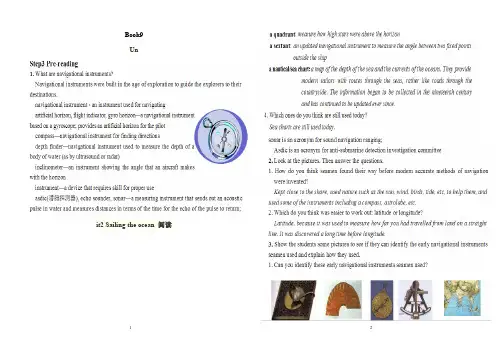
Book9Unit2 Sailing the ocean 阅读Comprehension questions1.What is the main topic of this passage?A.The voyages of the travelers before the 17th centuryB.How to plot a ship’s position on a mapC.How did ancient men navigate so welle nature to aid navigation2.Ancient navigators used navigational instruments to help them _______.A.find celestial bodiesB. predict the weatherC. explore the seaD. find latitude3.The author of the passage implies that the ancient navigators were ______.A.Hard-workingB. braveC. intelligentD. energetic4.According to the passage, _______.A.The ancient accomplished navigators were able to use South Star to plot their positionsB.Sea birds could be used to show the way to land when it was nowhere to be seenC.Wise seamen used the snows to direct their sailingD.The sextant proved to be the most accurate and reliable of these early navigationalinstruments.True or False?1).An early method of calculating longitude was to use a knotted rope tied to a log.2).The astrolabe was the first instrument to measure the sun’s position.3).The quadrant was more precise and simplified than the astrolabe, but still had its shortcoming.4).Up to now, the most accurate and reliable navigational instrument is the sextant. 5) The astrolabe, quadrant and sextant are different kinds of navigational instruments and they have nothing to do with each other.Read the passage and answer the following questions (见课文P14 Ex1)1 _______ _______2_____________________________________________________________ ______________________________________________________________ _______________________________________ .3._____________________________________________________________ ______________________________________________________________ _____________________________Using nature (见课文P14 Ex4)1. To find the ship’s position at sea a sailor used ____________________.2. A sailor knew that land was nearby if he saw_____________________________________________________________.3. Sailors used ________________________________________________.Using instruments4. These were two methods to find longitude:1)._________________ 2) ________________________________5. Write down the working principles of the following instruments:Bearing circle: ____________________________________.Astrolabe: ___________________________________________________. Quadrant:______________________________________________________ ___________________________________________________________ Sextant:________________________________________________________ ______________________________________________________________ _________________________________________________________.。
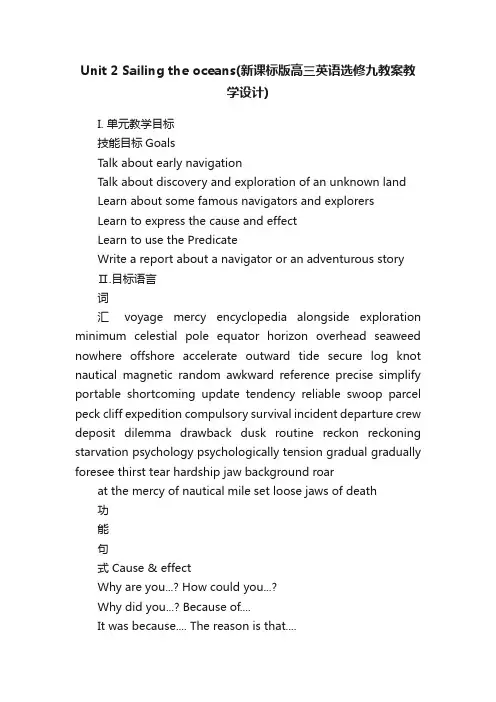
Unit2Sailingtheoceans(新课标版高三英语选修九教案教学设计)
Unit 2 Sailing the oceans(新课标版高三英语选修九教案教学设计)I. 单元教学目标技能目标GoalsTalk about early navigationTalk about discovery and exploration of an unknown landLearn about some famous navigators and explorersLearn to express the cause and effectLearn to use the PredicateWrite a report about a navigator or an adventurous storyⅡ.目标语言词汇voyage mercy encyclopedia alongside exploration minimum celestial pole equator horizon overhead seaweed nowhere offshore accelerate outward tide secure log knot nautical magnetic random awkward reference precise simplify portable shortcoming update tendency reliable swoop parcel peck cliff expedition compulsory survival incident departure crew deposit dilemma drawback dusk routine reckon reckoning starvation psychology psychologically tension gradual gradually foresee thirst tear hardship jaw background roarat the mercy of nautical mile set loose jaws of death功能句式 Cause & effectWhy are you...? How could you...?Why did you...? Because of....It was because.... The reason is that....As he.... Since she....Now that.... Therefore,...He was due to.... It is ..., so I’m afraid....That's why.... He.... so he is ill with fever after the voyage.语法复习谓语(The Predicate)So how did they navigate so well?As you can see from the map we kept to straight course pretty well.The tension in the boat got worse as the supply of food and water gradually disappearSo accomplished navigators were able to use it to plot their position.Captain Cook had led three great Pacific voyages during his life.I’ll go and get ready to begin work.重点句子1. You may well wonder…(p12)2. … show that they were not at the mercy of the sea even though…(p12)3. Sea birds could be used to show the way to land when it was nowhere to be seen. (p12)4. There was no secure method of measuring longitude until the 17th century when the British solved this theoretical problem. (p13)5. Its shortcoming was that it still used the moving ship as one of the fixed points of reference. (p13)6. I am proud to have sailed with Captain Bligh on his journeyof…(p17)7. You could not imagine a more disturbing sight than what we looked like when arriving in Timor over forty days after being set loose in…(p17)Ⅲ..教材分析与教材重组1. 教材分析本单元的中心话题是“Sailing the oceans”,内容涉及海洋航行、人类早期的航海技术、中国历史上最著名的航海家郑和、辛巴达的第一次冒险航行等。
高中英语(人教版)选修九Unit2Sailingtheoceans同步课件教案课件教案和测试(参考)
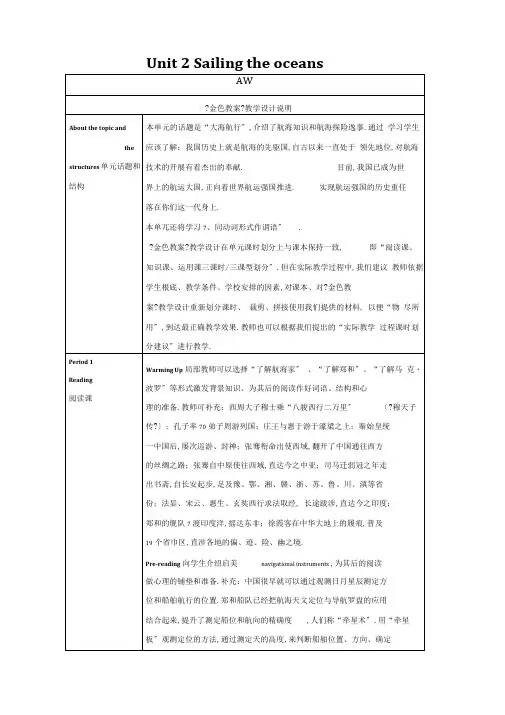
Unit 2 Sailing the oceansPart 1 Teaching Design第一局部教学设计Period 1 A sample lesson plan for reading(SAILING THE OCEANS)IntroductionIn this period, after the warming up, students will first be guided to learn about navigational instruments.Then they will be helped to read an exposition about sailing the oceans.Three “WarmingUp" designs are presented in this book for teachers reference. Computer and overhead projector may be used to a id the teaching and learning.Objectives■To help students learn to express causes and effects■To help students learn to read an exposition about sailing the oceans■To help students better understand a sailing〞■To help students learn to use some important words and expressions■To help students identify examples of the future passive voice in the textFocusAidsMultimedia facilities, tape-recorder, photos, diagramsProcedures1.Warming up(1)Warming up by leaning about navigatorA navigator is the person onboard a ship responsible for the navigation of the vessel. On aircraft, the position may also be referred to as a flight officer. The navigator's responsibilities include planning the journey, advising the captain (or pilot) while en route, and ensuring that hazards or obstacles are avoided.(2)Warming up by talking about Zheng He's Seven VoyagesIn July 11, 1405, the eunuch Zheng He of the Ming Dynasty royal court set out on his first overseas voyage.In the following 28 years, this navigator proceeded to carry out six more voyages, accompanied by a huge entourage of nearly 30,000 people. By traveling throughout Southeast Asia, and around the Indian Ocean to the Red Sea and East Africa, he also landed at over thirty different nations. He was the earliest largest scale navigation in world history, coming more than half a century earlier than Columbus'famous exploits...(3)Warming up by looking and listeningHello, class. Do you know this man? Yes, he is Marco Polo.Marco Polo (1254-1324), is probably the most famous Westerner traveled on the Silk Ro ad. He excelled all the other travelers in his determination, his writing, and his influence. His journey through Asia lasted 24 years. He reached further than any of his predecessors, beyond Mongolia to Chin a. He became a confidant of Kublai Khan (1214-1294). He traveled the whole of China and returned to tell the tale, which became the greatest travelogue.2.Pre-reading by learning about navigational instruments◊ artificial horizon, flight indicator, gyro horizon - a navigational instrument based on a gyroscope;provides an artificial horizon for the pilot◊ compass - navigational instrument for finding directions◊ depth finder - navigational instrument used to measure the depth of a body of water (as by ultrasound or radar)◊inclinometer - an instrument showing the angle that an aircraft makes with the horizon◊instrument - a device that requires skill for proper use◊asdic, echo sounder, sonar - a measuring instrument that sends out an acoustic pulse in water and measures distances in terms of the time for the echo of the pulse to return; sonar is an acronym for sound navigation ranging; asdic is an acronym for anti-submarine detection investigation committee3.Reading for formsRead the text SAILING THE OCEANS on page 12 to: cut/ the sentence into thought groups, blacken the predicative, darken the connectives and underline all the useful expressions.4.Copying useful expressions and making sentencesYou are going to copy in your notebook all the useful expressions and make sentences of your own with them.5. Transforming information Next you are going to read the text again to complete the chart below.7. Making a diagram of SAILING THE OCEAN8. Closing down by answering comprehension questions1. What is the main topic of this passage?A. The voyages of the travelers before the 17th centuryB. How to plot a ship ' s position on a mapC. How did ancient men navigate so wellD. Use nature to aid navigation2. Ancient navigators use navigational instruments to help them.A. find celestial bodiesB. predict the weatherC. explore the seaD. find latitude…,rather •・ as one of the points of3.The author of the passage implies that the ancient navigators were.A. hard-workingB. braveC. intelligentD. energetic4.According to the passage,.A.the ancient accomplished navigators were able to use South Star to plot their positions .B.Sea birds could be used to show the way to land when it was nowhere to be seen .C.Wise seamen used the snows to direct their sailing .D.The sextant proved to be the most accurate and reliable of these early navigational instruments. (Keys: BDCB )。
人教版高中英语选修9Unit2《Sailingtheoceans》word单元教案
⼈教版⾼中英语选修9Unit2《Sailingtheoceans》word单元教案Unit Two Sailing the oceans课程标准中的内容标准:本单元的话题是围绕“航海、发现探索未知的⼤陆”的主题。
内容涉及航⾏、⼈类早期的航海技术、中国历史上最著名的航海家郑和、⾟巴达的第⼀次冒险航⾏等。
教学细⽬:1、(情感⽬标)通过阅读,了解⼈类早期的航海术、历史上著名的航海家、探险家及著名的航海事迹。
2、(交际)通过听说学习表⽰“原因与结果”的⽤语。
3、(词汇)通过阅读、师⽣互动掌握本单元的教学⽬的和要求中的词汇。
4、(写作)通过阅读和书⾯训练,学习并掌握正式信件的写法和⽤语。
5、(语法)通过书⾯训练,深⼊理解和进⼀步复习谓语的⽤法。
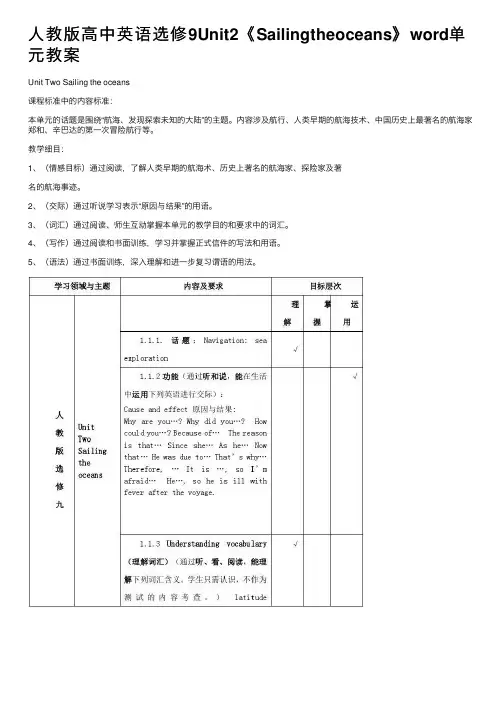
Part One 单元重点知识点I. 重点单词和词组P. 1Words: navigate, navigator, navigation, navigational; explore, explorer, explorationPhrases: the difference between… and …P.2Words: voyage mercy minimum nowhere pole overhead offshore accelerate outward longitude latitude precise simplify portable shortcoming updatedtendency reliablePhrases: at the mercy of, even though, work out, be used to, in relation to, aim to, …P.3Words: incident departure crew deposit dilemma drawback dusk routine pretty starvation extreme psychologically tension gradually foresee thirsthardshipPhrases: in addition cope with set loose the jaws of deathII. 重点句型见表1.1.7III. 重点语法复习谓语:谓语⽤来说明主语的动作或状态,由动词或动词词组担任。
人教版高中英语选修9《Unit2Sailingtheoceans》教案
人教版高中英语选修9《Unit2Sailingtheoceans》教案人教版高中英语选修9《Unit 2 Sailing the oceans》教案教学准备教学目标1、知识目标(1).理解并记住Reading部分本单元的单词和短语。
(2).理解并掌握整个故事的情节,并能填写summary.2、能力目标(1)充分发挥学生的主体地位,调动学生思维的积极性,提高综合语言的运用能力(2)通过对学生说读写的训练,增大学生的语言输入,增强其语言输出能力。
3、情感、态度、价值观目标学生分析布莱船长在40多天的航程中所采用的航海技术以及所表现出的领导才能。
同时,又适时地对他们进行情感教育:在任何困难面前绝不畏惧,不抛弃,不放弃。
教学重难点教学重点与难点:读写说均为本节课的重点,写和说部分应为难点,需加大指导和练习。
教学过程Teaching procedures:Lead-in:通过歌曲Sailing导入,让学生在轻松愉悦的音乐下近入新课的学习之中。
促使学生积极主动地进入学习状态。
ComprehensionStep I Please Skim the passage and get the main idea.Step II. Scan the passage: True or False.1. I was forced to join Captain Bligh in the small boat.2. After the crew took over the ship “Bounty”, Captain Bligh was allowed to take with him a chart , a compass and a quadrant.3. It was very difficult for us to get a correct reading from the quadrant as the boat moved constantly during the course.4. Captain Bligh used a system called “dead reckoning” and he knew there was land directly southwest of their original position.5. Captain Bligh was as weak as the rest of us but he was determined not to give up.6. Captain Bligh kept us busy and tried to take our minds off our stomachs and thirst all the way.7. We finally escaped the jaws of death and arrived in Timor over fifty days after being set loose in our small boat.Step III. Group work: further reading.When captain Blight returned home he was honored as a hero. Discuss in groups whether he should receive a special medal or not.Step IV. Affective educationAfter learning the text, as senior three students, what can we learn from Captain Blight in our life?Step V. Summary:I am _____ to have sailed with Captain Bligh on his journey of over40 days through about4,000 miles in an open boat ______the Pacific Ocean in 1789.In the beginning, on our ________(depart), some of the crew took _____theship and the captain ___________(deposit) into a small boat. Thus we werecaught _____a dilemma. We decided to stick with him _______thick and thin though we seemed to face _____uncertaindeath.During the long and toughjourney, we encountered manyunexpected hardships. Despite _____(lack) of foodand water, he kept us _______(occupy) and cheerful to take our minds ____troubles. All the way he taught us how to cope _______various situations. Finallythey arrived at Timor __________(success) andthey were honored as _______(hero).The story shows that one man’sspirit and his determination should not ________ (defeat) by circumstances.Complexsentences(分析并翻译1-2个长难句)Challengeyourself!---Grammar Filling1. I’m proud to have sailed withCaptain Blight ____his journey of over 40 days _________about 4,000miles ____anopen small boat _______ the Pacific Ocean.2. On our _________(depart) from T ahiti, some crew took _____the ship. And those of us onboard ____________(catch) in a dilemma.3. As you can see from the map we kept_____a straight course pretty well.4. The captain kept us busy________ (read) the tables to work out our position .5. It was the extreme lack of waterthat was hard to cope with ______________ (psychology)6.He kept us busy and tried to take our minds课后习题Challenge yourself!---Grammar Filling1. I’m proud to have sailed with Captain Blight ____his journey of over 40 days _________about 4,000miles ____an open small boat _______ the Pacific Ocean.2. On our _________(depart) from T ahiti, some crew took _____the ship. And those of us on board ____________(catch) in a dilemma.3. As you can see from the map we kept _____a straight course pretty well.4. The captain kept us busy________ (read) the tables to work out our position .5. It was the extreme lack of water that was hard to cope with ______________ (psychology)6.He kept us busy and tried to take our minds _____our __________(stomach).。
人教高中英语选修9 Unit2 Sailing the oceans-Reading
D. To tell the time
2) Why are speed and time important in working out the longitude of a ship?
fog or seaweed to
show that land id the passage again and use the information to analyze the navigational skills.
Using nature
1. To find the ship’s position at sea a sailor used the North Star and the sun. 2. A sailor knew that land was nearby if he saw _fr_e_s_h_s_e_a_w_e_e_d_,_n_e_s_t_in_g__b_i_r_d_s_r_e_tu_r_n_i_n_g_ _h_o_m__e_i_n__th_e__e_v_en__in_g__o_r_f_o_g. 3. Sailors used _s_e_a_c_u_r_r_e_n_t_s_o_r_t_i_d_e_s_a_n_d___ __w_i_n_d_s__to increase their speed.
What would you do if :
You were far from land and a storm arose.
Plan of action
Wait till the storm is over, and then find your new position and return to your original course.
Students’ book 9 Unit 2 Sailing the oceans
Students’ book 9: Unit 2 Sailing the oceans陕西省渭南市华县铁中许红Reading: Sailing the oceansAnalysis of the text:This Reading “Sailing the oceans” is an exposition. It uses the form of encyclopedia to show us the information about how the seamen explored the ocean before the modern navigational instruments were invented.The passage can be divided into 3 parts.The first part is a general introduction of the text;The second part is an introduction about how the seamen navigated the ocean with the help of the nature: keeping alongside the coastline seems to have been the most useful form of exploration which carried the minimum amount of risk; using celestial bodies could plot their positions or work out their latitude;using the seaweed and the wildlife could help them find land; using wind could accelerate the speed; using fog could help them find streams or rivers; using tides and currents could carry ships to their destination .The third part is an introduction about how the early seamen used the navigational instruments to work out the latitude and the longitude. The seamen used some approximate methods to work out the longitude .At first, they used the speed of the ship and time to calculate their longitude; in the 12th century, they could calculate longitude using mathematical tables; in the 17th century, the seamen could use the secure method to measure longitude. The early seamen used the navigational instruments to measure latitude: using the bearing circle to set a straight course; using the astrolabe to identify the position of the ship and find their latitude at sea; using the quadrant to measure how high the stars were above the horizon and the sextant was the updated version of the astrolabe and quadrant which reduced the tendency to make mistakesLearning Aims:1. Learn and master the key words and expressions2. Train the students’ reading ability. Let the students have some knowledge of early navigational methods. Learn how seamen explored the oceans and what kind of navigational instruments were used by sailors before the 17th century when they were navigating the open seas without seeing the land.Learning Important Points:1. Grasp the important words and phrasesVerbs: knot, simplify, updateNouns: latitude, voyage, mercy, encyclopedia, exploration, pole, equator, horizon, seaweed, tide, log, reference, shortcoming Adj. & Adv.: minimum, celestial, overhead, offshore, outward, secure, nautical, magnetic, random, awkward, precise,portable, alongside2.Understand the general structure of the passage3. Grasp the main idea of the passageLearning Difficult Points:1. Improve students’ reading ability2. Know what to do when we meet difficulties at sea3. Train students’ coop erative abilityLearning Methods:1. Skimming2. Scanning3. Asking others for helpLearning Steps:Step I Greetings and Lead-in1. How do you think the seamen found their way before modernnavigational instruments were invented?2. Can you identify these instruments and explain how they are used?Which group wants to tell us what the pictures are?Step II ReadingPart A: Fast Reading1.Where are these pages from?2.How many parts are there in this passage? What are they?3. The reading passage mainly wants to tell us ___.A. that keeping alongside the coastlines is the first and mostuseful form of exploration.B. the skills and navigational aids early seamen used while sailingthe oceans.C. that finding longitude a nd latitude is a must to plot a ship’sposition on a mapD. how the early sailors used their skills and simple instruments.4.From the reading passage we have learned ___.A. why early seamen wanted to sail the seven seasB. that there is useful information in an encyclopediaC. that early sailors went exploring the sea using their skills andsimple instrumentsD. why latitude and longitude are important to plot a ship’spositionPart B: Careful Reading1.According to page 1, match the left part with the right part. Tides and currents can be used to work out the latitude AThe North Star accelerates the speedBWind can be used to plot their positionCThe sun identifies the position of a stream or a river DThe cloud indicates there is land nearbyEFresh seaweed leads people to land FBirds carry ships to their destinationGFog2. How many parts are there on page 2?3. Why are speed and time important in working out the longitude of aship?4. How many methods of finding longitude are mentioned in the first part?What are they?5. How many instruments are used to find latitude?What are they?6.What is the relation among the astrolabe, the quadrant and the sextant? Step ⅢPracticeWhat would you do if you come across the following problem during your voyage? Read the conditions below, then discuss inyour group and write down your plans of action to deal with them.Step IV Useful Expressions(Group work)1. 使……成为可make it possible to do sth.2. 在地图上标出船只位置plot a ship’s position on a map3. 现代航海技术的帮助modern navigational aids4. 听任……摆布be at the mercy of5. 冒的风险最小carry the minimum amount of risk6. 熟练的航海探险家skillful/ accomplished navigators7. 计算出; 解决work out8. 观测岛上的云层observe the clouds over the islands9. 在附近,接近,靠近be close to (to为介词)10. 根据……判断tell…by…11. 被用来指明通往陆地的去路be used to show the way to land12. 筑巢而居的鸟nesting birds13. 导航direct the sailing14. 加快速度accelerate the speed15. 把船送往他们的目的地carry ships to their destination16. 一根打结且系在圆木上的绳子a knotted rope tied to a log17. 这样, 用这种方法in this way18. 将……和…. 作比较compare… with…把……比作…… compare… to …19. 确定溪流和江河的位置identify the position of a stream or river20. 一种特殊的集多功能于一体的工具 a special all-in-one tool21. 在海洋中间in the middle of the ocean22. 测出精确的读数be accurate with reading23. 改进版updated version24. 向西运动move westwards25. 被扔进……里be thrown into26. ….的数字the number of27. 与……相关in relation to28. 减少出错的趋势reduce the tendency to make mistakes29. 作为一个固定的参照点as one of the fixed points of reference30. 使得计数更加精确, 更容易操作make the calculations more precise and easier to do31.在水中前进advance through the water32.在固定的一段时间内during a fixed time33.复杂得数学图表complicated mathematical table34. 径直前进set a straight course35. 在正午at midday36.有联系be connected37覆盖了整个天空cover the whole sky38.当地时间local time39.在地平线之上above the horizon40.干某事很难It is awkward to do sth41.而不是rather than42.通过测量角度来工作work by measuring the angle43.在两个固定的物体之间between 2 fixed objects44.把…..作为…来用use …..as….45.解决了这个理论问题solve the theoretical problem46.沿着海岸线航行keep alongside the coastline47.在它的最高点at its highest position48.在广阔的海上in the open sea49.观察云observe the clouds50.航海sail the oceanStep ⅤConsolidation (Individual work)precise outward nowhere awkward reference seaweed accelerate mercy randomly voyage alongside approximate Samuel the sailor was extremely good at plotting his course using the stars as a ().One day he was determined to set out on a ( ) across an unknown sea to an unknown continent. He set out with his instruments so he would not be at the ( ) of the sea. He found on his ( ) journey a rocky island. It seemed to be covered in nests. Suddenly, as Samuel looked, an enormous bird swooped down and picked him up as if he was an ( ) parcel. It ( ) its speed and rose straight up into the air so as to reach the ( ) place on the rocks where its nests lay. Once there, it shook itself and throw Samuel in the ( ) direction of the nest .There seemed to be ( ) to hide but then he noticed lots of ( ) on his left and quickly hid under it. The bird landed nearby and pecked ( ) at the rocks. Samuel rolled over swiftly and found himself at the edge of the cliff. He looked down slowly with a beating heart. Below him was his boat lying ( ) theshore! “How Lucy I am!” Samuel thought to himself. He then gave a mighty leap and landed in it. Once inside he could safely sail away.Step ⅥConclusion and Assignment.After class, please remember all the phrases on the screen and finish exercise 4 on page 14.。
人教版选修九Unit2 Sailing the ocean 阅读
Book9 Unit2 Sailing the ocean阅读Comprehension questions1.What is the main topic of this passage?A.The voyages of the travelers before the 17th centuryB.How to plot a ship’s position on a mapC.How did ancient men navigate so welle nature to aid navigation2.Ancient navigators used navigational instruments to help them _______.A.find celestial bodiesB. predict the weatherC. explore the seaD. find latitude3.The author of the passage implies that the ancient navigators were ______.A.Hard-workingB. braveC. intelligentD. energetic4.According to the passage, _______.A.The ancient accomplished navigators were able to use South Star to plot their positionsB.Sea birds could be used to show the way to land when it was nowhere to be seenC.Wise seamen used the snows to direct their sailingD.The sextant proved to be the most accurate and reliable of these early navigationalinstruments.True or False?1).An early method of calculating longitude was to use a knotted rope tied to a log.2).The astrolabe was the first instrument to measure the sun’s position.3).The quadrant was more precise and simplified than the astrolabe, but still had its shortcoming.4).Up to now, the most accurate and reliable navigational instrument is the sextant.5) The astrolabe, quadrant and sextant are different kinds of navigational instruments and they have nothing to do with each other.Read the passage and answer the following questions (见课文P14 Ex1)1 _______ _______2_____________________________________________________________ ______________________________________________________________ _______________________________________ .3.___________________________________________________________________________________________________________________________ _____________________________Using nature (见课文P14 Ex4)1. To find the ship’s position at sea a sailor used ____________________.2. A sailor knew that land was nearby if he saw _____________________________________________________________.3. Sailors used ________________________________________________. Using instruments4. These were two methods to find longitude:1)._________________ 2) ________________________________5. Write down the working principles of the following instruments:Bearing circle: ____________________________________. Astrolabe: ___________________________________________________. Quadrant:______________________________________________________ ___________________________________________________________ Sextant:________________________________________________________ ______________________________________________________________ _________________________________________________________.。