
Unit 11 How was your school trip 课件(4课时)
四、动词过去式的构成
1. 规则动词的过去式 1) 一般情况下,在动词原形后面加-ed。 2)以不发音e结尾的动词,在词尾直接加-d。 3)以“辅音字母+ y”结尾的动词,先将 y 改为i ,再加 –ed。 4)以重读闭音节(即辅音+元音+辅音)末尾只有一个 辅音字母的动词,要先双写这个辅音字母后,再加 –ed。 look cooked try looked cook tried watch watched live lived play played start used started use stop stopped visit tasted plan visited taste planned pull pulled study studied stop stopped
What do you do every day? What did you do last weekend? play played basketball basketball
play the guitar playd computer
had (have) a good time yesterday. 1. They ______ watch (not watch) TV last night. 2. They didn’t ___________ Did you _____ go (go) to the park yesterday? 3. ____ did / _____, No I didn’t. Yes, I____. 注意:1. did和didn’t 是构成一般过去时的助动词, 其特点是要在其后跟动词的原形。 2. 实意动词do的一般过去时 I do my homework every day.(用yesterday改写句子) did I ____my homework yesterday. didn’t do my homework yesterday.(否定句) I _________ do your homework yesterday? ____ you ____ Did Yes ,I did. /No, I didn’t.(一般疑问句)
3. 情态动词的一般过去时态 肯定句式:主语 + 情态动词的过去式 +v原型+ 其它. 否定句式:主语 + 情态动词的过去式 + not +v原型 + 其它. 一般疑问句:情态动词的过去式 + 主语 + v原型+ 其它? could , may→______, might 注:情态动词的过去式:can→_____ would ,shall-______ must ,will-______ should must→_____ 。 4.特殊疑问句式:特殊疑问词+ 一般疑问句? 1)特殊疑问词+was/were+主语+其他? 2)特殊疑问词+情态助动词过去式+主语+v.原形+其他? 3)特殊疑问词+did+主语+v.原形+其他? 1)Why ____ was ____he late for school last Monday? 他上周一为什么上学迟到了? do 2)What _____ could ______she ____twenty years ago? 20年前她能做什么? Where did go yesterday?昨天你去哪了? 3) _____ _____you_____
三、一般过去时的判断标志词
一般过去时的判断标志词 yesterday , yesterday morning, the day before yesterday , last + 时间 , this morning, 时间 + ago , just now , a moment ago , in + 过去的时间 , 等。 注意:一般过去时表示过去经常或反复发生的动作, 也常和often经常,always总是,once a week一周一次, 等表示频度的时间状语连用。
What did you/he/she/they/Mr. Green do last weekend?
studied for the watched TV test did some reading
had a party
played tennis went to the beach
went to the mountains
一般过去时
一、 一般过去时的概念
一般过去时用来表示过去某一时间内发生的动作或存在的 状态以及过去习惯性、反复性的动作;过去主语所具备的 能力和性格。谓语动词要用动词的过去式(v-ed), 基本结构:主语+动词过去式+其他; 常和表示过去的时间状语连用, 如yesterday昨天、last night昨晚、last week上周、 last year去年,等。
Section A(1a-2c)
A: What does he /she do they
Practice
often do on weekends? B: He/ She often… They
play football
do his homework
does
plays
go shopping
watch TV
二、一般过去时的结构(可分三类不同的结构)
are---were 1. Be动词的一般过去时 am/is ---was wasn’t 肯定句式:主语 + was / were + 其它. =was not 否定句式:主语 + wasn’t /weren’t+ 其它. weren’t 一般疑问句:Was/Were + 主语 + 其它? =were not 肯定回答:Yes,主语+ was / were . 否定回答:No,主语+ wasn’t /weren’t. 2. 行为动词(v.)的一般过去时态 【did not = didn’t】 肯定句式:主语 + v-ed+ 其它. 否定句式:主语 + didn’t + v原形+ 其它. 一般疑问句:Did + 主语+ v.原形+ 其它? 【do , does---did】 肯定回答:Yes,主语+did. 否定回答:No,主语+did’t.
合集下载
人教PEP版初中七年级英语下册 《How was your school trip_》PPT课件4
A. Loudly B. Clearly C. Nearly D. Luckily 【解析】选D。考查副词辨析。loudly大声地; clearly清楚地; nearly几乎; luckily幸运地。句意:昨天上午我叔叔把身份证丢
了。幸运的是, 下午一位男生找到后把它送还给了他, 所以答
案选D。
3. (2013·遂宁中考)Everyonewas
Theyalsotookmanyphotos.
Theyweretired,
buttheyallthoughtitwasagreatschooltrip.
Ⅰ. 词汇速记 1. 相当; 完全(adv.) 2. 种植(v.) 3. 采摘(v.) 4. 担心; 担忧(v.) 答案:1. quite 2. grow 3. pick 4. worry
flowers 7. interested 8. everything 9. feed10. pick
1. (2013·滨州中考)IknowalittleaboutThailand, as
I
therethreeyearsago.
A. havebeen
B. havegone
C. willgo
D. went
句型转换
▪ 5.IwatchTVeveryevening.(用过去时改写) ▪ I____w_a_t_ch_e_d___TVyesterdayevening.
▪ 6.Itwasafinedayyesterday.(对划线部分提问)
▪ ___H_o_w_____w__a_s_____the___w__e_a_th_e_r___yesterday? ▪ 7.Hedidhishomeworklastnight.(改为否定句)
人教版七年级英语下册《Unit 11 How was your school trip》公开课课件
10、阅读一切好书如同和过去最杰出的人谈话。2021/7/272021/7/272021/7/277/27/2021 6:21:39 AM 11、一个好的教师,是一个懂得心理学和教育学的人。2021/7/272021/7/272021/7/27Jul-2127-Jul-21 12、要记住,你不仅是教课的教师,也是学生的教育者,生活的导师和道德的引路人。2021/7/272021/7/272021/7/27Tuesday, July 27, 2021 13、He who seize the right moment, is the right man.谁把握机遇,谁就心想事成。2021/7/272021/7/272021/7/272021/7/277/27/2021 14、谁要是自己还没有发展培养和教育好,他就不能发展培养和教育别人。2021年7月27日星期二2021/7/272021/7/272021/7/27 15、一年之计,莫如树谷;十年之计,莫如树木;终身之计,莫如树人。2021年7月2021/7/272021/7/272021/7/277/27/2021 16、提出一个问题往往比解决一个更重要。因为解决问题也许仅是一个数学上或实验上的技能而已,而提出新的问题,却需要有创造性的想像力,而且标志着科学的真正进步。2021/7/272021/7/27July 27, 2021 17、儿童是中心,教育的措施便围绕他们而组织起来。2021/7/272021/7/272021/7/272021/7/27
2) 副词 adv. yesterday, luckily 3)动词 v. worry 2. 句型:How was your school trip?
It was great.
Talk about the picture.
2) 副词 adv. yesterday, luckily 3)动词 v. worry 2. 句型:How was your school trip?
It was great.
Talk about the picture.
公开课获奖《Unit 11 How was your school trip周周清课件

11.A.talked B.told C.said D.spoke
12.A.good B.sad C.bad D.well
13.A.studies
B.study
C.studying D.studied
14.A.boring
B.interesting
C.open
D.relaxed
15.A.happy B.excited C.free D.tired
“We went to the science museum.All kinds of model robots are my favorites.I learned a lot about robots.The food in London was kind of expensive , but very delicious.All in all,it was a great trip.〞—James
五、根据各题后括号内的要求完成以下各题,每空一词(含 缩略形式)。(15分) 36.Julie did her homework last night.(改为否认句)
Julie didn't do her homework last night. 37.Jim cleaned his room yesterday.(改为一般疑问句)
25.A had a good time last weekend. A.Glen and Alan B.Judy and Alan C.Glen and Judy D.Donna and Judy
四、词汇。(10分) A)根据句意及汉语提示完成单词。 26.Can you ride a horse(马)? 27.The room is dark(黑暗的).I can't see anything in it. 28.On my birthday I got lots of gifts(礼物)from my friends. 29.Are there any cows(奶牛)on your farm? 30.Don't play with fire(火).It's dangerous.
Unit11-How-was-your-school-trip复习课件(共40张)

第21页,共40页。
P142
1. We _w_e_n_t_(go) to the cinema last night. The
film _w__a_s_(be) very good.
2.Jim _d_i_d_(do) a lot yesterday. Hew__e_n_t(go) shopping andc_o_o_k_e_d(cook) supper.
last
week
month
term
3.与yesterday 连用:
Monday
yesterday
morning aftern yesterday
第13页,共40页。
4.与one 连用 : (liányòng)
morning
evening
one day
第27页,共40页。
He _________some nice gifts _______ his mother for her birthday last Sunday.
11.昂贵的
12.缓慢的
13.去旅行
→ expensive 反义词 cheap
→ slow 反义词 fast
go on a trip
14.沿途
along the way
15.照相(zhào
take photos
xiàng)
16.给某人买某物 buy sb sth=buy sth for sb
17.总的来说
studied worried
第19页,共40页。
规则(guīzé)动词过去式词尾-ed的读音
读音规则 读 音
在浊辅音和元 音后面
/d/
例词
moved /mu:vd/ played enjoyed
P142
1. We _w_e_n_t_(go) to the cinema last night. The
film _w__a_s_(be) very good.
2.Jim _d_i_d_(do) a lot yesterday. Hew__e_n_t(go) shopping andc_o_o_k_e_d(cook) supper.
last
week
month
term
3.与yesterday 连用:
Monday
yesterday
morning aftern yesterday
第13页,共40页。
4.与one 连用 : (liányòng)
morning
evening
one day
第27页,共40页。
He _________some nice gifts _______ his mother for her birthday last Sunday.
11.昂贵的
12.缓慢的
13.去旅行
→ expensive 反义词 cheap
→ slow 反义词 fast
go on a trip
14.沿途
along the way
15.照相(zhào
take photos
xiàng)
16.给某人买某物 buy sb sth=buy sth for sb
17.总的来说
studied worried
第19页,共40页。
规则(guīzé)动词过去式词尾-ed的读音
读音规则 读 音
在浊辅音和元 音后面
/d/
例词
moved /mu:vd/ played enjoyed
人教版七年级下册英语课件:Unit 11 How was your school trip_Section A(1a-2d) (共39张PPT)
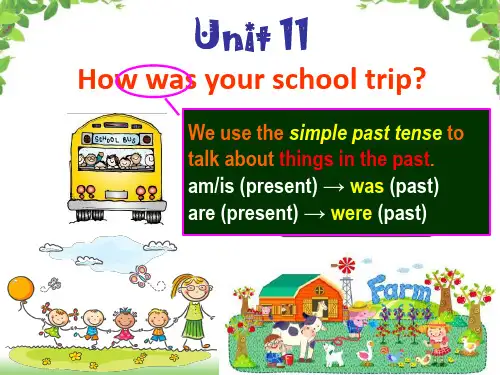
Peter: Oh, nice. W__h_a_t__d_id__y_o_u__d_o_?
Eric: I weRntefaisdhitnhgeevceorny vdeary.sAatnidonI fed the chickens waigthaimny, tghraenndpfial.lI_it_nw_a_tsh_s_eo_m__u_c_h_f_u_n. Peter: Soubnldasngkosodb.He_lo_ow_w_w_.a_s_t_h_e_w__ea_t_h_e_r_th_e_r_e?
4. Did Eric watch the stars at night? Yes, he did.
2d P62
L1ine.tRg’rosoleusppeslea; ywthhe iccohnvegrrsoatuiopn 2. Rodleopelsaytthhee cboensvetr.sation
A: Did he _ri_d_e__a_h_o_r_s_e last weekend? B: Yes, he did.
2a Listen and check ( ) the questions you hear. P62
___ What did the farmer say? ___ Did you grow any apples? ___ What did you see? ___ Do they grow apples? ___ Did you learn anything? ___ Did you eat them? ___ Did you ask him any questions? ___ Were they good?
1. How was Eric’s trip last week? It was excellent.
Eric: I weRntefaisdhitnhgeevceorny vdeary.sAatnidonI fed the chickens waigthaimny, tghraenndpfial.lI_it_nw_a_tsh_s_eo_m__u_c_h_f_u_n. Peter: Soubnldasngkosodb.He_lo_ow_w_w_.a_s_t_h_e_w__ea_t_h_e_r_th_e_r_e?
4. Did Eric watch the stars at night? Yes, he did.
2d P62
L1ine.tRg’rosoleusppeslea; ywthhe iccohnvegrrsoatuiopn 2. Rodleopelsaytthhee cboensvetr.sation
A: Did he _ri_d_e__a_h_o_r_s_e last weekend? B: Yes, he did.
2a Listen and check ( ) the questions you hear. P62
___ What did the farmer say? ___ Did you grow any apples? ___ What did you see? ___ Do they grow apples? ___ Did you learn anything? ___ Did you eat them? ___ Did you ask him any questions? ___ Were they good?
1. How was Eric’s trip last week? It was excellent.
人教版初中英语七年级英语下Unit11全单元课件

went for a walk
milked a cow
rode a horse
fed chickens
talked with a farmer took some photos
1. Did you see any cows? Yes, I did. I saw quite a lot.
quiet a lot (相当多)+of+可数或不可数, 也 可以单独使用。 quite a little 相当多+不可数名词 quite a few 相当多+可数名词
2b Listen again. Circle T for true or F for false.
1 The farmer showed Carol around the farm. T F
2 Carol learned a lot about farming. T F
3 The farmers grow strawberries from December
Did he/she......yesterday? Yes, he/she did. No,he /she didn't.
watch the stars play tennis
1b Listen and circle the three things Carol did on her school trip in 1a.
2020年6月23日
7
二、一般过去时的结构(可分三类不同的结构)
1. Be动词的一般过去时
am/is ---was are---were
(1)肯定句式:主语 + was / were + 其它.
(2)否定句式:主语 + wasn’t /weren’t+ 其它.
Unit 11 How was your school trip (单元课件)
saw some seals
需要更完整的资源请到 新世纪 教育网 -
saw some sharks
需要更完整的资源请到 新世纪 教育网 -
went to the zoo
需要更完整的资源请到 新世纪 教育网 -
需要更完整的资源请到 新世纪 教育网 -
2b. Listen again and circle “T” or “F”.
1. The farmer showed Carol around the farm. T F
2. Carol learned a lot about farming. 3. The farmers grow strawberries from
2c. Pairwork.
What did Carol do?
She picked some strawberries.
需要更完整的资源请到 新世纪 教育网 -
2d. Role-play conversation.
How was your trip last week? Peter: Hi, Eric. _______ Eric: It was exxellent. I _______ visited my grandparents in the countryside. did Peter: Oh, nice. What _______ you do? Eric: I went ___________ fishing every day. And I fed the chickens with my grandapa. It was so much fun. Sounds good How was the weather there? Peter: _____________. Eric: It was great and the air was so clean. I _________________ watched the stars at night. They were so beautiful. Peter: Lucky you.
人教版英语七下课件Unit_11_How__was_your_school_trip_?_Section__B
e
a
d
b
f
c
写出下列动词的过去式。
不规则动词
go went ride rode
do did
is
was
are were
have had
eat ate
buy bought
see saw
规则动词
pick picked visit visited
watch watched
climb climbed
study studied
否定句:句中有were或was在构成否定句时, 在was或were后面加not
Youweren’tatschoolyesterday.(否定句)
疑问句:构成疑问句时,把were或was放在主 语前面,句尾加问号;肯定回答和否定回答 时态要与问句中的时态一致
---Wereyouatschoolyesterday?(一般疑问句) ---Yes,Iwas. ---No,Iwasn’t.
Whatdoyoudoe Whatdidyoudola
veryday?
stweekend?
feedchickens
fedchickens
milkacow
milkedacow
rideahorse
rodeahorse
Whatdoeshe/shedoWhatdidhe/shed
everyday?
oyesterday?
写出下列动词的过去式:
• go—hwaevne/thas—see— had • eat—bautye—take—bought ride—fereodd—ebring--- fed • is/am-awrea-s--come-w--ere buy---cubto--u-dgoh/tdoes---cut
a
d
b
f
c
写出下列动词的过去式。
不规则动词
go went ride rode
do did
is
was
are were
have had
eat ate
buy bought
see saw
规则动词
pick picked visit visited
watch watched
climb climbed
study studied
否定句:句中有were或was在构成否定句时, 在was或were后面加not
Youweren’tatschoolyesterday.(否定句)
疑问句:构成疑问句时,把were或was放在主 语前面,句尾加问号;肯定回答和否定回答 时态要与问句中的时态一致
---Wereyouatschoolyesterday?(一般疑问句) ---Yes,Iwas. ---No,Iwasn’t.
Whatdoyoudoe Whatdidyoudola
veryday?
stweekend?
feedchickens
fedchickens
milkacow
milkedacow
rideahorse
rodeahorse
Whatdoeshe/shedoWhatdidhe/shed
everyday?
oyesterday?
写出下列动词的过去式:
• go—hwaevne/thas—see— had • eat—bautye—take—bought ride—fereodd—ebring--- fed • is/am-awrea-s--come-w--ere buy---cubto--u-dgoh/tdoes---cut
初中英语人教版七年级下册How was your school trip课件
• • • • • •
an exciting day 让人兴奋的一天 exciting物“让人兴奋的,使人兴奋的”, excited 人感到兴奋的, 同类 interesting, interested; boring, bored。
辨析:interested / interesting
interested be interested in 某人对……是感兴趣的; interesting 某物有趣的;有意思的 I am interested in collecting stamps. 我对收集邮票很感兴趣。 That is an interesting book,you must read it. 那是一本很有意思的书,你一定要读读。
5. Everything was about robots. everything 作主语,谓语动词用单数。
6. I’m not interested in that. be interested in 对…感兴趣 7. it was difficult to take photos. It is + adj. (for sb.) to do sth. (对某人 来说)做 … 怎么样 e.g. 对我来说骑车上学是很容易的。 It is easy for me to go to school by
not …at all 5. 根本不 6. 今天的报纸 today’s newspaper 7. 太多学生 too many students too much water 太多水 8. 学英语对我来说很容易。 It is easy for me to learn English. 9. 上周李老师教我如何下棋。 Last week Mr. Li taught me how to play chess.
Unit 11 单元知识点复习课件 人教版七年级英语下册
5. quite a lot 相当多;许多 ✓ quite 作副词,意为“相当;完全”。 ✓ a lot 后面不能直接跟名词,a lot of 相当于lots of,其后可接可数名词复数或不可数名词。 ✓ quite a lot意为“许多”,如果后面接名词, 则用quite a lot of。
【辨析】quite与very
walk作动词,“走路;散步”,后接地点名 词时,要加上介词to,其后接here,there,home 等地点副词时,不加介词to。
Your home is near the school, so you can walk home. We walk to school every day.
2. milked a cow 给奶牛挤奶 ✓ milk 在此处作动词,意为“挤奶”。
拓展not at all单独使用时的用法: ① 可作为当别人表示感谢的应答语,意为“不
客气;不用谢”。 — Thank you very much. — Not at all.
② 可作为别人称赞或带感谢性质的客套语,意 为“别客气”。 — It’s very kind of you. — Not at all.
含义
总的来说
all in all
总共,合计
句子位置/适用句型
常用于句首 句首或句末
in all at all
根本
常用于否定句中 not (…) at all 根本不
他们总共筹集了一万元。 They raised 10,000 yuan _i_n_a_l_l__.
总的来说,她是一位优秀的老师。 __A_ll__in__a_ll_, she is an excellent teacher.
_________ .